

Getting invited to an interview is a good sign: your application has already given the employer a reason to consider you. The interview is your opportunity to turn the qualifications on your CV into clear evidence that you understand the role, can solve relevant problems and will work well with other people.
Good preparation is not about memorising perfect speeches. It is about understanding what the employer needs, selecting truthful examples from your experience and practising until you can explain them naturally.
To prepare for a job interview in Kenya, confirm and verify the invitation, study the job description, research the employer and prepare examples showing how your experience matches the role. Practise concise answers to common questions using the STAR method. Organise the documents requested, choose clean and role-appropriate clothing, and plan your transport or test your online interview setup. Prepare two or three thoughtful questions for the employer. During the interview, listen carefully, answer honestly and support your claims with examples. Afterwards, send a short thank-you message when appropriate and follow up only after the employer’s stated timeline.
Remember: preparation can improve your performance, but no interview technique can guarantee a job offer.
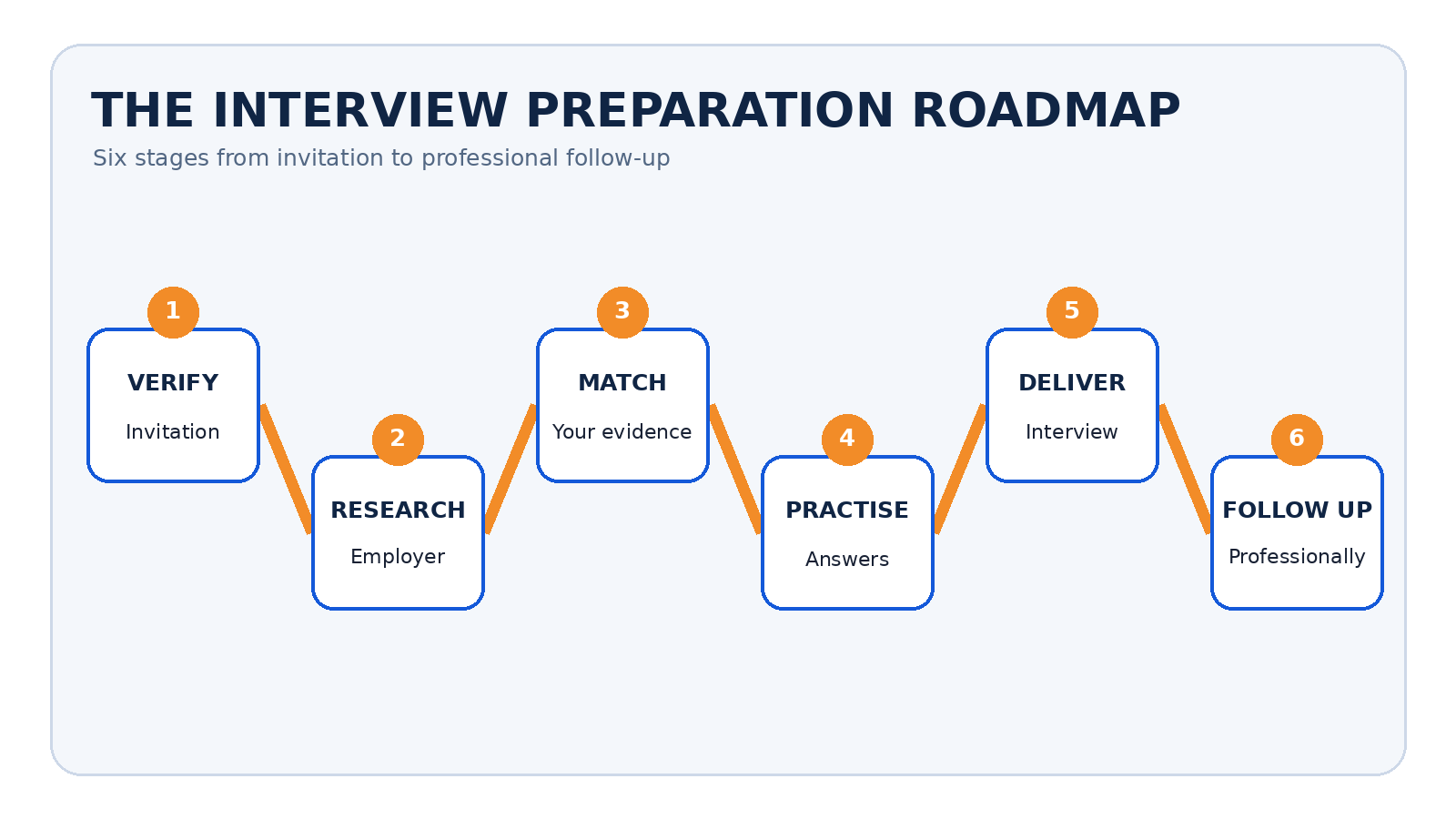 Job interview preparation roadmap for Kenyan job seekers.
The six essential stages of preparing for a job interview.
Read the invitation carefully before replying. Confirm the employer’s name, job title, date, time, location or online platform, expected duration and any documents or assessments mentioned. If something important is missing, ask politely instead of guessing.
A simple confirmation can say:
Thank you for inviting me to interview for the Administrative Assistant position. I confirm that I will attend on Tuesday, 15 September at 10:00 a.m. at your Westlands office. Please let me know if you would like me to bring any additional documents. Kind regards, Amina Kamau.
You should also confirm that the invitation is genuine. Compare the sender’s address with the organisation’s official website, locate the vacancy you applied for and use an independently published telephone number if you need to call. Do not trust a message only because it contains a familiar logo.
Requests for interview fees, urgent M-Pesa payments, banking credentials or sensitive documents before you have verified the employer are serious warning signs. A genuine recruitment process can vary, but pressure and secrecy deserve careful checking.
Once satisfied, save the recruiter’s contact details and instructions. For an in-person interview, confirm the route and create a backup transport plan. For an online interview, add the meeting to your calendar and check whether special software is required.
Many candidates read the organisation’s About page and stop there. Better research helps you understand the employer’s actual work and gives you something specific to discuss.
Check the official website, services, customers or beneficiaries, office locations, recent announcements and verified social pages. Ask yourself:
Then return to the job description. Highlight required skills, qualifications, responsibilities, tools and behavioural words such as “collaborate,” “analyse,” “supervise,” “sell” or “respond under pressure.” Repeated phrases usually indicate important priorities.
Create a small preparation table:
| What the employer needs | My evidence | Example I can discuss |
|---|---|---|
| Customer service | Six-month clinic attachment | Calmed a frustrated visitor and resolved an appointment problem |
| Excel reporting | Volunteer and academic projects | Cleaned records and created a weekly summary |
| Teamwork | Student association event | Coordinated four volunteers and delivered on time |
Your evidence can come from employment, attachments, internships, freelancing, volunteering, academic work or personal projects. What matters is that it is relevant, truthful and specific. For the wider application process, read Vezill’s complete guide to getting a job in Kenya. Students can also use the practical options in How Students Can Make Money Online Legally to build genuine experience they can discuss in an interview.
Do not try to predict and memorise every possible question. Instead, prepare six to eight flexible stories that demonstrate skills employers commonly test: teamwork, problem-solving, communication, initiative, customer service, learning, handling pressure and responding to a mistake.
Use the STAR method to organise each story:
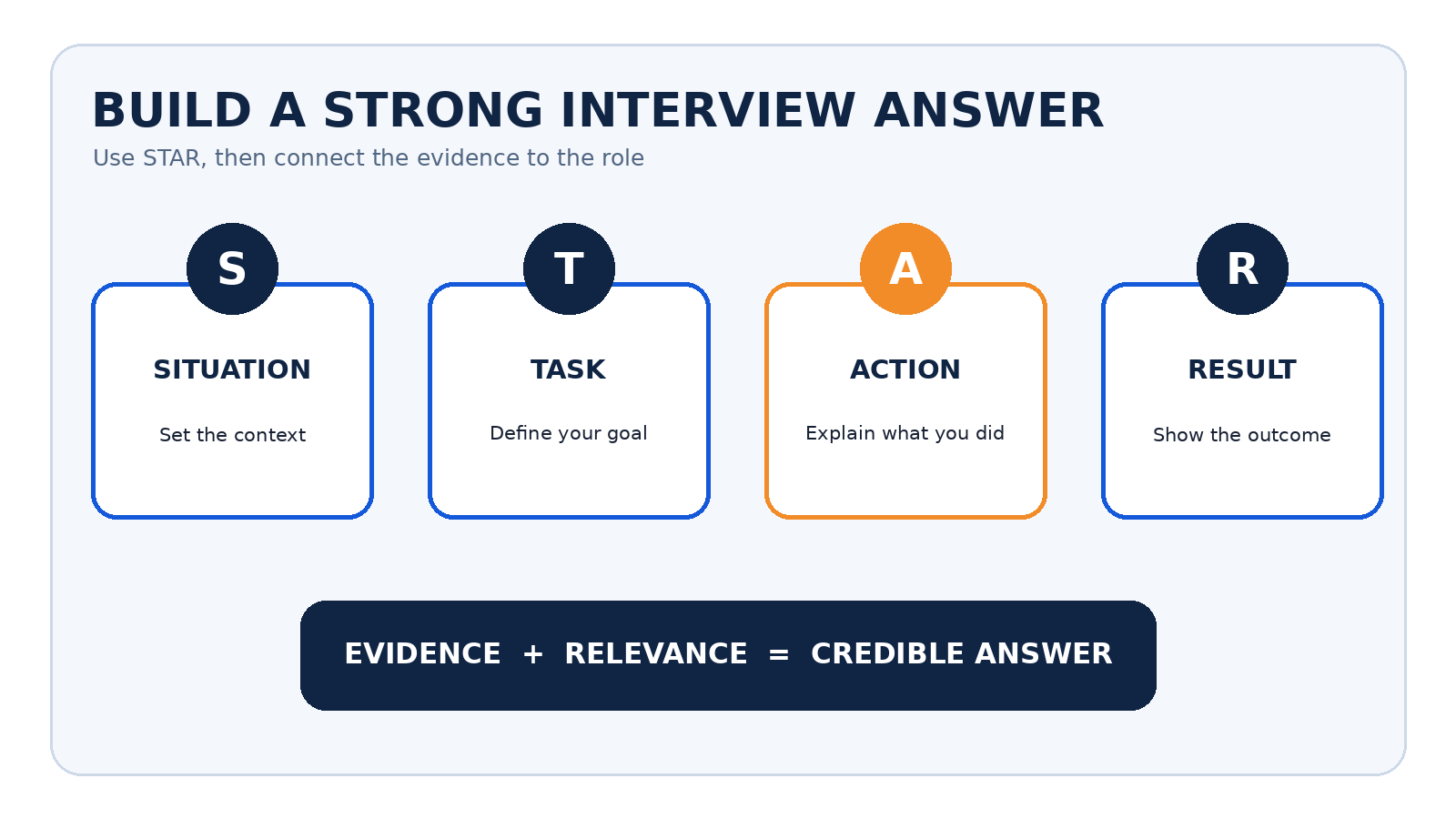 STAR interview method and strong-answer formula.
A strong answer combines context, action, evidence and relevance.
Here is a realistic example:
During my attachment, staff reported password problems through several different channels, so requests were easy to miss. My supervisor asked me to help organise them. I created a simple request log, grouped recurring issues and drafted a short reset guide for approval. The team could track open requests more clearly, and staff had a useful first step before escalating a problem.
The Action should normally be the longest part because the interviewer wants to understand your judgement. If the achievement belonged to a team, explain your own contribution without claiming everybody’s work.
Practise aloud. An answer that looks good on paper may sound too long or unnatural when spoken. Aim for enough detail to prove your point, then stop.
This question usually asks for a professional introduction, not your complete personal history. A useful structure is:
Who you are professionally + relevant background + strongest evidence + why this role interests you
For a graduate:
I recently completed a Diploma in ICT and gained practical experience during an attachment where I supported users, documented common technical problems and helped maintain device records. I also built a small inventory-tracking project using spreadsheets, which strengthened my problem-solving and reporting skills. I am interested in this support role because it combines user service with the technical work I have trained for.
For an experienced digital marketer:
I am a digital marketer with three years of experience planning content, managing campaigns and reporting results for small businesses. In my current role, I reorganised our monthly content process and improved on-time publishing while giving clients clearer performance reports. This position interests me because it combines campaign execution with client communication, which are the strongest parts of my experience.
For someone changing careers:
I have worked in retail operations for four years, where I developed strong customer-service, stock-control and team-coordination skills. Over the last year, I have added data-analysis training and completed two dashboard projects using public datasets. I am now moving towards an entry-level reporting role where I can combine operational knowledge with analytical skills.
Keep the answer focused on the vacancy. Avoid repeating every line of your CV or leading with personal information that does not help the employer understand your suitability.
The wording may change, but most questions test motivation, competence, self-awareness or behaviour.
Connect something specific about the organisation or role to your experience and direction. “Your company is successful” is too generic. A stronger answer mentions the employer’s actual work, the responsibilities that interest you and the value you can bring.
Use this formula: relevant capability + evidence + connection to the employer’s need.
You need someone who can coordinate customer requests and maintain accurate records. In my current role, I manage daily enquiries across telephone and email, update the service log and prepare weekly summaries for my supervisor. That combination of communication and organised follow-through would allow me to contribute quickly in this position.
Choose strengths that matter to the role and attach evidence. Instead of only saying “I am organised,” explain the system you used to coordinate schedules, records or deadlines.
Choose a genuine but manageable weakness, explain its effect and show how you are improving it.
Earlier, I sometimes waited too long before asking for clarification because I wanted to solve everything independently. I realised this could waste time. I now document what I have tried and ask a focused question earlier when the issue could affect a deadline.
Avoid disguised boasts such as “I work too hard.” Also avoid naming a weakness that makes you fundamentally unable to do the job unless you can accurately explain changed circumstances or appropriate support.
Answer briefly, truthfully and without attacking your former employer. You can mention a completed contract, restructuring, relocation, professional growth or the search for a role that better matches your skills.
Use STAR. Show that you listened, made a sensible decision and helped move the work forward. Do not use the answer to prove that everyone else was wrong.
Give a credible direction rather than an exact title. Explain the skills and responsibility you hope to build and why this position is a sensible next step.
Do not end your answer with “I have no experience.” You may not have held a permanent job, but you may still have served customers, managed deadlines, handled information, led a group, created a product or solved a technical problem.
Use examples from:
Describe the task, tools, decisions and result. For example, a student who organised registration for a community event can demonstrate planning, communication and record management. A developer who built a functioning website for a local organisation can discuss requirements, feedback and delivery.
If your evidence is limited, deliberately create something useful. Vezill explains why tech students should build digital assets instead of relying only on employment. A dashboard, website, campaign plan or case study can support an interview when it reflects your real work and you can explain every part of it.
Build evidence that matches the position you want. An applicant pursuing administrative or remote-support roles can use Vezill’s article on becoming a virtual assistant in Kenya to identify practical portfolio tasks. Someone targeting analytics roles can study Vezill’s breakdown of online opportunities for data analysts and compare the required skills with Inceptor’s project-based Data Analytics course. These resources should help you create truthful examples—not answers to memorise.
Research the role, sector, location, seniority and organisation before settling on a figure. Consider base salary alongside benefits, travel, working hours, commission, contract length and growth opportunities. There is no single correct salary for a job title across Kenya.
If you understand the role well, give a considered range and clarify whether you mean gross monthly pay:
Based on the responsibilities described and my three years of relevant experience, I would be comfortable discussing a gross monthly range of KSh X to KSh Y. I am also open to understanding the complete package and expectations for the role.
If the responsibilities remain unclear, you can say:
I am looking for a fair offer that reflects the scope of the role and the organisation’s salary structure. Could you share the approved range so I can respond more accurately?
Do not invent your previous salary. A calm, informed answer is better than either refusing to discuss compensation or quoting an arbitrary figure.
Follow the invitation because requirements differ. A sensible folder may contain copies of your CV, the job description, requested academic or professional certificates, selected portfolio samples, a referee list if requested, identification for legitimate verification, a notebook and a working pen.
Keep original documents secure and under your control unless a verified employer needs to inspect them. Do not send banking information, PINs, passwords or unnecessary identity documents to an unverified recruiter.
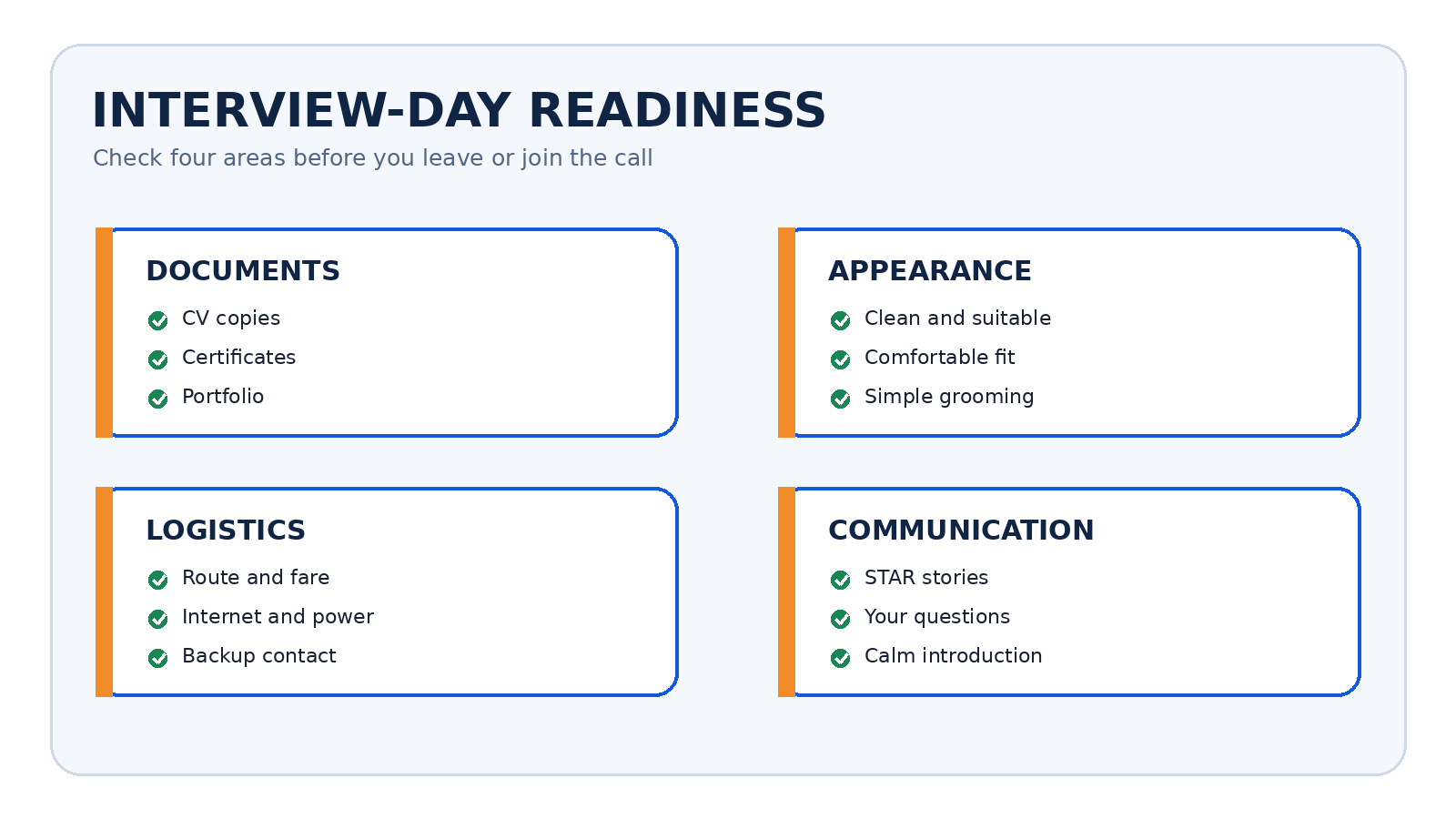 Interview-day readiness dashboard.
The four areas to check before attending an interview.
Choose clean, comfortable clothing that suits the work environment. Conservative business clothing is a safe starting point for many corporate, financial, legal and public-sector interviews. Some technology and creative employers may be less formal, but neat smart-casual clothing is usually safer than guessing too casually. Expensive clothing is not required.
For an in-person interview, test the route and allow for realistic traffic or transport delays. Reach the area early and normally report to reception around 10–15 minutes before the scheduled time unless instructed otherwise. If an unavoidable delay occurs, contact the employer promptly and give an accurate update.
For an online interview, test your internet, camera, microphone, meeting link and power supply. Use a quiet, well-lit space, place the camera near eye level, close unrelated applications and disable notifications. Keep the recruiter’s number and a charged phone nearby as a backup.
Greet the panel professionally, sit when invited and listen to the complete question. A short pause is better than starting an unfocused answer. Maintain natural eye contact and open posture without trying to control every movement.
If a question is unclear, ask for clarification. If you do not know an answer, do not bluff. Explain what you do know, state your assumptions and describe how you would find the answer or approach the problem.
In a panel interview, begin your response toward the person who asked, then include the other members naturally. For a multi-part question, answer in order. You can say, “I will address the customer issue first, then explain the reporting process.”
During a technical interview, the reasoning may matter as much as the final answer. Clarify the problem, break it into steps and explain trade-offs. Never pretend to know a tool you have not used. It is more credible to connect it to a similar tool and explain how you would learn the difference.
Prepare two or three questions for the interviewer, such as:
Avoid asking something easily answered on the website. Salary and benefits are valid topics, but choose the timing carefully so they do not appear to be your only interest.
AI can create questions based on a vacancy, conduct a mock interview and point out vague or excessively long answers. It should help you communicate your experience, not manufacture a different candidate.
Try this prompt:
Act as a fair but demanding interviewer for the position described below. Ask one question at a time. Include introductory, competency, situational and role-specific questions. After each answer, assess relevance, clarity, evidence and concision. Tell me what is missing, then let me try again. Do not invent experience for me. Job description: [paste the vacancy after removing sensitive information]. My truthful experience summary: [insert summary].
Never paste confidential employer documents, identity numbers, medical information or private client data into an AI tool. Verify facts about the employer independently.
If you need stronger practical evidence before an interview, explore Vezill’s article on high-demand AI and digital skills for work opportunities. Candidates pursuing marketing roles can review Inceptor’s practical Digital Marketing course and compare its projects with the skills requested in target vacancies. Applicants preparing for programming interviews can similarly examine Inceptor’s Python training or Software Development with AI course and identify projects they can genuinely demonstrate. Training can strengthen skills, but it cannot guarantee employment.
If your longer-term aim is self-employment rather than a conventional position, Vezill’s beginner’s guide to building an AI business without coding can help you understand another route. Keep the interview answer focused on the job in front of you unless the employer specifically asks about outside projects or entrepreneurial goals.
After the interview, write down the questions asked, examples you used and anything you want to improve. When you have an appropriate contact, a short thank-you message within a day is professional:
Thank you for the opportunity to discuss the Operations Assistant role today. I appreciated learning more about the team’s reporting priorities. Our conversation strengthened my interest in the position, particularly the opportunity to contribute my coordination and customer-service experience. Kind regards, Peter Mwangi.
If the panel gave a timeline, wait until it passes before following up. If no timeline was provided, one polite message after roughly five to seven business days is usually reasonable, although the context may differ. Do not send daily messages.
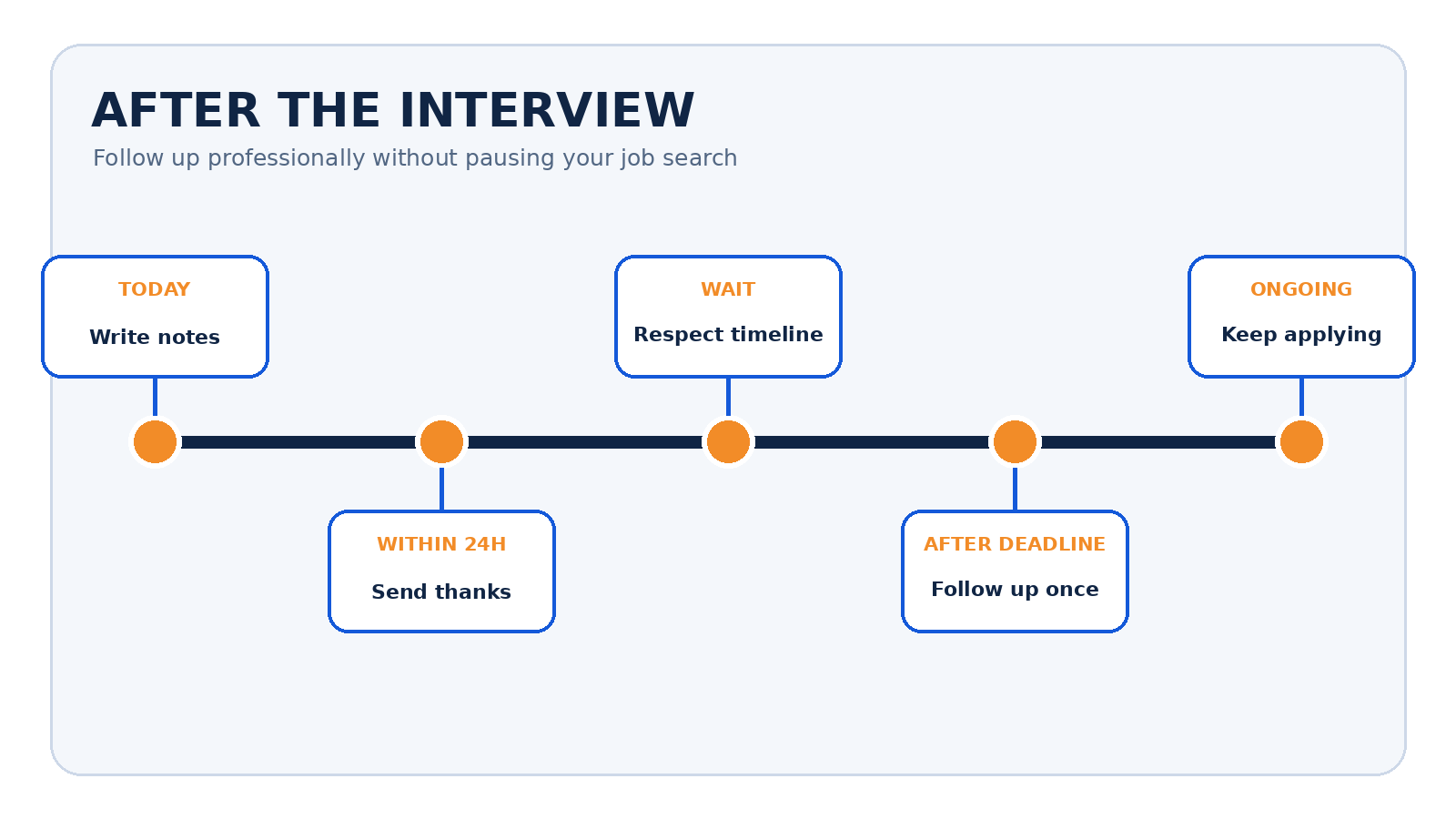 Professional follow-up timeline after a job interview.
A professional follow-up timeline after a job interview.
Continue applying while you wait. You can also improve your portfolio or explore Vezill’s ideas for creating or reselling digital products while searching for work. For more specific directions, compare Vezill’s lists of educational digital products Kenyans can create and digital-product ideas that can be developed with AI.
Inceptor also publishes a broader overview of legitimate ways to make money online in Kenya and offers a Digital Product Trading Masterclass with AI. These are alternative learning or income resources while a job search continues; they are not substitutes for preparing properly for the interview you have already secured.
Remain alert after the interview. Requests for recruitment fees, sudden pressure to pay for training or medical checks, unrealistic salaries, unrelated email domains and demands for banking credentials are warning signs. Verify the employer using independently found official channels. Never send money simply to secure a job.
Before the interview, confirm that you have:
During the interview, listen carefully, answer the question actually asked and support important claims with evidence. Afterwards, note what you learned, send a concise thank-you message when appropriate and respect the stated timeline.
Reach the area early and normally report about 10–15 minutes before the scheduled time unless the employer gives different instructions. Arriving extremely early can also inconvenience a small office.
Carry what the invitation requests. Common items include CV copies, requested certificates, identification for legitimate verification, a portfolio, references, a notebook and a pen. Keep originals secure.
Choose clean, well-fitting and role-appropriate clothing. Conservative business wear suits many formal organisations, while neat smart-casual clothing may suit some technology or creative workplaces.
Use evidence from attachments, volunteering, academic projects, leadership, freelancing and personal projects. Explain the task, your action and the result honestly.
Do not bluff. Acknowledge the limit, explain what you know and describe how you would investigate or solve the problem.
A short, personalised thank-you is appropriate when you have a legitimate contact. Express appreciation, reinforce your interest and avoid pressuring the recruiter.
Yes. Use it to generate practice questions and improve your answers, not to invent experience. Remove confidential and sensitive information before pasting anything.
Compare it with your application, verify the sender and vacancy using official channels and independently contact the organisation if necessary. Never pay to secure an interview.
A good interview is not a performance built from perfect memorised sentences. It is a professional conversation in which you understand the employer’s needs, present truthful evidence and communicate clearly.
Research the organisation, study the vacancy, prepare flexible STAR stories and practise aloud. Then enter the interview ready to listen—not merely ready to speak. Even when one application does not produce an offer, the notes you collect can make your next interview stronger.
Start now: select one vacancy, write down its three most important requirements and prepare one truthful example for each.
Discover more articles you might be interested in

how to create your first knowledge product in one weekend
By Davie

how to build multiple digital products from one skill
By Davie

how to find problems people will pay you to solve
By Davie

How to turn a hobby into a digital product
By Davie
Get the updates, on newly released, popular & fast-moving MRR digital products
Up to Top
Comments All
Precious nyambura
@precious_nyambura
This is a very helpful and practical guide! 👏 I especially liked the emphasis on proper preparation, researching the employer, and using real examples when answering interview questions. The STAR method is also a great tip for giving clear and confident answers. Definitely a useful read for anyone preparing for a job interview in Kenya! 💯
September 03,2026 At 09:53 PM