
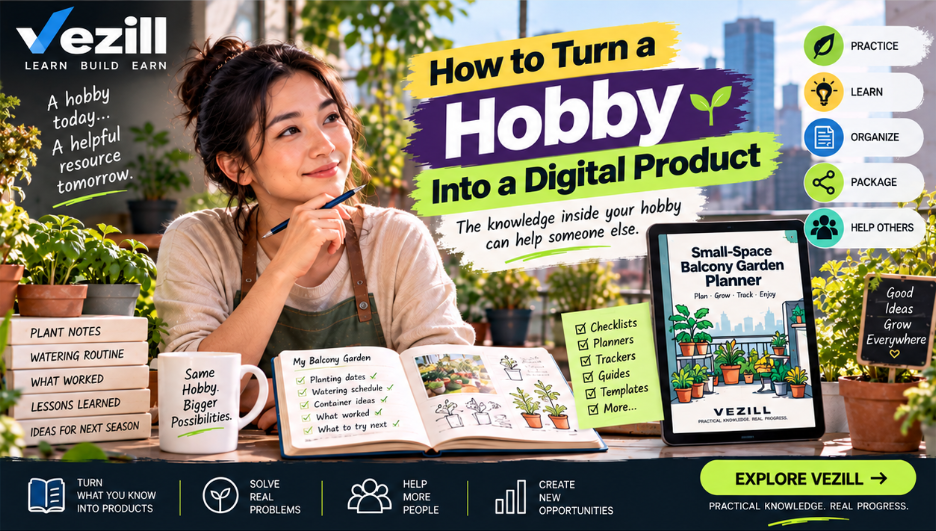
How to extract the skills, systems, lessons and beginner-friendly knowledge hiding inside something you already enjoy—and test whether one useful piece deserves to become a digital product.
Saturday morning light reaches a small apartment balcony where Yuki is sitting between pots of herbs, gardening gloves, labels and a notebook with softened corners. She is in her early thirties and has been growing plants on this balcony for about six years. Gardening is not her profession. She began because she liked plants, liked experimenting and wanted a small green space of her own.
She flips through old pages. There are planting dates, rough sketches, container notes, observations about sunlight, reminders, things that failed, things she wants to try again and simple seasonal plans. None of it looks like a business plan. It looks like what it is: evidence of a hobby practiced repeatedly.
A friend visiting the apartment looks across the balcony and says, “I wish I knew how to start something like this.” Yuki laughs: “It’s just my hobby.”
“Okay,” her friend says, “but where would I even start?”
Ten minutes later, Yuki has explained how she first mapped the limited space, what she bought before she began, how she records what she plants, how she keeps routine tasks from disappearing from memory and which early mistakes made her change her planning system. Then she notices something: she has a system.
Not professional horticultural expertise. Not a revolutionary gardening method. Not permission to diagnose plant diseases or give agricultural advice beyond her competence. What she has is narrower and more honest: practical beginner-to-beginner knowledge produced by six years of doing.
THE THING YOU DO FOR FUN MAY HAVE TAUGHT YOU SOMETHING THAT A BEGINNER IS STILL TRYING TO FIGURE OUT. QUICK ANSWER — How do I turn a hobby into a digital product?“Photography” is a hobby category, not a product. Inside photography may be a repeatable shoot-planning routine, a photo-organization system, a location-scouting sheet, a beginner practice sequence or a checklist you use before leaving home. “Baking” is not automatically a product either. Inside it may be a preparation checklist, recipe-index system or planning worksheet.
This distinction is consistent with VEZILL’s current knowledge-to-product framework: broad knowledge becomes more useful when it is narrowed around a person, a problem, a result and an application-friendly resource.
DO NOT ASK ONLY: “WHAT IS MY HOBBY?”Skills are things you can do. Processes are sequences you repeatedly follow. Decisions are choices experience has made easier. Tools are equipment, software or materials you understand. Mistakes are failures that changed how you work. Organization systems are the structures that keep the hobby manageable. Preparation is what happens before the visible activity. Troubleshooting is what you have learned to recognize safely. Beginner questions reveal where newcomers still struggle. Personal lessons are the things practice taught that were not obvious at the start.
That does not mean every lesson is universally true. Personal experience can be useful evidence about your own process without becoming scientific proof, professional qualification or market demand. The creator’s job is to separate “this is what worked in my context” from claims that require authoritative external support.
YOUR HOBBY IS THE CONTAINER. Your Hobby Is a Bundle of Knowledge
Start with the hobby, then move downward rather than jumping directly to a product name: HOBBY → ACTIVITIES → SKILLS → REPEATED PROCESSES → TOOLS → DECISIONS → MISTAKES → LESSONS → BEGINNER PROBLEMS → KNOWLEDGE ASSETS.
Ask yourself: What do I repeatedly do? What have I become faster at? What do beginners ask me? What mistakes did I make early? What do I prepare before starting? What equipment or software do I understand? What do I track? What decisions have become easier? What have I organized into a personal system? What would I tell myself if I could return to day one? What do people compliment or ask me about? What have I documented? What do I wish someone had explained when I started?
This resembles the broader inventory logic in How to Identify Valuable Knowledge You Already Have and 100 Things You Know That Could Become Digital Products: repeated tasks, mistakes, questions, systems and explainable outcomes can reveal knowledge assets that familiarity makes easy to overlook.
 The VEZILL Hobby Knowledge Extraction Map
A hobbyist with five years of practice often stops consciously noticing small decisions. An experienced home baker says, “Just check the batter.” A beginner asks, “What exactly am I checking?” A photographer says, “Find good light.” A beginner asks what good light looks like in practice. A gardener says, “Don’t overwater it.” A beginner still needs to understand what observations, context and reliable sources should guide that decision.
This is one reason worked examples and structured guidance can help learning when used appropriately: they make processes visible rather than leaving a novice to infer every step. Recent educational research continues to examine how worked examples and active problem solving can be sequenced to support learning, while showing that examples alone are not a substitute for practice.
EXPERIENCE COMPRESSES STEPS. The Beginner Gap
Ask eight questions: What feels obvious to me now? What was not obvious when I started? What did I have to learn through experience? What do beginners keep getting wrong? What do they need before they begin? Where do they get stuck? What decisions confuse them? What simple tool would have helped me?
EXPERIENCED HOBBYIST → “This is obvious.”The qualification matters. If the hidden step involves food safety, medical risk, electrical work, chemicals, structural work or another safety-sensitive area, your memory is not enough. Verify current authoritative guidance and stay within your competence.
The following are recognition prompts, not claims of proven demand. Each one begins with knowledge a hobbyist may genuinely have and ends with a product hypothesis that still requires research, rights checks and validation.
Hobby: Balcony gardening
What the person may know: planning limited space before buying plants.
Who may need it: apartment beginners.
Problem: they buy plants before deciding where containers can realistically fit.
Possible digital product: Small-Space Balcony Garden Planner.
Best format: planner + layout worksheet.
Hobby: Plant journaling
What the person may know: recording planting dates and observations.
Who may need it: new home gardeners.
Problem: they forget what they planted, when they planted it and what happened.
Possible digital product: Simple Plant Journal.
Best format: printable/digital journal.
Hobby: Garden task organization
What the person may know: turning recurring garden tasks into reminders.
Who may need it: busy hobby gardeners.
Problem: care tasks live only in memory.
Possible digital product: Garden Task Calendar.
Best format: calendar + checklist.
Hobby: Seed-starting records
What the person may know: tracking seed batches and outcomes.
Who may need it: beginner seed starters.
Problem: they cannot remember which batch, date or method produced each result.
Possible digital product: Seed-Starting Record Sheet.
Best format: tracker.
Hobby: Container gardening
What the person may know: organizing pots, locations and plant notes.
Who may need it: small-space gardeners.
Problem: containers accumulate without a clear inventory or plan.
Possible digital product: Container Garden Organizer.
Best format: spreadsheet + planner.
Hobby: Home cooking
What the person may know: organizing weekly meal preparation.
Who may need it: busy home cooks.
Problem: they decide every meal from scratch and forget preparation steps.
Possible digital product: Weekly Meal-Prep Workflow.
Best format: planner + checklist.
Hobby: Home baking
What the person may know: preparing ingredients, tools and timing before baking.
Who may need it: beginner bakers.
Problem: they start recipes before everything is measured and ready.
Possible digital product: Home Baking Preparation Planner.
Best format: checklist + planner.
Hobby: Recipe collecting
What the person may know: organizing personally created or lawfully used recipes.
Who may need it: home cooks with scattered notes.
Problem: recipes are spread across notebooks and devices.
Possible digital product: Personal Recipe Index System.
Best format: template + index.
Hobby: Grocery planning
What the person may know: turning planned meals into an organized shopping list.
Who may need it: households that meal-plan.
Problem: ingredients are duplicated or forgotten.
Possible digital product: Meal-to-Grocery Planner.
Best format: worksheet.
Hobby: Kitchen workflow
What the person may know: sequencing safe preparation and cleanup tasks.
Who may need it: new home cooks.
Problem: they become overwhelmed by simultaneous tasks.
Possible digital product: Home Cooking Workflow Board.
Best format: workflow sheet.
Hobby: Street photography
What the person may know: planning purposeful photo walks.
Who may need it: beginner photographers.
Problem: they go outside to practice but do not know what to focus on.
Possible digital product: 30-Day Street Photography Practice Cards.
Best format: prompt cards + tracker.
Hobby: Portrait photography
What the person may know: preparing a simple personal shoot plan.
Who may need it: new hobby photographers.
Problem: they forget shot ideas, props and location notes.
Possible digital product: Portrait Shoot Planner.
Best format: planner.
Hobby: Photo organization
What the person may know: building a repeatable file-sorting routine.
Who may need it: photographers with large personal libraries.
Problem: images become difficult to find.
Possible digital product: Photo Library Organization Checklist.
Best format: checklist.
Hobby: Location scouting
What the person may know: recording light, access and composition notes.
Who may need it: hobby photographers.
Problem: good locations are forgotten or poorly documented.
Possible digital product: Photo Location Scout Sheet.
Best format: template.
Hobby: Photography practice
What the person may know: tracking one technique at a time.
Who may need it: camera beginners.
Problem: random practice makes progress hard to observe.
Possible digital product: Photography Practice Log.
Best format: workbook + tracker.
Hobby: Sketching
What the person may know: maintaining a consistent drawing-practice routine.
Who may need it: beginner sketchers.
Problem: they want to practice but do not know what to draw each day.
Possible digital product: 30-Day Sketch Practice Deck.
Best format: prompt cards.
Hobby: Color planning
What the person may know: recording color combinations used in personal projects.
Who may need it: hobby artists.
Problem: they repeatedly rebuild palettes they liked.
Possible digital product: Personal Color Study Journal.
Best format: journal template.
Hobby: Digital illustration
What the person may know: organizing layers, exports and versions.
Who may need it: new digital artists.
Problem: project files become confusing.
Possible digital product: Digital Art File Organization Checklist.
Best format: checklist.
Hobby: Creative projects
What the person may know: breaking a personal art project into stages.
Who may need it: hobby creators.
Problem: ideas remain unfinished because next steps are unclear.
Possible digital product: Creative Project Planner.
Best format: planner.
Hobby: Portfolio organization
What the person may know: selecting and documenting personal work.
Who may need it: emerging hobby artists.
Problem: finished work is scattered and lacks context.
Possible digital product: Personal Portfolio Inventory.
Best format: worksheet.
Hobby: Sewing
What the person may know: planning an original sewing project before cutting.
Who may need it: beginner sewists.
Problem: materials, measurements and steps are not organized.
Possible digital product: Sewing Project Planning Sheet.
Best format: planner.
Hobby: Crochet
What the person may know: tracking personal works-in-progress.
Who may need it: crochet hobbyists.
Problem: hooks, yarn, sizes and project notes get mixed up.
Possible digital product: Crochet Project Tracker.
Best format: tracker.
Hobby: Crafting
What the person may know: planning material quantities and purchases.
Who may need it: craft hobbyists.
Problem: supplies are bought without a project inventory.
Possible digital product: Craft Materials Planner.
Best format: spreadsheet.
Hobby: Pattern organization
What the person may know: cataloguing patterns the hobbyist owns or is licensed to use.
Who may need it: sewers with growing pattern libraries.
Problem: they forget what they own and where files are stored.
Possible digital product: Pattern Library Catalogue.
Best format: database template.
Hobby: Paper crafts
What the person may know: organizing recurring project preparation.
Who may need it: beginner paper crafters.
Problem: tools and materials are gathered inefficiently.
Possible digital product: Paper-Craft Setup Checklist.
Best format: checklist.
Hobby: Walking
What the person may know: tracking a personal walking habit.
Who may need it: people building a simple walking routine.
Problem: they struggle to see consistency over time.
Possible digital product: Walking Habit Tracker.
Best format: tracker.
Hobby: Gym journaling
What the person may know: recording sessions without prescribing a program.
Who may need it: recreational gym-goers.
Problem: personal notes are inconsistent.
Possible digital product: Personal Workout Log.
Best format: journal.
Hobby: Mobility practice
What the person may know: organizing a personally chosen practice routine.
Who may need it: hobby movers using appropriate guidance.
Problem: they forget what they intended to practice.
Possible digital product: Movement Practice Planner.
Best format: planner.
Hobby: Beginner gym preparation
What the person may know: organizing what to bring and what to ask.
Who may need it: first-time gym visitors.
Problem: the first visit feels confusing.
Possible digital product: First Gym Visit Preparation Checklist.
Best format: checklist.
Hobby: Recreational training
What the person may know: tracking goals, sessions and reflections.
Who may need it: hobby athletes.
Problem: training information is scattered.
Possible digital product: Training Reflection Workbook.
Best format: workbook.
Hobby: Travel planning
What the person may know: organizing research into one trip plan.
Who may need it: independent travelers.
Problem: bookings, notes and ideas are scattered.
Possible digital product: Trip Research Organizer.
Best format: planner.
Hobby: Packing
What the person may know: building a reusable packing process.
Who may need it: frequent travelers.
Problem: important personal items are forgotten.
Possible digital product: Reusable Packing Checklist Builder.
Best format: template.
Hobby: Itinerary planning
What the person may know: balancing booked activities and flexible time.
Who may need it: self-planned travelers.
Problem: daily plans become unrealistic.
Possible digital product: Flexible Itinerary Worksheet.
Best format: worksheet.
Hobby: Day hiking
What the person may know: organizing pre-hike research and preparation.
Who may need it: beginner recreational hikers.
Problem: they overlook route, conditions, essentials and emergency planning.
Possible digital product: Beginner Day-Hike Planning Checklist.
Best format: safety-aware checklist.
Hobby: Travel journaling
What the person may know: capturing useful trip memories and details.
Who may need it: travel journal beginners.
Problem: blank pages make reflection difficult.
Possible digital product: Travel Memory Prompt Deck.
Best format: prompt cards.
Hobby: Competitive gaming
What the person may know: tracking personal practice goals.
Who may need it: players trying to practice deliberately.
Problem: sessions become play-only with no reflection.
Possible digital product: Game Practice Tracker.
Best format: tracker.
Hobby: Team gaming
What the person may know: organizing non-toxic team communication roles.
Who may need it: casual teams.
Problem: coordination is inconsistent.
Possible digital product: Team Session Communication Sheet.
Best format: worksheet.
Hobby: Tournament hosting
What the person may know: planning a small community tournament.
Who may need it: hobby organizers.
Problem: rules, brackets and communications become scattered.
Possible digital product: Community Tournament Planner.
Best format: planner.
Hobby: Game learning
What the person may know: building an original beginner glossary from personal explanations.
Who may need it: new players.
Problem: basic terminology creates friction.
Possible digital product: Beginner Game Learning Notes Template.
Best format: template.
Hobby: Gaming sessions
What the person may know: organizing goals and review notes.
Who may need it: players learning a complex game.
Problem: they repeat mistakes without recording them.
Possible digital product: Session Review Journal.
Best format: journal.
Hobby: Instrument practice
What the person may know: planning focused practice blocks.
Who may need it: beginner musicians.
Problem: practice becomes unfocused repetition.
Possible digital product: Weekly Music Practice Planner.
Best format: planner.
Hobby: Home recording
What the person may know: organizing pre-recording setup.
Who may need it: hobby musicians.
Problem: recording starts before files, equipment and session goals are ready.
Possible digital product: Home Recording Prep Checklist.
Best format: checklist.
Hobby: Content creation
What the person may know: organizing recurring content ideas.
Who may need it: new creators.
Problem: ideas disappear or remain undeveloped.
Possible digital product: Content Idea Capture System.
Best format: template.
Hobby: Video creation
What the person may know: planning shots and assets before filming.
Who may need it: hobby video creators.
Problem: they discover missing footage during editing.
Possible digital product: Video Shoot Planner.
Best format: shot-list template.
Hobby: Creator equipment
What the person may know: cataloguing personally owned gear and accessories.
Who may need it: small creators.
Problem: batteries, cables and accessories are difficult to track.
Possible digital product: Creator Gear Inventory.
Best format: spreadsheet.
Hobby: Book collecting
What the person may know: cataloguing a personal library.
Who may need it: readers with growing collections.
Problem: duplicates are bought and books are hard to locate.
Possible digital product: Personal Library Catalogue.
Best format: spreadsheet.
Hobby: Reading
What the person may know: recording insights and next reads.
Who may need it: active readers.
Problem: useful notes disappear after finishing a book.
Possible digital product: Reading Reflection Journal.
Best format: journal.
Hobby: Journaling
What the person may know: building a consistent reflection routine.
Who may need it: people staring at blank journal pages.
Problem: they do not know what to write.
Possible digital product: 30-Day Guided Reflection Prompt Deck.
Best format: prompt cards.
Hobby: Collecting
What the person may know: documenting provenance, condition and storage notes for lawful collections.
Who may need it: collectors.
Problem: collection records are inconsistent.
Possible digital product: Collection Inventory Template.
Best format: database template.
Hobby: Personal projects
What the person may know: tracking multi-step hobby projects.
Who may need it: people with several unfinished projects.
Problem: next actions and materials are forgotten.
Possible digital product: Hobby Project Dashboard.
Best format: planner + tracker.
Format should follow the job the knowledge needs to do. Repeated steps often fit a checklist. Planning fits a planner. Tracking fits a spreadsheet or tracker. A recurring document fits a template. A decision process may need a worksheet or decision tree. Beginner explanation can justify a guide. A visual process may need a tutorial. A practice system can become a workbook. Reference information can become a reference sheet. Several connected tools can become a toolkit or bundle.
DO NOT FORCE A HOBBY INTO AN EBOOK WHEN A ONE-PAGE CHECKLIST WOULD HELP THE USER MORE.VEZILL’s knowledge-monetization guide makes the same useful distinction: knowledge can be delivered through many models and formats. The value is not the page count. It is whether the intended person can use the resource.
This is an editorial decision framework, not a mathematical guarantee. A high-quality resource can still fail commercially because of weak demand, poor positioning, price, timing, distribution, competition or lack of trust.
 The Hobby-to-Product Engine
“I love gardening” does not mean people will buy a gardening ebook. “I love baking” does not mean people want your baking planner. Enjoyment matters because it can sustain practice and curiosity, but commercial demand exists outside your feelings about the activity.
Separate four layers: personal enjoyment → useful knowledge → customer problem → willingness to pay. Each transition requires different evidence. You can know you enjoy something without research. You can demonstrate knowledge through real practice. You can investigate a problem through observation and conversations. Willingness to pay requires stronger market evidence.
YOUR ENTHUSIASM CAN HELP YOU CREATE.A hobby tells you where your knowledge may live. Market research tells you whether someone else needs it. Validation asks whether your proposed solution is useful enough for the intended person to use, seek out or pay for.
Step 1 — Identify one narrow knowledge asset. Do not validate “gardening.” Validate something like a small-space planning worksheet for first-time balcony gardeners.
Step 2 — Identify who may need it. “Everyone interested in plants” is too broad. A first-time apartment gardener with limited space is clearer.
Step 3 — Define the problem. Write the difficulty in plain language, without mentioning your product.
Step 4 — Research how people solve it now. Look at search results, communities, existing resources, courses, videos, tools and professional services where appropriate.
Step 5 — Look for recurring questions. Repetition is a signal, not proof of payment.
Step 6 — Talk to relevant beginners or hobbyists. Ask about recent real experiences rather than only “Would you buy this?”
Step 7 — Study alternatives. A crowded market can indicate demand, but you still need a useful angle and realistic distribution.
Step 8 — Create the smallest useful prototype. A one-page planner may test the core idea better than a 70-page ebook.
Step 9 — Put it in front of intended users. Watch whether they understand and use it.
Step 10 — Observe. Does it help? What is missing? Would people seek it out? Would they pay? Then choose: BUILD, REVISE, BUNDLE, KEEP FREE OR DROP.
This evidence-first approach aligns with VEZILL’s skill-monetization guide, which distinguishes having a capability from having a commercially useful offer.
Yuki’s knowledge asset is not “all gardening.” It is the way she plans limited balcony space and keeps records so experiments do not disappear from memory. The beginner problem is starting with plants but no system for deciding what fits where or recording what is being tried. A reasonable hypothesis is a Small-Space Balcony Garden Planner: a printable/digital planner and tracker. It stays organizational and educational rather than pretending to replace horticultural expertise.
A hobby photographer notices that beginners often go on photo walks but practice randomly. The hobbyist has developed a personal system of choosing one visual challenge per walk and reviewing the results afterward. A product hypothesis is 30-Day Street Photography Practice Cards plus a tracker. The creator should use original photographs and exercises or properly licensed material rather than copying another teacher’s course.
A home baker notices that beginners often begin a recipe before ingredients, tools and timing are organized. The transferable knowledge is preparation, not a claim to professional food-science authority. A Home Baking Preparation Planner could combine a mise-en-place-style checklist, timing notes and a personal recipe-workflow sheet. Any food-safety statements should be checked against current authoritative guidance; for example, USDA FSIS emphasizes safe temperatures and prompt refrigeration for leftovers.
A long-time journaler may have developed prompts that help them begin when a blank page feels intimidating. The problem is not “people cannot journal”; it is a narrower starting-friction problem. A 30-Day Guided Reflection Prompt Deck can be original, low-risk and easy to test. It should not be marketed as therapy or treatment unless appropriately qualified and supported.
A recreational hiker may know how they organize trip research, but outdoor safety deserves a higher bar than personal preference. A Beginner Day-Hike Planning Checklist can point users toward route research, current conditions, emergency planning and official local guidance. The U.S. National Park Service trip-planning guidance recommends checking current conditions, planning for emergencies and carrying the Ten Essentials; the checklist should never imply it replaces location-specific advice, weather checks, ranger guidance or emergency judgment.
The weak prompt is: “My hobby is photography. Give me products to sell.” That invites generic invention. A stronger approach makes AI interview you first so the source material comes from your actual practice.
This follows the extraction-first logic in VEZILL’s ChatGPT knowledge-to-ebook workflow: use AI as interviewer and organizer before asking it to generate a finished product.
USE AI TO EXTRACT WHAT EXPERIENCE TAUGHT YOU.Act as a structured knowledge-discovery interviewer. I want to identify useful knowledge I have genuinely developed through one of my hobbies. Do NOT suggest digital products yet. Interview me ONE question at a time about: • how long I have practiced the hobby • what I actually do • projects I have completed • tools I use • repeated processes • preparation and planning • decisions • mistakes and lessons • personal systems • things I track • things beginners ask me • things that confused me when I started • things I can now do without constantly looking them up • things I have documented • problems I have repeatedly solved Ask follow-up questions whenever an answer reveals a potentially useful process, system or lesson. At the end, organize ONLY what I genuinely told you into: SKILLS PROCESSES SYSTEMS TOOLS LESSONS MISTAKES BEGINNER GAPS KNOWLEDGE ASSETS Do not invent expertise, credentials, results or experience for me.PHASE 2 — PRODUCT HYPOTHESESCOPY PROMPT
Using only the knowledge assets extracted from my hobby interview, generate potential digital-product HYPOTHESES.

For each show:
KNOWLEDGE ASSET
WHO MAY NEED IT
PROBLEM
DESIRED OUTCOME
BEST FORMAT
PRODUCT HYPOTHESIS
WHAT STILL REQUIRES RESEARCH
SAFETY / IP CONCERNS

Do not invent customer demand, sales, expertise or evidence. Clearly label assumptions.
You can share legitimate beginner knowledge without pretending to possess professional authority you do not have. The honest positioning matters.
HONEST: “I am a hobby gardener sharing the balcony-planning system I developed over six years.”The same boundary applies elsewhere. A recreational runner can share a personal tracking template without diagnosing injuries. A home baker can share an organization planner without presenting personal experience as universal food-safety science. A hobby photographer can teach their own workflow without claiming every creative choice is objectively correct.
YOU CAN TEACH WITHIN THE BOUNDARIES OF WHAT YOU ACTUALLY KNOW.Copyright is especially important for hobby products because hobbies often involve other people’s patterns, photographs, songs, books, courses, game assets, templates and designs. The U.S. Copyright Office explains that copyright protects original expression such as writing, photographs, songs and artwork, while ideas, facts, systems and methods themselves are treated differently. Laws vary by jurisdiction, so use local legal guidance when rights are uncertain.
Recipes illustrate the nuance. The Copyright Office FAQ notes that a mere ingredient list is not protected by copyright, while substantial literary expression accompanying a recipe or a collection may be protectable. That is a reason to create your own explanations, photographs, structure and tested material rather than copying another cookbook.
Sewing: do not simply copy another designer’s protected pattern or instructions and resell them. Photography: sell only images you own or have appropriate rights to use. Music: do not redistribute copyrighted sheet music or recordings without rights. Gaming: do not package proprietary artwork, logos or other protected game assets as your own. Art: inspiration does not automatically grant permission to reproduce another creator’s expression.
PACKAGE YOUR KNOWLEDGE.There is another valid outcome: do nothing commercial. A hobby can be valuable precisely because nobody is waiting for delivery, requesting revisions, judging the result or attaching revenue to it.
Monetization can introduce deadlines, customer expectations, support work and pressure to repeat what once felt exploratory. It can make a relaxing activity feel like inventory. For some people that transition is energizing; for others it removes the reason the hobby mattered.
YOU ARE ALLOWED TO HAVE A HOBBY THAT NEVER BECOMES A BUSINESS.The goal is not to monetize everything you enjoy. It is to recognize that useful knowledge may exist there if you want to explore it.
Context changes how hobbies are practiced. A Nairobi balcony gardener may think about limited apartment space and local availability. A Kenyan hiking enthusiast may organize local trip preparation. A home baker may create a cake-order preparation worksheet. A church musician may have a rehearsal-organization system. An event-decoration hobbyist may use a workbook to organize themes, measurements and materials.
Local relevance can make a resource more useful because generic global advice may ignore local climate, infrastructure, prices, institutions, languages or routines. But local context is not permission to claim ownership of community or traditional knowledge.
Be especially careful with indigenous knowledge, traditional designs, cultural symbols, community practices and knowledge received through relationships. Legal rights are only part of the question; attribution, consent, community norms and responsible stewardship may also matter.
LOCAL CONTEXT CAN MAKE KNOWLEDGE MORE USEFUL.Score each candidate idea from 1–5 on ten dimensions: genuine experience, knowledge, explainability, beginner problem, specific audience, useful outcome, format fit, safety, ownership and evidence. A high score does not mean “guaranteed product.” It means the idea may deserve more research.
Ask: Have I actually done this? Do I understand it? Can I explain it? Does it solve a real difficulty? Do I know who needs it? Does it help someone do something useful? Can it be packaged simply? Can I share it responsibly? Do I own or have rights to the material? Is there evidence worth investigating?
HIGH SCORE ≠ GUARANTEED PRODUCT.Write down three hypotheses: IDEA A ______ · IDEA B ______ · IDEA C ______. Then compare them. Which uses knowledge you genuinely have? Which solves the clearest problem? Which can you build smallest? Which has the lowest safety or IP risk? Which is easiest to test? Which has the strongest early evidence?
Choose one to validate first. The discipline of not building everything is part of product thinking.
When Yuki deliberately audits her notebook, possibilities appear everywhere: a watering tracker, plant journal, balcony layout sheet, seasonal planner, container inventory, planting log, beginner checklist, garden budget planner, observation sheet and small-space garden workbook.
Six years ago she might have treated that list as proof she should create ten products. Now she does the opposite. She chooses one narrow hypothesis: Small-Space Balcony Garden Planner.
The reason is personal but testable. She remembers her own starting problem: “When I started, I had plants I wanted to buy, but no system for deciding where anything would go or keeping track of what I was trying.”
“I JUST LIKE GARDENING.”VEZILL’s About page currently describes VEZILL as a digital knowledge marketplace connecting people who know how with people who need to know how. It emphasizes that the format is not the most important thing; what matters is the useful knowledge inside it.
HOBBY → EXPERIENCE → KNOWLEDGE → EXTRACT → ORGANIZE → PACKAGE → DIGITAL KNOWLEDGE PRODUCT → VEZILL → PERSON WHO NEEDS TO KNOW HOW → ACCESS → LEARN → APPLY YOUR KNOWLEDGE IS THE VALUE.Continue with How to Turn What You Know Into a Digital Product, How to Identify Valuable Knowledge You Already Have, How to Monetize a Skill You Already Have, How to Turn Your Experience Into a Digital Product, How to Sell Your Knowledge Online, 100 Things You Know That Could Become Digital Products, How to Use ChatGPT to Turn Your Knowledge Into an Ebook and What Can I Create and Sell Online Using AI?. You can also browse VEZILL Products or return to the VEZILL homepage.
Yes. A practiced hobby can contain useful processes, systems, lessons, checklists, templates or beginner explanations. Extract one specific knowledge asset, connect it to a real problem and validate the product hypothesis.
Many hobbies can produce useful knowledge products, including gardening, cooking, photography, art, crafts, fitness organization, travel planning, gaming, music, journaling and collecting. Safety, competence, rights and demand still matter.
You do not need to be the world’s leading expert, but you should have genuine experience, be honest about your scope and avoid claiming professional qualifications or results you do not possess.
Possible formats include checklists, planners, trackers, templates, workbooks, reference sheets, tutorials, prompt workflows, practice cards and toolkits. Choose the format that makes the knowledge easiest to apply.
Audit repeated activities, tools, decisions, mistakes, preparation, personal systems, questions beginners ask and things that now feel obvious but were confusing when you started.
You cannot know from passion alone. Research the problem, study current alternatives, talk to intended users, test a small prototype and look for real usage or purchasing evidence.
Yes. AI can interview you, organize your genuine experience, expose beginner gaps and generate product hypotheses. It should not invent expertise, demand, customers or results.
Yes, if the material is original or properly licensed, useful, safe and within your competence. Check intellectual-property and platform rules where relevant.
The easiest useful format depends on the problem. A one-page checklist or simple tracker may be better than an ebook when the user mainly needs a repeatable process.
Create original expression, use assets you own or are licensed to use, respect other creators’ patterns, photographs, music, artwork and game assets, and seek local legal guidance when rights are uncertain.
No. A hobby can remain private, recreational and valuable without becoming a business. Monetization is an option, not an obligation.
You can use your own website or an appropriate marketplace. VEZILL is designed around practical digital knowledge packaged as guides, templates, spreadsheets, prompts, tutorials, toolkits and other useful formats.
Yuki is still a hobby gardener when the article ends. The balcony still belongs to the part of her life she enjoys. Creating a product hypothesis does not erase that.
What changed is simply what she can see. Six years of experimentation produced more than plants. It produced routines, notes, failures, decisions and a small planning system. One part of that system may help somebody who is still staring at an empty balcony and wondering where to begin.
YOU DO NOT HAVE TO TURN YOUR WHOLE HOBBY INTO A BUSINESS.Extract what you genuinely know. Find one useful problem. Package it responsibly. Validate before you build big.
EXPLORE VEZILL → VEZILL — Practical Knowledge, Packaged for Action.Discover more articles you might be interested in
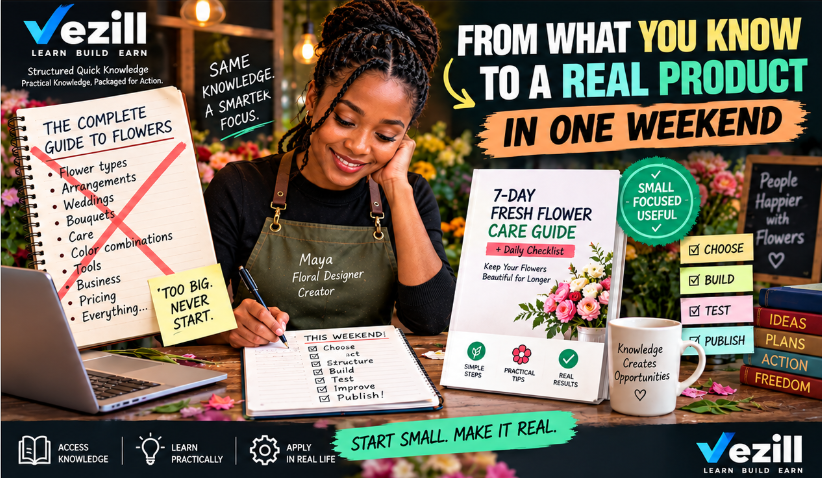
how to create your first knowledge product in one weekend
By Davie
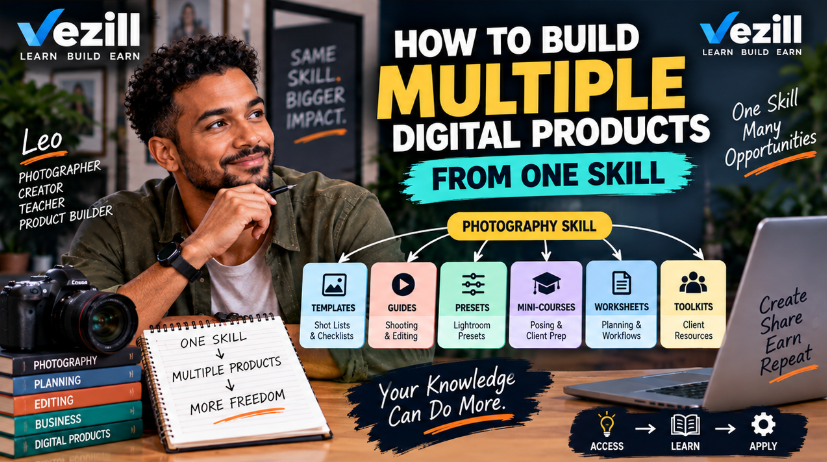
how to build multiple digital products from one skill
By Davie

how to find problems people will pay you to solve
By Davie
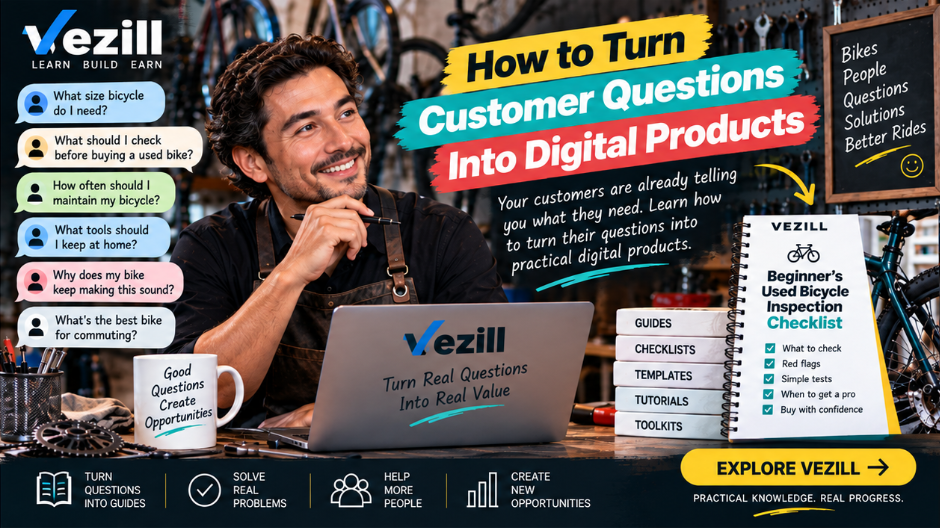
How to turn customer questions into digital products
By Davie
Get the updates, on newly released, popular & fast-moving MRR digital products
Up to Top