
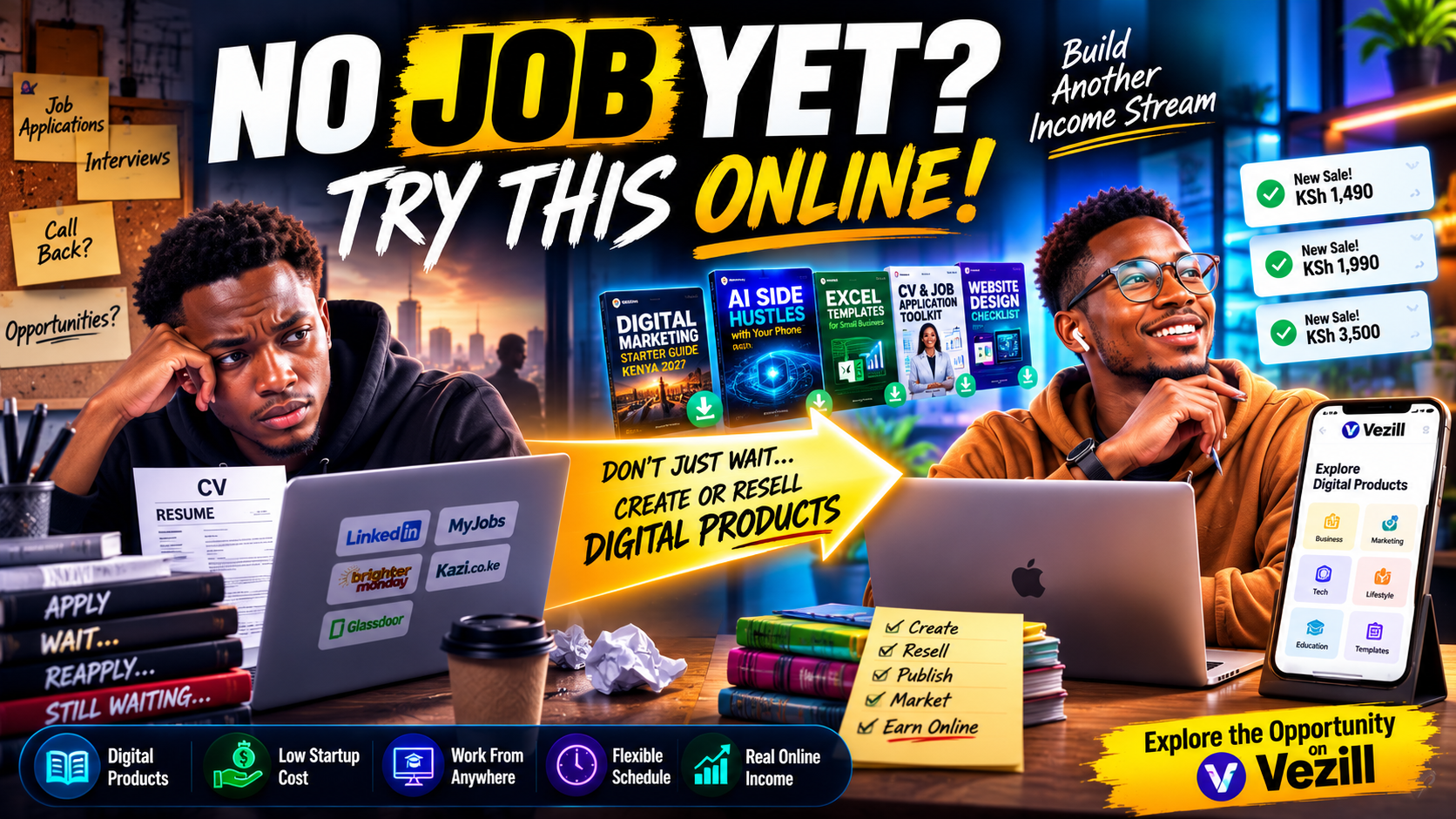
Job applications can take time. While you keep applying, you can also turn a useful skill, solved problem or properly licensed product into something people can buy online.
Updated September 202615-minute readPractical guide 
You do not have to choose between looking for employment and testing a small online business. Employment can offer stability, mentorship and experience; a digital product can give you a portfolio asset and another potential income path. Neither guarantees results, but running both experiments can be more productive than waiting passively.
Quick answer: Start with one audience, one painful or recurring problem and one small useful product. You can create an ebook, template, spreadsheet, checklist, planner, tutorial or mini-course yourself—or resell a product only when its licence explicitly permits resale. A marketplace such as Vezill can provide a place to discover, host and sell digital products, but it does not replace product quality, marketing or customer trust.
A normal job search follows a chain you do not fully control: apply, wait, interview, receive a decision. You control your preparation and targeting, but an employer controls the final opportunity.
A digital product changes the question from “Will somebody hire me?” to “Can I package a useful outcome clearly enough that somebody will pay for it?” That is not an easier question. It is simply a different experiment—one where you control more of the product and distribution.
Apply for roles Build a skill Create a useful asset Publish and test
The asset may help your job search even before it earns money. A content planner shows marketing ability. A spreadsheet shows analytical thinking. A website template demonstrates design and implementation. A practical guide demonstrates research and communication.
A digital product is a useful item delivered electronically rather than physically. The format matters less than the outcome it helps a customer achieve.
For small businessesExpense trackers, stock sheets, invoice templates and content calendars. For job seekersCV checklists, application trackers, interview preparation worksheets and portfolio templates. For studentsStudy planners, revision systems, scholarship checklists and subject guides. For creatorsPrompt packs, caption libraries, scripts, design assets and production workflows.
A three-page checklist that saves a salon owner an hour every week may be more valuable than an 80-page generic ebook. Start with the problem, not the file type.
 Start with a skill and a specific customer problem; the product format comes later.
You do not need to present yourself as the leading expert in Africa. You need to be accurate, useful and honest about your level of experience.
Use this product formula:
Knowledge or skill → problem → audience → product → sales page → marketing → customer
For example, “Everything About Graphic Design” is broad. “50 Social-Media Templates for Kenyan Restaurants” identifies a user, context and job to be done. “A Simple Cash-Flow Sheet for Small Shops” is more actionable than “How to Manage Money.” Specificity makes it easier to build, explain and promote the product.
AI is useful for brainstorming, outlining, restructuring, editing, drafting FAQs, finding gaps in a process and generating marketing variations. Design tools can help with layout, covers and diagrams.
A safer workflow is:
Your experience and research → AI-assisted structure → independent fact-checking → original examples and templates → human editing → quality review.
The unsafe workflow is to ask for a long ebook, download it and sell it immediately. AI can produce confident errors, repetitive writing and advice that ignores Kenya-specific realities. For medical, legal, tax, investment, financial or safety topics, verify information carefully and do not imply professional qualifications you do not have.
Inceptor’s Digital Product Trading Masterclass with AI is a relevant training route for learners who want structured practice in product creation, packaging, marketplaces, sales funnels, marketing and launch execution.
You may resell a digital product only when the licence gives you that permission. Buying an ordinary ebook, downloading a file from Telegram or purchasing a Canva template does not automatically grant redistribution rights.
 Resale is a permission structure, not a shortcut around copyright.
You may encounter these labels:
RR — Resell RightsMay permit resale under stated conditions. MRR — Master Resell RightsMay permit resale and, depending on the licence, transfer of certain resale permissions to your buyer. PLR — Private Label RightsMay permit editing or rebranding, but the exact boundaries depend on the licence. Personal useUsually means you may use the product yourself, not redistribute it.
These labels are not universal guarantees. Read the actual licence for branding, editing, pricing, distribution channels, transfer rights and prohibited claims.
Vezill’s explanation of how its MRR model works describes eligible products, licence information, digital delivery and resale according to the applicable terms. Treat “up to 90%” as a platform/product-specific commercial claim, not a guaranteed net profit. Check current platform terms, subscription requirements and withdrawal fees before calculating earnings.
Create your ownSlower to produce, but you have more control over originality, positioning, pricing and long-term brand value. Resell a licensed productPotentially faster to launch, but differentiation, branding and permitted channels depend on the licence—and marketing is still your responsibility.
Reselling removes some product-development work; it does not remove the need to understand the customer. If ten people offer the same file, your advantage must come from trust, audience, explanation, service, niche positioning or a better bundle.
Vezill positions itself as a marketplace for creators and digital traders. Its public materials describe digital-product hosting, marketplace discovery, automated delivery and eligible products with Master Resell Rights.
Use the platform for the part it can provide: a place to list or discover products and deliver them digitally. You still need to choose a real problem, write an honest product description, set a sensible price, promote without spam and support customers.
Useful next reads include the Vezill creator guide and its step-by-step reselling guide. These are internal references for understanding the platform workflow; always confirm live terms before paying for a plan or promising an earning outcome.
Browse Vezill to study how creators package guides, templates, courses and other digital products. Choose an eligible product only after checking the licence, or prepare your own original product for listing.
Uploading a file does not create demand. Distribution is part of the product business.
Choose one discovery channel first: Google search, a blog, TikTok, Instagram, WhatsApp, YouTube, Facebook, email or a relevant community. Then publish useful content around the same problem your product solves.
For example, a “30-Day Instagram Planner for Kenyan Salons” can be supported by posts such as “10 content ideas when your salon has no new photos” and “What should a salon post this week?” The free content demonstrates competence; the product packages the deeper solution.
Inceptor’s Digital Marketing Course covers SEO, social media, content, email, analytics, WhatsApp marketing and digital-product marketing—skills that can support both employment applications and your own product distribution.
Do not confuse attention with validation. Likes are not sales. Stronger signals include specific questions, email sign-ups, requests for access, pre-orders where appropriate and customers returning for related products.
Seven days is enough to start a test—not enough to promise an income.The result is not “I must already be earning.” The result is “I am still applying for jobs, but I have also created something I can test, improve and show to employers.”
Practical templates, checklists, planners, spreadsheets, niche guides, simple tutorials and educational resources based on knowledge they genuinely understand.
Yes, sales are possible, but no income is guaranteed. Demand, usefulness, price, trust, distribution and consistency determine results.
Yes. A marketplace can provide product pages and delivery infrastructure; social media, search, email and communities can help people discover the offer.
It can be legal when you have the appropriate rights and follow the licence. An ordinary purchase does not automatically grant resale permission.
Digital marketing can support job applications, freelancing, business promotion and product sales. Inceptor’s Kenya-focused training covers SEO, social media, paid advertising, content, analytics and digital-product marketing.
A job can provide stability, experience and a career path. A digital product can help you practise skills, build a portfolio and potentially create another income stream. The disciplined approach is not “forget employment and become an entrepreneur.” It is:
Apply for work + keep learning + create something useful + publish + market + improve.
Start small, respect licences, verify claims and let evidence—not online hype—tell you what to do next.
Creator routeMRR and licensingVezill marketplaceMarketing and validationSeven-day plan
Explore digital products on VezillVezill reselling guideInceptor digital-product training15 legit online-income paths A practical guide for Kenya and Africa. Digital products can create opportunities, but no platform or licence guarantees sales. Check current terms before making financial decisions.
Discover more articles you might be interested in
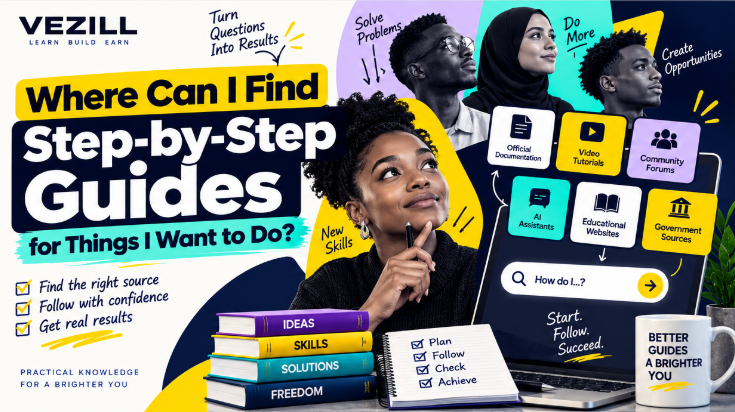
Learn where to find reliable step-by-step guides online, how to choose the right tutorial for your task, check whether it is current and follow instructions safely.
By Davie
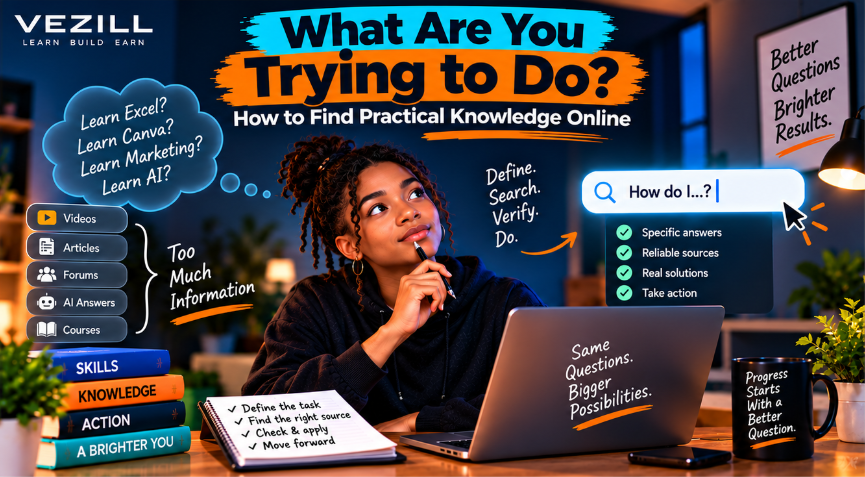
Stop searching broad topics and start finding the exact knowledge you need. Learn how to define your problem, search smarter, choose reliable sources, verify answers and take action.
By Davie
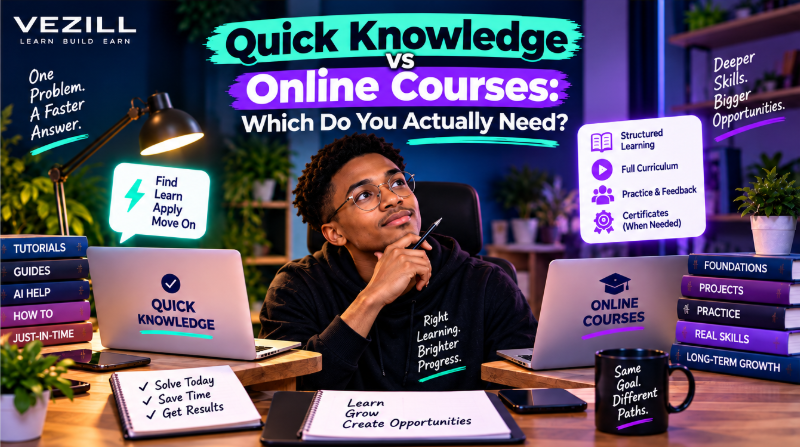
Quick Knowledge or an online course? Learn when a focused answer is enough, when structured learning is better, and how to choose the right learning depth for your goal.
By Davie
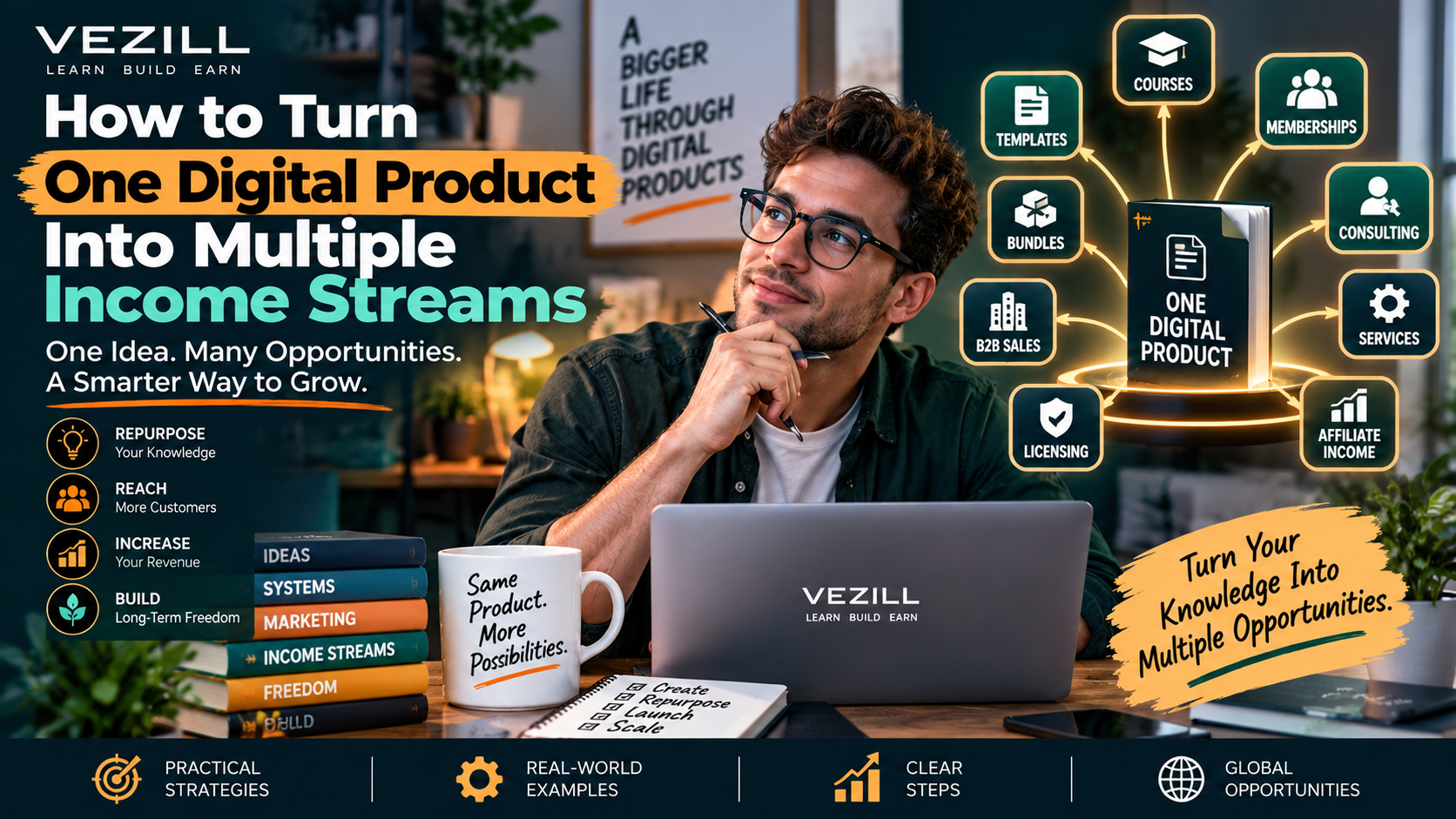
Learn how to turn one useful digital product into multiple income streams through premium versions, bundles, courses, licensing, services, subscriptions, B2B sales and complementary products.
By Davie
Get the updates, on newly released, popular & fast-moving MRR digital products
Up to Top
Comments All
Miriam
@miriam
I really liked this one. Job hunting can be stressful, so I like the idea of using the time to learn something new and possibly create another source of income. It’s a simple idea, but honestly something I hadn’t thought about before.
September 11,2026 At 10:26 PM