

How to decompose one real skill into distinct knowledge assets, problems and outcomes—then validate a coherent product family without selling the same information five times.
Leo has just finished a portrait session. His camera bag is on the floor, memory cards sit beside his laptop, and photographs are importing. His notebook says THE COMPLETE PHOTOGRAPHY GUIDE — 120 PAGES. Under it: cameras, lighting, composition, posing, editing, clients, pricing, events, delivery—everything.
Then another photographer asks how he avoids forgetting important shots at a small event. A client asks what to prepare before a portrait session. Someone else asks how he organizes files after a shoot. Leo writes three new lines: SHOT LIST. CLIENT PREPARATION. PHOTO WORKFLOW.
LEO DID NOT NEED MORE SKILLS. HE NEEDED TO SEE THE PRODUCTS ALREADY HIDING INSIDE THE SKILL HE HAD.
Break one skill into the smaller decisions, processes, workflows, mistakes, templates, calculations, examples and outcomes that make it up. Map those knowledge assets to different audiences, problems, stages, contexts and desired outcomes. Each result is only a product hypothesis until you validate that a real user needs that distinct solution.
ONE SKILL → KNOWLEDGE ASSETS → PROBLEMS → AUDIENCES → OUTCOMES → PRODUCT HYPOTHESES → VALIDATION → PRODUCT FAMILY
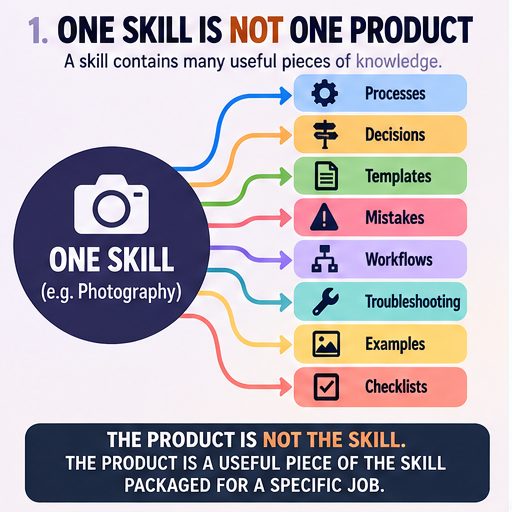
A PDF, EPUB, audio file, video and slide deck may be useful delivery options, but if they contain the same “Beginner Photography Basics,” they may still perform one job. A Portrait Preparation Checklist, Posing Prompt Cards, Event Shot-List Planner and Editing Workflow are more defensible as separate products because they can solve different jobs at different moments.
DO NOT MULTIPLY FILES. MULTIPLY USEFUL OUTCOMES.
Practical expertise often includes tacit knowledge: useful procedural judgment that people pick up through experience and may not routinely verbalize. Research on reflection shows that experience-based knowledge can be made more explicit, while task-analysis research has been used to elicit tacit skills in complex work. For product creation, that means the broad label “photography” is less useful than inspecting what an experienced photographer actually prepares, decides, checks, repeats and troubleshoots.
Instructional research also matters. Worked examples can be especially useful for novices because they expose solution steps instead of forcing beginners to discover every step unaided. More experienced learners may need less guidance. That is one reason “beginner,” “intermediate” and “advanced” products should differ in the job and support they provide—not merely in the title.
FOUNDATIONS — what must be understood? PREPARATION — what happens before? PROCESS — what repeats? DECISIONS — what choices matter? TOOLS — what is used? TEMPLATES — what gets reused? CALCULATIONS — what gets measured? MISTAKES — what goes wrong? TROUBLESHOOTING — how is it diagnosed? QUALITY CONTROL — how is the result checked? COMMUNICATION — what must be explained? WORKFLOW — how is the whole job organized? SHORTCUTS — what reduces effort? EXCEPTIONS — when does the normal path change? EXPERIENCE — what has repetition taught you?
SKILL: ________
I KNOW HOW TO: ________
I PREPARE BY: ________
I ALWAYS CHECK: ________
I DECIDE: ________
I CALCULATE: ________
I REPEAT: ________
I HAVE TEMPLATES FOR: ________
BEGINNERS ASK ME: ________
CLIENTS ASK ME: ________
PEOPLE GET STUCK WHEN: ________
COMMON MISTAKES: ________
I TROUBLESHOOT BY: ________
I SAVE TIME BY: ________
EXPERIENCE TAUGHT ME: ________
WHICH OF THESE ASSETS SOLVES A REPEATED PROBLEM?
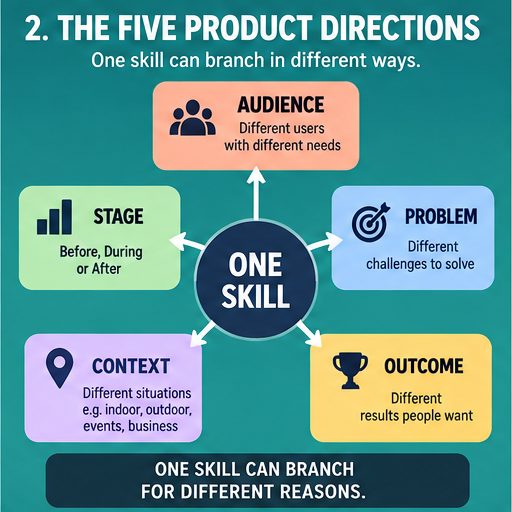
Audience: the same skill can serve a beginner, professional or business differently. Problem: poor lighting and messy file organization are different frictions. Stage: before, during and after a task contain different jobs. Outcome: preparing clients and editing consistently are different promises. Context: indoor, outdoor, event, product and portrait work can change what is useful.
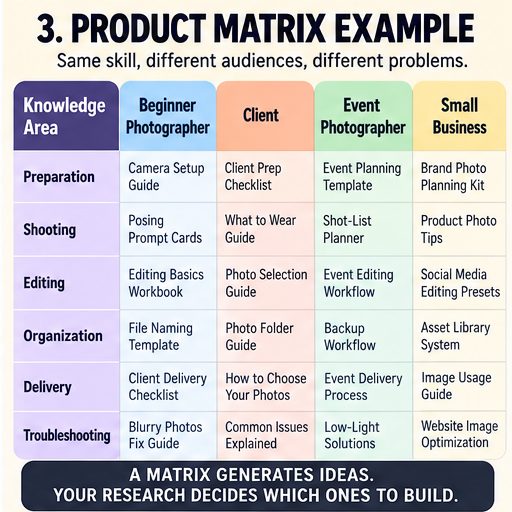
Put audiences on one axis and problems/outcomes on the other. For photography, rows might be PREPARE, SHOOT, ORGANIZE, EDIT, DELIVER and TROUBLESHOOT; columns might be BEGINNER, CLIENT, EVENT and BUSINESS. Every intersection is a research question—not a command to create inventory.
THE MATRIX GENERATES HYPOTHESES. THE MARKET DECIDES WHICH DESERVE TO EXIST.
WHO has WHAT PROBLEM while trying to achieve WHAT OUTCOME in WHAT CONTEXT and needs WHAT PRACTICAL KNOWLEDGE OR TOOL delivered as WHAT FORMAT?
Example: a beginner event photographer forgets important moments during fast-moving small events and needs structured shot planning delivered as a printable/mobile-friendly shot-list system.
Every item below is an illustrative product hypothesis, not a claim of validated demand.
Skill: Photography · Target user: a person already working in or learning this skill who encounters this job before the task.
Specific problem: The user needs a clearer, repeatable way to handle the event shot-list job instead of relying on memory or scattered notes.
Desired outcome: Prepare with fewer omissions.
Knowledge asset: preparation sequence drawn from genuine experience in photography.
Product hypothesis: Event Shot-List Planner.
Why it is distinct: Its primary job is preparation; it should not repeat a broad “complete Photography guide.”
What must be validated: Whether this problem recurs for the intended user, whether current alternatives already solve it well, whether this format fits the job, and whether the outcome matters enough to seek or pay for a solution.
EXAMPLE 2Skill: Photography · Target user: a person already working in or learning this skill who encounters this job during execution.
Specific problem: The user needs a clearer, repeatable way to handle the portrait client preparation job instead of relying on memory or scattered notes.
Desired outcome: Make the task easier to execute consistently.
Knowledge asset: decision rules and examples drawn from genuine experience in photography.
Product hypothesis: Portrait Client Preparation Checklist.
Why it is distinct: Its primary job is execution; it should not repeat a broad “complete Photography guide.”
What must be validated: Whether this problem recurs for the intended user, whether current alternatives already solve it well, whether this format fits the job, and whether the outcome matters enough to seek or pay for a solution.
EXAMPLE 3Skill: Photography · Target user: a person already working in or learning this skill who encounters this job after execution.
Specific problem: The user needs a clearer, repeatable way to handle the natural-light posing prompt cards job instead of relying on memory or scattered notes.
Desired outcome: Reduce avoidable confusion during use.
Knowledge asset: reusable prompts/checks drawn from genuine experience in photography.
Product hypothesis: Natural-Light Posing Prompt Cards.
Why it is distinct: Its primary job is guidance; it should not repeat a broad “complete Photography guide.”
What must be validated: Whether this problem recurs for the intended user, whether current alternatives already solve it well, whether this format fits the job, and whether the outcome matters enough to seek or pay for a solution.
EXAMPLE 4Skill: Photography · Target user: a person already working in or learning this skill who encounters this job during a recurring workflow.
Specific problem: The user needs a clearer, repeatable way to handle the photo file organization workflow job instead of relying on memory or scattered notes.
Desired outcome: Organize repeated work more clearly.
Knowledge asset: workflow and organization method drawn from genuine experience in photography.
Product hypothesis: Photo File Organization Workflow.
Why it is distinct: Its primary job is organization; it should not repeat a broad “complete Photography guide.”
What must be validated: Whether this problem recurs for the intended user, whether current alternatives already solve it well, whether this format fits the job, and whether the outcome matters enough to seek or pay for a solution.
EXAMPLE 5Skill: Photography · Target user: a person already working in or learning this skill who encounters this job at a decision point.
Specific problem: The user needs a clearer, repeatable way to handle the editing workflow job instead of relying on memory or scattered notes.
Desired outcome: Make a specific decision or record status.
Knowledge asset: comparison/recording structure drawn from genuine experience in photography.
Product hypothesis: Editing Workflow Guide.
Why it is distinct: Its primary job is decision/recording; it should not repeat a broad “complete Photography guide.”
What must be validated: Whether this problem recurs for the intended user, whether current alternatives already solve it well, whether this format fits the job, and whether the outcome matters enough to seek or pay for a solution.
EXAMPLE 6Skill: Photography · Target user: a person already working in or learning this skill who encounters this job during review.
Specific problem: The user needs a clearer, repeatable way to handle the client photo delivery job instead of relying on memory or scattered notes.
Desired outcome: Review results and improve the next cycle.
Knowledge asset: quality-control and reflection process drawn from genuine experience in photography.
Product hypothesis: Client Photo Delivery Checklist.
Why it is distinct: Its primary job is review; it should not repeat a broad “complete Photography guide.”
What must be validated: Whether this problem recurs for the intended user, whether current alternatives already solve it well, whether this format fits the job, and whether the outcome matters enough to seek or pay for a solution.
Skill: Cooking / Baking · Target user: a person already working in or learning this skill who encounters this job before the task.
Specific problem: The user needs a clearer, repeatable way to handle the baking measurement reference job instead of relying on memory or scattered notes.
Desired outcome: Prepare with fewer omissions.
Knowledge asset: preparation sequence drawn from genuine experience in cooking / baking.
Product hypothesis: Baking Measurement Reference.
Why it is distinct: Its primary job is preparation; it should not repeat a broad “complete Cooking / Baking guide.”
What must be validated: Whether this problem recurs for the intended user, whether current alternatives already solve it well, whether this format fits the job, and whether the outcome matters enough to seek or pay for a solution.
EXAMPLE 8Skill: Cooking / Baking · Target user: a person already working in or learning this skill who encounters this job during execution.
Specific problem: The user needs a clearer, repeatable way to handle the substitution decision job instead of relying on memory or scattered notes.
Desired outcome: Make the task easier to execute consistently.
Knowledge asset: decision rules and examples drawn from genuine experience in cooking / baking.
Product hypothesis: Substitution Decision Guide.
Why it is distinct: Its primary job is execution; it should not repeat a broad “complete Cooking / Baking guide.”
What must be validated: Whether this problem recurs for the intended user, whether current alternatives already solve it well, whether this format fits the job, and whether the outcome matters enough to seek or pay for a solution.
EXAMPLE 9Skill: Cooking / Baking · Target user: a person already working in or learning this skill who encounters this job after execution.
Specific problem: The user needs a clearer, repeatable way to handle the cake troubleshooting decision tree job instead of relying on memory or scattered notes.
Desired outcome: Reduce avoidable confusion during use.
Knowledge asset: reusable prompts/checks drawn from genuine experience in cooking / baking.
Product hypothesis: Cake Troubleshooting Decision Tree.
Why it is distinct: Its primary job is guidance; it should not repeat a broad “complete Cooking / Baking guide.”
What must be validated: Whether this problem recurs for the intended user, whether current alternatives already solve it well, whether this format fits the job, and whether the outcome matters enough to seek or pay for a solution.
EXAMPLE 10Skill: Cooking / Baking · Target user: a person already working in or learning this skill who encounters this job during a recurring workflow.
Specific problem: The user needs a clearer, repeatable way to handle the cake preparation job instead of relying on memory or scattered notes.
Desired outcome: Organize repeated work more clearly.
Knowledge asset: workflow and organization method drawn from genuine experience in cooking / baking.
Product hypothesis: Cake Preparation Checklist.
Why it is distinct: Its primary job is organization; it should not repeat a broad “complete Cooking / Baking guide.”
What must be validated: Whether this problem recurs for the intended user, whether current alternatives already solve it well, whether this format fits the job, and whether the outcome matters enough to seek or pay for a solution.
EXAMPLE 11Skill: Cooking / Baking · Target user: a person already working in or learning this skill who encounters this job at a decision point.
Specific problem: The user needs a clearer, repeatable way to handle the baking test log job instead of relying on memory or scattered notes.
Desired outcome: Make a specific decision or record status.
Knowledge asset: comparison/recording structure drawn from genuine experience in cooking / baking.
Product hypothesis: Baking Test Log.
Why it is distinct: Its primary job is decision/recording; it should not repeat a broad “complete Cooking / Baking guide.”
What must be validated: Whether this problem recurs for the intended user, whether current alternatives already solve it well, whether this format fits the job, and whether the outcome matters enough to seek or pay for a solution.
EXAMPLE 12Skill: Cooking / Baking · Target user: a person already working in or learning this skill who encounters this job during review.
Specific problem: The user needs a clearer, repeatable way to handle the cooling & storage job instead of relying on memory or scattered notes.
Desired outcome: Review results and improve the next cycle.
Knowledge asset: quality-control and reflection process drawn from genuine experience in cooking / baking.
Product hypothesis: Cooling & Storage Planner.
Why it is distinct: Its primary job is review; it should not repeat a broad “complete Cooking / Baking guide.”
What must be validated: Whether this problem recurs for the intended user, whether current alternatives already solve it well, whether this format fits the job, and whether the outcome matters enough to seek or pay for a solution.
Skill: Graphic Design · Target user: a person already working in or learning this skill who encounters this job before the task.
Specific problem: The user needs a clearer, repeatable way to handle the font pairing job instead of relying on memory or scattered notes.
Desired outcome: Prepare with fewer omissions.
Knowledge asset: preparation sequence drawn from genuine experience in graphic design.
Product hypothesis: Font Pairing Workbook.
Why it is distinct: Its primary job is preparation; it should not repeat a broad “complete Graphic Design guide.”
What must be validated: Whether this problem recurs for the intended user, whether current alternatives already solve it well, whether this format fits the job, and whether the outcome matters enough to seek or pay for a solution.
EXAMPLE 14Skill: Graphic Design · Target user: a person already working in or learning this skill who encounters this job during execution.
Specific problem: The user needs a clearer, repeatable way to handle the client design brief job instead of relying on memory or scattered notes.
Desired outcome: Make the task easier to execute consistently.
Knowledge asset: decision rules and examples drawn from genuine experience in graphic design.
Product hypothesis: Client Design Brief.
Why it is distinct: Its primary job is execution; it should not repeat a broad “complete Graphic Design guide.”
What must be validated: Whether this problem recurs for the intended user, whether current alternatives already solve it well, whether this format fits the job, and whether the outcome matters enough to seek or pay for a solution.
EXAMPLE 15Skill: Graphic Design · Target user: a person already working in or learning this skill who encounters this job after execution.
Specific problem: The user needs a clearer, repeatable way to handle the mini brand consistency kit job instead of relying on memory or scattered notes.
Desired outcome: Reduce avoidable confusion during use.
Knowledge asset: reusable prompts/checks drawn from genuine experience in graphic design.
Product hypothesis: Mini Brand Consistency Kit.
Why it is distinct: Its primary job is guidance; it should not repeat a broad “complete Graphic Design guide.”
What must be validated: Whether this problem recurs for the intended user, whether current alternatives already solve it well, whether this format fits the job, and whether the outcome matters enough to seek or pay for a solution.
EXAMPLE 16Skill: Graphic Design · Target user: a person already working in or learning this skill who encounters this job during a recurring workflow.
Specific problem: The user needs a clearer, repeatable way to handle the design file handoff job instead of relying on memory or scattered notes.
Desired outcome: Organize repeated work more clearly.
Knowledge asset: workflow and organization method drawn from genuine experience in graphic design.
Product hypothesis: Design File Handoff Checklist.
Why it is distinct: Its primary job is organization; it should not repeat a broad “complete Graphic Design guide.”
What must be validated: Whether this problem recurs for the intended user, whether current alternatives already solve it well, whether this format fits the job, and whether the outcome matters enough to seek or pay for a solution.
EXAMPLE 17Skill: Graphic Design · Target user: a person already working in or learning this skill who encounters this job at a decision point.
Specific problem: The user needs a clearer, repeatable way to handle the social layout starter system job instead of relying on memory or scattered notes.
Desired outcome: Make a specific decision or record status.
Knowledge asset: comparison/recording structure drawn from genuine experience in graphic design.
Product hypothesis: Social Layout Starter System.
Why it is distinct: Its primary job is decision/recording; it should not repeat a broad “complete Graphic Design guide.”
What must be validated: Whether this problem recurs for the intended user, whether current alternatives already solve it well, whether this format fits the job, and whether the outcome matters enough to seek or pay for a solution.
EXAMPLE 18Skill: Graphic Design · Target user: a person already working in or learning this skill who encounters this job during review.
Specific problem: The user needs a clearer, repeatable way to handle the pre-presentation review sheet job instead of relying on memory or scattered notes.
Desired outcome: Review results and improve the next cycle.
Knowledge asset: quality-control and reflection process drawn from genuine experience in graphic design.
Product hypothesis: Pre-Presentation Review Sheet.
Why it is distinct: Its primary job is review; it should not repeat a broad “complete Graphic Design guide.”
What must be validated: Whether this problem recurs for the intended user, whether current alternatives already solve it well, whether this format fits the job, and whether the outcome matters enough to seek or pay for a solution.
Skill: Social Media Management · Target user: a person already working in or learning this skill who encounters this job before the task.
Specific problem: The user needs a clearer, repeatable way to handle the client onboarding job instead of relying on memory or scattered notes.
Desired outcome: Prepare with fewer omissions.
Knowledge asset: preparation sequence drawn from genuine experience in social media management.
Product hypothesis: Client Onboarding Workbook.
Why it is distinct: Its primary job is preparation; it should not repeat a broad “complete Social Media Management guide.”
What must be validated: Whether this problem recurs for the intended user, whether current alternatives already solve it well, whether this format fits the job, and whether the outcome matters enough to seek or pay for a solution.
EXAMPLE 20Skill: Social Media Management · Target user: a person already working in or learning this skill who encounters this job during execution.
Specific problem: The user needs a clearer, repeatable way to handle the 30-day content job instead of relying on memory or scattered notes.
Desired outcome: Make the task easier to execute consistently.
Knowledge asset: decision rules and examples drawn from genuine experience in social media management.
Product hypothesis: 30-Day Content Planner.
Why it is distinct: Its primary job is execution; it should not repeat a broad “complete Social Media Management guide.”
What must be validated: Whether this problem recurs for the intended user, whether current alternatives already solve it well, whether this format fits the job, and whether the outcome matters enough to seek or pay for a solution.
EXAMPLE 21Skill: Social Media Management · Target user: a person already working in or learning this skill who encounters this job after execution.
Specific problem: The user needs a clearer, repeatable way to handle the content approval job instead of relying on memory or scattered notes.
Desired outcome: Reduce avoidable confusion during use.
Knowledge asset: reusable prompts/checks drawn from genuine experience in social media management.
Product hypothesis: Content Approval Tracker.
Why it is distinct: Its primary job is guidance; it should not repeat a broad “complete Social Media Management guide.”
What must be validated: Whether this problem recurs for the intended user, whether current alternatives already solve it well, whether this format fits the job, and whether the outcome matters enough to seek or pay for a solution.
EXAMPLE 22Skill: Social Media Management · Target user: a person already working in or learning this skill who encounters this job during a recurring workflow.
Specific problem: The user needs a clearer, repeatable way to handle the publishing responsibility sheet job instead of relying on memory or scattered notes.
Desired outcome: Organize repeated work more clearly.
Knowledge asset: workflow and organization method drawn from genuine experience in social media management.
Product hypothesis: Publishing Responsibility Sheet.
Why it is distinct: Its primary job is organization; it should not repeat a broad “complete Social Media Management guide.”
What must be validated: Whether this problem recurs for the intended user, whether current alternatives already solve it well, whether this format fits the job, and whether the outcome matters enough to seek or pay for a solution.
EXAMPLE 23Skill: Social Media Management · Target user: a person already working in or learning this skill who encounters this job at a decision point.
Specific problem: The user needs a clearer, repeatable way to handle the monthly report job instead of relying on memory or scattered notes.
Desired outcome: Make a specific decision or record status.
Knowledge asset: comparison/recording structure drawn from genuine experience in social media management.
Product hypothesis: Monthly Report Template.
Why it is distinct: Its primary job is decision/recording; it should not repeat a broad “complete Social Media Management guide.”
What must be validated: Whether this problem recurs for the intended user, whether current alternatives already solve it well, whether this format fits the job, and whether the outcome matters enough to seek or pay for a solution.
EXAMPLE 24Skill: Social Media Management · Target user: a person already working in or learning this skill who encounters this job during review.
Specific problem: The user needs a clearer, repeatable way to handle the content idea scoring worksheet job instead of relying on memory or scattered notes.
Desired outcome: Review results and improve the next cycle.
Knowledge asset: quality-control and reflection process drawn from genuine experience in social media management.
Product hypothesis: Content Idea Scoring Worksheet.
Why it is distinct: Its primary job is review; it should not repeat a broad “complete Social Media Management guide.”
What must be validated: Whether this problem recurs for the intended user, whether current alternatives already solve it well, whether this format fits the job, and whether the outcome matters enough to seek or pay for a solution.
Skill: Bookkeeping / Business Admin · Target user: a person already working in or learning this skill who encounters this job before the task.
Specific problem: The user needs a clearer, repeatable way to handle the weekly records job instead of relying on memory or scattered notes.
Desired outcome: Prepare with fewer omissions.
Knowledge asset: preparation sequence drawn from genuine experience in bookkeeping / business admin.
Product hypothesis: Weekly Records Checklist.
Why it is distinct: Its primary job is preparation; it should not repeat a broad “complete Bookkeeping / Business Admin guide.”
What must be validated: Whether this problem recurs for the intended user, whether current alternatives already solve it well, whether this format fits the job, and whether the outcome matters enough to seek or pay for a solution.
EXAMPLE 26Skill: Bookkeeping / Business Admin · Target user: a person already working in or learning this skill who encounters this job during execution.
Specific problem: The user needs a clearer, repeatable way to handle the invoice follow-up job instead of relying on memory or scattered notes.
Desired outcome: Make the task easier to execute consistently.
Knowledge asset: decision rules and examples drawn from genuine experience in bookkeeping / business admin.
Product hypothesis: Invoice Follow-Up Tracker.
Why it is distinct: Its primary job is execution; it should not repeat a broad “complete Bookkeeping / Business Admin guide.”
What must be validated: Whether this problem recurs for the intended user, whether current alternatives already solve it well, whether this format fits the job, and whether the outcome matters enough to seek or pay for a solution.
EXAMPLE 27Skill: Bookkeeping / Business Admin · Target user: a person already working in or learning this skill who encounters this job after execution.
Specific problem: The user needs a clearer, repeatable way to handle the month-end preparation job instead of relying on memory or scattered notes.
Desired outcome: Reduce avoidable confusion during use.
Knowledge asset: reusable prompts/checks drawn from genuine experience in bookkeeping / business admin.
Product hypothesis: Month-End Preparation Checklist.
Why it is distinct: Its primary job is guidance; it should not repeat a broad “complete Bookkeeping / Business Admin guide.”
What must be validated: Whether this problem recurs for the intended user, whether current alternatives already solve it well, whether this format fits the job, and whether the outcome matters enough to seek or pay for a solution.
EXAMPLE 28Skill: Bookkeeping / Business Admin · Target user: a person already working in or learning this skill who encounters this job during a recurring workflow.
Specific problem: The user needs a clearer, repeatable way to handle the business records filing map job instead of relying on memory or scattered notes.
Desired outcome: Organize repeated work more clearly.
Knowledge asset: workflow and organization method drawn from genuine experience in bookkeeping / business admin.
Product hypothesis: Business Records Filing Map.
Why it is distinct: Its primary job is organization; it should not repeat a broad “complete Bookkeeping / Business Admin guide.”
What must be validated: Whether this problem recurs for the intended user, whether current alternatives already solve it well, whether this format fits the job, and whether the outcome matters enough to seek or pay for a solution.
EXAMPLE 29Skill: Bookkeeping / Business Admin · Target user: a person already working in or learning this skill who encounters this job at a decision point.
Specific problem: The user needs a clearer, repeatable way to handle the admin routine job instead of relying on memory or scattered notes.
Desired outcome: Make a specific decision or record status.
Knowledge asset: comparison/recording structure drawn from genuine experience in bookkeeping / business admin.
Product hypothesis: Admin Routine Planner.
Why it is distinct: Its primary job is decision/recording; it should not repeat a broad “complete Bookkeeping / Business Admin guide.”
What must be validated: Whether this problem recurs for the intended user, whether current alternatives already solve it well, whether this format fits the job, and whether the outcome matters enough to seek or pay for a solution.
EXAMPLE 30Skill: Bookkeeping / Business Admin · Target user: a person already working in or learning this skill who encounters this job during review.
Specific problem: The user needs a clearer, repeatable way to handle the invoice preparation worksheet job instead of relying on memory or scattered notes.
Desired outcome: Review results and improve the next cycle.
Knowledge asset: quality-control and reflection process drawn from genuine experience in bookkeeping / business admin.
Product hypothesis: Invoice Preparation Worksheet.
Why it is distinct: Its primary job is review; it should not repeat a broad “complete Bookkeeping / Business Admin guide.”
What must be validated: Whether this problem recurs for the intended user, whether current alternatives already solve it well, whether this format fits the job, and whether the outcome matters enough to seek or pay for a solution.
Skill: Writing · Target user: a person already working in or learning this skill who encounters this job before the task.
Specific problem: The user needs a clearer, repeatable way to handle the writing brief intake job instead of relying on memory or scattered notes.
Desired outcome: Prepare with fewer omissions.
Knowledge asset: preparation sequence drawn from genuine experience in writing.
Product hypothesis: Writing Brief Intake Template.
Why it is distinct: Its primary job is preparation; it should not repeat a broad “complete Writing guide.”
What must be validated: Whether this problem recurs for the intended user, whether current alternatives already solve it well, whether this format fits the job, and whether the outcome matters enough to seek or pay for a solution.
EXAMPLE 32Skill: Writing · Target user: a person already working in or learning this skill who encounters this job during execution.
Specific problem: The user needs a clearer, repeatable way to handle the article outline builder job instead of relying on memory or scattered notes.
Desired outcome: Make the task easier to execute consistently.
Knowledge asset: decision rules and examples drawn from genuine experience in writing.
Product hypothesis: Article Outline Builder.
Why it is distinct: Its primary job is execution; it should not repeat a broad “complete Writing guide.”
What must be validated: Whether this problem recurs for the intended user, whether current alternatives already solve it well, whether this format fits the job, and whether the outcome matters enough to seek or pay for a solution.
EXAMPLE 33Skill: Writing · Target user: a person already working in or learning this skill who encounters this job after execution.
Specific problem: The user needs a clearer, repeatable way to handle the multi-pass editing job instead of relying on memory or scattered notes.
Desired outcome: Reduce avoidable confusion during use.
Knowledge asset: reusable prompts/checks drawn from genuine experience in writing.
Product hypothesis: Multi-Pass Editing Checklist.
Why it is distinct: Its primary job is guidance; it should not repeat a broad “complete Writing guide.”
What must be validated: Whether this problem recurs for the intended user, whether current alternatives already solve it well, whether this format fits the job, and whether the outcome matters enough to seek or pay for a solution.
EXAMPLE 34Skill: Writing · Target user: a person already working in or learning this skill who encounters this job during a recurring workflow.
Specific problem: The user needs a clearer, repeatable way to handle the about-page story worksheet job instead of relying on memory or scattered notes.
Desired outcome: Organize repeated work more clearly.
Knowledge asset: workflow and organization method drawn from genuine experience in writing.
Product hypothesis: About-Page Story Worksheet.
Why it is distinct: Its primary job is organization; it should not repeat a broad “complete Writing guide.”
What must be validated: Whether this problem recurs for the intended user, whether current alternatives already solve it well, whether this format fits the job, and whether the outcome matters enough to seek or pay for a solution.
EXAMPLE 35Skill: Writing · Target user: a person already working in or learning this skill who encounters this job at a decision point.
Specific problem: The user needs a clearer, repeatable way to handle the newsletter idea bank job instead of relying on memory or scattered notes.
Desired outcome: Make a specific decision or record status.
Knowledge asset: comparison/recording structure drawn from genuine experience in writing.
Product hypothesis: Newsletter Idea Bank.
Why it is distinct: Its primary job is decision/recording; it should not repeat a broad “complete Writing guide.”
What must be validated: Whether this problem recurs for the intended user, whether current alternatives already solve it well, whether this format fits the job, and whether the outcome matters enough to seek or pay for a solution.
EXAMPLE 36Skill: Writing · Target user: a person already working in or learning this skill who encounters this job during review.
Specific problem: The user needs a clearer, repeatable way to handle the client draft handoff job instead of relying on memory or scattered notes.
Desired outcome: Review results and improve the next cycle.
Knowledge asset: quality-control and reflection process drawn from genuine experience in writing.
Product hypothesis: Client Draft Handoff Checklist.
Why it is distinct: Its primary job is review; it should not repeat a broad “complete Writing guide.”
What must be validated: Whether this problem recurs for the intended user, whether current alternatives already solve it well, whether this format fits the job, and whether the outcome matters enough to seek or pay for a solution.
Skill: Fitness / Sports Coaching · Target user: a person already working in or learning this skill who encounters this job before the task.
Specific problem: The user needs a clearer, repeatable way to handle the sports session setup job instead of relying on memory or scattered notes.
Desired outcome: Prepare with fewer omissions.
Knowledge asset: preparation sequence drawn from genuine experience in fitness / sports coaching.
Product hypothesis: Sports Session Setup Checklist.
Why it is distinct: Its primary job is preparation; it should not repeat a broad “complete Fitness / Sports Coaching guide.”
What must be validated: Whether this problem recurs for the intended user, whether current alternatives already solve it well, whether this format fits the job, and whether the outcome matters enough to seek or pay for a solution.
EXAMPLE 38Skill: Fitness / Sports Coaching · Target user: a person already working in or learning this skill who encounters this job during execution.
Specific problem: The user needs a clearer, repeatable way to handle the running club session log job instead of relying on memory or scattered notes.
Desired outcome: Make the task easier to execute consistently.
Knowledge asset: decision rules and examples drawn from genuine experience in fitness / sports coaching.
Product hypothesis: Running Club Session Log.
Why it is distinct: Its primary job is execution; it should not repeat a broad “complete Fitness / Sports Coaching guide.”
What must be validated: Whether this problem recurs for the intended user, whether current alternatives already solve it well, whether this format fits the job, and whether the outcome matters enough to seek or pay for a solution.
EXAMPLE 39Skill: Fitness / Sports Coaching · Target user: a person already working in or learning this skill who encounters this job after execution.
Specific problem: The user needs a clearer, repeatable way to handle the match-day parent info job instead of relying on memory or scattered notes.
Desired outcome: Reduce avoidable confusion during use.
Knowledge asset: reusable prompts/checks drawn from genuine experience in fitness / sports coaching.
Product hypothesis: Match-Day Parent Info Template.
Why it is distinct: Its primary job is guidance; it should not repeat a broad “complete Fitness / Sports Coaching guide.”
What must be validated: Whether this problem recurs for the intended user, whether current alternatives already solve it well, whether this format fits the job, and whether the outcome matters enough to seek or pay for a solution.
EXAMPLE 40Skill: Fitness / Sports Coaching · Target user: a person already working in or learning this skill who encounters this job during a recurring workflow.
Specific problem: The user needs a clearer, repeatable way to handle the training equipment job instead of relying on memory or scattered notes.
Desired outcome: Organize repeated work more clearly.
Knowledge asset: workflow and organization method drawn from genuine experience in fitness / sports coaching.
Product hypothesis: Training Equipment Checklist.
Why it is distinct: Its primary job is organization; it should not repeat a broad “complete Fitness / Sports Coaching guide.”
What must be validated: Whether this problem recurs for the intended user, whether current alternatives already solve it well, whether this format fits the job, and whether the outcome matters enough to seek or pay for a solution.
EXAMPLE 41Skill: Fitness / Sports Coaching · Target user: a person already working in or learning this skill who encounters this job at a decision point.
Specific problem: The user needs a clearer, repeatable way to handle the match-day operations job instead of relying on memory or scattered notes.
Desired outcome: Make a specific decision or record status.
Knowledge asset: comparison/recording structure drawn from genuine experience in fitness / sports coaching.
Product hypothesis: Match-Day Operations Planner.
Why it is distinct: Its primary job is decision/recording; it should not repeat a broad “complete Fitness / Sports Coaching guide.”
What must be validated: Whether this problem recurs for the intended user, whether current alternatives already solve it well, whether this format fits the job, and whether the outcome matters enough to seek or pay for a solution.
EXAMPLE 42Skill: Fitness / Sports Coaching · Target user: a person already working in or learning this skill who encounters this job during review.
Specific problem: The user needs a clearer, repeatable way to handle the first-session preparation job instead of relying on memory or scattered notes.
Desired outcome: Review results and improve the next cycle.
Knowledge asset: quality-control and reflection process drawn from genuine experience in fitness / sports coaching.
Product hypothesis: First-Session Preparation Guide.
Why it is distinct: Its primary job is review; it should not repeat a broad “complete Fitness / Sports Coaching guide.”
What must be validated: Whether this problem recurs for the intended user, whether current alternatives already solve it well, whether this format fits the job, and whether the outcome matters enough to seek or pay for a solution.
Skill: Gardening · Target user: a person already working in or learning this skill who encounters this job before the task.
Specific problem: The user needs a clearer, repeatable way to handle the balcony garden space job instead of relying on memory or scattered notes.
Desired outcome: Prepare with fewer omissions.
Knowledge asset: preparation sequence drawn from genuine experience in gardening.
Product hypothesis: Balcony Garden Space Planner.
Why it is distinct: Its primary job is preparation; it should not repeat a broad “complete Gardening guide.”
What must be validated: Whether this problem recurs for the intended user, whether current alternatives already solve it well, whether this format fits the job, and whether the outcome matters enough to seek or pay for a solution.
EXAMPLE 44Skill: Gardening · Target user: a person already working in or learning this skill who encounters this job during execution.
Specific problem: The user needs a clearer, repeatable way to handle the planting & observation log job instead of relying on memory or scattered notes.
Desired outcome: Make the task easier to execute consistently.
Knowledge asset: decision rules and examples drawn from genuine experience in gardening.
Product hypothesis: Planting & Observation Log.
Why it is distinct: Its primary job is execution; it should not repeat a broad “complete Gardening guide.”
What must be validated: Whether this problem recurs for the intended user, whether current alternatives already solve it well, whether this format fits the job, and whether the outcome matters enough to seek or pay for a solution.
EXAMPLE 45Skill: Gardening · Target user: a person already working in or learning this skill who encounters this job after execution.
Specific problem: The user needs a clearer, repeatable way to handle the weekly garden care job instead of relying on memory or scattered notes.
Desired outcome: Reduce avoidable confusion during use.
Knowledge asset: reusable prompts/checks drawn from genuine experience in gardening.
Product hypothesis: Weekly Garden Care Checklist.
Why it is distinct: Its primary job is guidance; it should not repeat a broad “complete Gardening guide.”
What must be validated: Whether this problem recurs for the intended user, whether current alternatives already solve it well, whether this format fits the job, and whether the outcome matters enough to seek or pay for a solution.
EXAMPLE 46Skill: Gardening · Target user: a person already working in or learning this skill who encounters this job during a recurring workflow.
Specific problem: The user needs a clearer, repeatable way to handle the container setup worksheet job instead of relying on memory or scattered notes.
Desired outcome: Organize repeated work more clearly.
Knowledge asset: workflow and organization method drawn from genuine experience in gardening.
Product hypothesis: Container Setup Worksheet.
Why it is distinct: Its primary job is organization; it should not repeat a broad “complete Gardening guide.”
What must be validated: Whether this problem recurs for the intended user, whether current alternatives already solve it well, whether this format fits the job, and whether the outcome matters enough to seek or pay for a solution.
EXAMPLE 47Skill: Gardening · Target user: a person already working in or learning this skill who encounters this job at a decision point.
Specific problem: The user needs a clearer, repeatable way to handle the community garden roster job instead of relying on memory or scattered notes.
Desired outcome: Make a specific decision or record status.
Knowledge asset: comparison/recording structure drawn from genuine experience in gardening.
Product hypothesis: Community Garden Roster.
Why it is distinct: Its primary job is decision/recording; it should not repeat a broad “complete Gardening guide.”
What must be validated: Whether this problem recurs for the intended user, whether current alternatives already solve it well, whether this format fits the job, and whether the outcome matters enough to seek or pay for a solution.
EXAMPLE 48Skill: Gardening · Target user: a person already working in or learning this skill who encounters this job during review.
Specific problem: The user needs a clearer, repeatable way to handle the season-end review job instead of relying on memory or scattered notes.
Desired outcome: Review results and improve the next cycle.
Knowledge asset: quality-control and reflection process drawn from genuine experience in gardening.
Product hypothesis: Season-End Review Workbook.
Why it is distinct: Its primary job is review; it should not repeat a broad “complete Gardening guide.”
What must be validated: Whether this problem recurs for the intended user, whether current alternatives already solve it well, whether this format fits the job, and whether the outcome matters enough to seek or pay for a solution.
Skill: Web Design · Target user: a person already working in or learning this skill who encounters this job before the task.
Specific problem: The user needs a clearer, repeatable way to handle the website content preparation job instead of relying on memory or scattered notes.
Desired outcome: Prepare with fewer omissions.
Knowledge asset: preparation sequence drawn from genuine experience in web design.
Product hypothesis: Website Content Preparation Workbook.
Why it is distinct: Its primary job is preparation; it should not repeat a broad “complete Web Design guide.”
What must be validated: Whether this problem recurs for the intended user, whether current alternatives already solve it well, whether this format fits the job, and whether the outcome matters enough to seek or pay for a solution.
EXAMPLE 50Skill: Web Design · Target user: a person already working in or learning this skill who encounters this job during execution.
Specific problem: The user needs a clearer, repeatable way to handle the website planning worksheet job instead of relying on memory or scattered notes.
Desired outcome: Make the task easier to execute consistently.
Knowledge asset: decision rules and examples drawn from genuine experience in web design.
Product hypothesis: Website Planning Worksheet.
Why it is distinct: Its primary job is execution; it should not repeat a broad “complete Web Design guide.”
What must be validated: Whether this problem recurs for the intended user, whether current alternatives already solve it well, whether this format fits the job, and whether the outcome matters enough to seek or pay for a solution.
EXAMPLE 51Skill: Web Design · Target user: a person already working in or learning this skill who encounters this job after execution.
Specific problem: The user needs a clearer, repeatable way to handle the website launch job instead of relying on memory or scattered notes.
Desired outcome: Reduce avoidable confusion during use.
Knowledge asset: reusable prompts/checks drawn from genuine experience in web design.
Product hypothesis: Website Launch Checklist.
Why it is distinct: Its primary job is guidance; it should not repeat a broad “complete Web Design guide.”
What must be validated: Whether this problem recurs for the intended user, whether current alternatives already solve it well, whether this format fits the job, and whether the outcome matters enough to seek or pay for a solution.
EXAMPLE 52Skill: Web Design · Target user: a person already working in or learning this skill who encounters this job during a recurring workflow.
Specific problem: The user needs a clearer, repeatable way to handle the website handover job instead of relying on memory or scattered notes.
Desired outcome: Organize repeated work more clearly.
Knowledge asset: workflow and organization method drawn from genuine experience in web design.
Product hypothesis: Website Handover Checklist.
Why it is distinct: Its primary job is organization; it should not repeat a broad “complete Web Design guide.”
What must be validated: Whether this problem recurs for the intended user, whether current alternatives already solve it well, whether this format fits the job, and whether the outcome matters enough to seek or pay for a solution.
EXAMPLE 53Skill: Web Design · Target user: a person already working in or learning this skill who encounters this job at a decision point.
Specific problem: The user needs a clearer, repeatable way to handle the website maintenance job instead of relying on memory or scattered notes.
Desired outcome: Make a specific decision or record status.
Knowledge asset: comparison/recording structure drawn from genuine experience in web design.
Product hypothesis: Website Maintenance Planner.
Why it is distinct: Its primary job is decision/recording; it should not repeat a broad “complete Web Design guide.”
What must be validated: Whether this problem recurs for the intended user, whether current alternatives already solve it well, whether this format fits the job, and whether the outcome matters enough to seek or pay for a solution.
EXAMPLE 54Skill: Web Design · Target user: a person already working in or learning this skill who encounters this job during review.
Specific problem: The user needs a clearer, repeatable way to handle the website review feedback form job instead of relying on memory or scattered notes.
Desired outcome: Review results and improve the next cycle.
Knowledge asset: quality-control and reflection process drawn from genuine experience in web design.
Product hypothesis: Website Review Feedback Form.
Why it is distinct: Its primary job is review; it should not repeat a broad “complete Web Design guide.”
What must be validated: Whether this problem recurs for the intended user, whether current alternatives already solve it well, whether this format fits the job, and whether the outcome matters enough to seek or pay for a solution.
Skill: Event Planning · Target user: a person already working in or learning this skill who encounters this job before the task.
Specific problem: The user needs a clearer, repeatable way to handle the event responsibility job instead of relying on memory or scattered notes.
Desired outcome: Prepare with fewer omissions.
Knowledge asset: preparation sequence drawn from genuine experience in event planning.
Product hypothesis: Event Responsibility Planner.
Why it is distinct: Its primary job is preparation; it should not repeat a broad “complete Event Planning guide.”
What must be validated: Whether this problem recurs for the intended user, whether current alternatives already solve it well, whether this format fits the job, and whether the outcome matters enough to seek or pay for a solution.
EXAMPLE 56Skill: Event Planning · Target user: a person already working in or learning this skill who encounters this job during execution.
Specific problem: The user needs a clearer, repeatable way to handle the vendor comparison worksheet job instead of relying on memory or scattered notes.
Desired outcome: Make the task easier to execute consistently.
Knowledge asset: decision rules and examples drawn from genuine experience in event planning.
Product hypothesis: Vendor Comparison Worksheet.
Why it is distinct: Its primary job is execution; it should not repeat a broad “complete Event Planning guide.”
What must be validated: Whether this problem recurs for the intended user, whether current alternatives already solve it well, whether this format fits the job, and whether the outcome matters enough to seek or pay for a solution.
EXAMPLE 57Skill: Event Planning · Target user: a person already working in or learning this skill who encounters this job after execution.
Specific problem: The user needs a clearer, repeatable way to handle the guest communication job instead of relying on memory or scattered notes.
Desired outcome: Reduce avoidable confusion during use.
Knowledge asset: reusable prompts/checks drawn from genuine experience in event planning.
Product hypothesis: Guest Communication Checklist.
Why it is distinct: Its primary job is guidance; it should not repeat a broad “complete Event Planning guide.”
What must be validated: Whether this problem recurs for the intended user, whether current alternatives already solve it well, whether this format fits the job, and whether the outcome matters enough to seek or pay for a solution.
EXAMPLE 58Skill: Event Planning · Target user: a person already working in or learning this skill who encounters this job during a recurring workflow.
Specific problem: The user needs a clearer, repeatable way to handle the event payment job instead of relying on memory or scattered notes.
Desired outcome: Organize repeated work more clearly.
Knowledge asset: workflow and organization method drawn from genuine experience in event planning.
Product hypothesis: Event Payment Tracker.
Why it is distinct: Its primary job is organization; it should not repeat a broad “complete Event Planning guide.”
What must be validated: Whether this problem recurs for the intended user, whether current alternatives already solve it well, whether this format fits the job, and whether the outcome matters enough to seek or pay for a solution.
EXAMPLE 59Skill: Event Planning · Target user: a person already working in or learning this skill who encounters this job at a decision point.
Specific problem: The user needs a clearer, repeatable way to handle the event-day final check sheet job instead of relying on memory or scattered notes.
Desired outcome: Make a specific decision or record status.
Knowledge asset: comparison/recording structure drawn from genuine experience in event planning.
Product hypothesis: Event-Day Final Check Sheet.
Why it is distinct: Its primary job is decision/recording; it should not repeat a broad “complete Event Planning guide.”
What must be validated: Whether this problem recurs for the intended user, whether current alternatives already solve it well, whether this format fits the job, and whether the outcome matters enough to seek or pay for a solution.
EXAMPLE 60Skill: Event Planning · Target user: a person already working in or learning this skill who encounters this job during review.
Specific problem: The user needs a clearer, repeatable way to handle the post-event review job instead of relying on memory or scattered notes.
Desired outcome: Review results and improve the next cycle.
Knowledge asset: quality-control and reflection process drawn from genuine experience in event planning.
Product hypothesis: Post-Event Review Workbook.
Why it is distinct: Its primary job is review; it should not repeat a broad “complete Event Planning guide.”
What must be validated: Whether this problem recurs for the intended user, whether current alternatives already solve it well, whether this format fits the job, and whether the outcome matters enough to seek or pay for a solution.
Ask: Do the products serve different people? Solve different problems? Create different outcomes? Get used at different stages or contexts? Does each have a clear reason to exist independently? Would a buyer understand the difference? Is the content meaningfully different? Could one replace the other? Would combining them create a better product?
Classify the result as DISTINCT PRODUCT, RELATED PRODUCT, ADD-ON, BONUS, BUNDLE COMPONENT, FORMAT VARIANT or DUPLICATE.
NOT EVERYTHING DESERVES ITS OWN CHECKOUT PAGE.
An Instagram guide, invoice template, meal planner, photography ebook and AI prompt pack may all be digital products, but together they are not a coherent family. A Portrait Photography Starter Guide, Client Preparation Checklist, Natural-Light Posing Cards, Location Planner, Editing Workflow and Delivery Checklist share a domain while solving connected but distinct tasks.
A PRODUCT FAMILY SHOULD FEEL CONNECTED WITHOUT FEELING DUPLICATED.
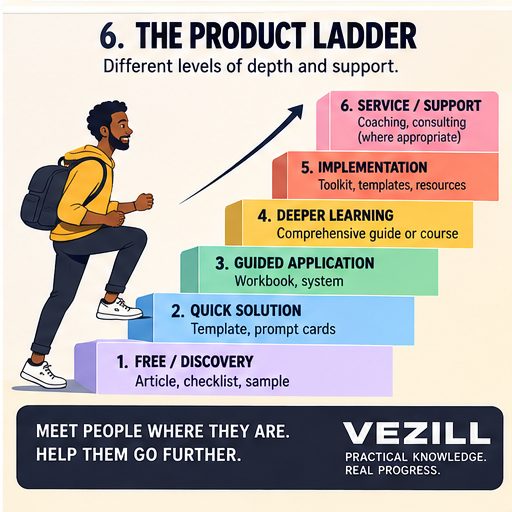
A free article can help discovery. A focused checklist or template can provide a quick solution. A workbook can guide application. A comprehensive guide or course can support deeper learning. A toolkit can support implementation. A service can provide professional help where customization is necessary. Do not cripple a cheaper product merely to force an upgrade; every paid product should fulfill its stated promise.
An Event Shot List, Client Preparation Checklist and Delivery Checklist may belong in a Small Event Photography Workflow Kit if the same buyer naturally uses them together. Bundle when the components serve the same audience and broader outcome.
A GOOD BUNDLE REMOVES MULTIPLE CONNECTED PROBLEMS. A BAD BUNDLE IS JUST A LARGE ZIP FILE.
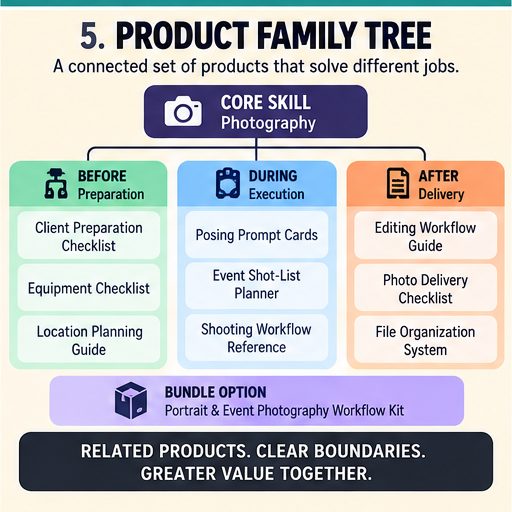
CORE SKILL → AUDIENCE → PROBLEM → KNOWLEDGE ASSET → FOCUSED PRODUCT → RELATED PRODUCT → COMPLEMENTARY PRODUCT → BUNDLE.
For small-event photography: PREPARATION can contain a shot-list planner and client-preparation checklist; DURING can contain posing prompts; AFTER can contain backup, editing and delivery workflows.
Leo decomposes client preparation, equipment preparation, shot planning, posing, editing, delivery and backup. A posing card is used during the shoot; a client-preparation checklist is sent before it; a delivery checklist is used after editing. He avoids creating five duplicates because the jobs, moments and outcomes differ.
Measurement, substitutions, preparation, troubleshooting, storage and experimentation can become different assets. “Complete Baking Ebook Parts 1–4” is weak segmentation if a manuscript was simply cut apart. A troubleshooting decision tree performs a different job from a preparation checklist.
Briefing, typography, layout, approvals, exports and handoff can serve different users. A client brief helps freelancers; a brand-use kit helps small businesses; a review sheet helps junior designers. The same skill base can serve different people without copying the same product.
Document organization, invoice-status tracking, record collection and month-end preparation can become organizational resources. But workflow support is not individualized tax, accounting or legal advice. Professional and jurisdictional boundaries still apply.
A Website Content Preparation Workbook helps clients arrive ready; a Launch Checklist helps designers review a build; a Handover Checklist helps transfer access and documentation. The same skill can create products for the professional and the professional’s customer.
Beginners may need definitions, sequence, examples, worked examples and mistake prevention. More experienced users may need troubleshooting, efficiency and specialized reference. Do not publish three tiers whose content barely changes.
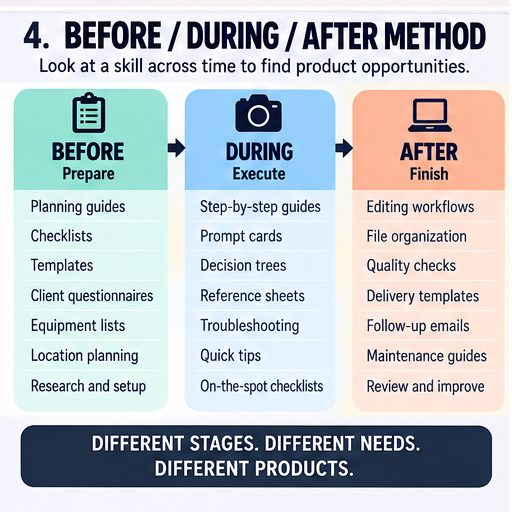
Before: planning, setup, research, materials and checks. During: execution, decisions, scripts, references and tracking. After: review, quality control, delivery, maintenance, analysis and follow-up. For Leo, those become Portrait Preparation Checklist → Posing Prompt Cards → Photo Delivery Workflow.
Repeated mistakes can reveal prevention value. Repeated questions can reveal clusters of confusion. Search behavior can show how people describe problems. None proves demand by itself. Use QUESTION → PROBLEM → OUTCOME → VALIDATION → HYPOTHESIS and SEARCH → INTENT → GAP → VALIDATION → HYPOTHESIS.
Build product #1, observe real users, collect follow-up questions, study searches and usage, identify the next connected problem, validate it, then decide whether product #2 deserves to exist. Buyers may reveal a problem before using product #1, a next-step problem after it, or a related tool they repeatedly need.
YOUR FIRST PRODUCT CAN BECOME RESEARCH FOR YOUR SECOND PRODUCT.
Beginner Photography Guide, Photography for Beginners, Photography Starter Handbook and Learn Photography Fast may be unnecessary fragmentation if all solve the same job. Overlap can create buyer confusion, duplicate purchases and weak positioning. Merge, differentiate, bundle or retire.
PRODUCT A: ________ PRODUCT B: ________
SAME AUDIENCE? YES / NO
SAME PROBLEM? YES / NO
SAME OUTCOME? YES / NO
SAME CONTENT? LOW / MEDIUM / HIGH
USED AT SAME STAGE? YES / NO
COULD ONE REPLACE THE OTHER? YES / NO
WOULD A BUYER UNDERSTAND THE DIFFERENCE? YES / NO
DECISION: SEPARATE / MERGE / BUNDLE / BONUS / FORMAT OPTION / REPOSITION
Do not ask AI for “100 profitable products.” First provide real tasks, workflows, questions, mistakes, templates, decisions, examples and troubleshooting notes. AI can extract assets, group tasks, identify stages and spot overlap. It cannot invent your expertise or prove demand, sales, market size or willingness to pay.
I want to identify multiple useful product hypotheses inside ONE skill I already have.

My skill: [SKILL]
My real experience: [EXPERIENCE]
Tasks I repeatedly perform: [TASKS]
Questions people ask me: [QUESTIONS]
Common mistakes: [MISTAKES]
Workflows: [WORKFLOWS]
Existing templates/checklists/tools: [ASSETS]

PHASE 1: Decompose the skill into foundations, preparation, process, decisions, tools, templates, calculations, mistakes, troubleshooting, quality control, communication, workflow, shortcuts, exceptions and experience-based knowledge. Separate what I supplied from what you inferred. Do not invent expertise.

PHASE 2: Map supported assets across AUDIENCE, PROBLEM, STAGE, OUTCOME and CONTEXT. For each hypothesis give target user, problem, outcome, knowledge asset, best format, why it fits, how it differs, evidence and what must be validated.

PHASE 3: Run an overlap audit and classify ideas as SEPARATE, MERGED, BUNDLED, BONUS, FORMAT VARIANT or DROPPED. Optimize for customer clarity, not maximum product count.
Experience gained through work does not automatically give you rights to sell every document you encountered. Under U.S. copyright law, copyright protects original expression rather than ideas, procedures, methods or systems; work-made-for-hire rules can also affect ownership. Trade-secret protection can apply to valuable information kept secret. Other jurisdictions differ, and contracts matter.
Do not copy employer documents, client files, confidential information, private customer data, licensed course materials, proprietary templates, trade secrets or internal SOPs you do not own.
Medicine, law, tax, financial advice, electrical work, engineering, chemical handling, food safety, mental health and high-risk fitness can require current regulation, qualifications, safety warnings, jurisdiction-specific information or professional review. More knowledge assets do not remove professional responsibility.
Photography, event planning, social media management, design, administration, tailoring, baking, beauty, tourism, web design, CV preparation, small-retail operations, WhatsApp business workflows and content creation can contain practical systems worth examining. An event planner may use a vendor-comparison sheet, responsibility planner, guest-communication checklist, budget tracker and event-day checklist. But a manual or informal workflow is not automatically broken, and local demand must be validated locally.
Evidence that people pay photographers does not prove photographers will buy Leo’s posing cards. Evidence that people seek baking help does not validate every baking worksheet. Each hypothesis needs its own evidence from relevant questions, searches, interviews, alternatives, current spending, workarounds, prototypes or small honest tests.
YOUR SKILL MAY BE VALUABLE. THAT DOES NOT MEAN EVERY PRODUCT YOU EXTRACT FROM IT WILL BE.
SKILL · KNOWLEDGE ASSET · AUDIENCE · PROBLEM · DESIRED OUTCOME · STAGE · CONTEXT · CURRENT ALTERNATIVE · CURRENT QUESTIONS · SEARCH EVIDENCE · EXISTING SPEND · POSSIBLE FORMAT · PRODUCT HYPOTHESIS · OVERLAPS WITH · DISTINCT VALUE · VALIDATION EVIDENCE · ASSUMPTIONS · STATUS: RESEARCH / TEST / BUILD / MERGE / BUNDLE / DROP
Week 1: decompose the skill—tasks, decisions, questions, mistakes, workflows, assets. Week 2: research questions, searches, communities, existing solutions, workarounds and spending. Week 3: map audience × problem × outcome and run the Difference Test and Overlap Audit. Week 4: choose one or two hypotheses to validate, then BUILD, REVISE, MERGE or DROP.
THE GOAL OF 30 DAYS IS NOT TO FILL A STORE. IT IS TO DISCOVER WHICH PRODUCTS DESERVE TO BE BUILT.
ONE SKILL → DECOMPOSE → KNOWLEDGE ASSETS → AUDIENCES → PROBLEMS → OUTCOMES → PRODUCT HYPOTHESES → DIFFERENCE TEST → VALIDATION → PRODUCT #1 → CUSTOMER LEARNING → PRODUCT #2 → PRODUCT FAMILY
VEZILL positions itself around practical digital knowledge: knowledge is the value, the digital product is the container, and the marketplace is the delivery mechanism. When a genuine knowledge asset can responsibly solve a specific problem, it can be packaged for application. Not every asset should be paid; some belong in free information, support documentation, professional advice, a service or another product.
Continue with How to Turn What You Know Into a Digital Product, How to Monetize a Skill You Already Have, How to Turn a Hobby Into a Digital Product, How to Turn Customer Questions Into Digital Products, How to Find Problems People Will Pay You to Solve, and How to Sell Your Knowledge Online. Explore the VEZILL homepage and VEZILL products.
Leo’s notebook no longer says “Complete Photography Guide — 120 pages.” It says PREPARATION, SHOT PLANNING, POSING, FILE ORGANIZATION, EDITING and DELIVERY. Six hypotheses sit underneath. He does not build six. He circles SMALL EVENT SHOT-LIST PLANNER and writes TEST FIRST.
He does not need ten different skills to create ten possible products. He needs to understand one skill deeply enough to see the useful jobs inside it—and enough discipline not to confuse an idea with evidence.
ONE SKILL CAN CONTAIN MANY PRODUCTS. BUT MORE PRODUCTS ARE NOT THE GOAL. MORE USEFUL OUTCOMES ARE.
Decompose the skill into knowledge assets, then match each asset to a specific user, problem and outcome. Validate each distinct hypothesis.
There is no universal number. Create only as many distinct products as evidence supports.
A family contains related products that can stand alone; a bundle packages compatible products together.
Choose the format after defining the job the user needs to do.
Compare audience, problem, outcome, stage, context and content overlap. If one can replace the other, merge or reposition.
Usually validate one or two strong hypotheses first rather than multiplying production before learning.
Prioritize the clearest repeated problem, reachable user, useful outcome and strongest evidence.
Yes, when it is genuinely relevant and each product still delivers a distinct promise without misleading buyers.
Combine products that serve the same audience and are naturally used together for one broader outcome.
AI can organize real experience and spot patterns, but it cannot prove demand or invent your expertise.
Test each hypothesis separately with relevant users, alternatives, behavior, prototypes and other evidence.
Use product #1 as research, identify the next connected problem, validate it, then add a complementary product.
Package each useful piece for a real problem.
EXPLORE VEZILL →VEZILL — Practical Knowledge, Packaged for Action.
Discover more articles you might be interested in

how to create your first knowledge product in one weekend
By Davie

how to find problems people will pay you to solve
By Davie

How to turn a hobby into a digital product
By Davie

How to turn customer questions into digital products
By Davie
Get the updates, on newly released, popular & fast-moving MRR digital products
Up to Top