
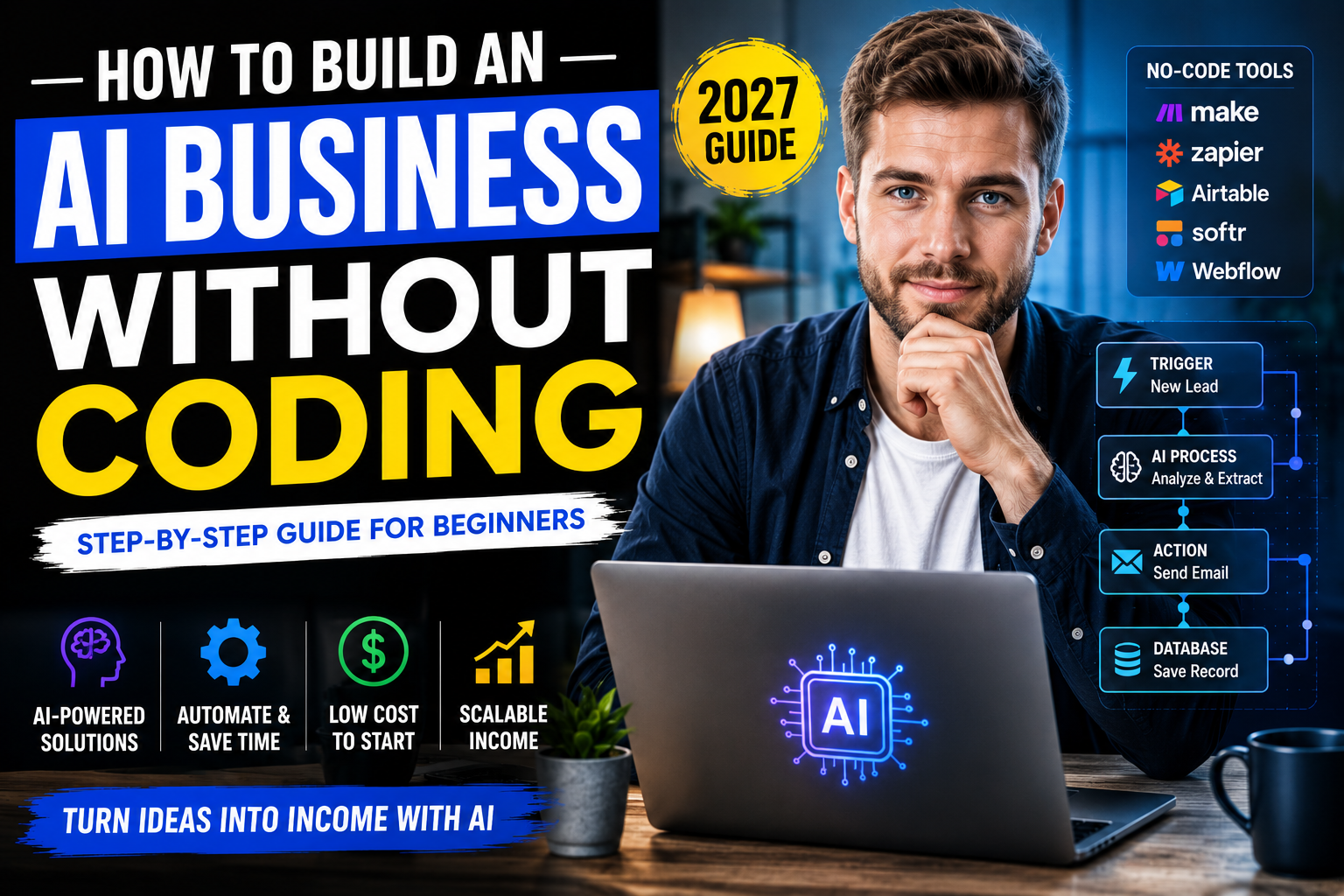
A small business does not need to build its own artificial-intelligence model.
You do not need a machine-learning team. You do not need to become a programmer. And the goal should not be to replace everyone who works in the business with AI.
For most small businesses, the opportunity is much more practical.
Imagine a salon owner who spends every Monday wondering what to post on Instagram. A bakery owner repeatedly answering the same questions about delivery, cake sizes and prices. A cleaning company manually sorting new enquiries. A freelance designer writing similar proposals for every prospect. Or a small online shop with hundreds of product descriptions that need updating.
Those are the places where AI can become useful.
Modern business AI can already help with marketing materials, customer work, data analysis, operations and other everyday tasks. OpenAI now explicitly positions ChatGPT for small businesses around managing customers, preparing reports, creating marketing materials and running operations. (OpenAI)
But there is a second opportunity that many small-business owners overlook.
The experience you gain from running your business can itself become a product.
A baker does not only know how to bake. They may know: how to price a first cake order; how much deposit to request; how to organize orders; how to package cakes; what beginners usually get wrong; how to communicate with difficult customers; how to photograph finished work; how to market locally.
Someone who wants to start a home-baking business may happily learn from that experience.
The baker can therefore use AI in two different ways: Business #1 — use AI to operate and market the bakery more efficiently. Business #2 — use AI to help organize the baker's experience into a guide, template, checklist or toolkit that can be sold digitally to beginners.
That second product can then be distributed through a digital-product marketplace such as Vezill, which currently supports products including ebooks, courses, templates, worksheets, checklists, software, apps, PDFs and planners.
That is the central idea of this guide: use AI to improve the business you already have — and then consider turning what that business has taught you into another digital product.
AI can help small businesses create marketing content, research customers and competitors, draft emails, respond to common enquiries, organize leads, analyze information, create graphics and videos, improve websites and automate repetitive workflows. Business owners can also use AI to organize their real-world expertise into digital products such as guides, templates, checklists and toolkits, which can create an additional revenue stream.
Instead of thinking about hundreds of AI tools, divide your business into five areas.
1. Attract customers — AI can assist with social media, SEO, advertising, content, videos, email campaigns and market research.
2. Convert customers — It can help organize enquiries, draft follow-ups, prepare proposals and summarize sales conversations.
3. Serve customers — AI can answer approved FAQs, retrieve information, categorize support requests and help employees draft replies.
4. Run the business — It can assist with reports, documentation, meeting summaries, research, data analysis and repetitive administrative workflows.
5. Create new revenue — This is where things become especially interesting. AI can help a business owner transform existing expertise into guides, templates, training resources, checklists and other digital products.
Think of the model as: ATTRACT → CONVERT → SERVE → OPERATE → CREATE NEW REVENUE.
 Five areas, one system — most businesses only ever use AI for the first one.
Let's make each part practical.
The problem. Many small businesses know they need to publish consistently, but content becomes another job. The owner wakes up and thinks: "What am I supposed to post today?" Eventually the account becomes a stream of "Buy now," "We are open," "Call us today," "Special offer." That is not a content strategy.
How AI helps. AI can take information already inside the business and turn it into content ideas. Suppose a salon has a real customer transformation. Instead of asking AI "Write me an Instagram post for my salon," give it the actual story: customer problem, service performed, time required, products used, result, aftercare advice, what customers commonly misunderstand.
AI can help transform that one source into: Instagram post → Facebook post → WhatsApp Status → short-video script → email → FAQ → promotional poster copy. That is far more useful than generating random posts.
AI Advantage: speed, variations, repurposing and overcoming the blank page.
Human Advantage: real photographs, customer stories, taste, local language, personality, offers and understanding what customers actually care about. Do not remove those human ingredients.
AI can make content production significantly easier, but "generate 100 articles and publish them" is not a sensible SEO strategy.
A small business can instead use AI to investigate: questions customers repeatedly ask; topics associated with its services; search intent; article structures; FAQs; competing content; content gaps; old articles needing updates.
Imagine a Nairobi web-design company. Potential searches around its customers might include: "How much does a website cost in Kenya?", "Does my small business need a website?", "Website vs Instagram page for a small business", "How long does it take to build a website?" Those questions can become genuinely useful articles. AI can help research and structure them — the company's actual expertise, gained through practical training like Inceptor's Web Design and Coding course, should supply the substance.
Business Reality: AI makes producing words cheaper. That makes experience, evidence, originality and usefulness more valuable, not less valuable.
A customer who has already interacted with your business should not automatically disappear after one purchase. AI can help small businesses build basic email systems around the customer journey.
For example, a bakery might have: New subscriber → Welcome email → Product introduction → Seasonal offer → Birthday promotion → Customer reactivation. An online shop could develop: New customer → Order information → Product-use advice → Related product → Review request → Re-engagement.
AI can assist with subject-line variations, email drafts, calls to action, newsletter ideas, segmentation ideas, promotional campaigns, follow-ups, and reactivation messages.
The important part is giving the model real context. Tell it what you sell, who buys, why they buy, what objections they have, your brand voice, your offer, and what you do not want claimed. Otherwise, you will get generic marketing copy — the same discipline covered alongside broader campaign strategy in Inceptor's Digital Marketing course.
Consider how many times a business answers the same questions. A hotel might repeatedly receive: What time is check-in? Do you have parking? Is breakfast included? Can children stay? A salon might receive: Do I need an appointment? What are your opening hours? Where are you located? How much does this service cost?
A good AI support system can retrieve approved answers, draft responses and direct complicated cases to humans. Current CRM platforms are moving in this direction. HubSpot's AI tooling, for example, now spans marketing, sales and service and includes customer-facing agents and CRM-aware assistance. (HubSpot)
But there is an important boundary. AI answering "What time do you open?" is very different from AI making a sensitive decision about a customer's finances, health, legal situation or major complaint. Use greater human oversight as consequences increase.
Imagine a cleaning company receives enquiries through Website, Instagram, WhatsApp, and Email. Some want residential cleaning. Some need offices cleaned. Some need deep cleaning. Some simply ask for a quotation. Someone has to understand each message and determine what happens next.
A simple AI-assisted workflow could be: Enquiry → classify request → extract contact details → add CRM record → prepare response → notify employee → human approves/sends.
AI can also help with discovery-call summaries, CRM notes, proposal drafts, personalized follow-ups, lead research, and meeting preparation. Notice the wording: help. The business still decides pricing, promises, discounts and unusual customer situations.
Small-business research is often informal. Owners look at competitors' Instagram pages occasionally and try to remember what changed. AI can make that process more systematic.
You could periodically collect information about competitor products, pricing, promotions, customer reviews, frequently mentioned complaints, new services, positioning, and industry developments. Then ask AI to organize it into: WHAT CHANGED → WHY IT MAY MATTER → WHAT WE SHOULD INVESTIGATE.
AI is particularly useful for organizing large amounts of information. It should not automatically determine your business strategy. A competitor lowering a price does not necessarily mean you should lower yours. That decision requires context.
Imagine an online store carrying 300 products. Writing useful product information for every item can become a serious workload. AI can help transform structured product data into descriptions, collection copy, FAQs, comparison information, advertising variations, email copy, and social captions.
One non-negotiable rule: AI must not invent product facts. If a shoe is made from synthetic leather, AI should not decide that "premium Italian leather" sounds better. Provide factual product information first. Then let AI help communicate it.AI-assisted creative tools can help a small company produce campaign concepts, posters, social graphics, thumbnails, product mockups, backgrounds, presentation visuals, and advertisement concepts.
The mistake is believing generation equals design. A professional-looking business still needs consistency in typography, photography, logo treatment, visual hierarchy, brand personality, and product accuracy. A restaurant should not advertise an AI-generated burger that looks nothing like what arrives at the customer's table. Use AI to accelerate creative production — not to misrepresent the product.
Video production is another area where AI has lowered the barrier to entry. A small business can now use AI assistance for parts of the workflow: Business idea → script → storyboard → visuals/footage → voice → editing → captions → human review → publish.
Possible applications include product explainers, promotional videos, training, social clips, demonstrations, educational content, and multilingual versions.
The valuable part is still the underlying message. A beautiful AI-generated video promoting a weak offer remains a weak advertisement.
AI can assist with website structure, headlines, landing-page copy, FAQs, product information, page layouts, basic code, and SEO structure. This means a small business can prototype websites much faster than before.
But distinguish between a simple marketing website and systems handling customer passwords, private data, payments, financial transactions, or complex permissions. AI-generated code is still code. Security-sensitive applications need appropriate testing and expertise — this is exactly the gap that a structured foundation such as Inceptor's Software Development with AI course is built to close.
Some of the least exciting AI applications may produce the most useful improvements. Consider the time businesses spend creating meeting summaries, action lists, SOPs, checklists, internal policies, reports, spreadsheet summaries, invoice descriptions, and training documents.
Suppose an employee explains the company's opening procedure verbally: "First unlock the front entrance, switch on the POS, check yesterday's pending orders, check WhatsApp enquiries..." Instead of leaving that knowledge inside one employee's head, AI can help turn the explanation into a structured Opening Procedure SOP. The employee then verifies it. That creates organizational knowledge.
This is where AI begins moving beyond "write something for me." Traditional automation follows explicit rules: when X happens → do Y. For example: New website form → create CRM contact → email salesperson.
AI becomes useful when the information is less structured. For example: Customer message → AI understands request → categorizes it → extracts details → workflow continues based on category.
Modern business systems increasingly combine AI with connected tools and company data. OpenAI's current business offering, for example, supports connections across operational tools, while CRM platforms such as HubSpot combine AI with customer records and workflows. (OpenAI) Learners who want a structured foundation in this exact combination of automation and AI agents can explore Inceptor's AI, Agents & Automation course.
A good first automation is usually small. Do not begin with "AI will operate my entire company." Begin with "AI will categorize our incoming website enquiries and prepare a draft reply." Then test it.
Use this formula: Repetitive + Time-Consuming + Text/Data Heavy + Low Risk = Good First AI Candidate.
Good candidates include summarizing, drafting, research, FAQs, categorization, meeting notes, content repurposing, reporting, and document organization.
Poor first candidates include unsupervised medical decisions, legal judgments, employee termination decisions, and major financial approvals.
Start with one task. Then: TASK → WORKFLOW → TEAM → BUSINESS.
You do not need 50 AI applications. Try one repeatable weekly system.
Monday — Research: Collect customer questions, reviews, competitor changes and relevant trends. Use AI to organize patterns.
Tuesday — Create: Turn those insights into social posts, email ideas, a blog outline and video scripts.
Wednesday — Publish: Human-review everything, add genuine images or examples and publish.
Thursday — Engage: Respond to customers and leads. AI can assist with drafts, but real conversations should still feel real.
Friday — Analyze: Feed relevant performance data into an appropriate analysis tool and ask what improved, declined or deserves further investigation.
Then repeat. The advantage is not simply that AI writes faster. The advantage is that your marketing becomes a system.
Now we reach the opportunity many small-business owners miss. You may be sitting on valuable information without realizing it.
A baker sees cake orders. AI sees text. A smart entrepreneur sees something else: knowledge accumulated through repeated real-world experience.
A bakery owner may know how to price orders, which equipment beginners actually need, how to collect deposits, how to avoid accepting impossible deadlines, how to package cakes, how to communicate pickup times, how to calculate ingredient costs, and which beginner mistakes waste money.
A salon owner understands booking policies, service menus, customer consultations, pricing, upselling, client retention, and appointment scheduling. A photographer understands client briefs, shot lists, quotations, equipment, locations, delivery, and revisions. A web designer understands website briefs, domains, hosting, pricing, client onboarding, revision limits, handover, and maintenance.
Someone else is currently trying to learn those things. That creates the possibility of a knowledge product.
This is important. Suppose you have operated a home bakery successfully for four years. Could you teach a world-famous pastry chef? Probably not. But that is the wrong customer.
Could you help someone who has baked cakes for friends but has never charged their first customer? Potentially, yes. Think: you → person one or two steps behind you.
A freelancer who has served 30 clients may be able to help someone trying to get their first three. A photographer who has delivered 100 shoots may have useful systems for someone booking their first paid shoot. A restaurant owner may know things someone opening a small takeaway has never encountered.
Your useful experience does not have to make you the world's leading expert. It needs to solve the buyer's problem accurately and responsibly.
| Existing Business | Knowledge You Already Have | Possible Digital Product |
|---|---|---|
| Bakery | Pricing, orders, packaging | Home Baking Business Starter Guide |
| Salon | Pricing, bookings, clients | Salon Starter Toolkit |
| Photographer | Shoots, briefs, clients | Photography Client Kit |
| Restaurant | Menu planning, costing | Menu & Food-Costing Toolkit |
| Freelancer | Proposals, pricing, onboarding | Freelance Client Starter Kit |
| Digital marketer | Content, audits, campaigns | Marketing Planner & Audit Kit |
| Web designer | Briefs, pricing, projects | Website Client Onboarding Kit |
| Teacher | Lessons, revision, planning | Revision Planner & Worksheets |
| Airbnb host | Guest communication, hosting | Beginner Hosting Checklist |
| Cleaning company | Quotes, jobs, procedures | Cleaning Business Starter Pack |
The product does not necessarily have to be an ebook. It might be: template + checklist + calculator + examples. In many cases that can be more useful than 100 pages of theory.
 Experience → Repeated Questions → Beginner's Problem → Digital Product → Online Marketplace.
Here is a practical framework.
Step 1 — Find Repeated Questions. What do people constantly ask you? A photographer may repeatedly hear "How did you get your first clients?" A baker: "How do you know what to charge?" A freelancer: "What do you send a client before starting?" Repeated questions are potential product signals.
Step 2 — Identify the Beginner. Be specific. Not "entrepreneurs." Better: "people trying to start their first home cake business."
Step 3 — Capture Your Process. Write or record what you actually do. Do not worry about making it beautiful. Capture steps, mistakes, examples, decisions, checklists, and scripts.
Step 4 — Choose the Product. Possible formats include PDF guide, checklist, spreadsheet, planner, workbook, template, prompt pack, mini-course, resource directory, or toolkit.
Step 5 — Use AI to Organize It. AI can help group ideas, create structure, identify missing questions, rewrite confusing explanations, generate FAQ candidates, improve formatting, and draft product descriptions. But your experience should remain the source of differentiation.
Step 6 — Package It Professionally. Give it a clear title, attractive cover, useful preview, simple instructions, accurate description, and bonus tools where useful.
Step 7 — Sell It. Now your business knowledge has become an asset.
Suppose Mary has run a home bakery for four years. Customers see cakes. Mary has also accumulated four years of operating knowledge. She decides to create: "How to Start a Home Baking Business: Beginner Pricing, Orders & Customer Guide."
Step 1 — Brain Dump. Mary records a voice note explaining everything she wishes she knew before taking her first order.
Step 2 — Organize. She asks AI to organize the transcript into themes. It identifies: getting started, equipment, costing, pricing, taking orders, deposits, customer communication, packaging, delivery, marketing, and common mistakes.
Step 3 — Find Gaps. She asks AI: "Based on this material, what questions might a first-time home baker still have that I have not answered?" Now she has a research checklist.
Step 4 — Add Reality. This is the most valuable part. Mary adds: "Here is the pricing mistake I made." "Here is the order form I now use." "Here is what happened when I accepted a last-minute order." "Here is my pre-delivery checklist." Now the product contains experience rather than generic AI prose.
Step 5 — Draft and Edit. AI helps turn the material into readable chapters. Mary verifies every factual claim.
Step 6 — Add Tools. She adds an order checklist, customer enquiry template, simple costing worksheet, and order confirmation script.
Step 7 — Design. Turn it into a polished digital guide.
Step 8 — Publish. Now she can sell a product derived from knowledge she already acquired by running her business.
Featured Guide
If you're still on "Business #1" — using AI to run and market the business you already have — this is the practical starting point: a beginner-friendly, 14-chapter handbook on using ChatGPT and modern AI tools to save time, attract more customers, automate repetitive work and grow faster, including a 30-Day AI Business Transformation Plan, checklists and action plans. Written for entrepreneurs, freelancers, shop owners, restaurants, salons and service businesses — no technical background required.
Get the guide →This is where the model connects directly to Vezill. Vezill's current seller page says creators can package and sell digital content across borders, and currently lists supported formats including ebooks, courses/tutorials, video, audio, templates, worksheets, checklists, scripts, software, apps, guides, PDFs and planners. It also distinguishes between creators and traders/resellers.
That makes the marketplace relevant to the experience-to-product model described above. A salon owner, for example, could create a Beginner Salon Business Starter Kit containing a startup checklist, service-menu template, pricing worksheet, client consultation form, booking policy template, and 30-day marketing calendar. The salon owner could then package those resources into a digital listing.
Vezill already publishes a dedicated guide to how to create and sell digital products online, as well as a current workflow for creating digital products with AI. (vezill.com)
And before spending days building the product, validation matters. Vezill's current validation guide — how to find winning digital product ideas before creating them — recommends checking search demand, competitors, marketplace activity and real buyer interest before committing to the full build. (vezill.com)
Once the product exists, creation is only half the job. Vezill also has a separate guide, how to become a top seller on Vezill, focused on marketing digital products rather than assuming uploading alone creates sales. (vezill.com) That distinction matters: product creation ≠ product demand.
Creators who want to package their business knowledge into a properly structured, sellable format can also study the practical, step-by-step approach taught in Inceptor's Digital Product Trading Masterclass with AI.
Ask yourself: Does this solve one clear problem? Can I describe the buyer in one sentence? Is it based on something I genuinely understand? Have I verified factual information? Does it contain something more useful than generic AI output? Does it contain examples? Does it help the buyer take action? Is it easy to use? Is it professionally presented? Does the title clearly explain the benefit? Have I avoided unrealistic claims? Have I avoided copying other people's copyrighted work? Does the buyer know exactly what is included?
If the answer to several of these is no, improve the product before publishing.
This strategy can be summarized simply.
Bakery — Business revenue: cakes. Knowledge-product opportunity: baking-business guide, costing sheet, order templates.
Photographer — Business revenue: photography. Knowledge-product opportunity: beginner photography-business toolkit.
Web designer — Business revenue: websites. Knowledge-product opportunity: website planning templates, freelancer onboarding kit.
Restaurant owner — Business revenue: food. Knowledge-product opportunity: menu-costing template or restaurant startup checklist.
Digital marketer — Business revenue: marketing services. Knowledge-product opportunity: marketing planner, client audit kit, content templates.
The second revenue stream should not distract from the first. Ideally, it comes from knowledge generated by the first.
 Your experience running the business is the asset — the business itself is just one way to monetize it.
These examples illustrate the model; they are not claims about actual businesses or earnings.
Salon. AI helps with content ideas, FAQ drafts and WhatsApp promotion copy. Over time the owner notices beginners constantly asking about salon pricing and booking policies. She creates a Salon Starter Kit containing the systems she has learned.
Restaurant. AI helps organize reviews and identify recurring customer feedback. The owner has years of experience with menus and food costing. He creates a Small Restaurant Menu & Costing Toolkit.
Freelance Designer. AI helps research prospects, draft proposal structures and repurpose portfolio content. The designer notices new freelancers repeatedly asking how client projects work. She packages her workflow into a Freelance Client Onboarding Kit.
Airbnb Host. AI assists with guest-message drafts, listing copy and organizing local recommendations. The host packages accumulated experience into a Beginner Hosting Guide.
Same principle each time: USE AI → LEARN FROM BUSINESS → DOCUMENT SYSTEM → PACKAGE KNOWLEDGE.
There is no single figure. A small business can begin with free or low-cost AI access for individual tasks, while advanced automation may introduce costs for subscriptions, CRM software, automation platforms, API usage, hosting, staff training, implementation, and maintenance.
Some current business products use tiered or usage/outcome-based models. HubSpot, for example, currently offers some AI functionality in its free tier while charging credits for certain agent outcomes. (HubSpot)
Do not judge cost by subscription price alone. Ask: What does this workflow currently cost us in time? How much review does AI output require? How expensive would an error be? Does the tool eliminate work or merely move it somewhere else? Those are better business questions.
Hallucinations. AI can produce plausible but incorrect information. Verify important facts.
Customer privacy. Do not paste sensitive customer information into random tools without understanding how that data is processed. Business-focused AI offerings increasingly provide stronger controls; for example, OpenAI states that its business workspace does not use business data for model training by default and provides administrative and security controls. (OpenAI)
Copyright. Do not use AI as an excuse to copy someone else's ebook, course, photography, branding or proprietary content.
Brand damage. One ridiculous automated response can undo the time supposedly saved.
Over-automation. Customers do not want every interaction to feel like they are trapped inside a machine.
Security. Treat generated code and automated actions according to their potential consequences.
Vendor dependency. Do not make a critical business process impossible to operate if one AI service changes.
The principle is straightforward: the higher the consequence, the greater the human oversight.
The opportunity is especially interesting for businesses operating in mobile-first environments. Think beyond Silicon Valley SaaS companies. Consider salons, restaurants, tourism businesses, online shops, Airbnb hosts, agencies, photographers, tutors, freelancers, small manufacturers, and local service businesses.
For many of these businesses, the first useful AI implementation may not be a sophisticated autonomous agent. It might simply be: WhatsApp enquiry → organize information → prepare response → employee reviews → customer receives answer. Or: customer reviews → AI identifies patterns → owner changes service. Or: one real customer story → social posts + email + video script.
The knowledge-product opportunity is equally important. A Kenyan Airbnb host might create "Beginner Airbnb Hosting Checklist for Kenya." A cleaning-business owner might create "How to Start a Small Cleaning Business in Nairobi." A local photographer might create "First 10 Photography Clients Starter Kit."
Digital distribution means useful local knowledge can potentially reach buyers beyond the owner's immediate physical location. Vezill's seller page itself positions the platform around selling digital content across borders.
Here is a seven-day experiment.
| Business Need | AI Use | Example Tool Category | Human Review |
|---|---|---|---|
| Marketing | Ideas, copy, campaigns | ChatGPT/CRM AI | Yes |
| Research | Market and competitor analysis | Research-capable AI | Yes |
| Drafting and personalization | AI + email/CRM | Yes | |
| Sales | CRM summaries and follow-up | CRM AI | Yes |
| Graphics | Concepts and assets | AI design tools | Yes |
| Video | Scripts, generation, localization | AI video tools | Yes |
| Support | FAQs and triage | Support/CRM agents | Escalation essential |
| Website | Copy, layout, code | AI site/coding tools | Yes |
| Administration | Summaries, SOPs, documents | General AI assistants | Yes |
| Automation | Classification and actions | Workflow/agent tools | Strong controls |
Do not choose software because it appears on an "AI tools" list. Choose the business problem first.
Inceptor Institute offers hands-on, project-based training in AI, Agents & Automation, Software Development with AI, Digital Marketing, and Digital Product Trading with AI — the practical foundation behind almost every use case in this guide.
Explore all courses at Inceptor →AI can help small businesses with marketing, content, research, customer support, sales, administration, data analysis and repetitive workflow automation. It can also help owners organize their expertise into digital products.
There is no universal best tool. Choose based on the task. General AI assistants are useful for writing, research and analysis; CRM AI can assist with sales and customer work; design and video AI can support creative production; workflow tools can automate repetitive processes.
Yes. AI can help generate ideas, repurpose content, draft emails, analyze customer questions, prepare campaigns and organize research. Human review and real business context remain important.
You can use it to assist with research, content, documents, marketing materials, data analysis, planning and other knowledge-work tasks. Current business offerings also support connections with external business tools. (OpenAI)
AI can improve activities involved in customer acquisition — such as research, content, lead follow-up and campaign creation — but it cannot guarantee customers or sales.
Yes. A business can combine AI with workflow systems to classify information, draft responses, summarize data and trigger actions. Start with low-risk workflows and maintain human approval where consequences are significant.
Yes, provided your experience contains something useful and accurate that another person wants to learn. Guides, templates, checklists, spreadsheets, planners and toolkits are possible formats.
Examples include beginner guides, pricing worksheets, client forms, checklists, templates, training materials, planners and business toolkits.
You do not need to be the world's leading expert, but you should genuinely understand what you teach. Avoid presenting yourself as qualified to give regulated professional advice when you are not.
Vezill currently supports creators selling various forms of digital content, including ebooks, courses, templates, checklists, software, guides, PDFs and planners. Review its current seller requirements and product setup instructions before publishing.
AI can automate or accelerate particular tasks, but that does not mean an entire employee role should automatically disappear. Many useful implementations combine AI speed with human judgment, accountability and customer understanding.
It does not have to be. A business can test individual use cases with relatively simple tools before investing in advanced automation. Costs rise with subscriptions, usage, integrations, implementation and maintenance.
The most useful way to think about AI for small business is not: "How can I put AI everywhere?"
Ask two better questions. First: How can AI improve the business I already run? Use it to reduce repetitive work, improve marketing, understand information faster and assist employees.
Then ask: Second: What valuable knowledge has running this business taught me? That question changes the opportunity.
The bakery is no longer only a bakery. It is also years of accumulated knowledge about baking, pricing, orders, customers and operations. The salon is not only a salon. The photographer is not only a photographer. The restaurant is not only a restaurant.
Each business can potentially contain knowledge that can be packaged for someone at an earlier stage. AI makes organizing, researching, editing and packaging that knowledge faster. The owner's experience makes it worth learning. And a digital marketplace can provide a way to distribute it.
The complete progression becomes: Run the Business → Learn From Experience → Document What Works → Package the Knowledge → Sell to Beginners.
That is where AI becomes more interesting than another productivity tool. It can help a small business improve its first revenue engine while helping the owner discover and build a second one.
AI for Small Business is a 14-chapter, beginner-friendly handbook covering everything in the "Business #1" half of this guide, plus a 30-Day AI Business Transformation Plan.
Get the guide on Vezill →Discover more articles you might be interested in
Learn where to find reliable step-by-step guides online, how to choose the right tutorial for your task, check whether it is current and follow instructions safely.
By Davie
Stop searching broad topics and start finding the exact knowledge you need. Learn how to define your problem, search smarter, choose reliable sources, verify answers and take action.
By Davie
Quick Knowledge or an online course? Learn when a focused answer is enough, when structured learning is better, and how to choose the right learning depth for your goal.
By Davie

Learn how to turn one useful digital product into multiple income streams through premium versions, bundles, courses, licensing, services, subscriptions, B2B sales and complementary products.
By Davie
Get the updates, on newly released, popular & fast-moving MRR digital products
Up to Top
Comments All
Fatuma Muhammed
@fatuma_muhammed
I really enjoyed this one. I like how it makes starting an AI business feel less complicated, even if you don’t know how to code. The steps are easy to follow and gave me a better idea of where to start. Definitely a useful read for beginners! 👏
September 05,2026 At 10:40 PM