
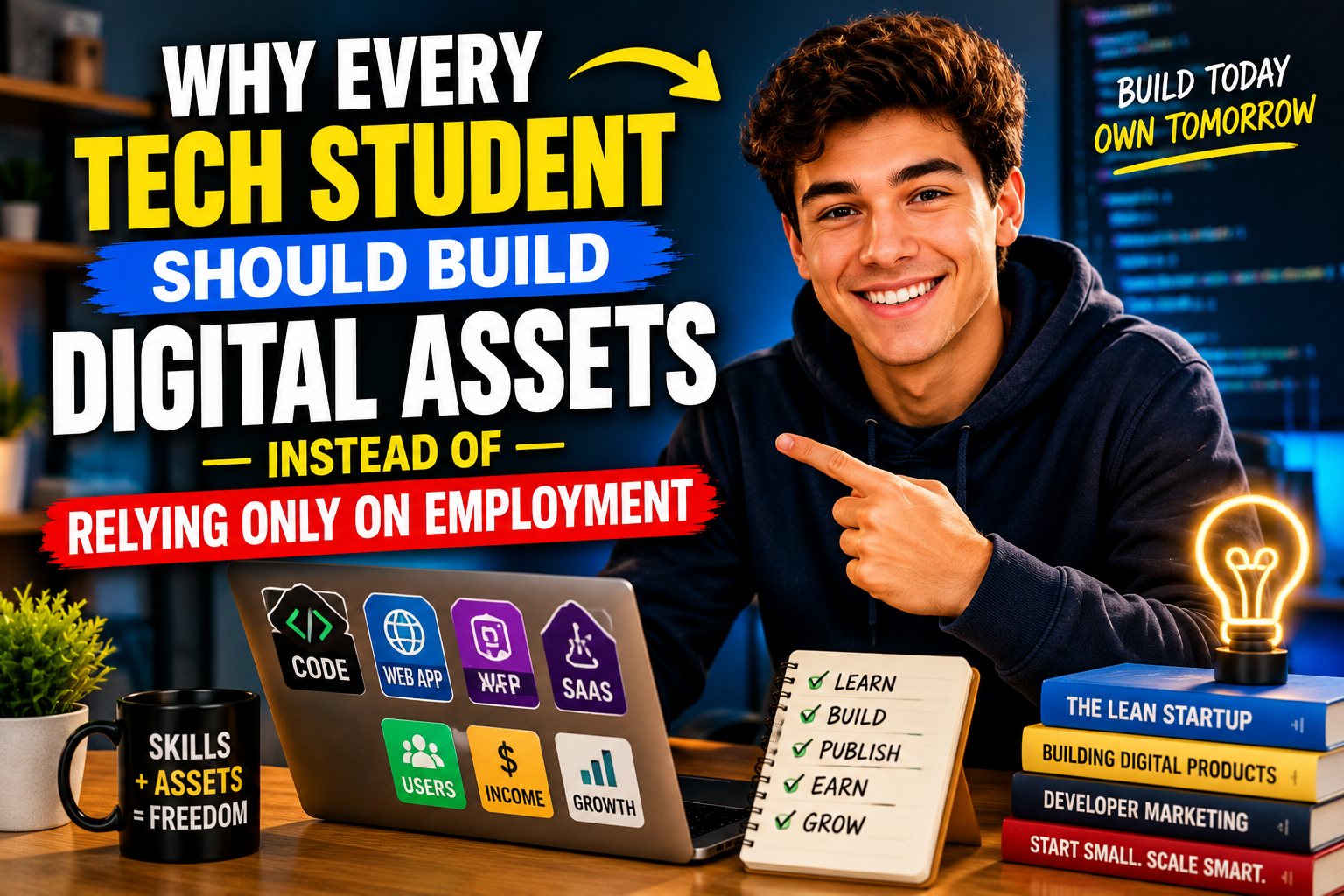
Imagine two computer science students graduating in the same month.
Both have degrees. Both understand programming fundamentals. Both have completed coursework and are applying for entry-level technology jobs.
The first student graduates with a CV, several class assignments and a list of programming languages under “Skills.”
The second graduates with those things too—but also has a deployed web application, a maintained open-source project, a small technical newsletter, a useful template available online and a few real users who have tested something they built.
There is no guarantee the second student will get the job. Employment decisions depend on many factors.
But there is a more important question:
Which student has created more options?
The second student can apply for employment. But they can also attract freelance clients, continue developing a product, demonstrate their abilities publicly, grow an audience, contribute to open source, sell a digital product or potentially turn one of those projects into a business.
That is the idea behind career optionality.
Technology students should still prepare for internships and employment. Jobs can provide mentorship, stable income, teamwork, exposure to production systems and experience that is difficult to reproduce alone.
But a CV should not be the only valuable thing you build before graduation.
A better strategy is: Employment readiness + digital ownership.
The brief for this article deliberately makes that distinction: the goal isn't “employment versus entrepreneurship,” but preparing for employment while accumulating useful things you own — a mindset covered practically in Inceptor's own course catalogue, and packaged into a step-by-step workbook in Vezill's Build Your First Digital Asset as a Tech Student guide.
Tech students should build digital assets because they create owned proof of work that can continue producing value beyond a single assignment or job application. An app, open-source project, template, technical guide, dataset, newsletter or Micro-SaaS can generate learning, reputation, users, customers, portfolio evidence or income. Digital assets should complement—not replace—formal education, internships and employment preparation.
 A tech student building more than a CV — a real, deployed project alongside coursework.
In this article, digital asset does not mean cryptocurrency.
A digital asset is a useful digital resource, product, software project, piece of intellectual property, audience, dataset, system or content library that you create or legitimately own and that can continue creating value after the initial work.
That could be: a mobile or web application, Micro-SaaS, browser extension, API, open-source project, code library, developer tool, website template, UI kit, automation workflow, dataset you have the rights to distribute, technical guide, course, tutorial library, newsletter, blog, YouTube tutorial library, spreadsheet tool, Notion template, digital toolkit, niche directory, or research database.
The word value is important. Not every digital asset needs to make money. An open-source library might create technical credibility. A blog could make you discoverable through search. A free tool could bring potential clients to your consulting business. A newsletter could build an audience. A paid template might produce sales. A Micro-SaaS might eventually generate subscription revenue.
And a technically challenging project may simply make you a better engineer. Those are all forms of value.
Suppose you design a landing page for a client. The normal freelance model looks like: Client → Work → Payment → Project ends. You may get another project later, but the payment was primarily tied to that piece of work.
Now imagine you create a well-designed website template you legitimately own. The model becomes: Build → Publish → Distribute → Improve → Repeated value.
That repeated value could be: sales, downloads, portfolio evidence, leads, GitHub contributions, subscribers, job interviews, licensing, consulting enquiries, or recurring subscriptions.
This does not make digital assets automatically “passive income.” A software product can require hosting, security updates and customer support. A newsletter needs publishing. An open-source project may need maintenance. Templates become outdated. SaaS products have bugs. Courses need updates.
The advantage is not that you never work again. It is that the result of yesterday's work can remain useful tomorrow.
The traditional student career journey usually looks something like: STUDY → GRADUATE → CV → APPLY → WAIT → INTERVIEW → JOB.
There is nothing inherently wrong with this path. A good technology employer can give a graduate things that are difficult to acquire alone: senior engineers to learn from, code review, production infrastructure, teamwork, professional discipline, complex projects, customers at scale, stable income, networks, and career progression.
The weakness is dependence. Until someone selects you, most of your career opportunity sits behind somebody else's hiring process.
Consider a second pathway: STUDY → LEARN → BUILD → PUBLISH → GET USERS → BUILD REPUTATION → CREATE OPPORTUNITIES. And alongside it: APPLY → INTERNSHIPS → JOBS.
You are not replacing one path with another. You are running both.
 Two parallel paths — employment preparation continues alongside asset building, not instead of it.
Software development itself is changing quickly.
GitHub's 2025 Octoverse data reported more than 180 million developers on the platform and more than 1.1 million public repositories importing an LLM SDK. It also found AI-related repositories had exceeded 4.3 million. GitHub says roughly 80% of new users tried Copilot during their first week.
That tells students something important. AI-assisted development is becoming normal.
A student can now use AI to help explain unfamiliar code, prototype, debug, generate tests, research libraries, draft documentation, analyze data, explore UI ideas, refactor code, or create marketing material.
But this creates a paradox. When building becomes easier, more people can build. If almost every student has access to powerful AI tools, merely saying “I know how to use AI” becomes less differentiating.
What becomes more valuable is your ability to: Find a problem → understand users → design a solution → build it → verify it → ship it → distribute it → improve it.
And verification matters enormously. In Stack Overflow's 2025 Developer Survey, 46% of respondents said they distrusted the accuracy of AI tools, compared with 33% who trusted them.
So the future developer is not simply someone who can make AI produce code. They need judgment. GitHub's own analysis of AI-era development similarly emphasizes verification, clearer specifications, testing and stronger guardrails as AI becomes embedded in development workflows.
The opportunity for students is therefore bigger than “learn prompting.” A structured path — like the practical, hands-on modules in Inceptor's AI training course — builds exactly this judgment rather than just prompt fluency. When production becomes cheaper, deciding what to build—and getting it into people's hands—becomes more important.
AI Advantage: Use AI to increase the amount of useful work you can produce—not to lower your standards for what counts as useful. Don't become the student who can generate 10 applications but cannot explain any of them.You do not need to build all of these. Choose one that fits your existing skills and a problem you understand.
| Digital Asset | Difficulty | Main Value | Monetization | Maintenance |
|---|---|---|---|---|
| Micro-SaaS | High | Product + business | Subscription | High |
| Mobile app | Medium–High | Portfolio/product | Ads, paid app, subscription | Medium–High |
| Browser extension | Medium | Utility/product | Paid features/subscription | Medium |
| Open-source project | Medium | Career/reputation | Indirect/sponsorship/services | Medium |
| Developer tool | Medium–High | Technical credibility | License/SaaS | Medium |
| API | High | Infrastructure/product | Usage/subscription | High |
| Website template | Low–Medium | Product/portfolio | Sales/licensing | Low–Medium |
| UI kit | Low–Medium | Product/design proof | Sales/licensing | Medium |
| Automation workflow | Medium | Service/product | Setup/template/service | Medium |
| Technical guide | Low–Medium | Knowledge/product | Sales/leads | Medium |
| Tutorial series | Medium | Audience/knowledge | Course/sponsors/leads | High |
| Newsletter | Low | Distribution | Sponsors/products/services | High |
| Technical blog | Low–Medium | Search/reputation | Leads/affiliate/products | High |
| Dataset/database | Medium–High | Research/data | Access/license | High |
| Digital toolkit | Low–Medium | Product | Sales/licensing | Medium |
The best first asset is rarely the one with the highest theoretical revenue. It is usually something small enough to finish, useful enough for someone to care about, and difficult enough to teach you something. Vezill's own Build Your First Digital Asset as a Tech Student workbook includes a Digital Asset Scorecard built specifically to help you pick between ideas like these.
Micro-SaaS is a small software business designed around a narrow problem or customer group.
Suppose you notice that small landlords struggle to manage maintenance requests. Do not immediately build an enormous property-management platform with accounting, payments, tenant screening, AI agents and 50 other features.
Start with: Tenant submits issue → landlord receives request → issue categorized → status updated → maintenance history stored. The first version could be extremely small.
The customer: Small landlords or property managers. The problem: Maintenance requests disappear across calls, texts and WhatsApp conversations. MVP: One place to submit and track requests. Validation: Talk to landlords before spending months coding. Distribution: Reach property managers directly. Monetization: Potentially a monthly subscription or per-property fee after proving value. Technical risk: Once the product handles authentication, private tenant information, payments, permissions or sensitive records, security and architecture become much more important.
AI can help you build faster. It cannot make those responsibilities disappear — the backend logic, authentication and data-handling foundation for this is exactly what Inceptor's Software Development with AI course is built around.
The Micro-SaaS rule: Problem → Customer → Validation → MVP → Users → Improvement. Not: AI → Code → 47 features → Launch → Nobody uses it.
An open-source project doesn't need to generate direct sales to be valuable.
GitHub reported 1.12 billion contributions to public and open-source projects during its 2025 reporting period, while March 2025 recorded 255,000 first-time open-source contributors.
A good open-source project can demonstrate how you structure code, whether you document your work, how you handle issues, how you review contributions, whether you test, whether you maintain software, and how you communicate technically.
That is different from uploading 20 unfinished university assignments into repositories named assignment-final-final2.
A useful open-source project should solve something. For example: CSV Cleaner for Kenyan SME Sales Reports. Perhaps it detects common formatting problems, standardizes dates, removes duplicate rows, identifies missing fields, and produces a clean export.
Now write a good README. Add examples. Add tests. Explain installation. Respond to issues. You have transformed a programming exercise into public proof of engineering.
Understand licensing. If you open-source your software, understand the license you choose. At a very simplified level: MIT is a permissive license allowing broad reuse subject to its terms. Apache License 2.0 is also permissive and includes explicit patent-related provisions. GPL uses a copyleft model that imposes conditions on distribution of derivative works. That is only a basic orientation, not legal advice. Read the actual license and get appropriate advice when the stakes matter.
Tech students constantly learn valuable information and then discard it after an exam. That is a missed opportunity.
Consider a cybersecurity student learning Linux security fundamentals. They learn the material. Then they practice it. Instead of allowing everything to disappear into old notes, they might create an original: Linux Security Checklist for Beginner Developers.
The process becomes: LEARN → APPLY → DOCUMENT → TEACH → PACKAGE. This can deepen the student's understanding because explaining a concept forces them to confront what they do and do not understand.
Possible knowledge assets include: tutorials, technical articles, cheat sheets, documentation, guides, video lessons, courses, newsletters, and implementation checklists. Students building this kind of security-focused knowledge asset benefit from a structured foundation like Inceptor's penetration testing course or its broader cybersecurity course.
The key is accuracy and originality. Do not copy your lecturer's materials, paid courses, textbooks or copyrighted resources and sell them as your own.
A technology student already has access to potential product ideas through what they are learning. Examples include: computer science — a Git/GitHub beginner cheat sheet; web development — a small-business website starter template; graphic design — a social-media brand kit; cybersecurity — a beginner cybersecurity hygiene checklist; data analytics — a spreadsheet analysis toolkit; AI — a small-business AI workflow starter pack; software engineering — a developer project-planning template; job preparation — a technical interview tracker; UI/UX — reusable interface components.
But remember: Information ≠ Product. You can ask an AI model to produce 100 pages about Python. That doesn't mean you have created something worth buying.
A focused, tested 10-page guide that helps a beginner deploy their first Python application may create far more value than a 100-page generic ebook.
Ask: What can someone do after using this that they couldn't do before? That is a much stronger product question. It's the exact filter behind Vezill's Build Your First Digital Asset as a Tech Student guide, which walks through choosing and validating a product idea before you spend months building it.
One route for packaging that knowledge is Vezill.
Current Vezill material describes digital products including guides, templates, checklists, courses, videos and other downloadable resources, and its publishing material explains uploading products with a title, description, cover, price and product file.
For example, imagine a web-development student who has become good at building simple sites for local businesses. They could create: Small Business Website Starter Kit. It might contain a website planning worksheet, sitemap template, homepage wireframe, launch checklist, SEO basics checklist, and client-content collection sheet.
Instead of trying to sell “everything I know about web development,” the student packages a solution for one person: a beginner trying to build their first small-business website — the same instinct behind Inceptor's Web Design and Coding course.
Featured Vezill Guide
A compact 20-page action guide and workbook built exactly for this article's thesis: one skill → one real problem → one small useful asset. It includes a Digital Asset Scorecard, guidance on validating ideas with real users, a 30-Day Digital Asset Challenge (Find, Validate, Build, Publish), and a fill-in worksheet mapping Skill → Problem → User → Asset → MVP → Features → Distribution → Success Metric → Launch Date. Includes 90% Master Resell Rights.
Get the guide on Vezill →Vezill also currently supports Master Resell Rights for eligible products. Its current MRR guide states that resellers can keep up to 90% per resale, depending on the applicable arrangement. MRR should be treated as a licensing choice—not a guarantee of sales. Product quality, demand, distribution and the exact rights attached to the product still matter.
For a broader walkthrough, Vezill also has a current guide on creating and selling digital products online.
This is the habit I would encourage a tech student to repeat throughout university.
LEARN. Suppose you learn Python. Don't stop at “I completed a Python course.”
BUILD. Use it. Perhaps you create a script that takes messy expense CSV files and turns them into organized monthly reports — the exact hands-on approach taught in Inceptor's Python Programming course.
DOCUMENT. Explain the problem, how your solution works, technologies used, limitations, installation, and examples.
PACKAGE. The same work could potentially become a GitHub repository, tutorial, reusable script, template, technical guide, or portfolio case study.
DISTRIBUTE. Share the appropriate version through GitHub, LinkedIn, technical communities, your website, a blog, relevant social communities, or Vezill if it becomes an appropriate digital product.
Then learn from the response. LEARN → BUILD → DOCUMENT → PACKAGE → DISTRIBUTE → REPEAT.
You are no longer merely consuming education. You are accumulating evidence.
Consider web development. You learn one valuable skill. That skill could eventually create: your portfolio website, a website template, freelance website services, a web-design guide, tutorial videos, a newsletter, a component library, a Micro-SaaS frontend, a beginner course, or consulting services.
So the equation becomes: ONE SKILL → MANY ASSETS → MANY OPPORTUNITIES.
 One skill, many assets — web development alone can branch into eight different opportunities.
This is why students should think beyond certificates. A certificate proves you completed something. An asset can demonstrate what you can actually do with what you learned.
If you still need structured training before building, the current Inceptor course catalogue lists programs including Software Development with AI, Web Design and Coding, penetration testing and digital marketing. Choose training because it fills a real skill gap—not simply to accumulate another certificate.
| Dimension | Employment-Only Prep | Employment + Digital Assets |
|---|---|---|
| Main objective | Get hired | Get hired while creating additional options |
| Income | Primarily employer | Employer + possible independent sources |
| Portfolio | Coursework/personal projects | Public products and maintained projects |
| Ownership | Limited | Own selected projects/IP |
| Mentorship | Potentially excellent | Employer/community/self-directed |
| Large-system experience | Strong potential | Harder to replicate independently |
| Distribution | Usually unnecessary | Important skill |
| Customer exposure | Depends on role | Can be direct |
| Stability | Generally stronger with good employment | Assets can be unpredictable |
| Entrepreneurship | Optional | Learned through building |
| Time required | Already substantial | Higher |
| Career optionality | Concentrated around employment | Potentially broader |
The lesson is not that the right column wins every row. It doesn't. A junior engineer working alongside experienced engineers on a large production system can learn things that building alone may never teach them. The strongest strategy can be both.
Imagine these two lines.
CV claim: Proficient in Python.
Hypothetical evidence: Built and maintained an open-source Python utility for cleaning inconsistent CSV files, documented the project, incorporated user feedback and shipped three improvements.
The second tells an employer much more. It suggests: CODE + DOCUMENTATION + USERS + FEEDBACK + ITERATION.
Notice that it does not need thousands of users. Even a small project can demonstrate execution if it is genuinely useful and well maintained.
A student's portfolio should answer: What did you build? Why? For whom? What technical decisions did you make? What failed? What did users tell you? What did you change?
That is a compelling engineering story.
One of the biggest lessons students can learn early is distribution. You can build excellent software nobody knows exists.
Depending on the asset, distribution might happen through: GitHub, LinkedIn, X, Product Hunt, Hacker News, Dev.to, YouTube, search engines, email newsletters, student communities, Discord, relevant Reddit communities, local businesses, industry groups, or Vezill for digital products.
Do not spam every community with your link. Distribution starts with understanding where the people who experience the problem already spend time.
If you build a scheduling tool for barbershops, 10 conversations with actual barbers may teach you more than posting it to 50 developer communities.
The loop is: BUILD → DISTRIBUTE → LISTEN → IMPROVE. Distribution is not something you “add after building.” It is part of building. It's also a skill explicitly practiced in Inceptor's digital marketing course, which covers exactly this kind of audience-first thinking.
Technology students often enjoy building. That can become a weakness.
It is much easier to spend four months coding than spend four hours hearing potential customers tell you that your idea isn't important.
Suppose you want to create: The Ultimate AI Student Productivity Platform. It includes a timetable, notes, AI tutor, study groups, assignment tracker, flashcards, calendar, marketplace, chat, and social feed.
You spend five months building. Then students don't use it.
A better process: PROBLEM → TALK TO USERS → MANUAL SOLUTION → MVP → FEEDBACK → IMPROVE.
Interview students first. Perhaps the interviews reveal one recurring problem: “I keep losing track of assignment deadlines across different classes.”
Then build a simple assignment tracker. Get 20 students using it. Observe what happens. Maybe that is all they need. Maybe it becomes something larger. Either result is useful.
Compounding does not mean automatic exponential income. It means one asset can make the next asset easier to create or distribute.
Year 1: You publish three excellent tutorials. Year 2: Those tutorials continue attracting some readers. You start a newsletter for those readers. Year 3: The newsletter gives you an audience for a small developer tool or paid guide.
Now your assets support each other. The flywheel becomes: LEARN → BUILD → PUBLISH → USERS → FEEDBACK → REPUTATION → OPPORTUNITIES → BUILD BETTER.
The student starting this process at 19 has time to learn through many small experiments. That is a major advantage.
You do not need a startup worth millions.
A student portfolio might eventually contain: a career asset (maintained open-source project), an income asset (useful digital template), a distribution asset (technical blog or newsletter), a product asset (small software utility), and a knowledge asset (tutorial or guide).
This is often healthier than spending your entire degree secretly building one enormous startup nobody has validated.
Small projects give you more learning cycles. You learn to start → finish → publish → get feedback → improve. Those skills transfer to almost everything else in technology.
Not everything that can be built deserves to exist. Be cautious with:
Build something because a problem deserves solving—not because a technology is fashionable.
Technology students operate in a world of reusable components. That makes licensing important.
Before distributing an asset, understand: copyright, open-source licenses, third-party libraries, API terms, dataset rights, image licenses, trademarks, university policies, client ownership agreements, and software dependencies.
A crucial rule is: Being able to download something does not automatically give you the right to resell it.
Similarly, if you build something during an internship, employment or funded university project, do not automatically assume all intellectual property belongs to you. Check the applicable agreements and policies. Vezill's Build Your First Digital Asset as a Tech Student guide includes a basic IP, copyright and licensing checklist to run through before publishing or selling.
This article is general information, not legal advice.
AI is a genuine force multiplier. GitHub's latest data shows how deeply AI has entered developer workflows, including rapid growth in AI repositories and LLM-SDK adoption.
A student can use AI for research, coding assistance, debugging, test generation, documentation, UI exploration, data analysis, translation, marketing, prototyping, and customer-support drafts. This can dramatically reduce the friction between idea and prototype.
But AI also introduces new failure modes: hallucinated APIs, incorrect explanations, insecure code, weak architecture, privacy problems, licensing uncertainty, overdependence, and generic output.
Remember the Stack Overflow finding: developer distrust of AI accuracy currently exceeds trust.
The correct mindset is therefore: AI should increase the amount of useful work you can produce—not lower your standards for what counts as useful.
Use AI to become a stronger builder. The security-conscious version of this — knowing where AI-generated code introduces risk — is covered practically in Inceptor's penetration testing course.
The internet allows a software asset created in Nairobi, Lagos or Kigali to be distributed far beyond its creator's immediate geography.
GitHub's 2025 analysis specifically identifies developer growth across Africa and projects substantial expansion in communities including Kenya, Nigeria, Egypt and Morocco.
That creates two directions for African students.
Build for the world. A Kenyan developer can create a developer tool, open-source library, website template, SaaS application, or educational product and distribute it internationally.
Build for problems you understand locally. There are also problems that students encounter around them: M-Pesa reconciliation, SME inventory, SACCO workflows, school administration, logistics, agriculture, informal retail, tourism, property management, or local-language software.
Not every problem needs a startup. Some may need a spreadsheet. Others need an API. Some need better training. Others may already have excellent solutions. Research first.
Kenya also has a formal National AI Strategy 2025–2030, placing AI infrastructure, data, talent, research, governance and commercialization within the country's development agenda. That does not guarantee success for individual startups, but it is relevant context for students entering the technology ecosystem.
The opportunity is not “build something because Africa needs technology.” It is: understand a specific problem better than outsiders do, then decide whether technology is actually the right solution.
You don't need to follow this exactly. Think of it as a possible progression.
Year 1 — Learn Publicly. Focus on fundamentals. Build a personal website, GitHub profile, tiny tools and simple tutorials. Goal: learn how to finish things.
Year 2 — Solve Small Problems. Build one useful project, a template, an open-source contribution and your first real client project. Goal: move from exercises to usefulness.
Year 3 — Find Users. Experiment with a Micro-SaaS prototype, a technical newsletter, a digital product and an internship. Goal: learn what happens when strangers use your work.
Year 4 — Consolidate. Aim to leave with some combination of a strong portfolio, two or three maintained projects, public technical writing, customer/user experience, internship experience, potentially one revenue-producing asset, and strong employment applications.
You do not need every item. Quality matters more than quantity.
Here is a realistic student challenge.
At day 90, you should know far more than you knew at day one—even if the project never makes money. This exact 4-week structure (Find, Validate, Build, Publish) is the backbone of Vezill's Build Your First Digital Asset as a Tech Student challenge, complete with a fill-in worksheet to plan it out.
 The digital asset flywheel — each cycle makes the next asset easier to build and distribute.
Score each idea from 1 to 5 across five dimensions: SKILL × PROBLEM × CUSTOMER × DISTRIBUTION × MAINTENANCE.
Ask yourself: Can I build it? Does somebody actually need it? Can I reach those people? Can I maintain it? Can I legally distribute it?
And for a student, add one more question: Will building this teach me something valuable even if it earns nothing?
That changes the economics of experimentation. A failed student product that teaches you authentication, databases, user interviews, deployment, analytics and customer support may still be a valuable investment in your career.
Do not define success as “My SaaS makes $10,000 per month.”
A student digital asset might be successful because it creates: your first paying customer, an internship interview, 100 real users, meaningful open-source contributors, an email audience, useful customer feedback, deeper technical competence, a powerful portfolio case study, your first freelance enquiry, or a recurring product sale.
Different assets have different metrics. A free open-source tool shouldn't be judged by the same metric as a paid template. Define success before building.
There is a dangerous version of online entrepreneurship advice that tells young people: “Jobs are dead. Don't work for anyone. Build your own company.”
That is poor advice for many students.
Working with experienced engineers can teach you production engineering, code review, architecture, security, collaboration, reliability, incident response, stakeholder management, and professional communication.
Employment can also give you stable income while you continue building assets outside work, subject to your employment agreement and intellectual-property obligations.
So the goal is not JOB OR ASSET. It is JOB + ASSETS + SKILLS + NETWORK + OPTIONALITY. That is a much stronger career strategy.
Inceptor Institute offers hands-on, project-based training in Software Development with AI, Web Design and Coding, AI Training, Penetration Testing, Digital Marketing, Python Programming and more — the practical foundation behind nearly every digital asset covered here.
Explore all courses at Inceptor →Put everything together and you get:
LEARN → BUILD → PUBLISH → FIND USERS → GET FEEDBACK → IMPROVE → BUILD REPUTATION → CREATE OPPORTUNITIES → LEARN MORE.
Then repeat.
After several years, the result can be far more valuable than a folder containing certificates. You have accumulated proof.
It is a useful digital resource the student creates or legitimately owns that can continue generating value after the initial work. Examples include software, open-source projects, templates, guides, datasets, newsletters and digital products.
They can provide proof of ability, deeper learning, portfolio evidence, users, reputation, distribution and potentially independent income or business opportunities.
You can do both. Internships and jobs provide valuable mentorship and production experience, while personal digital assets provide ownership and independent proof of work.
Examples include programming guides, developer templates, automation workflows, code utilities, interview planners, website templates and beginner technical toolkits.
Yes, some projects can be sold through subscriptions, licenses, templates, services or digital products. But building software does not guarantee demand or revenue.
Yes. It may create reputation, skills, contributors, networking and career opportunities even if it generates no direct revenue.
Possible routes include freelancing, software products, Micro-SaaS, digital products, templates, technical education and consulting. The best option depends on skill, demand and distribution.
Yes, but keep the scope small and validate the problem before spending months developing it.
AI can assist with research, programming, debugging, documentation, design, testing and marketing. Its output still needs human verification.
Students can use digital marketplaces appropriate to their products. Vezill currently supports various downloadable digital products and MRR-enabled products where applicable, including the step-by-step Build Your First Digital Asset as a Tech Student workbook.
Digital products can technically be distributed internationally, although payment availability, taxes, platform restrictions, licensing and other requirements vary by platform and jurisdiction.
Aim for a small number of finished, useful projects that demonstrate your strongest skills. Two well-maintained projects with real documentation and users can tell a better story than dozens of abandoned repositories.
Your degree is an asset. Your technical skills are assets. Your professional relationships are assets. Your internships and employment experience can become extremely valuable assets too.
But technology students have another unusual opportunity. You can build things that remain yours.
A first-year Python script could eventually become an open-source utility. A design assignment could teach you enough to create a template. A technical subject you master could become a tutorial. A recurring problem you encounter during an internship could inspire a future product—provided you respect confidentiality and IP obligations.
A small product could bring your first user. One user could teach you what to improve. That improvement could become a portfolio case study. That case study could help you get an internship. The internship could expose you to a better problem. And that problem might eventually inspire your next asset.
That is compounding.
So don't graduate able to say only: “I learned Python.”
Try to graduate able to explain: “I learned Python, used it to build something useful, published it, found people who needed it, learned from their feedback and improved it.”
The objective is not to escape employment. It is to avoid having only one path.
STUDY + BUILD SKILLS + GET EXPERIENCE + BUILD DIGITAL ASSETS + CREATE PUBLIC PROOF + DEVELOP DISTRIBUTION = MORE CAREER OPTIONALITY.
That is the mindset worth developing before graduation.
Start This Week
Vezill's Build Your First Digital Asset as a Tech Student gives you the scorecard, validation steps, 30-day challenge and worksheet to actually finish one. Pair it with practical skill-building at Inceptor.
Get the guide on Vezill →Discover more articles you might be interested in
Learn where to find reliable step-by-step guides online, how to choose the right tutorial for your task, check whether it is current and follow instructions safely.
By Davie
Stop searching broad topics and start finding the exact knowledge you need. Learn how to define your problem, search smarter, choose reliable sources, verify answers and take action.
By Davie
Quick Knowledge or an online course? Learn when a focused answer is enough, when structured learning is better, and how to choose the right learning depth for your goal.
By Davie
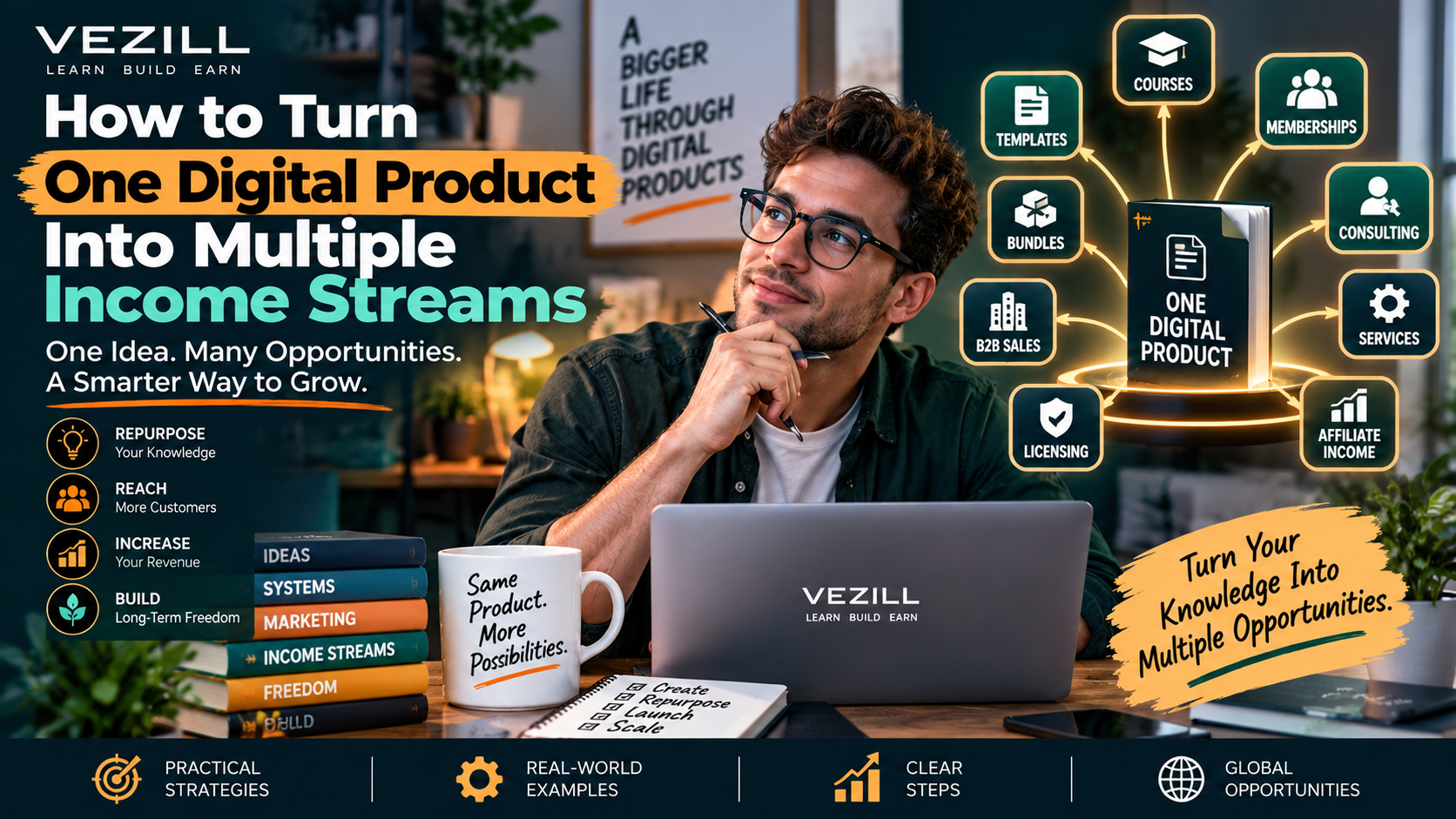
Learn how to turn one useful digital product into multiple income streams through premium versions, bundles, courses, licensing, services, subscriptions, B2B sales and complementary products.
By Davie
Get the updates, on newly released, popular & fast-moving MRR digital products
Up to Top
Comments All
Moses Kuria
@moses_kuria
This really gave me something to think about. I like the idea of not relying only on employment but also building digital assets that can grow over time. The article makes a good point about using tech skills to create something of your own instead of only looking for a job. Very insightful read, especially for tech students! 👏
September 04,2026 At 11:27 PM