

Receiving a job offer should feel exciting. Yet many Kenyan candidates open the email, see a salary lower than they expected and immediately feel trapped: If I ask for more, will they withdraw the offer? If I accept quickly, will I regret it every payday?
Professional salary negotiation is not a confrontation. It is a respectful business conversation about the work, the value you can deliver and the compensation attached to it. You do not need to sound aggressive, disclose every personal expense or issue an ultimatum. You need reliable information, a defensible request and calm language.
To negotiate salary professionally in Kenya, first research a realistic range for the role, industry, location and level of responsibility. Then examine the entire offer—not only the headline salary—and confirm whether the stated amount is basic, gross or estimated take-home pay. Once you have a formal offer, thank the employer, show enthusiasm and ask for a short period to review it. Present two or three specific reasons your experience or skills justify an adjustment, request a clear gross monthly figure and remain open to alternatives such as medical cover, flexible work, training support or a written salary review after probation. Never bluff about competing offers. When an agreement is reached, ensure the revised salary, benefits and start date appear in writing before you resign from another job.
The first mistake is comparing two jobs using only one number. A KSh 100,000 offer with medical insurance, pension matching, predictable hours and a short commute can be more valuable than KSh 115,000 with no cover, expensive daily travel and frequent unpaid overtime.
Ask what the quoted figure means. Basic salary is the fixed pay before allowances. Gross salary generally combines basic pay and applicable regular allowances before deductions. Net salary, or take-home pay, is what reaches your account after statutory and other authorised deductions. If a recruiter simply says “the salary is KSh 80,000,” respond politely: “May I confirm whether that is the basic salary, gross monthly salary or expected net pay?”
As at September 2026, Kenya Revenue Authority information shows PAYE bands ranging from 10% to 35%, with monthly personal relief of KSh 2,400. An employee also generally encounters NSSF, the Affordable Housing Levy and Social Health Insurance Fund contributions. The employee Housing Levy is 1.5% of gross monthly salary, while the salaried SHIF contribution is 2.75% of gross salary, subject to the statutory minimum. NSSF Year 4 rates took effect in February 2026, using a 6% employee contribution across the applicable tiers, with an upper earnings limit of KSh 108,000 and a maximum employee contribution of KSh 6,480. These rules can change, so confirm current figures through KRA, NSSF and SHA before making a financial decision.
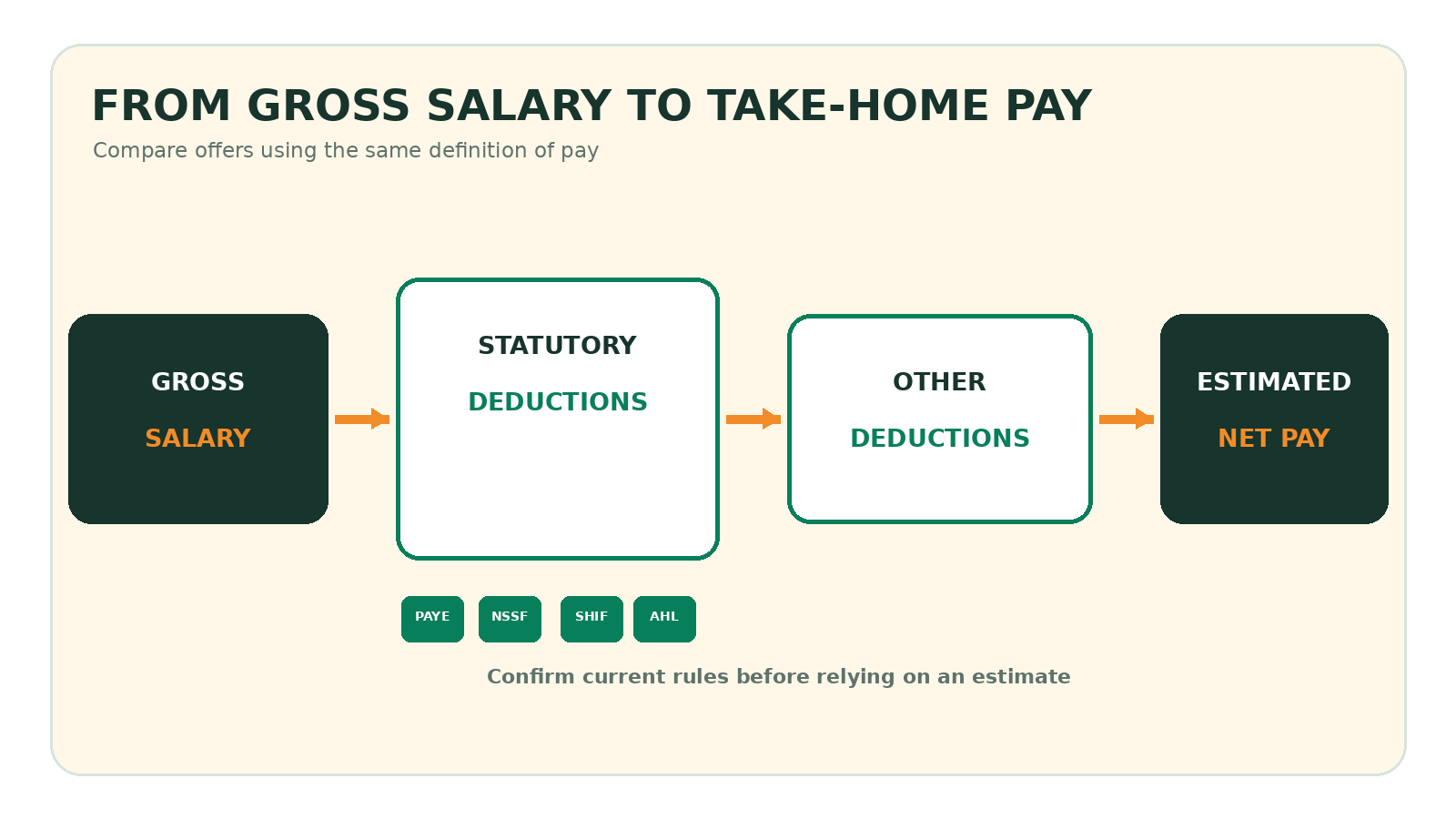 A flow diagram showing gross salary passing through PAYE, NSSF, SHIF, Housing Levy and other deductions to reach estimated net pay
Gross salary is not the same as the amount that reaches your bank account.
Consider an illustrative offer of KSh 100,000 gross per month. Before any voluntary pension, loan, SACCO or insurance deductions, payroll may account for PAYE, NSSF, SHIF and the Housing Levy. The final net amount depends on the current rules, allowable deductions and the employee’s circumstances. The point is not to memorise one take-home figure; it is to compare offers on the same basis and request a payslip simulation when the difference matters.
Also ask about bonuses, commission rules, medical cover and dependants, pension contributions, transport, airtime, meals, remote-work support, paid leave, training budgets and professional certification. If the salary is reviewed after probation, ask whether the review is automatic or performance-based, which targets apply and whether the timing can be stated in the offer letter.
A title alone does not determine fair pay. “Marketing Executive” could describe a junior social-media role at a small business or a regional position managing a large advertising budget. Compare actual responsibilities, required skills, reporting level, years of experience, industry, company size, location and contract type.
Use several signals: recent vacancies with disclosed ranges, recruiter conversations, professional associations, credible compensation surveys, LinkedIn roles and discreet conversations with people doing comparable work. Salary websites can provide clues, but self-reported figures may be old or based on small samples. Treat them as inputs, not verdicts. The broader Kenyan job-search process also matters: a role advertised nationally may have a different budget from a Nairobi-based specialist position or an international remote contract.
Build a three-number range before speaking to the employer:
Do not apply a universal “ask for 20% more” rule. If the initial offer is already near the top of a well-supported range, a modest request or benefits discussion may be appropriate. If the duties are substantially larger than the title suggests, you may have evidence for a stronger counteroffer. Your figure should come from the role—not your rent, loans or desired lifestyle.
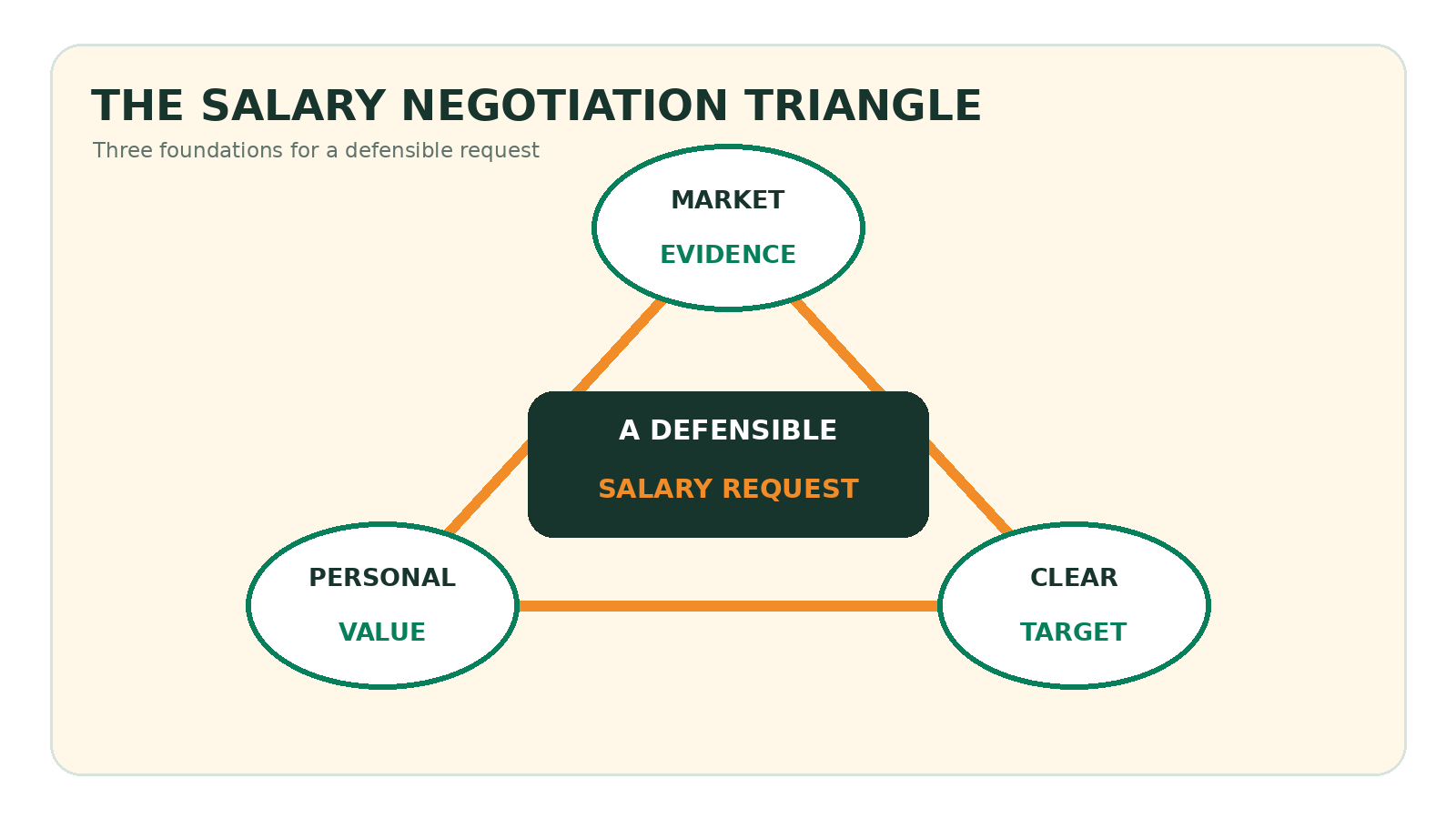 A triangle connecting market evidence, personal value and a clear target to form a defensible salary request
A strong request stands on evidence, value and a specific target.
Leverage is a reason the employer should improve the package, not simply a reason you want more money. Useful evidence includes scarce technical capability, industry knowledge, professional certification, leadership experience, a strong portfolio, a competing written offer or the ability to solve an urgent problem quickly.
Translate your experience into outcomes. “I managed social media” is weaker than “I grew qualified enquiries by 32% while reducing the cost per lead.” “I know Excel” is weaker than “I automated the monthly reconciliation and reduced reporting time from three days to six hours.” If you are unsure which modern capabilities employers value, Vezill’s overview of AI and digital skills for employment can help you identify evidence worth developing.
Training can strengthen leverage only when it becomes usable proof. A marketer might connect a relevant digital marketing course to a campaign case study. An analyst can turn data analytics training into a dashboard that answers a real business question. A developer can pair software-development training with a working application, or use a verified Python programme to create a useful automation. The certificate is supportive; the demonstrated result is persuasive.
Prepare three concise value points. Each should follow this pattern: problem → action → result → relevance to the new role. That keeps the conversation commercial and prevents it becoming emotional.
During an initial screening call, it is reasonable for a recruiter to confirm whether expectations roughly match the budget. You can offer a researched range while asking to understand the role and total package. In the first interview, prioritise fit unless the interviewer raises compensation. Your strongest negotiating position usually comes after the employer has decided that they want you and has made a verbal or written offer.
If asked early, do not become combative or mysterious. Say: “I’m open to discussing compensation. Based on comparable roles, I am currently considering a gross monthly range of KSh X to KSh Y, depending on the responsibilities and complete benefits package. Could you share the approved range for this position?”
Before a final interview, prepare as carefully for compensation questions as you would for technical ones. Knowing how to stand out in a competitive hiring period is useful, but do not let competition pressure you into accepting before understanding the terms.
For an internal raise, use a different moment: after a measurable achievement, when responsibilities expand, during budgeting or ahead of the formal performance-review cycle. Avoid making a surprise demand in a corridor or immediately after a team crisis. Request a focused meeting and give your manager time to prepare.
When you do not yet understand the role:
“I would like to understand the scope and full package before settling on a precise figure. May I ask what range has been budgeted for the position?”
When you have researched the market:
“Based on the responsibilities, my experience and comparable roles, I am targeting a gross monthly salary in the KSh X–Y range. I am open to discussing the complete package.”
When an application form forces one number:
Enter a defensible gross figure within your researched range, then clarify during the interview that it depends on the final scope and benefits. Do not enter an unrealistically low number merely to pass screening.
For a fresh graduate:
“I understand this is an entry-level position. Based on similar roles and the practical projects I can demonstrate, I would be comfortable around KSh X gross, while remaining open to the training, responsibilities and review structure.”
For a remote role:
“For an employee position with the stated responsibilities, I am targeting X in gross monthly compensation. Could we also confirm the employment status, currency, medical cover, equipment, paid leave and whether transfer fees are covered?”
If asked for current salary, you can answer honestly and redirect: “My present package reflects a different scope. For this role, based on its responsibilities and current market evidence, I am targeting KSh X–Y gross.” Never fabricate your pay or a competing offer; a request that depends on deception is fragile.
When the offer arrives, thank the employer and show genuine enthusiasm. Ask for a reasonable review period—often one or two working days—rather than negotiating while surprised. Compare your research, minimum, target and alternatives. Then request a short call or send a concise email.
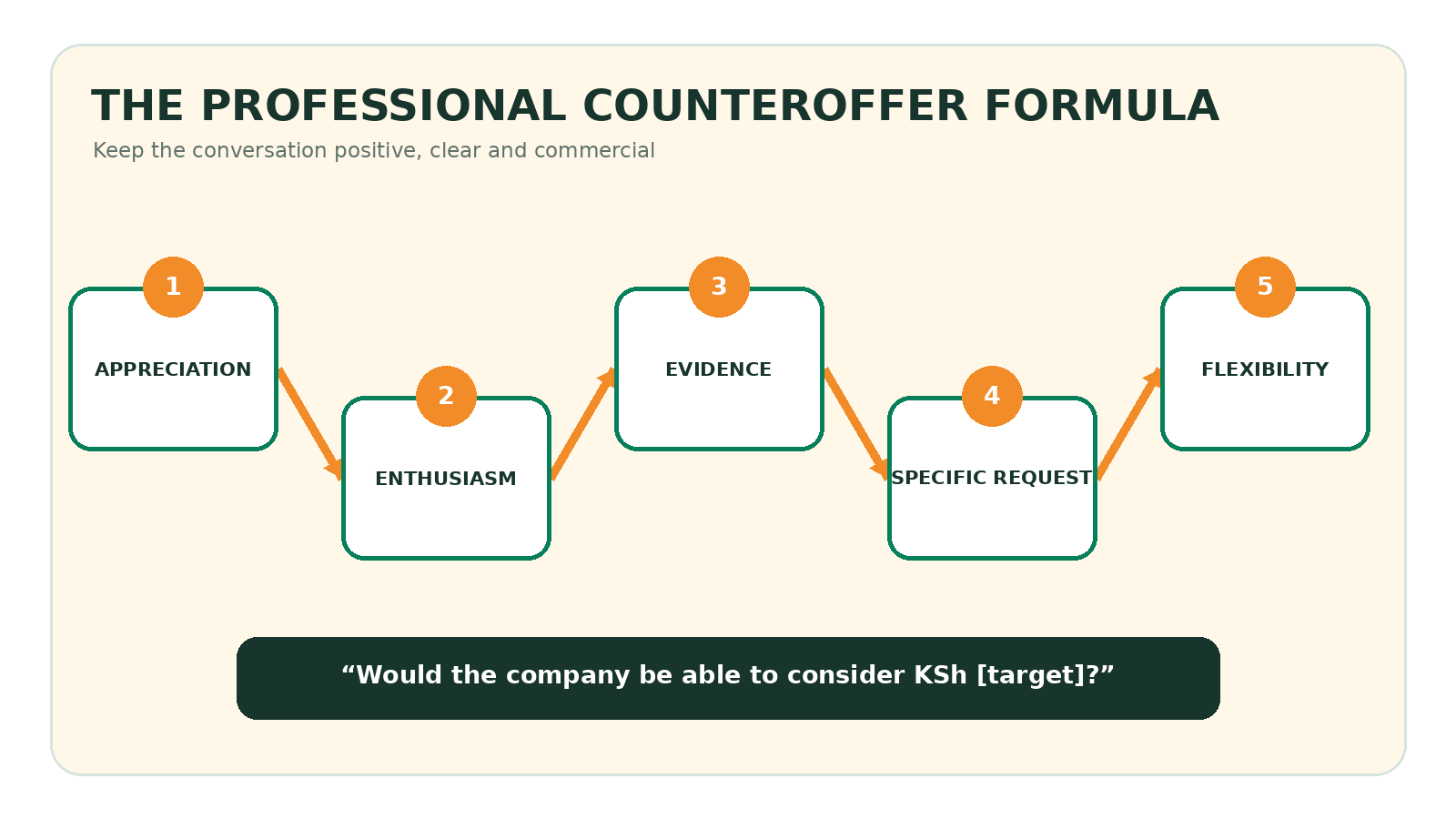 A five-step formula moving from appreciation and enthusiasm through evidence and a specific request to flexibility
A professional counteroffer is positive, specific and evidence-based.
Subject: Discussion of offer for [Role]
Thank you for offering me the [Role] position. I am excited by the opportunity to contribute to [specific priority]. After reviewing the responsibilities and package, I would like to discuss the gross monthly salary. Based on [relevant experience/result] and the market range for comparable work, would the company be able to consider KSh [target]? I remain enthusiastic about the role and open to discussing the complete package. Please let me know a convenient time to speak.
“Thank you again for the offer—I’m genuinely interested in joining the team. I wanted to discuss the compensation. Given the responsibility for [scope] and my experience achieving [result], I was hoping we could move the gross monthly salary from KSh [offer] to KSh [request]. Is there flexibility in the budget?”
Then pause. Do not weaken your own request by immediately talking it down.
“I appreciate the offer and remain interested. The figure is below the range I identified for responsibilities at this level. If the organisation can move closer to KSh [request] gross, I would be more comfortable proceeding. Is that possible?”
“I understand the base budget is fixed. Could we explore medical cover, transport support, flexible working, a training budget or a written compensation review after successful completion of probation?”
“Thank you for revising the package. I’m pleased to accept, subject to receiving the updated written offer showing the agreed gross salary, benefits, start date and other terms.”
Entry-level candidate: A graduate receives KSh 40,000 gross for a junior operations role. Similar vacancies suggest a broad KSh 40,000–50,000 range, and the candidate has completed an internship using the employer’s software. A measured request could be KSh 45,000, supported by the internship and immediate readiness. They should not say the offer is “too small to survive on.” If the employer cannot move, a written six-month review tied to clear targets, medical cover or training support may be a sensible fallback. Graduates can negotiate, but the value of structured experience and mentorship may sometimes outweigh a small immediate difference.
Mid-career professional: A candidate is offered KSh 145,000 gross for work that includes team leadership and regional reporting. Their evidence shows cost savings, successful delivery and a scarce skill, while comparable roles cluster higher. They request KSh 165,000 and explain the business outcomes behind it. If the organisation offers KSh 155,000 plus family medical cover and a performance bonus, they compare the total annual value rather than treating the first number as defeat. Professionals in data, software, design and other digital fields can also study the income options available to data analysts, software developers, graphic designers and web designers when evaluating the opportunity cost of a restrictive offer.
Existing employee: An employee has managed a larger client portfolio for eight months after a colleague left. They document the added accounts, renewal rate, revenue protected and positive client feedback, then request a review meeting. Their opening is: “Since March, my role has expanded to include X and Y. The portfolio retained Z% of clients, and I delivered [result]. I would like to discuss aligning my title and gross salary with the responsibilities I am now handling.” If an immediate increase is impossible, they ask for written targets and a firm review date rather than accepting “we will see later.”
These figures are illustrative. They are not universal market rates or promises of what any employer will approve.
An internal request is strongest when it shows that the job has changed or your contribution has increased. Prepare a one-page evidence file: original duties, added responsibilities, measurable results, positive feedback, new qualifications, credible market signals, the adjustment requested and acceptable alternatives.
Request the meeting professionally:
“Could we schedule 30 minutes to review how my responsibilities and contribution have developed over the past year, and discuss whether my title and compensation remain aligned with the role?”
In the meeting, lead with results, not inflation or a colleague’s rumoured pay. Personal costs may explain why the issue matters to you, but employers usually approve compensation based on role value, retention risk, equity, performance and budget. If a manager needs approval, ask when you should expect a decision. If the answer is no, ask what measurable conditions would justify a review and have the timeline documented.
Building independent projects can improve both your evidence and resilience. The case for building demonstrable digital assets applies beyond students: proof of initiative can strengthen a promotion discussion and create alternatives outside one employer.
A “no” is information, not an invitation to argue. Ask whether the constraint is the salary band, internal equity, timing or your experience level. The reason reveals which alternatives may be realistic.
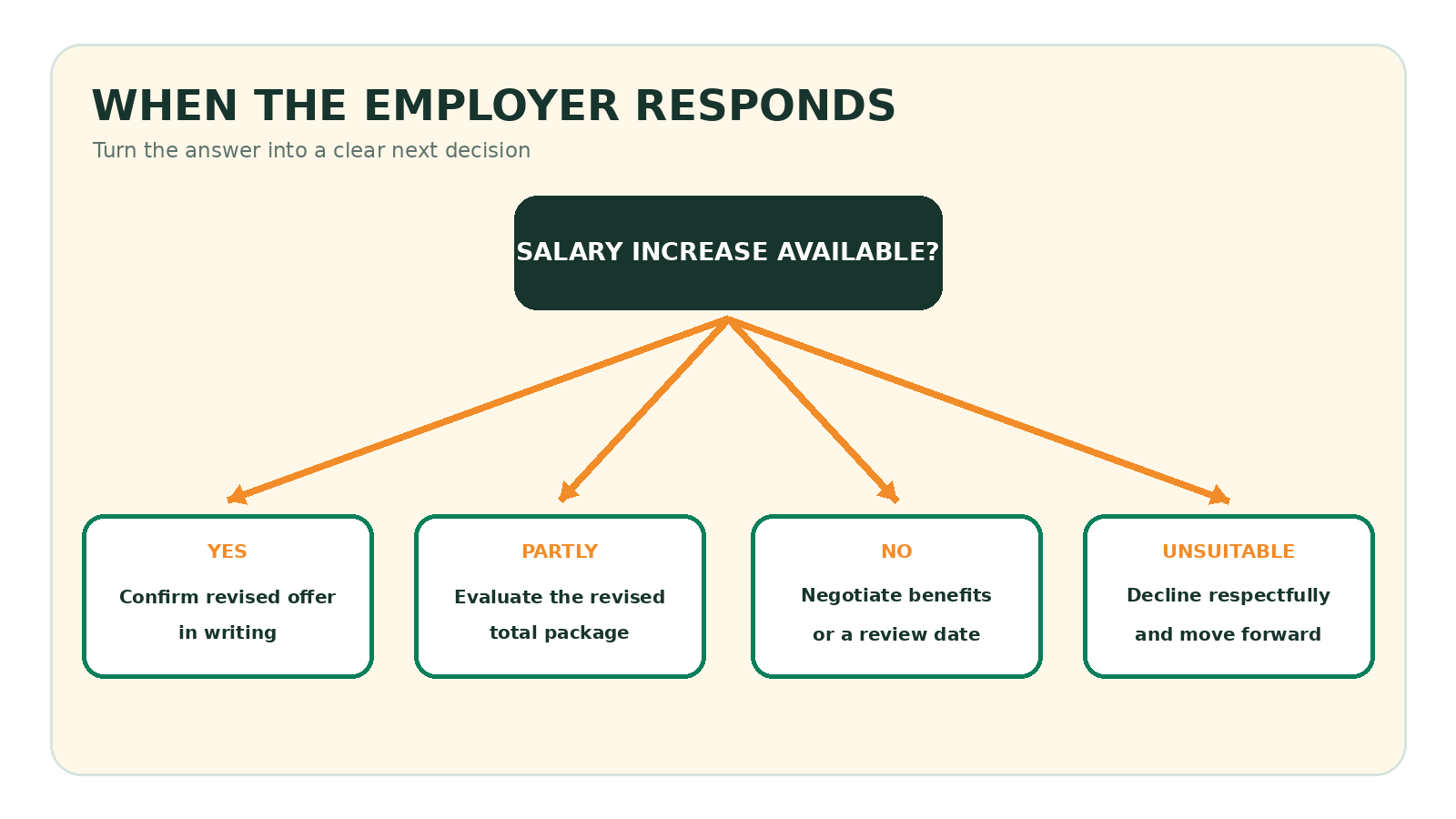 A decision tree showing the options after an employer accepts, partly accepts or declines a salary request
A rejected salary request can still lead to a better package, a review date or a clear decision.
If the employer can move partly, evaluate the revised total package. If base salary cannot change, consider a signing or performance bonus, transport or airtime support, medical cover, extra leave, flexible work, professional training or a written review after three or six months. Make targets specific: “successful probation” is vague unless the criteria are clear.
If the gap remains too large, decline respectfully:
“Thank you for the offer and for discussing the package with me. After careful consideration, I’m unable to accept at the current compensation level. I appreciate the opportunity and hope we can stay in touch.”
Declining is not always the best decision. Consider stability, learning, ethical culture, workload, commute, career progression and the value of experience. For someone between roles, legitimate online income options in Kenya or the flexible ideas available to students who need to earn legally may reduce pressure—but they should not be used to exaggerate your leverage.
An international figure can look impressive until exchange rates, payment fees, unpaid leave and equipment costs are considered. Confirm whether you will be an employee or independent contractor, who handles Kenyan tax obligations, the payment currency, pay date, transfer method, fees, hours, time-zone overlap, leave, medical cover, equipment, internet support, termination terms and intellectual-property clauses.
Ask whether compensation is benchmarked to your Kenyan location, the employer’s country or the value of the role. There is no single correct approach, but you need to understand which one the company uses. Compare the annual net value and risk, not only a converted monthly headline.
Never assume a remote contract gives the protections of formal Kenyan employment. When the sums or clauses are significant, obtain qualified tax or legal advice. If an international employer resists documenting the basics, delays payment details or requests money from you, treat that as a warning sign.
The fastest way to damage a reasonable request is to make it personal or dishonest. Avoid demands without evidence, random figures, invented offers, emotional comparisons with colleagues and ultimatums you cannot honour. Do not negotiate every minor term repeatedly after the organisation has clearly stated its final position.
Other costly errors include forgetting gross-versus-net differences, ignoring statutory deductions, accepting verbally before reviewing the package, resigning before receiving a signed offer and assuming a promised bonus or salary review is guaranteed when it is absent from the contract.
Confidence should sound like clarity: “Here is the evidence, here is my request, and I am open to discussing the package.” It should not sound like entitlement. A thoughtful career plan may include employment, freelancing and asset-building; early-career candidates can build practical proof while learning without pretending to have years of experience.
Yes. A polite, evidence-based counteroffer is a normal professional conversation, especially after a formal offer. An employer may still have a fixed budget, so ask respectfully and remain prepared for either answer.
It is possible, although a reasonable employer is unlikely to withdraw solely because of one respectful request. Reduce risk by showing enthusiasm, avoiding threats and framing the request as a discussion rather than a condition.
There is no universal percentage. Use the offered figure, credible market range, responsibilities, total package and your evidence. Request a specific number you can explain rather than automatically adding 10% or 20%.
Gross monthly salary is usually clearer for comparison, but always label it. Ask the employer to confirm whether its figure is basic, gross or net and request a payroll illustration if necessary.
Yes, particularly when they have internships, scarce skills, strong projects or another offer. However, training, mentorship and a documented review path can be more valuable than pushing beyond a fair entry-level band.
Ask about benefits, flexible work, professional training, a signing bonus or a written review after probation. If the total package still falls below your minimum, decline courteously.
Do not lie. You can explain that your present package reflects a different role and redirect the discussion to the responsibilities and market value of the new position.
Good moments include after measurable achievements, when responsibilities expand, before budgeting or during a formal performance cycle. Prepare evidence and request a dedicated meeting.
A professional salary negotiation rests on six things: reliable market evidence, a clear understanding of the offer, proof of value, respectful communication, realistic expectations and written confirmation. You cannot control the employer’s budget, but you can control how well you prepare and how clearly you speak.
Before your next conversation, write down your researched range, your three strongest value points and one fallback benefit you would genuinely accept. That single page will make you calmer and more precise. Continue sharpening your wider job-search strategy, and use relevant skills training only when it can become real evidence of what you can deliver.
Discover more articles you might be interested in

how to create your first knowledge product in one weekend
By Davie

how to build multiple digital products from one skill
By Davie

how to find problems people will pay you to solve
By Davie

How to turn a hobby into a digital product
By Davie
Get the updates, on newly released, popular & fast-moving MRR digital products
Up to Top
Comments All
Shalline
@shalline
This was such an insightful and practical read, especially for the Kenyan job market. I really liked the reminder that salary negotiation isn’t about being demanding, but about knowing your worth, doing proper research, and confidently communicating the value you bring. The point about looking beyond the basic salary and considering the entire package was also very helpful. Definitely a great guide for anyone preparing for a job offer or salary review! 👏
September 03,2026 At 09:37 PM