
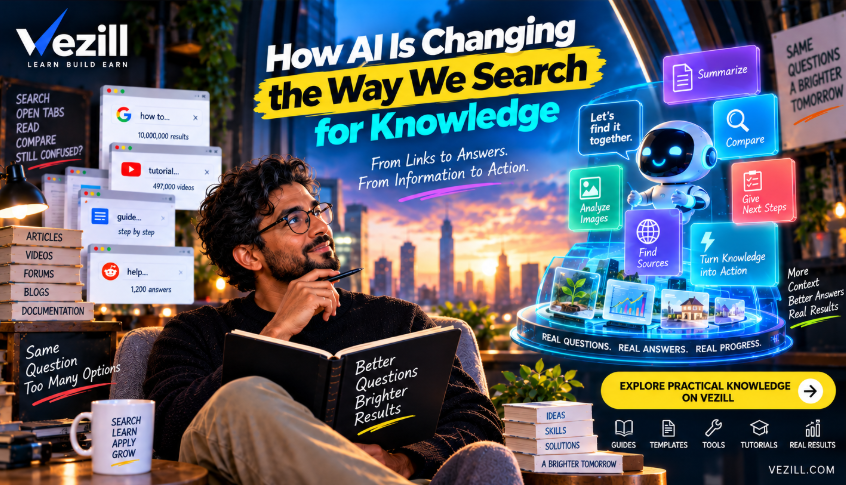
Search is moving beyond keywords and lists of links. AI can help people describe a problem, bring context, compare sources, ask follow-up questions and move toward action. That is powerful—but it makes source judgment more important, not less.
Imagine your tomato plant is flowering but refusing to produce tomatoes. In the older web-search model, you might type “tomato flowers no fruit Kenya”, scan a results page, open several tabs, learn a new term such as pollination or fruit set, change the query, compare explanations and eventually decide what to try.
TYPE QUERY → SCAN RESULTS → OPEN TABS → COMPARE → SEARCH AGAIN
Now ask: “My tomato plant is flowering but not producing fruit. It gets about six hours of sunlight, I am growing it in a container in Nairobi, and daytime temperatures have been unusually warm. What are the most likely causes, what should I check first, and which parts of your answer should I verify?”
The system can potentially interpret the context, retrieve relevant material, organize likely causes, explain terminology, suggest a diagnostic order, cite sources and respond to the next question. The question did not simply become longer. The relationship between the person and the search system changed.
QUICK ANSWER
AI is changing how we search for knowledge by making search more conversational, contextual, multimodal and synthesis-oriented. People can increasingly ask complex questions, provide context, use images or files where supported, request comparisons and continue with follow-up questions. AI can reduce the work of organizing information, but users still need to evaluate sources, assumptions, recency and uncertainty.
“FIND ME PAGES” → “HELP ME UNDERSTAND THIS” → “HELP ME DO THIS”
A useful way to see the shift is through three overlapping eras. This is an original VEZILL explanatory framework, not a formal historical classification. Directory-style navigation, conventional search engines and AI-mediated search all still exist. In the directory era, the path was QUESTION → CATEGORY → WEBSITE. In the search-engine era, it became QUERY → RESULTS → WEBSITE → INFORMATION. In the AI-mediated era, the path can become QUESTION → CONTEXT → SYNTHESIS → SOURCES → FOLLOW-UP → ACTION.
Google reported in May 2026 that AI Mode had surpassed one billion monthly active users globally and that its queries had more than doubled every quarter since launch. Google also says people are asking questions that are closer to what is actually on their minds. That is evidence of changing behavior inside a major search product, not proof that every search is now AI-first. Google's current AI Mode analysis provides the useful context.
 The Three Eras of Knowledge Search — VEZILL editorial framework.
Traditional search taught us to compress a messy situation into a few useful words. That skill remains valuable. AI interfaces can accept a fuller representation of the problem: goal, location, tool, experience level, constraints, examples and what has already been tried.
Compare tomato flowers no fruit kenya with: “My container tomatoes in Nairobi are flowering but not setting fruit. Daytime temperatures have been high. What are the most likely causes and what should I check first?” The second question does not merely contain more words; it represents the problem more accurately.
Many bad searches begin before the search box. The internet may contain enough information, but the question is too broad. VEZILL's guide to finding practical knowledge online makes the same point: define the outcome before hunting for information.
THE SEARCH BOX IS BECOMING LESS LIKE A COMMAND LINE AND MORE LIKE A CONVERSATION. Concise keyword search still wins when you already know the exact page, product, portal or specification you need.
A difficult conventional search often behaves like a chain: query, results, new vocabulary, refined query, another page, another query. AI can keep more of that sequence inside one interaction. You can ask for a simpler explanation, challenge an assumption, add a missing constraint, request a comparison or ask for the primary source behind a claim.
QUESTION → ANSWER → FOLLOW-UP → CLARIFICATION → DEEPER QUESTION → ACTION.
The important change is continuity. The search session can increasingly preserve the problem you are trying to solve. Context retention varies by product and setting, so users should not assume every system remembers everything. The deeper lesson is that search is becoming iterative without requiring the user to restart the problem from zero each time.
Suppose a bakery owner asks, “How do I count customers in Google Sheets?” That is underspecified. Now add: “I run a small bakery in Nairobi. Each customer can appear several times because they make multiple purchases. I want unique customers per month without deleting order rows.” The second version helps distinguish counting transactions from counting unique customers.
QUESTION + RELEVANT CONTEXT = BETTER PROBLEM REPRESENTATION.
But more context does not guarantee a correct answer. AI can misunderstand the sheet structure, infer the wrong date format or suggest a formula that fails on blanks. Context improves the input; verification still tests the output. This distinction is essential because a personalized-sounding answer can still be technically wrong.
Search is no longer limited to typed words. Depending on the product, a user may ask with voice, a screenshot, a photograph, a PDF, another file or a combination of text and visual context. A software error can be shown rather than described. A chart can be uploaded and questioned. A plant can be photographed. A document can become the object of a search-like conversation.
This also creates a privacy obligation. Before uploading screenshots, logs or files, remove passwords, API keys, customer records, private identifiers and confidential material. A richer query can also be a richer data disclosure. Multimodal search is useful because some problems are easier to show than describe, but visual confidence should not be mistaken for diagnostic certainty.
 AI Is Expanding What Can Count as a Query — VEZILL editorial framework.
Classic web search is excellent at locating sources. Generative AI adds another layer: it can compare, summarize, organize and explain material retrieved from different places. Instead of opening five articles about invoicing and building your own comparison, you can ask for three approaches organized by setup cost, complexity and payment tracking.
That can save reading and sorting time. It also creates new failure modes. A synthesis may omit disagreement, flatten nuance, combine facts from incompatible contexts, misunderstand a source or present an uncertain inference with confident prose.
SYNTHESIS REDUCES READING WORK. IT INCREASES THE IMPORTANCE OF SOURCE JUDGMENT.
OpenAI's current ChatGPT Search guidance explicitly says search results and citations can be incomplete, outdated or incorrect. It recommends opening citations, checking that they support the answer and using authoritative sources when accuracy matters. OpenAI's current source-checking guidance should be treated as part of AI search literacy, not an optional extra.
Information retrieval is a technical field with a precise history, so it would be misleading to casually redefine it. Editorially, however, we can describe a new user experience as knowledge navigation: the person is not merely locating a document; they are navigating from a goal through questions, sources, explanations and decisions.
DOCUMENT-FINDING VIEW: QUERY → DOCUMENT.
VEZILL KNOWLEDGE-NAVIGATION VIEW: GOAL → QUESTION → SOURCES → SYNTHESIS → UNDERSTANDING → NEXT QUESTION → ACTION.
The distinction shifts attention from “Did I receive an answer?” to “Do I understand enough to choose the next reliable step?” That is a better measure for practical knowledge because the final objective is not information possession. It is useful movement.
Beginners often face a search paradox: the best search terms are the terms they have not learned yet. Someone may ask, “What is the thing on a website that remembers whether I logged in?” A useful AI explanation can introduce sessions, cookies and authentication tokens, explain that they are related but not interchangeable, and help formulate the next search.
Exact keywords, quotation marks, site restrictions and technical operators remain useful. The change is that imperfect vocabulary is less of a dead end. AI can act as a bridge from the user's language to the field's language.
AI CAN HELP YOU DISCOVER THE WORDS YOU DIDN'T KNOW YOU NEEDED TO SEARCH FOR. That is especially valuable in unfamiliar technical, academic and professional domains where vocabulary itself is part of the knowledge gap.
The same interface can support different depths of work. Level 1 is “answer my question.” Level 2 is “explain this.” Level 3 is “compare these.” Level 4 is “research this.” Level 5 is “help me decide.” Level 6 is “help me do it.”
The risk is assuming that a more sophisticated interaction is automatically more trustworthy. It is not. As the interaction becomes more consequential, verification should become stronger. Comparing note-taking apps is not equivalent to a tax decision. A recipe substitution is not equivalent to a medication decision. Sophistication can increase usefulness, but it should also increase awareness of evidence, assumptions and consequences.
The old expectation was simple: give me relevant results. AI interfaces raise the expectation: understand what I mean, explain it, compare options, retain relevant context, show sources, tell me what is uncertain and help me decide what to do next.
Google's 2026 description of AI Mode explicitly frames it as bridging conventional search and conversational AI. Its usage analysis says people are asking questions closer to what is actually on their minds. That is a product shift and a literacy shift. Users need to learn not only how to formulate questions but also how to interrogate answers.
A strong AI search user does not merely ask better prompts. They know when to open the source, when to narrow the context, when to ask for disagreement and when to stop searching and act.
It is tempting to tell a dramatic story in which AI “kills Google” or makes websites irrelevant. The evidence does not justify that conclusion. AI search depends on an information ecosystem containing original reporting, research, official documentation, businesses, communities, databases, creators, expert knowledge and structured resources.
Google continues to surface web links in AI search experiences, and ChatGPT Search exposes citations and sources. The interface may change, but provenance still points outward.
AI CAN BECOME THE INTERFACE. THE WEB REMAINS PART OF THE KNOWLEDGE INFRASTRUCTURE.
The more an AI system synthesizes, the more important it becomes that high-quality original sources continue to exist underneath the synthesis.
AI answers intensify a long-running web tension. A user wants the useful part immediately. A publisher, researcher, journalist, creator or business needs a reason to invest in producing the underlying information. When a system can synthesize an answer before a click, attribution, referral traffic and value exchange become harder questions.
USER: ANSWER NOW. PUBLISHER / CREATOR: REASON TO CREATE THE KNOWLEDGE.
There is no honest one-line solution. Platforms are experimenting with links, source controls and publisher relationships; creators are adapting toward original data, distinctive expertise, tools and resources that remain useful beyond a summary. The unresolved question is economic as much as technical: if AI becomes better at answering without requiring a visit, how does the web continue rewarding the people and organizations that create the knowledge?
A fluent AI answer can feel complete even when its evidence is weak. That makes provenance a core skill. Before acting on an important answer, ask: Where did this claim come from? Is the source primary? Is it current? Does it actually support the sentence? Are important sources missing? Is the advice location-specific? Do credible sources disagree? What happens if it is wrong?
WHEN AI MAKES ANSWERS EASIER TO CONSUME, SOURCE LITERACY BECOMES MORE IMPORTANT TO LEARN.
For a low-risk orientation question, one explanation may be enough to start. For software configuration, check current documentation. For tax, legal, health, finance, electrical, cybersecurity or other high-consequence decisions, move toward responsible authorities and qualified professionals. The cost of being wrong should determine how deeply you verify.
 The Source Layer Becomes More Important, Not Less — VEZILL editorial framework.
AI-mediated search can potentially use context such as the current conversation, location, user-provided files, explicit preferences or connected data when the user has authorized access. That can make the same question more useful. “Help me plan this report” changes when the system can see the report the user intentionally supplied.
Personalization also creates risks: incorrect assumptions, stale preferences, privacy trade-offs and answers that become too narrowly fitted to what the system thinks the user wants. Not every AI search product remembers the same information. Users should not assume that context or connected data is available unless the product makes that clear, and they should correct wrong assumptions quickly.
Another 2026 shift is from finding information toward helping accomplish an objective. Google announced new agentic capabilities in Search in May 2026, describing a Search experience that can use agents when a user asks for help. Google's I/O 2026 Search announcement matters because it moves the product conversation beyond answer generation.
A possible flow is GOAL → PLAN → SEARCH → COMPARE → USE TOOLS → REQUEST USER DECISION → ACTION.
This does not mean every AI system can autonomously complete every task, nor should it. Permissions, payment, identity, safety, availability and user approval all matter. The direction is still significant: search is being designed not only to answer what, but increasingly to assist with what next.
This is where the distinction between information and practical knowledge becomes useful. Search can find information. AI can help organize and explain it. But many real outcomes require something more structured between knowing and doing.
An AI might correctly tell a small-business owner, “You need a monthly cash-flow forecast.” Producing one may still require categories, formulas, assumptions, spreadsheet structure, examples, instructions and checks. The answer identifies the need. A spreadsheet template, guide or worked example helps operationalize it.
AI CAN HELP YOU FIND OR EXPLAIN KNOWLEDGE. SOMETIMES YOU STILL NEED A RESOURCE THAT HELPS YOU APPLY IT.
This is why a strong step-by-step guide needs more than a numbered list: it should match the task and starting state, expose prerequisites and include checkpoints so the user can tell whether the process is working.
VEZILL should not be positioned as a replacement for Google, ChatGPT, official documentation or full courses. Those solve different problems. Search helps discover. AI can help question, synthesize and explain. Official sources establish authority. Courses build broader capability. VEZILL's role is narrower: helping people discover practical knowledge packaged for application.KNOWLEDGE IS THE VALUE. DIGITAL PRODUCTS ARE THE CONTAINER. THE MARKETPLACE IS THE DELIVERY MECHANISM.
A useful resource might be a guide, spreadsheet, template, checklist, tutorial, prompt system, calculator or toolkit. VEZILL's About page describes the buyer cycle as FIND → APPLY → RESULT, while the FAQ describes Quick Knowledge as focused practical information for a specific task, problem or outcome. When the task is already clear, users can browse practical knowledge on VEZILL.
Generative AI makes explanations cheaper to produce and easier to request. That does not automatically make every explanation good. It changes where value can sit. A user asking “How do I make a budget?” may still value a tested spreadsheet. Someone asking how to onboard clients may need an SOP, checklist and email templates. A freelancer learning pricing may need a calculator and decision framework, not another paragraph about “charging your worth.”
One plausible knowledge-value shift is: OLD SCARCITY — ACCESS TO INFORMATION. SEARCH ERA — FINDING THE RIGHT INFORMATION. AI ERA — TRUST + CONTEXT + SYNTHESIS + APPLICATION.
This is analysis, not an established economic law. But it suggests a useful creator question: what can you organize, verify or operationalize better than the raw internet? VEZILL's article on identifying valuable knowledge you already have starts from repeated problems, questions, mistakes and processes rather than content volume.
WHEN ANSWERS BECOME CHEAPER, USEFUL STRUCTURE CAN BECOME MORE IMPORTANT.
AI search works best when the user treats it as a process rather than a magic answer box.
1. DEFINE THE OUTCOME. State what you are actually trying to accomplish.2. GIVE RELEVANT CONTEXT. Add the tool, location, level, constraints and what you tried.3. SET THE SOURCE STANDARD. Ask for current primary or official sources where the task requires them.4. ASK WHAT IS UNCERTAIN. Identify assumptions and claims that need verification.5. OPEN IMPORTANT SOURCES. Do not stop at the generated summary when accuracy matters.6. APPLY. Try the next safe action instead of collecting endless answers.7. CHECK. Compare the expected result with what actually happened.8. ESCALATE. Use deeper learning, official support or a professional when consequence or complexity rises.DEFINE → CONTEXT → ASK → SOURCE → VERIFY → APPLY → CHECK → ESCALATE.
 The VEZILL AI Knowledge Search — VEZILL editorial framework.
AI does not make every search better. A conventional search or direct website visit is often the shortest path for navigational queries such as “KRA iTax login,” a known destination such as “VEZILL,” an exact product specification, an official policy page, current breaking reporting or documentation you already know exists.
If you know the source you need, do not create an unnecessary synthesis layer between you and the source. For a simple fact, an AI explanation may add complexity without adding value.
AI DOES NOT MAKE EVERY SEARCH BETTER. SOMETIMES THE SHORTEST PATH IS STILL THE LINK YOU ALREADY NEED.
AI search becomes particularly useful when the problem is ambiguous, vocabulary is unfamiliar, the question has several parts, context changes the answer, multiple sources need comparison, technical material needs translation, or troubleshooting requires repeated follow-up. It can also help a beginner turn a broad topic into smaller searchable questions.
The key is task-source fit. Quick Knowledge and full courses solve different learning depths; similarly, AI search and conventional search solve different discovery problems. Use the interface that removes the most friction without removing necessary verification.
Search increasingly appears inside browsers, AI assistants, operating systems, productivity software, ecommerce experiences, cameras, voice interfaces and file workflows. A person may search without consciously “going to a search engine.” The function is becoming embedded in the place where the question appears.
That does not mean the standalone search engine disappears. It means search becomes both a destination and an infrastructure layer: sometimes you visit it; sometimes it comes to you. This matters for knowledge creators because discovery can now happen far away from a conventional results page.
The weakest creator response to AI is to publish more generic information simply because AI can produce it quickly. The stronger question is: what useful knowledge can I organize better than the raw internet?
That may be original expertise, local knowledge, a tested workflow, spreadsheet, calculator, decision aid, checklist, SOP, dataset, set of examples or verified niche procedure. The resource should earn its existence by reducing uncertainty or work for the user.
VEZILL's creator model is useful here: KNOW → PACKAGE → SELL. Packaging should not mean decorating copied information. It means turning legitimate knowledge into something another person can understand and apply. Browse VEZILL practical knowledge to see the kinds of digital containers the platform supports.
For years, SEO could tempt publishers into thinking page production was the goal. AI search increases the pressure to create material worth retrieving, citing, visiting or using. That favors original information, first-hand expertise, transparent sourcing, useful tools, clear authorship, unique data, structured explanations and strong task satisfaction.
No publisher can guarantee that a page will be recommended by ChatGPT, Google AI Mode or another AI system. The sensible strategy is more fundamental: create a resource that deserves to be a source, make its claims understandable, keep it current and make the next action useful.
Better AI queries do not need to be long. Add only the context that changes the answer.
| Goal | Traditional | Better AI Search |
|---|---|---|
| Excel | Excel percentage formula | Old price B2, new price C2: show percentage change and explain negatives. |
| WordPress | WordPress spacing broken | Extra space appears on mobile only. What should I check before CSS? |
| Tomatoes | tomato no fruit Kenya | Container tomatoes in Nairobi are flowering but not setting fruit. What should I inspect first? |
| CV | good CV | Review this CV for an entry-level support role. Identify weak evidence; do not invent experience. |
| Interview | interview questions | Use this job description to create five behavioral questions and score my answers. |
| Budget | make budget | I have irregular income. Help me structure fixed costs, variable costs and a buffer. |
| Registration | register business Kenya | Find the current official Kenya source and separate requirements from explanation. |
| Canva | Canva print PDF | I am sending an A4 flyer to a printer. Which export settings should I confirm? |
| SEO | website SEO problem | My page is published but not appearing in Google. Give a diagnostic order. |
| Python | Python KeyError | Explain this pandas KeyError, ask what columns exist, then suggest the smallest fix. |
| Cooking | rice too wet | My rice is cooked but too wet. What can I do now without making it mushy? |
| Fitness | workout plan | What information would a qualified trainer need before a beginner strength plan? |
| Photography | blurry night photos | Explain how shutter speed, ISO and stabilization interact at night. |
| Power BI | Power BI wrong total | My measure is correct per row but total is wrong. What context issue should I test? |
| Ecommerce | checkout drop off | Give a checklist to diagnose checkout abandonment before changing pricing. |
| low open rate | Open rate fell after a list import. What deliverability checks come first? | |
| Service | angry customer reply | Draft a calm late-delivery reply without promising an unapproved refund. |
| Freelancing | freelance price | Help define scope, assumptions, revisions and exclusions before price. |
| Study | learn statistics | I understand mean and median but not standard deviation. Explain, then quiz me. |
| Phone | phone battery bad | Battery drains overnight even in airplane mode. Give safe checks and escalation. |
A plausible statement may be invented. Ask for sources and check consequential claims.
A real source may not support the exact claim. Open the citation.
The answer may ignore a primary source or important opposing evidence.
Software, law, pricing and policies change. Ask for dates.
Fluent wording can hide uncertainty. Ask what assumptions drive the answer.
The system may misunderstand country, version or starting state.
A leading question can encourage one-sided synthesis. Ask for disconfirming evidence.
Remembered or inferred context may not apply. Correct it explicitly.
Precise numbers or procedures can be wrong. Precision is not proof.
Summaries can erase caveats. Read primary material for important decisions.
Repeated weak sources do not become strong evidence because AI summarizes them.
AI is making some search experiences more conversational, contextual and synthesis-oriented, with fuller questions, follow-ups and multimodal inputs.
There is no good basis for assuming complete replacement. Search engines are integrating AI while conventional results and direct websites remain useful.
It depends on the task, and Google itself includes AI search experiences. Direct search, AI synthesis and official sources each have strengths.
It lets users refine a question through follow-ups while the system uses relevant context from the interaction.
It uses machine learning or generative AI to interpret queries, retrieve information, organize results or generate responses.
ChatGPT Search can combine web retrieval with conversational answers, citations and follow-up questions.
Search engines primarily retrieve and rank sources; AI assistants can also explain, compare and synthesize information.
Some AI products can search the live web when web-search functionality is available. Do not assume every answer used live search.
They can be useful but are not automatically reliable. Important claims should be checked.
Open citations, confirm support, check dates and location, prefer authoritative sources and increase verification with consequence.
Yes. Websites remain sources of original reporting, documentation, research, services, expertise and practical resources.
AI can help define the task, discover vocabulary, compare sources and explain material; then verify and apply it.
THE BIG SHIFT
Search used to ask: “Which page has my answer?”
AI search increasingly asks: “What are you actually trying to understand?”
Practical knowledge pushes one step further: “What are you actually trying to do?”
QUESTION → CONTEXT → SOURCES → UNDERSTANDING → PRACTICAL KNOWLEDGE → ACTION → RESULT
The future of search is not simply fewer links or longer AI answers. It is a changing interface between questions and knowledge. Users need better context and stronger source judgment; creators need knowledge that is useful, verifiable and applicable.
FROM SEARCHING FOR INFORMATION TO FINDING KNOWLEDGE YOU CAN USE. Explore Practical Knowledge on VEZILL →
Don't just search for more information. Find knowledge you can apply.
Discover more articles you might be interested in

how to create your first knowledge product in one weekend
By Davie

how to build multiple digital products from one skill
By Davie

how to find problems people will pay you to solve
By Davie

How to turn a hobby into a digital product
By Davie
Get the updates, on newly released, popular & fast-moving MRR digital products
Up to Top
Comments All
Abdul
@abdul
The way we search for information is definitely changing with AI. Getting answers so quickly is convenient, but it also makes it important to know which information you can trust.
September 17,2026 At 05:56 PM