
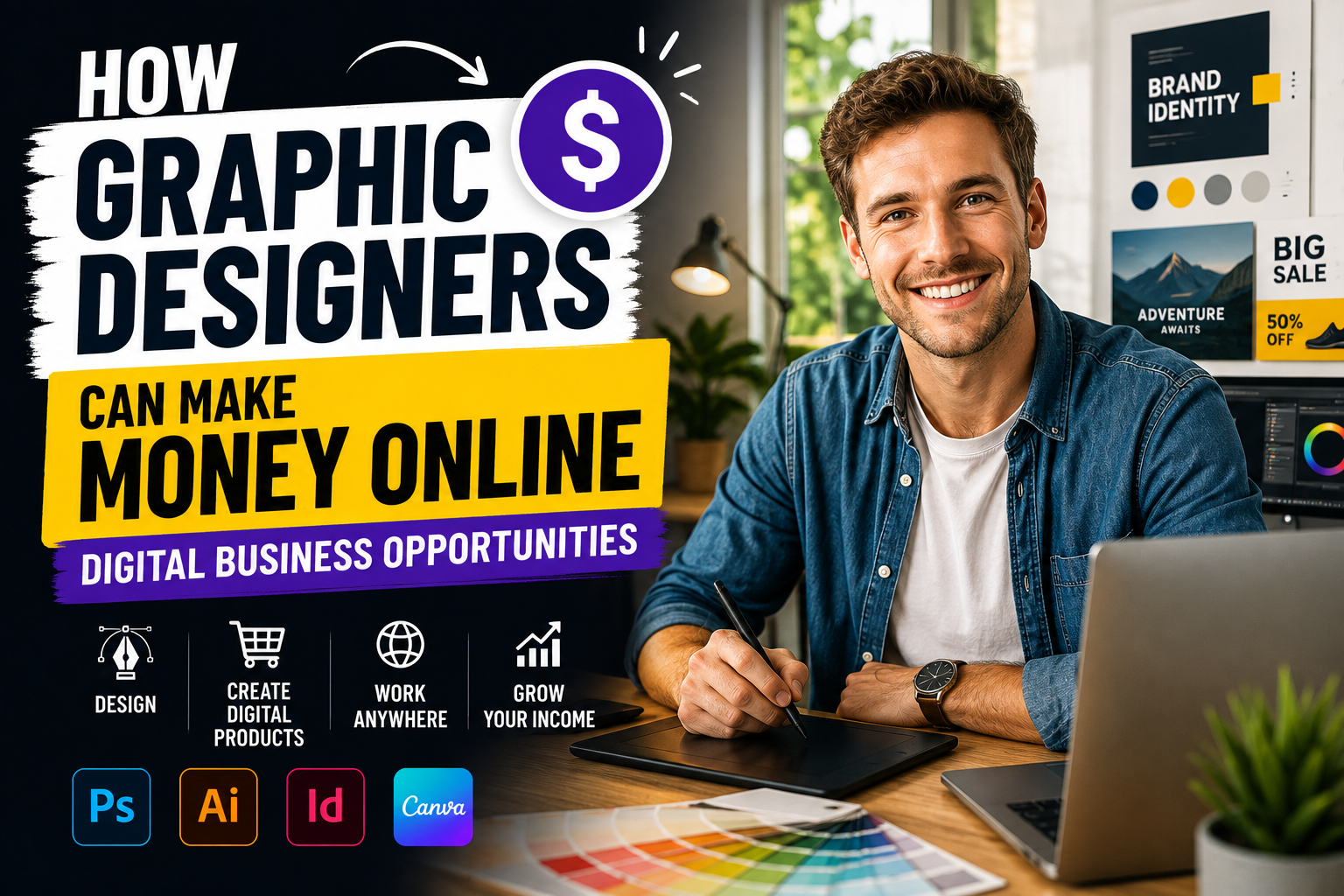
Graphic design is no longer a skill that only leads to a job at an advertising agency, printing company, or media house. You can design for clients, manage recurring business accounts, sell templates and other digital products, create content, license creative assets, teach design, or eventually build a design agency.
You also don't have to choose between being employed and running a business. Many designers start with freelance projects while studying or working, then expand once they discover which services people are willing to pay them for. The important question is therefore not simply "Can graphic designers make money online?" It is: which graphic design business model is right for your skills, experience and goals?
Graphic designers can make money online by offering freelance design services, creating brand identities, designing social media content, selling Canva and other design templates, creating digital products, designing YouTube thumbnails, licensing illustrations and creative assets, selling print-on-demand designs, teaching graphic design, creating design content, offering website/UI design services, or building a graphic design agency.
Beginners will usually find it easier to start with a direct service such as social media graphics, posters, thumbnails, or logo design. More experienced designers can expand into scalable models such as templates, digital assets, courses, retainers, and agencies. The best opportunity depends on whether you want to sell your time, build recurring client income, or create something that can be sold repeatedly.
Freelancing is one of the most straightforward ways to make money online as a graphic designer. Instead of working for one employer, you provide design services to different businesses, organizations, or individuals and charge for each project or package. Businesses constantly need visual materials — logos, brand identity design, social media graphics, posters, advertising creatives, business cards, packaging, presentation design, infographics, website graphics, and YouTube thumbnails.
The advantage of freelancing is that you don't need to create a complicated business before getting started. You need a marketable skill, examples of your work, and a way of reaching potential clients.
One of the biggest mistakes beginners make is waiting for customers to discover them. You need to actively put your work in front of people who could need it — freelance marketplaces, LinkedIn, Instagram, X, professional communities, referrals, and direct outreach to businesses. Local outreach can be particularly useful: if you notice a restaurant with great food but poorly designed menus and social graphics, redesign one promotional graphic as an example and approach the business with a specific improvement rather than a generic pitch.
Create fictional projects. Choose five businesses and imagine they hired you — branding for a coffee shop, an Instagram campaign for a restaurant, a logo and business card for a law firm, YouTube thumbnails for a finance channel, product advertisements for an online store. Clearly identify them as concept projects rather than pretending they were real clients. A strong portfolio demonstrates ability even before you have a long client list. Learners building this foundation from scratch can strengthen core tools and technique through Inceptor's Graphic Design course.
Freelancing usually means selling your own time. An agency takes the model further. The progression might look something like: designer → recurring clients → standardized services → subcontractors/team → design agency.
 The step most designers skip is the middle one — standardizing a service before trying to hire help for it.
A common problem with freelance graphic design is constantly starting from zero: you finish a logo, the client pays, the project ends, and now you need another customer. Recurring services work differently. Businesses continuously need social media designs, advertising creatives, marketing materials, website banners, presentation graphics, and event graphics. Instead of selling one poster today and searching for another customer tomorrow, you could offer a monthly package — for example, 12 social media graphics per month, 4 advertising creatives, 2 promotional banners, and basic resizing for different platforms. The exact price should depend on your market, experience, workload, and complexity. The important idea is the business model: turn an occasional design need into an ongoing service.
Graphic designers don't always have to sell custom work. You can also create a design once and sell access to that design multiple times. Businesses, creators, and individuals want attractive designs but may not have the budget to hire a designer every time they need something — an editable template solves that. Designers can create templates for Instagram posts and stories, restaurant menus, business flyers, real-estate listings, wedding invitations, CVs, business proposals, media kits, content calendars, presentations, e-books, and lead magnets.
Canva currently operates a Template Creator program — accepted creators can publish templates to Canva's marketplace and earn royalties when their templates are used. You don't have to depend entirely on a platform's creator program, though; designers can also create template-based products and distribute them through suitable digital-product marketplaces or their own stores, provided they follow the relevant platform and licensing rules.
Instead of "50 Instagram Templates," consider "50 Editable Instagram Templates for Kenyan Restaurants." Instead of "Business Flyers," create "25 Editable Property Listing Templates for Real Estate Agents." The second version immediately answers three questions: who is it for, what problem does it solve, and what does the buyer receive. That is the difference between simply creating attractive graphics and creating a digital product around a specific customer problem.
Canva templates are only one type of digital product a graphic designer can create. Other possibilities include Photoshop templates, Illustrator assets, icon packs, mockups, social media kits, presentation templates, printable and digital planners, e-book layouts, resume templates, invitation templates, UI kits, brand kits, and Lightroom presets.
 Client work resets to zero after every payment. A digital product doesn't — the same build can sell again.
The business model is different from freelancing. With client work, the basic model is client → request → design → payment. With a digital product, it becomes research → create product → publish → market → multiple potential customers. This doesn't make digital products automatically "passive income" — you still need to research demand, create a good product, produce previews, market it, support customers, and potentially update it. The scalable advantage is that fulfilling the 50th sale doesn't require creating the entire product again.
Many small businesses don't simply need a logo — they need a recognizable brand. That creates an opportunity for designers to sell brand packages rather than individual designs: a primary and secondary logo, a color palette, typography selection, business card, social media profile graphics, five social media templates, and simple brand guidelines.
Now you aren't competing purely on the price of a logo — you are solving a larger problem: "how should my business look everywhere customers encounter it?" Potential customers include restaurants, salons, online stores, real-estate agents, consultants, churches, content creators, startups, coaches, and small professional firms. You can specialize even further — instead of being "a graphic designer for everyone," you might become a designer specializing in restaurant branding, making your portfolio easier for potential clients to understand.
Open Instagram, Facebook, or LinkedIn and look at the number of businesses publishing visual content every day — someone has to create it. A company might need product promotions, sales announcements, testimonials, event posters, holiday graphics, educational posts, recruitment graphics, infographics, ad creatives, and Instagram Stories. Instead of charging for every individual poster, designers can offer monthly content packages.
This becomes even more valuable when you understand why the graphic is being created. A designer who understands digital marketing — covered alongside design fundamentals in Inceptor's Digital Marketing course — can think about the offer, audience, call to action, and advertising objective rather than only making something visually attractive. That is an important way to increase your value: you stop being the person who simply "makes posters" and become part of the business's marketing process.
YouTube has created another specialized graphic-design service: thumbnail design. A thumbnail has one major job — convince the right viewer to consider clicking the video. Good thumbnail designers need more than software skills; they need to understand visual hierarchy, contrast, typography, curiosity, simplicity, audience psychology, subject placement, mobile readability, and consistency with the creator's brand.
Creators publishing several videos each month may also need several thumbnails, creating recurring client work. And YouTube isn't the only creator opportunity — designers can provide podcast artwork, channel banners, social media promotion, video graphics, course graphics, newsletter graphics, and personal-brand templates. Instead of targeting "businesses," you can build an entire graphic-design service specifically for content creators.
Print-on-demand allows designers to place their artwork on physical products — t-shirts, hoodies, posters, mugs, stickers, tote bags, phone cases — without necessarily manufacturing large quantities themselves. When a customer purchases an item, the production partner prints and fulfills it according to the platform or supplier arrangement.
Design skill isn't the same as product-market fit: a beautifully designed T-shirt nobody wants is still a product nobody wants. Successful product creation requires research into copyright, trademarks, platform rules, fulfillment costs, margins, and advertising before launching. Print-on-demand can become a useful business model, but it should not be treated as guaranteed passive income.
If you create original illustrations, vectors, icons, backgrounds, textures, or other assets, you may be able to license them through creative marketplaces. The key word is licensing — when somebody licenses an asset, they are generally purchasing permission to use it according to specific terms rather than purchasing ownership of everything you have created. Always understand the license offered by the marketplace you use. This model can be especially attractive to designers who already create large amounts of original artwork — instead of leaving unused concepts on your computer, some may be suitable for packaging into useful creative assets, built with the fundamentals covered in Inceptor's Adobe Illustrator and Photoshop training.
Experienced designers can monetize what they know in addition to what they create — Canva for beginners, Photoshop basics, Illustrator, logo design, social media design, branding fundamentals, building a portfolio, or finding freelance clients. A designer who has become exceptionally good at one narrow thing, like restaurant menus, could create a focused tutorial explaining the entire process. Teaching works best when you actually understand the subject — don't rush to create a course immediately after learning something yourself. Your students are paying for clarity, experience, and a shorter path to a useful result.
You can also build an audience through educational or entertaining design content — logo redesigns, tutorials, design critiques, branding breakdowns, before-and-after designs, typography tips, portfolio advice, and freelancing lessons. The business model is useful content → audience → trust → products/services. The audience itself isn't necessarily the business; it becomes a distribution channel that can eventually monetize through client services, digital products, courses, memberships, sponsorships, or affiliate relationships.
Graphic designers already understand many principles useful in digital interface work — layout, hierarchy, typography, spacing, color, visual communication, branding. That creates a pathway into landing-page design, website layouts, e-commerce graphics, UI design, app interfaces, and conversion-focused page design, a natural next step for designers building on Inceptor's Web Design and Coding course. Graphic design and UI/UX design aren't identical disciplines, though — interface design introduces usability, accessibility, interaction patterns, responsive layouts, and user flows on top of visual skill.
AI has changed graphic-design workflows, but the useful question isn't simply "will AI replace graphic designers?" A better question is: what can a skilled designer do faster or differently because AI exists? AI tools can help with brainstorming, mood-board exploration, early concepts, image generation, rapid variations, copy ideas, background generation and removal, research, and workflow automation. A designer preparing an advertising campaign could use AI to explore several creative directions before manually developing the strongest concept.
But AI output does not remove the need for design judgment. Clients still care about whether a design communicates clearly, represents their brand, reaches the intended audience, and can actually be used in the required context. Typography, composition, hierarchy, branding, originality, communication, and understanding client objectives remain important. The opportunity belongs to designers who can combine design fundamentals, business understanding, and modern AI workflows.
For graphic designers in Kenya, the internet means your potential market isn't limited to your neighborhood, town, or even the country. Start with Kenyan businesses: SMEs, restaurants, salons, churches, schools, event organizers, real-estate agents, online stores, content creators, startups, NGOs, and hospitality businesses. A restaurant might need a logo once, but it could need menus, promotional posters, social media posts, delivery graphics, holiday campaigns, and advertising creatives throughout the year — which is why understanding a customer's ongoing needs can be more valuable than chasing one-off logo projects.
Digital design services can also be delivered remotely — a designer in Nairobi can create a presentation for a company in London, thumbnails for a creator in the United States, or social media graphics for a startup elsewhere in Africa. Your portfolio, communication, reliability, and ability to solve the client's problem become extremely important when competing internationally. Don't position yourself solely as a "cheap designer" — competing only on price creates a race to the bottom. Compete on specialization, reliability, communication, creativity, and business understanding.
There isn't one universally "best" option.
| Opportunity | Beginner Friendly? | Requires Clients? | Can Scale? | Recurring Revenue |
|---|---|---|---|---|
| Freelance design | Yes | Yes | Moderate | Moderate |
| Design agency | Intermediate | Yes | High | High |
| Social media design | Yes | Yes | Moderate | High |
| Digital templates | Yes–Intermediate | No direct clients | High | Moderate |
| Brand kits | Yes–Intermediate | Usually | Moderate | Low–Moderate |
| Print-on-demand | Intermediate | No direct clients | High | Variable |
| Stock assets | Intermediate | No | High | Variable |
| Content creation | Yes | No | High | Variable |
| Online courses | Experienced | No direct clients | High | Variable |
| UI/web design | Intermediate | Usually | High | Moderate |
If you're a beginner who needs income and experience, freelance services may be the simplest place to start. If you dislike client work but enjoy creating reusable assets, digital products and templates may be more attractive. If you're experienced and good at managing people, an agency could offer greater scale. If you enjoy teaching, content and education can eventually become another business model.
If you're starting from zero, don't rush directly into selling services. Build the foundation first: design fundamentals, design software, a portfolio, a niche, a business model, customers, repeatable systems, and complementary skills — roughly in that order.
Understand typography, color, contrast, alignment, composition, spacing, visual hierarchy, and branding. Software can help you execute an idea; it cannot automatically give you good design judgment.
Depending on the work you want to do, this might include Photoshop, Illustrator, InDesign, CorelDRAW, Canva, or other relevant creative software. For beginners who prefer structured training, Inceptor Institute of Technology currently offers a four-week Graphic Design course covering photo editing, Illustrator, Photoshop, InDesign, and CorelDRAW, with practical outcomes around branding, typography, and digital design composition. Learning complementary skills also helps — a designer who understands digital marketing can better understand why businesses need advertising creatives, landing-page graphics, and social content rather than simply knowing how to make them look attractive.
Create approximately 5–10 strong projects representing the type of work you actually want customers to hire you for. Quality matters more than filling your portfolio with everything you have ever designed.
You might specialize in graphic design for restaurants, YouTube thumbnail design for business creators, or brand identities for startups. A clear niche makes it easier for potential clients to understand what you do.
Don't start freelancing, print-on-demand, YouTube, an agency, a template store, and a course simultaneously. Pick one. Get it working. Then expand.
You don't need to build everything immediately. Use your first month to establish the basics.
 Four weeks, four decisions — not four unrelated tasks.
Inceptor Institute offers hands-on, project-based training in graphic design, Illustrator, Photoshop, digital marketing, and web design — the practical skill layer underneath every opportunity in this guide.
Explore all courses at Inceptor →
Yes. Graphic designers can sell services and products that can be delivered digitally, including freelance design, social media graphics, branding, templates, creative assets, thumbnails, courses, and web/UI design. The challenge isn't whether graphic design can be monetized — it's developing enough skill, choosing a specific customer problem, and consistently finding buyers.
Start with one service you can deliver confidently, such as social media graphics for restaurants or YouTube thumbnails for creators. Create several portfolio examples, identify potential customers, and begin targeted outreach rather than waiting until you have mastered every area of graphic design.
For beginners, selling a specific service is often the simplest model because you receive payment directly for completed work. For experienced designers, recurring retainers, digital products, agencies, education, and specialized services can provide additional ways to scale.
Yes. Canva can be used to create client designs and certain digital products, and it operates a Template Creator program where accepted creators can publish templates and earn royalties based on usage. Always check Canva's current licensing and creator terms before selling or distributing designs.
Designers can create templates, social media kits, presentation layouts, mockups, icon packs, printable products, digital planners, brand assets, UI assets, invitations, resumes, and other original design resources. The strongest products usually solve a specific problem for a clearly defined customer.
Graphic designers can create products that may be sold repeatedly, such as templates, licensed assets, and educational products. However, calling these completely "passive" can be misleading — product research, marketing, customer support, and updates still require ongoing work.
Yes. AI changes how design work is produced, but businesses still need effective visual communication. Designers can use AI for ideation, variations, image generation, and workflow assistance while differentiating themselves through creative judgment, brand understanding, typography, composition, and business knowledge.
Kenyan designers can provide branding, social media graphics, advertising creatives, event designs, menus, thumbnails, and other services to local businesses while also pursuing remote clients internationally. Digital products provide another route, since items like templates can potentially be sold beyond Kenya.
You need a combination of design fundamentals, competence with relevant design tools, portfolio development, communication, basic business skills, and the ability to understand a client's objective. Technical skill gets you started; reliability, communication, and the ability to solve business problems turn individual projects into repeat customers.
Graphic designers now have several ways to turn their skills into digital businesses, but those opportunities fall into a few simple categories: sell your expertise through freelance projects, sell repeatable services through retainers and productized packages, sell products such as templates and creative assets, build an audience and monetize your knowledge, or build a business by combining these models and eventually involving other people.
You don't need to do all five. If you're starting today, choose one customer, one problem, and one offer — for example: customer is restaurants, problem is they struggle to consistently create attractive promotional content, offer is a monthly social media design package. That is already the foundation of a real graphic design business.
Browse Inceptor's graphic design and digital skills courses to explore structured training options before deciding which digital business opportunity to pursue.
Discover more articles you might be interested in
Discover 10 practical skills you can begin learning in 30 days, create proof of your ability and package into a realistic starter offer for earning online.
By Davie
How to Make Money Online as an SEO Specialist: 18 Realistic Income Opportunities
By Davie
Learn how small businesses can use AI for marketing, sales, customer service and automation—and turn real business experience into digital products to sell online.
By Davie

Learn how to build an AI-powered online business with practical ideas, tools, customer strategies, AI automation and a 30-day startup roadmap
By Davie
Get the updates, on newly released, popular & fast-moving MRR digital products
Up to Top