

Learning to build software gives you more ways to earn online than simply applying for developer jobs. A developer can solve problems for clients, automate business processes, build small software products, offer technical consulting, create developer resources, teach technical skills, or move into adjacent fields such as cybersecurity.
The important distinction is that knowing how to code is not itself a business model. Someone still needs to value the problem you solve enough to pay for it. That is why the best alternative income opportunities for software developers tend to combine technical ability with a specific customer, a specific problem, and a specific way of getting paid.
Software developers can make money online outside a traditional job through freelance development, AI automation, cybersecurity services, micro-SaaS products, mobile apps, API integrations, technical consulting, developer tools, and educational digital products.
The quickest route is often selling an existing skill as a service, because you do not need to build an audience or a successful product first. Building software products can be more scalable, but it also introduces product validation, marketing, customer acquisition, and support. The best opportunity therefore depends on whether you want client income, recurring service revenue, or a product-based business.
Freelancing is probably the most obvious alternative to conventional software employment, but it is also broader than many developers realize. You do not necessarily need to compete for generic projects advertised as "looking for a web developer." Businesses pay developers to solve specific problems.
A restaurant may need an ordering system. A school might need a student portal. A small company may need an internal dashboard instead of managing operations through spreadsheets. An online business might need its payment provider connected to its website. These are software problems, even when the customer never describes them that way.
Services can include: websites and web applications; e-commerce development; internal business tools; dashboards; database applications; payment integrations; bug fixes and maintenance; API development; mobile applications; and existing-system improvements.
A useful approach is to package the outcome rather than simply advertise programming languages. Compare "I am a React, JavaScript and Python developer" with "I build online booking systems for service businesses." The second statement immediately tells a potential customer what problem you can solve.
Developers who still need to broaden their practical full-stack capabilities can strengthen areas such as front-end development, Python, APIs, databases, deployment, and AI-assisted coding through Inceptor's Software Development with AI training. But learning the technology is only one half of freelancing — you also have to learn how to scope projects, communicate with non-technical customers, price work, manage revisions, and deliver reliably.
Start narrower than you think. Choose one type of customer and identify a recurring software problem — for example, dental clinics struggling with appointment management could use a simple online booking system, or small online retailers doing manual order reporting could use an automated sales dashboard. Then build one demonstration project around that problem. A relevant working demo is often more persuasive to a potential customer than a portfolio containing ten unrelated tutorial projects.
AI has created another interesting opportunity for developers: helping businesses turn AI tools into actual working systems. There is a large difference between opening an AI chatbot and integrating AI into a business workflow.
A company might want incoming enquiries automatically classified and routed to the right department. Another might want information extracted from documents and entered into a database. An online shop may want customer questions answered using its own product information. Those projects require more than prompting — they can involve APIs, authentication, databases, backend logic, webhooks, data processing, error handling, and interfaces with existing software. Those are familiar problems for developers.
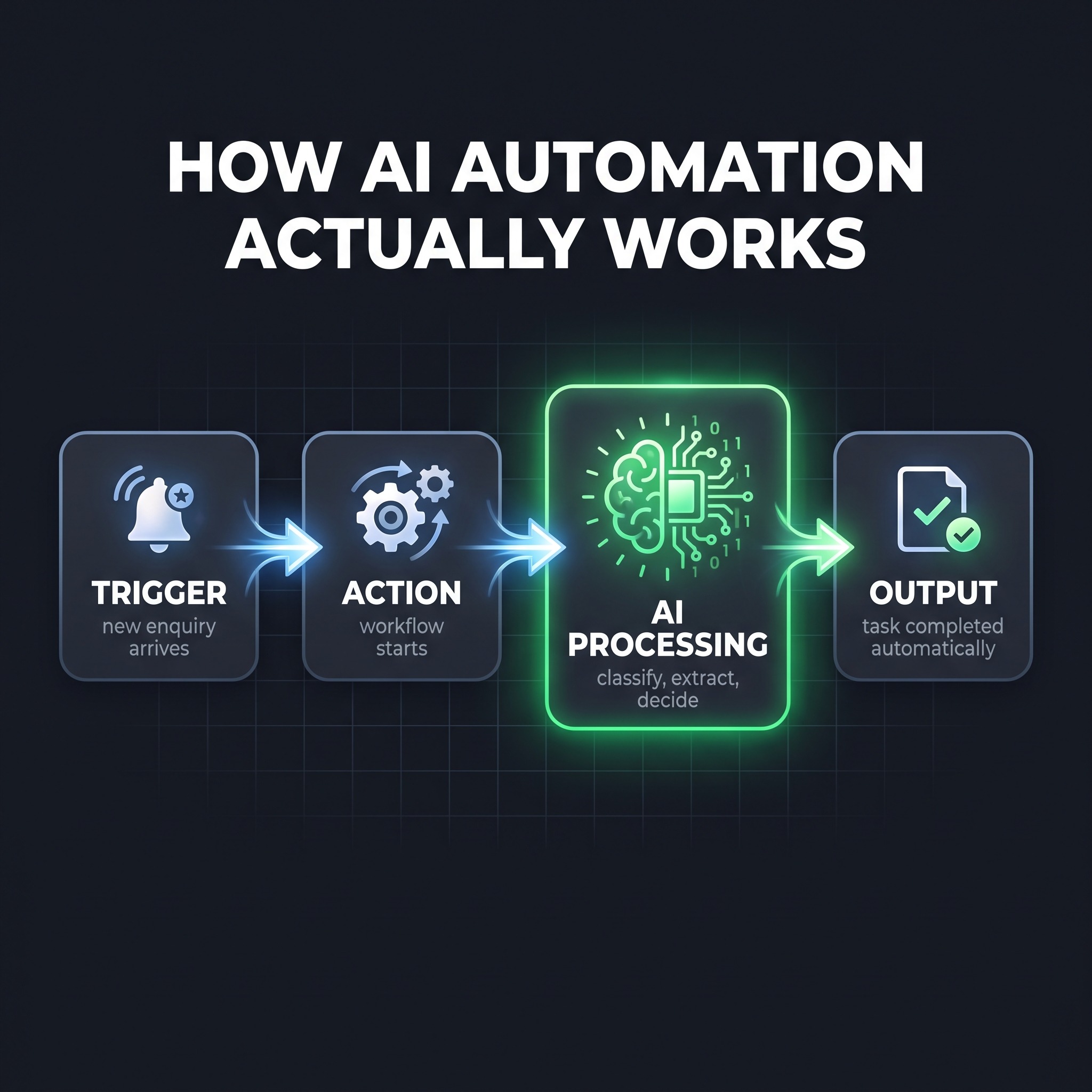 The gap between "using an AI chatbot" and "building an AI automation" is exactly this pipeline.
Examples include: customer-support assistants connected to company knowledge; document-processing workflows; automated lead qualification; email classification systems; AI search across internal documents; reporting automations; content-processing pipelines; CRM automations; and AI features added to existing applications.
The mistake would be selling "AI" simply because the term is popular. Sell the outcome. A business is much more likely to understand "I can reduce the amount of time your staff spend manually sorting incoming enquiries" than "I build AI agents."
Python is particularly useful for automation, backend development, data processing, and connecting services through APIs. Developers moving into this area should understand the underlying code rather than blindly accepting AI-generated scripts — somebody still has to verify the logic, protect credentials, handle failures, and ensure customer data is treated appropriately. Inceptor's AI, Agents & Automation course works through this exact combination of automation fundamentals, AI agents, and business application over five structured levels.
Developers understand how software is built. That knowledge can become an advantage when learning how software breaks. Cybersecurity is therefore an interesting adjacent field for programmers, particularly in areas such as application security, secure coding, vulnerability assessment, and authorized penetration testing.
A developer who already understands HTTP requests, APIs, databases, authentication, server-side logic, JavaScript, and application architecture has concepts directly relevant to investigating vulnerabilities in web applications. However, being a developer does not automatically make someone a security professional — security work requires additional knowledge of attack techniques, network security, security testing methodology, threat analysis, defensive controls, reporting, and legal boundaries. Developers interested in building that foundation can explore Inceptor's structured cybersecurity training or its dedicated penetration testing course, both covering vulnerability assessment, web application security, API security, and authorized testing methodology.
Possible legitimate paths include application-security consulting, secure-code reviews, vulnerability assessments performed with authorization, penetration-testing work, security implementation, security training, bug bounty programs, and security-focused technical writing.
Authorization matters: testing systems you do not own or do not have permission to test can cross legal and ethical boundaries. A professional security service begins with clearly defined permission and scope.
You do not necessarily need to become a penetration tester. Secure development itself is valuable — companies increasingly need developers who understand how to build authentication properly, protect APIs, handle secrets, manage permissions, and reduce common application vulnerabilities. That makes security knowledge useful even if it never becomes your primary career.
Client work usually has a simple relationship: do work, get paid. Software products create a different possibility: build one system, sell access to multiple customers. A micro-SaaS is a relatively focused software-as-a-service product designed to solve a narrow problem for a particular group of users. It does not have to become the next billion-dollar technology company.
Imagine a developer notices that small property managers repeatedly prepare the same tenant reports manually. Instead of building a completely general property-management platform, the developer might create a small tool that automates that one workflow. Customers could then pay monthly or annually to use it.
Developers frequently have the technical ability to build far more than customers actually need — that can become a disadvantage. You can spend six months building account systems, dashboards, settings, integrations, AI features, mobile applications, and advanced analytics, and discover afterwards that nobody cares enough about the underlying problem to pay for any of it.
A better sequence is: problem, customer, validation, smallest useful product, payment, improvements. Talk to potential users before building the full product. Find out how they solve the problem today, how frequently it occurs, and what it costs them in time, money, or missed opportunities. Then build.
Usually not. Software requires hosting, maintenance, customer support, security updates, billing management, and continuous improvements. It can become more scalable than hourly freelance work, but "scalable" and "passive" are not the same thing.
Not every software product needs subscriptions, user accounts, and a hosted backend — sometimes the product can simply be a useful technical asset. Developers repeatedly build similar foundations: authentication flows, landing-page components, admin dashboards, starter applications, email templates, API wrappers, deployment configurations, automation scripts, database schemas, and reusable UI components.
If one of those assets solves a recurring problem for other developers or businesses, it may be possible to package it as a digital product. For example, instead of rebuilding a particular project structure for every client, a developer working across JavaScript and full-stack projects could turn a well-documented version into a starter kit. The value isn't simply the source code — the buyer is often paying to avoid several hours or days of setup and debugging.
A technically impressive product with poor documentation can be harder to sell than a simpler product a buyer understands immediately. A commercial developer resource should make clear what problem it solves, who it is for, requirements, installation, configuration, examples, limitations, licensing terms, and what support is included. This is where product thinking becomes as important as programming.
The app stores contain millions of applications, so "build an app and make money" is not particularly useful advice on its own. Start with the problem instead. A developer might notice a recurring problem within a profession, hobby, community, or local market that existing apps handle poorly — that could become a focused application built with skills from Inceptor's Android development or iOS development courses.
Possible monetization models include paid downloads, subscriptions, in-app purchases, business licensing, premium features, and advertising where the audience is large enough. The opportunity becomes more interesting when you already understand the niche — a generic budgeting app enters a crowded category, while a budgeting tool designed around the workflows of a very specific profession or market has a clearer reason to exist.
Building version one is only the beginning. You still need to answer: how will the first 100 users discover this? If there is no convincing answer, investigate distribution before spending months building. A small application with a clear audience can be a better business than an ambitious application nobody knows exists.
Many companies already use several software products — a website, payment processor, CRM, accounting software, email marketing system, inventory database, and customer-support platform — and the problem is that those products often do not communicate properly. Employees then manually move information from one system to another. That is an opportunity for a developer.
Suppose a company receives an online payment and an employee manually confirms the transaction, updates the customer's account, records it in another system, sends a confirmation, and updates an internal spreadsheet. If the relevant platforms expose APIs or other supported integrations, a developer may be able to automate much of that workflow. Businesses aren't buying "API calls" — they are buying fewer repetitive tasks, faster processing, and fewer avoidable mistakes.
Before writing code, ask what happens from the moment this event occurs until the process is finished. Map every step, identify which systems are involved, check whether official APIs, webhooks, or integration methods exist, and determine which steps can safely be automated. For developers comfortable with backend programming and APIs — the same foundation covered in Inceptor's Software Development with AI course — this can become a specialized consulting service rather than generic freelance development.
Experienced developers accumulate something more valuable than syntax knowledge: judgment. You begin to understand why projects fail, when a seemingly simple feature will create architectural problems, when a company is choosing unnecessary technology, and the difference between a prototype and production software. Businesses can pay for that judgment.
Technical consulting might involve architecture reviews, technology selection, codebase assessments, cloud-cost reviews, software-project planning, development workflow improvements, technical due diligence, performance reviews, security recommendations, and AI implementation planning. The difference between consulting and ordinary development is that the primary deliverable may be a decision, not code.
This is not necessarily the easiest starting point for a new developer. Clients need a reason to trust your recommendations, and that credibility may come from years of professional work, successful projects, specialization, case studies, or recognized expertise in a particular technology. For experienced developers, however, consulting can turn knowledge accumulated over many projects into a separate service.
A developer can also monetize knowledge rather than software. Suppose you have become particularly good at deploying applications, building APIs, front-end performance, database design, Git, secure coding, Python automation, mobile development, or using AI effectively during development — someone else is trying to learn that exact skill.
That knowledge can become an eBook, technical guide, code workbook, template, video tutorial, mini-course, workshop, mentorship program, or interview-preparation resource. The opportunity works best when the material solves a narrow problem: "Learn Python" competes with an enormous amount of free content, while "Build and deploy your first inventory API with Python" has a much clearer outcome.
Teach what you can demonstrate. A mid-level developer does not need to position themselves as the world's leading software engineer to explain something they genuinely understand to a beginner. The key is accuracy: test the code, show real examples, explain errors people are likely to encounter, and update technical material when tools change. Developers interested in productizing their knowledge can also study how digital products are created and sold online through Inceptor's Digital Product Trading Masterclass with AI before deciding whether a guide, template, tutorial, or course makes sense for their expertise.
The economics here differ from consulting: a consultant may sell one hour once, while a useful digital resource can potentially be sold to multiple buyers — although it still requires marketing, updates, and customer support.
There is no single best option because these models solve different goals.
|
Opportunity |
Best Suited To |
Upfront Effort |
Path to Revenue |
Scalability |
|
Freelance development |
Developers wanting client income |
Low–Medium |
Relatively direct |
Medium |
|
AI automation |
Developers comfortable with APIs/backend |
Medium |
Client projects |
Medium–High |
|
Cybersecurity services |
Developers willing to specialize further |
High |
Employment/clients/programs |
Medium |
|
Micro-SaaS |
Developers interested in entrepreneurship |
High |
Product subscriptions |
High |
|
Code products |
Developers with reusable expertise |
Medium |
Product sales |
High |
|
Mobile/niche apps |
Developers who understand a specific market |
High |
App/product revenue |
High |
|
API integrations |
Backend/integration developers |
Medium |
Client projects/retainers |
Medium–High |
|
Technical consulting |
Experienced developers |
Low–Medium |
Consulting fees |
Medium |
|
Digital education |
Developers who can teach clearly |
Medium |
Product/training sales |
High |
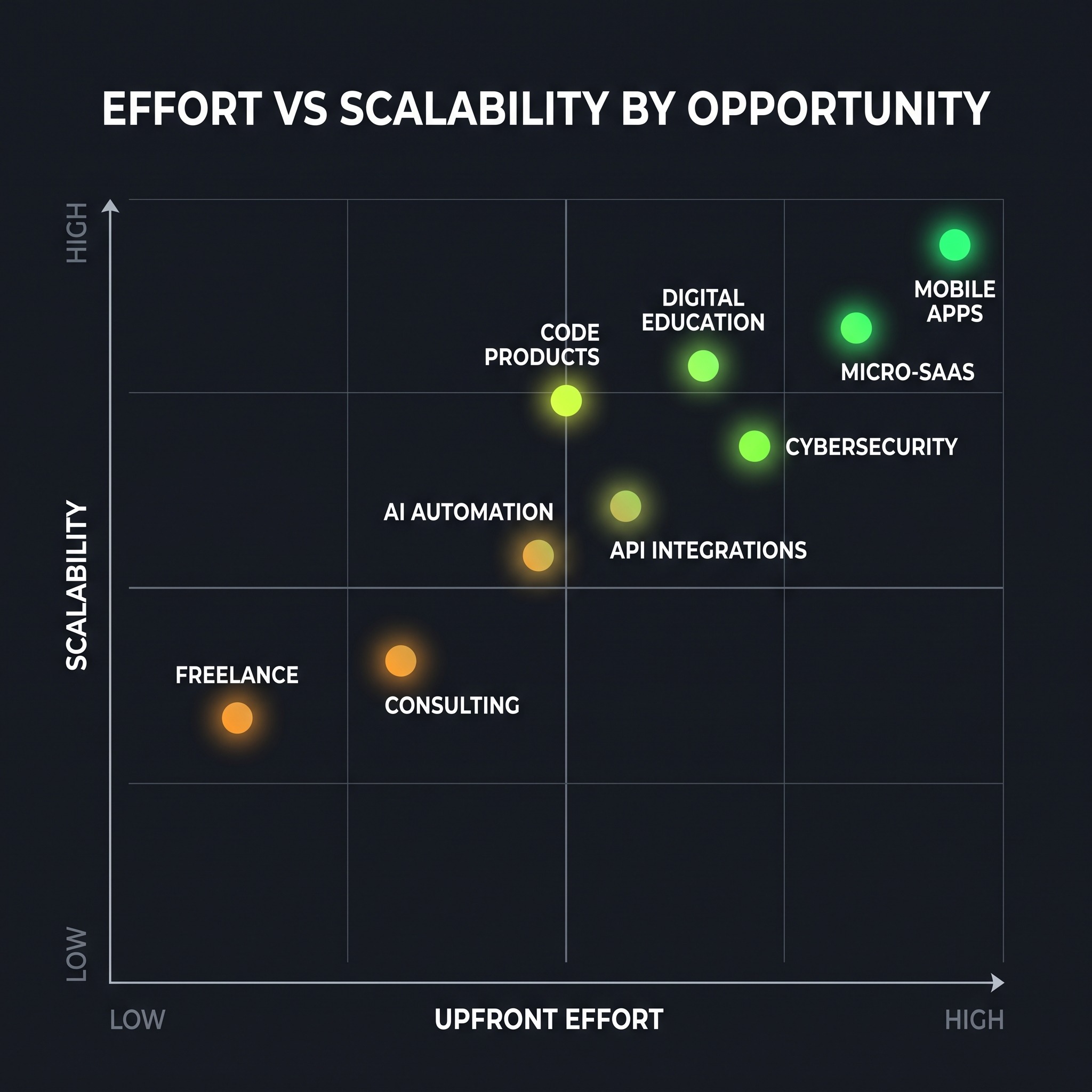 Low effort and high scalability rarely overlap — every opportunity here trades one for the other.
"High scalability" does not mean easy money. It means revenue has the potential to become less directly tied to the number of hours you personally work. Product businesses usually compensate for that advantage with higher uncertainty at the beginning.
If you need your first online income relatively quickly, a service is often the simpler model: you already have the skill, find someone with a problem, solve it, get paid. Products reverse the order — you usually invest time before knowing how many people will buy. That doesn't make products worse, it simply changes the risk.
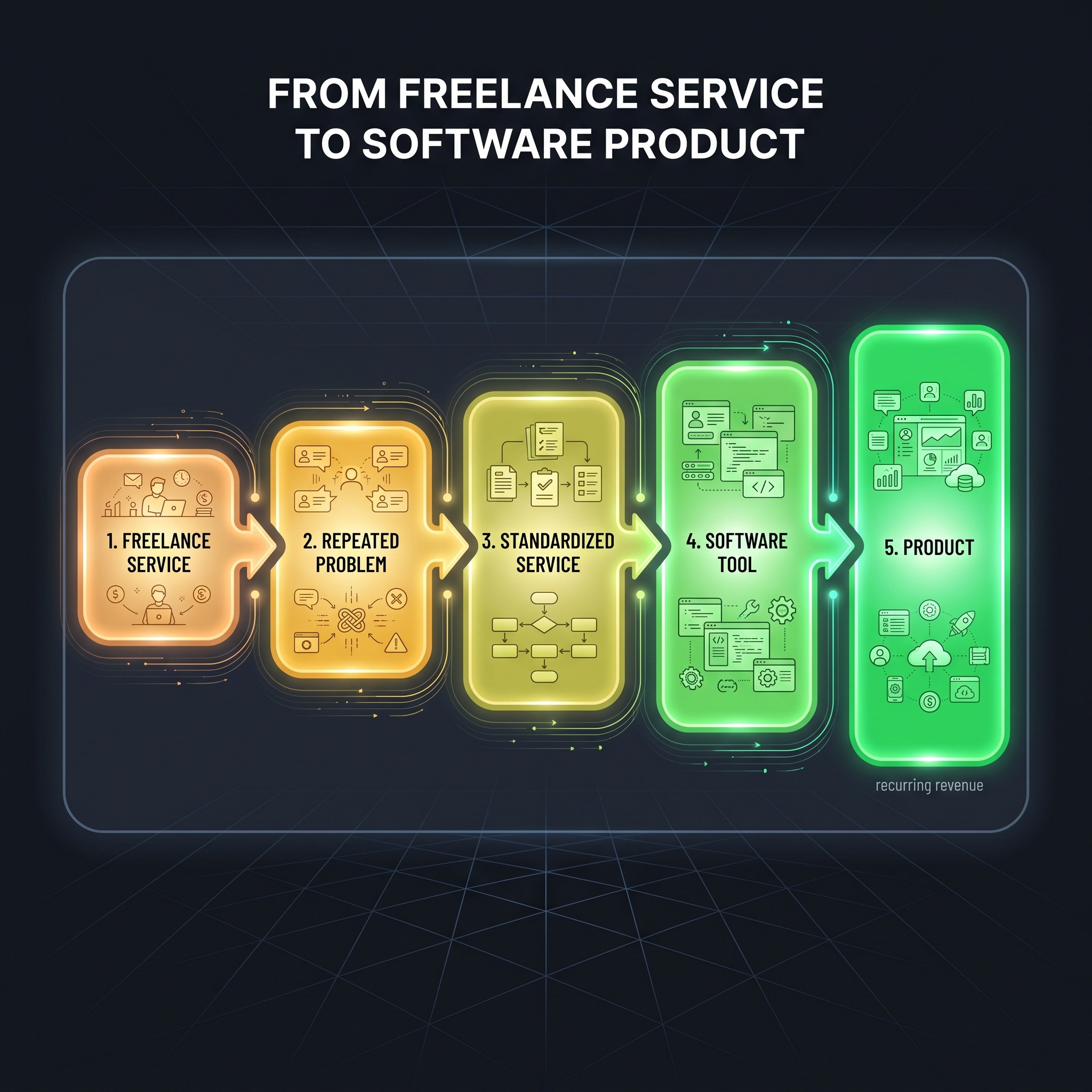 Your freelance work becomes market research the moment the same request shows up for the third time.
One practical progression is: freelance service, repeated customer problem, standardized service, software or tool, product. Imagine you build inventory dashboards for several businesses — after the third or fourth project, you realize most customers need roughly the same functionality. That recurring problem may be evidence for a product. Your freelance work has effectively become market research.
You do not need to pursue all nine opportunities. Choose one, then use this framework.
Inventory your skills. Write down what you can actually build without following a tutorial from beginning to end.
Pick a customer. "Businesses" is too broad — restaurants, online sellers, accountants, schools, and property managers have different problems.
Find an expensive or repetitive problem. Talk to people rather than guessing.
Choose the business model. Will you solve it as a service, a consultation, or a product?
Identify your skill gap. Perhaps you can build the backend but need stronger security knowledge, or you understand software but not mobile development. Learn what the opportunity actually requires rather than collecting unrelated certificates.
Build proof. Create a demonstration, case study, small working product, or documented project.
Find five potential users before chasing 5,000 followers. Early conversations reveal whether your idea solves something people care about.
Charge for a real outcome. Your first objective is not passive income — it is proving that somebody values the solution enough to pay for it.
The developer who learns to connect code to real problems becomes much less dependent on one way of earning. A programming language is a tool. The economic value comes from what you can use that tool to solve.
Inceptor Institute offers hands-on, project-based training in software development, AI automation, and cybersecurity — the practical skill layer underneath every opportunity in this guide.
Explore all courses at Inceptor →
Software developers can earn additional income through freelance projects, API integrations, AI automation, cybersecurity services, consulting, mobile apps, micro-SaaS products, developer resources, and technical education. Client services are generally easier to validate quickly, while products can offer greater scalability if there is sufficient demand.
For an experienced programmer, selling a skill they already possess is usually simpler than learning an entirely new business. That might mean fixing websites, building integrations, automating repetitive tasks, or developing small applications for clients. Finding customers remains an important part of the work.
Yes. Developers can build SaaS products, mobile applications, browser extensions, templates, code libraries, educational products, and other digital assets. They can also work in consulting, technical education, or security. These alternatives still require customers, users, or an audience.
Yes, but building software is only one part of running a SaaS business. Developers must also validate demand, acquire customers, manage billing, provide support, maintain infrastructure, and continue improving the product. A narrow micro-SaaS solving a clear problem can be a more manageable starting point than a large platform.
It can be. Software developers already understand applications, APIs, databases, and code, which provides useful context for areas such as application security and secure development. However, professional security work requires additional security-specific knowledge, methodology, and clear legal authorization.
Depending on their experience, developers can move into cybersecurity, DevOps, cloud engineering, solutions architecture, developer relations, technical consulting, product management, data engineering, technical education, and other adjacent technology roles.
Developers do not need to abandon programming fundamentals for AI. A more useful approach is learning how AI fits into software work: assisting with debugging and testing, processing information, integrating models through APIs, automating workflows, and adding appropriate AI functionality to applications. Developers still need to evaluate whether generated code is correct, secure, and suitable for production.
Software development is more than a job title — it is the ability to turn a problem into instructions a computer can execute. Once you look at the skill that way, the alternatives become much broader. You can sell the work directly through freelancing, specialize in security or automation, sell your judgment through consulting, turn repeated problems into software products, or package what you have learned into resources that help other people.
None of those paths guarantees income. But they give developers something valuable: more than one way to turn technical ability into economic value. Start with one problem, one type of customer, and one way of getting paid. Then build from there.
Visit Inceptor Institute to explore practical, project-based training in software development, AI, and cybersecurity.
Discover more articles you might be interested in

Discover 10 practical skills you can begin learning in 30 days, create proof of your ability and package into a realistic starter offer for earning online.
By Davie

How to Make Money Online as an SEO Specialist: 18 Realistic Income Opportunities
By Davie

Learn how small businesses can use AI for marketing, sales, customer service and automation—and turn real business experience into digital products to sell online.
By Davie

Learn how to build an AI-powered online business with practical ideas, tools, customer strategies, AI automation and a 30-day startup roadmap
By Davie
Get the updates, on newly released, popular & fast-moving MRR digital products
Up to Top
Comments All
Maina
@maina
This was a useful read. I took the ideas and started thinking about how I could turn my coding skills into actual income by offering simple freelance services and building small solutions for real problems. It gave me a clearer idea of where to start instead of just learning code without a plan.
August 26,2026 At 08:25 AM