
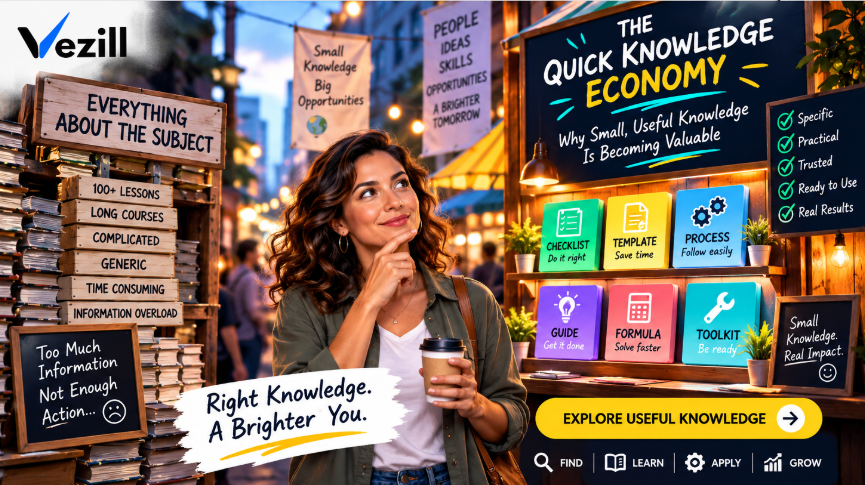
Information is becoming abundant. The scarce part may increasingly be knowing what matters, trusting it, organizing it and applying it to a real task.
Tomorrow morning, you receive a spreadsheet with hundreds of sales records. Your manager asks: “Can you show me total sales by region?” You could enroll in a complete Excel course and learn workbook fundamentals, formulas, charts, Power Query, VBA and dozens of features. Those may eventually be useful. But none changes the immediate job: summarize these rows by region.
A focused PivotTable guide may solve the bounded problem. If spreadsheet analysis becomes part of your job every week, deeper Excel learning becomes sensible. If you want to become a professional data analyst, one PivotTable tutorial is nowhere near enough. The point is not that short learning is superior. The point is that your problem may be smaller than the subject.
THE SHIFT A growing part of digital learning is moving from “teach me everything about this subject” toward “help me accomplish this specific thing.”
The Quick Knowledge Economy is VEZILL’s term for an emerging digital environment where focused practical knowledge can be packaged, discovered and exchanged around specific tasks, problems and outcomes. Its value comes not simply from making information shorter, but from selecting, organizing, contextualizing and packaging the knowledge someone needs to act.
CORE PRINCIPLE SMALL DOES NOT CREATE THE VALUE. USEFULNESS DOES.
“Quick Knowledge Economy” is a VEZILL concept, not an established academic branch of economics. The established knowledge economy is much broader and concerns the role of knowledge, skills, innovation and intellectual capability in economic activity. VEZILL’s phrase describes a practical digital layer inside that wider world: focused knowledge packages connecting people who know how with people who need to know how.
Here, small does not mean trivial, low quality or literally tiny. It means bounded: a unit of useful knowledge designed around a relatively specific outcome. “Digital marketing” is a subject; “set up your first retargeting campaign” is bounded. “Excel” is a subject; “create a PivotTable that summarizes monthly sales” is bounded. “Web design” is a subject; “connect a custom domain” is bounded.
A Quick Knowledge product might be a five-minute checklist, a 20-page guide, spreadsheet, calculator, template, prompt system, decision framework, SOP, troubleshooting guide, mini-course or toolkit. The format is secondary. The defining characteristic is not simply shortness; it is being focused enough to match a bounded need.
A recent systematic review of 40 studies describes microlearning as an instructional approach delivering targeted, action-oriented, bite-sized content for specific objectives, typically in short periods. The review also emphasizes individual, situational and subject differences. That research is relevant, but the concepts should not be collapsed.
Microlearning is primarily an instructional approach built from small learning units. Quick Knowledge is VEZILL’s broader idea of practical knowledge packaged around a task, problem or outcome. A calculator can be Quick Knowledge without being a lesson. A 20-page troubleshooting guide can be Quick Knowledge without being a seconds-long microlearning unit.
IMPORTANT DISTINCTION QUICK KNOWLEDGE ≠ MICROLEARNING. The overlap is focus; the boundaries and formats are different.
Useful knowledge has often been bundled inside books, degrees, manuals, courses, training programs and institutions. Those larger structures remain valuable because they can provide foundations, progression, practice, assessment and feedback. Digital distribution, however, makes it easier to separate useful pieces from the larger bundle.
A person who needs one formula no longer has to acquire an entire spreadsheet textbook. A founder who needs an interview scorecard can use a template. A photographer can use a wedding-day checklist without taking another complete photography program. This is knowledge unbundling: not destroying the subject, but making some useful components independently accessible.
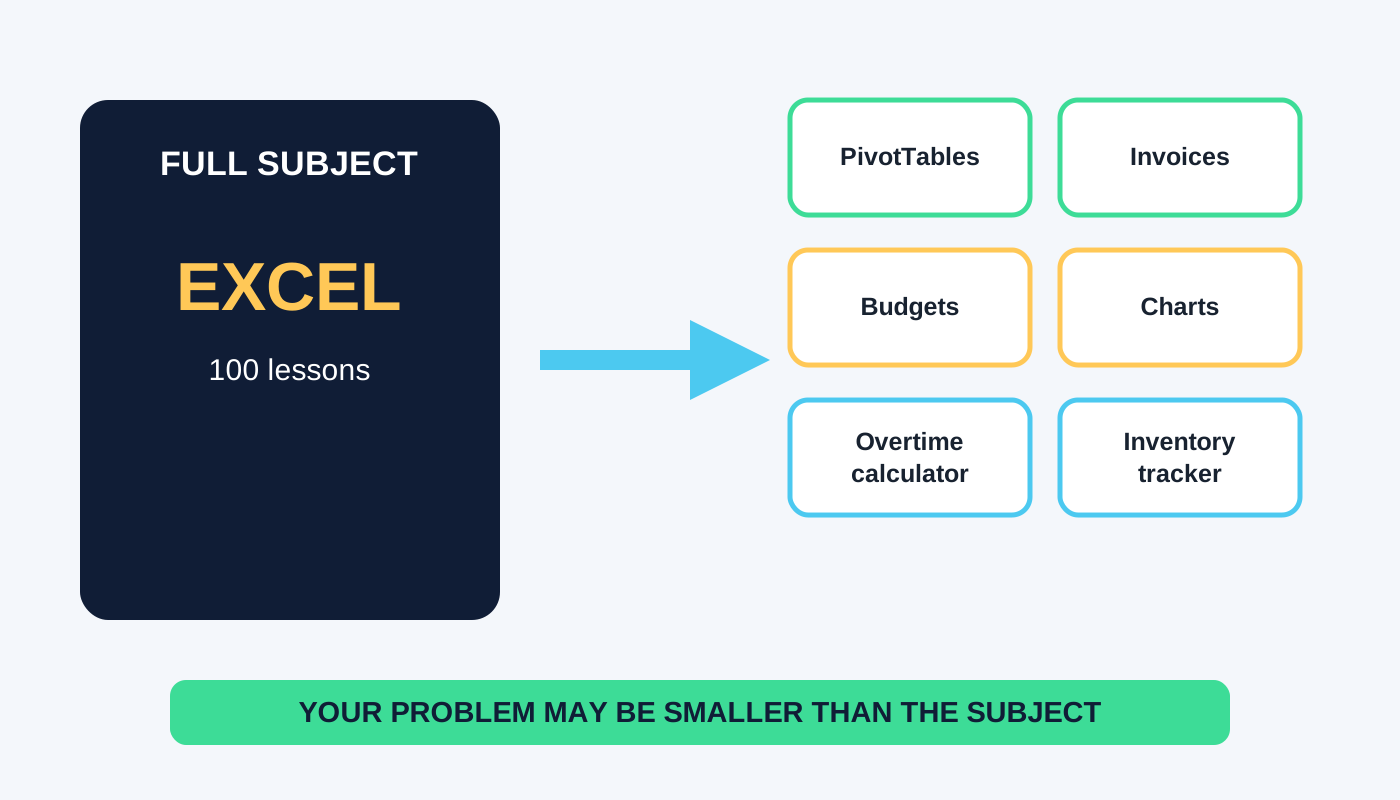 Unbundling lets the learner choose a unit whose scope matches the immediate problem; it does not make broad education obsolete.
Different problems require different sizes of knowledge. VEZILL can describe that range with a six-level explanatory model. It is a practical framework, not an academic standard.
1 — ANSWER What keyboard shortcut does X? A fact may be enough. 2 — INSTRUCTION Where do I change this setting? A few steps may be enough. 3 — TASK GUIDE How do I connect my domain? A bounded process with prerequisites and checkpoints. 4 — TOOLKIT Everything I need to launch my first newsletter. Several coordinated resources around one outcome. 5 — CAPABILITY Learn email marketing. Connected concepts, practice and feedback. 6 — PROFESSION Become a professional digital marketer. Foundations, judgment, experience and continued development. VEZILL EXPLANATORY MODEL THE VALUE OF KNOWLEDGE DEPENDS PARTLY ON HOW WELL ITS SIZE MATCHES THE PROBLEM.
This is consistent with Quick Knowledge vs Online Courses: one bounded task and a profession do not require the same learning depth. A good system helps the learner choose the appropriate granularity rather than assuming one format wins every time.
Knowledge has always had economic value. Skills, methods, scientific understanding, organizational know-how and experience shape productivity and innovation. The internet did not invent the value of knowing how. What digital systems changed is the cost and speed of packaging, distributing and discovering knowledge.
The Quick Knowledge layer is therefore not a replacement for the knowledge economy. It describes one increasingly practical digital behavior: someone has already solved a problem; someone else is trying to solve that problem now; digital infrastructure can connect them through a focused resource.
Digital distribution makes delivery nearly instant. Smartphones put learning at the point of need. Search engines let people express specific problems. Digital payments reduce transaction friction. Creator tools lower production costs. Marketplaces help strangers discover one another. Global distribution lets local expertise reach niche audiences. Generative AI can organize, summarize, translate and personalize information.
UNESCO’s 2025 digital-learning work places digital and AI competencies within a broader lifelong-learning transition. Conversational search also changes access: OpenAI describes ChatGPT search as giving timely answers with links to web sources, reducing some of the work of multiple searches and link-hopping.
These forces do not prove that every short guide has a market. They change the infrastructure around knowledge. It is easier than before for a narrowly defined need to meet a narrowly defined resource.
Generative AI creates a difficult question for any knowledge marketplace: if an AI system can produce an explanation, summary or checklist in seconds, why would someone pay for a knowledge product? The weakest answer is to ignore AI. The stronger answer is to ask what AI makes abundant and what remains difficult.
Generic explanation is becoming cheaper to produce. That can increase the supply of articles, answers, summaries, videos and guides. More supply can also increase the importance of deciding what is current, trustworthy, relevant and appropriate for a particular situation. AI can reduce search friction while raising the quality bar for anything sold as structured knowledge.
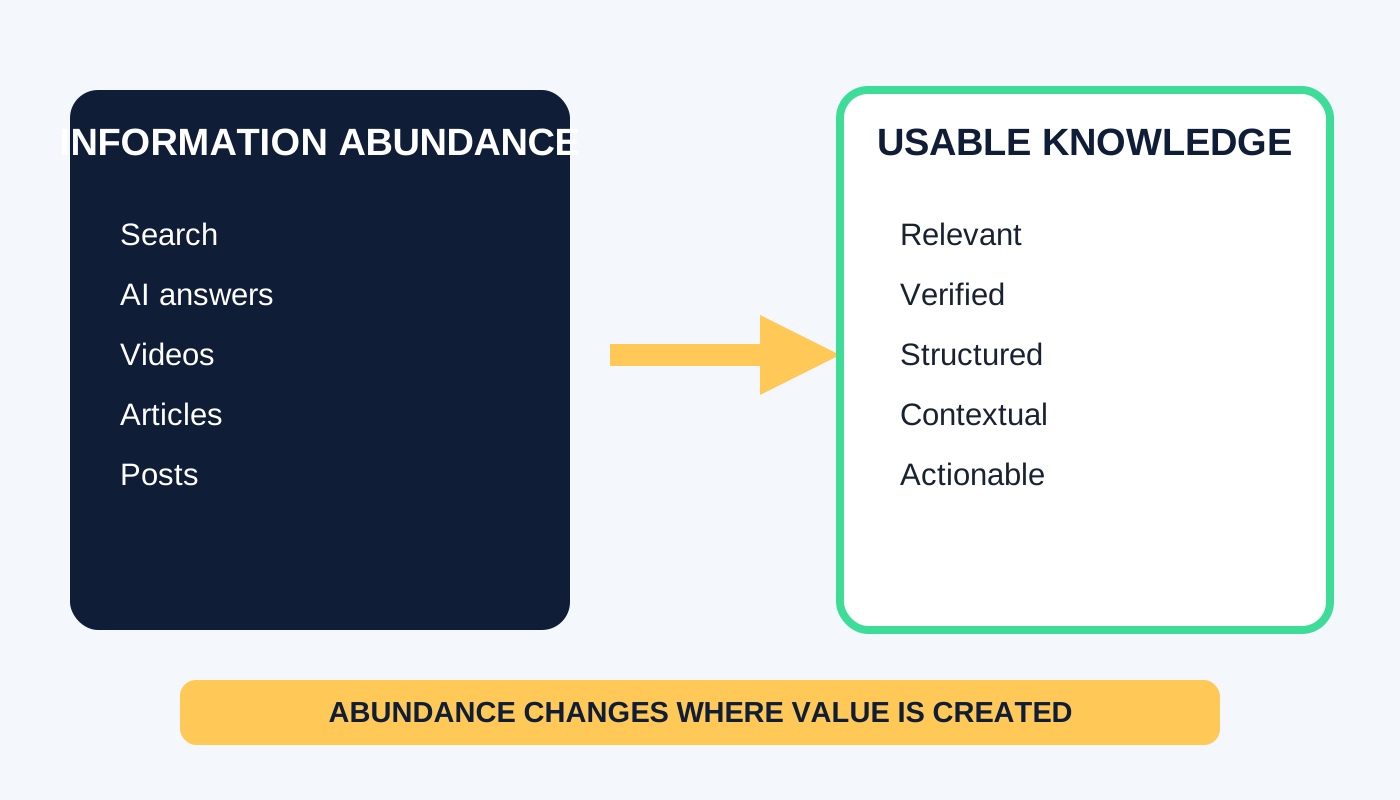 As information becomes abundant, differentiation can move toward relevance, verification, structure, context and actionability.
A useful way to think about the change is a stack. Raw information can be abundant. Filtering makes it relevant. Checking makes it more trustworthy. Context matches it to a situation. A process turns it into ordered action. A tool makes repeated action easier. Application produces evidence. Judgment helps someone adapt when the original recipe no longer fits.
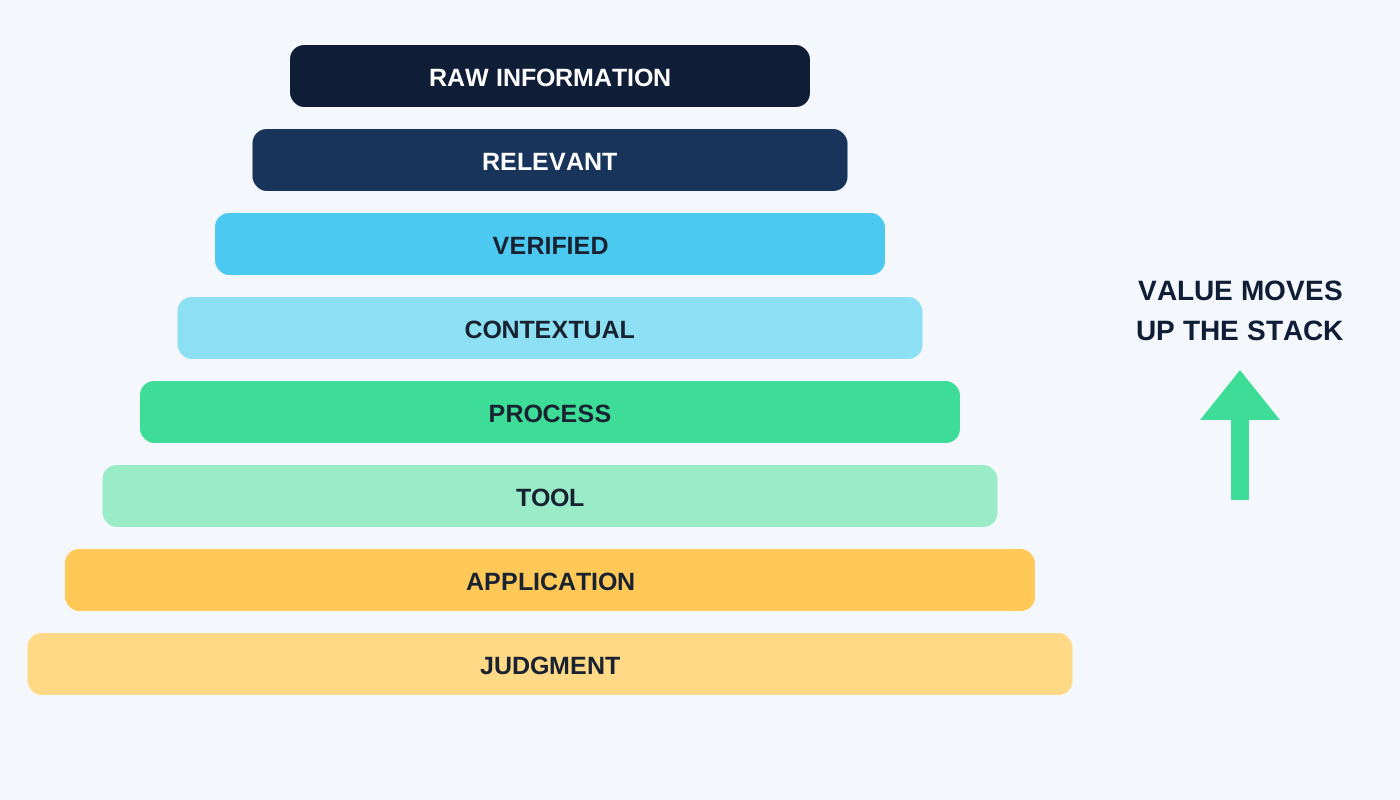 This is a conceptual model of practical usefulness, not a law saying each higher layer always commands a higher market price.
CORE IDEA WHEN INFORMATION BECOMES CHEAPER, CONTEXT, TRUST, STRUCTURE AND APPLICATION CAN BECOME MORE IMPORTANT.
VEZILL uses curation premium to describe the value created when someone reduces a large information space to the smaller set that matters for an outcome. The creator is not claiming secret facts. The useful work may be deciding what to exclude, what to keep, what order to use and what must be verified.
CURATION PREMIUM IN AN INFORMATION-RICH WORLD, KNOWING WHAT TO REMOVE CAN BE AS VALUABLE AS KNOWING WHAT TO ADD.
Twenty browser tabs may contain the same broad facts as one good package. Yet the package can combine explanation, process, checklist, template, examples and troubleshooting. VEZILL uses packaging premium for the usability created by turning scattered knowledge into a coherent resource.
“Create better content” is generic. “A weekly content system for a one-person Kenyan catering business selling through WhatsApp” is contextual. Industry, country, tool, role, experience, budget and goal can change what is useful. More specificity can mean higher relevance but a smaller audience.
A good resource can reduce search time, decision time, setup time and error correction. That does not give every minute a fixed monetary value. It simply recognizes that reduced friction can be useful.
Paid does not mean correct. Stronger resources earn trust through credible sourcing, dates, versions, examples, boundaries, verification steps and updates. Confidence without accuracy can be dangerous; the value comes from making important claims easier to check.
VEZILL can summarize the thesis with a deliberately non-scientific decision model:
VEZILL CONCEPTUAL FRAMEWORK VALUE ≈ (RELEVANCE × TRUST × STRUCTURE × APPLICABILITY) ÷ (TIME + FRICTION)
This is not an economic equation and should never be used to calculate a price. It forces a better question than “How many pages is it?” A tiny checklist can have high practical value if it is relevant, trustworthy and usable. A 500-page document can have low practical value for an urgent narrow task if the answer is buried.
PRICING PRINCIPLE VALUE IS NOT MEASURED IN PAGES.
A one-page resource can represent years of pattern recognition. A wedding photographer who has covered hundreds of events may know which shots are forgotten, where timelines fail, what backup equipment matters and which client questions prevent confusion. A well-designed wedding-day checklist can compress part of that experience into a reusable structure.
The buyer is not purchasing all those years of experience. They are accessing one carefully selected slice of what the photographer learned. Knowledge compression means turning extensive experience, research or repeated problem-solving into a smaller reusable structure without stripping away essential context.
The path is often: EXPERIENCE → PATTERNS → METHOD → DOCUMENTATION → TOOL / GUIDE / TEMPLATE → KNOWLEDGE PRODUCT. AI can assist extraction and formatting, but expertise, validation and responsibility still matter.
Useful know-how lives with accountants, chefs, mechanics, photographers, designers, farmers, teachers, developers, recruiters, event planners, office administrators, technicians, parents, craftspeople and small-business owners. A creator-economy lens can make valuable knowledge look like something owned by people with audiences. A knowledge-market lens asks: who has solved this problem repeatedly?
THE KNOWLEDGE FAMILIARITY GAP What feels obvious to an experienced person can be difficult to a beginner. The opportunity is to translate genuine know-how into beginner-friendly action—not to repackage public facts without adding value.
Digital distribution can support narrower niches than traditional mass publishing. A broad “Excel course” serves a large topic; an “Excel inventory tracker for small restaurants” serves a smaller group with a clearer need. “Photography” is broad; “indoor product photography with one phone and one light” is bounded. “Farming” is broad; “record-keeping spreadsheet for a small poultry farm” is specific.
Many individually small knowledge needs can exist alongside a few huge subjects. The opportunity is never guaranteed—some niches are too small, easy to substitute or difficult to reach—but digital distribution makes experimentation with niche knowledge more feasible.
Generic global knowledge is useful, but tax processes, payments, business registration, procurement, agriculture, ecommerce and employment systems can depend heavily on place. Someone living inside a local environment may understand details a generic global article misses.
Local does not mean locally trapped. A Kenyan specialist might package knowledge about Kenyan sourcing, agriculture, tourism, payments or business procedures for a global niche that needs that context. The internet allows local expertise to travel, while accuracy, jurisdiction and freshness remain essential.
The Quick Knowledge Economy is not a promise that anyone can create a PDF and become wealthy. Generic, inaccurate, outdated, badly packaged or unnecessary resources can fail. Products solving no meaningful problem can fail. Resources easily replaced by a one-sentence AI answer can fail. Products without trust or discovery can fail.
QUALITY BAR THE ECONOMY REWARDS USEFULNESS — NOT FILE CREATION.
AI intensifies this. If a generic beginner guide can be generated in seconds, creators need stronger differentiation: original experience, tested processes, real examples, useful tools, templates, data, local context, judgment, verification and maintenance. AI does not necessarily eliminate knowledge products; it can reduce the value of lazy, undifferentiated ones.
AI can also help experts interview themselves, extract a process from notes, organize steps, draft checklists, generate alternative explanations, translate, improve accessibility and maintain multiple formats. A responsible workflow is EXPERT EXPERIENCE → AI-ASSISTED EXTRACTION → STRUCTURED KNOWLEDGE → HUMAN VERIFICATION → KNOWLEDGE PRODUCT.
Human verification becomes more important as consequences rise. Medical, legal, financial, cybersecurity, tax, electrical, structural and child-safety information require stronger sourcing, professional boundaries, jurisdiction and qualified review where appropriate.
VEZILL’s What Are You Trying to Do? starts from the outcome rather than the subject. That has marketplace implications. Traditional education discovery often begins with “What do you want to learn?” Quick Knowledge discovery can begin with “What are you trying to do?”
“Learn graphic design” becomes “remove a background from 100 product photos.” “Learn Excel” becomes “calculate monthly employee overtime.” “Learn marketing” becomes “create my first WhatsApp promotion.” The task is not always the whole learning journey, but it can be the most useful entry point.
Focused learning can become fragmented if a learner collects disconnected tutorials. But modular knowledge does not have to be random. “Write a proposal,” “price a service,” “build a portfolio” and “onboard a client” are separate modules that can combine into broader freelance capability.
The design challenge is to connect modules so users know what comes before, what comes next and when they need deeper foundations. A future knowledge graph could map “start a newsletter” into choosing a platform, creating a landing page, connecting a domain, writing a welcome email, publishing, attracting subscribers and analyzing results. That is future product thinking, not a claim about a current VEZILL feature.
A search engine traditionally returns documents. An AI assistant can synthesize an answer. A Quick Knowledge platform can aim to surface a structured resource designed around completing the task. None automatically guarantees truth.
A useful future direction for VEZILL is therefore not simply “more files.” It is better outcome-based discovery: from “find information” toward “find what helps me do this.”
When production becomes easier, trust signals become more important. A knowledge marketplace can consider creator identity, relevant experience, previews, citations, update dates, version information, usage examples, reviews and clear limitations. These are design considerations, not a claim that every one is already implemented on VEZILL.
Trust should be proportional. A Canva formatting checklist does not require the same verification regime as medical guidance. The consequence of error should determine how much evidence, professional review and warning a resource needs.
Software interfaces, APIs, tax rules, platform policies, advertising systems and AI tools can change quickly. Cooking fundamentals, basic mathematics and many communication principles may change much more slowly. It is tempting to give every topic a precise “knowledge half-life,” but most practical topics do not have a defensible universal number.
A better distinction is fast-changing knowledge, which needs dates, versions and updates, versus slow-changing knowledge, which may remain useful longer. For changing topics, maintenance becomes part of the product. The creator may need to become a maintainer of knowledge.
Quick Knowledge can help someone understand, begin, complete, troubleshoot or decide around a bounded task. It cannot compress professional judgment, years of experience, complex foundations or supervised practice into twenty minutes.
BOUNDARY QUICK ACCESS TO KNOWLEDGE ≠ QUICK MASTERY OF A PROFESSION.
A focused knowledge product becomes more useful when seven conditions are strong. This is an original VEZILL framework, not a scientifically validated scoring system.
1. Specific Clear problem 2. Relevant Right audience and situation 3. Trustworthy Credible source or creator 4. Structured Easy to follow 5. Actionable Leads to something the user can do 6. Verified Includes evidence, checks or expected results 7. Maintained Updated when the subject changes
The examples below show why page count is a weak proxy for usefulness. Value depends on context, quality and consequence.
| Broad Subject | Quick Knowledge Need | Useful Format | Why It Has Value |
|---|---|---|---|
| Excel | Calculate overtime | Spreadsheet + guide | Reduces repeated manual calculation |
| Word | Reusable proposal layout | Template | Avoids rebuilding formatting |
| Canva | Prepare artwork for print | Checklist | Clarifies export checks |
| Websites | Connect a custom domain | Task guide | Orders a multi-provider setup |
| AI | Reusable research workflow | Prompt system | Structures repeat work |
| Marketing | Plan a WhatsApp promotion | Checklist | Focuses one campaign |
| Freelancing | Scope a client project | Questionnaire | Reduces ambiguity |
| Photography | Prepare for a wedding day | Checklist | Compresses repeat experience |
| Cooking | Scale a recipe | Calculator + guide | Turns ratios into action |
| Parenting | Pack for a baby day trip | Checklist | Reduces forgotten essentials |
| Farming | Track poultry records | Spreadsheet | Creates consistent records |
| Business | Calculate unit cost | Calculator | Supports repeatable costing |
| Finance | Build a monthly budget | Spreadsheet | Structures recurring decisions |
| Ecommerce | Prepare listing photos | Shot list | Standardizes output |
| Job search | Prepare for behavioral interview | Framework | Targets one format |
| Productivity | Run a weekly review | Checklist | Makes routine repeatable |
| Data | Clean duplicate records | Task guide | Reduces accidental deletion |
| Social media | Plan a content calendar | Template | Turns planning into a system |
| Home maintenance | Assess a dripping tap | Decision guide | Helps identify escalation |
| Software | Migrate settings | Checklist | Protects prerequisites |
| Smartphones | Transfer photos | Task guide | Clarifies sequence |
| Logistics | Prepare dispatch handover | Checklist | Reduces missing details |
| Event planning | Confirm suppliers | Tracker | Centralizes deadlines |
| Customer service | Handle refund requests | Response framework | Creates consistency |
| HR | Onboard an employee | Checklist | Coordinates repeated tasks |
| Google Sheets | Shared expense tracker | Template + guide | Combines tool and instruction |
| Set up welcome sequence | Workflow map | Orders messages | |
| Presentations | Build client update | Template | Reduces layout decisions |
| Analytics | Weekly KPI report | Dashboard template | Focuses measurement |
| Retail | Count stock at closing | SOP + sheet | Standardizes process |
| Restaurant | Opening checklist | Checklist | Coordinates checks |
| Recruiting | Screen applicants | Scorecard | Makes criteria explicit |
| Design | Brand handoff package | Checklist | Prevents missing files |
| Coding | Set up project environment | Setup guide | Captures dependencies |
| Cybersecurity | Document account recovery | Internal SOP | Reduces confusion |
| Education | Revise one concept | Mini-guide + quiz | Targets a learning gap |
| Travel | Prepare trip documents | Checklist | Organizes requirements |
| Procurement | Compare supplier quotes | Comparison sheet | Structures decisions |
| Consulting | Run discovery call | Question framework | Captures context |
| Operations | Close a project | Closeout checklist | Prevents unfinished handoffs |
A buyer may value urgency, convenience, specificity, reduced search, practical tools and immediate applicability. But Quick Knowledge should not automatically mean cheap. A one-page industrial troubleshooting procedure can be more consequential than a long generic ebook. Price should reflect the problem, quality, market and rights—not page count.
A creator may already possess methods, templates, workflows, formulas, checklists and accumulated experience. Packaging makes part of that know-how transferable. This is not passive-income magic: creation, verification, positioning, discovery, support and maintenance can all require work.
Buyers need discovery; creators need distribution. A marketplace can attempt to reduce search friction, transaction friction and trust friction. VEZILL’s current public positioning describes it as a digital knowledge marketplace connecting people who know how with people who need to know how.
The strongest version of this economy is not a warehouse of static files. It is a feedback loop. Real-world experience produces know-how. Know-how is packaged. A user discovers it, learns, applies it and gets a result. Feedback reveals missing steps, confusing language or changing conditions. The package improves, which can strengthen trust and future discovery.
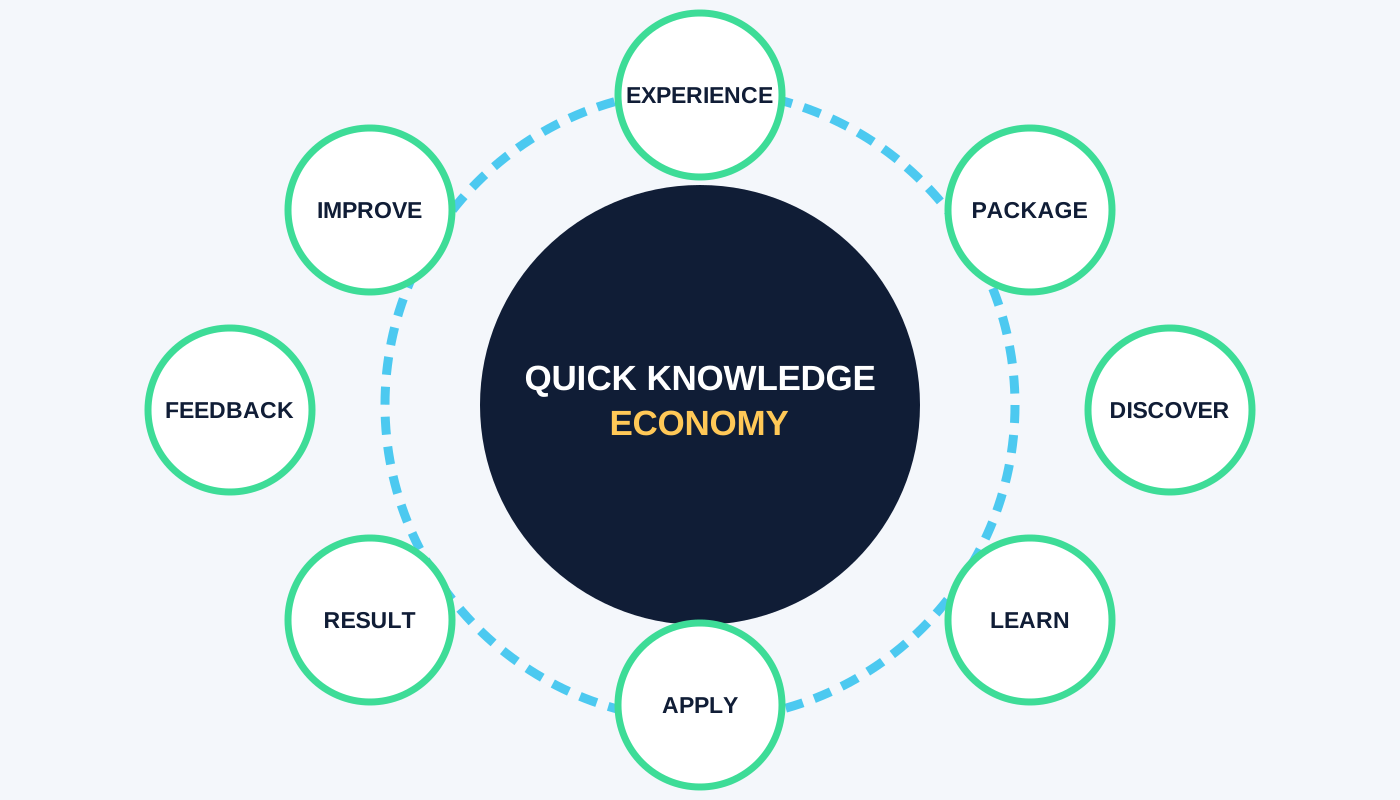 VEZILL conceptual flywheel: experience becomes a package, application creates feedback, and feedback can improve the maintained knowledge.
VEZILL’s About page frames the platform around people who know how and people who need to know how. Its FAQ defines Quick Knowledge as focused practical information for a specific task, problem or outcome. The strategic opportunity is to make that positioning deeper than “a marketplace for PDFs.”
VEZILL POSITIONING KNOWLEDGE IS THE VALUE. DIGITAL PRODUCTS ARE THE CONTAINER. THE MARKETPLACE IS THE DISTRIBUTION LAYER.
The VEZILL homepage can orient people around practical outcomes, while the VEZILL products page provides discovery for available knowledge products. The differentiation is not simply courses or ebooks. It is helping a person answer: “What are you trying to do?” and find knowledge whose granularity fits that task.
The existing series supports this logic. Where Can I Find Step-by-Step Guides? focuses on matching guides to tasks and checkpoints. Quick Knowledge vs Online Courses explains when broader structured learning is the better choice. These boundaries keep Quick Knowledge from becoming a claim that every problem can be solved with a tiny guide.
The most interesting future may be knowledge products that behave more like maintained tools than frozen documents. A software guide can carry a version. A tax checklist can state its jurisdiction and last verification date. A workflow can be revised when a platform changes. A template can improve from user feedback.
That creates a different creator role: not only author, but maintainer. It also creates a marketplace responsibility: make freshness, scope and trust easier to evaluate. The more AI lowers the cost of generic content, the more these signals can matter.
VEZILL’s term for an emerging digital environment where focused practical knowledge can be packaged, discovered and exchanged around specific tasks, problems and outcomes. It is not an established academic economic category.
No. Microlearning is primarily an instructional approach using small targeted learning units. Quick Knowledge is broader and can include guides, templates, spreadsheets, calculators, SOPs, prompt systems and toolkits.
Because usefulness can come from relevance, trust, structure, context and applicability—not simply length.
A packaged resource that transfers useful know-how, such as a guide, template, checklist, spreadsheet, process, tutorial, prompt system or toolkit.
People may pay for curation, structure, context, tools, verification, convenience and maintenance. Payment itself is not proof of quality.
AI makes generic information easier to generate and raises the quality bar. Experience, context, tested processes, tools, verification and maintenance can still differentiate useful products.
Many bounded practical tasks can be packaged if the creator has the right and competence to share them and the resource is accurate and responsible.
People can package legitimate knowledge they are competent and entitled to share. High-stakes fields may require qualifications, stronger review or professional oversight.
Credible authorship, relevant experience, sources, dates, versions, examples, limitations, verification steps and updates are useful trust signals.
No. It fits bounded tasks. Courses and deeper training are better when connected concepts, repeated practice, credentials or professional competence matter.
Separating useful components from a larger subject so a task, tool, checklist or process can be accessed independently when appropriate.
VEZILL describes itself as a digital knowledge marketplace connecting people who know how with people who need to know how.
The internet made information abundant. AI is making information even easier to produce, summarize and retrieve. That does not make useful knowledge worthless. It changes the competitive question. When generic explanation is cheap, people may care more about whether knowledge is relevant, trusted, contextual, structured, usable and maintained.
The Quick Knowledge Economy is not a theory that everyone should learn less. It is a theory of fit. Sometimes the right unit is one answer. Sometimes it is a checklist. Sometimes it is a toolkit. Sometimes it is a full course, apprenticeship, degree or years of professional practice. Good knowledge systems help people choose the depth that matches the problem.
FINAL PRINCIPLE THE QUICK KNOWLEDGE ECONOMY IS NOT ABOUT LEARNING LESS. IT IS ABOUT MAKING THE RIGHT KNOWLEDGE EASIER TO FIND, USE AND APPLY.
VEZILL’s opportunity is to make structured Quick Knowledge easier to discover without pretending structure removes judgment. ACCESS → LEARN → APPLY. Browse VEZILL products or return to the VEZILL practical knowledge hub.
Discover more articles you might be interested in
how to create your first knowledge product in one weekend
By Davie
how to build multiple digital products from one skill
By Davie
how to find problems people will pay you to solve
By Davie

How to turn a hobby into a digital product
By Davie
Get the updates, on newly released, popular & fast-moving MRR digital products
Up to Top
Comments All
Terry
@terry
It’s interesting how even small pieces of useful information can have so much value. You don’t always need a full course to learn something helpful—sometimes one simple tip is all you need to get started.
September 17,2026 At 06:04 PM