
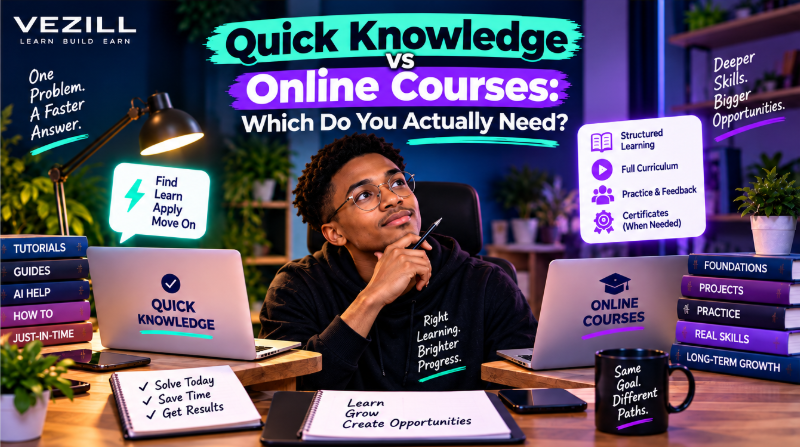
Sometimes you need one answer. Sometimes you need one task explained. Sometimes you need a real skill you can use repeatedly. And sometimes you need professional competence that cannot be built from isolated tutorials. The right choice is not “Quick Knowledge or courses?” It is: what level of capability does your goal actually require?
You need to create a PivotTable for a report tomorrow. Search results give you two very different options: a 12-minute tutorial explaining PivotTables, and a 22-hour Excel course covering formulas, data cleaning, charts, PivotTables, Power Query and more.
Which one should you choose?
If you only need one PivotTable for tomorrow's report, the focused tutorial may be enough. If your job now requires weekly spreadsheet analysis, the full course may become the smarter investment. If you want to become a professional data analyst, neither one tutorial nor one Excel course represents the whole learning journey.
The question is not “Which learning format is better?” The question is “What level of competence does my goal require?”
Quick Knowledge is usually better when you need to solve one specific, low-to-medium-risk problem immediately. An online course is usually better when you need connected knowledge, repeated practice and broader competence in a subject. If the skill involves professional responsibility or high-consequence decisions, structured training, supervised practice or recognized qualifications may be necessary. Many learners should use both: start with focused knowledge for an immediate task, then move into deeper learning when the skill becomes important or repetitive.
ONE TASK → QUICK KNOWLEDGE
REPEATED SKILL → COURSE + PRACTICE
PROFESSIONAL RESPONSIBILITY → DEEPER TRAINING
Quick Knowledge reduces unnecessary learning. It does not remove necessary learning.
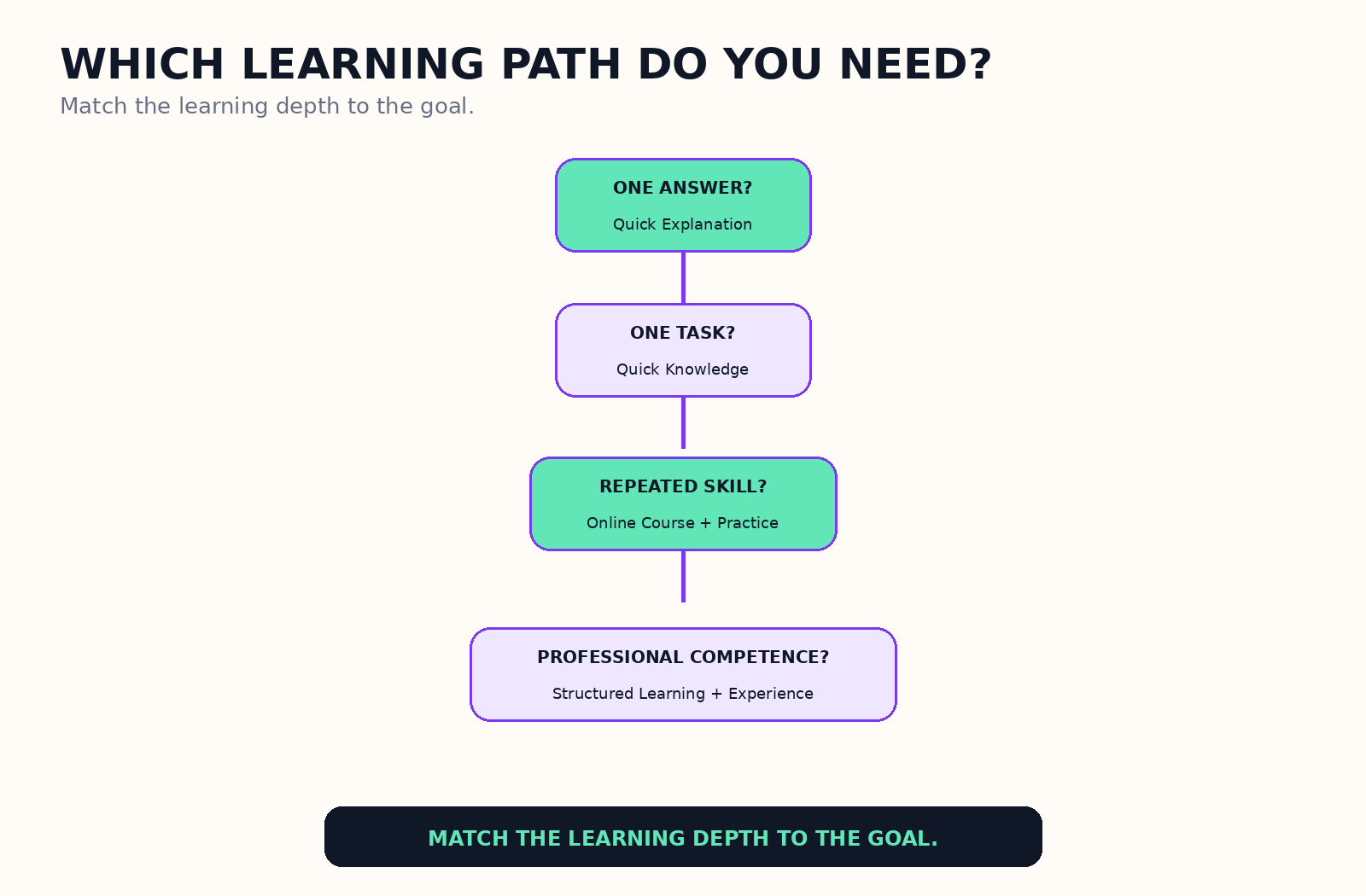 Match the depth of learning to the depth of capability you need.
Quick Knowledge is focused, task-specific learning designed to give you enough reliable knowledge to perform a particular action, solve an immediate problem, make a decision or take the next step without first studying an entire subject.
It is not instant expertise. It is not “learn anything in ten minutes.” It is a way to narrow the learning scope around a real outcome.
If your goal is “remove duplicate rows in Excel,” the knowledge requirement is narrow. If your goal is “become strong enough in Excel to work in business analytics,” the requirement is much broader.
An online course is a structured sequence of lessons designed to develop understanding or capability across a broader topic, usually through multiple concepts, examples, exercises, assessments or projects.
Online courses vary enormously. One may be a 30-minute mini-course. Another may be a three-hour workshop, a 20-hour self-paced program, a cohort experience, a university MOOC, a certificate course or a professional bootcamp.
The important point is structure: a good course gives you a map of a subject rather than only one answer.
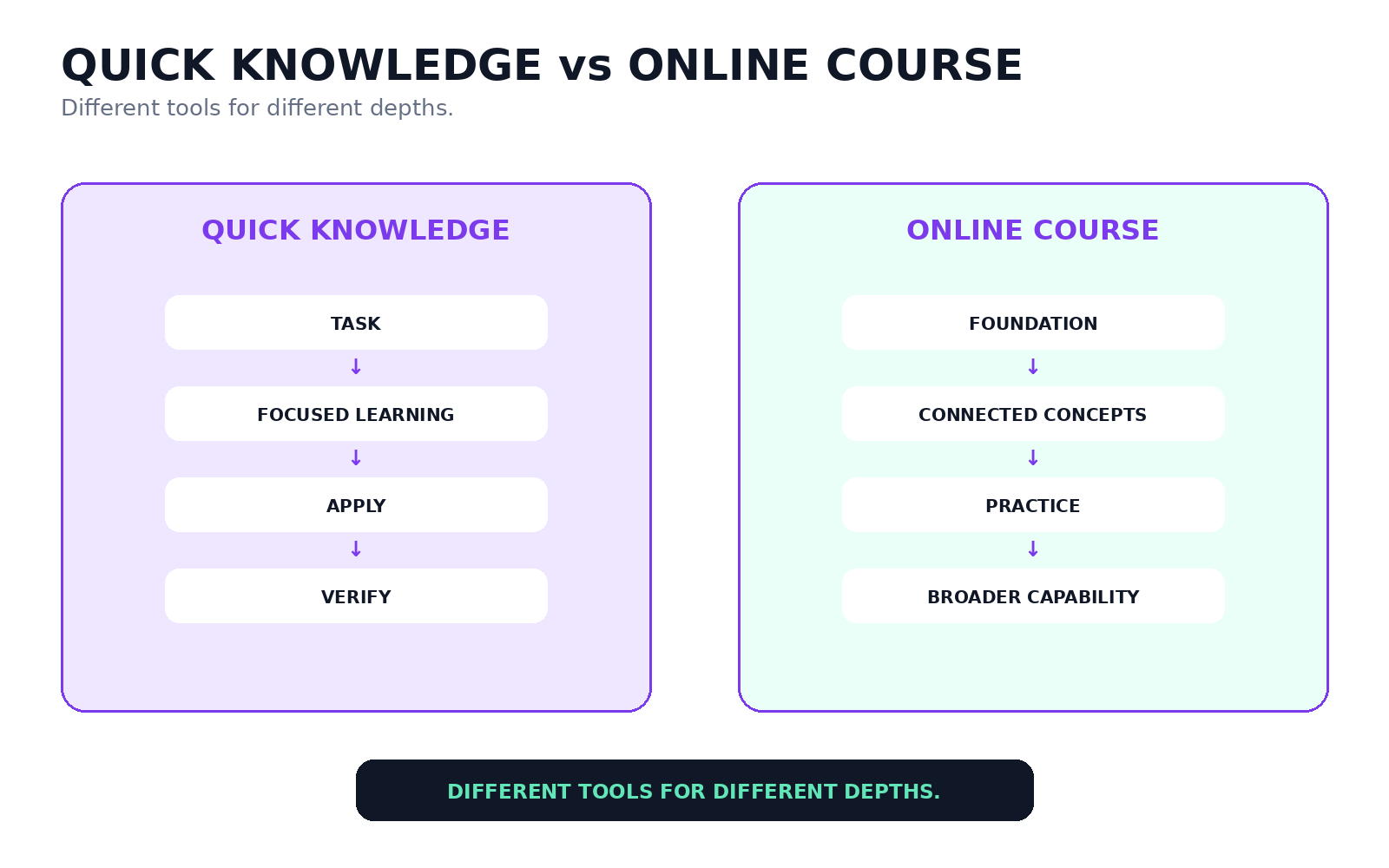 Quick Knowledge and courses solve different learning problems.
| Factor | Quick Knowledge | Online Course |
|---|---|---|
| Primary goal | Solve a specific problem | Build broader capability |
| Scope | Narrow | Broad |
| Time commitment | Usually lower | Usually higher |
| Structure | Task-driven | Curriculum-driven |
| Immediate application | Very high | Varies |
| Foundational knowledge | Limited | Usually stronger |
| Practice | Often limited | Can be substantial |
| Feedback | Depends on source | Depends on course |
| Assessment | Usually none | Sometimes included |
| Credential | Usually none | Sometimes available |
| Cost | Often low or free | Free to expensive |
| Best for | Immediate tasks | Repeated skills |
| Main risk | Missing context | Learning too much before applying |
| End goal | Do something | Understand and perform more broadly |
“I need to understand this.” Example: What does CTR mean? A quick explanation may be enough.
“I need to do this.” Example: Create UTM parameters for one campaign. Quick Knowledge can often work well.
“I need to do this repeatedly.” Example: Analyze marketing campaign performance every week. A course, projects and practice become more useful.
“I need to make reliable decisions across changing situations.” Example: work professionally as a digital marketer. That requires broader learning, practice, feedback and experience.
ANSWER → QUICK EXPLANATION → TASK → QUICK KNOWLEDGE → SKILL → COURSE + PRACTICE → PROFESSION → EXPERIENCE + CONTINUED DEVELOPMENT
Before choosing a tutorial, AI explanation, guide or full course, ask five questions:
The goal is not to make every decision mathematical. It is to stop choosing learning formats based only on price, course length or popularity.
This is a VEZILL decision aid, not a scientifically validated educational assessment.
| Factor | 0 | 1 | 2 |
|---|---|---|---|
| Frequency | Once | Occasionally | Repeatedly |
| Complexity | Simple isolated task | Several connected concepts | Broad interconnected skill |
| Consequence | Low | Moderate | High |
| Foundation | Little prerequisite knowledge | Some | Substantial |
| Credential | Unnecessary | Useful | Required or strongly expected |
0–3: Quick Knowledge may be enough. 4–6: combine focused learning with structured learning. 7–10: a course or deeper training is likely the better starting point.
Focused learning usually wins when the problem is narrow, the outcome is clear and mistakes are easy to detect or reverse.
SMALL PROBLEM + CLEAR OUTCOME + LOW CONSEQUENCE = FOCUSED LEARNING OFTEN WINS.
Courses become more useful when concepts depend on one another and the learner needs to perform repeatedly.
Learning Excel for employment, graphic design, digital marketing, data analytics, web development, accounting fundamentals, cybersecurity, programming, video editing, UX/UI, sales or project management usually benefits from structured progression.
You can learn individual pieces separately, but eventually you need a mental model of how the pieces connect.
Quick Knowledge can fail when the learner asks the wrong question because they lack the broader map.
Someone may search: “How do I increase Facebook ad conversions?” But perhaps the real problem is poor tracking, a weak offer, an unsuitable landing page, insufficient data or bad creative.
Quick Knowledge answers the question you ask. A good course can teach you which questions to ask.
This is one of the strongest reasons structured learning matters. It builds the mental model that helps you diagnose problems rather than patch symptoms.
Courses can fail too. Some are outdated, excessively long, poorly taught, highly theoretical or almost entirely passive video. Some contain no projects or feedback. Sometimes the learner begins treating completion as the goal.
Course completion ≠ competence.
A person can watch 40 hours of lessons and still struggle to perform a real task independently. Courses become valuable when knowledge is applied, tested, corrected and revisited.
Watching someone perform a task can produce a powerful feeling of familiarity.
WATCH → UNDERSTAND → FEEL CONFIDENT
But competence is built more like:
DO → FAIL → CORRECT → REPEAT
After a tutorial, close the video and try the task yourself. If you cannot reproduce the process without copying every step, you may understand the demonstration without owning the skill.
Learning can become a form of procrastination: “I will start after this course.” Then another course. Another certificate. Another playlist.
The better cycle is:
LEARN → APPLY → DISCOVER GAP → LEARN AGAIN
rather than:
LEARN → LEARN → LEARN → SOMEDAY APPLY.
The opposite problem is collecting disconnected fragments: tutorial A, TikTok B, AI answer C, YouTube D, Reddit comment E.
You may solve ten isolated problems without understanding how they relate. At that point, a structured course can reduce confusion by giving the field an order.
QUESTION → QUICK ANSWER → QUICK KNOWLEDGE → PRACTICE → COURSE → PROJECTS → FEEDBACK → EXPERIENCE → COMPETENCE
Not everyone needs every rung for every problem. You might stop after Quick Knowledge for a one-time task. For a career skill, you are likely to climb much farther.
Quick Knowledge works best when it has a clear role. It can help you cross a small gap, test interest in a skill or get unstuck inside a larger learning journey. It becomes weaker when it is expected to replace foundations, feedback and repeated practice.
A useful progression is: first solve a narrow problem, then notice whether that problem belongs to a larger category you keep encountering. If it does, move from isolated fixes into structured learning. VEZILL's guide to what you can realistically learn in 30 days uses the same principle: narrow outcomes are easier to practise and prove than vague goals such as “learn everything about design” or “master data analytics.”
If that learning starts producing real work you can show, build evidence. VEZILL's article on building a portfolio without prior experience explains why honest demonstration projects can be more useful than collecting certificates without showing what you can do.
One reason tutorials feel so effective is that the expert is carrying much of the cognitive load for you. They have already chosen the right sequence, avoided common mistakes and interpreted the interface. While watching, the process feels obvious.
Independent performance is different. The moment the screen looks slightly different, a dataset contains an unexpected value, a client asks an unusual question or the software changes, you must decide what to do without the tutorial narrating each move.
This is where practice matters. A good test is to repeat the task with a new example. If you learned a spreadsheet formula, use different columns. If you learned how to design one social post, create another for a different message. If you learned one Git command, explain what state the repository should be in before and after running it.
The goal is not memorizing clicks. It is building a small mental model that survives variation.
For career switchers, the biggest advantage of Quick Knowledge may be exploration. You can experience a small piece of the real work before committing to a much larger learning path.
Someone curious about data analytics can clean a small dataset, build a basic chart and explain one observation. Someone curious about digital marketing can create a campaign brief and define how they would measure it. Someone curious about graphic design can create one social post and then critique its hierarchy, typography and spacing.
If the work feels interesting, you have a stronger reason to invest in a course. If it does not, you have learned something useful without committing months. VEZILL's article on skills you can learn online and turn into a business is helpful once you move from exploration into choosing a field worth developing more seriously.
And if you are still unsure which problems are worth learning to solve, see what problems people can solve online. The key is still competence: the ability to produce a useful outcome matters more than saying you watched a course.
A useful alternative to “buy the course first” is:
PROBLEM → QUICK KNOWLEDGE → APPLICATION → REPEATED NEED / INTEREST → COURSE → DEEPER PRACTICE
This is especially useful for career exploration. Before committing to months of data analytics training, clean one dataset. Before a graphic-design program, build one real social graphic. Before coding training, write one tiny script.
The goal is not qualification. It is sampling the work.
Foundational programming, cybersecurity, accounting, electrical work, advanced analytics, professional design principles and complex technical systems often punish fragmented understanding.
If isolated instructions can create dangerous misunderstandings, learn the foundations first.
AI makes focused learning more interactive. Instead of searching, reading and hoping one page matches your level, you can ask for a simpler explanation, another example, a quiz or a step-by-step breakdown.
ChatGPT's current Study Mode is explicitly designed to guide learners with questions, explain ideas in layers, check understanding, work with uploaded study materials and create practice questions. Google's Guided Learning in Gemini similarly emphasizes questions and step-by-step understanding rather than only giving a final answer.
That makes Quick Knowledge easier to personalize—but it does not make AI automatically correct.
AI writes a spreadsheet formula. You paste it. It works.
Did you complete the task? Yes.
Did you learn Excel? Maybe not.
Distinguish:
The immediate result works.
You understand why the method works.
You can adapt the method when conditions change.
AI can help you complete a task without helping you understand it.
After AI gives you an answer, ask:
If the answer is no, you may have completed the task without learning the skill.
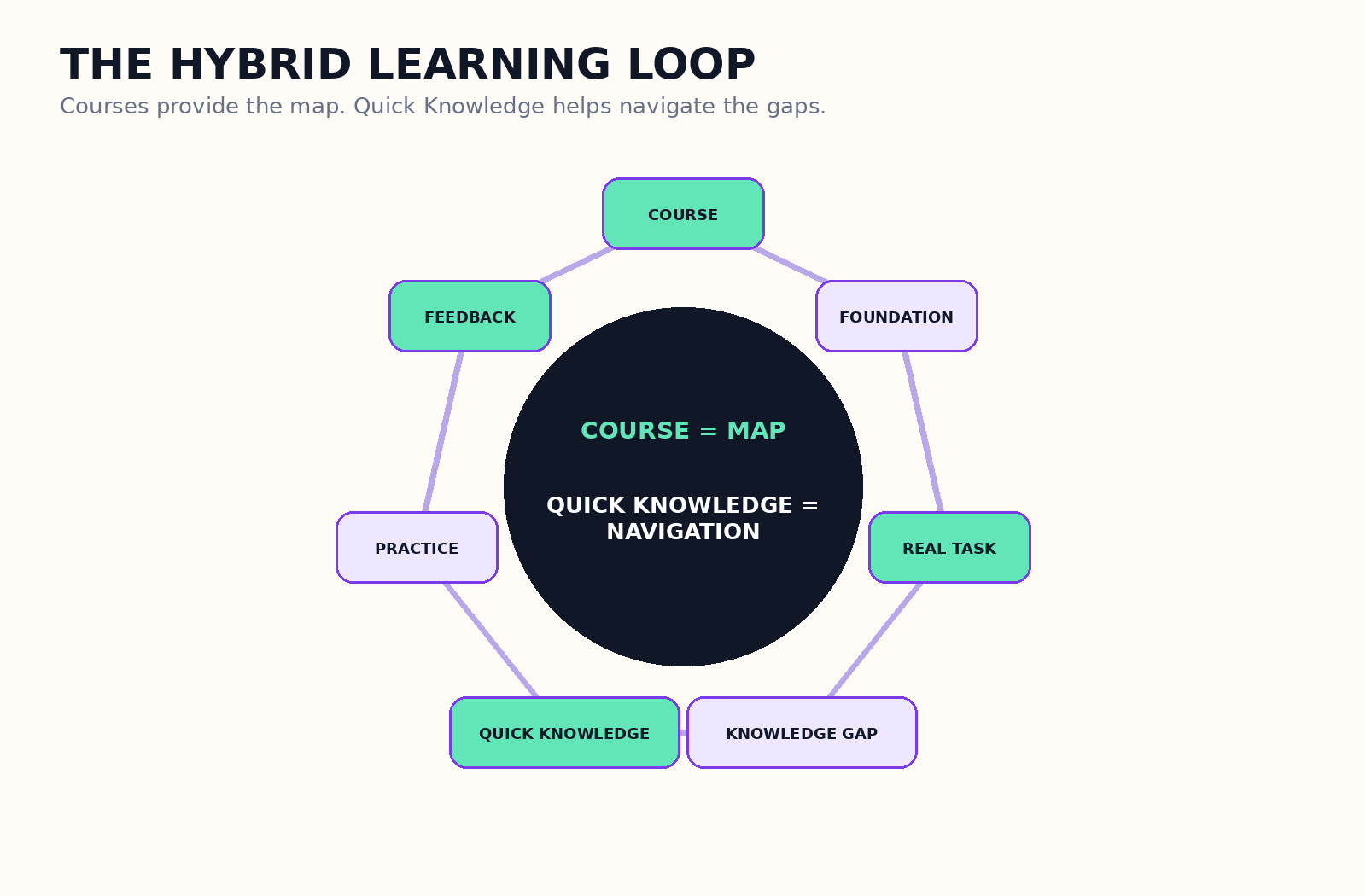 Courses provide the map; Quick Knowledge helps navigate specific obstacles; practice connects both.
COURSE → FOUNDATION → REAL TASK → KNOWLEDGE GAP → QUICK KNOWLEDGE → PRACTICE → NEXT GAP → QUICK KNOWLEDGE → COMPETENCE
This is often the strongest learning strategy. Courses give you the architecture of the field. Focused learning helps you deal with specific obstacles that appear during real work.
The practical lesson from established learning research is simple: durable learning usually requires more than exposure.
Retrieval practice asks you to recall information rather than reread it. Spacing revisits knowledge over time. Worked examples can reduce unnecessary cognitive load for beginners. Feedback helps correct errors before they become habits. Self-explanation forces you to articulate why a step makes sense. Transfer matters because real competence means applying knowledge in a new situation, not only repeating the original example.
You do not need to become a learning scientist to use these ideas. Ask yourself to explain the concept, practise it later, try a different example and check your result.
Whichever format you choose, convert knowledge into action quickly. A course without application becomes passive consumption. Quick Knowledge without repetition becomes temporary task support.
Use a simple loop: learn → perform → inspect → explain → repeat. “Inspect” means checking the result against an expected output, rubric, official documentation or feedback. “Explain” means being able to say why you used that method. “Repeat” means trying again in a different situation.
If you are a freelancer, this is also where learning starts becoming service capability. Before selling anything, make sure the skill is repeatable enough that you can define what you actually deliver. VEZILL's guide on packaging a freelance service shows how to move from “I know this tool” to a clear customer, problem, deliverable, scope and process.
That distinction protects clients as well as freelancers. VEZILL's research on problems small businesses pay freelancers to solve also makes clear that businesses buy useful outcomes, not your familiarity with an app.
An entrepreneur rarely needs professional-level mastery of every area inside the business. They need enough understanding to ask useful questions, make sensible decisions and recognize when a specialist is required.
That makes Quick Knowledge valuable for understanding one metric, one landing-page concept, one spreadsheet workflow or one AI-assisted process. But when the founder becomes responsible for something consequential—tax, cybersecurity, employee decisions, regulated data or significant advertising spend—the learning depth should increase.
This also applies to AI. VEZILL's article on how AI can support small businesses focuses on bounded practical use rather than assuming AI replaces broad business competence. Use AI to reduce friction; do not use it to hide what you do not understand.
A long course is not automatically thorough. A short course is not automatically superficial. Duration is only one design choice.
A useful course should make its learning outcome visible. Does it teach you to understand a concept, perform a workflow, build a project or prepare for a professional assessment? Are there exercises where you must make decisions rather than simply watch? Does the instructor show failure cases? Is the material current enough for the tools being taught?
For practical skills, projects are especially valuable because they reveal gaps the learner could not predict beforehand. This is also why a portfolio can become a better signal of capability than a completion badge alone.
If your eventual goal is to turn existing expertise into something teachable, VEZILL's article on turning work experience into a digital product is a useful reminder that structured knowledge is most valuable when it comes from a real method, not copied information.
Quick Knowledge is faster for one isolated task. A course can be faster across 100 related tasks.
If you learn 20 Excel features through 20 separate searches, you may eventually spend more time patching individual gaps than you would have spent learning the spreadsheet system properly.
THE REPEAT-USE RULE: IF YOU KEEP SEARCHING FOR THE SAME CATEGORY OF PROBLEM, STOP PATCHING AND LEARN THE SYSTEM.
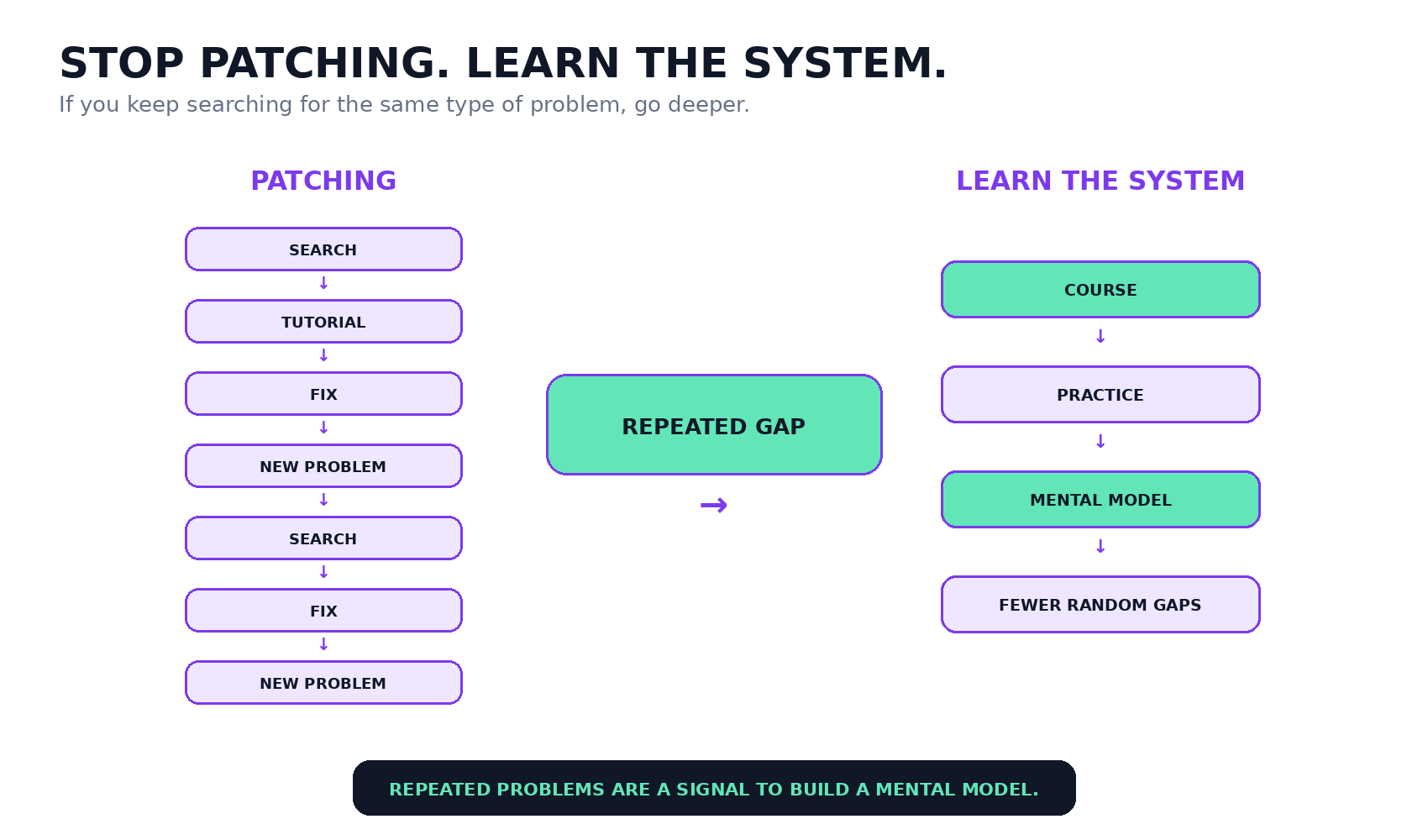 Repeated problems are often a signal that you need a system, not another isolated fix.
If you have had to search for help in the same skill area repeatedly—say around three meaningful times—ask whether the underlying skill now deserves structured learning.
This is a practical VEZILL heuristic, not a research-established threshold. “Three” is not magic. The point is recognizing repetition before your workflow turns into permanent troubleshooting.
Free does not automatically mean worse. Paid does not automatically mean better.
A free official documentation page may be better than an expensive outdated course for one software feature. A structured paid course may be far better than 100 disconnected free tutorials for a profession.
Compare organization, instructor expertise, curriculum, freshness, projects, feedback, community, assessment, credential relevance, support, accountability and accessibility.
Buy the outcome—not the number of hours.
Ask whether it is specific, accurate, current, credible, actionable and verifiable. A good focused resource should also warn you when the problem exceeds its scope.
| Situation | Best Starting Format | Why | When to Escalate |
|---|---|---|---|
| Create one invoice | Quick Knowledge | Narrow outcome | When managing accounts regularly |
| Learn Excel for employment | Course + projects | Many connected tasks | As job demands deepen |
| Resize a social image | Quick Knowledge | Low-risk task | If design becomes recurring work |
| Become a graphic designer | Structured course + portfolio | Principles and repeated practice matter | Continue with projects and feedback |
| Understand CTR | Quick explanation | One concept | If managing campaigns |
| Become a digital marketer | Course + projects | Multiple connected channels | As specialization increases |
| Fix WordPress spacing | Quick Knowledge | Specific interface problem | If maintaining sites professionally |
| Build websites professionally | Structured learning | Design, code, security and deployment | Ongoing practice |
| Create one SQL query | Quick Knowledge | Narrow query task | If data querying becomes recurring |
| Become a data analyst | Course + projects | Statistics, data cleaning and tools connect | Job-specific specialization |
| Create a simple budget | Quick Knowledge | Low-risk personal task | If managing business finance |
| Manage company accounting | Structured/professional learning | High consequence | Professional standards apply |
| Learn one Git command | Quick Knowledge | Specific operation | If collaborating on software regularly |
| Become a developer | Structured learning + projects | Foundations and debugging matter | Experience builds competence |
| Understand one AI prompt technique | Quick Knowledge | Narrow technique | If building workflows professionally |
| Build AI workflows professionally | Course + projects + technical depth | Data, automation, security and reliability | Production responsibility |
| Export a video correctly | Quick Knowledge | Specific setting | If editing professionally |
| Become a video editor | Structured learning + projects | Story, pacing, sound and software connect | Client experience |
Quick Knowledge is excellent for sampling a field before committing to months of training.
Clean one dataset before buying a data analytics course. Create one campaign brief before pursuing digital marketing. Make one social graphic before studying design. Build one tiny script before committing to coding.
Then ask: Did I enjoy the work? Do I want to go deeper?
Do not confuse sampling with qualification. One Python calculator does not make you a software developer. One CSV analysis does not make you a data analyst. One logo does not make you a graphic designer.
Entrepreneurs often need enough understanding to make decisions without becoming professionals in every function. They may need basic SEO, one landing page, simple analytics, a cash-flow explanation, email setup, ad metrics or an AI workflow.
The rule is proportionality: learn enough to understand and manage the task, then involve a professional when the consequence or complexity exceeds your competence.
Freelancers can use focused learning for adjacent gaps. A web designer may need basic copywriting. A graphic designer may need social-media sizing. A marketer may need basic spreadsheet analysis.
Learn adjacently. Sell competently.
Do not market yourself as a professional in a field because you completed one tutorial.
Workplace learning often happens inside the task: a new CRM feature, a report format, an Excel function, a presentation setting, meeting documentation or a project-management tool.
This is where “learning in the flow of work” becomes useful. But if the same questions keep appearing, employers and employees benefit from moving from ad hoc help toward structured training and documented processes.
Focused learning can help students understand one difficult concept, get another explanation, create practice questions, understand feedback or prepare for a practical task.
It should not replace foundational study or be used to complete assessed work dishonestly. AI-generated answers are especially risky when the learner never checks why they are correct.
The decision in Kenya is still the same: match the learning format to the goal. A university student who needs one Excel function may benefit from focused help. A job seeker trying to become a data analyst needs broader structured learning and projects. A small-business owner may need one WhatsApp marketing setup; a marketing employee responsible for campaign performance may need deeper training.
Mobile access, online learning, TVET, university programs and practical short courses create multiple routes. Cost, internet access, device constraints, certification relevance and employment goals can all affect the choice.
Kenya should not be treated as representative of all Africa. Learning access, regulation, devices and credentials vary significantly between countries.
| Situation | Best Start | Why |
|---|---|---|
| University student needs one Excel function for an assignment | Quick Knowledge | The gap is narrow; the student should still understand and follow academic rules. |
| Job seeker wants data analytics as a career | Course + projects | Excel, SQL, data cleaning, visualization and analytical thinking connect. |
| Small-business owner wants to set up one WhatsApp marketing workflow | Quick Knowledge first | One bounded setup may solve the immediate need. |
| Marketing employee now responsible for campaign performance | Structured course + work practice | Measurement, channels, creative, conversion and analytics interact. |
| Freelancer needs to format a client proposal professionally | Quick Knowledge | Specific document task with easy verification. |
| Cyber attendant repeatedly handles Word, Excel and document-conversion problems | Structured computer applications learning | Repeated demand makes a broader mental model efficient. |
| Entrepreneur needs one landing page for a test | Quick Knowledge or focused workshop | Validate the idea before investing in a full web-development path. |
These are illustrative scenarios, not prescriptions for every learner. Costs, device access, employer expectations and credential requirements vary by role.
Once someone becomes competent at a repeated problem, they may eventually organize that knowledge into a guide, checklist, tutorial or training resource. That is a different step from learning the skill itself.
VEZILL's article on what you can create and sell online using AI shows how knowledge can be turned into different digital formats. The important sequence is still learn → practise → verify → organize—not generate first and hope expertise appears later.
If AI is used during creation, VEZILL's digital product with AI workflow emphasizes validation and human review. That same standard should apply to educational content: do not teach what you cannot verify.
The immediate-task versus broader-skill distinction can be seen in current Inceptor programs. Someone who needs one marketing answer may use Quick Knowledge; someone seeking broader digital-marketing capability can consider a structured Digital Marketing course. The same applies to Data Analytics and Graphic Design with AI.
Quick Knowledge solves the immediate task. Structured training builds the broader skill.
Quick Knowledge is focused, task-specific learning designed to help you solve one immediate problem or perform one action without first studying the entire subject.
No. Quick Knowledge is better for narrow tasks; courses are better when you need connected knowledge, repeated practice or broader competence.
Take a course when you need the skill repeatedly, concepts depend on one another, mistakes matter or you need a portfolio, assessment or credential.
Yes, but reliable skill still requires structured practice, feedback and increasing difficulty even if you learn through tutorials, projects or mentorship instead of a formal course.
They can be when the curriculum is current, structured and aligned with your goal. Price alone does not determine quality.
For some skills, high-quality YouTube resources can support substantial learning. The main risk is fragmented progression and limited feedback.
Not universally. AI can explain, quiz and adapt learning, but structured courses may provide curriculum, projects, assessment, feedback and credentials that AI alone does not replace.
Yes, especially for explanations, examples and practice, provided you verify important information and actively test your understanding.
If the task repeats, errors carry greater consequences, you keep searching for similar problems or you need professional responsibility, go deeper.
Learn the minimum reliable foundation, perform a real task, get feedback, identify the next gap and repeat.
For one low-risk task, tutorials can be ideal. For a field with connected foundations, a structured beginner course may save time and confusion.
They can help build skills, but employers may also look for projects, experience, qualifications and proof that you can perform the work. The value depends on the field and course.
Do not ask, “Which learning format is best?” Ask, “What am I trying to become capable of?”
Need an answer? Get an answer.
Need to perform one task? Use Quick Knowledge.
Need a repeatable skill? Use structured learning and practise.
Need professional competence? Build foundations, get feedback, gain experience and meet the standards of the field.
THE BEST LEARNING METHOD IS THE ONE THAT MATCHES THE DEPTH OF THE PROBLEM YOU ARE TRYING TO SOLVE.
Discover more articles you might be interested in
Learn where to find reliable step-by-step guides online, how to choose the right tutorial for your task, check whether it is current and follow instructions safely.
By Davie
Stop searching broad topics and start finding the exact knowledge you need. Learn how to define your problem, search smarter, choose reliable sources, verify answers and take action.
By Davie
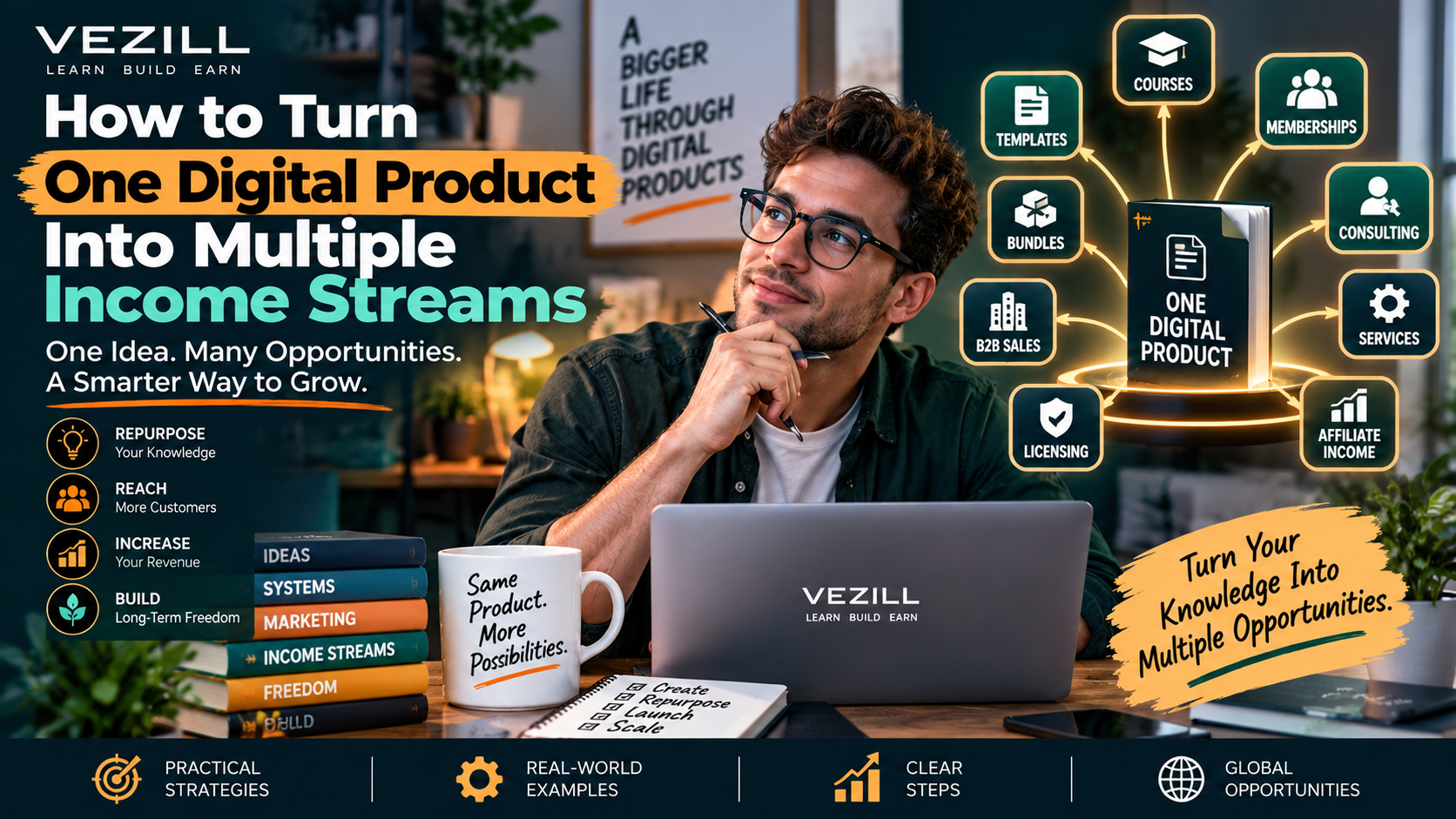
Learn how to turn one useful digital product into multiple income streams through premium versions, bundles, courses, licensing, services, subscriptions, B2B sales and complementary products.
By Davie
Can selling digital products become a sustainable long-term business? Learn what makes the model durable, why products fail, how AI changes the market and how to build recurring value.
By Davie
Get the updates, on newly released, popular & fast-moving MRR digital products
Up to Top
Comments All
Mike
@mike
Not everything needs a full online course. Sometimes you just need a quick answer that helps you get something done, and this made that difference really clear. It’s a good reminder to choose what actually fits what you’re trying to learn.
September 17,2026 At 05:50 PM