

Millions of people complete online courses, watch tutorials and collect certificates, yet still cannot explain how what they learned will produce income. The missing link is often not another course. It is the ability to connect skill → problem → customer → offer → proof → sale.
An online skill becomes commercially useful when it changes something a customer values: it attracts buyers, saves time, reduces waste, improves communication, makes a decision clearer or helps someone learn faster. This article will help you choose such a skill and turn it into a service, productised offer or digital product—without pretending that a certificate alone creates a business.
The strongest skills you can learn online and turn into a business include digital marketing, graphic design, web and no-code development, software development, data analysis, AI workflow implementation, video production, writing and research, teaching, and business operations or virtual assistance. The best choice is not automatically the most technical or highest-paid skill. It is the one that sits where four things meet: a problem people already pay to solve, work you can practise repeatedly, proof you can create without waiting for employment, and customers you can realistically reach. Start with one customer group, one recurring problem and one modest offer. Learn the fundamentals, complete a useful project, show the result, ask potential buyers for feedback and attempt a small sale. That is how online learning begins to become a business rather than another unfinished course.
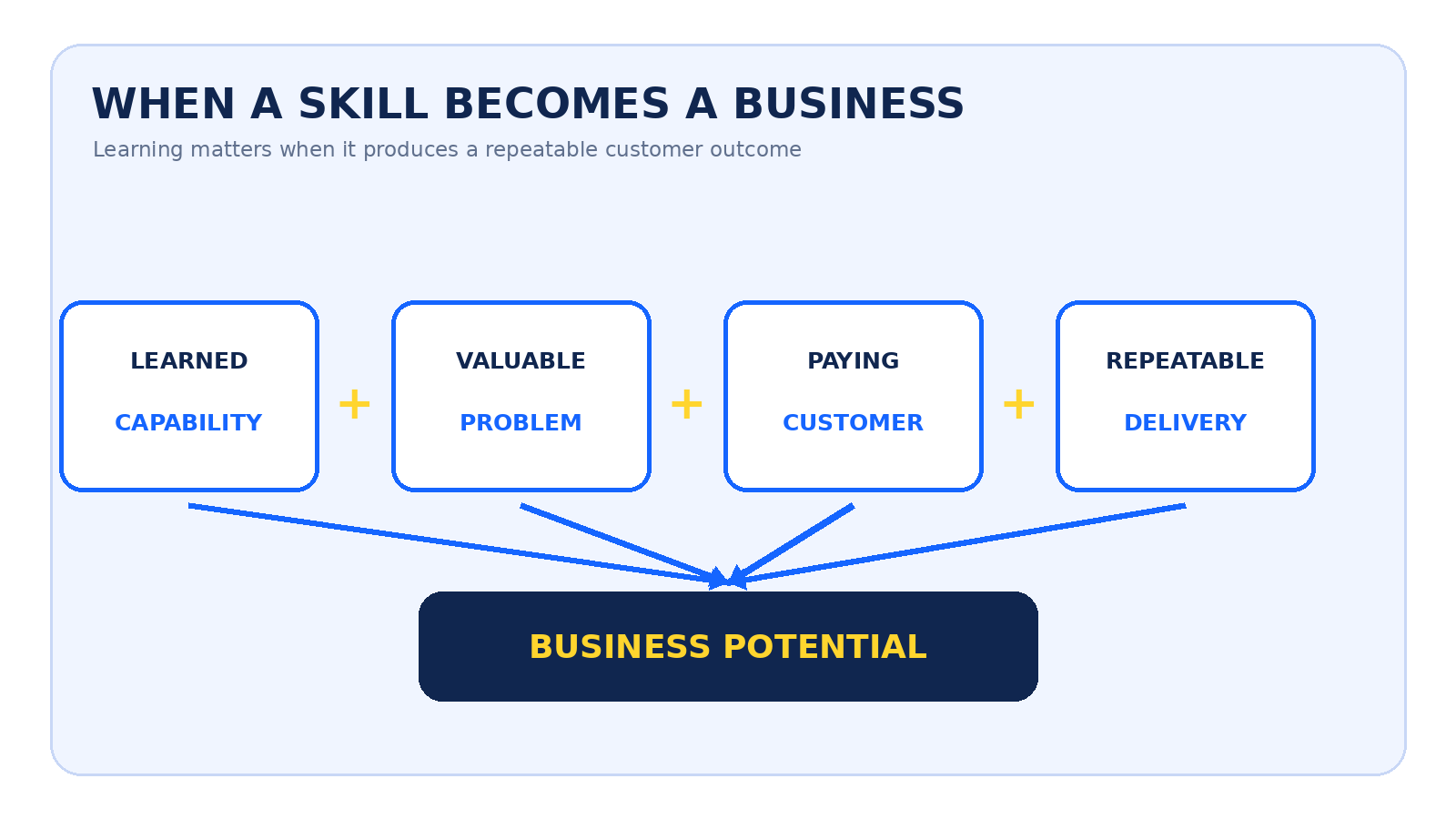 A formula showing how a learned capability, valuable problem, paying customer and repeatable delivery create business potential
A skill becomes commercial when it connects to a buyer, an outcome and repeatable delivery.
People rarely pay for skills in isolation. A restaurant does not buy “social media”; it buys better visibility and more bookings. A retailer does not buy “Excel”; it buys clearer stock information. A coach does not buy “graphic design”; she buys visual materials that make her offer credible. The tool matters, but the outcome explains the purchase.
Here is a useful VEZILL definition:
A business-ready skill is a learnable capability that can be applied repeatedly to solve a clear problem for a specific customer at a price higher than the cost of delivering the solution.
This definition separates four ideas that are often mixed together. Market demand asks whether buyers care about the problem. Learning difficulty asks how long it may take to become competent. Business potential asks whether the work can be packaged and sold reliably. Personal suitability asks whether you can tolerate and improve at the work. A popular skill can still be a poor choice for you, and a narrow skill can become a strong business when attached to an urgent niche problem.
Current evidence supports learning a combination of technical and human capabilities. The World Economic Forum’s Future of Jobs Report 2025—based on more than 1,000 employers representing over 14 million workers—places AI and big data, networks and cybersecurity, and technological literacy among the fastest-growing skill areas. It also highlights analytical thinking, creative thinking, resilience, leadership and collaboration. Coursera’s 2026 Job Skills Report, drawing on nearly six million professionally motivated enterprise learners, similarly emphasises AI built on technical foundations and human judgement. The lesson is not “learn AI instead of everything else.” It is combine a useful domain skill with judgement, communication and responsible AI use.
Vezill’s overview of AI and digital skills for work and income offers a useful starting map, but your final choice should be tested against a real buyer.
The VEZILL Six-Part Skill-to-Business Test helps you compare ideas before investing months in them. Score each factor from one to five.
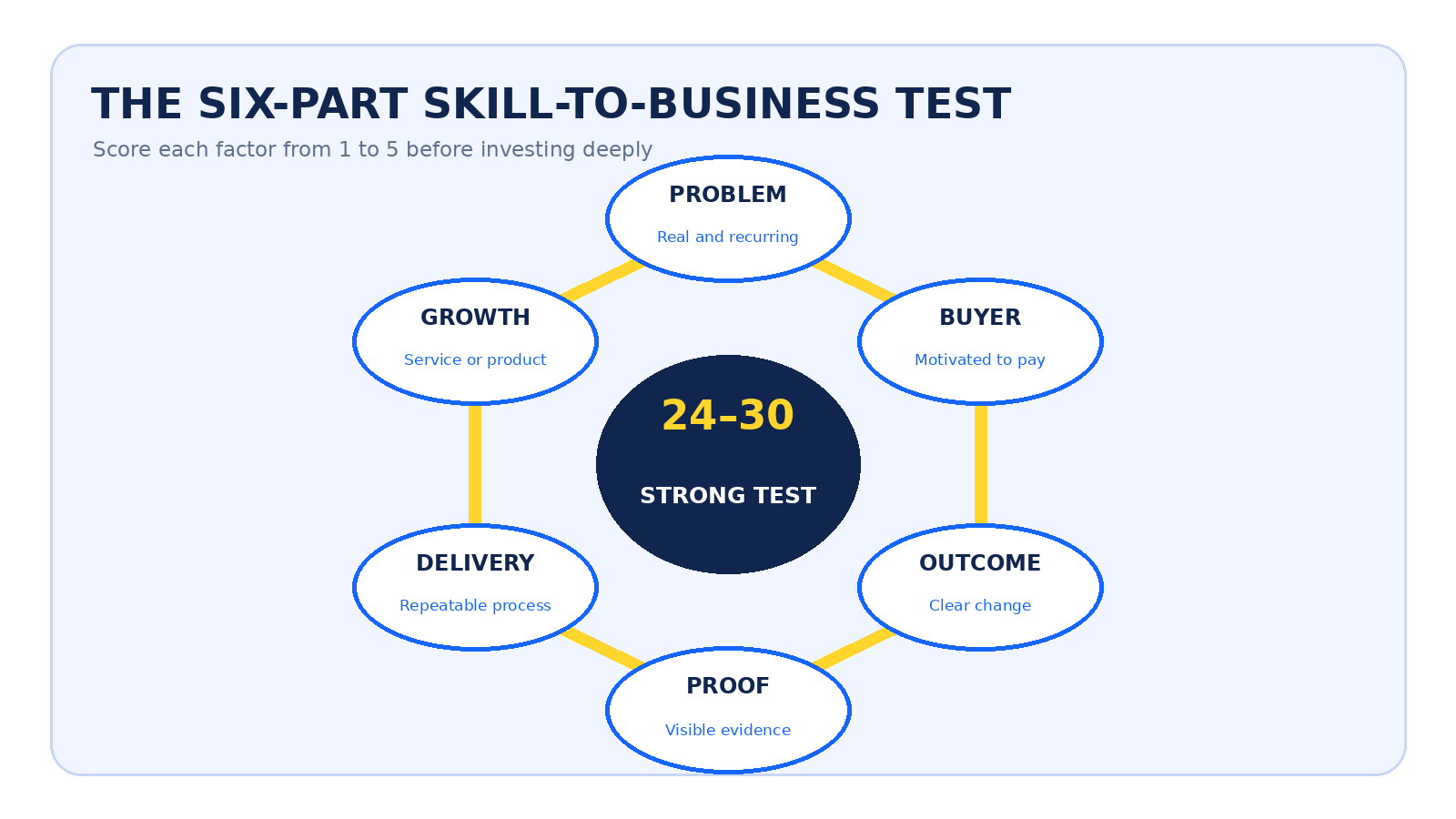 A six-segment hexagonal framework showing problem, buyer, outcome, proof, delivery and growth
The VEZILL Six-Part Skill-to-Business Test evaluates more than online popularity.
A score below 18 suggests weak or unclear potential. A score from 18 to 23 suggests the idea needs better positioning, proof or customer access. A score from 24 to 30 suggests strong potential worth testing. This is an editorial decision framework—not a scientific forecast or promise of profitability.
Imagine learning presentation design. “I make slides” is unclear. “I redesign investor presentations for early-stage African startups that need to explain their business clearly” identifies a buyer, problem and outcome. You can build proof by redesigning a public deck, package delivery into a ten-slide offer and later grow through templates or a monthly presentation service. The underlying design skill did not change; the commercial definition did.
The simplest starting model is a service: you perform work for one customer. It produces direct feedback and helps you understand what buyers actually value. Examples include editing a video, setting up email automation or designing a landing page.
A productised service turns repeated custom work into a defined package with a clear scope, process and deliverable: “four short-form videos every month,” “a five-page business website delivered in ten days,” or “a monthly sales dashboard.” It is still a service, but it becomes easier to explain, price and deliver.
A digital product packages knowledge, tools or repeatable work into a downloadable or online asset such as a template, checklist, guide, prompt pack, spreadsheet, course or code component. It can be sold more than once, but that does not make sales automatic. Product businesses still require validation, positioning, distribution, support and improvement. Vezill’s explanation of why many digital products fail to sell shows why production without customer understanding is risky.
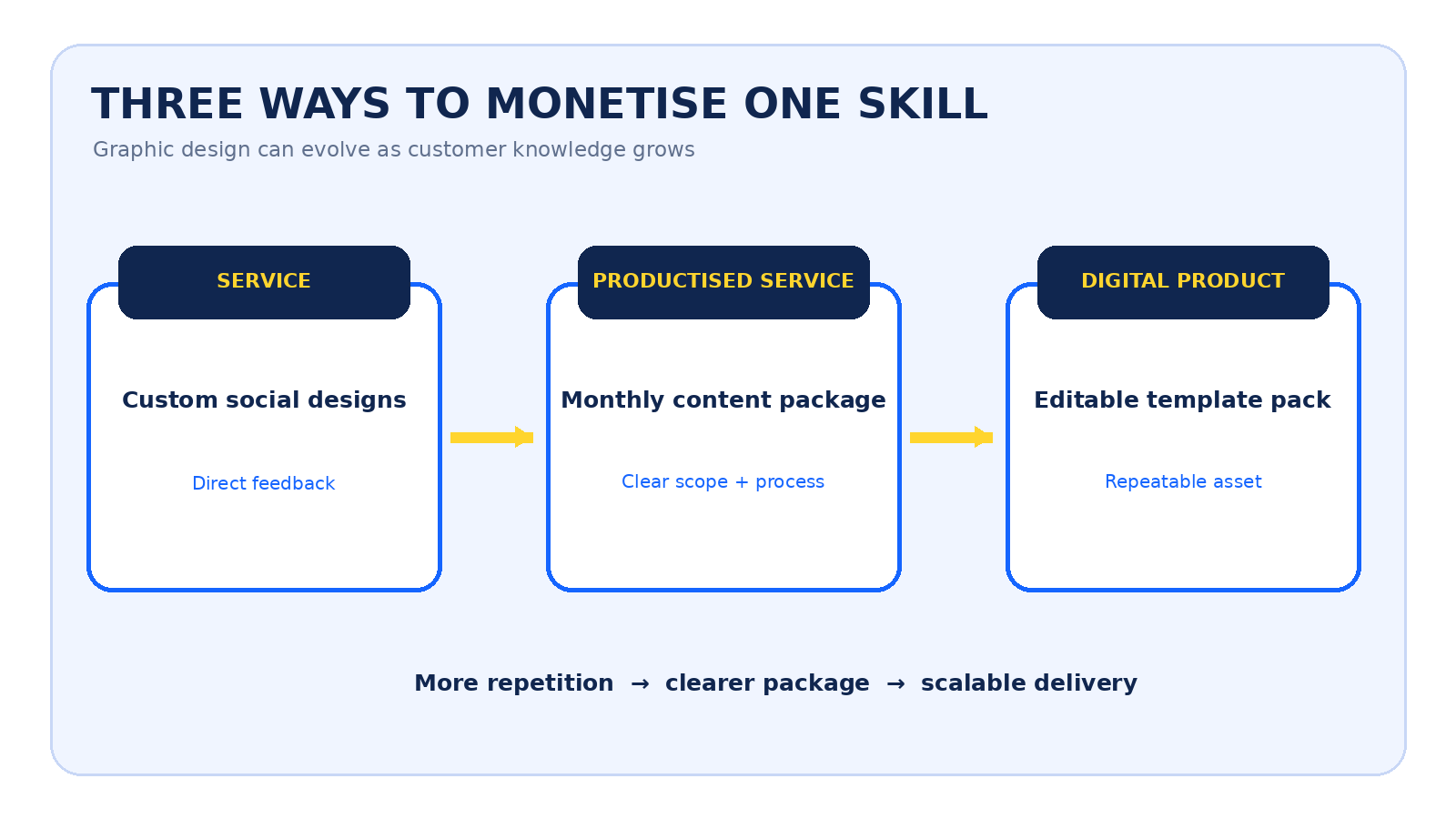 A three-column diagram showing a skill becoming a service, productised service and digital product
Begin with feedback-rich work, then package what proves repeatable.
For example, graphic design can begin as custom social-media visuals, become a monthly content package and later produce editable template packs. Teaching can begin as one-to-one tutoring, become a four-week cohort and later become worksheets or a recorded course. Vezill’s article on how to create and sell online courses using AI is most useful after you have confirmed the learning outcome people need.
Digital marketing solves a problem nearly every organisation recognises: finding, converting and retaining customers. It includes content strategy, search optimisation, email, social media, paid advertising, lead generation and analytics. A beginner can audit a local business’s online presence, plan a small content campaign or build a welcome email sequence. Possible products include content calendars, campaign templates, checklists and training. AI can accelerate research, drafts and analysis, but strategy, brand judgement, fact-checking and customer knowledge remain human responsibilities. A practical digital marketing course should lead to campaign evidence, not only terminology.
Graphic design and visual communication help organisations explain, attract and appear trustworthy. Buyers include small businesses, creators, schools, event organisers and professional firms. Starter offers can focus on presentation design, social graphics or simple campaign assets; digital products can include editable templates, brand worksheets and slide systems. Tools include Canva, Adobe applications and AI-assisted image tools. The durable value is not clicking buttons—it is hierarchy, typography, composition and understanding what the audience must notice. Vezill’s breakdown of online opportunities for graphic designers demonstrates the range beyond logo work.
Web design and no-code development turn business information and transactions into usable online experiences. Customers pay for websites, landing pages, stores, booking flows, maintenance and conversion improvements. A strong proof project is a complete site for a fictional but realistic local business, with mobile views and a clear objective. Starter packages work better than “I build anything.” Templates and tutorials can later become products. AI can draft layouts or copy, but accessibility, security, responsiveness, performance and conversion decisions still require care. Learners can connect structured training to the service opportunities explained in Vezill’s guide to building income as a web designer.
Software development and automation can produce websites, integrations, internal tools, mobile applications and recurring workflow services. Buyers pay when technology saves labour, reduces errors or enables a new capability. Beginners should not sell security-critical production systems after a few tutorials. Start with controlled projects: a booking prototype, form-to-spreadsheet workflow or simple reporting tool. AI-assisted coding speeds experimentation, but architecture, testing, security and maintenance remain serious responsibilities. A software-development programme becomes commercially valuable when paired with working projects and clear documentation; Vezill also outlines business opportunities for software developers beyond conventional employment.
Data analysis helps buyers understand sales, customers, marketing, inventory and operations. Useful tools include Excel, Google Sheets, SQL, Power BI, Tableau and Looker Studio. A beginner can turn a messy sample dataset into a clean dashboard and short decision memo. Services may include report automation, dashboard setup or monthly performance analysis; products may include trackers and spreadsheet systems. AI can help write formulas and explore patterns, but data quality, privacy, context and interpretation require human judgement. Relevant data analytics training should result in evidence a buyer can inspect. Vezill’s article on income models for data analysts shows how one capability can support employment, consulting and products.
AI implementation and workflow design is not simply writing clever prompts. It involves mapping a process, choosing where AI helps, protecting sensitive information, designing human review and measuring whether the workflow improves speed or quality. Potential services include knowledge-base assistance, document triage, content operations and customer-support drafting. A good proof project compares the original workflow with the improved one and records failure cases. AI changes delivery rapidly, so domain expertise and quality control are part of the offer. For product-minded learners, Inceptor’s verified digital product and AI masterclass connects creation to validation, marketing and delivery rather than generation alone.
Video creation and editing serve brands, educators, events and creators. Starter services include short-form edits, product demonstrations, captions and content repurposing. Product options include editing presets, shot lists, storyboards and tutorials. AI can support transcription, rough cuts and visual generation, but pacing, narrative, taste and rights clearance still matter. A small portfolio should show before-and-after editing decisions, not only flashy effects.
Writing, research and communication can produce sales pages, articles, scripts, technical documentation, email sequences and business reports. Generic AI text is easy to obtain, so the advantage must be sharper: specialist knowledge, original interviews, factual reliability, clear reasoning or conversion insight. A beginner should publish three samples for one audience rather than twenty unrelated pieces. Sell an outcome—such as a complete onboarding email sequence—not “500 words.”
Teaching and knowledge packaging turn expertise into tutoring, workshops, cohort programmes, tutorials, guides, worksheets and courses. Customers pay for a structured path, feedback and reduced confusion. A useful first product solves one narrow learning problem and is tested with real learners. AI can help organise material, but accuracy, pedagogy and learner support remain human. Vezill’s list of digital products that can be created with AI assistance can generate formats, but customer evidence should determine which one deserves production.
Business operations and virtual assistance cover customer support, scheduling, CRM management, e-commerce administration, process documentation, research and basic reporting. Buyers pay for reliability and fewer operational distractions. A beginner can demonstrate a documented customer-enquiry workflow or organised CRM sample. Productised offers might include weekly inbox and calendar management; products might include SOP templates and trackers. AI can draft and categorise, but confidentiality, escalation and accurate execution are essential. Never offer regulated accounting, legal or financial services without the required qualifications.
The ratings below are VEZILL editorial estimates, not income predictions. Learning speed varies by background, practice time and specialisation.
| Skill family | Beginner difficulty | Time to build basic proof | Service potential | Digital-product potential | Typical buyers | Best starting model |
|---|---|---|---|---|---|---|
| Digital marketing | Moderate | 3–6 weeks | Very high | High | SMEs, creators, organisations | Small campaign service |
| Graphic design | Moderate | 3–6 weeks | High | Very high | Brands, events, professionals | Focused design package |
| Web/no-code design | Moderate | 4–8 weeks | Very high | High | SMEs, professionals, stores | Fixed-scope website |
| Software/automation | High | 8–16+ weeks | Very high | Very high | Firms, startups, teams | Small automation project |
| Data analysis | Moderate–high | 6–12 weeks | High | High | Retailers, NGOs, companies | Dashboard or report setup |
| AI workflow design | Moderate–high | 4–10 weeks | High | High | Knowledge-work teams | Workflow audit and prototype |
| Video editing | Moderate | 3–6 weeks | High | High | Brands, educators, creators | Short-video package |
| Writing/research | Moderate | 3–6 weeks | High | High | Firms, publishers, experts | Outcome-based content package |
| Teaching/knowledge | Moderate | 2–6 weeks | High | Very high | Learners, schools, professionals | Tutoring or live workshop |
| Operations/VA | Low–moderate | 2–5 weeks | High | Moderate | Entrepreneurs, SMEs, teams | Defined weekly support package |
“Time to build basic proof” does not mean mastery. It means enough structured practice to create an honest sample. Complex, regulated or high-risk work requires deeper training and supervision.
Ask five questions. What problems do you already understand? Which kind of work can you practise repeatedly? Can you build visible proof without waiting for a client? Can you name ten possible buyers? Can you deliver a small useful result within 30 days?
Then narrow the choice to one customer + one problem + one core skill + one starter offer. For example:
This is stronger than “I do marketing, coding, design, AI and consulting.” Specialisation makes it easier to practise, build proof and explain the offer. It does not lock you in forever. Once you understand one buyer, adjacent services become clearer.
Choose a learning resource by its outcomes: Does it include projects? Does it teach foundations instead of only tools? Can you receive feedback? Is the curriculum current? Does it address responsible practice? A useful course should shorten the path to competence, not replace practice.
Learn the fundamentals and the customer’s problem. Do exercises until you can produce a credible result. Create a useful service, template, guide, tool or system. Share demonstrations and explanations so people can evaluate your thinking. Sell one specific outcome to one specific buyer. Grow by collecting feedback, specialising and improving delivery.
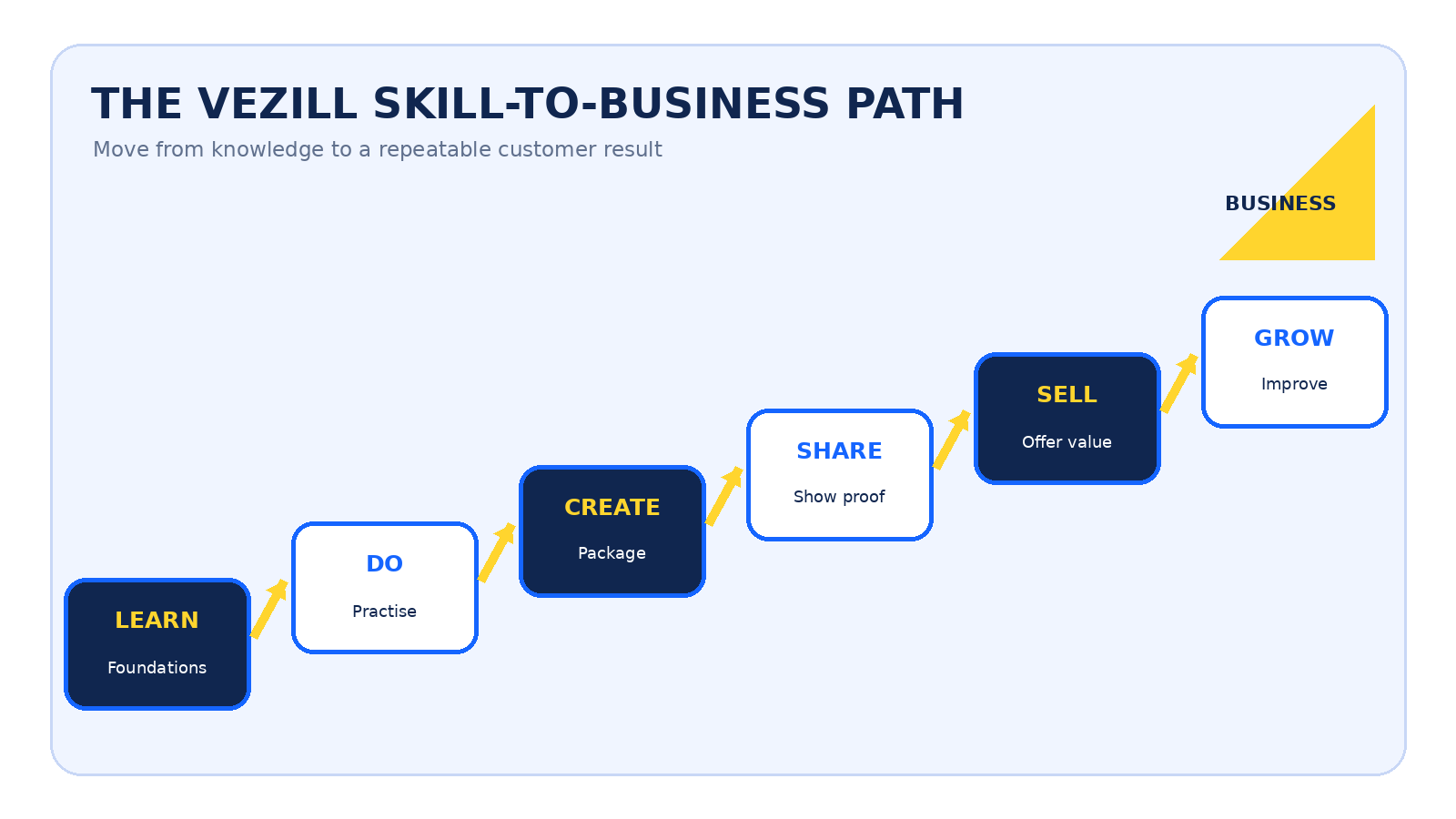 An ascending six-stage path from learn and do through create, share, sell and grow
The VEZILL pathway turns learning into evidence, an offer and a repeatable business.
Skipping DO and CREATE produces certificates without evidence. Skipping SHARE produces capable people nobody knows about. Skipping customer feedback produces polished products nobody needs. Vezill’s collection of high-demand digital product ideas should therefore be treated as inspiration to validate—not a guarantee that every listed idea will sell.
During days 1–7, learn the fundamentals, inspect real customer problems and practise the core tools. During days 8–14, complete one small project that demonstrates a useful outcome. During days 15–21, package a starter offer: customer, problem, deliverable, scope, delivery time and pricing basis. During days 22–26, show the work to potential users and ask what is unclear or missing. During days 27–30, contact suitable prospects or publish a small validated product.
The goal is evidence, not instant success. At the end, you should know whether you enjoy the work, can produce a credible result, understand a buyer and can improve the offer. If nobody responds, investigate the problem, audience, proof and distribution before concluding that the entire skill is worthless.
When a validated skill produces a useful product, a marketplace can simplify hosting and delivery. Vezill explains its model in its overview of a platform for selling digital products. Always check the individual product licence before making resale claims.
Local market understanding can be an advantage. Kenyan opportunities exist around M-Pesa-enabled commerce, small retailers, schools, churches, restaurants, property professionals, SACCOs, agricultural businesses, e-commerce sellers, NGOs and professional firms. A local freelancer understands customer behaviour, payment habits and practical constraints that an overseas provider may miss.
The constraints are real: equipment and internet costs, uneven budgets, delayed payments, informal scopes, premium-software costs and international payment friction. Reduce risk with written scope, staged payments, limited revisions, secure handling of client data and tools appropriate to the customer’s budget. A smartphone can support marketing, customer communication, simple design and video, but development, analysis and production work often becomes easier and safer with a suitable computer.
Do not assume global clients are automatically better. Local businesses can provide faster feedback and referrals; global work can offer larger markets but greater competition and compliance complexity. Build proof where access is easiest, then expand deliberately.
What is the easiest online skill to learn and sell? Basic operations support, simple design or focused content services may have lower entry barriers, but “easy” depends on your starting ability and customer access. Choose a narrow outcome rather than the broadest skill.
Which online skill has the best business potential? No single skill wins for everyone. Marketing, software, data, design and teaching can all be strong when attached to an important problem, reachable buyers and convincing proof.
Can I start a business after completing an online course? A course can provide foundations, but you still need practice, proof, a defined offer, customer conversations and reliable delivery.
How long does it take to make a skill commercially useful? Simple proof may take several weeks; dependable professional competence can take months or years. Complexity, prior experience and practice quality matter.
Do I need a certificate before selling a digital service? Many unregulated services are judged mainly by proof and reliability. Regulated fields may legally require qualifications, registration or supervision.
Can I build a skill business using only a phone? Some marketing, communication, video and simple-design offers are phone-friendly. More complex analysis, development and production generally benefit from a computer.
Will AI make digital skills less valuable? AI reduces the value of undifferentiated execution while increasing the value of problem definition, domain knowledge, judgement, verification and responsible workflow design.
Should a beginner sell services or digital products first? Services usually provide faster feedback and reveal customer language. A product becomes more defensible after repeated problems and useful solutions are understood.
The best online skill is not the one with the most tutorials. It is the one you can connect to a valuable problem, demonstrate through proof and deliver consistently. Learning is only the first stage.
Use the full path: LEARN → DO → CREATE → SHARE → SELL → GROW. Today, choose one skill family, identify one customer, write down one recurring problem and design one small proof project. If it passes the Six-Part Skill-to-Business Test, speak with real buyers before expanding it.
The internet gives you access to knowledge. A business begins when that knowledge becomes a useful, trusted result for somebody else.
Discover more articles you might be interested in
Learn where to find reliable step-by-step guides online, how to choose the right tutorial for your task, check whether it is current and follow instructions safely.
By Davie
Stop searching broad topics and start finding the exact knowledge you need. Learn how to define your problem, search smarter, choose reliable sources, verify answers and take action.
By Davie
Quick Knowledge or an online course? Learn when a focused answer is enough, when structured learning is better, and how to choose the right learning depth for your goal.
By Davie

Learn how to turn one useful digital product into multiple income streams through premium versions, bundles, courses, licensing, services, subscriptions, B2B sales and complementary products.
By Davie
Get the updates, on newly released, popular & fast-moving MRR digital products
Up to Top
Comments All
Francis
@francis
There are so many skills you can learn online, but I like how this shows that they can actually be turned into something you can earn from. It definitely gave me a few ideas to consider.
September 11,2026 At 10:31 PM