

The internet does not pay people simply for being online. Customers pay when someone saves them time, improves a result, reduces uncertainty or completes work they cannot—or do not want to—do themselves.
Quick answer: You can get paid online for solving problems involving time, marketing, sales, technology, education, communication, organization, design, research and business operations. The strongest beginner opportunity is usually a specific, recurring problem experienced by a reachable customer that you can solve competently and demonstrate clearly. Use this path: choose a customer → observe repeated problems → measure urgency and value → confirm willingness to pay → match the problem to your skills → test a small solution → collect evidence → improve.Income is never guaranteed. The importance of the problem, the buyer’s ability to pay, your skill, solution quality, trust, competition, pricing, distribution and execution all affect the outcome.
People pay for useful outcomes: saving time, making or protecting money, reducing risk, learning something, becoming more organised, communicating clearly, creating professional work and making better decisions. Your job is to connect one outcome to one identifiable customer.
| Problem category | Who may experience it | Online solution | First validation test |
|---|---|---|---|
| Time-consuming administration | Consultants, shops, associations | Workflow, template or virtual-assistance service | Ask how the task is handled today |
| Weak customer acquisition | Local service businesses | Landing page, content or lead-follow-up system | Audit five businesses and request feedback |
| Unclear sales communication | Online sellers, freelancers | Product descriptions, proposals or FAQs | Rewrite one example and compare clarity |
| Inconsistent visual content | Shops, churches, educators | Brand template kit or design service | Show three sample layouts |
| Disorganised information | Small teams, researchers | Spreadsheet, dashboard or knowledge base | Build a small sample with dummy data |
| Learning difficulty | Students, employees, beginners | Original workbook, tutorial or course | Test one lesson with suitable learners |
| Repetitive digital work | Agencies and administrators | No-code workflow or automation setup | Time the task before and after a prototype |
| Technical setup | Professionals and small businesses | Website, form or software configuration | Demonstrate a safe test environment |
These are categories, not promises. A restaurant and a farmer group may both need record-keeping, but their workflows, language, risks and budgets differ. The closer your solution fits the real situation, the easier it becomes to explain its value.
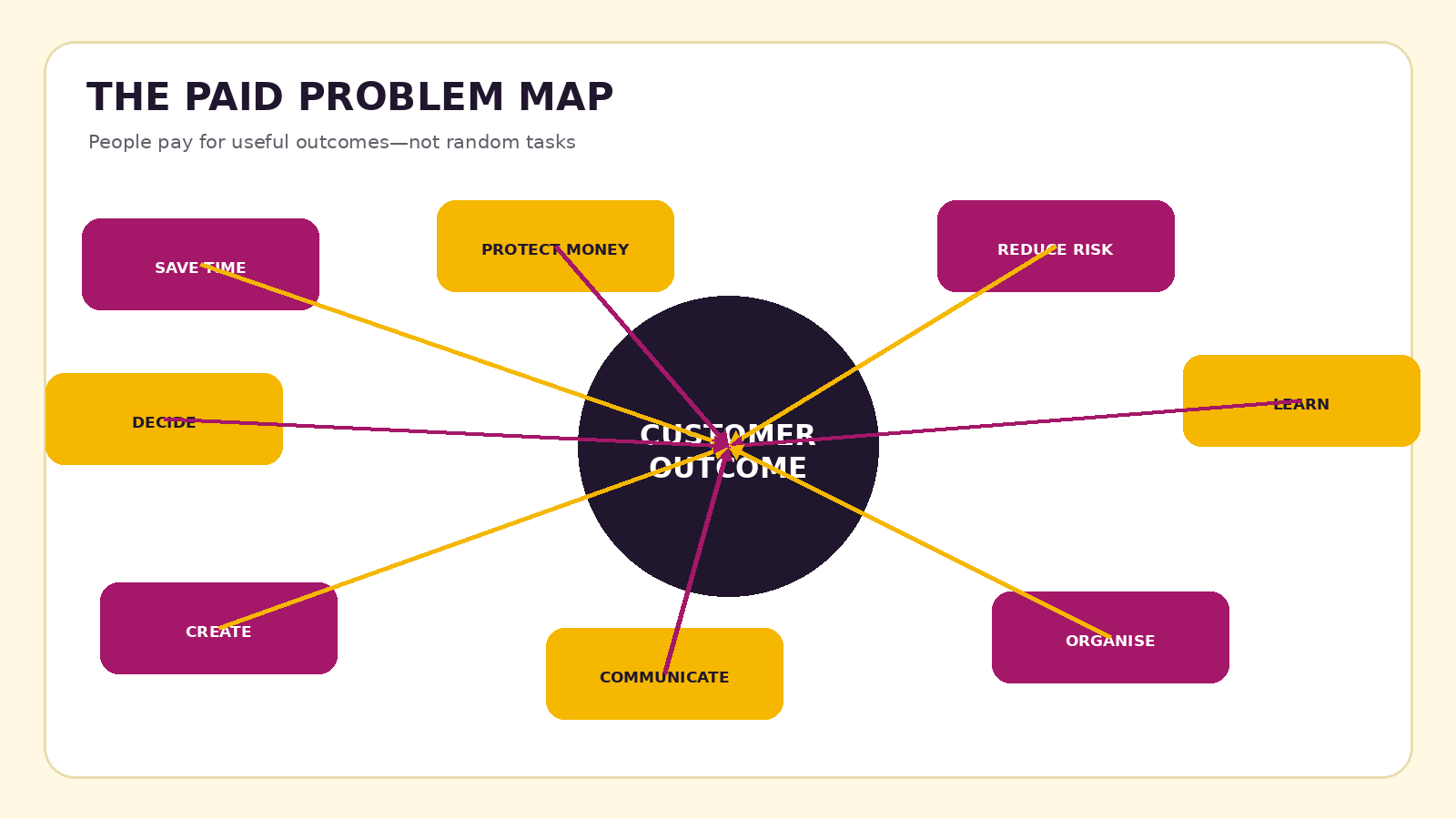 Paid problem map showing the useful outcomes customers may value online
A worthwhile commercial problem is important to a recognisable customer, supported by behaviour and reachable with a responsible solution. An interesting complaint is not automatically a business opportunity.
Score a candidate problem from 1 to 5 on the following factors. Use the score to compare ideas, not to predict success.
| Factor | Question to ask | Stronger evidence |
|---|---|---|
| Frequency | How often does it occur? | Weekly or tied to a repeated workflow |
| Urgency | How soon must it be fixed? | A deadline, customer request or blocked task |
| Cost | What does it waste or prevent? | Time, lost enquiries, errors or rework |
| Purchasing power | Can the customer reasonably pay? | Existing budget or paid alternative |
| Reachability | Can you find suitable buyers? | Searchable roles, communities or networks |
| Existing spending | Do people pay for a workaround? | Staff, software, freelancers or training |
| Skill fit | Can you deliver responsibly? | Relevant work samples or verifiable ability |
| Proof | Can the result be demonstrated? | Before-and-after output or working prototype |
| Repeatability | Can the process be reused? | Similar steps across multiple customers |
| Risk | Are risks manageable? | Clear scope, permissions and quality controls |
Imagine a Nairobi Instagram clothing shop that repeatedly answers questions about sizes, delivery areas and stock. The problem is frequent and reachable; it costs staff time and delayed replies may lose enquiries. The shop already pays someone to manage messages, which is stronger evidence than a general complaint.
A creator could test a structured FAQ, response-template library or AI-assisted support workflow. Before building it, they should review actual approved questions, avoid customer personal data, confirm the shop’s tone and measure whether the system improves response consistency. The opportunity score may be promising, but only a real trial can show whether the shop values it.
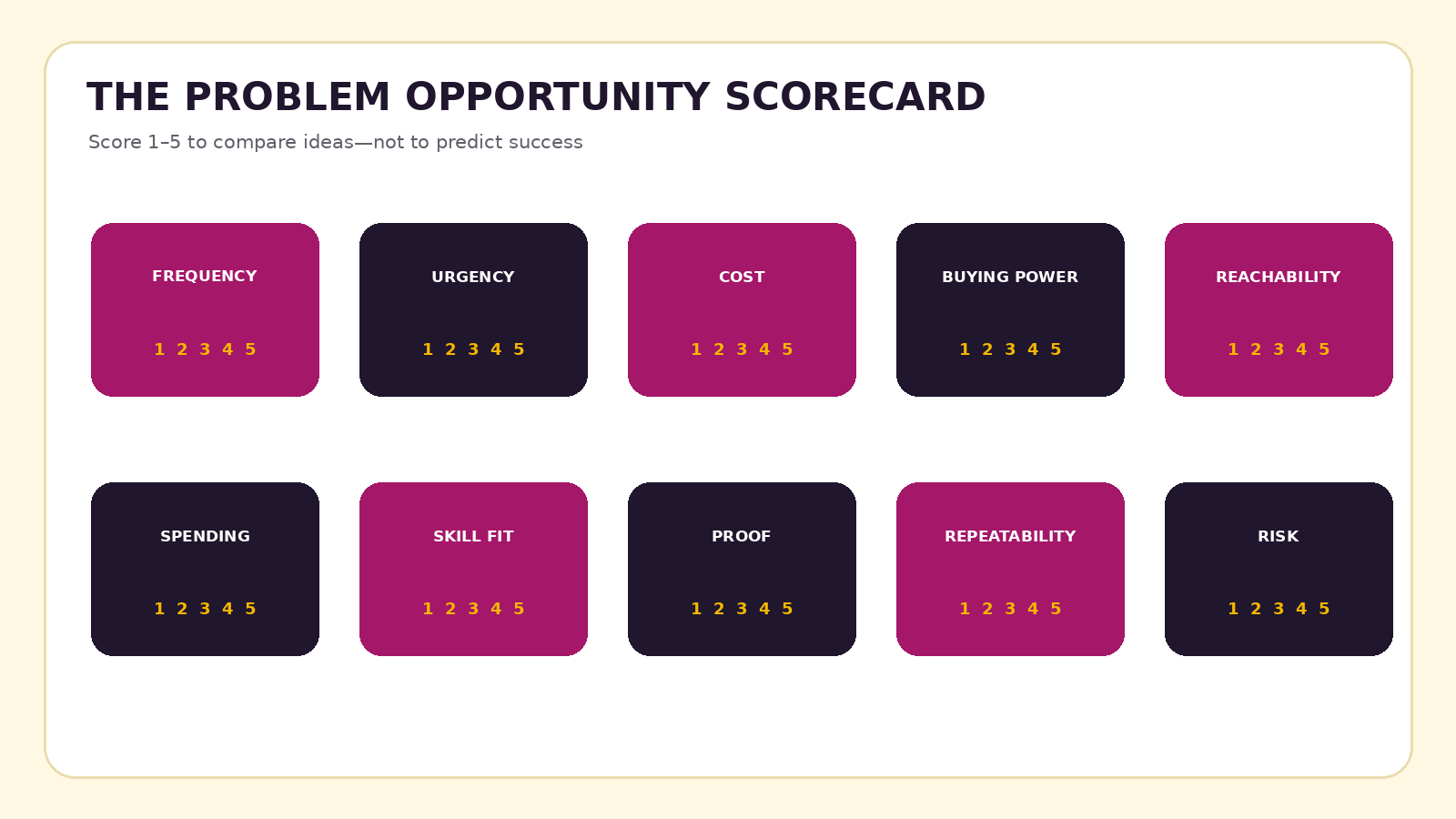 Problem opportunity scorecard covering frequency, urgency, cost, purchasing power, reachability, spending, skill fit, proof, repeatability and risk
Look where people reveal effort, delay, repeated questions or spending. Good problem research observes what people do—not only what they say they might buy.
Useful sources include customer interviews, small-business conversations, search suggestions, public product reviews, freelance job listings, job descriptions, support questions, tutorial comments, professional groups, local networks, recurring workplace tasks and existing manual spreadsheets. The VEZILL article on AI tools that save small businesses time can help you notice workflow categories, but you must still verify the specific problem yourself.
Keep a Problem Evidence Log:
| Customer | Situation | Exact problem | Current solution | Frequency | Cost or frustration | Evidence | Possible offer | Status |
|---|---|---|---|---|---|---|---|---|
| Example: salon owner | Booking through messages | Double-booked appointments | Paper diary | Weekly | Rework and unhappy clients | Interview notes | Booking form setup | Interviewing |
Record exact public language where appropriate, but never copy private information or confidential business documents. Do not join a community merely to advertise, scrape contacts or reproduce another creator’s paid work. If group rules prohibit market research or promotions, respect them.
“Would you buy my idea?” often produces polite but weak answers. Ask what happened the last time the problem occurred, what the person did, how long it took, what failed and what they paid for. Behaviour, paid pilots, deposits and purchases are stronger signals than likes or compliments.
Beginners should choose outcomes they can deliver, check and support. Simple work can be valuable when it removes a real obstacle.
Possible starting problems include poorly formatted CVs, disorganised spreadsheets, inconsistent social posts, rough presentation slides, unedited short videos, scattered digital files, missing online forms, repeated customer questions, unclear product descriptions and unstructured study plans.
For example, a beginner may organise a consultant’s onboarding documents, create a basic content calendar for a small shop, format an original revision worksheet, prepare reusable email templates or build a simple online enquiry form. A current guide on becoming a virtual assistant in Kenya illustrates how administrative abilities can become defined services rather than a vague “I can help” offer.
Stay within your competence. Do not present yourself as a lawyer, doctor, accountant, financial adviser or cybersecurity professional without the qualifications and authorisation the work requires. Even apparently simple tasks can involve personal data, intellectual property or safety obligations.
Small businesses pay when a problem blocks customers, creates repeated work, causes errors or weakens professional presentation. Start by observing a business process rather than prescribing a trendy tool.
Consider a hypothetical salon. Bookings arrive through calls and three messaging apps, so the owner sometimes records the same slot twice. A suitable solution might be a booking form plus a simple calendar process—not necessarily a custom app. The deliverable is the configured system, instructions and staff test. Evidence includes documented double bookings, current message volume and willingness to trial a new process.
The key is proportionality. Do not sell a complicated KSh 200,000 system when a well-configured form and spreadsheet solve the immediate problem. Conversely, do not promise a basic template can safely replace specialist business software when it cannot.
AI can accelerate research, drafting, summarisation, classification, design exploration and automation. You remain responsible for accuracy, usefulness, permissions and the final outcome.
AI-assisted opportunities include customer-response libraries, original lesson resources, product-description systems, content repurposing, workflow documentation, research summaries, internal knowledge bases, spreadsheet assistance, small no-code assistants and custom content systems. AI agents and their practical possibilities may help a technically curious reader understand more advanced workflows.
Distinguish among raw AI output, a human-reviewed service, a reusable product, an AI-powered tool and training that teaches a workflow. Customers should know what they receive and what human review was performed.
Never enter confidential customer files into an AI service without appropriate permission and safeguards. Check outputs for hallucinations, bias, plagiarism, copyright and unsafe advice. Review commercial-use and licensing terms for every tool and input. AI lowers some production costs; it does not create demand or professional competence.
List tasks you perform at work, software you understand, results you have produced, mistakes you prevent, subjects you can explain and problems people already ask you to solve. Then connect skill to outcome.
| Existing skill | Customer problem | Useful outcome | Possible offer |
|---|---|---|---|
| Excel | Business records are disorganised | Cleaner tracking | Spreadsheet setup and training |
| Graphic design | Posts look inconsistent | Professional visual system | Editable social template kit |
| Teaching | Learners lack structure | Organised revision | Original workbook or lesson series |
| Administration | New clients miss steps | Consistent onboarding | Onboarding workspace |
| Video editing | Businesses lack short clips | Publishable content | Defined editing package |
| Web design | Business has no clear online presence | Easier enquiries | Focused landing page |
If you need a deeper skill-selection method, use the VEZILL framework for how to find a skill people are willing to pay for. Having the skill is only the first half; you still need evidence that a customer values the particular outcome.
Formal training can close a genuine capability gap. Inceptor’s current Advanced Excel training covers analysis, reporting, dashboards and automation; its web design and coding course describes HTML, CSS, responsive design and WordPress; and its WordPress training focuses on practical website building. Check the current course details directly and never treat a certificate alone as proof you can deliver every client outcome.
Validation tests whether the problem, customer and buying behaviour are real before you spend heavily.
Stopping an unsupported idea is useful. It protects time and gives you evidence for the next experiment.
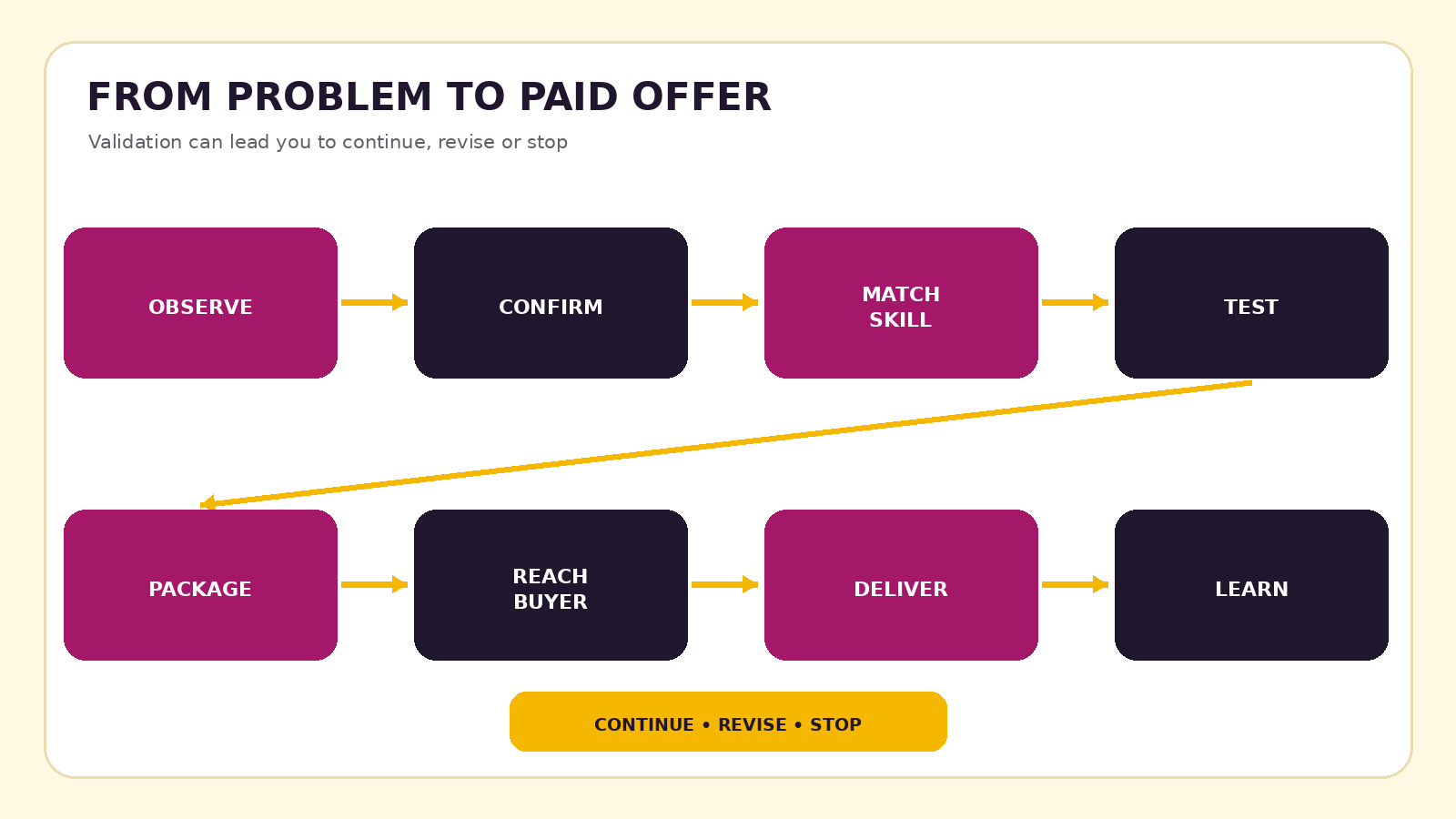 Workflow from observing a problem through validation, skill matching, solution testing, offer packaging, reaching buyers, delivery and learning
Choose a service when the work varies, needs judgement or requires customisation. Choose a digital product when the same problem repeats and customers can use a standardised solution independently. Use a hybrid when a reusable resource becomes more valuable with setup or guidance.
| Decision | Service | Digital product | Hybrid |
|---|---|---|---|
| Best fit | Custom, changing problem | Repeated standard problem | Standard base plus personal help |
| Feedback speed | Fast and direct | Depends on buyer access | Fast through assisted use |
| Customer contact | High | Lower | Medium to high |
| Scalability | Limited by delivery time | More repeatable | Balanced |
| Trust need | Proof of competence | Preview and clear listing | Both |
| Support | Project-specific | Instructions and product support | Product plus implementation |
A service can teach you how customers describe the problem. After delivering it several times, you may turn repeatable elements into a checklist, template, course or tool. An educator could learn the course-product workflow through the current article on creating an online course using AI, while remaining responsible for original teaching quality and facts.
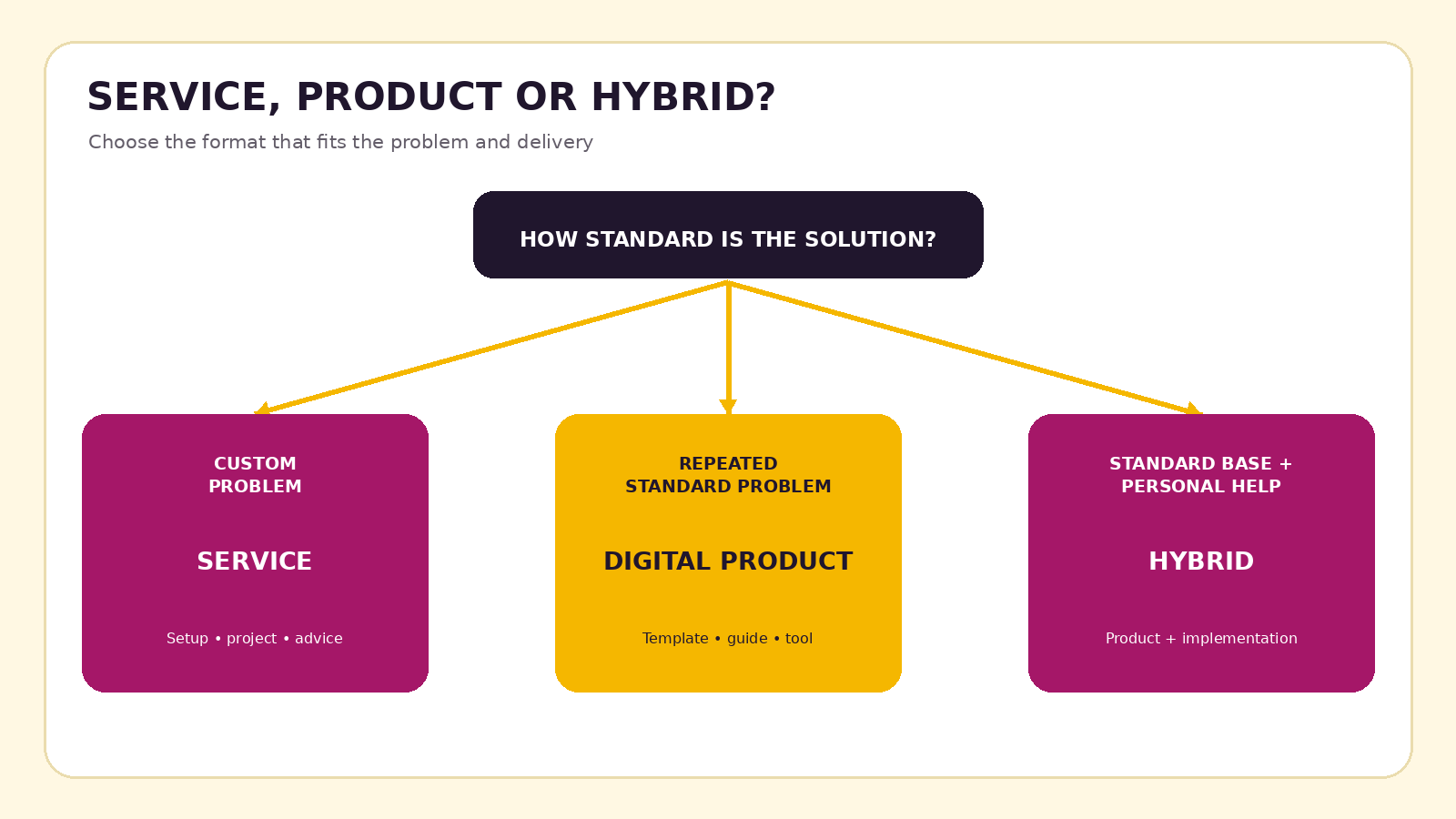 Decision tree for choosing a service, digital product or hybrid offer
Use this sentence: I help [specific customer] achieve [specific outcome] by providing [deliverable] without [important difficulty or avoidable risk].
Define the customer, painful situation, result, deliverables, scope, timeline, evidence, limitations, price and next action. A buyer should understand what happens after saying yes.
Weak offer: “I provide digital marketing services.”
Stronger offer: “I create a 30-day Instagram content system for small Kenyan beauty businesses, including editable post templates, caption starters and a publishing calendar.”
The stronger version does not promise sales; it makes the scope and customer clear. If the solution is a downloadable resource, browsing why customers buy digital products on VEZILL may help you think from the buyer’s side. A resource such as Mastering Google Applications may support productivity learning, but verify the current listing and fit before purchasing.
Price according to value, complexity, time, skill, urgency, risk, customer type, competition, support, tools and transaction costs. Do not assume one “standard rate” applies across Kenya or globally.
Common models include hourly billing, a fixed project, packages, retainers, subscriptions, paid pilots and product pricing. A beginner may use a clearly limited pilot price in exchange for feedback—but should never pretend a permanent discount or fake deadline exists.
Here is a hypothetical illustration, not a market rate: a creator estimates six hours for a custom spreadsheet and training. At an internal target of KSh 1,000 per hour, plus KSh 1,500 for testing and support, the starting calculation is KSh 7,500 before payment costs and tax. The customer may reject it; the creator may discover the value supports more or less. The calculation simply prevents random pricing.
Do not compete only by being cheapest. Reduce scope, clarify the deliverable or offer tiers instead of quietly taking on unlimited work.
Choose one group, create one demonstration and contact a small number of relevant prospects respectfully.
Small business: “Hi Wanjiku, I noticed customers ask the same delivery questions under your posts. I’m testing a clear FAQ and response system for online shops. May I send a one-page example for feedback?”
Teacher: “Hello Mr Kamau. I created an original revision-planning sample for learners who struggle to organise topics. Would you be open to reviewing two pages for clarity?”
Community organisation: “Hi Sarah. I saw that event registrations arrive through several channels. I’m testing a simple form-and-tracker process. May I demonstrate it using dummy information?”
Never buy contact lists, scrape private details, send bulk unsolicited messages or post promotional links against community rules. Early outreach is a learning process, not proof of future sales. The VEZILL article on realistic alternatives to waiting for a remote job can provide broader context, but evaluate every option carefully.
One repeated problem can support different formats, but you should validate one before building a catalogue.
Suppose small online sellers struggle to answer repeated questions. Possible offers include a done-for-you FAQ, response-template pack, WhatsApp reply library, prompt workflow, short tutorial, training session, customised setup or small no-code assistant.
The underlying customer outcome is consistent responses with less repetitive effort. The formats differ in customisation, price, skill and support. Start with a service if you need to learn the workflow; package the repeatable elements after enough evidence. If an ebook is truly the right format, a current AI-assisted ebook creation walkthrough can help with the production process—without replacing original expertise or review.
This follows LEARN → DO → CREATE → SHARE → SELL → GROW. Learn the problem, do the work, create a repeatable solution, share useful proof, sell responsibly and grow through evidence.
Avoid opportunities where you cannot verify the result, where the downside of a mistake is serious, or where the customer expects credentials you do not possess. A problem can look profitable while being a poor fit for you.
Be cautious when:
Risk does not always mean “never.” It may mean obtaining suitable training, narrowing the scope, bringing in a qualified professional, using safer data or declining the project. The best early offer is one where success and failure are understandable.
If you want to explore a larger business direction, digital entrepreneurship with AI can provide broader context. Still, an “AI business” is not a substitute for a safe, valuable customer outcome.
Build evidence around the work, not an imaginary customer story. You can create a demonstration, improve a public example with permission, use realistic dummy information, complete a supervised volunteer project or document your own process.
For a spreadsheet service, publish a short screen recording that shows how sample records become a useful summary. For a content system, show a small before-and-after set and explain the decisions. For a website, create a fictional demonstration business and clearly label it as a concept. For an original workbook, ask an appropriate educator to review a sample and describe the review accurately.
A useful proof package might contain:
Never invent a testimonial, client logo, revenue number or “results” screenshot. A transparent demonstration is more credible than fabricated popularity. A relevant small-business AI article can help you identify tasks worth demonstrating, but the proof must be your own and must match the specific offer.
Treat the gap as information. The problem may be real but not urgent, the person praising it may not control a budget, the solution may be hard to trust, or the offer may reach the wrong segment. Ask what prevented action without arguing with the answer.
Then test one change at a time: a narrower customer, a more visible demonstration, a smaller pilot, clearer scope or a different access channel. Do not immediately cut the price. If repeated suitable prospects will not commit after credible tests, pause and choose a better-supported problem.
Once the offer is ready, use a respectful acquisition system rather than random posting. The VEZILL guide to getting clients online without paid ads covers outreach, communities, proof and referrals. Follow platform rules, ask permission and prioritise relevance.
The goal is not guaranteed payment in seven days. It is a better-supported decision.
| Day | Action | Evidence to collect | Expected outcome |
|---|---|---|---|
| 1 | Define one customer group and context | Role, situation and access route | A precise customer statement |
| 2 | Observe repeated frustrations and workarounds | Questions, manual work and existing tools | Five candidate problems |
| 3 | Conduct three short interviews | Recent examples, consequences and spending | First-hand problem evidence |
| 4 | Score the top three problems | Ten-factor scorecard plus notes | One leading hypothesis |
| 5 | Match the problem to your skills | Proof, gaps, permissions and risks | A responsible solution boundary |
| 6 | Build a small demonstration | Sample, mock-up or process test | Something people can evaluate |
| 7 | Request meaningful commitment | Pilot, deposit, pre-order, sign-up or booked demo | Evidence to continue, change or stop |
If nobody commits, do not manipulate them. Review whether the wrong customer saw the offer, the problem lacks urgency, the demonstration is weak or the solution creates new friction.
You can solve problems involving time, organisation, marketing, communication, education, design, technology, research and business operations. Choose one you can handle competently for a reachable customer.
Observe repeated effort, current spending, urgent requests and imperfect workarounds. Interview suitable customers about recent behaviour, then test a small solution before building extensively.
Beginners can address defined, low-risk tasks such as document formatting, basic spreadsheets, content calendars, presentations, online forms, file organisation and original learning resources—provided they can verify the result.
There is no guaranteed test. Evaluate frequency, urgency, cost, purchasing power, reachability, current spending, skill fit, proof, repeatability and risk, then seek behavioural evidence through a pilot or purchase.
Yes. AI can assist with drafting, organisation, analysis and automation, but a human must verify outputs, protect data, respect licensing and remain accountable for the promised result.
Start with a service when the problem requires custom judgement or when you need customer learning. Use a digital product when the problem and solution can be reliably standardised.
Conduct interviews, review existing workarounds, create a simple mock-up and request a meaningful commitment. Use free or low-cost tools until demand evidence justifies further investment.
Choose one customer group, create a relevant demonstration and contact a small number of suitable prospects with permission-based, personalised messages. Offer a limited pilot and learn from the response.
Yes. Marketplaces, search, professional networks, referrals and direct outreach can provide access to buyers. You still need trust, relevance and consistent distribution.
Consider value, scope, time, complexity, risk, skill, support, customer type and costs. Test a clearly defined price rather than copying a universal rate from the internet.
The best online opportunity is rarely a fashionable job title. It is a clear customer problem, supported by evidence, matched to a skill you can use responsibly and packaged into an outcome people understand.
Choose one group this week. Observe what repeatedly costs them time, money or progress. Ask about what happened, test the smallest useful solution and let evidence decide what you build next.
Discover more articles you might be interested in

Learn where to find reliable step-by-step guides online, how to choose the right tutorial for your task, check whether it is current and follow instructions safely.
By Davie

Stop searching broad topics and start finding the exact knowledge you need. Learn how to define your problem, search smarter, choose reliable sources, verify answers and take action.
By Davie

Quick Knowledge or an online course? Learn when a focused answer is enough, when structured learning is better, and how to choose the right learning depth for your goal.
By Davie

Learn how to turn one useful digital product into multiple income streams through premium versions, bundles, courses, licensing, services, subscriptions, B2B sales and complementary products.
By Davie
Get the updates, on newly released, popular & fast-moving MRR digital products
Up to Top
Comments All
Purity
@purity
This was a really good read. I like the idea of looking at everyday problems and asking yourself how you can actually help solve them and make money from it. It definitely got me thinking about what I could offer online.
September 12,2026 At 09:26 PM