
Yes—digital products can support a sustainable long-term business. But sustainability does not come from the fact that a file is digital. It comes from persistent demand, customer results, healthy economics, reliable distribution, repeat purchases, product improvement and the ability to adapt when technology, competition and customer expectations change.
Digital products are attractive because a creator can often produce one useful asset and sell access to it repeatedly without manufacturing or shipping another physical unit. That creates leverage. It does not create a business automatically.
A single ebook can sell for months and then fade. A spreadsheet can rank well in search and then lose traffic after an algorithm change. A course can perform strongly until the software it teaches changes. A template can be copied by competitors. A prompt pack can become nearly worthless when general-purpose AI can generate something similar instantly.
Yes. Selling digital products can become a sustainable business when the products solve ongoing problems, customers can consistently discover them, the economics remain profitable, and the creator continues improving or expanding the offer as the market changes. The unsustainable version is uploading one ebook or template and expecting permanent passive income. The sustainable version is building a system around customer demand, distribution, product quality, repeat purchases and a growing portfolio of useful digital assets.
USEFUL PROBLEM → SPECIFIC CUSTOMER → VALUABLE PRODUCT → DISTRIBUTION → CONVERSION → CUSTOMER RESULT → TRUST → REPEAT / EXPANSION → PRODUCT IMPROVEMENT → PORTFOLIO / BRAND → LONG-TERM BUSINESS
The core distinction is simple: product ≠ business. A PDF is a product. A spreadsheet is a product. A course is a product. A sustainable business is the system that repeatedly connects useful products with customers and remains economically viable over time.
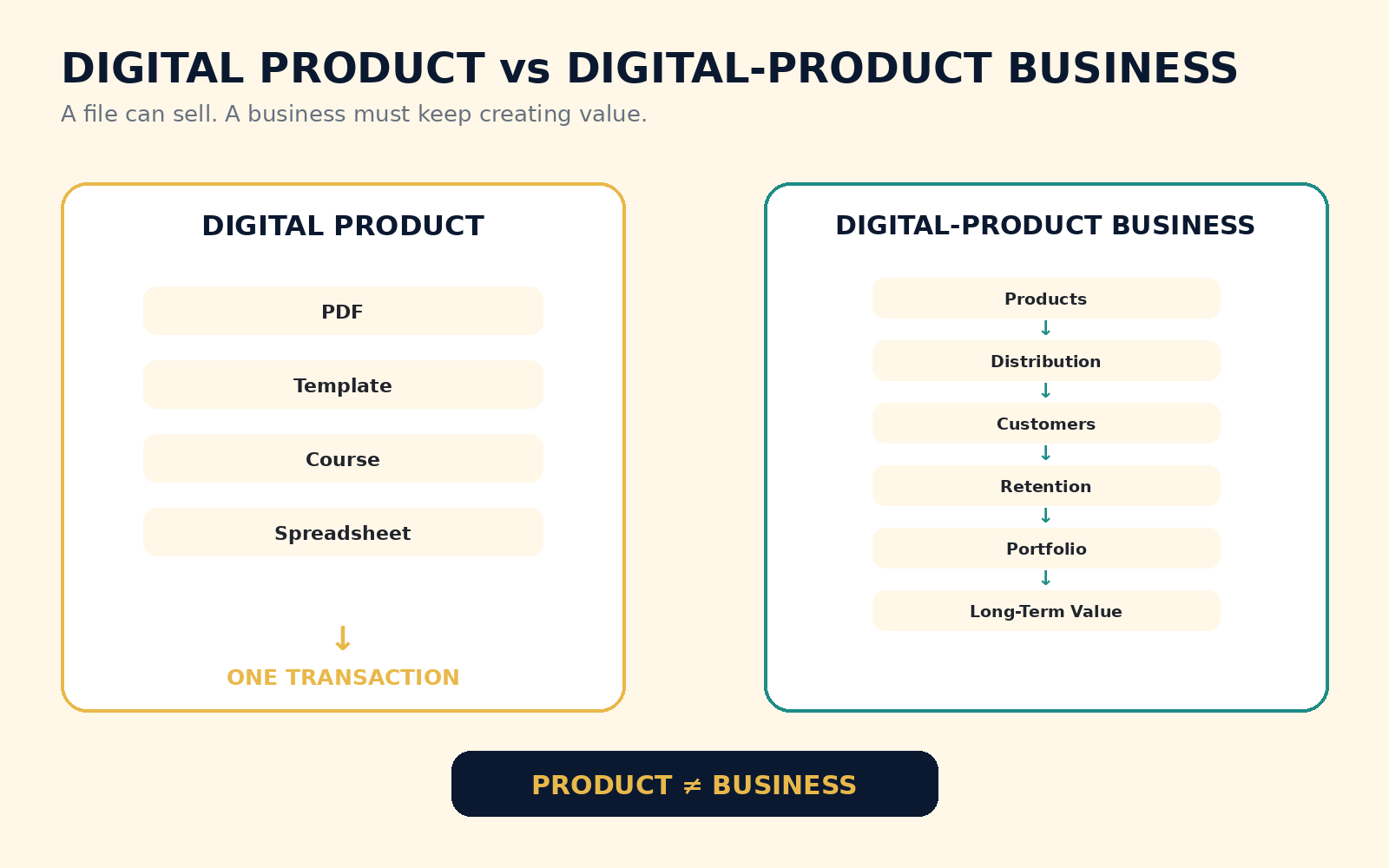 A product can create a transaction. A business has to keep creating value around that product.
A sustainable digital-product business is not simply a product that remains available online. It is a business that can keep producing economically meaningful value without requiring unsustainable advertising spend, founder workload, constant launches, endless discounts, excessive support or dependence on one platform.
Ideally, it demonstrates persistent demand, healthy margins, reliable distribution, customer satisfaction, manageable maintenance, product adaptability, repeat or expanded revenue and a reasonable founder workload.
This means sustainability can exist at different scales. A solo creator with a small but dependable portfolio can be sustainable. A larger company with courses, software and recurring memberships can also be sustainable. The important question is whether the system keeps working without burning more time and money than it creates.
| Selling a Product | Building a Business |
|---|---|
| One file | Product portfolio |
| One launch | Ongoing distribution |
| One transaction | Customer relationship |
| Random price | Pricing strategy |
| Individual product | Brand/category |
| No follow-up | Customer lifecycle |
| Product creation | Product management |
| Sales only | Sales + retention |
| One platform | Distribution resilience |
| Hope | Measurement |
That difference explains why two creators can sell similar products with very different outcomes. One depends on occasional launches. The other develops search traffic, an email list, customer feedback, bundles, updated versions and multiple products that serve the same audience.
Digital products have several genuine advantages. Reproduction cost is usually low because another customer can often receive the same file without manufacturing another unit. Delivery can be automated. There is no traditional physical inventory. Products can be updated faster than many physical goods. Knowledge can be packaged into reusable tools. Related resources can be bundled. Revenue can sometimes grow without delivery workload increasing at the same rate.
Scalable does not mean automatically profitable.Acquisition cost, transaction fees, software, customer support, refunds, updates, taxes, advertising and creator time still matter. A product with no inventory can still be an unprofitable business.
You do not need to become a finance analyst, but you do need to understand what happens between a customer paying and actual profit remaining.
| Metric | Plain-English Meaning | Why It Matters |
|---|---|---|
| Revenue | Money customers pay. | Shows sales activity. |
| Gross revenue | Total sales before costs. | Not the same as profit. |
| Transaction fees | Marketplace/payment costs. | Reduce money retained per sale. |
| Customer acquisition cost | What it costs to get a buyer. | High acquisition can make a product unsustainable. |
| Production cost | Research, software, contractors and creator time. | Shows the real cost of creating the asset. |
| Maintenance cost | Updates, hosting and support. | Some products become expensive to keep current. |
| Refunds | Revenue returned after purchase. | Often signals quality, fit or expectation problems. |
| Gross margin | What remains after direct costs. | Helps assess whether the model can support growth. |
| Customer lifetime value | Revenue from one customer across multiple purchases. | Shows why repeat customers matter. |
| Repeat purchase rate | How often buyers return. | Reduces dependence on acquiring strangers forever. |
| Conversion rate | How many visitors become customers. | Shows whether traffic and offer fit. |
| Average order value | Average amount per transaction. | Bundles and higher-value offers can improve economics. |
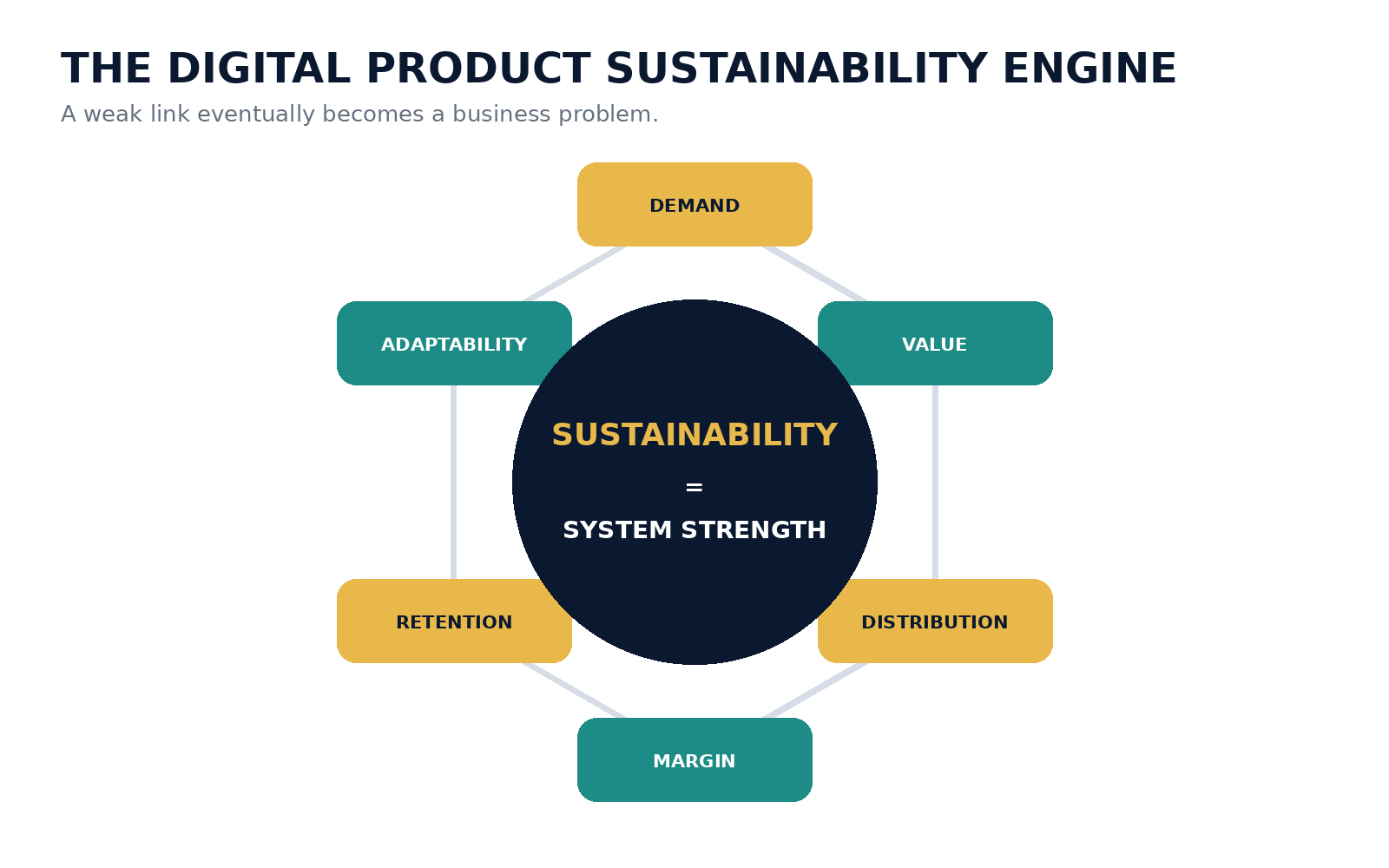 Demand, value, distribution, margin, retention and adaptability all contribute to long-term sustainability.
DEMAND × VALUE × DISTRIBUTION × MARGIN × RETENTION × ADAPTABILITY
Does the problem continue to exist? A recurring operational problem is usually more durable than a short-lived trend.
Does the product create a useful result? Customers tolerate less friction when the outcome is clear and practical.
Can new customers continue discovering it? A great product with no discovery system eventually disappears from view.
Does enough revenue remain after fees, advertising, support, software and updates?
Can customers return, upgrade, buy complementary products or recommend you?
Can the product survive changes in technology, regulation, competitors and customer expectations?
A weak link eventually becomes a business problem. Strong demand cannot rescue impossible support costs forever. High margins do not help if discovery disappears.
The creator builds what feels exciting instead of what customers actually need.
The product is useful, but nobody consistently discovers it.
Revenue collapses if interest in the only product fades.
The product exists only because of a temporary platform, tactic or cultural moment.
Software, tax rules, laws, platforms and AI tools can change quickly.
Many competitors offer similar files with little differentiation.
Basic information, generic prompts and surface-level explanations become easier to generate.
Marketplace policies, search rankings or social algorithms change.
Acquisition becomes too expensive relative to product margin.
Customers learn to wait for promotions and the product loses pricing credibility.
Every sale requires finding a completely new buyer.
The product looks good but does not actually help.
The buyer sees no reason to choose yours.
Unauthorized sharing can reduce control and revenue.
A low-priced product generates more support than its economics can carry.
Revenue depends on constant launches, posting and manual customer service.
They can create passive delivery: a customer pays and receives a file automatically. That is different from a passive business.
A business still needs discovery, marketing, SEO, updates, support, testing, customer research, payment infrastructure and product management. The more useful term is leveraged income: one piece of work can generate revenue more than once without being recreated for every customer.
Digital products can be partially automated. They are rarely permanently passive businesses.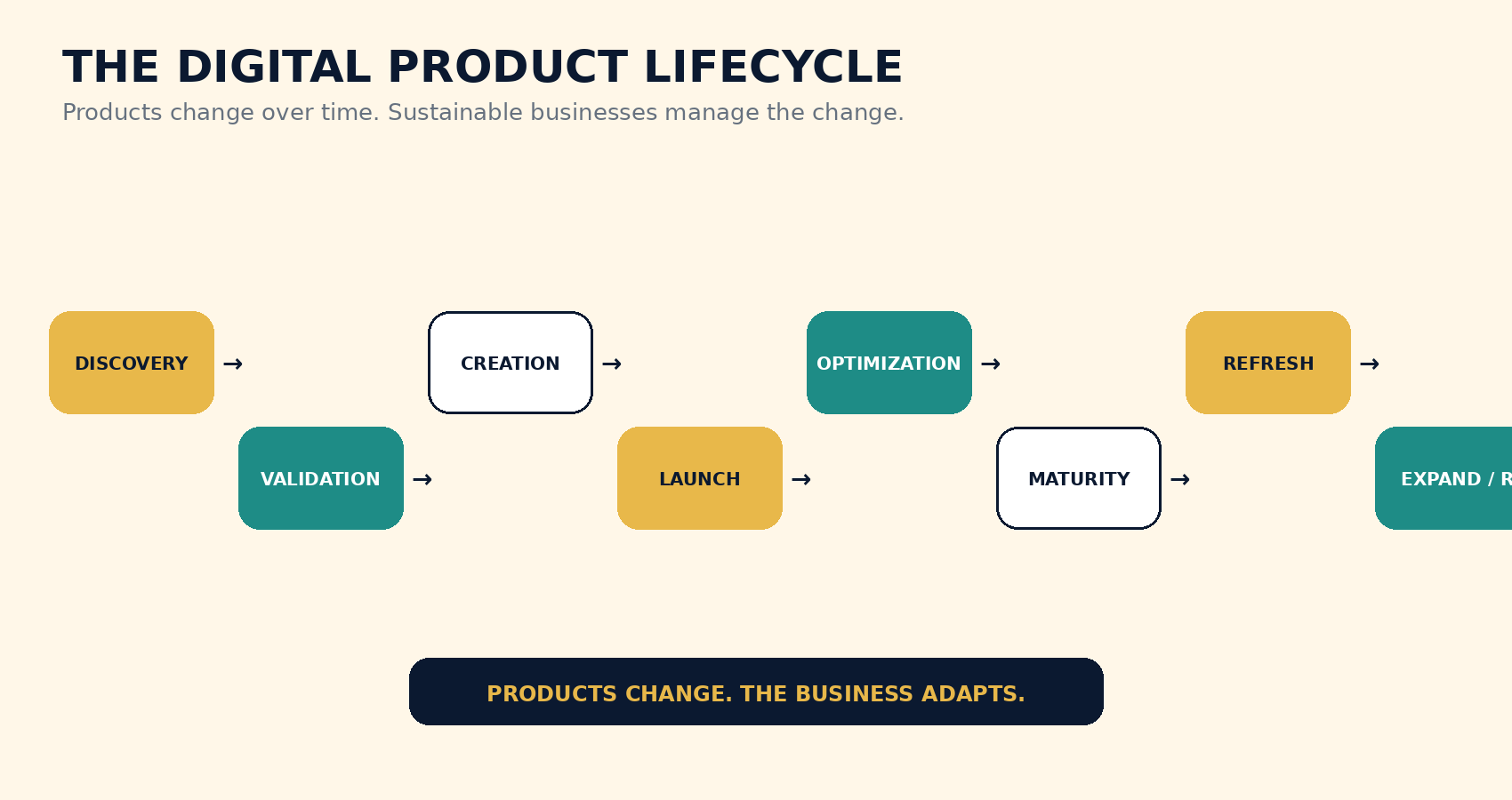 Products change over time. Sustainable businesses manage that change instead of assuming every offer sells forever.
Every product has a lifecycle.
A sustainable creator expects products to change. They do not assume a 2026 guide should still be sold unchanged in 2031.
| Category | Examples | Main Sustainability Characteristic |
|---|---|---|
| Evergreen | Budgeting templates, planning systems, business checklists, fundamental skills | Persistent underlying problem |
| Update-dependent | Tax guides, software tutorials, AI tool guides, regulatory resources | Can remain valuable if maintained |
| Trend products | Temporary platform opportunities, viral tactics | May have short demand windows |
| Event-based | Exam preparation, annual planners, wedding resources | Demand can recur seasonally or annually |
Score each idea from 1–5 on problem persistence, update burden, differentiation, customer result, distribution potential, expansion potential, repeat-purchase potential and AI resistance.
AI resistance asks a simple question: does the product create more value than information a general AI assistant can generate instantly?
This scorecard is a decision aid, not a scientific predictor. Use it to compare ideas and identify risk before investing heavily.
Yes—for weak products. No—and potentially the opposite—for strong product businesses.
AI makes generic ebooks, basic checklists, random prompt packs, simple worksheets, generic stock graphics and surface-level information easier to produce. Information alone is becoming cheaper.
Long-term products increasingly need curation, expertise, original frameworks, real experience, proprietary data, strong design, convenience, implementation, community, personalization, updates, trust, brand and specific outcomes.
Do not sell information AI can generate in 30 seconds. Sell organization + judgment + implementation + convenience + outcome.| Weak Digital Product | Stronger 2026 Product |
|---|---|
| Generic information | Curated solution |
| 100 random prompts | Tested workflow |
| Generic ebook | Outcome-based guide |
| Basic spreadsheet | Ready-to-use system |
| Information course | Implementation program |
| Stock template | Niche-specific template |
| AI-generated content dump | Expert-edited resource |
| Static product | Updated product ecosystem |
VEZILL's guide on creating a digital product with AI makes the same core point: AI can accelerate creation, but customer value still requires validation, review and real usefulness.
Digital files can be copied. Sustainable businesses therefore build moats around the file itself: brand, trust, search visibility, audience, community, proprietary research, unique frameworks, expertise, product ecosystem, updates, customer experience, distribution, partnerships and—where relevant—network effects.
The strongest moat is often not the PDF itself. It is everything surrounding the PDF.A portfolio might include an entry product, core product, advanced product, bundle, recurring offer and optional service or consulting layer. Not every creator needs all of them.
For example, a useful article could lead to a beginner resource, then a toolkit, then advanced training or implementation. Hypothetical Kenyan pricing might look like KSh 500–1,500 for an entry resource, KSh 2,000–5,000 for a toolkit and KSh 5,000–15,000 for advanced training. These figures are illustrations only, not market standards.
Repeat revenue can come from new products, annual editions, product updates, bundles, advanced versions, complementary products, memberships, paid communities, software, research products, template libraries, licences, business/team versions or services.
A subscription is useful only when recurring value exists. Forcing a monthly fee onto a product that does not need ongoing value can damage trust.
Imagine a hypothetical customer buys Product A for KSh 1,000, Product B for KSh 2,500 and later a bundle for KSh 3,500. Their lifetime revenue is KSh 7,000.
This example is hypothetical, but the strategic lesson matters: building a second useful product for existing customers can sometimes be more sustainable than constantly acquiring strangers.
Sustainable distribution may combine SEO, AI search, email, social media, YouTube, communities, marketplaces, partnerships, referrals, affiliates, paid advertising and direct outreach where appropriate.
Do not depend entirely on one marketplace, TikTok account, Google ranking, Instagram profile or ad campaign. Distribution diversification reduces single-platform risk.
VEZILL's digital-product marketing guide covers this side of the business in more detail.
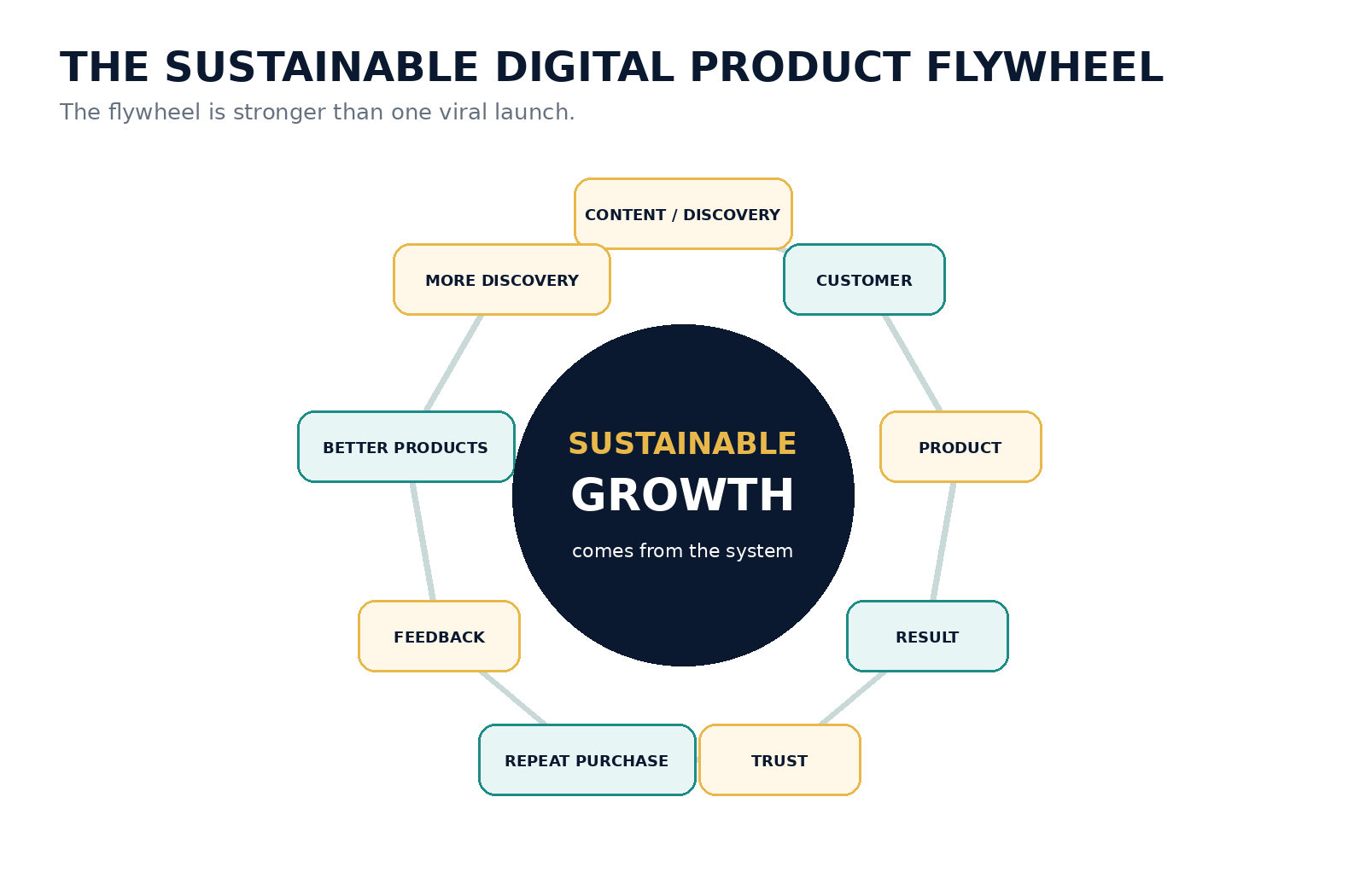 A sustainable flywheel compounds customer results, trust, repeat purchases and better products instead of depending on one viral launch.
CONTENT → DISCOVERY → EMAIL / FOLLOW → PRODUCT → CUSTOMER RESULT → REVIEW / REFERRAL → MORE TRUST → MORE DISCOVERY
Email can reduce dependence on social or marketplace algorithms because the relationship is more direct, but you still depend on email providers, consent rules and privacy requirements. “Owned audience” should not be interpreted as complete ownership without constraints.
Marketplace suspension, commission changes, search algorithm updates, social reach decline, payment restrictions, platform shutdowns and policy changes can all damage a business that depends on one channel.
Cheap does not automatically mean sustainable. Expensive does not automatically mean profitable.
Pricing should consider customer value, alternatives, positioning, support burden, acquisition cost, transaction fees, update burden, taxes, refunds and desired margin.
A KSh 500 product that generates 20 support messages may be less sustainable than a KSh 2,000 product that generates two. This is hypothetical, but it illustrates why revenue per sale is not the same as profit per sale.
| Product | Typical Update Need |
|---|---|
| Fundamental skill guide | Low–Moderate |
| AI tool tutorial | High |
| Tax/regulatory guide | High |
| Planner | Annual/periodic |
| Spreadsheet system | Low–Moderate |
| Software template | Moderate–High |
| Design asset | Low |
| Course | Depends on subject |
The correct update frequency depends on how quickly the subject changes and how damaging outdated information would be.
Stop selling a product when information becomes unsafe or outdated, demand disappears, support cost exceeds value, the underlying platform no longer exists, a better replacement has been released, the legal environment changes or the product damages brand quality.
Maintain version numbers and archives so you know which customer received which version.
Piracy is a real risk, but it cannot be eliminated completely. Watermarking, licences, access controls, terms and legal enforcement can help, but the business should not depend entirely on making the file impossible to copy.
Updates, support, community, trusted source, convenience, legitimate licences, bonuses and ecosystem value are harder to pirate than a static file.
Copyright, trademarks, stock assets, fonts, AI-generated material, templates, resale rights, PLR and MRR all involve different rights and restrictions. Buying a product does not automatically give permission to resell it. MRR terms can vary by licence and product.
If you turn professional experience into products, VEZILL's guide on turning work experience into a digital product also explains why employer-owned and confidential material must be separated from general knowledge.
Poor quality damages margin, reputation, repeat purchases, referrals and marketplace standing. Improve onboarding, instructions, FAQs, file naming, compatibility information and product UX to reduce avoidable support.
Customer success is a business metric. A product that sells well but consistently fails customers can eventually destroy its own distribution through poor reviews and low trust.
Monitor trends in revenue, number of sales, conversion rate, average order value, refund rate, support requests per sale, customer acquisition cost, repeat purchase rate, product update cost, traffic-source mix, email-list growth, customer satisfaction, product age and revenue by product.
Do not chase arbitrary “good” numbers. Compare your own trends and investigate changes.
A sustainable digital-product business usually becomes stronger when the same customer can move to another useful solution instead of disappearing after one purchase. That does not mean forcing every buyer into an expensive funnel. It means understanding what problem often comes next.
A beginner might first discover your business through a useful article or free checklist. They may then buy a small practical resource, later upgrade to a toolkit, and eventually choose advanced training or a higher-touch implementation service. The sequence should follow customer need, not artificial upselling.
| Stage | Customer Need | Possible Offer | Business Benefit |
|---|---|---|---|
| Discovery | Understand the problem | Article, tutorial, sample | Builds trust and search visibility |
| Entry | Get a quick practical solution | Checklist, template, short guide | Creates first purchase |
| Core | Solve a larger part of the problem | Toolkit, workbook, advanced template | Raises customer value |
| Advanced | Learn or implement deeply | Training, course, implementation system | Supports higher-value revenue |
| Ongoing | Keep current or receive new value | Updates, community, software, research | Creates recurring potential |
Not every business needs every stage. A focused spreadsheet creator may only need a free tutorial, one spreadsheet, one bundle and a consulting option. Sustainability comes from useful progression, not the number of steps.
Acquiring a new customer often requires discovery, trust and persuasion from zero. An existing satisfied customer already understands your brand, file quality, support process and point of view. That makes the next relevant offer easier to explain.
This is why customer lifetime value matters even for businesses without subscriptions. If one customer buys a beginner planner today, an advanced tracker next month and a related training resource later, the business earns more from one trusted relationship without depending entirely on new traffic.
Repeat revenue should still be earned. Creating unnecessary “Part 2” products simply to sell again can damage trust. The next product should solve a genuine adjacent problem. Customer questions, support tickets, reviews, survey responses and usage patterns can reveal what that next problem is.
Digital delivery can be automated, but customer support cannot always be removed. Some products generate questions because files are difficult to open, instructions are unclear, links expire, buyers misunderstand compatibility or the product requires setup.
Support becomes a sustainability problem when the founder spends so much time answering repetitive questions that the supposedly scalable product begins behaving like a low-priced service.
Reduce support through clearer onboarding, screenshots, setup instructions, compatibility notes, FAQs, version numbers, sensible file names and troubleshooting guidance. If ten customers ask the same question, improve the product rather than answering the same question forever.
Track support requests per sale. You do not need an industry benchmark. Your own trend is useful. If support requests fall after an onboarding update while refunds remain stable or improve, the product system is becoming more efficient.
Customer acquisition cost is often associated with advertising, but “free traffic” still has a cost. A creator may spend hours producing SEO articles, videos, social posts, partnerships or outreach. That time is part of customer acquisition even if no ad platform receives money.
For a small business, the goal is not to calculate every minute with accounting-level precision. The goal is to recognize whether the business requires unreasonable effort to produce each sale.
If a KSh 1,000 product requires five hours of direct outreach for every customer, it may be difficult to scale. If one useful search article continues attracting qualified readers for months, the economics may improve over time. Paid advertising can also work, but only when conversion and margin can support the cost.
This is one reason sustainable businesses develop more than one acquisition path. Search can compound slowly. Referrals grow from good customer results. Email helps reactivate existing interest. Partnerships can reach concentrated audiences. Marketplaces may provide discovery. Each channel has different economics and risk.
A large catalogue can create its own problems: outdated files, confused customers, duplicated offers, support complexity and weak positioning. A sustainable portfolio is organized around one audience or a coherent set of problems.
For example, a freelancer-focused business might have an onboarding checklist, proposal template, client tracker and project handover toolkit. Those products reinforce each other. A catalogue containing a wedding planner, crypto guide, recipe ebook, job tracker and random prompt pack may be much harder to brand and distribute coherently.
Use the portfolio matrix regularly. Products with strong demand and healthy profit deserve investment. High-demand products with weak profit need pricing or support improvements. High-profit products with low demand may need better positioning or distribution. Low-demand, low-profit products should be rebuilt or retired rather than kept for emotional reasons.
Early sustainability is mostly about proving demand and delivering value. Later sustainability introduces different problems.
As sales grow, refund policies matter more. Customer support becomes operational. Piracy becomes more visible. Payment failures matter. Platform dependence becomes more dangerous because more revenue is exposed. Product updates affect larger numbers of customers. Brand reputation becomes harder to repair if a bad update is released.
A product business therefore needs stronger processes as it grows: backup files, version control, clear licences, customer records handled legally, documented support procedures, revenue tracking and a schedule for reviewing old products.
The objective is not bureaucracy. It is preserving the leverage that made digital products attractive in the first place.
Yes, it can be, especially where products solve specific education, career, SME, professional, marketing, record-keeping, creator or agricultural problems. Kenyan creators can serve local customers, African markets or global buyers.
M-Pesa and mobile-first commerce can make local buying convenient, but creators still need to account for price sensitivity, internet access, customer trust, payment workflows and platform compatibility. For cross-border sales, payment availability, currency and platform terms matter.
Kenyan creators handling personal customer information should also be aware of the Data Protection Act and the Office of the Data Protection Commissioner. Tax, registration and digital-service obligations can vary with the exact business and should be checked against current KRA and official sources rather than guessed from social-media advice.
VEZILL's guide to digital products to sell in Kenya is useful for local idea exploration, but product-category popularity is not proof that your exact offer will be sustainable.
Product: exam-preparation resource. Customer: students. Why demand may persist: recurring exam cycles. Risk: curriculum changes. Expansion: annual updates and adjacent subjects.
Product: bookkeeping spreadsheet. Customer: small businesses. Why demand may persist: recurring record-keeping. Risk: local rules or software practices change. Expansion: business versions and training.
Product: niche brand templates. Customer: microbusinesses. Risk: commoditization. Expansion: collections and bundles.
Product: hiring toolkit. Customer: small companies. Risk: legal or policy changes. Expansion: onboarding and interview bundles.
Product: content planning system. Customer: small firms. Risk: generic competition. Expansion: industry-specific editions.
Product: dashboard template. Customer: managers. Risk: platform changes. Expansion: templates plus training.
Product: farm record system. Customer: small farms. Risk: weak local fit. Expansion: crop-specific editions.
Product: software boilerplate. Customer: developers. Risk: dependency updates. Expansion: updates, documentation and licence tiers.
A creator launches one generic ebook, has no audience, search strategy, updates or customer research. Initial sales come from a launch, then disappear. The problem is not that ebooks cannot work; the system has no demand evidence or durable distribution.
A creator has one strong spreadsheet with good SEO and stable sales. The economics are healthy, but nearly all traffic comes from one search ranking. The product is valuable, but distribution risk remains high.
A creator has three complementary products, search traffic, an email list, customer feedback, regular updates, bundles, multiple distribution channels and healthy margins. One product can slow without collapsing the whole business.
This is an operational example, not a guaranteed timeline.
Demand and profitability should be based on actual evidence, not intuition.
Product — What do I sell? __________________________
Customer — Who buys it? __________________________
Problem — Does the problem persist? ______________
Result — What useful outcome does the customer get? ______
Demand — What evidence proves demand? ______________
Distribution — Where do customers come from? _______
Conversion — Does traffic convert? _________________
Margin — What remains after costs? _________________
Maintenance — What work keeps the product current? ___
Support — How much support does each sale require? ____
Retention — Can customers buy again? _______________
Portfolio — What complementary product could come next? __
Risk — What happens if my main platform disappears? ___
AI Risk — Can AI generate an acceptable substitute instantly? __
Differentiation — Why buy mine? ___________________
Decision — KEEP / IMPROVE / EXPAND / RETIRE
A useful sustainability question is whether the business could absorb a weaker month without immediately collapsing. If one algorithm change, one refund spike or one slow launch wipes out all revenue, the system is fragile. Stronger businesses usually have some combination of cash reserves, several traffic sources, more than one useful product, repeat buyers and products that do not all depend on the same trend.
This does not mean a small creator needs corporate-level complexity. It means building enough resilience that one setback becomes a problem to solve rather than the end of the business.
It can be when demand, distribution, pricing, margin and product quality remain healthy. Long-term profitability is not automatic.
For some businesses, yes. Whether they can support a full-time income depends on sales volume, margins, portfolio size, customer acquisition and personal financial needs.
Delivery can be automated, but the business still needs marketing, support, updates and product management. Leveraged income is usually a more accurate description.
Some do. AI, software, regulatory and tax products often require more frequent updates than evergreen planning or design resources.
Create new products when customer evidence supports an adjacent need, not simply to increase catalogue size.
Possibly for a long time, but no creator should assume permanent demand or unchanged positioning.
Products tied to persistent problems—planning, record keeping, education, business operations and reusable tools—often have stronger longevity characteristics.
AI weakens generic information products but can strengthen differentiated products built around expertise, implementation, curation and outcomes.
Create complementary products, advanced versions, updates or bundles that solve the customer's next problem.
There is no ideal number. A small portfolio of useful complementary products is usually stronger than a large catalogue of weak products.
Yes, when the product solves a real problem and the creator manages pricing, payments, distribution, compliance and customer support realistically.
One of the biggest risks is assuming creation equals demand. A product without reliable distribution and customer value is not a sustainable business.
Find a persistent problem. Create a useful product. Validate. Build distribution. Deliver a customer result. Learn. Improve. Create complementary products. Build customer relationships. Diversify distribution. Manage the portfolio. Adapt.
A DIGITAL PRODUCT CAN SELL WHILE YOU SLEEP. A DIGITAL-PRODUCT BUSINESS STILL NEEDS TO BE MANAGED WHILE YOU ARE AWAKE.
Discover more articles you might be interested in

Learn where to find reliable step-by-step guides online, how to choose the right tutorial for your task, check whether it is current and follow instructions safely.
By Davie

Stop searching broad topics and start finding the exact knowledge you need. Learn how to define your problem, search smarter, choose reliable sources, verify answers and take action.
By Davie

Quick Knowledge or an online course? Learn when a focused answer is enough, when structured learning is better, and how to choose the right learning depth for your goal.
By Davie
Learn how to turn one useful digital product into multiple income streams through premium versions, bundles, courses, licensing, services, subscriptions, B2B sales and complementary products.
By Davie
Get the updates, on newly released, popular & fast-moving MRR digital products
Up to Top
Comments All
Francis
@francis
It’s easy to get excited about making money from digital products, but building something that can actually last is a different story. This got me thinking about creating products that people genuinely find useful and would want to come back to.
September 17,2026 At 05:38 PM