
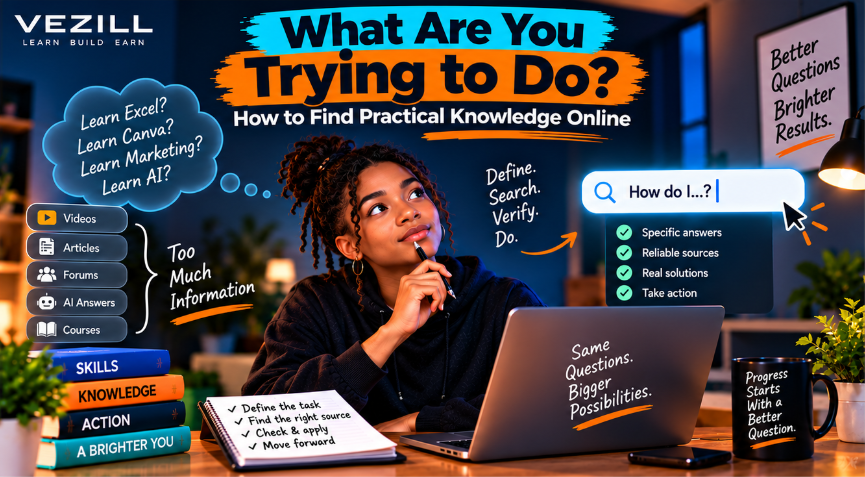
Most bad searches begin before the search box. The problem is often not that the internet has too little information; it is that the question is too broad. Practical searching starts by defining the outcome, narrowing the gap, choosing the right source, verifying what matters and testing the answer in the real task.
Imagine your manager sends you a spreadsheet before a meeting and says, “Remove the duplicates.” You barely use Excel, so you search learn Excel. Within seconds you have beginner playlists, 18-hour courses, certification programs, hundreds of tutorials, AI-generated explanations, Microsoft documentation and forum threads.
But you do not need to learn Excel before the meeting. You need to know how to remove duplicate rows safely without deleting information you still need.
The internet did not have too little information. Your question was too large.
To find practical knowledge online, first define the exact outcome you are trying to achieve. Break the problem into a specific task, identify what you already know and what is blocking you, then search for the smallest useful answer using the relevant tool, platform, error message, location or context. Choose sources based on the type and consequence of the problem, verify important information, apply it immediately and only expand into deeper learning when the task reveals a larger knowledge gap.
DEFINE → SEARCH → FILTER → VERIFY → APPLY → ESCALATE
This article is not about memorizing “Google tricks” or finding one perfect AI prompt. It is about turning a vague need into a searchable problem. Better searching starts before the search box.
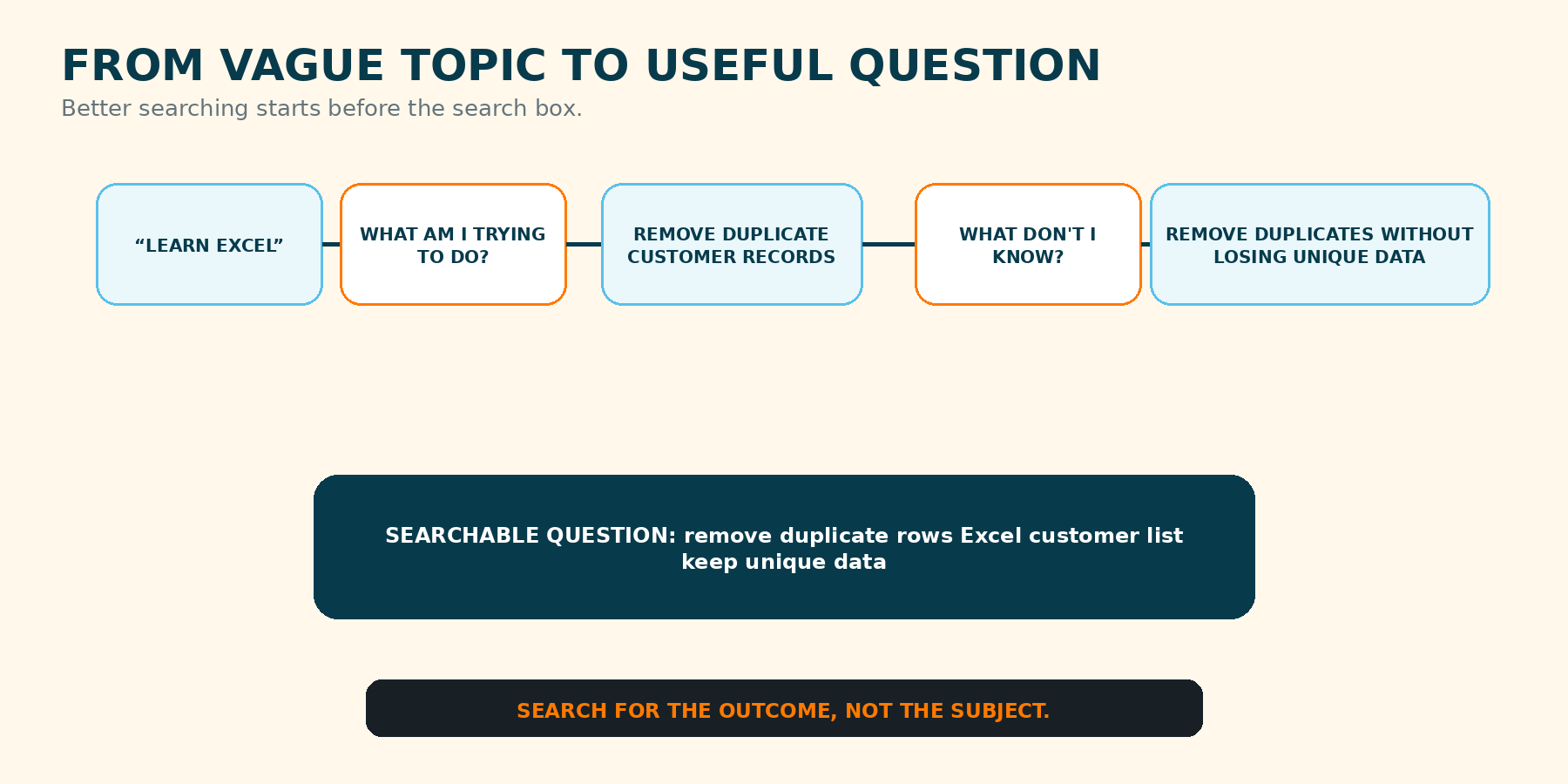 Search for the outcome, not the subject.
Use this six-stage process whenever you are trying to solve a practical problem online.
What exactly are you trying to accomplish? “Learn WordPress” is too broad. “Change the spacing between two blocks on this page” is a task.
What is the smallest part you do not understand? Maybe you know where the page editor is but cannot find the spacing control. That is a much smaller search space.
Use the language of the task: the action, object, tool, context and important constraint.
Choose a source that fits the problem. Official documentation is often best for current product behavior; a video may be better for a visual workflow; an AI assistant can be useful for explanation and follow-up questions.
Check whether the answer is current and reliable enough for the consequence of being wrong.
Try it. Check the result. If it works, move on. If it does not, refine the question rather than collecting another ten unrelated resources.
DEFINE → NARROW → SEARCH → FILTER → VERIFY → APPLY
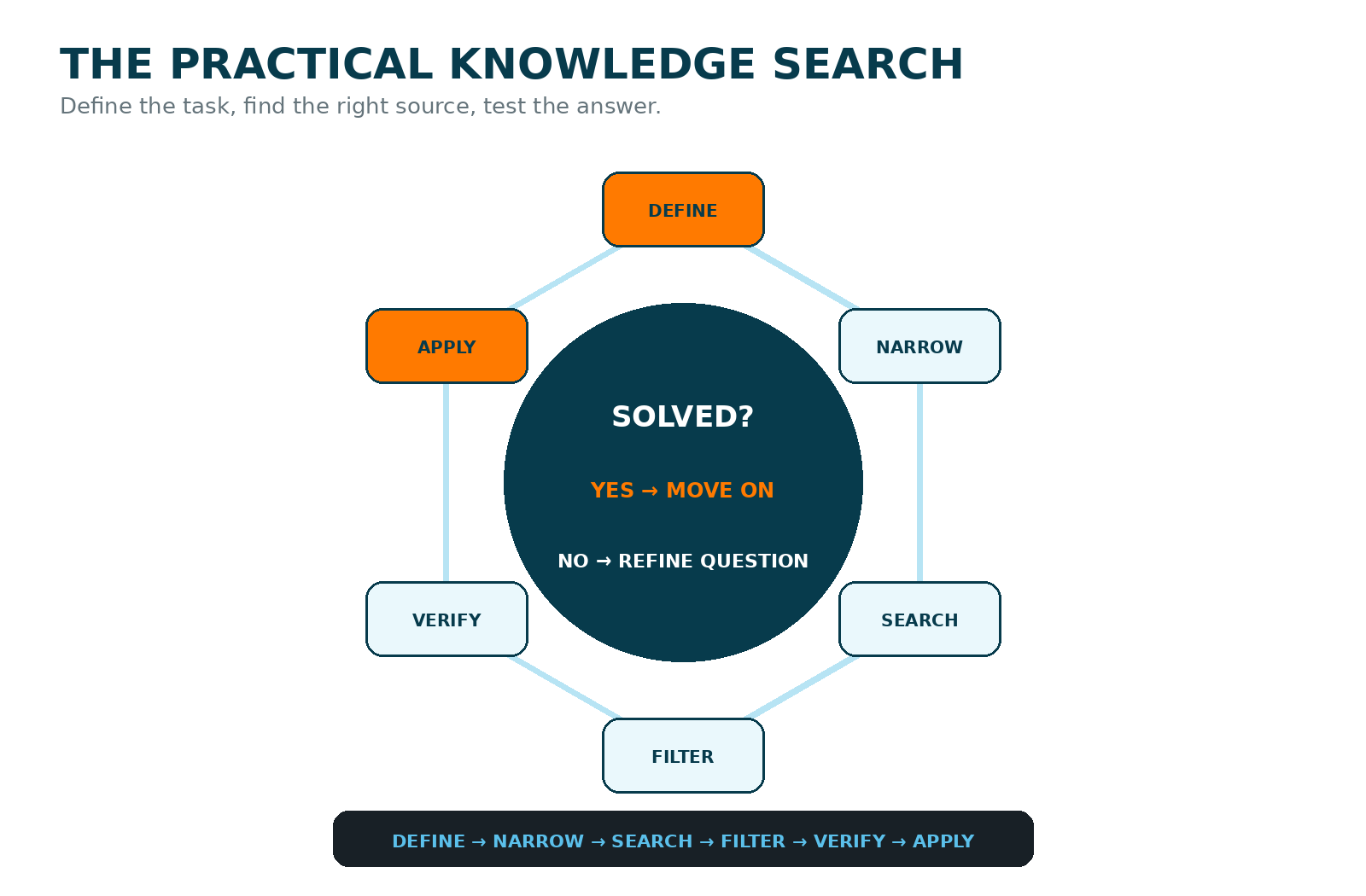 The best search process ends in action, not in a larger bookmark folder.
| Topic Search | Outcome Search |
|---|---|
| Learn Excel | Remove duplicate rows in Excel |
| Learn Canva | Export a Canva design as a print-ready PDF |
| Learn SEO | Find pages on my site that Google has not indexed |
| Learn WordPress | Change spacing between WordPress blocks |
| Learn ChatGPT | Turn meeting notes into action items with ChatGPT |
| Learn video editing | Remove background noise from a phone recording |
| Learn analytics | Find which page generates the most enquiries |
| Learn coding | Read a CSV file with Python |
| Learn accounting | Create a simple monthly cash-flow statement |
| Learn digital marketing | Track which campaign generated a lead |
The broad topic can still matter later. But it is usually a poor starting query when you have an immediate task.
Search for the outcome, not the subject.
Before opening Google, YouTube or an AI assistant, finish this sentence:
I AM TRYING TO ____________________.
Examples:
Then ask: What is stopping me? That second question turns the task into a knowledge gap.
Use four lines:
WHAT I KNOW: The file is an Excel spreadsheet.
WHAT I WANT: One row per customer.
WHAT IS WRONG: Some customers appear more than once.
WHAT I DON'T KNOW: How to remove duplicates without losing useful data.
That becomes a useful query such as:
remove duplicate rows Excel customer list keep unique data
This technique works because it separates the problem you understand from the part you actually need help with.
[ACTION] + [OBJECT] + [TOOL] + [CONTEXT] + [CONSTRAINT]
Example:
Action: remove. Object: duplicate rows. Tool: Excel. Context: customer list. Constraint: keep newest entry.
Search:
remove duplicate rows Excel customer list keep newest entry
Another example:
export Canva A4 brochure commercial printing PDF
Not every query needs every component. The formula is a reminder to include the context that changes the answer.
Do not search “my website is broken” if the page gives you an exact error. Search the exact error text plus the product or framework.
Examples:
A specific error reduces the search space dramatically.
Before pasting an error into a search engine, forum or AI tool, remove passwords, API keys, private URLs, customer information, personal data and internal company details.
Many current AI and search experiences can accept images, screenshots or files. Google's AI Mode, for example, supports text, voice, images and files, while ChatGPT can work with uploaded images and files in supported chats. That means a visual error can sometimes be easier to show than describe.
Instead of “there is a weird thing in Excel,” you might provide a safe screenshot and ask:
“What does this warning mean, and what should I check before clicking Continue?”
But remove personal information, account names, customer records and confidential details first. A screenshot is data.
| Need | Good Starting Source |
|---|---|
| Official software feature | Official documentation |
| Specific visual task | Tutorial or video |
| Concept explanation | Educational source or AI tutor |
| Academic claim | Original research or university source |
| Government requirement | Official government website |
| Tax question | Tax authority and, where appropriate, qualified professional |
| Product troubleshooting | Manufacturer documentation |
| Community experience | Forums or Reddit |
| Current news | Reputable news sources |
| Code/library problem | Official docs plus repository/issues |
| Comparison | Multiple independent sources |
| Local business procedure | Relevant official/local source |
The best source depends on the question.
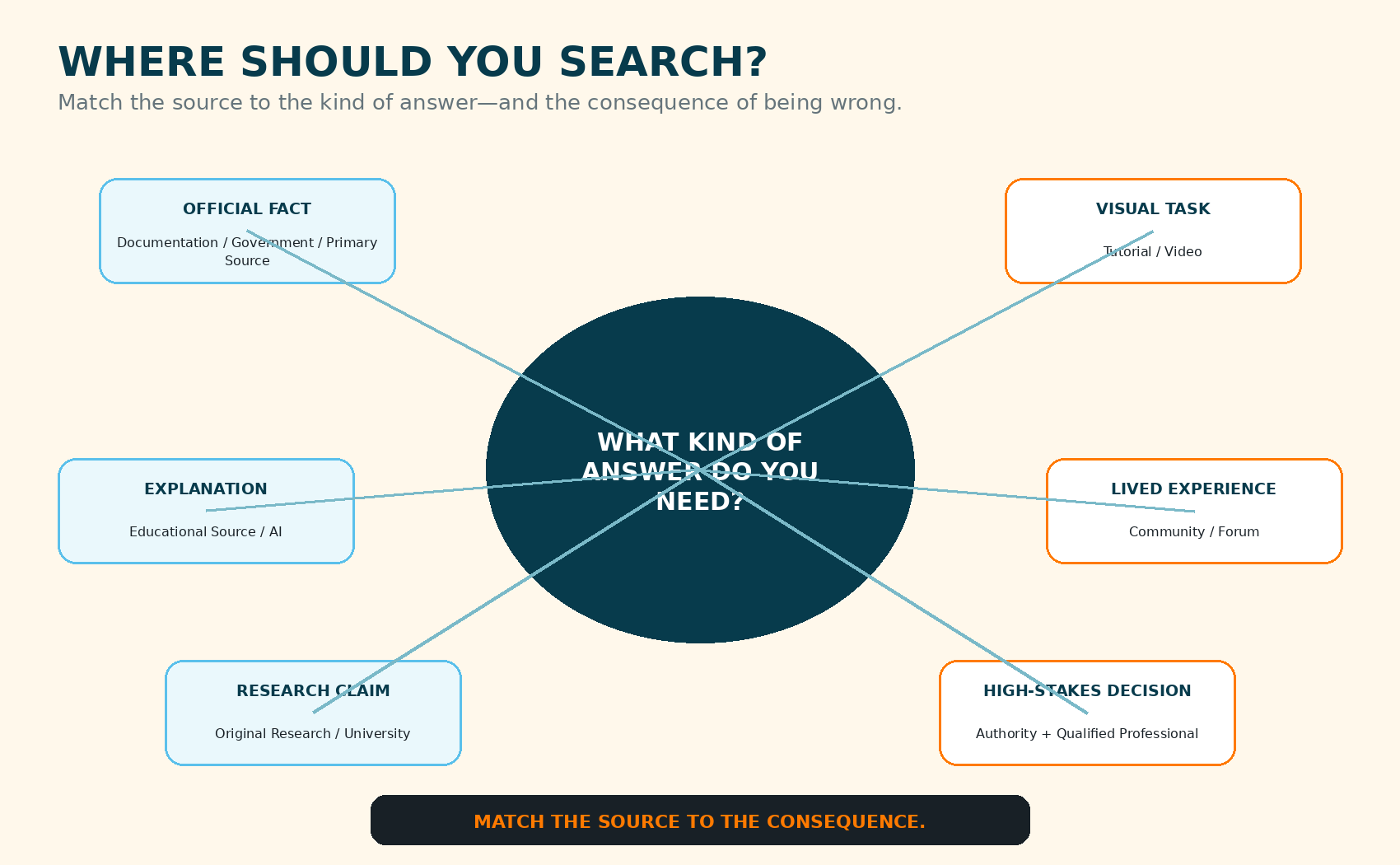 Match the source to the question and to the consequence of being wrong.
Best for locating sources, comparing pages, finding official documentation and searching exact error messages. Google currently supports operators such as quotation marks for exact phrases, site:, the minus operator and date operators such as before: and after:.
Excellent for interfaces, physical demonstrations and visual workflows. The risk is freshness: a three-year-old tutorial may show an interface that no longer exists.
Useful for clarifying, simplifying, generating examples, asking follow-up questions and adapting an explanation to your context. Current ChatGPT search can retrieve web information with citations, and Google AI Mode supports conversational follow-up. But AI answers can still contain mistakes, incomplete sources or incorrect interpretations.
Useful for edge cases, lived experience and discovering the vocabulary people use for a problem. But an anecdote is not an official fact.
Often the best source for current product behavior, specifications and official procedures. The downside is that documentation sometimes assumes background knowledge. Use a secondary explanation when you need help understanding the primary source.
Google's current AI Mode lets users ask follow-up questions and search using text, voice, images and files. AI Overviews can summarize information from multiple sources, and Google explicitly warns that AI-generated responses can contain mistakes. ChatGPT search can also retrieve current web information and provide links to sources.
The practical change is significant: search no longer has to be one query followed by ten tabs. You can refine the question interactively.
Search is becoming a conversation. Conversation does not remove verification.
Do not search for a “magic prompt.” Give the information that changes the answer.
CONTEXT → GOAL → CURRENT STATE → PROBLEM → CONSTRAINT → DESIRED EXPLANATION
Weak:
“Explain Excel.”
Better:
“I have an Excel sheet with customer names in column A and email addresses in column B. Some customers appear more than once. I want one row per email address without deleting unique customers. Explain the safest method for a beginner and how I can verify the result before saving.”
You may not know what details matter. Try:
“I am trying to accomplish [goal]. Before giving me instructions, ask me up to five questions needed to understand my situation.”
Useful clarifying questions may reveal your software version, device, current setup, constraint or skill level. AI can still miss important context, but the method is often better than forcing a premature answer.
Most difficult searches improve in stages.
SEARCH 1 → LEARN VOCABULARY → SEARCH 2 → BECOME MORE SPECIFIC → SEARCH 3 → FIND AUTHORITATIVE SOURCE → APPLY
Example:
The first search may not find the answer. It may find the words needed to ask the better question.
Google's current help documentation lists several operators that remain useful:
Examples:
Operators are useful when they reduce noise. They are not a substitute for defining the task.
“Change notification settings iPhone” may return instructions for multiple operating-system versions. Adding the relevant version can make the result more useful.
The same applies to Windows, Android, WordPress, Python libraries, React, database engines and other software where menus or behavior change over time.
Freshness matters for taxes, government processes, AI products, software, regulations, prices, visa requirements, APIs and platform policies.
Adding “2026” is not proof that a page is current. Check the publication or update date, effective date and whether an official source reflects the same requirement.
“Register business” is too broad for a location-dependent process.
Better:
register business Kenya
Better still:
Kenya business name registration official
For tax, business registration, banking, mobile money, law, licensing, health, education, jobs and government services, location is part of the question.
Example: a Canva shortcut. One credible current tutorial may be enough.
Example: configuring software used by a business. Prefer official documentation plus a credible explanation or safe test.
Tax, law, health, financial decisions, cybersecurity, immigration and safety require stronger sources and, where appropriate, qualified professionals.
Consequence determines verification depth.
Skepticism should be proportional, not paranoid.
Primary sources include government regulations, official documentation, original research papers, company policies, court decisions and standards.
Secondary sources include tutorials, news articles, blogs, educators and analysts explaining or interpreting the primary material.
PRIMARY FOR AUTHORITY. SECONDARY FOR UNDERSTANDING.
One official source can sometimes be stronger than ten random blogs.
Ask AI:
Then open the important sources. ChatGPT's own help documentation warns that search results and citations can be incomplete, outdated or incorrect and advises users to check authoritative sources when accuracy matters.
Many people do not have an information shortage. They have a pile of saved information with no decision attached to it: browser tabs, TikToks, YouTube playlists, AI chats, bookmarks, PDFs, courses and newsletters.
The solution is not “never research.” It is deciding what would count as enough information to take the next safe step.
For a low-risk task, once you find an answer that matches your problem, is current enough, comes from a credible source and can be tested safely, stop searching and try it.
Search less. Test sooner.
Continue searching when sources conflict, consequences are high, the information appears outdated, you do not understand the instructions or the solution depends on missing context.
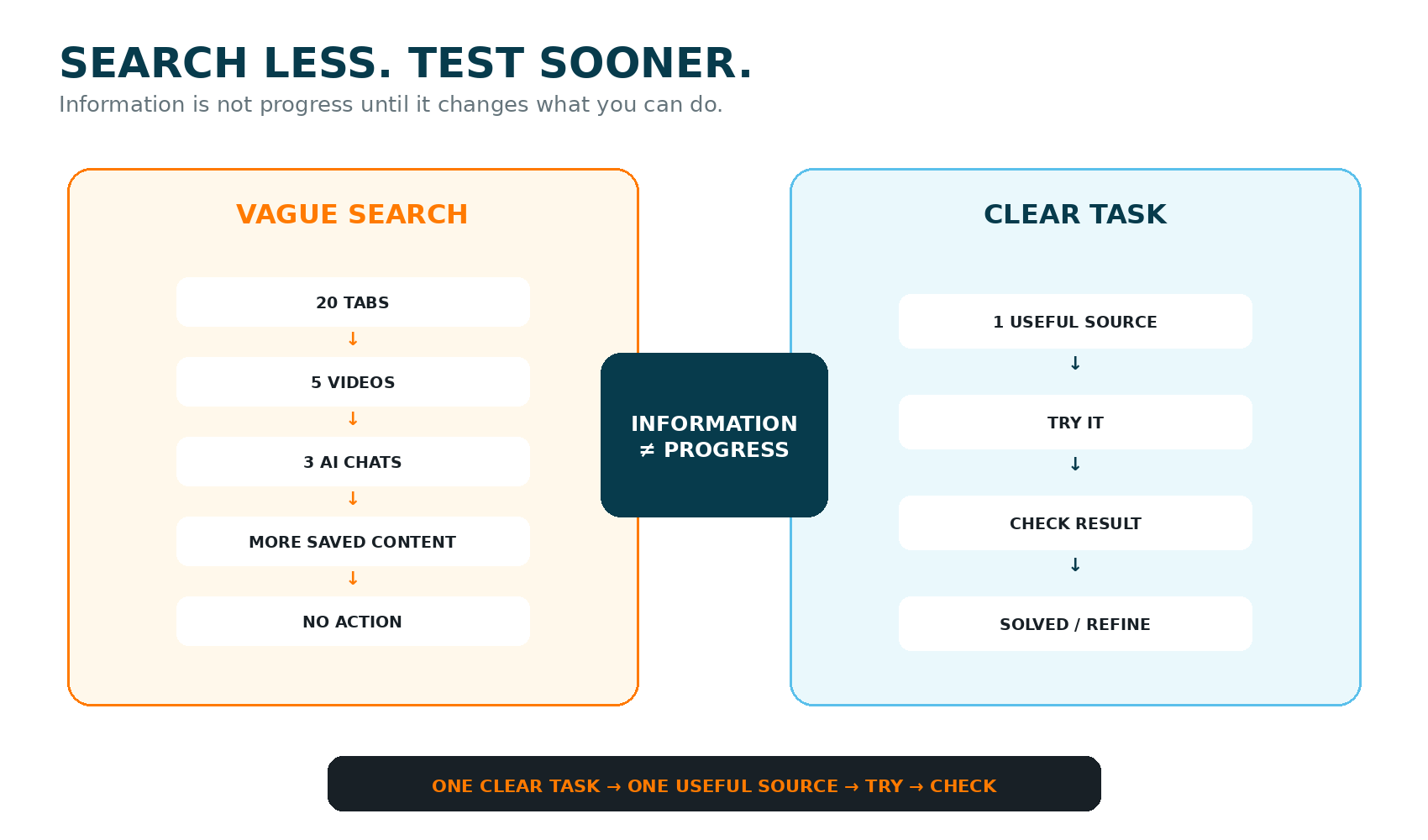 Information is not progress until it changes what you can do.
Suppose you find instructions for removing duplicates in Excel. Do not immediately overwrite the only copy of your customer file.
Knowledge becomes useful when it survives reality.
If you repeatedly search for Excel formulas, formatting, PivotTables, lookups and charts, the problem may no longer be “I need an answer.” It may now be “I need Excel as a skill.”
This is the point where isolated searches become inefficient. Stop patching and learn the system. VEZILL's article on what you can realistically learn in 30 days uses the same principle: narrow outcomes are useful, but repeated work eventually deserves broader capability.
The internet is not always the right destination. Ask a teacher, colleague, mentor, technician, accountant, lawyer, doctor or qualified specialist when the consequence is high, the situation is unusual, confidential information is involved, physical inspection is necessary, diagnosis is required or repeated searching is not resolving the issue.
Knowing when not to search is also information literacy.
Your query can contain data. Before pasting screenshots, error logs, documents or customer messages into a search engine, forum or AI system, remove passwords, API keys, ID numbers, phone numbers, addresses, customer names, health records, company secrets, financial details and confidential documents.
If the material belongs to an employer or client, follow their policies before sending it to an external tool.
| Vague Need | Better Question | Best Starting Source | Verification |
|---|---|---|---|
| Excel | Remove duplicate email rows but keep the newest record | Microsoft documentation + tutorial | Low–Medium |
| Canva | Export A4 brochure as print-ready PDF | Canva help | Low |
| WordPress | Reduce spacing between two blocks in current editor | WordPress docs/tutorial | Low |
| ChatGPT | Turn meeting notes into action items without exposing client names | Official product help + safe test | Medium |
| Coding | Read UTF-8 CSV in Python 3 and preserve commas inside quotes | Python docs + examples | Medium |
| Digital marketing | Track which campaign generated a form submission | Platform analytics docs | Medium |
| SEO | Check whether one page is indexed by Google | Google Search Console docs | Medium |
| Accounting | Create a simple cash-flow summary from business transactions | Accounting guide / professional | Medium–High |
| Graphic design | Export a transparent logo for web use | Design software docs | Low |
| Phone settings | Turn off app notifications on current Android version | Phone/OS documentation | Low |
| Video editing | Remove steady background hum from phone audio | Editor docs/video | Low |
| Analytics | Find which landing page generated the most enquiries | Analytics documentation | Medium |
| Business registration | Kenya business name registration official process | BRS/eCitizen | High |
| Tax | Which KRA rule applies to this specific business situation? | KRA + tax professional where needed | High |
| University assignment | Explain this concept and give me a practice question without writing my submission | Course materials / tutor / study AI | Medium |
| Job application | What skills appear repeatedly in current entry-level data analyst roles in Kenya? | Real job postings | Medium |
| Cybersecurity | What does this security alert mean in this product version? | Vendor docs / qualified specialist | High |
| Online selling | What payment and delivery options work for this customer location? | Official provider pages | Medium |
Vague: Learn Excel. Goal: remove duplicates from a customer list. Known: duplicate emails exist. Unknown: how to remove them safely. Query: “Excel remove duplicate email rows keep newest record.” Source: Microsoft documentation plus a clear tutorial if needed. Application: work on a copy. Verification: compare row counts and inspect sample customers.
Vague: WordPress site slow. First learn vocabulary: is the problem page-load time, image size, hosting, a plugin, JavaScript or server response? Use a speed report to identify the symptom, then search the specific finding. One broad “speed up WordPress” article is unlikely to diagnose every site.
Goal: summarize customer feedback into recurring complaint categories. First remove customer names and private information. Then ask the AI to group only the supplied feedback, quote or reference the original items by safe ID and identify uncertain categories. Manually inspect the grouped results before using them for business decisions.
Vague: how to register a business. Better: Kenya business name registration official. The Business Registration Service says name reservation and business registration are handled together online and directs users through the BRS/eCitizen system. For a government procedure, prefer the official BRS source over an old blog walkthrough.
A search can help you understand terminology, prepare questions or find an appropriate service. But if the task is diagnosing a concerning symptom or deciding whether treatment is safe, the correct outcome may be to seek qualified medical help rather than keep searching for a self-diagnosis.
“How do I become successful?” is too vague to produce a useful learning plan.
Move from:
ASPIRATION → REQUIREMENTS → SKILL GAP → LEARNING PLAN
For example: “What skills are required for entry-level data analyst jobs in Kenya?” Then compare several real postings and identify repeated requirements. Do not assume one job advert defines the whole market.
Once you are building skills, VEZILL's guide to building a portfolio without experience explains how to convert practice into honest evidence of capability.
“How to start business” mixes several different questions: customer demand, registration, finance, marketing, operations and legal requirements.
Separate them. A customer question might be: “Would small accounting firms pay for a monthly educational-content service?” A government-process question might be: “Kenya business name registration official.” They require different sources.
VEZILL's article on problems you can solve online is useful when the search is about identifying a specific customer problem rather than merely learning a tool.
Include the exact error, language or framework, version, operating system, expected behavior and actual behavior when those details matter.
Bad:
React not working
Better:
React 19 useEffect runs twice development StrictMode
The improved query gives the search engine or AI a much narrower technical context.
Some problems are easier to show than describe: an interface, layout, appliance component, chart or error screen. Modern multimodal search and AI can help interpret these inputs, but they can also misread them.
Text is not always the best query format. Privacy and consequence still matter.
For Kenyan government processes, start with official domains and agencies. Business Registration Service information is available through BRS and eCitizen. Tax requirements should be checked against KRA. Communications regulation should be checked with the Communications Authority. Statistical claims about Kenya are better grounded in KNBS or another official statistical source than in an unsourced social post.
Do not assume every process is completely online or that an old YouTube walkthrough still reflects the current procedure. Official systems can change.
Fake job listings, scholarship pages, tenders, investment offers, customer-care contacts and government-lookalike pages can exploit urgency. Check the domain, organization, official announcements and payment instructions before acting.
For a difficult question, write this before searching:
MY GOAL: __________________________
WHAT I ALREADY KNOW: __________________________
WHAT I DON'T KNOW: __________________________
MY CONTEXT: __________________________
MY CONSTRAINTS: __________________________
A SUCCESSFUL ANSWER WOULD: __________________________
You can adapt the same brief for search engines, AI assistants, support tickets, forums or a question to a colleague.
I am trying to:
[specific outcome]
I am using:
[tool / platform / version]
My current situation is:
[relevant context]
The problem is:
[specific obstacle / error]
I have already tried:
[steps]
My constraint is:
[time / device / budget / permission / etc.]
A successful answer would help me:
[desired result]
You do not need the perfect question to start. You need a question that can become better.
If the same type of search keeps returning, treat that as information. Repeated Excel problems may mean you need spreadsheet skills. Repeated marketing questions may mean you need structured marketing fundamentals. Repeated design fixes may mean you need design foundations.
At that point, VEZILL's guide to skills you can learn online and develop into a business capability can help you think beyond isolated answers.
If the repeated task becomes client work, packaging a freelance service is the next step—but only after you can perform the task competently and reliably.
A second common search mistake is choosing the tool too early. Someone may search “best AI for customer support” before defining the customer-support problem. Another person may search “best project-management app” when the real problem is that responsibilities are unclear. A business may search “best CRM” when it first needs a consistent way to record enquiries.
Start with the process. What is happening now? Where does it fail? What outcome would improve the situation? Then ask whether a tool is even necessary.
This is the same problem-first logic used in VEZILL's guide to problems small businesses pay freelancers to solve: useful work starts with a repeated business problem, not with the fact that someone knows Canva, ChatGPT, Excel or another tool.
When AI is appropriate, VEZILL's small-business AI guide also treats AI as a tool attached to a bounded workflow rather than the starting point for every business decision.
Search engines and AI assistants can easily show you information that sounds confident. The more important question is whether the claim is supported.
If you search “Does this strategy work?” you may find enthusiastic testimonials, marketing pages and people repeating one another. A better research question might be: “What evidence would show whether this strategy works in my situation?”
That could mean looking for official statistics, before-and-after measurements you can verify, peer-reviewed research, platform documentation, current customer behavior or several independent examples. The evidence type depends on the claim.
For your own work, the same principle applies. If you are trying to learn whether a new skill is useful, build a small honest project and inspect the result. If you are trying to identify knowledge you can explain reliably, VEZILL's article on identifying valuable knowledge you already have helps separate repeated real-world usefulness from something that merely sounds impressive.
When you are a complete beginner, the first goal should not be a final answer. It should be a map.
Start with a broad orientation question: What are the main parts of this topic? Which terms are essential? Which sources are considered authoritative? What mistakes do beginners make? Then use the vocabulary you discover to narrow the research.
For example, “I want to understand website speed” may reveal concepts such as image optimization, caching, server response, Core Web Vitals and JavaScript. You do not need to master all of them immediately. The first search gives you the map; the next search follows the path relevant to your actual problem.
This is also where AI can help responsibly: ask it to create a topic map, define unfamiliar terms and suggest what should be checked in official documentation. Then verify important details from primary sources instead of treating the generated map as authority.
Research is incomplete until you know what you are going to do differently.
At the end of a search session, write three lines:
WHAT I LEARNED: __________________________
WHAT I WILL DO NEXT: __________________________
WHAT I STILL NEED TO VERIFY: __________________________
This simple habit prevents a common failure mode: reading useful information, closing the tab and returning to the same uncertainty tomorrow.
For people learning toward freelance or entrepreneurial work, the next action might be a test project, a customer conversation or a small process improvement—not immediately selling something. VEZILL's freelance-service packaging guide becomes useful only after the underlying capability is reliable enough to turn into a defined deliverable.
After you solve the same problem repeatedly, you may notice that you are no longer merely searching for answers. You have developed a method.
You know which details matter, which shortcuts are unsafe, which sequence works, which edge cases appear and how to verify the result. That is a different level of knowledge from following one tutorial.
VEZILL's article on turning work experience into a digital product explains how repeated experience can be organized into a useful method without exposing confidential or employer-owned material. The lesson applies even if you never sell anything: repeated solutions can become documentation, SOPs, checklists or training resources for your own team.
If AI helps you organize that material, use it for structure and editing rather than inventing expertise. VEZILL's AI-assisted digital-product workflow makes the same distinction between AI acceleration and human responsibility for accuracy.
You do not need to formulate the perfect question on attempt one. In fact, beginners often cannot because they lack the vocabulary.
A productive search leaves you with one of three things: the answer, a better term or a better question. If you gained none of those, change the search strategy instead of repeating slightly different versions of the same vague query.
This is why practical online research is a skill. You learn to notice whether the problem is missing vocabulary, weak source selection, insufficient context, conflicting evidence or a task that is actually too complex for isolated searching.
The result is not merely faster Googling. It is better judgment about what kind of knowledge you need and where that knowledge should come from.
Practical knowledge is information or understanding that helps you perform a task, solve a problem, make a decision or take a useful next step.
Define the outcome, identify the exact gap, include relevant context such as the tool or version, choose the right source type and test the answer.
Use specific outcome-based queries, exact phrases when useful, site restrictions for authoritative domains and date or version details when freshness matters.
Use search engines to locate and compare sources; use AI when interactive explanation or synthesis helps. Important claims should still be verified against appropriate sources.
Check who publishes it, the author's authority, update date, evidence, primary sources, location relevance and the consequence if the information is wrong.
Ask for sources, open the important sources, compare the claim with authoritative material and increase verification when the consequence is higher.
Reddit can be useful for experiences, vocabulary and edge cases, but community comments are not automatically factual or representative.
Yes, especially for visual workflows. Check the publication date, software version and whether the demonstrated result matches your context.
Describe what you see or want to accomplish, then use the first search to discover the vocabulary needed for a more precise second search.
When you understand the next action, the source is credible enough for the consequence and you can test the step safely.
Define what would count as a useful answer before searching, then stop collecting once you can take the next safe step.
For official matters, start with the relevant government agency, eCitizen/BRS, KRA, KNBS, the Communications Authority or another responsible official source.
Before you ask what to search, what to learn or which AI tool to use, define the outcome.
DEFINE THE OUTCOME → FIND THE GAP → ASK THE BETTER QUESTION → CHOOSE THE RIGHT SOURCE → VERIFY ACCORDING TO CONSEQUENCE → APPLY → CHECK → MOVE ON OR GO DEEPER
The best search is not the one that gives you the most information. It is the one that helps you take the right next step.
Discover more articles you might be interested in
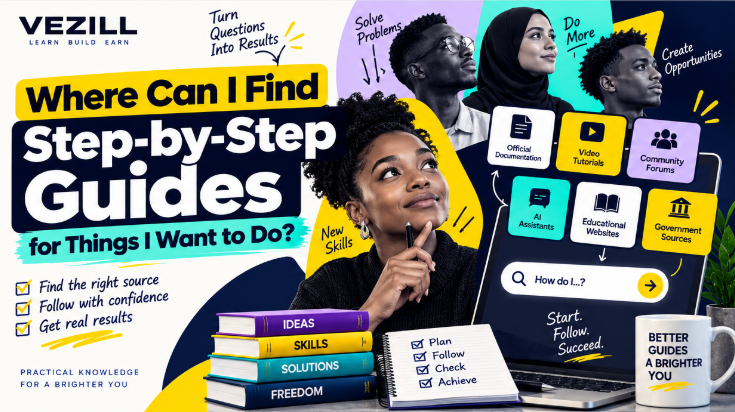
Learn where to find reliable step-by-step guides online, how to choose the right tutorial for your task, check whether it is current and follow instructions safely.
By Davie
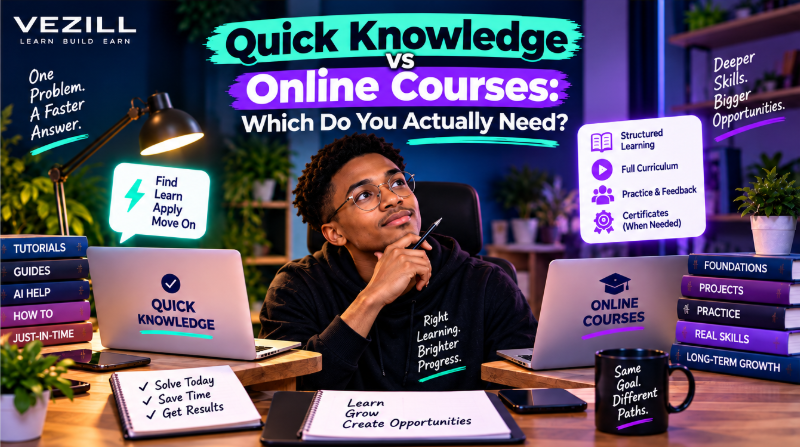
Quick Knowledge or an online course? Learn when a focused answer is enough, when structured learning is better, and how to choose the right learning depth for your goal.
By Davie

Learn how to turn one useful digital product into multiple income streams through premium versions, bundles, courses, licensing, services, subscriptions, B2B sales and complementary products.
By Davie

Can selling digital products become a sustainable long-term business? Learn what makes the model durable, why products fail, how AI changes the market and how to build recurring value.
By Davie
Get the updates, on newly released, popular & fast-moving MRR digital products
Up to Top
Comments All
Mercy
@mercy
Sometimes the hardest part isn’t learning something, it’s finding the right information in the first place. Having practical knowledge that actually helps you get something done makes a big difference.
September 17,2026 At 05:49 PM