

AI can help you research, draft, design, analyse, edit, code and automate, but access to an AI tool is not a business advantage by itself. The opportunity begins when you use those capabilities to solve a specific problem for a customer—and take responsibility for the finished result.
Quick Answer: You can use AI to help create and sell practical ebooks, templates, checklists, workbooks, spreadsheets, prompt systems, online courses, video tutorials, audio lessons, design assets, marketing resources, educational materials, no-code tools, software and AI-assisted services. The strongest product is not the one AI can generate fastest. It is the smallest accurate, original and easy-to-use solution to a problem people care enough to pay to solve.
Before creating anything, identify the buyer, validate the problem, select an appropriate format and check the commercial-use rules for every tool and asset involved. AI can accelerate production; it cannot replace expertise, fact-checking, consent, licensing or distribution.
Creating with AI can mean several different things. An AI-assisted product may use AI during research or drafting while a human supplies the expertise and final work. A primarily AI-generated product relies heavily on generated text, imagery, audio or video. An AI-powered product uses an AI model while the customer is using it, such as a chatbot or classification tool. An AI-assisted service uses AI behind the scenes while a human remains responsible for client delivery.
AI can act as a brainstorming partner, drafting assistant, design aide, coding assistant, translation helper, data-analysis tool, video-production assistant or automation component. These roles have different risks. A spelling suggestion is relatively easy to review; an AI-generated legal document, medical recommendation or security configuration can create serious harm if the seller lacks appropriate expertise.
The creator remains responsible for checking the output, respecting rights, protecting customer information and representing the product honestly. “AI made it” does not transfer accountability to a machine.
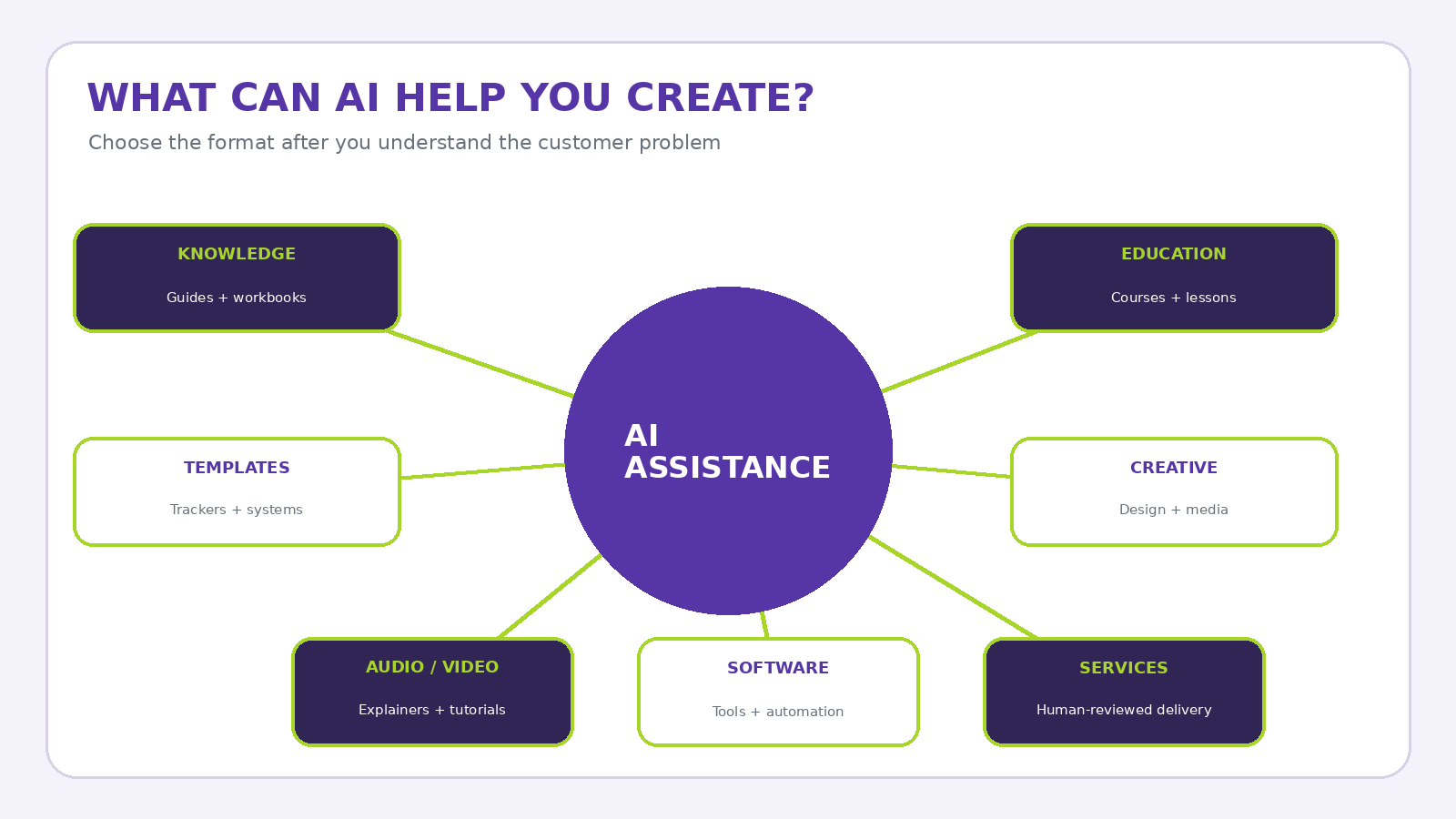 Map of seven product and service categories AI can assist: knowledge products, templates, education, creative assets, audio and video, software and services.
AI can support many formats, but the buyer’s problem should determine which format you choose.
A worthwhile AI-assisted product connects a specific customer to a clear result. It is accurate, original, organised, easy to apply and legally packaged.
Compare these two ideas:
The stronger idea does more than supply text. It identifies a user, structures a workflow and helps the buyer evaluate output. Raw generation is only one ingredient.
A useful value test asks:
VEZILL’s article on finding a winning digital-product idea before creating it offers a relevant validation starting point. Treat competitor activity as evidence to investigate, not permission to copy.
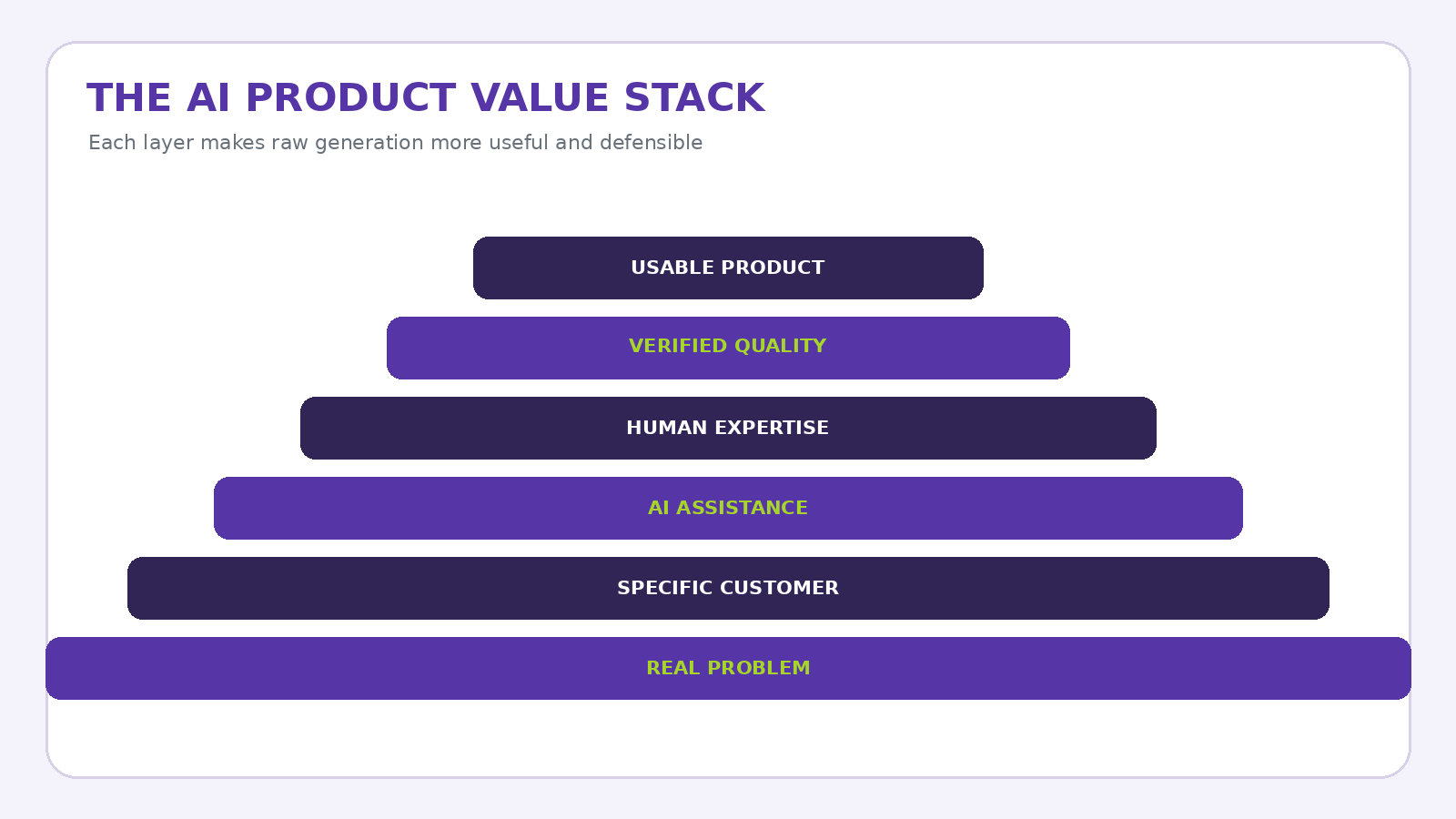 The AI product value stack: a real problem and specific customer combined with AI assistance, human expertise, verification and usable delivery.
Customers buy the solution—not the fact that AI helped produce it.
The possibilities are broad, so choose by customer need rather than by whichever tool is fashionable.
AI can help organise research, generate interview questions, compare outlines, simplify language and suggest examples for ebooks, guides, checklists, workbooks, research briefs, glossaries and standard operating procedures.
A realistic minimum product might be a ten-page checklist-driven guide that solves one narrow task. A Kenyan catering consultant, for example, could create a food-costing starter workbook based on genuine experience. AI might help structure the explanations, while the consultant verifies calculations, local units, ingredient assumptions and food-safety statements.
Do not ask a chatbot to manufacture expertise. Every factual claim needs an appropriate source or knowledgeable review. Anyone exploring this format can inspect a currently listed guide to creating a complete ebook with AI and evaluate its preview, usefulness and licence before purchasing.
Templates help customers perform a recurring task more consistently. Examples include content calendars, budget sheets, proposal templates, client-onboarding documents, project trackers, job-application kits, Notion systems and spreadsheet dashboards.
AI can suggest fields, formulas, instructions and example data. Human testing determines whether the tool is clear, safe and useful. A restaurant consultant could create a menu-pricing spreadsheet with editable assumptions. A virtual assistant could build an onboarding kit that tells a new client exactly what information to supply.
Avoid selling a beautiful but untested file. Give it to representative users without coaching them, observe where they become confused and improve the instructions.
AI can assist with lesson outlines, practice questions, flashcards, quizzes, scripts, worksheets and learning roadmaps. Possible formats include micro-courses, short tutorials, teacher resources and workplace training.
Subject expertise matters. A teacher creating an original revision workbook must check every answer, align it with the intended curriculum and avoid restricted examination material. A software instructor should test every code example in the stated environment.
Creators can develop original presentation templates, social-media packs, printable planners, icons, illustrations, video assets and editing presets. AI can assist with ideation and variations, but the creator must check tool terms, asset licences, trademarks and the marketplace’s AI-content rules.
Avoid prompts such as “make this exactly in the style of a living artist” or requests for protected characters and logos. Distinct art direction, original composition and properly licensed elements create a safer, more durable product.
Possible products include guided audio lessons, audiobooks based on original writing, micro-podcasts, explainers, screen-recorded tutorials, video courses and product demonstrations.
AI can assist with scripts, captions, cleanup, translation, storyboards, voice generation and animation. Consent is essential when cloning a voice or likeness. Do not imitate a celebrity, customer or private person without clear rights. Label synthetic presenters where platform policy or the context requires disclosure.
Prompt packs can save time when they are tested, narrow and connected to a workflow. Useful products may include role-specific prompts, input templates, example outputs, failure checks and evaluation criteria.
VEZILL’s article on selling AI prompts as digital products introduces the format, while its page on ChatGPT prompts people may buy offers additional examples. Improve on generic bundles by showing when each prompt should be used, what information to supply and how to judge the response.
The Prompt Engineer’s Handbook listing is one example of a prompt-focused learning product. Check its current description and licence directly; a listing’s presence does not guarantee that it fits every buyer.
AI can assist with simple calculators, chatbots, workflow automations, data-extraction tools, reporting systems, small applications and industry-specific assistants. These products may provide more defensibility than a PDF, but they carry more responsibility.
Software requires functional testing, security, privacy protection, maintenance, model-cost planning and user support. A prototype that works on sample data is not automatically safe for customer data.
Someone developing technical foundations can review Inceptor’s current Python programming course or its mobile app development training. Verify the latest curriculum and suitability directly; completing a course does not guarantee a viable product or customer demand.
AI-assisted services may be easier to validate than a finished product because a client can describe the desired result. Possible areas include research support, social content, presentation design, short-video editing, product descriptions, transcription, data organisation, customer-response drafts and basic workflow setup.
The seller must understand the task without the tool. If you cannot recognise a factual error, inappropriate image, broken formula or insecure workflow, you are not ready to promise that outcome.
A beginner should offer a narrow, low-risk deliverable. “I provide complete AI marketing” is vague. “I turn one approved article into five draft LinkedIn posts, then edit them to match your supplied brand voice” is bounded and reviewable.
VEZILL’s AI Marketing Playbook is a relevant learning-product example for marketing workflows. Inspect its preview and licensing terms rather than assuming it provides professional competence by itself.
The best first product fits your existing knowledge, customers you can reach and the level of risk you can manage. Score each candidate from 1 to 5, then validate the two strongest options with real users.
| Decision factor | Question to ask |
|---|---|
| Existing knowledge | Can I independently judge whether the output is correct? |
| Customer access | Can I name and reach at least 20 plausible users? |
| Problem evidence | Do people already spend time or money solving it? |
| Minimum version | Can I test a useful version without months of production? |
| Equipment | Can my device produce and test it reliably? |
| Research burden | What evidence and expert review will be necessary? |
| Technical complexity | Can I maintain every component after launch? |
| Support burden | How much onboarding, troubleshooting or updating is required? |
| Rights risk | Do I control or license all text, media, code and data? |
| Repeatability | Can the same solution help more than one buyer? |
If you have subject knowledge but limited design skill, a clear workbook may be better than an elaborate video course. If you can code and understand a narrow workflow, a small tool may fit. If you know neither the customer nor the subject, research and learn before selling.
A smartphone can support short guides, checklists, simple workbooks, prompt systems, social templates, audio lessons, short videos and screen-recorded tutorials. Cloud-based AI and design tools can handle much of the production.
The limitations are real. Complex spreadsheets are difficult to test on a small screen. Long videos strain storage and rendering. Coding, bulk file management, backups and detailed visual quality control are harder. Mobile-only creation can also hide formatting problems that appear on a buyer’s laptop.
Choose a phone-friendly format, keep source files backed up and test the finished product on the devices your customers use. Do not advertise “works everywhere” until you have checked.
Do not start with “What can ChatGPT generate?” Start with “What does this customer repeatedly need?”
Search traffic, likes and compliments show attention. Email sign-ups show more commitment. A deposit or purchase is stronger evidence. Even a successful test does not guarantee future demand.
VEZILL’s catalogue of digital products currently described as being in demand can inspire categories, but you still need to validate your specific audience, promise and format.
Use a controlled process in which AI accelerates work but does not make final decisions.
What: Define one group with a shared situation. How: Describe their role, context and current workaround. Why: Specific users make product decisions clearer. Outcome: A one-sentence audience definition.
What: Confirm that the problem is repeated and meaningful. How: Combine interviews, reviews, paid alternatives and real requests. Why: Creation without evidence wastes time. Outcome: A documented problem with several independent signals.
What: Select a checklist, template, guide, lesson, course or tool. How: Match the format to how the customer performs the task. Why: A long ebook is wrong when the buyer needs a reusable spreadsheet. Outcome: One minimum-product definition.
What: Gather current evidence, official documentation and expert input. How: Use AI to generate questions and keywords, then verify using primary sources. Why: AI responses can be incomplete or wrong. Outcome: A traceable source set.
What: Organise the product around the user’s task. How: Sequence the problem, decisions, actions, examples and checks. Why: Structure is part of the value. Outcome: A user-focused production plan.
What: Delegate bounded jobs such as alternative headlines, draft explanations or test cases. How: Supply clear context and ask for uncertainty to be flagged. Why: Controlled tasks are easier to review. Outcome: Draft components, not an unchecked final product.
What: Add judgment, local context, original examples and decisions. How: Explain what experience or evidence means for this particular buyer. Why: Generic generation is easily replaced. Outcome: A differentiated resource.
What: Check claims, calculations, code, links and assets. How: Test outputs and compare important facts with authoritative sources. Why: The seller is responsible for quality. Outcome: A corrected, documented product.
What: Observe people using the product. How: Ask them to complete the task without live coaching. Why: Confusion becomes visible. Outcome: A list of specific improvements.
What: Prepare the title, description, preview, files, instructions and licence. How: Connect each feature to the intended result. Why: Buyers need to understand what they receive. Outcome: A clear, honest offer.
What: Select a marketplace, website, course platform or app store. How: Compare current fees, policies, formats, delivery and audience fit. Why: Distribution affects sales and support. Outcome: A functioning product page and delivery path.
What: Demonstrate the product’s use and collect performance evidence. How: Share samples, tutorials, case examples and answers to buyer questions. Why: Useful products remain invisible without distribution. Outcome: Data on traffic, conversion, completion, support and refunds.
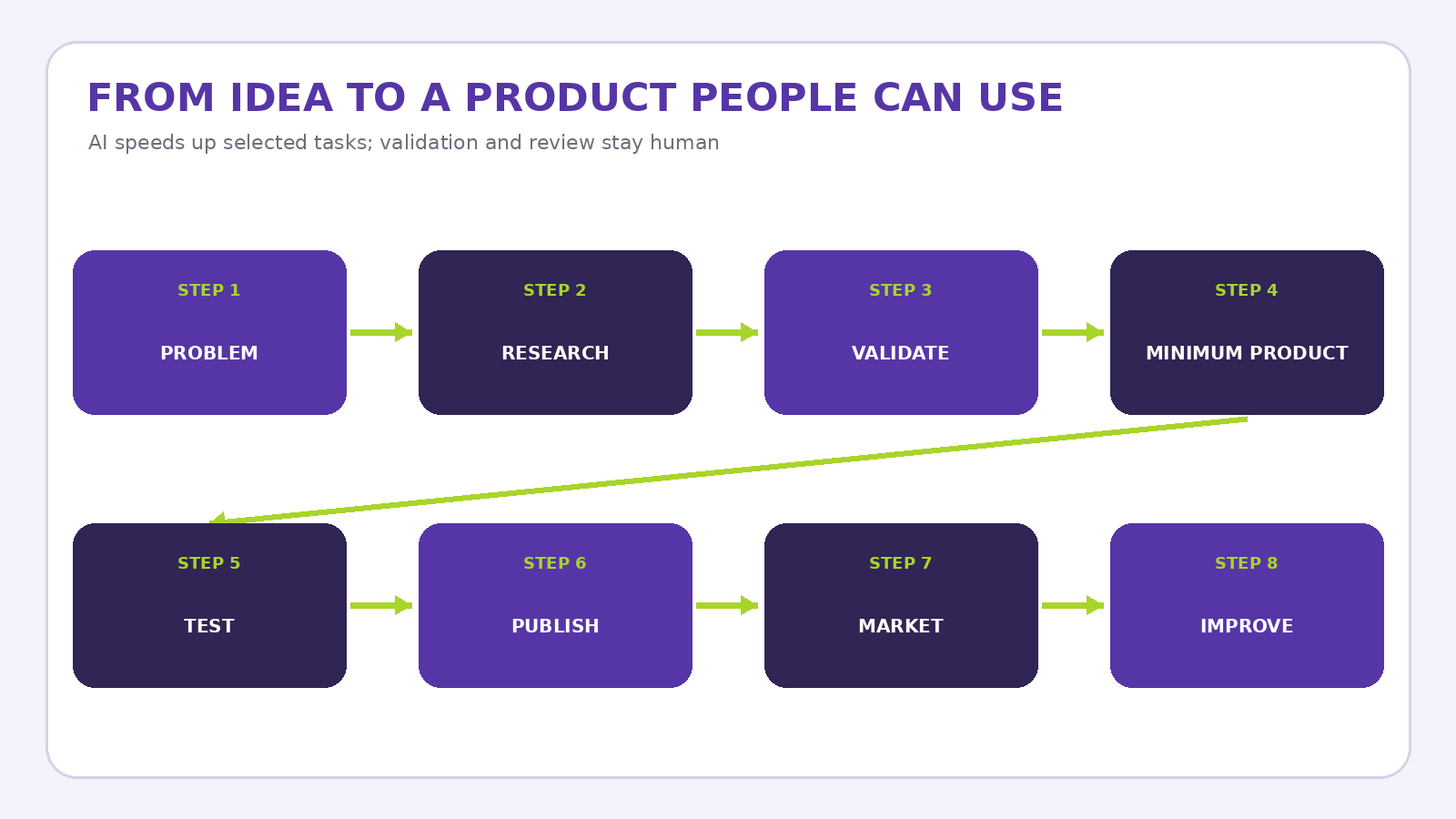 Twelve-stage idea-to-sale workflow from customer problem and validation through creation, testing, publishing, marketing and improvement.
Do not confuse generating a file with building a product customers can trust and use.
Costs depend on the format and quality standard. Consider AI subscriptions, data, internet, equipment, design tools, hosting, marketplace fees, payment processing, advertising, editing, professional review, support and updates.
Here is a hypothetical illustration, not a recommended budget. Suppose a Kenyan creator uses KES 2,500 for one month of tools, KES 1,500 for data and KES 3,000 for specialised editing or review. Initial cash cost would be KES 7,000 before platform fees, payment charges, tax and the value of the creator’s time. At an illustrative rate of KES 130 per US dollar, that is about USD 54. Exchange rates and actual charges change.
A software tool or professionally filmed course may cost much more. A short checklist using existing equipment may cost less. Start by listing your real expenses and the minimum quality required.
Price should reflect customer value, alternatives, product depth, purchasing power, production costs, ongoing support, marketplace fees and licence rights—not simply the number of pages or minutes AI generated.
Test a price with a small audience and watch behaviour. A lower introductory price can reduce friction, but constant discounting may attract poor-fit customers or make support uneconomic. Bundles work when products solve connected problems; combining unrelated files does not create genuine value.
VEZILL’s article on pricing digital products discusses relevant pricing factors. Verify current platform fees and your own margins before publishing.
Possible channels include digital-product marketplaces, personal websites, course platforms, freelance platforms, professional networks, social-commerce channels, email audiences, partnerships and app stores.
Each channel has its own rules for AI content, prohibited products, refunds, fees and customer data. Check official terms at the time of publishing.
VEZILL describes itself as a marketplace supporting several digital formats; review its current platform guide for selling digital products rather than relying on an old summary. You can also inspect a concrete listing such as Sell Your First Digital Product to understand how a product is presented. Always evaluate the preview and specific licence yourself.
Sometimes, but legality and commercial permission depend on the tool terms, source material, jurisdiction, marketplace and type of output. This is general information, not legal advice.
Check:
Do not assume that generating an image of a protected character makes it yours. Do not sell a cloned voice without consent. Do not paste confidential customer documents into an unapproved AI system.
VEZILL’s digital-product glossary can help distinguish common product and licence terms, but the exact terms attached to a product control what buyers may do.
Avoid plagiarised ebooks, stolen templates, fake expert guides, unverified health claims, personalised legal or financial advice beyond your qualifications, fabricated research, deepfakes, unauthorised celebrity voices, copyrighted character packs, fake reviews, fraudulent certificates, cheating materials, malware and products containing private customer data.
Also avoid generic prompt dumps and “guaranteed income” systems. A large quantity of generated content does not compensate for poor accuracy or missing customer value.
If privacy is your concern rather than deception, building under a brand can be legitimate. VEZILL’s article on selling digital products without showing your face explains faceless promotion approaches. A brand does not remove legal, tax, platform or customer obligations.
Use this quality formula:
AI draft + human expertise + customer context + verified evidence + original examples + clear design + user testing
Interview users. Add local or industry context. Test every template. Show examples using original or licensed materials. Explain limitations. Include instructions and evaluation criteria. Update the product when tools, laws or customer needs change.
A small-business creator might use AI to draft email variations, but real value comes from adapting them to the business’s voice, customer journey and actual policies. VEZILL’s AI Guide for Small Business is a relevant marketplace example; verify the listing’s contents and rights before deciding whether it fits your needs.
Use this quick decision logic:
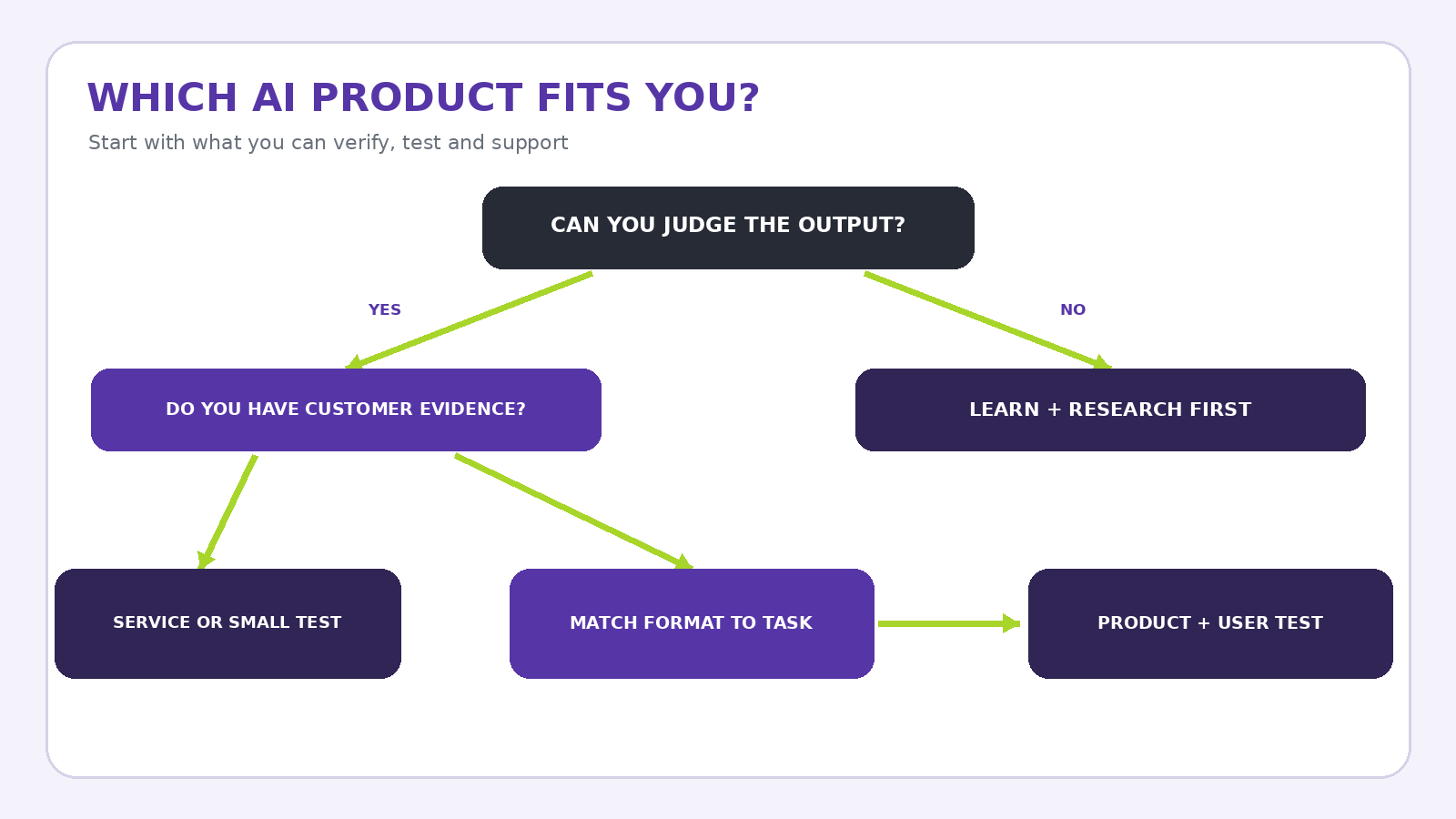 Decision tree matching existing expertise, customer evidence, equipment, technical ability and support capacity to an AI-assisted product or service.
Choose the simplest product you can verify and support—not the most impressive format AI can generate.
It can be worthwhile when the product solves a real problem, the creator understands the subject, the result can be checked, costs are controlled and a practical distribution channel exists.
It is unlikely to be worthwhile when the idea is copied, the market is full of identical outputs, the creator cannot verify accuracy or marketing is treated as an afterthought.
The strongest opportunity is rarely “sell AI content.” It is “use AI responsibly to build a better solution for this particular customer.”
You can create AI-assisted guides, templates, workbooks, prompt systems, courses, videos, audio lessons, design assets, software and services. Choose the format that best solves a validated customer problem.
Yes, if they can verify the work, represent their ability honestly and comply with tool, asset and marketplace rules. Beginners should start with a narrow, low-risk product.
Commercial permission depends on the AI tool’s terms, the source material, local law, output type and marketplace policy. Check current official terms and seek professional advice for high-risk cases.
Potentially, if commercial use is permitted and the book is original, accurate, properly sourced, human-reviewed and compliant with the selling platform. Publishing unchecked generated text is risky and unlikely to provide strong value.
Simple checklists, templates and short workbooks may require less production than courses or software. The easiest product to create is not necessarily the easiest to sell; demand and usefulness still matter.
Yes. A phone can support simple documents, designs, audio and short videos. Complex spreadsheets, long video projects, coding and detailed quality checks may require better equipment.
No large audience is required, but you need distribution through marketplace search, SEO, communities, partners, direct outreach, content, email or advertising.
Options include digital marketplaces, personal websites, course platforms, professional networks and app stores. Compare current AI-content policies, fees, delivery and audience fit.
Disclose AI use when required by law, a platform, a client agreement or the nature of the product. Even when disclosure is optional, never make deceptive claims about authorship, expertise or production.
Add customer research, human expertise, verified evidence, original examples, tested workflows, clear design and useful support. The value should come from the complete solution, not raw generation.
You can create many things with AI, but the correct starting question is not “What will AI make for me?” Ask: “Which customer problem can I understand, verify and solve better with AI’s assistance?”
Select one customer, validate one repeated problem and create the smallest useful version. Test it with real users, check every claim and asset, publish under clear terms and improve from customer behaviour. That is how AI becomes part of a credible product rather than a shortcut to more generic content.
Discover more articles you might be interested in

Learn where to find reliable step-by-step guides online, how to choose the right tutorial for your task, check whether it is current and follow instructions safely.
By Davie
Stop searching broad topics and start finding the exact knowledge you need. Learn how to define your problem, search smarter, choose reliable sources, verify answers and take action.
By Davie
Quick Knowledge or an online course? Learn when a focused answer is enough, when structured learning is better, and how to choose the right learning depth for your goal.
By Davie

Learn how to turn one useful digital product into multiple income streams through premium versions, bundles, courses, licensing, services, subscriptions, B2B sales and complementary products.
By Davie
Get the updates, on newly released, popular & fast-moving MRR digital products
Up to Top
Comments All
Paul
@paul
AI has made it so much easier to create things online, but sometimes it’s hard to know what’s actually worth selling. This gave me a few ideas I’d definitely consider trying.
September 11,2026 At 10:39 PM