
Being good at a skill does not automatically make that skill easy to buy. “I do digital marketing,” “I design graphics,” and “I help businesses with AI” describe capabilities, but they leave a potential client to work out the problem, result, contents, timeline, price and risk.
To package a freelance service, choose one type of client and one meaningful problem; define the useful result you can responsibly support; specify the deliverables, boundaries and delivery process; calculate a sustainable price; show relevant proof; and give the buyer one clear next step.
Use this formula:
Specific client + specific problem + useful outcome + defined deliverables + clear scope + price + process + proof + call to action
A package removes uncertainty. It does not guarantee demand, clients, sales or business results. Success still depends on the problem, budget, competence, positioning, quality, proof, trust, competition and delivery.
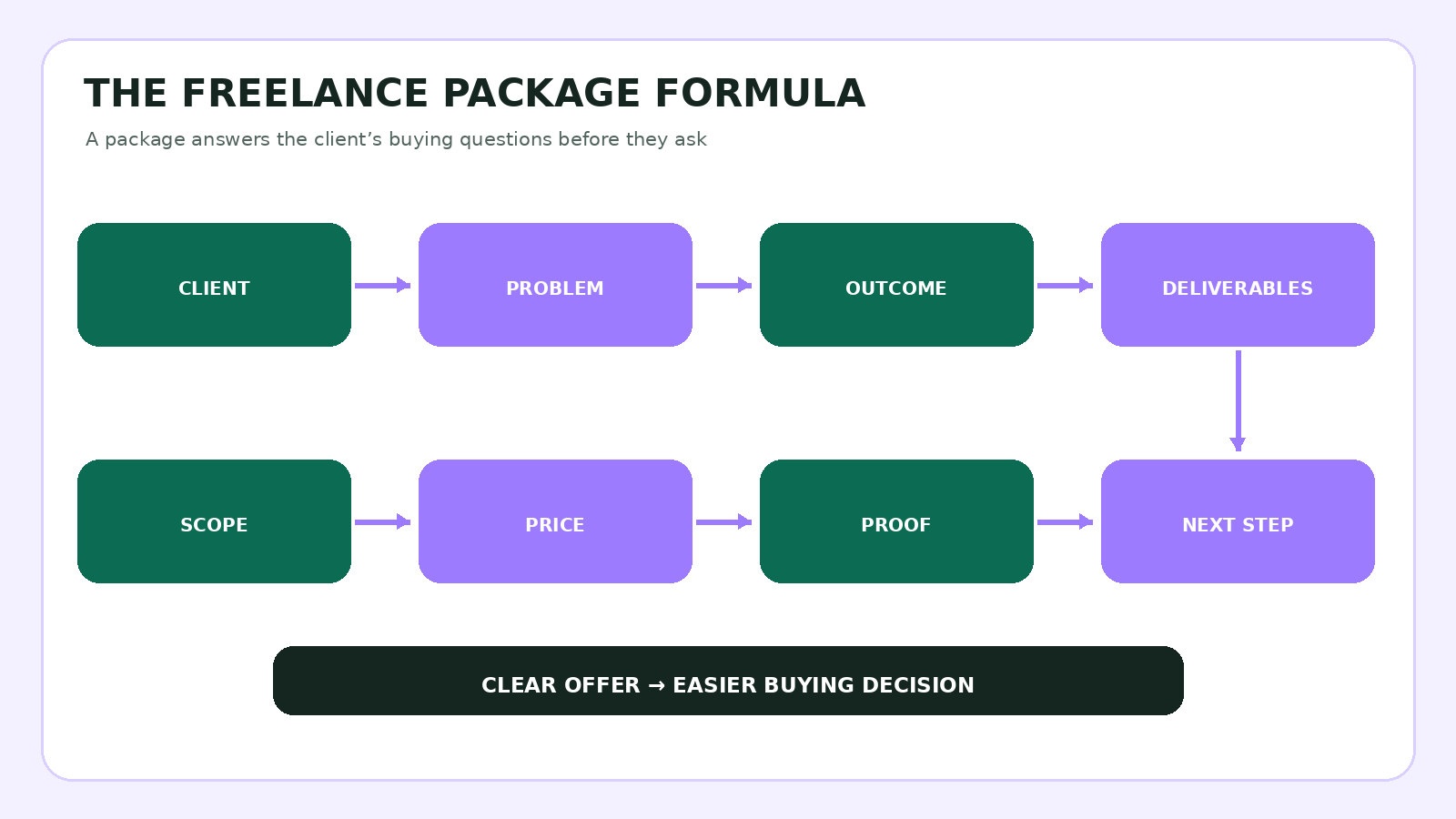 The freelance package formula showing client, problem, outcome, deliverables, scope, price, proof and next step
Packaging means turning an open-ended capability into an understandable buying and delivery experience. A client can see whom the service is for, what it addresses, what will be delivered, what is outside scope, how the work proceeds, how long it normally takes and how payment works.
Packaging creates a standard core while leaving controlled room for discovery and customization.
| Model | Customization | Scope and price | Delivery and client involvement | Repeatability | Best use case |
|---|---|---|---|---|---|
| Skill | Not yet defined | None | None | Low | Describing an ability, such as graphic design |
| General service | Usually high | Quoted after discussion | Varies by client | Low | Complex or exploratory work |
| Service package | Moderate | Defined core, limits and price or price range | Stated process with review points | Medium | A repeated problem with some variation |
| Productized service | Low to moderate | Standard scope, price and timeline | Standard intake and workflow | High | Repeatable work such as an audit |
| Retainer | Moderate | Recurring monthly scope and payment | Continuing collaboration | Medium | A recurring operational need |
| Digital product | Usually none after purchase | Fixed asset and listed price | Usually self-service | Very high | A reusable template, guide or course |
For example, the skill is graphic design. The general service is social-media design. A package is 12 branded Instagram graphics delivered monthly. A productized service adds a standard intake form, fixed quantity, fixed review process, normal turnaround and predictable price. A digital product is an editable social-media template kit that buyers customize themselves.
If you later convert a repeatable process into checklists, templates or training, VEZILL’s article on turning YouTube knowledge into digital products illustrates the broader principle of packaging knowledge into reusable assets. Always confirm the licence of any resource you buy or sell; purchase does not automatically grant resale rights.
A clear package helps a buyer compare the offer, helps the freelancer quote consistently and gives both sides a reference point when expectations change.
It can reduce repetitive sales explanations, improve proposals, limit scope confusion and reveal work that takes longer than it earns. Complex work may still need paid discovery, and packages need updating as costs and client needs change. Most importantly, clarity does not create demand by itself.
Choose a narrow customer situation before choosing deliverables. The same skill should often be packaged differently for a salon, a property agent and an online educator because their buying reasons, operating rhythm and constraints differ.
The companion article on problems small businesses pay freelancers to solve can help you choose a business problem before building the offer.
A useful research question is: “When this happens, what do you do, what does it cost, and what would improvement look like?” Five conversations can reveal language and objections brainstorming misses. For the next step, see getting clients online without paid ads.
An outcome describes the improvement your work supports, not a result you cannot control. Separate the task you perform, the deliverable the buyer receives and the business change that deliverable is intended to support.
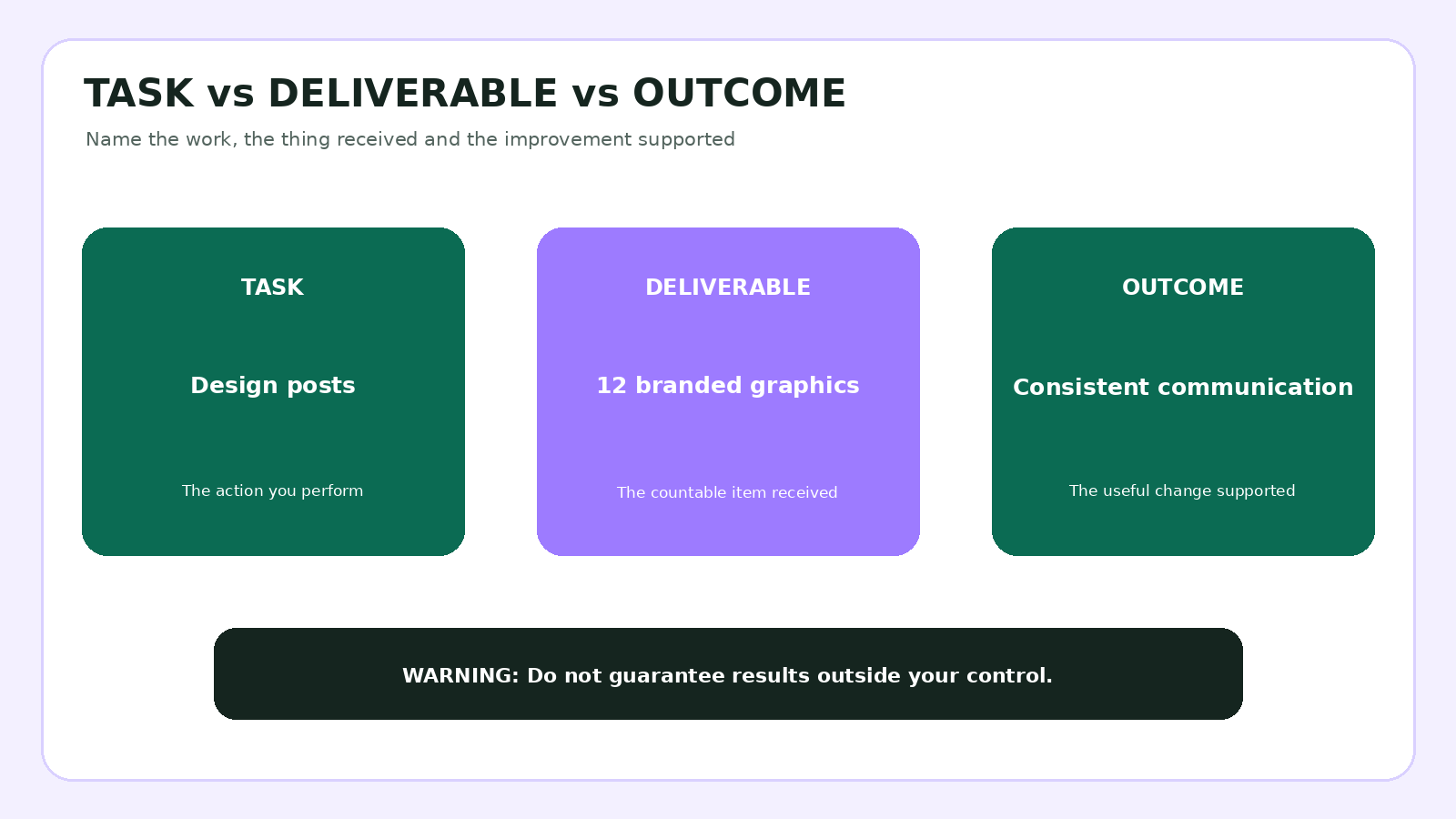 Task versus deliverable versus outcome, with a warning against uncontrolled guarantees
| Layer | Social-media example | Spreadsheet example |
|---|---|---|
| Task | Write captions | Clean transaction records |
| Deliverable | 12 approved caption drafts | Clean workbook plus summary dashboard |
| Supported outcome | More consistent customer communication | Easier monthly review and fewer manual steps |
| Unacceptable guarantee | “These captions will double sales” | “This dashboard will eliminate every error” |
Useful outcome categories include saving time, improving clarity, organizing information, reducing manual effort, improving consistency, creating professional materials, supporting informed decisions and making a business easier to find.
Write: “This package helps [client] move from [current problem] to [useful improvement] by delivering [specific work].” Use “supports,” “helps” or “is designed to” when the final result depends on advertising spend, customer demand, staff use, market conditions or other factors outside your control.
A deliverable should be countable or otherwise verifiable. Define quantity, format, length, platform, dimensions, language, delivery method, review stage, approval process, ownership and deadline where relevant.
“Social-media content” is vague. “Twelve branded Instagram graphics, 12 caption drafts and one 30-day publishing calendar, delivered as editable Canva links and exported PNG files” is inspectable. More deliverables do not automatically mean more value; unnecessary items increase cost and distract from the outcome.
Other deliverables can include web pages, videos, reports, dashboards, templates, forms, audits, training, documentation and support. Technical freelancers can study VEZILL’s examples of no-code development services and software-development opportunities.
Scope is the written boundary around the result, work and responsibilities. It protects the client from surprise omissions and the freelancer from invisible expansion.
| Included | Not included | Available as an add-on |
|---|---|---|
| 12 graphics in two agreed sizes | Daily community management | Extra platform resize set |
| One approved visual direction | New logo or full rebrand | Mini brand guide |
| Two consolidated revision rounds | Unlimited edits or new concepts | Additional revision round |
| Delivery through one shared folder | Paid-media buying | Ad creative variants |
| 14 days of file-support questions | Ongoing strategy calls | Monthly performance review |
Also specify page or asset limits, platforms, meeting length, response windows, client-supplied access, feedback deadlines, delivery assumptions, support, ownership, licensing and how extra work will be quoted.
Scope creep is not always a difficult client; the brief may have been unclear or the need may have changed. Pause, explain the effect, then use a change request: “That is outside the agreed package. I can add it for KSh X and move delivery to date Y, or keep the original scope.”
Do not accept passwords through insecure channels. Request the least access necessary, use role-based access where available, remove access at handover and document what was transferred. For legal, tax, medical, accounting or cybersecurity work, stay within your qualifications and recommend an appropriately licensed professional when required.
Revision limits should reflect the type, risk and review cycle of the work. A revision round is one consolidated set of feedback, not every individual text change.
Define the difference between correcting your error, refining an approved direction and replacing that direction. State who may approve work, how feedback must be submitted and how client delays affect the timetable. For example:
Revision wording: The package includes two revision rounds after the first draft. Each round must be submitted as one consolidated feedback document by the authorized contact within three business days. Corrections to work that does not match the approved brief do not consume a revision round. A new concept, changed brief or extra asset is quoted separately.
One policy cannot fit every service. Code may need defect correction; branding needs milestone approvals; ongoing content may use a monthly window. The aim is to make decision points visible.
A delivery process tells the client what happens next, what they must provide and where approval is required. Keep it short enough to follow and detailed enough to prevent lost access, feedback or payments.
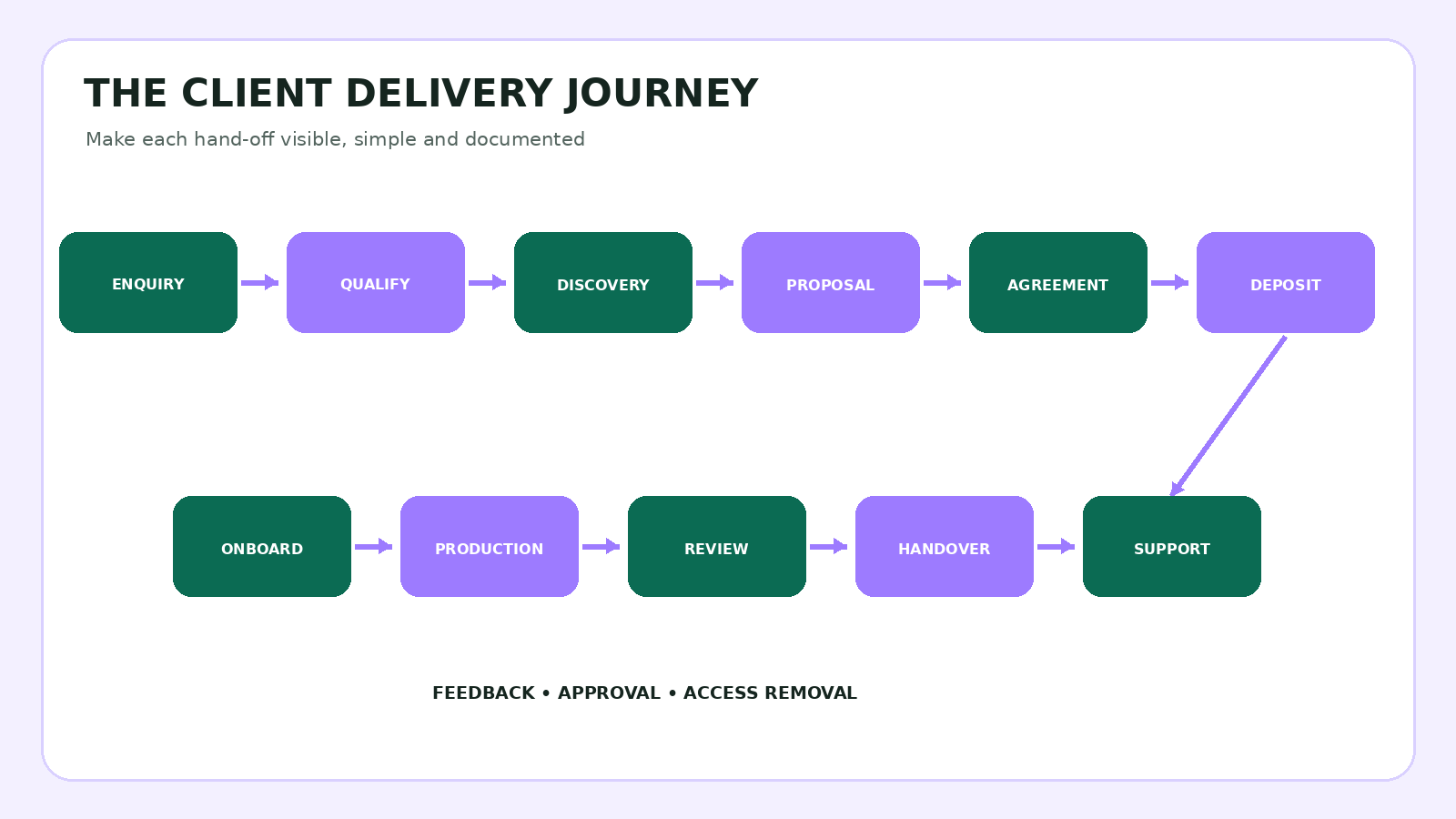 Client delivery journey from enquiry to support
Start with delivery economics, then adjust for value, market alternatives, client budget, experience, complexity, urgency and risk. Do not copy a competitor’s number without knowing what their scope and costs include.
Use this internal floor:
Estimated labour + tools + subcontractors + revision allowance + support + overhead + project risk + business margin = starting price
Hypothetical Kenya example—not a standard market rate: suppose a dashboard-cleanup package needs 18 hours at an internal target of KSh 1,500 per hour (KSh 27,000), KSh 3,000 in tools, KSh 4,500 for revisions and support, and KSh 5,500 for overhead and risk. The starting quote is KSh 40,000. You would still test it against complexity, buyer value and alternatives.
| Pricing model | Useful when | Main caution |
|---|---|---|
| Hourly | Scope is uncertain or advisory | Buyer cannot easily predict total cost |
| Fixed project | Deliverables and assumptions are clear | Underestimation becomes your problem |
| Package | A problem repeats with controlled variation | Exceptions must be priced separately |
| Value-informed | Business impact can be responsibly understood | Never invent value or promise outcomes |
| Monthly retainer | Useful work repeats every month | Capacity and carryover rules must be clear |
| Paid discovery or pilot | Complexity is unknown or trust is new | Define what the client receives from discovery |
Display prices when scope is standard. Use “from” pricing or quote after discovery when complexity varies, explaining what changes the price. The client buys defined work and a supported outcome, while hours remain an essential internal cost check.
Use tiers only when buyers have genuinely different needs. “Setup,” “Growth” and “Ongoing Support” often communicate more than “Bronze,” “Silver” and “Gold.” Differentiate by quantity, complexity, turnaround, strategy, platforms, reporting, support or customization—not filler bonuses.
Hypothetical social-content packages for a Kenyan beauty business:
| Package | Designed for | Deliverables | Process | Illustrative price |
|---|---|---|---|---|
| Setup | A new shop needing a base system | Mini visual direction, 8 graphics, 8 captions, 30-day calendar | One kickoff, one review round | KSh 24,000 one-time |
| Monthly Content | A shop posting consistently | 12 graphics, 12 captions, calendar, monthly review | Monthly intake, two review rounds | KSh 36,000/month |
| Multi-format Support | A business using two channels | 16 graphics, 4 short edits, captions, calendar, report | Monthly planning and review | KSh 62,000/month |
These figures are calculation examples, not recommended or standard Kenyan rates. If most buyers need the same thing, one package plus three relevant add-ons is clearer than three tiers.
A productized service is still work performed for a client, but it has a defined customer, repeated problem, standard deliverables, consistent workflow, boundaries, predictable price and normal delivery time. Examples include a landing-page audit, spreadsheet cleanup, presentation redesign, CV and LinkedIn optimization, local SEO setup or podcast-to-short-video package.
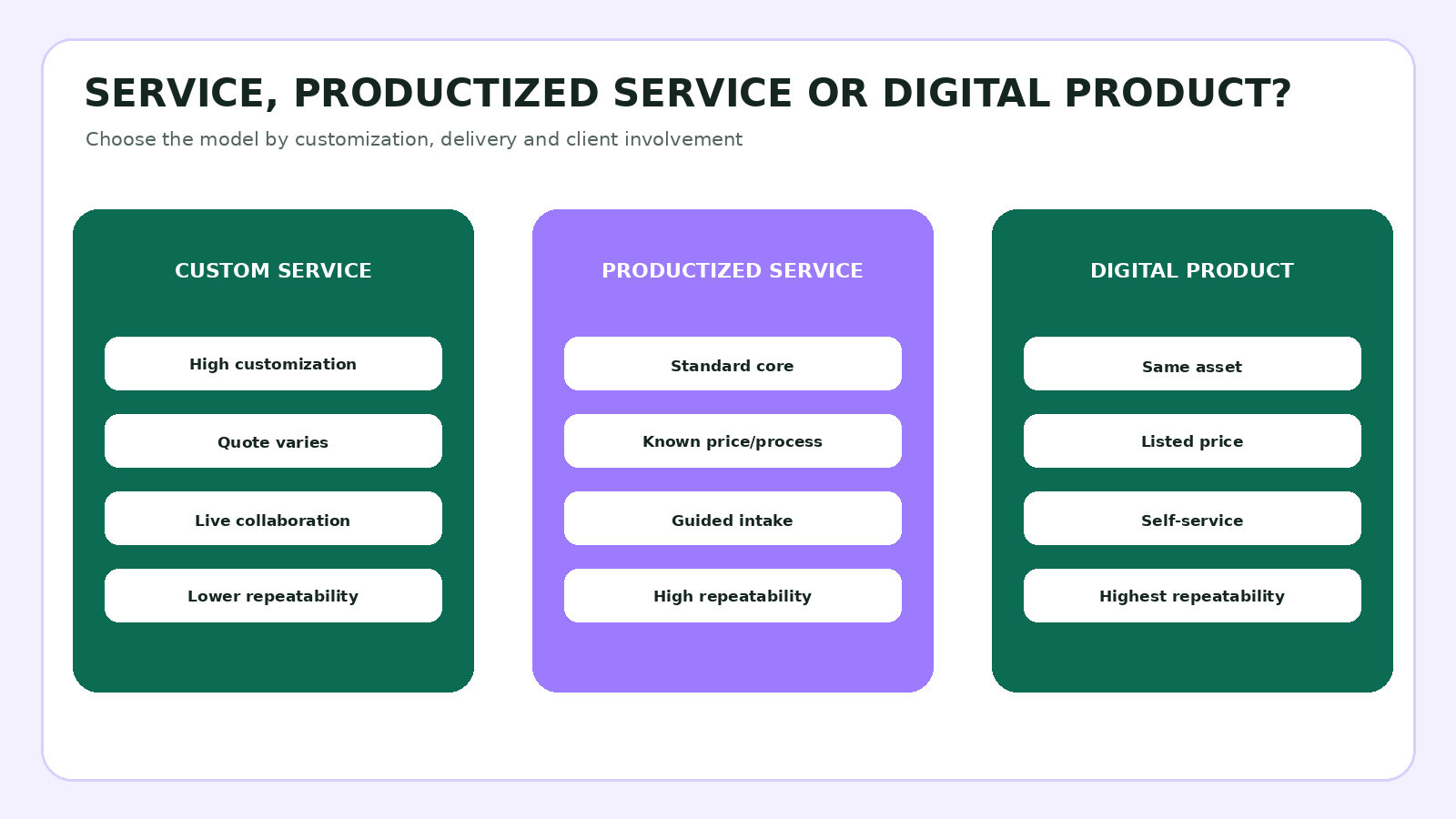 Comparison of custom service, productized service and digital product
A downloadable asset is different: it is created once and supplied to many buyers with little or no custom execution. VEZILL’s guide to using ChatGPT for services and products explains both routes. A current VEZILL resource containing AI prompts for freelancers may help with drafting and client communication; review its description and licence before use, and never paste confidential client data into an AI tool without permission and appropriate safeguards.
Build a retainer around a recurring problem, not around vague availability. Define monthly deliverables, service days, communication windows, reporting, unused-work carryover, pause and cancellation terms, minimum commitment where appropriate, emergency requests and review dates.
Examples include content production, video editing, website maintenance, reporting, administrative support, email campaigns and design support. Recurring work is not passive income; you must keep delivering useful work. Capacity matters: reserving 20 hours for a client has a cost even if the work arrives late.
Sell the professional outcome and controlled process, not access to a tool. AI can accelerate research, drafting, organization, transcription and automation, but your package still needs human review, fact-checking, confidentiality, copyright and licensing checks.
Possible packages include a customer-response library, content-repurposing system, product-description set, knowledge-base setup, workflow documentation, no-code assistant setup, AI adoption audit, staff training or SOP creation. State which data may enter third-party systems, obtain client permission, remove personal information where possible and document limitations. Generic unedited output is not premium professional work.
If you need capability development, Inceptor currently describes training in ICT and technical problem-solving, data analysis using several business tools, data science and software development with AI. Course details can change, so verify the page directly before enrolling.
The following are hypothetical structures, not real client results or standard prices. Replace every number after researching your costs and market.
Create evidence that resembles the package: a demonstration, clearly labelled fictional business, personal project, process walkthrough, paid pilot, authorized volunteer project or quality checklist.
Never invent clients, reviews, analytics or sales; do not use logos without permission or present copied work as your own. A prospective website client needs a working site or audit—not an unrelated certificate. A spreadsheet client needs a clean workbook and explanation of decisions. A content client needs on-brief samples.
VEZILL also has a current resource on building a personal brand that attracts opportunities, which may be useful when presenting expertise; inspect the product page first and use only according to its stated licence.
The service page explains the standard offer; the proposal adapts that offer to one buyer. Use this order: who it is for, problem, supported outcome, inclusions, process, timeline, client responsibilities, exclusions, price or quote method, proof, FAQs and call to action.
Before: “I am a virtual assistant who can do email, research, social media and many other tasks.”
After: “The Inbox Reset is for independent consultants whose enquiries and follow-ups are getting lost. In two weeks, I organize one inbox, create 15 approved response templates, build a follow-up tracker and document the daily workflow. It does not include sending contractual or financial decisions on your behalf. Start with a 20-minute fit call.”
A proposal should state the situation, solution, deliverables, timeline, responsibilities, price, milestones, revisions, ownership, confidentiality, assumptions and acceptance method. Keep a simple offer simple.
An add-on extends the core service without changing its purpose. Limit the menu to three to five relevant choices, such as faster delivery, extra assets, another platform, translation, an additional revision round, training or extended support.
If almost every client needs an add-on, it belongs in the core package. If an add-on changes the problem, workflow and buyer, it is probably a separate package.
Package name: [clear name]
Designed for: [specific customer]
Problem addressed: [repeated situation]
Outcome supported: [responsible improvement]
Deliverables: [quantity, format and specifications]
What is included: [work, platforms and access]
What is excluded: [important boundaries]
Timeline: [start conditions, milestones and delivery]
Client responsibilities: [assets, access, feedback and approvals]
Revision policy: [rounds, method and limits]
Communication method: [channel and response window]
Support period: [duration and type]
Ownership and licensing: [what transfers and when]
Price: [fixed, range, retainer or discovery]
Payment schedule: [deposit and milestones]
Optional add-ons: [no more than five]
Proof: [relevant sample or process evidence]
How to begin: [one action]
Avoid offering unrelated services under one name, packaging around a tool instead of a problem, vague outcomes, undefined deliverables, unlimited revisions, hidden exclusions and ignored client responsibilities. Also watch for underpriced communication time, useless bonuses, copied competitor packages, unlicensed assets and undocumented handover.
Do not accept work beyond your competence or let AI output bypass professional review. Never promise a result controlled by customers, platforms or markets. The best package is not the largest one; it is the clearest responsible route from a specific problem to a useful deliverable and supported outcome.
A freelance service package is a defined offer for a specific client problem. It states the supported outcome, deliverables, scope, process, timeline, price or pricing method, proof and next step.
Choose one customer and repeated problem, convert your skill into countable deliverables, define a responsible outcome, set boundaries and revisions, map delivery, calculate pricing, build matching proof and test the offer with potential buyers.
Include the target client, problem, outcome, deliverables, inclusions, exclusions, client responsibilities, timeline, revision policy, communication, ownership, price, payment schedule, proof and call to action.
Only when buyers have meaningfully different needs. Differentiate tiers by quantity, complexity, turnaround, support or platform. One core package with a few add-ons is often clearer.
Calculate labour, tools, subcontracting, revisions, support, overhead, risk and margin, then assess business value, client budget, market alternatives, experience, urgency and complexity. There is no universal correct rate.
It depends on the work and approval process. Define revision rounds, require consolidated feedback and distinguish corrections from a change of direction or new deliverable.
A productized service is client work sold with a standard customer, problem, deliverables, process, boundaries, price and normal delivery time. Unlike a digital product, work is still performed for each client.
Display pricing when scope is sufficiently standard. For variable work, publish a starting price or explain the factors that determine a quote, then use discovery before committing.
Write measurable deliverables, exclusions, client responsibilities, revision limits and assumptions. When requirements change, document the effect on cost and schedule through a change request.
Yes, if you can perform it competently. Build a labelled demonstration with fictional or authorized data, document human review and privacy controls, and consider a paid pilot. Never invent proof or expose confidential information.
Clients do not need a longer list of everything you can do. They need a clear decision: “This is for a business like mine, it addresses this problem, I receive these items, the boundaries and price make sense, I trust the process, and I know how to start.”
Choose one service this week and run it through WHO → PROBLEM → OUTCOME → DELIVERABLES → BOUNDARIES → PROCESS → PRICE → PROOF → NEXT STEP. Test it with real potential buyers, improve it from evidence and keep every promise inside your control.
Discover more articles you might be interested in

Learn where to find reliable step-by-step guides online, how to choose the right tutorial for your task, check whether it is current and follow instructions safely.
By Davie

Stop searching broad topics and start finding the exact knowledge you need. Learn how to define your problem, search smarter, choose reliable sources, verify answers and take action.
By Davie

Quick Knowledge or an online course? Learn when a focused answer is enough, when structured learning is better, and how to choose the right learning depth for your goal.
By Davie

Learn how to turn one useful digital product into multiple income streams through premium versions, bundles, courses, licensing, services, subscriptions, B2B sales and complementary products.
By Davie
Get the updates, on newly released, popular & fast-moving MRR digital products
Up to Top
Comments All
Josphine
@josphine
This I like how it shows that you don’t just need a skill, you also need to know how to present and package it so people understand what they’re paying for. Simple but really useful tips.
September 12,2026 At 09:29 PM