

Small businesses rarely hire a freelancer because the freelancer knows a particular app. They hire when a useful result matters and employing a full-time specialist would be unnecessary, too slow or too expensive for the current need.
Quick answer: Small businesses commonly pay freelancers to help attract customers, improve sales communication, create content, design professional materials, manage administration, organise information, build and maintain websites, edit videos, automate repetitive tasks and provide specialist technical support. Start with one business type and one repeated problem: choose a business → identify a problem → measure its consequence → confirm current behaviour → demonstrate a solution → package one service → approach relevant businesses → test and improve.The most valuable service is not always the most advanced. It is one that solves a costly, urgent or repeated problem for a clearly defined business. Clients and income are never guaranteed; demand, purchasing power, competence, proof, trust, pricing, competition and delivery all influence the result.
Businesses outsource problems connected to customers, communication, operations, information and technology. A freelancer turns a skill into a defined deliverable that helps the business move from an undesirable situation toward a useful outcome.
If you are still exploring broadly, first study problems you can solve online and get paid for. This article narrows that process to small businesses, where the consequence, buyer and deliverable must be specific.
| Business problem | Possible consequence | Freelance deliverable | Common work pattern |
|---|---|---|---|
| Poor online visibility | Suitable customers cannot find the business | Local-search audit, landing page or content plan | Project plus ongoing updates |
| Slow enquiry response | Prospects lose interest | FAQ, response library or lead workflow | Setup plus maintenance |
| Inconsistent branding | Confusion and weak recognition | Brand starter kit and editable templates | One-time plus content package |
| Disorganised records | Errors and slow decisions | Clean spreadsheet, tracker or dashboard | Project or monthly reporting |
| Outdated website | Lost trust or broken enquiries | Redesign, form repair or maintenance | Project plus care plan |
| Repetitive administration | Owner time is consumed | Virtual-assistance package or documented process | Recurring |
| No video capacity | Useful stories remain unpublished | Defined editing or production package | Per project or monthly |
| Manual repeated workflow | Delay and copy-paste errors | No-code automation with documentation | Setup plus monitoring |
These categories do not prove demand. A salon, teacher and agricultural group may all need “marketing,” but the message, channel, decision-maker, budget and risk differ.
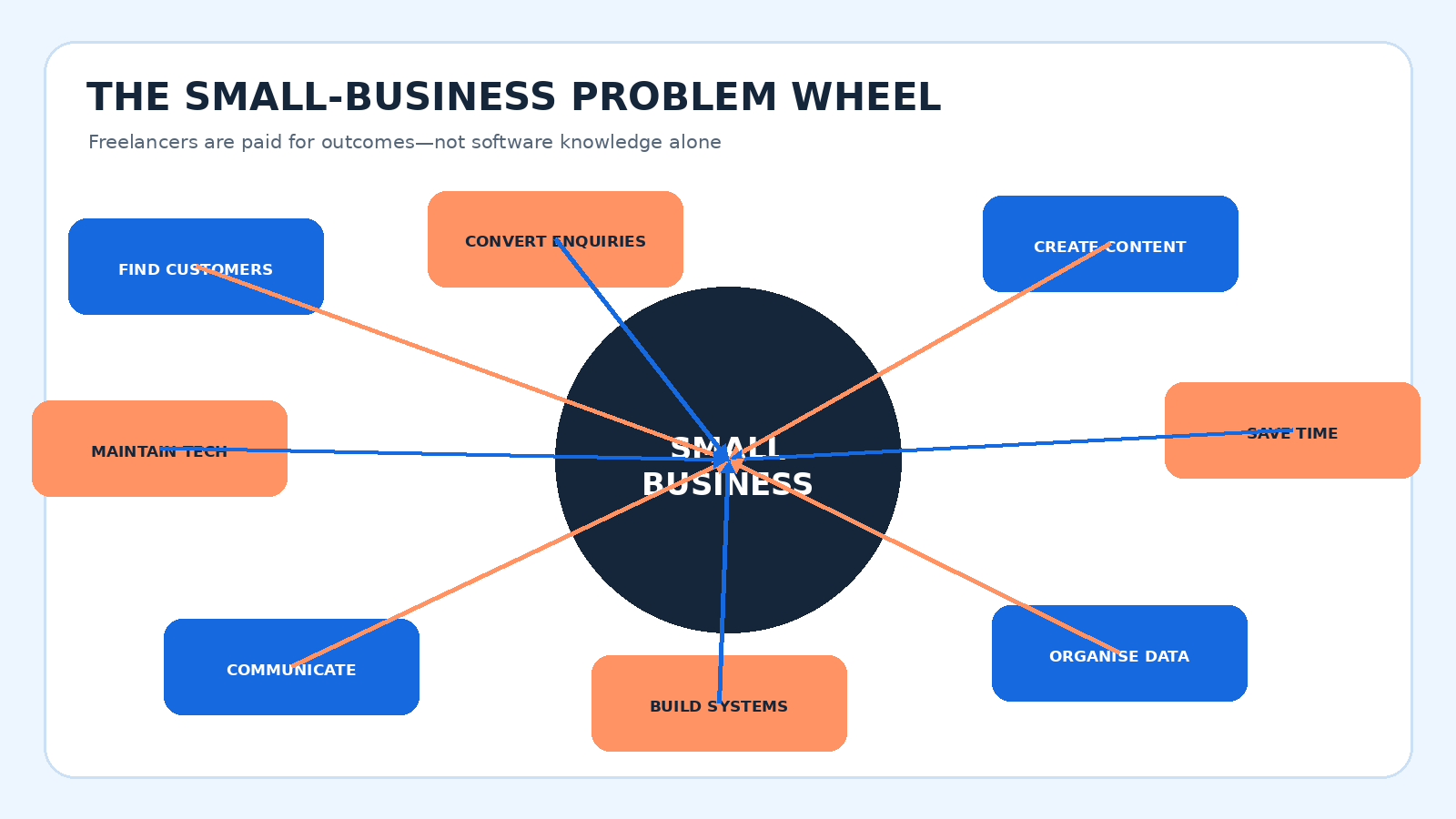 Small-business problem wheel connecting customer, operations, content, information and technology outcomes
A business hires a freelancer when it needs specialised or temporary capacity without making a permanent staffing decision. The arrangement works best when the result, scope and responsibilities are clear.
Common reasons include a time-limited project, a missing internal skill, seasonal workload, an urgent repair, a desire to test before expanding, or a need for an outside perspective. Flexible access can be useful, but it also creates risks: missed deadlines, poor communication, weak data protection, unclear ownership, inconsistent quality and dependency on one person.
A professional freelancer reduces these risks with a written scope, milestones, access limits, secure file handling, revision rules, handover documents and realistic promises. “I will make you go viral” is not a professional scope. “I will deliver twelve approved short-form edits in the agreed formats by these dates” is measurable.
Marketing freelancers help suitable customers discover and understand a business. They can control their research, content, setup and reporting—but not guarantee rankings, leads or sales.
Useful services include local SEO, customer research, content planning, email campaigns, product descriptions, landing pages, Google Business Profile support, lead magnets, marketing audits, content repurposing and paid-ad assistance by competent practitioners.
Separate three ideas:
The freelancer promises the deliverable. The outcome also depends on the offer, audience, timing, competition, budget and business response. A specialist exploring this path can review online opportunities for digital marketers and Inceptor’s current digital sales training, while checking each resource’s current details and fit directly.
Choose a business, channel, bottleneck and output. “Digital marketing for everyone” is hard to trust. “Google Business Profile cleanup and a four-week local-post plan for Nairobi salons” is easier to understand, test and price.
Do not copy a competitor’s content or invent customer evidence. Audit public information respectfully, describe visible gaps without insulting the owner, and ask questions before prescribing a solution.
Freelancers can organise how a business receives, answers, qualifies and follows up enquiries. The goal is consistent service—not replacing human judgement in sensitive situations.
Possible deliverables include customer FAQs, approved response templates, lead-tracking spreadsheets, CRM setup, follow-up sequences, quotation templates, onboarding documents, feedback forms and support knowledge bases.
Consider a hypothetical Kenyan clothing shop receiving questions through Instagram and WhatsApp. Staff repeatedly type sizing, stock and delivery answers, then lose track of serious enquiries. A freelancer could map the questions, build an approved response library, configure a simple tracker, train the owner and review it after two weeks. The first test is whether response handling becomes more consistent with authorised sample data—not a promise that sales will increase.
For brand partnerships, Inceptor’s influencer marketing course describes campaign fit, propositions, engagement and measurement. Refer to the current course page before relying on any schedule, fee or curriculum detail.
Virtual assistants can remove repeatable administrative load when access, authority and quality checks are carefully defined.
Services may include calendar coordination, inbox organisation, public research, document formatting, data entry, file management, meeting notes, travel research, customer follow-up, invoice organisation, form setup, SOP documentation and basic project coordination.
“General VA services” forces the buyer to design the job. A clearer offer is: “Weekly client-administration support for independent consultants: organise meeting notes, update the approved project tracker, prepare follow-up drafts and maintain the document folder for up to five active clients.”
Use least-privilege access. Do not ask for a main password when a delegated account or shared folder will work. Agree what the assistant may send without approval, protect confidential files and revoke access after the engagement. Banking, accounting, legal and HR decisions require appropriate authority and expertise.
Creative freelancers improve clarity, consistency, accessibility and presentation. Attractive work alone does not guarantee business performance.
Small businesses may need brand starter kits, social templates, presentation redesign, product mock-ups, short-video editing, thumbnail systems, menus, catalogues, event materials and accessible document layouts. A creator can learn from the VEZILL article on building a portfolio without experience, while never using confidential or stolen work.
The business problem should shape the output. A restaurant menu must make items and prices easy to understand. A church poster must communicate time, venue and action quickly. A property video needs accurate features, readable captions and a clear enquiry route. Design is a communication system, not decoration applied at the end.
Presentation work can also be a focused offer. Inceptor’s PowerPoint presentation training currently describes practical presentation design and delivery learning; verify current enrollment information directly.
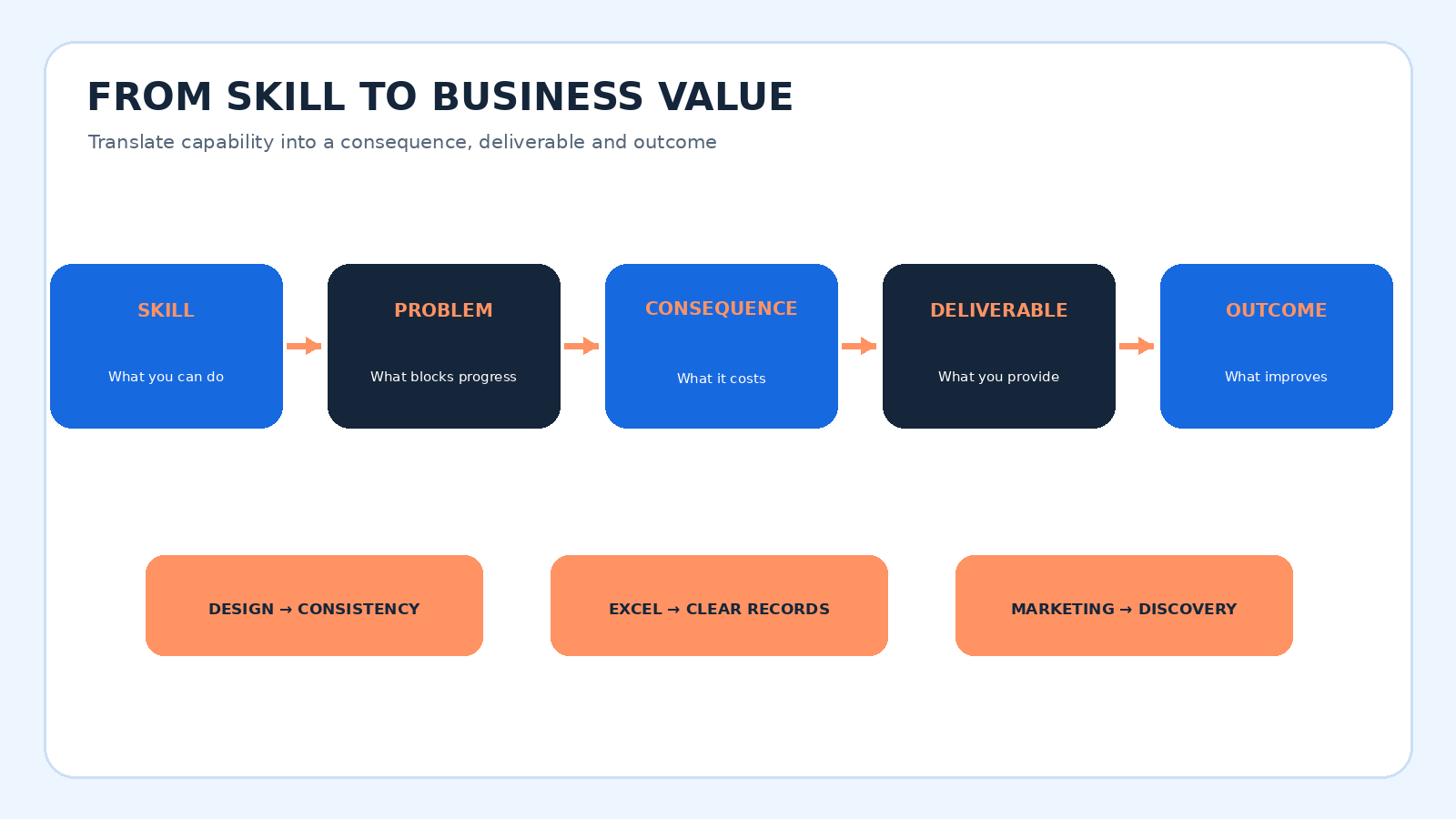 Skill-to-business-value chain from capability through problem, consequence, deliverable and outcome
Technical freelancers help businesses create, repair or maintain digital systems. The higher the consequence of failure, the stronger the competence and safeguards required.
Possible work includes landing pages, mobile-layout improvements, broken-form repairs, analytics setup, site updates, e-commerce configuration, backups, software setup, no-code workflows and small internal tools. The VEZILL resource on how web designers can earn through specific business outcomes illustrates several packaging options.
Document domain ownership, hosting, accounts, licences, backups and handover. Do not register critical assets in your personal account without an agreed ownership plan. Test forms and mobile layouts, keep a rollback path, and never describe a site as “secure” merely because it loads over HTTPS.
Cybersecurity is a specialist field, not an add-on for inexperienced freelancers. Inceptor’s current cybersecurity course describes ethical hacking, SOC analysis and other advanced areas. Training does not remove the need for written authorisation, lawful scope and professional competence.
Data freelancers turn scattered records into accurate, usable information. The work may include spreadsheet cleanup, duplicate removal, trackers, dashboards, survey organisation, reporting templates and documented data-entry processes.
The useful outcome is not “a colourful dashboard.” It may be knowing which products are low in stock, which enquiries remain unanswered or whether expenses were recorded consistently. Define the decision the output supports before choosing a tool.
Use permitted data, keep an untouched backup, document transformations and agree retention or deletion. Do not offer accounting, tax or financial advice without appropriate qualifications. A current VEZILL article on earning online as an SEO specialist also demonstrates how reporting and audits can become defined specialist services rather than vague tool knowledge.
AI can accelerate selected work such as drafting, summarisation, classification, research organisation, content repurposing, workflow documentation and prototyping. The freelancer remains accountable for the final result.
Potential offers include customer-response systems, product-description workflows, internal FAQ libraries, content repurposing, research summaries, SOPs, knowledge-base organisation, no-code assistants and responsible staff training.
Distinguish raw output from a human-reviewed service. “AI wrote it” is not a quality process. Explain inputs, review facts, remove confidential information, check licensing and test the output in the customer’s real workflow. Never upload private customer or employee data to a model without appropriate permission and safeguards.
For business owners investigating AI discovery, the verified VEZILL product Get Your Business Recommended by AI may be relevant; readers should inspect its current description, licence and suitability before buying. It is a resource, not a guarantee of recommendation or rankings.
Recurring work comes from a recurring business process. A retainer should fund continuing value—not keep a client paying for tasks they no longer need.
| Problem frequency | Example deliverable | Work model | Scope risk | Useful measure |
|---|---|---|---|---|
| One-time launch | Website or brand kit | Fixed project | Endless revisions | Approved milestones and handover |
| Monthly communication | Content calendar and assets | Monthly package | Unplanned channels | Approved quantity and dates |
| Ongoing site needs | Updates, backups and checks | Maintenance agreement | Emergency work creep | Logged maintenance tasks |
| Repeated reporting | Dashboard refresh and summary | Retainer | Unclean source data | On-time validated report |
| Daily enquiries | Support administration | Hours or service level | Undefined authority | Response handling and escalation |
| Repeated editing | Fixed number of videos | Productised package | Variable footage quality | Accepted outputs per cycle |
One-time projects include initial audits, website builds, brand kits and system setups. Recurring services include maintenance, content, reporting, customer support and follow-up. A hybrid might pair a setup fee with a smaller monitoring agreement.
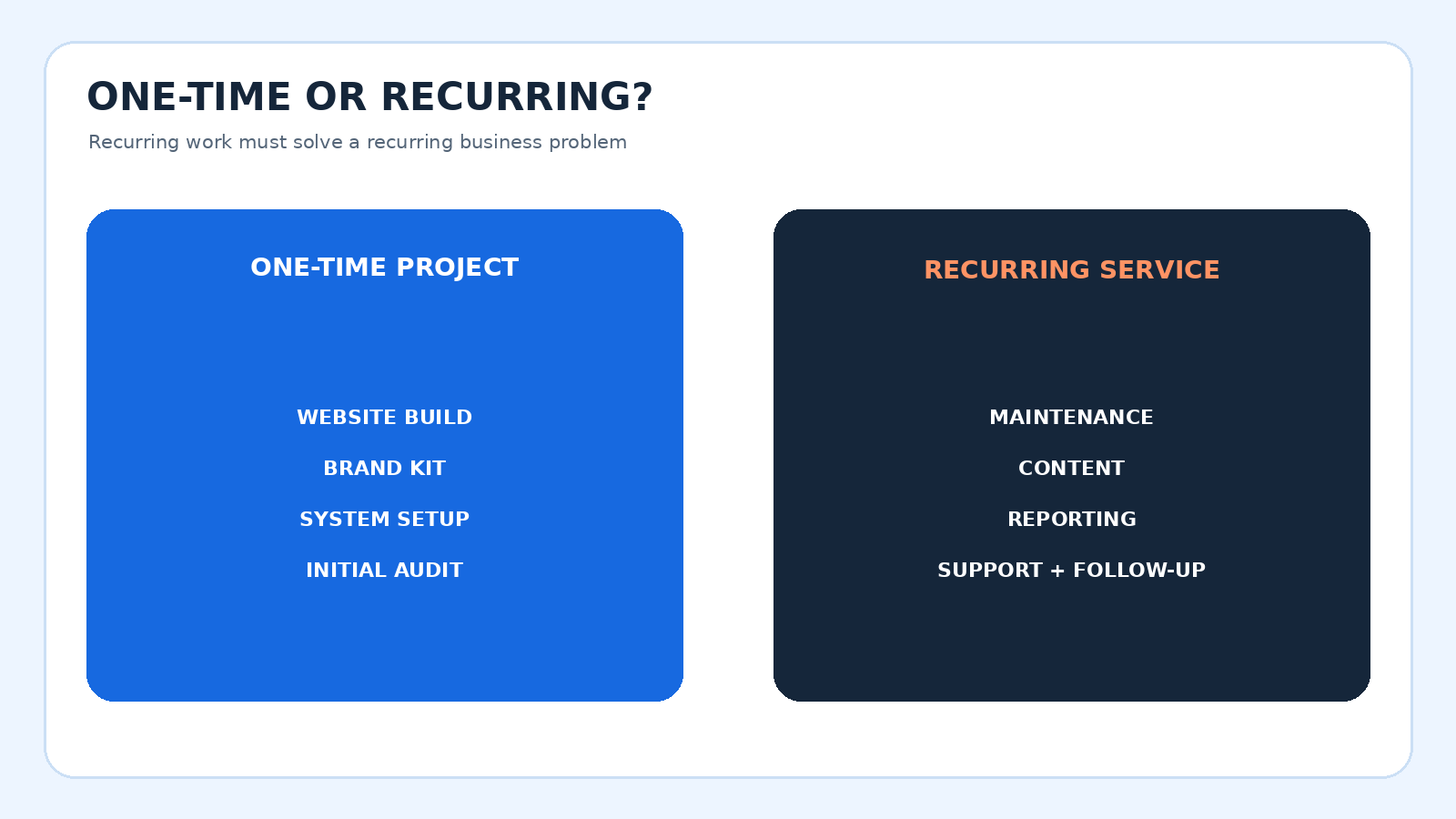 One-time versus recurring freelance services mapped to one-off and repeated business problems
Compare opportunities instead of choosing the first service you can name. Score each from 1 to 5 for frequency, urgency, business consequence, purchasing power, reachability, existing spending, skill fit, proof, repeatability, delivery risk, competition and recurring potential.
Imagine comparing three offers for salons:
The strongest choice depends on evidence and skill, not which sounds most profitable. A narrow pilot often teaches more than a broad monthly promise.
Look for observable symptoms, then ask about the internal consequence. A broken form is visible; whether it loses valuable enquiries must be confirmed.
Evidence can include repeated public questions, outdated information, active job posts, existing freelancer spending, manual workflows and requests for recommendations. Ask: How is this handled now? When did it last fail? What did it cost in time or rework? Who approves spending? What result would make a project worthwhile?
Do not publish an embarrassing “audit” of a business without permission. A respectful message describes an observation tentatively: “I noticed the booking link returned an error on mobile; is that something you are already addressing?”
Use: I help [specific business] achieve [useful outcome] by providing [specific deliverables] within [scope or timeframe].
Define the customer, problem, result, exact files or actions, exclusions, timeline, client responsibilities, revision limit, support, ownership, price and next step.
Weak: “I do social media, websites, marketing, design and VA work.”
Stronger: “I create a 30-day Instagram content system for Nairobi beauty businesses, including 12 editable graphics, caption starters and a publishing calendar.”
The stronger offer is easier to evaluate and does not promise sales. A freelancer building from a phone can use the smartphone-based online business examples for ideas, but should not accept work that their equipment cannot deliver professionally.
Pricing should cover labour, tools, delivery risk, support and a sustainable business margin while remaining appropriate for the customer and outcome. There is no universal Kenyan or global rate.
Common models include hourly pricing, fixed projects, packages, monthly retainers, maintenance agreements, paid pilots and productised services.
Use a starting calculation:
Estimated labour + tools + risk allowance + support + business margin = starting quote
Hypothetical example: a freelancer estimates eight hours for a lead-tracking setup and documentation. At an internal target of KSh 1,200 per hour, plus KSh 2,000 for testing and support, the starting calculation is KSh 11,600 before taxes and transaction costs. This is an illustration, not a market price or recommendation.
Do not hide unlimited revisions inside a low quote. If the budget is smaller, reduce scope openly. Collect a reasonable deposit where appropriate, write payment milestones and define what happens if the client delays feedback.
Build proof of the work instead of inventing social proof. Create a fictional demonstration labelled clearly, a personal project, a volunteer project with permission, a sample dashboard using dummy data, a before-and-after redesign or a process walkthrough.
A useful case-style sample explains the problem, constraints, choices, deliverable and how it was tested. Never fabricate a client, testimonial, revenue number, analytics screenshot or logo permission.
Proof also reveals whether you can finish the task. Someone interested in combining skill and business can explore skills that can become an online business, then create evidence for one narrow outcome rather than listing every skill they have encountered.
Research a small number of suitable businesses, contact the appropriate person, offer one relevant observation and ask permission to share a demonstration.
Online shop: “Hi Amina, I noticed customers ask similar delivery questions under several products. I build approved FAQ and reply systems for online shops. May I send a one-page example?”
Restaurant: “Hello, I found that the mobile menu link did not open during my test today. I help restaurants simplify mobile menus and enquiry paths. Would a short screen recording be useful?”
Consultant: “Hi Peter, your booking process appears to use email across several service types. I create simple enquiry forms and follow-up trackers for consultants. May I show a dummy-data example?”
Never scrape private contacts, buy lists or bulk-send the same pitch. A relevant offer sent without respect is still spam.
After repeated delivery, reusable parts of a service may become templates, checklists, tutorials or tools. Client information and commissioned work remain protected unless you have explicit rights to reuse them.
The progression is:
Custom service → documented process → reusable template → productised service → digital product → course or tool
A content-planning service may produce an original calendar template. A support setup may reveal a reusable response framework. A website process may become a planning workbook. A freelancer considering a larger product can evaluate freelancing versus selling digital products and, for publishing education, inspect the current AI-powered ebook publishing resource. Verify every product’s current licence; never assume resale rights.
This is LEARN → DO → CREATE → SHARE → SELL → GROW in practice: learn the problem, do the work, create the reusable asset, share proof, sell responsibly and grow from evidence.
The most damaging beginner mistakes usually happen when the freelancer focuses on appearing capable instead of defining and delivering the result.
A profile that lists design, websites, bookkeeping, ads, AI, writing and cybersecurity gives the buyer no clear reason to choose it. Start with one business type, one problem and one primary deliverable. Adjacent services can be added after real demand appears.
A public symptom does not reveal the whole cause. Low Instagram engagement may reflect weak content, an unsuitable audience, an uncompetitive offer or inconsistent customer service. Ask how the business operates before selling a content package.
A freelancer can promise agreed work, quality checks and deadlines. They cannot guarantee sales, rankings or viral reach because the business offer, budget, market and response also matter. Put assumptions and dependencies in the proposal.
A small tailored observation demonstrates attention. A complete free strategy or usable project invites exploitation and makes scope unclear. Offer a preview or time-limited diagnostic; request a paid pilot for delivery that creates material business value.
Agree who owns source files, accounts, domains, creative assets and custom code. Use client-controlled accounts where practical, create a handover checklist and remove your access when the engagement ends.
AI can accelerate tasks, but generic or incorrect output damages trust. A list of AI side-hustle possibilities is only inspiration; professional service still requires customer context, judgement, checking and accountability.
Professional delivery begins before the work. Confirm the decision-maker, objective, scope, files, deadlines, dependencies, communication channel, revision process, payment schedule, confidentiality, ownership and acceptance criteria in writing.
Use a simple delivery rhythm:
Keep a written decision log when feedback changes. If a client adds a new platform, extra report or different audience, describe how the change affects cost and time before accepting it. Scope control protects both sides: the owner knows what they will receive, and the freelancer can schedule realistic work.
If something goes wrong, communicate early. Explain the issue, what is affected, what remains safe, your proposed correction and a realistic new time. Silence usually damages trust more than an honest, manageable delay.
Retention comes from continued value, reliable communication and knowledge of the business—not from making the client dependent on you.
After delivery, ask what was useful, what caused confusion and what result the business can actually observe. Document repeated questions, improve the instructions and recommend only the next service that addresses a verified need. A website client may need a maintenance plan; they do not automatically need monthly social management from the same freelancer.
Use honest reviews. Ask for feedback after the client has used the work, make the request optional and never write a fabricated statement for them to approve. Obtain permission before displaying the business name, logo, screenshots or results in a portfolio.
Reduce dependency through handover documentation and client-controlled accounts. Paradoxically, making it easy for a client to leave can increase trust. The relationship continues because the work remains useful, not because the freelancer withholds passwords or knowledge.
Review recurring agreements periodically. Remove tasks that no longer matter, add new work only with agreement and update pricing when scope or responsibility changes. Healthy repeat work is a sequence of clear decisions—not an automatic subscription to your availability.
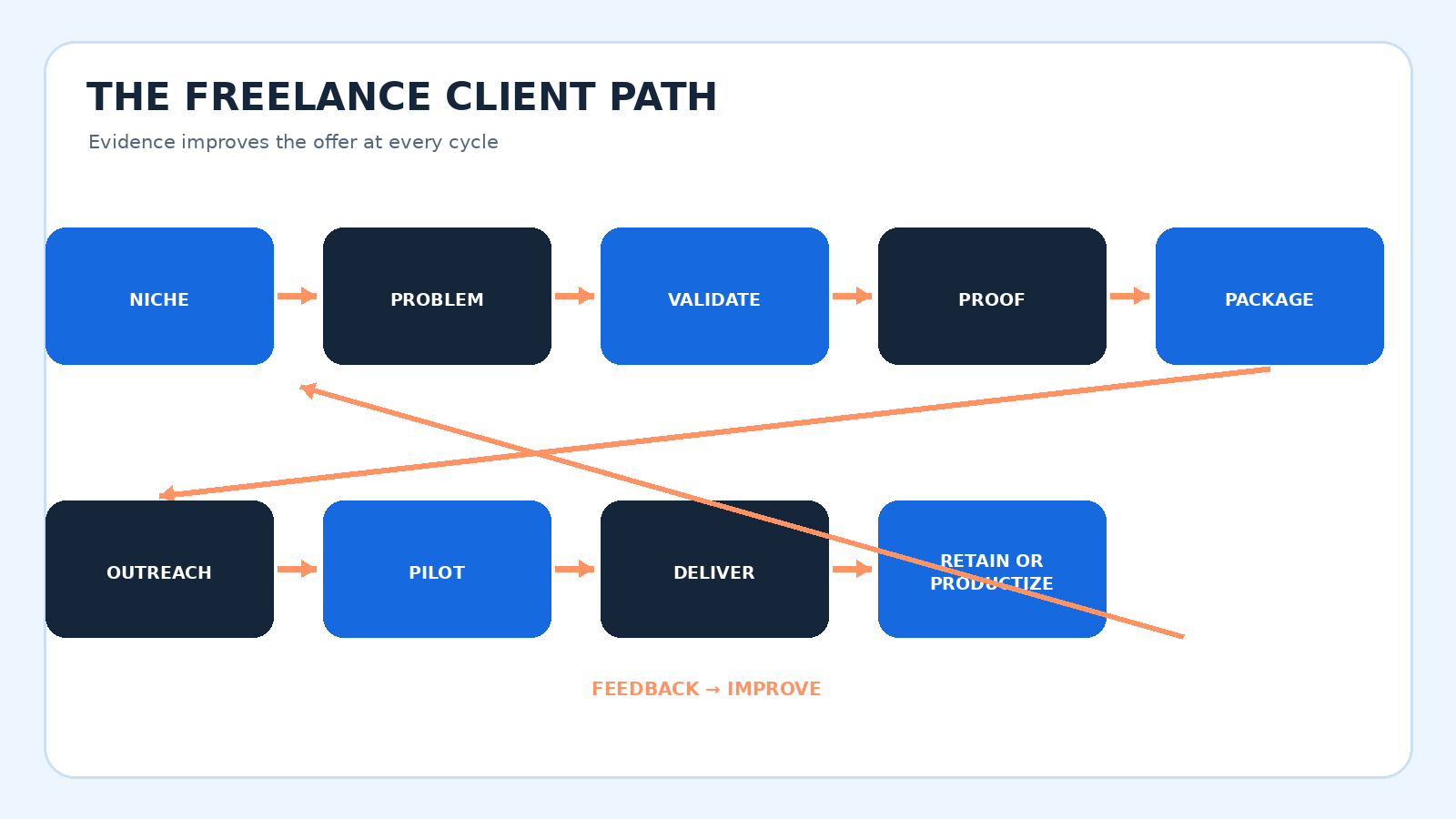 Freelance client path from niche and validation through proof, offer, outreach, pilot, delivery, retention and productisation
The expected outcome is evidence—not guaranteed clients.
| Days | Action | Evidence to collect | Expected outcome |
|---|---|---|---|
| 1–2 | Choose one business type and decision-maker | Business context and reachable contacts | Precise customer definition |
| 3–4 | Observe repeated problems and workarounds | Public symptoms and research notes | Five candidate problems |
| 5–6 | Conduct respectful conversations | Recent examples, consequences and current spending | First-hand evidence |
| 7 | Score and select one problem | Opportunity score plus risk notes | One hypothesis |
| 8–9 | Build a demonstration with dummy or permitted data | Working sample and test checklist | Credible proof |
| 10 | Package scope, deliverables and price | One-page offer | Understandable service |
| 11–12 | Send a few targeted messages | Replies, objections and permission | Buyer feedback |
| 13 | Offer a controlled paid pilot | Written scope and commitment | Stronger demand evidence |
| 14 | Review and decide | What worked, failed or remains unknown | Continue, revise, learn or stop |
If suitable prospects do not respond, do not immediately slash the price. Check whether the problem is important, the buyer is correct, the proof is credible and the contact method is appropriate.
They commonly outsource marketing, content, design, administration, customer support, websites, data, reporting, video, automation and specialist technical projects when the outcome is valuable and the scope is clear.
The most useful service solves a current, costly or repeated problem for that particular business. There is no universal best service across industries.
Choose a low-risk, well-defined service you can verify, such as document formatting, basic design, simple spreadsheets, content preparation or administrative support. Stay within your competence.
Look for observable symptoms, then ask how the process works, when it last failed, what the consequence was and whether the business has paid for help before.
Research the business, contact an appropriate person, mention one relevant observation, offer a small demonstration and ask permission before sending more information.
Consider labour, tools, complexity, risk, support, value, purchasing power and transaction costs. Use a defined scope and test a quote rather than copying a universal rate.
Yes, when permitted and appropriate. Protect data, verify facts, check licences, disclose material AI use where relevant and remain accountable for the final work.
Create labelled fictional demonstrations, personal projects, permission-based volunteer work, process walkthroughs or samples using dummy data. Never invent clients or testimonials.
Services connected to recurring processes—content, maintenance, reporting, support and administration—can support repeat engagements when they continue to provide value.
Begin with one clear service for one customer problem. Expand only when customer evidence shows that adjacent services are needed and you can deliver them well.
A small business does not need every freelancer. It needs a credible solution to a real problem at an appropriate cost and risk.
Choose one business type, study one repeated process, demonstrate one useful improvement and make one clear offer. The narrower your first promise, the easier it is to test, deliver and earn trust.
Discover more articles you might be interested in

Learn where to find reliable step-by-step guides online, how to choose the right tutorial for your task, check whether it is current and follow instructions safely.
By Davie

Stop searching broad topics and start finding the exact knowledge you need. Learn how to define your problem, search smarter, choose reliable sources, verify answers and take action.
By Davie

Quick Knowledge or an online course? Learn when a focused answer is enough, when structured learning is better, and how to choose the right learning depth for your goal.
By Davie

Learn how to turn one useful digital product into multiple income streams through premium versions, bundles, courses, licensing, services, subscriptions, B2B sales and complementary products.
By Davie
Get the updates, on newly released, popular & fast-moving MRR digital products
Up to Top
Comments All
Dickson
@dickson
This was a really interesting read. I like how it points out the actual problems small businesses need help with, instead of just saying “freelancing” in general. It gave me a better idea of the kind of skills businesses are willing to pay for.
September 12,2026 At 09:28 PM