

Freelancing and selling digital products can both turn useful knowledge into online income, but they work differently. Freelancing means delivering an agreed result to a client. A digital-product business packages a repeatable solution that customers can buy and use without commissioning custom work each time.
Quick Answer: Freelancing is often the faster route to first revenue because one client can pay for a useful service before you have a large audience. Digital products have greater scaling potential because the same resource can be sold repeatedly, but they normally require upfront validation, creation, trust and ongoing marketing. For many beginners, a practical sequence is: learn a useful skill → provide it as a service → notice repeated customer problems → convert the repeatable solution into a product → offer both. This is a useful pattern, not a rule or an income guarantee.
The better starting point depends on what you already know, how quickly you need feedback, whether you can reach buyers, how comfortable you are with clients and whether you have evidence that a reusable product is wanted.
Freelancing is an arrangement in which an independent worker provides a defined service or outcome to a client. The freelancer may charge by the hour, project, deliverable, package or monthly retainer.
Examples include designing ten social-media graphics, editing four short videos, cleaning a spreadsheet, building a landing page, tutoring a learner or managing customer enquiries. Strong freelance offers name the customer, scope and result. “I know video editing” is a skill description; “I turn four long interviews into 12 captioned social clips each month” is an offer.
Freelancing is not necessarily selling every hour separately. A designer can sell a fixed brand package. A marketer can sell a monthly content system. A developer can charge for a defined integration. Standardising the process makes delivery easier to estimate and reduces misunderstandings.
Beginners should first develop enough competence to deliver a small, low-risk outcome honestly. VEZILL’s overview of digital skills Kenyans can learn for online work provides possible starting areas, but a skill list is not proof that clients will hire you.
Selling digital products means offering resources that customers can purchase and access electronically, such as templates, ebooks, workbooks, courses, tutorials, spreadsheets, checklists, design assets, prompt packs, software or revision materials.
There are several distinct models:
Licences differ. A product marked for personal use cannot automatically be resold. Even when resale is permitted, the licence may restrict editing, branding, pricing, distribution or what rights can be transferred. VEZILL’s explanation of how its Master Resell Rights system works is a useful starting point, but buyers must still read the licence attached to the specific listing.
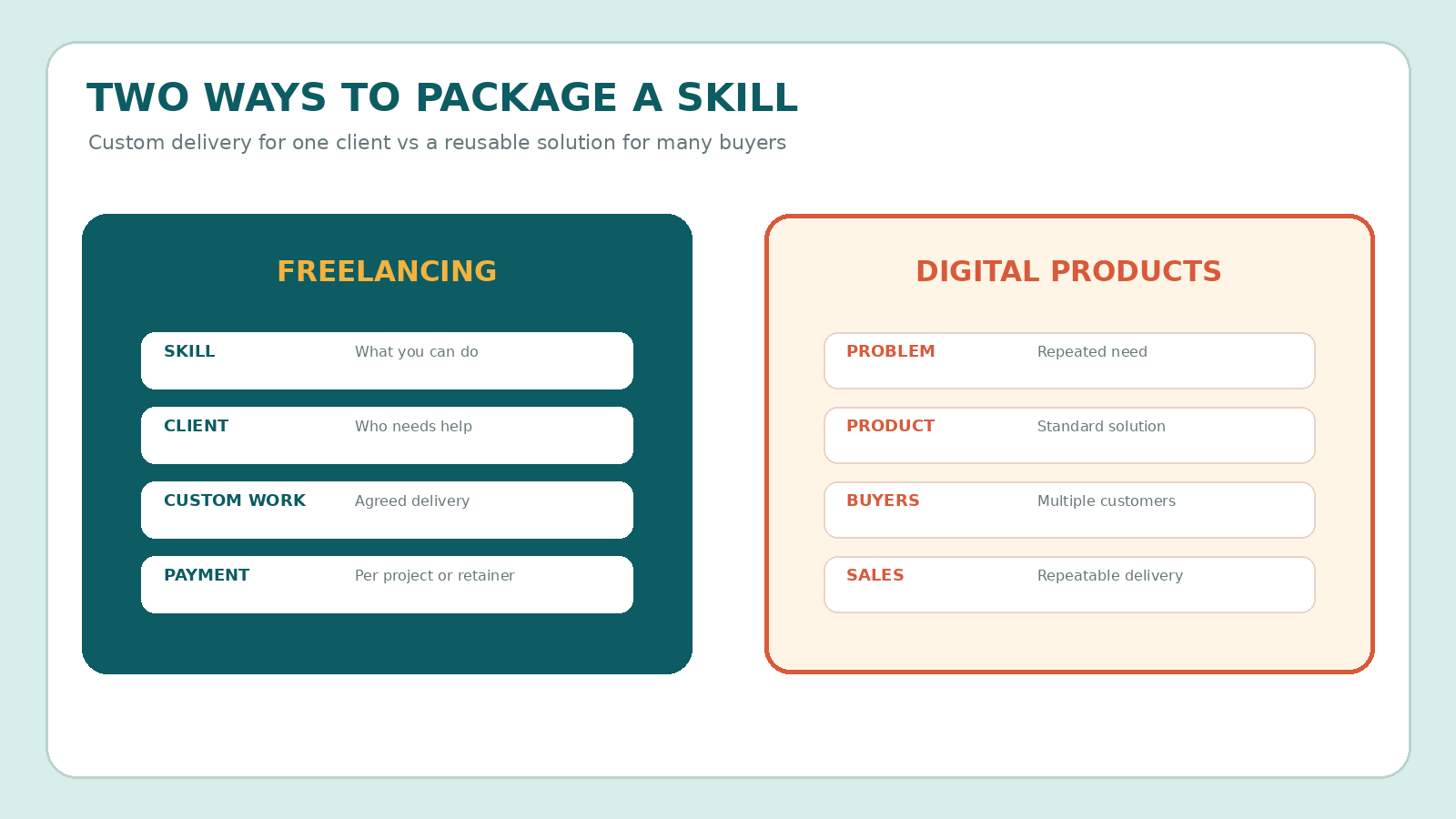 Freelancing compared with digital products: custom client work and payment versus a validated reusable product sold to multiple customers.
Freelancing customises delivery for a client; a digital product standardises a repeatable solution.
With freelancing, a buyer pays you to perform or deliver work. With digital products, a buyer pays to access a standardised resource you created or are legally authorised to sell.
Freelance delivery is usually more personal. You gather requirements, communicate with a client and adjust within an agreed scope. Digital-product delivery is more standardised: several customers may receive the same template, course or guide.
The boundary is not absolute. A freelancer can sell a productised service—for example, a fixed website audit with the same process for every client. A product seller may offer onboarding, support or a premium consultation. Both models still need marketing, trust, quality control and customer service.
Freelancing often reaches first revenue faster because one suitable client may be enough. A beginner with a credible sample can approach a business with a small, specific offer and receive direct feedback.
A digital product normally passes through more stages before a sale:
Problem research → validation → creation → packaging → pricing → sales page → distribution → marketing → purchase
That does not mean every freelancer earns quickly or every product takes months. Someone with a trusted audience and a proven repeated question may sell a small product quickly. A freelancer without proof, outreach skills or reachable prospects may struggle for longer.
The useful comparison is not “Which one is easy?” It is “Which uncertainty can I reduce first?” Freelancing tests whether one customer will pay for your contribution. A product tests whether several customers will buy a standardised solution without custom persuasion or delivery.
Neither is automatically easy. The better starting point depends on the beginner’s existing assets.
If you need to see several legitimate paths before choosing, VEZILL’s article on how students can make money online legally distinguishes services, tutoring, employment and digital products without requiring one route for everyone.
The following comparison describes common patterns, not fixed rules.
| Factor | Freelancing | Digital products |
|---|---|---|
| Speed to first revenue | Often faster with a sellable skill and reachable prospect | Often slower because validation, creation and distribution come first |
| Initial investment | Can be low, but equipment, software and training may matter | Can be low for simple formats; complex courses or software cost more |
| Skill required | Enough competence to deliver the promised client outcome | Problem knowledge plus creation, packaging and marketing skills |
| Proof required | Samples, portfolio, references or a safe pilot | Preview, demonstration, credibility, reviews or useful free content |
| Large audience required | Usually no; direct outreach and referrals can work | Not strictly, but a distribution channel is essential |
| Customer acquisition | Fewer buyers may produce meaningful revenue | Often requires more buyers at a lower price |
| Custom work | Usually moderate to high | Usually low after standardisation |
| Scalability | Limited by capacity unless systems, team or products are added | Higher potential because one product can serve many buyers |
| Income predictability | Retainers can improve predictability; projects may fluctuate | Catalogue sales may fluctuate; subscriptions can improve predictability |
| Marketing requirement | Prospecting, networking, referrals and positioning | Content, SEO, partnerships, affiliates, email or paid promotion |
| Customer support | Client meetings, revisions and delivery communication | Pre-sale questions, access issues, updates and refunds |
| Pricing | Hourly, project, package, result-linked where appropriate, or retainer | One-time, bundle, subscription or licensed access |
| Time flexibility | Deadlines and client schedules constrain time | Creation and support are flexible, but launches and updates still require work |
| Automation potential | Administration and repeatable delivery can be assisted | Checkout, delivery and some support can be automated |
| Long-term asset value | Relationships, reputation, systems and case studies | Intellectual property, catalogue, audience and distribution systems |
| Main risk | Scope creep, poor clients, capacity and inconsistent pipeline | Building unwanted products and failing to reach buyers |
| Often best suited for | People with a useful skill who need fast market feedback | People with validated repeated knowledge and distribution |
Freelancing can produce direct feedback, practical experience and cash flow, but it creates obligations to specific clients.
Freelancing is particularly useful for discovering product ideas. Repeated requests expose patterns that a generic keyword tool may miss.
Reduce these risks with a written scope, clear deliverables, deadlines, revision limits, payment milestones where appropriate and a process for changes. Keep business and tax records and check the rules that apply where you operate; this article is not legal or tax advice.
Freelancers using AI should also define what remains human-reviewed. Inceptor’s current Generative AI, agents and automation course describes practical AI workflows, but training does not remove the freelancer’s duty to protect client data and verify outputs.
Digital products can separate each sale from a new round of custom production, but sales do not happen automatically.
Creators interested in structured educational products can study VEZILL’s article on creating online courses with AI and selling them online. AI may accelerate drafts and production, but expertise, accuracy, teaching design and validation remain essential.
The phrase “passive income” can be misleading. A digital product may reduce fulfilment work per sale, but research, creation, promotion, customer service and maintenance remain active responsibilities.
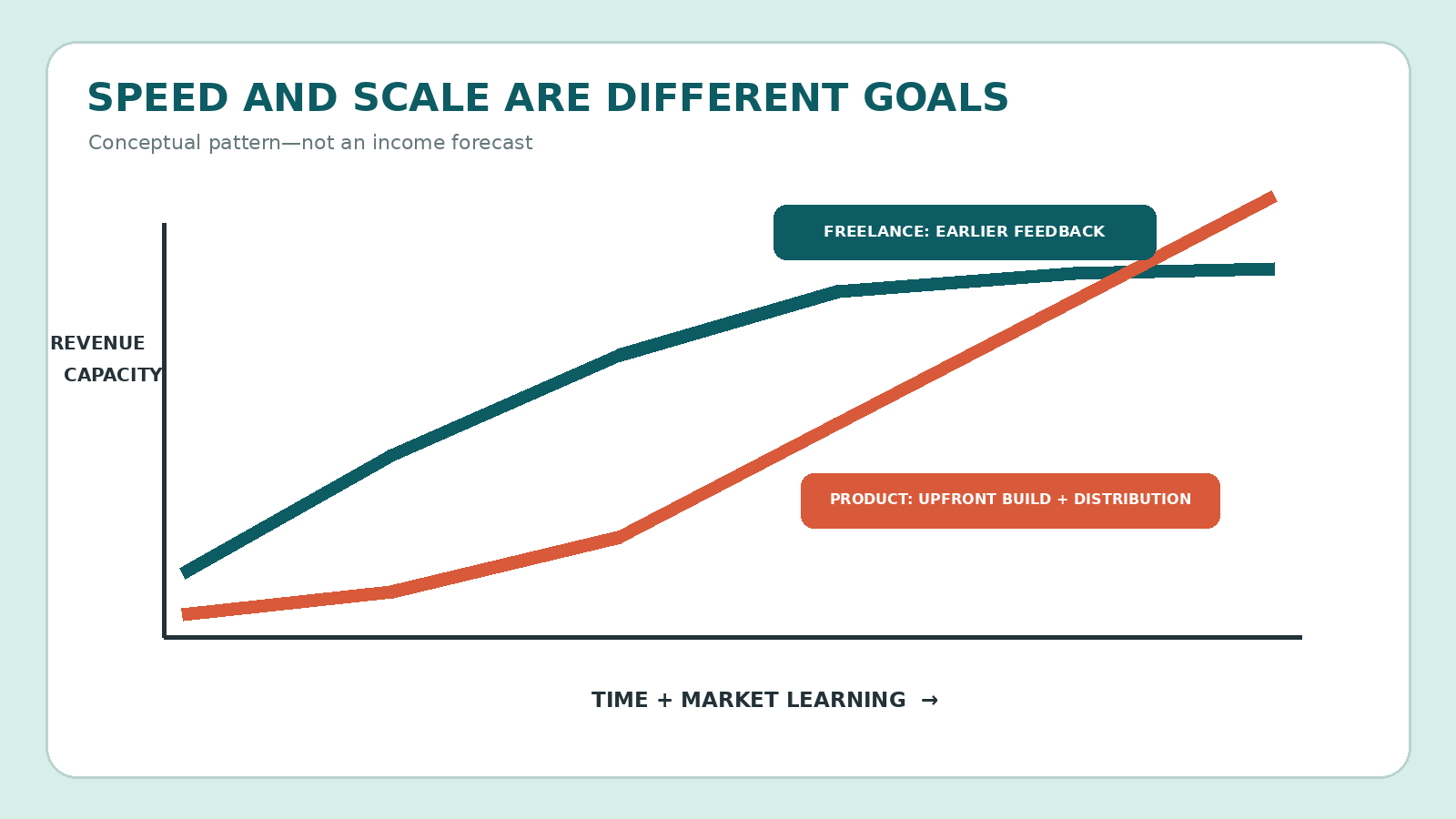 Income and scalability trade-off: freelancing can validate sooner but is constrained by delivery capacity, while digital products need upfront work and distribution before scaling.
Faster validation and greater scale are different goals; neither line represents guaranteed earnings.
You do not need a large audience to start either model, but you need a credible way to reach potential buyers.
Freelancers can use referrals, targeted outreach, professional networks, local businesses, job boards and freelance marketplaces. A clear message to 20 suitable prospects can teach more than broadcasting a vague offer to thousands of unrelated followers.
Product sellers can use marketplace discovery, search content, email, social media, partners, affiliates or paid promotion. “No audience” therefore means you must borrow, build or pay for distribution—it does not mean buyers will discover the product by chance.
VEZILL’s guidance on becoming a stronger marketplace seller highlights problem clarity and product presentation. Treat platform exposure as one channel, not a replacement for understanding the buyer.
Either model can begin inexpensively or become costly. The relevant question is what your chosen outcome requires.
Freelance costs can include training, equipment, internet, software, portfolio hosting, marketplace fees, communication and payment processing. Product costs may include research, creation software, design, recording equipment, hosting, marketplace fees, promotion, updates, customer support and refunds.
A Kenyan creator should also consider mobile data, device capability, M-Pesa or bank charges where applicable, international payment access and currency conversion. Verify current platform and payment terms before pricing.
Begin with the smallest reliable setup. A tutor may test a live paid workshop before recording a large course. A designer may use existing tools to create three samples before subscribing to several platforms. A product creator can test a short checklist before producing a 100-page guide.
Digital products generally have greater scaling potential because each new sale does not require an entirely new delivery. But “repeatable” is not the same as “infinite.” Support, traffic acquisition, refunds, updates and infrastructure can all grow with sales.
A product scales only when the problem is real, quality is consistent, customers can find it, checkout and delivery work, and support remains manageable.
Freelancing can also scale through specialisation, higher-value packages, retainers, productised services, documented procedures, automation, subcontractors or a team. Eventually, repeatable knowledge may become a template, training programme or software tool.
For a concrete service-to-product example, a no-code freelancer might build custom workflows, then package a repeatable solution. VEZILL’s no-code developer business resource is a relevant product example; check its current preview, licence and suitability before purchasing or reselling.
There is no dependable universal figure. Earnings depend on demand, ability, proof, pricing, costs, buyer access, marketing and execution. The calculations below are hypothetical illustrations—not income forecasts.
Suppose a freelancer completes four small projects at KES 15,000 each:
4 × KES 15,000 = KES 60,000 gross revenue
At an illustrative exchange rate of KES 130 per US dollar, that would be about USD 462. Exchange rates change, and gross revenue is not profit. Software, internet, platform fees, payment charges, taxes, revisions and unpaid sales time must still be considered.
Suppose a template sells 30 copies at KES 1,500:
30 × KES 1,500 = KES 45,000 gross revenue
At the same illustrative exchange rate, that would be about USD 346 before fees, advertising, refunds, support, taxes and product-development time.
The product example needs more buyers; the freelance example needs more custom delivery. Changing conversion, price, fulfilment cost or acquisition cost changes the outcome. Use your own verified costs rather than copying these numbers into a business forecast.
Yes. Repeated client work often reveals a reusable solution, provided client confidentiality and intellectual property are protected.
Examples include:
A data professional, for example, might first build custom reports and later create a generic reporting template using fictional data. VEZILL’s data-analyst income resource demonstrates the type of educational product that can complement a professional skill; verify its contents and licence on the listing itself.
Never package a client’s files, confidential information, brand assets or proprietary process without permission. Rebuild examples with original or properly licensed materials.
The hybrid strategy uses service work to learn what buyers need, then turns a repeated and separable part of delivery into a standard product.
Skill → Service → Customer insight → Standardised process → Digital product → Catalogue
Freelancing can provide cash flow, customer language, practical experience, case studies and product ideas. Products can provide a lower-priced entry point, serve customers who do not need custom help and create a reusable asset.
For example, a graphic designer might offer custom restaurant menus. After seeing repeated requests, the designer could create an original editable menu kit for small cafés. Custom clients still buy tailored work; do-it-yourself buyers choose the template.
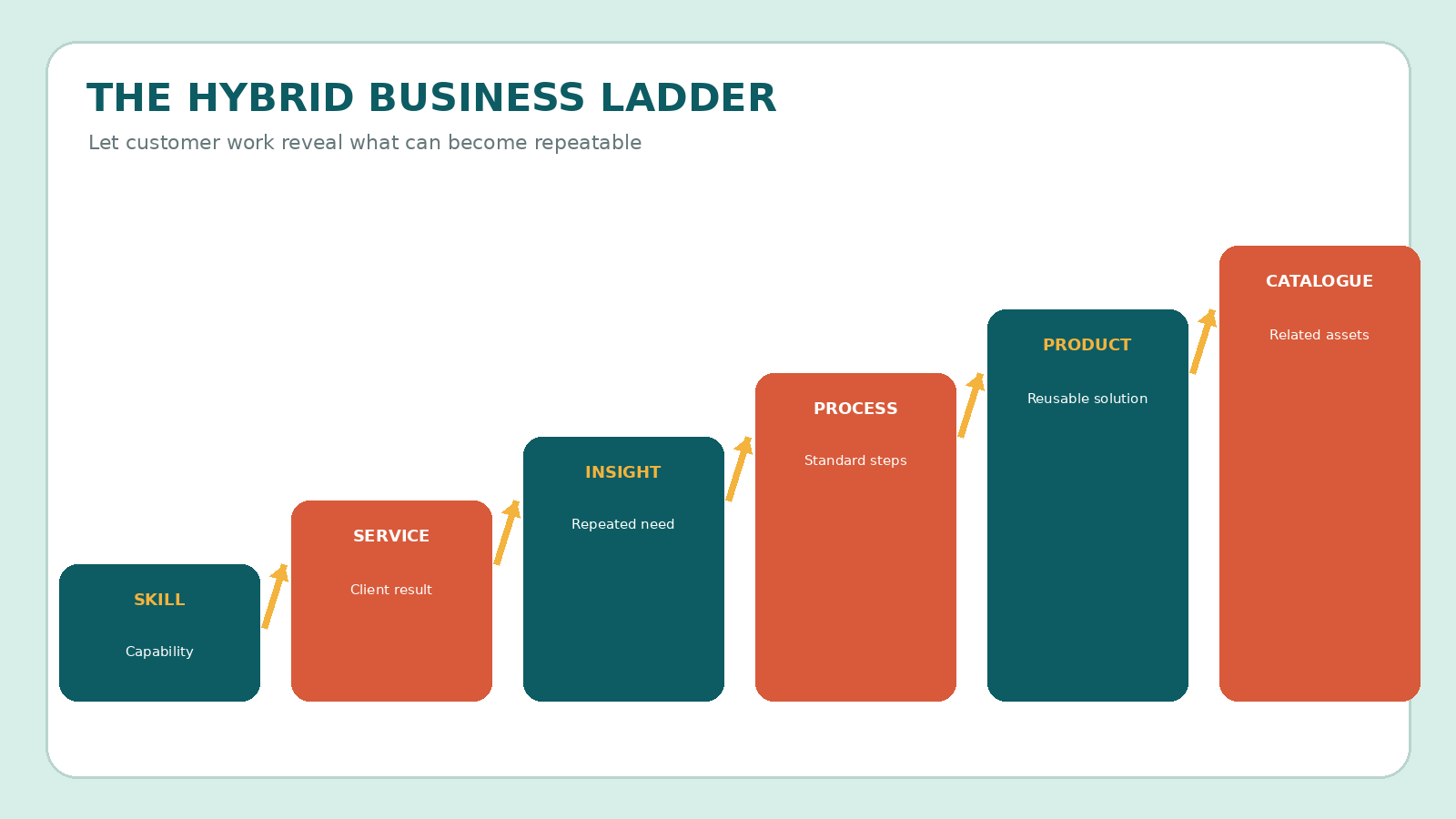 The hybrid business ladder showing how a skill becomes a service, customer insight, a standard process, a digital product and eventually a catalogue.
Service work can fund learning and reveal product ideas; products can extend the same expertise to more buyers.
Not every service should become a product. Highly confidential, complex or relationship-dependent work may remain better as consulting. The hybrid model is a choice, not a compulsory graduation path.
AI can reduce production time, but it also makes generic output easier for competitors to reproduce. The durable advantage is combining tools with domain knowledge, customer context, judgment and reliable delivery.
Freelancers may use AI for research, ideation, transcription, draft generation, data organisation or workflow automation. Product creators may use it for outlining, prototypes, editing assistance, design exploration and support drafts.
Both must address factual errors, bias, copyright, confidential data and platform policies. Never upload sensitive client material into an unapproved tool. Review every output and disclose AI use when a client agreement or professional rule requires it.
People exploring AI-enabled services and products can compare the options in VEZILL’s article on using AI and ChatGPT to make money online. For a deeper technical route, Inceptor’s web and software development with AI programme describes project-based development capabilities that may support employment, client services or original software products.
Video is another hybrid example: an editor can sell client work, then package original lessons or production resources. Inceptor’s current AI video generation and editing course outlines the practical production outputs learners work toward; course completion still does not guarantee customers or sales.
| Situation | More suitable starting point | Why |
|---|---|---|
| Student with a developing skill and no audience | Small freelance pilot | Provides direct feedback without building a full product |
| Skilled professional with limited spare time | Productised service or small product | Uses existing expertise within a controlled scope |
| Freelancer at full capacity | Hybrid | Standardisation or products may reduce dependence on custom delivery |
| Teacher with original resources and repeated learner questions | Small validated product | Existing knowledge and repeated need support a reusable resource |
| Creator with an engaged audience | Digital-product test | Distribution and audience feedback already exist |
| Beginner needing faster market feedback | Freelancing | A few targeted conversations reveal objections quickly |
| Person who strongly dislikes client interaction | Digital product, with realistic support expectations | Less custom delivery, but marketing and support remain |
| Smartphone-only beginner | Learn and validate first | Device limits affect which outcomes can be delivered reliably |
| Small agency with repeatable delivery | Hybrid | Services, templates and training can reinforce one another |
| Beginner with neither skill nor validated problem | Neither yet | Build competence and evidence before selling |
Someone job hunting may also use freelancing or a digital asset as a secondary experiment without abandoning appropriate employment goals. VEZILL’s remote-job resource is a directly listed example; inspect the product preview and terms to decide whether it matches your needs.
If your idea is educational, VEZILL’s article on high-demand educational digital products in Kenya can help you recognise formats. Validate the exact audience and problem independently; category demand does not prove demand for your particular product.
Choose the path that allows you to test the most important assumption safely and affordably.
VEZILL’s article on creating and selling digital products online can support this path. A directly listed AI-assisted digital-product creation resource is also available; confirm its preview and licence before purchasing.
If the repeated solution is a course, VEZILL has a listed resource on creating and selling online courses with AI. Review the current listing carefully rather than assuming its format, rights or suitability.
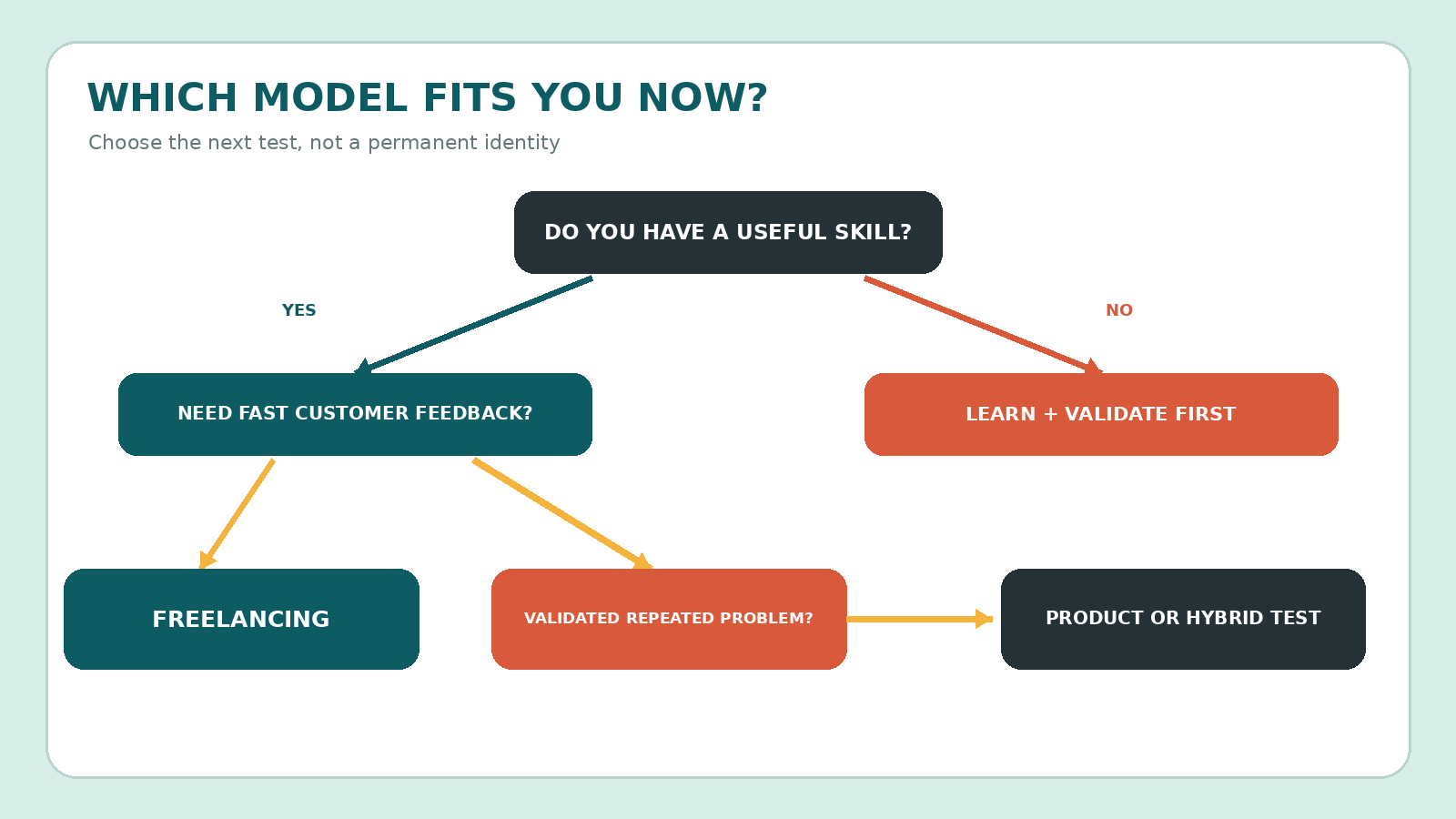 Decision tree for choosing freelancing, digital products, a hybrid model or learning and validating first.
Start with your evidence, skill, distribution and need for feedback—not with online hype.
The LEARN → DO → CREATE → SHARE → SELL → GROW framework works for both routes.
For freelancing: learn a useful skill, practise it, create proof, share a focused offer, sell a service and improve or specialise.
For products: learn about a problem, apply your knowledge, create a useful resource, share it with the right audience, sell it and grow a focused catalogue.
For a hybrid business: provide the service, document repeated needs, create a standard solution, sell both and build systems around what works.
Neither is universally better. Freelancing often suits people who have a useful skill and need direct feedback or earlier cash flow. Products may suit people with validated repeatable knowledge and a way to reach buyers.
Freelancing often reaches first revenue sooner because one client may pay for a service. Digital products may take longer because creation and distribution usually happen before sales. Neither guarantees fast income.
Yes, but you still need distribution. Marketplace search, SEO, partnerships, affiliates, direct communities, content or paid advertising can provide access to buyers.
You can test a small, low-risk service once you can deliver it competently and show honest sample work. Never invent clients, qualifications or results.
Not completely. Automated delivery can reduce fulfilment work, but research, creation, marketing, support, updates and refunds require ongoing attention.
Freelancing can scale through specialisation, retainers, productised services, procedures, automation, subcontractors or a team. Custom delivery still creates capacity constraints.
Yes. A freelancer can serve custom clients while selling an original reusable solution to buyers with simpler needs. Confidential client materials must never be repackaged without permission.
Either can be inexpensive depending on the skill and product. Compare the equipment, software, training, platform, marketing and support costs required for your specific offer.
Freelancers can create original templates, checklists, workbooks, lessons, presets, spreadsheets or tools based on repeated problems, provided they protect client confidentiality and third-party rights.
Often, but not always. Service work provides direct customer insight. A beginner who already has trusted expertise, repeated questions and distribution may reasonably test a small product first.
Choose freelancing if you have a useful skill, can work with clients and want direct feedback or a potentially faster path to first revenue. Choose digital products if you understand a repeated problem, can create a standard solution and have a realistic distribution plan. Choose the hybrid model if service work is already revealing solutions that can be separated from confidential client delivery.
If you have neither a useful skill nor evidence of a wanted product, pause the selling decision. Learn, practise, investigate demand and test something small. The best model is not the one that sounds most passive; it is the one whose most important assumptions you can verify and deliver responsibly.
Discover more articles you might be interested in

Learn where to find reliable step-by-step guides online, how to choose the right tutorial for your task, check whether it is current and follow instructions safely.
By Davie

Stop searching broad topics and start finding the exact knowledge you need. Learn how to define your problem, search smarter, choose reliable sources, verify answers and take action.
By Davie

Quick Knowledge or an online course? Learn when a focused answer is enough, when structured learning is better, and how to choose the right learning depth for your goal.
By Davie

Learn how to turn one useful digital product into multiple income streams through premium versions, bundles, courses, licensing, services, subscriptions, B2B sales and complementary products.
By Davie
Get the updates, on newly released, popular & fast-moving MRR digital products
Up to Top
Comments All
Julie
@julie
I really liked this one. I’ve always wondered whether freelancing or selling digital products is better when you’re just starting out. The comparison made it much easier to see the pros and cons of both, especially for beginners.
September 11,2026 At 10:37 PM