

You do not need thousands of followers to sell an AI-assisted product. You need a useful product for a specific customer, credible proof that it helps, and a dependable way to reach people who already care about the problem.
Quick answer: Choose one customer, validate one painful problem, create one small product, list it where buyers search, demonstrate the result, approach a few relevant people, collect feedback, and improve. A large audience is optional; distribution is mandatory. Sales are never guaranteed because demand, quality, trust, pricing, competition, visibility and execution all affect the result.
Yes. A creator with no followers can reach buyers through marketplaces, search engines, professional networks, partnerships, communities and careful direct outreach. These channels provide access to people you do not already own or control.
An audience and distribution are not the same thing. An audience is a group that has chosen to follow or hear from you. Distribution is the route that carries an offer to a relevant potential buyer. An email list is distribution, but so is a marketplace search result, a helpful Google article, a referral from a consultant or a personal message to a business that genuinely has the problem.
| Access type | Examples | Main advantage | Main risk |
|---|---|---|---|
| Owned | Email list, followers, website visitors | Direct, repeatable contact | Slow to build and must be maintained |
| Borrowed | Marketplaces, search, communities, partners | Existing attention or buyer intent | Rules, competition and limited control |
| Paid | Search ads, sponsored placements | Fast testing and measurable reach | Money can disappear before the offer works |
| Direct | Personal outreach, networks, referrals | Precise conversations and rich feedback | Labour-intensive; easily becomes spam if careless |
The strongest beginner plan usually combines two routes: one place where buyers search and one method that creates direct conversations. For example, list a focused spreadsheet on a marketplace, then show a tailored preview to ten relevant business owners. Over time, capture permission-based email subscribers so some borrowed access becomes owned access.
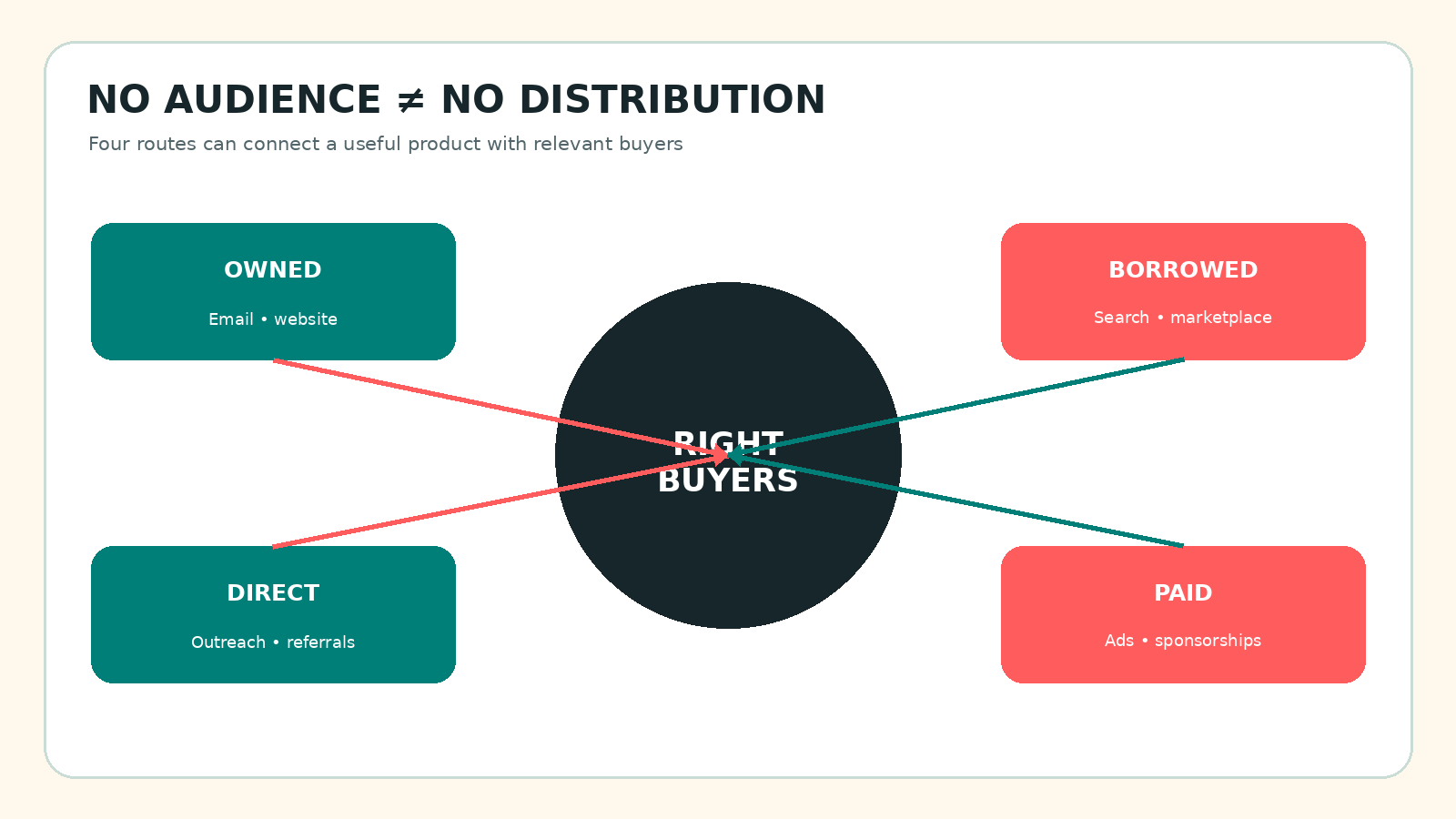 Audience versus distribution map showing owned, borrowed, paid and direct routes to buyers
An AI product is a useful outcome in which artificial intelligence helps create, deliver or operate the solution. The buyer should be purchasing the benefit—not unedited machine output.
If you have not selected a format yet, first explore what you can create and sell online using AI. Then return here and build a route to buyers. Check the terms of every AI tool and source asset; commercial-use rights, attribution duties and resale permissions vary.
Most fail because they are easy to produce but hard to justify buying. The creator starts with an AI feature instead of a costly customer problem, publishes a generic bundle, and expects discovery to happen automatically.
Typical causes include an undefined customer, weak demand evidence, generic output, unclear positioning, a poor thumbnail, no usable preview, an unsuitable marketplace, weak search language, misleading claims, inadequate quality control and no continuing promotion. Copyright, privacy or licensing mistakes can also make an otherwise attractive product unsafe to use.
Creating a PDF is not the same as creating a marketable product. A product needs a named user, a clear situation, an outcome, understandable instructions and a trustworthy buying experience. The psychology behind buying digital products is useful here: buyers reduce uncertainty before they act.
Start with a narrow minimum useful product: small enough to test quickly but complete enough to solve one real problem. It should be searchable, easy to preview, easy to explain and safe for you to support.
Good starting formats include a specialised checklist, a role-specific prompt workflow, a spreadsheet calculator, a short tutorial, an industry planning kit, an original revision workbook, a client-onboarding system or a tiny no-code utility. “50 Customer-Service AI Prompts for Kenyan Instagram Shops” is easier to understand and test than “Ultimate AI Bundle.”
A low-complexity product is not automatically valuable. A spreadsheet that saves a shop owner an hour each week can be more useful than a 100-page ebook that repeats free information. If sales-page writing is unfamiliar, study how a digital-product sales funnel and sales page turns attention into a sequence of informed decisions.
Find people through the situation that creates the problem—not through broad demographic labels. “Small businesses” is vague; “Nairobi Instagram shops that answer repeated delivery questions in DMs” suggests a problem, language and reachable channel.
In Kenya, that might mean interviewing teachers about revision planning, observing questions from job seekers, speaking to freelancers about client onboarding, or asking online sellers how they quote and track orders. Do not enter a church, school, farming group or WhatsApp community merely to drop promotional links. Ask permission and contribute something relevant first.
Validation means collecting evidence that people experience the problem and are willing to take a meaningful next step. Compliments are not purchases, and likes are weak evidence.
Use customer interviews, a simple landing page, a waiting list, a free prototype, a paid pilot, a deposit or a clearly explained pre-order. Begin with the least expensive method that can disprove your assumptions. Ask what the person does now, what the problem costs in time or money, what they have tried, and what would make a solution trustworthy.
Evidence ladder: Likes → comments → email sign-ups → requests for details → pre-orders → deposits → purchases → repeat purchases → referrals. Each step generally signals more commitment, but none guarantees the next.
For deeper research methods, use a structured product-validation process before creating. A good validation decision is not always “build.” It may be “change the customer,” “narrow the outcome,” “test a service first,” or “stop.”
Sell where a relevant customer already searches, learns, works or asks for help. The right channel depends on the format, price, buyer and amount of explanation required.
| Channel | Works well when | Limitation |
|---|---|---|
| Digital marketplace | Buyers recognise the product format | Competition and ranking uncertainty |
| Course platform | Learning needs structure and delivery | Higher creation and support burden |
| Freelance marketplace | A service or customisation builds trust | Time remains tied to delivery |
| App marketplace | The tool fits an established ecosystem | Approval, maintenance and technical rules |
| Search-focused website | People search for the exact problem | SEO requires time, quality and authority |
| LinkedIn or professional network | The buyer is role- or business-specific | Generic pitching performs poorly |
| WhatsApp or Telegram | You have permission and local relevance | Privacy and spam risk |
| YouTube or Pinterest | The product can be demonstrated visually | Consistent content is still required |
| Niche community | You participate genuinely | Promotion may be restricted or banned |
Pinterest marketing for digital products, LinkedIn marketing for digital products and a responsible WhatsApp marketing approach can each work for different buyer journeys. Select one based on where customers already behave—not on which platform is fashionable.
A marketplace can provide product categories, search, product pages, checkout, delivery, seller profiles and sometimes reviews. It does not guarantee impressions or sales.
VEZILL is a relevant place to list digital resources for buyers to discover, while the seller still needs a clear product, an accurate listing and promotion. Competition, platform rules, fees or payment arrangements, ranking changes and dependency on one channel remain important considerations. Verify the current seller terms directly before making pricing or delivery decisions.
Treat your listing as a salesperson that must work without you. State the customer, problem, outcome, files, format, requirements, limitations, licence, support expectations and any appropriate AI-use disclosure. Add readable preview images and an honest demonstration. The VEZILL article about acquiring early digital-product customers offers further customer-acquisition ideas; apply them as tests, not promises.
Use the exact language a suitable buyer would type, then remove uncertainty from every part of the page.
Weak: “Ultimate AI Bundle.” It hides the customer, use case and contents.
Stronger: “50 Customer-Service AI Prompts for Kenyan Instagram Shops.” It identifies the asset, task, quantity and customer. The description should still explain which AI tools are compatible, how prompts were tested, what buyers may edit, and what results are not promised.
SEO connects a useful answer with people already expressing a problem. It works best when an article genuinely solves the search question and leads naturally to a relevant demonstration or product—not when a page repeats keywords.
Build content around problem-based keywords, product-intent searches, comparisons, tutorials, use cases and FAQs. Link related pages clearly, write descriptive image alt text and use accurate structured data. A practical route is:
Search question → useful article → product demonstration → product listing → informed decision.
For a practical example, read how to sell digital products through Google without paid ads. SEO can compound, but it may take months, rankings can change and traffic does not guarantee purchases.
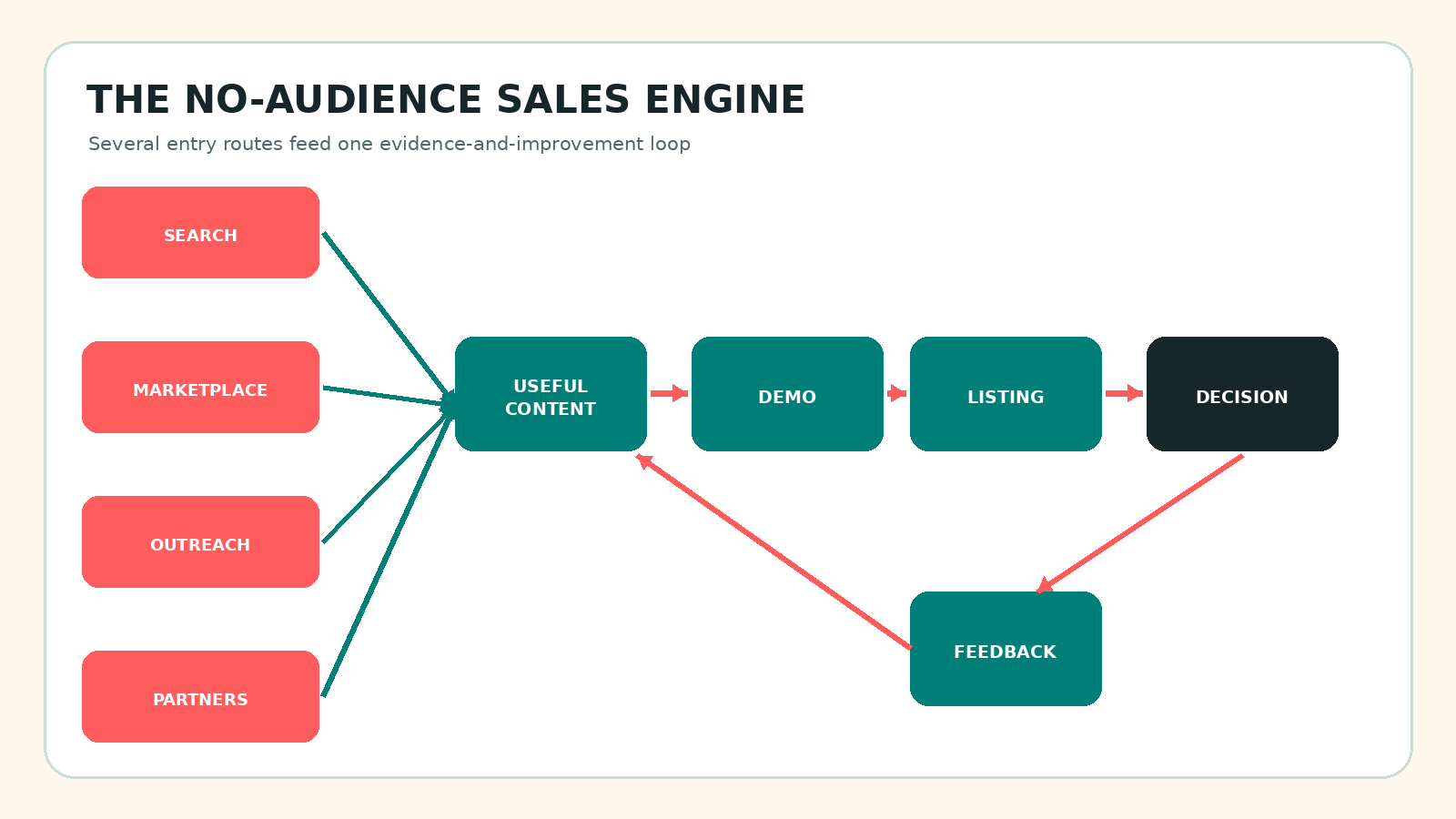 No-audience sales engine connecting search, marketplaces, outreach and partners to content, demonstrations, listings, decisions and feedback
Contact only a small number of carefully selected people whose situation genuinely matches the product. Research first, personalise the message, offer value, ask permission and stop when someone declines.
Small business: “Hi Amina, I noticed your shop answers sizing questions in comments. I’m testing a customer-response prompt sheet for Instagram sellers. May I send a one-page sample for your honest feedback?”
Teacher: “Hello Mr Otieno. I created an original revision-planning worksheet for Form Four learners. Would you be willing to review two sample pages for clarity? No obligation to purchase.”
Freelancer: “Hi David, I’m testing a client-onboarding workspace for independent designers. It combines a brief, scope checklist and handover prompts. May I share a preview and ask which part feels missing?”
Professional contact: “Hello Grace. We discussed quotation delays last month. I built a small pricing spreadsheet for service businesses. Would a five-minute demonstration be useful?”
The difference between outreach and spam is not merely personalisation; it is relevance, restraint, consent and respect.
Partners lend trusted access to a relevant group. Small creators, educators, consultants, freelancers, agencies, newsletter publishers and complementary product creators can demonstrate, bundle or refer a useful product.
Possible arrangements include an affiliate commission, transparent revenue share, a bundle, guest training, a co-created resource, newsletter placement or a community discount. Put the commission, attribution window, payment method, refund treatment, responsibilities, content approval, licence and termination terms in writing. Promotions must be disclosed clearly.
A focused micro-creator may outperform a large unrelated account because relevance and trust matter more than follower count. Evaluate audience fit, genuine engagement, geography, previous promotions, disclosure habits, cost and measurable goals. Never invent expected conversion rates.
Free content should demonstrate competence and let the buyer experience part of the solution. It is not a disguised advertisement.
Offer a checklist excerpt, one prompt, a small template, a short tutorial, a before-and-after demonstration or a product walkthrough. A useful preview helps the buyer judge quality; giving away the entire paid outcome may remove the reason to buy. Keep the free item complete enough to be useful and the paid product broader, faster, more customisable or more convenient.
The trust sequence is gradual: a clear listing reduces confusion; a preview reduces quality risk; a demonstration shows use; a sample creates experience; a buyer generates feedback; an honest review can help later buyers; a satisfied customer may refer someone. None of these steps happens automatically.
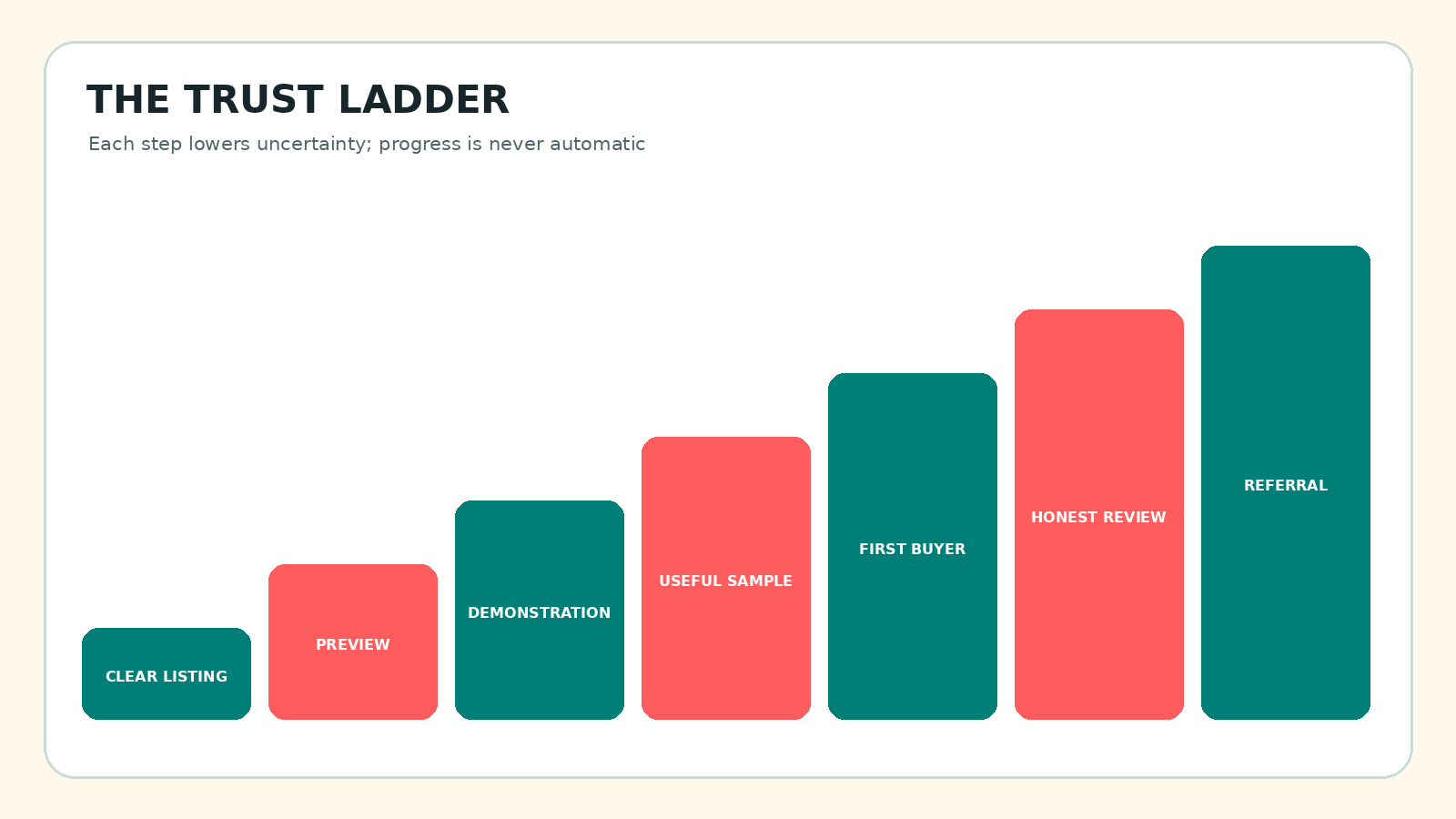 Trust ladder from clear listing through preview, demonstration, sample, buyer, honest review and referral
Offer one small resource to the right person, obtain explicit permission and deliver useful follow-up messages. Never buy a list.
The detailed VEZILL walkthrough on building an email list from zero can help you develop this owned channel. Laws differ by location and recipient, so review the rules that apply to your business and customers.
Usually not until the product, listing and tracking show credible organic demand. Ads amplify an offer; they do not repair a vague customer, weak product or confusing page.
Consider a hypothetical product priced at KSh 1,500. Suppose platform and payment costs are KSh 225, a prudent refund/support allowance is KSh 150, and an advertisement costs KSh 900 to acquire one buyer. The illustrative remainder is KSh 225 before tax, labour, software and other expenses. If acquisition rises above KSh 1,125, this simplified campaign loses money before those additional costs.
These figures are examples, not VEZILL fees or expected performance. Test tracking, landing-page behaviour and buyer feedback organically before setting a small loss limit for paid experiments.
Use evidence you genuinely possess: a clear preview, demonstration video, useful sample, transparent creator information, accurate FAQs, licence terms, security-conscious checkout, documented testing, responsive support and honest limitations.
Explain where AI contributed and where a human reviewed the result. Never fabricate customers, reviews, sales counters or screenshots. If you sell under a business brand or prefer privacy, the practical faceless digital-product guide may offer relevant ideas, while trust must still come from the product and experience.
Relevant learning can also strengthen execution. Inceptor’s current YouTube marketing course describes video strategy, content and video SEO; its Adobe Illustrator training and Photoshop training focus on practical visual-production skills. Review their current schedules, entry requirements and fees directly before enrolling.
Use the next 14 days to seek evidence, not a guaranteed sale. Each stage should reduce one major uncertainty.
| Days | What to do | Why it matters | Expected outcome |
|---|---|---|---|
| 1–2 | Define one customer, situation and costly problem | Prevents a generic product | A one-sentence customer/problem statement |
| 3–4 | Hold interviews and observe existing solutions | Tests whether the problem is real | Notes, objections and repeated language |
| 5–6 | Create the smallest complete solution | Limits wasted production | A minimum useful product |
| 7 | Test accuracy, instructions, files and rights | Protects quality and trust | A corrected test version |
| 8–9 | Build the listing, thumbnail, previews and FAQs | Removes buying uncertainty | A publishable product page |
| 10 | Record a demonstration and prepare a sample | Makes value visible | One demo and one useful preview |
| 11–12 | Contact a small, researched prospect list | Creates direct evidence | Replies, questions and objections |
| 13 | Approach two relevant partners | Tests borrowed distribution | Partnership interest or feedback |
| 14 | Review evidence and revise the offer | Turns learning into improvement | A keep, change or stop decision |
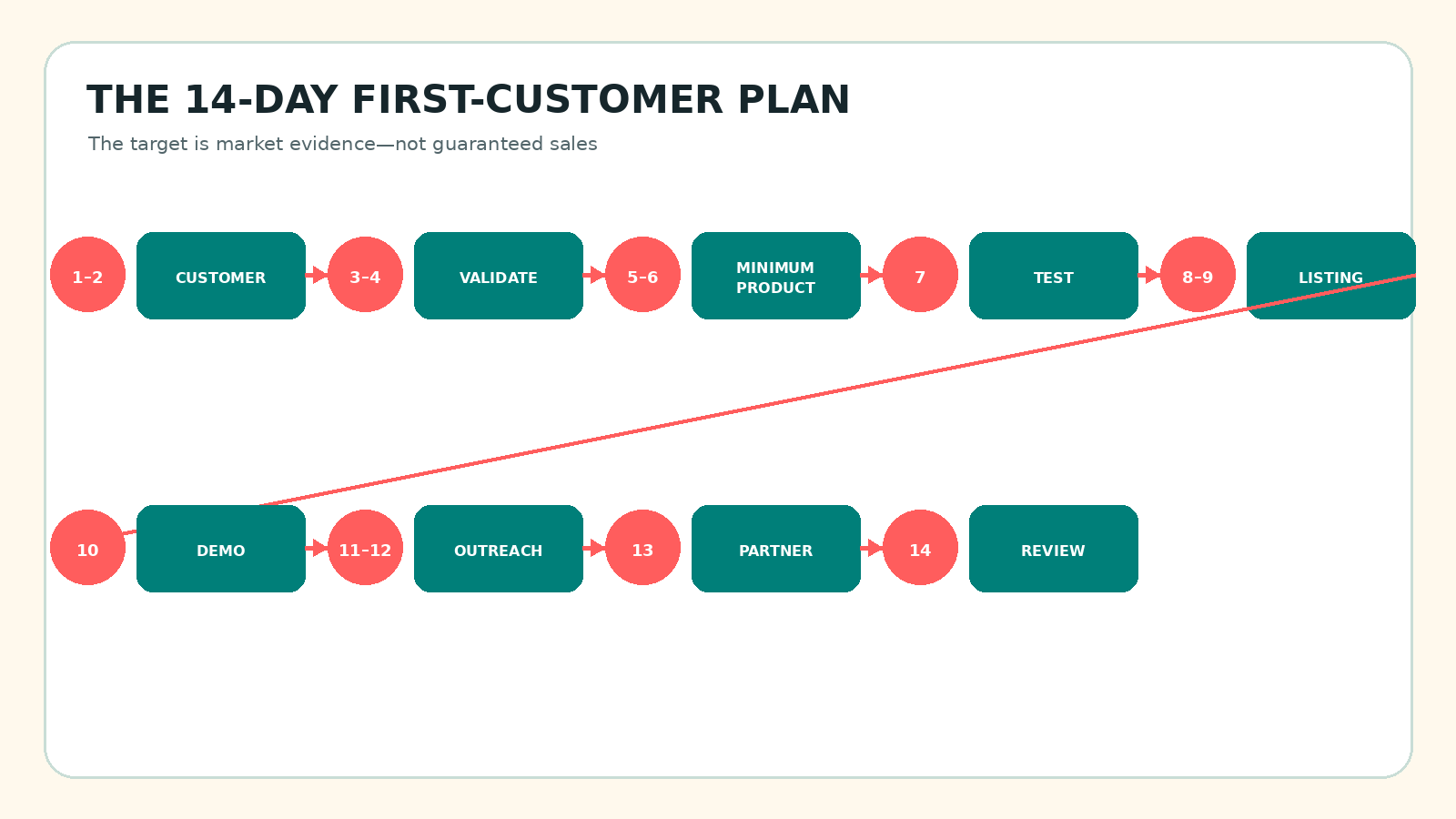 Fourteen-day first-customer plan showing customer, validation, minimum product, testing, listing, demonstration, outreach, partnership and review
| Customer | Problem | Product | Discovery route | Trust signal | First test |
|---|---|---|---|---|---|
| Kenyan social-media manager | Rebuilding calendars monthly | Editable content-calendar system | LinkedIn search | Screen-recorded walkthrough | Five peer reviews |
| Teacher | Learners lack revision structure | Original workbook | Teacher network | Two complete sample pages | Small paid pilot class |
| Job-search adviser | Clients submit inconsistent applications | Application toolkit | Google how-to article | Annotated example | Waiting-list sign-ups |
| Small-business consultant | Owners price services inconsistently | Pricing spreadsheet | Direct introductions | Visible formulas and test cases | Three owner interviews |
| Virtual assistant | New clients miss onboarding details | Onboarding workspace | Freelance community | Demo project | Feedback from experienced VAs |
| Developer | Teams repeat a narrow document task | Small AI-assisted tool | Niche directory | Live demo and privacy note | Supervised pilot users |
Each scenario is illustrative, not a real customer or earnings claim. The aim is to match one reachable group with a concrete problem, observable solution and credible test.
Deliver exactly what was promised, confirm access, invite honest feedback and improve the instructions. Ask for a review without pressure or incentives that would distort it.
Document every support question. Repeated confusion may reveal a listing or onboarding problem; repeated requests may suggest an add-on. Review pricing only after considering value, support, costs and alternatives. Ask satisfied buyers whether they know someone with the same problem, but make referral requests optional and transparent.
Then reduce dependence on one channel. Build permission-based email relationships, create related products, publish useful answers and maintain direct customer learning. This is VEZILL’s broader progression in practice: LEARN → DO → CREATE → SHARE → SELL → GROW. A practical marketing reference such as Digital Marketing and E-commerce can support skill-building, but always assess a product’s current description and suitability before purchasing.
Measure the movement between decisions, not vanity totals. A small number of relevant visitors can teach you more than a viral post seen by people who will never need the product.
Track where each visitor came from, whether they opened the listing, viewed the preview, started checkout, completed a purchase, requested help or returned later. For outreach, record messages sent, permission granted, replies, demonstrations requested, objections and follow-up outcomes. For partners, record the agreed link or code and the enquiries attributable to it. Collect only data you are entitled to use and protect personal information.
Interpret small samples cautiously. If 20 visitors produce no sale, that is not enough to declare the market dead—but their behaviour can reveal friction. If nobody opens the preview, improve its placement or title. If prospects request the demo but hesitate at checkout, investigate trust, price, payment, licence or delivery concerns. If they purchase but ask the same setup question, improve onboarding before driving more traffic.
Use a simple weekly decision sheet:
| Signal | Possible meaning | Next test |
|---|---|---|
| Few relevant visits | Distribution is too weak or poorly targeted | Try one stronger buyer-access channel |
| Visits but no preview views | The promise or presentation is unclear | Rewrite the headline and preview caption |
| Preview views but no enquiries | The demonstrated outcome may feel weak | Show a concrete use case and limitation |
| Enquiries but no purchases | Price, trust, fit or payment may block action | Ask what stopped the decision; test one change |
| Purchases plus repeated support | Product works but instructions need improvement | Add onboarding and examples |
| Positive use plus referrals | The customer and outcome may fit | Carefully repeat the channel and document why |
Change one major variable at a time when possible. If you change the audience, title, price, preview and channel together, you will not know which change affected the result. Early marketing is disciplined learning: form a hypothesis, run a small ethical test, observe evidence and decide whether to keep, revise or stop.
Yes. You can use marketplaces, search, partnerships, communities and respectful outreach to reach relevant buyers. You still need a useful product, trust and consistent distribution.
Options include digital-product marketplaces, course or app platforms, search-focused websites, professional networks and niche communities. Choose according to buyer intent, product format, platform rules and support needs.
Define one customer and problem, validate it through conversations, build a minimum useful product, demonstrate it and personally approach a small number of suitable prospects. Treat feedback as the primary early outcome.
No. SEO, marketplaces, email partnerships, referrals and direct outreach can work without regular social posting. Every option still requires a deliberate way to reach buyers.
Yes. SEO can attract people searching for the problem, a tutorial or a product comparison. It takes time, rankings are uncertain and traffic only converts when the offer is relevant and trustworthy.
Usually validate organically first. Paid ads can waste money when customer targeting, product economics, tracking or the sales page remain unproven.
Use accurate previews, demonstrations, samples, clear licences, transparent AI disclosure, professional presentation, documented tests and responsive support. Never create fake reviews.
Yes. A business brand, screen recording, product previews and written expertise can build trust without a personal on-camera presence. Do not confuse privacy with anonymity from legal or customer obligations.
The easiest product to market solves a narrow, urgent and searchable problem for a reachable customer. The best format depends on the task; there is no universal easiest product.
There is no reliable timeline. It depends on demand, quality, positioning, price, trust, competition, distribution and execution. Measure conversations and evidence before predicting sales.
You do not need fame. You need a precise customer, a useful and responsibly made product, proof, and a route to potential buyers. Start narrow, demonstrate the outcome, ask permission, learn from real responses and build owned access gradually.
Your first objective is not to look popular. It is to discover whether one specific group values one specific solution enough to act—and then improve based on honest evidence.
Discover more articles you might be interested in

Learn where to find reliable step-by-step guides online, how to choose the right tutorial for your task, check whether it is current and follow instructions safely.
By Davie
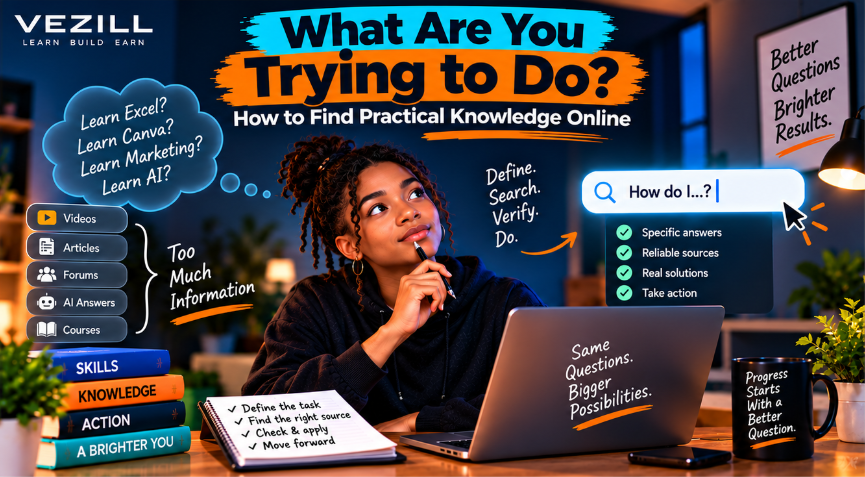
Stop searching broad topics and start finding the exact knowledge you need. Learn how to define your problem, search smarter, choose reliable sources, verify answers and take action.
By Davie
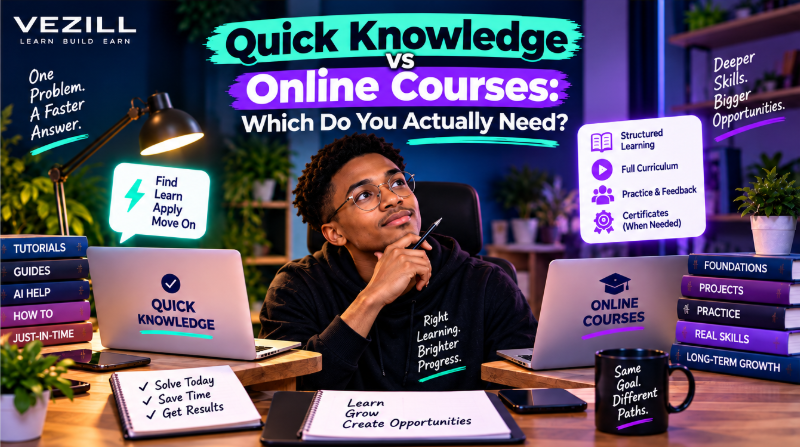
Quick Knowledge or an online course? Learn when a focused answer is enough, when structured learning is better, and how to choose the right learning depth for your goal.
By Davie

Learn how to turn one useful digital product into multiple income streams through premium versions, bundles, courses, licensing, services, subscriptions, B2B sales and complementary products.
By Davie
Get the updates, on newly released, popular & fast-moving MRR digital products
Up to Top
Comments All
John
@john
I really liked this one! Not having an audience can make selling online feel impossible, so I liked seeing that you can still get started without a big following. The ideas here are actually practical and gave me a few things to try.
September 11,2026 At 10:41 PM