
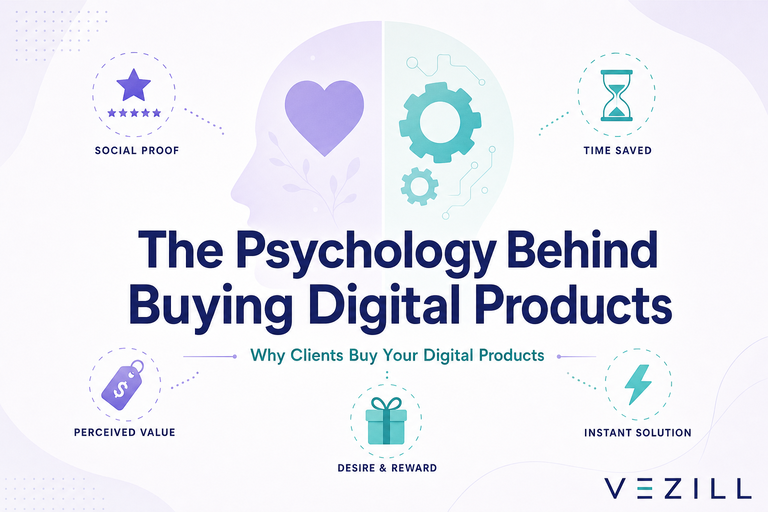
Two people land on the same product page. One buys in thirty seconds; the other leaves and never returns. The product didn’t change — the psychology did. If you understand why people actually buy digital products, you can design every part of your offer to earn more of those instant “yes” decisions.
This guide unpacks the real reasons clients buy, then shows you how to apply each trigger ethically to your own products. It pairs naturally with our guide to digital product sales funnels and high-converting sales pages — psychology is the why; the funnel is the how. New to selling entirely? Start with how to make money selling digital products online.
People buy digital products for emotional reasons — they want a result, an identity, relief from a problem, or a shortcut — and then justify the purchase with logic (price, features, reviews, guarantee). Clients buy your product when it clearly promises a desired outcome, feels trustworthy, and removes the risk of saying yes.
The strongest psychological triggers are social proof, scarcity and urgency, loss aversion, authority, reciprocity, price anchoring, and the instant gratification unique to digital products. Apply them honestly on your product page and conversions rise.
On Vezill, you can build a trustworthy, high-converting product page for free — complete with reviews, instant delivery, and resell rights.
Two people land on the same product page. One buys; one leaves. Below is exactly why — and how to design for the buyer who says yes.
Every purchase is, at its core, an emotional decision. A buyer doesn’t want a 120-page PDF; they want the confident feeling of finally knowing how to do something. They don’t want a course; they want the version of themselves who has already succeeded. The logical details — price, page count, format — come after the emotional yes, to justify a decision they’ve already leaned toward.
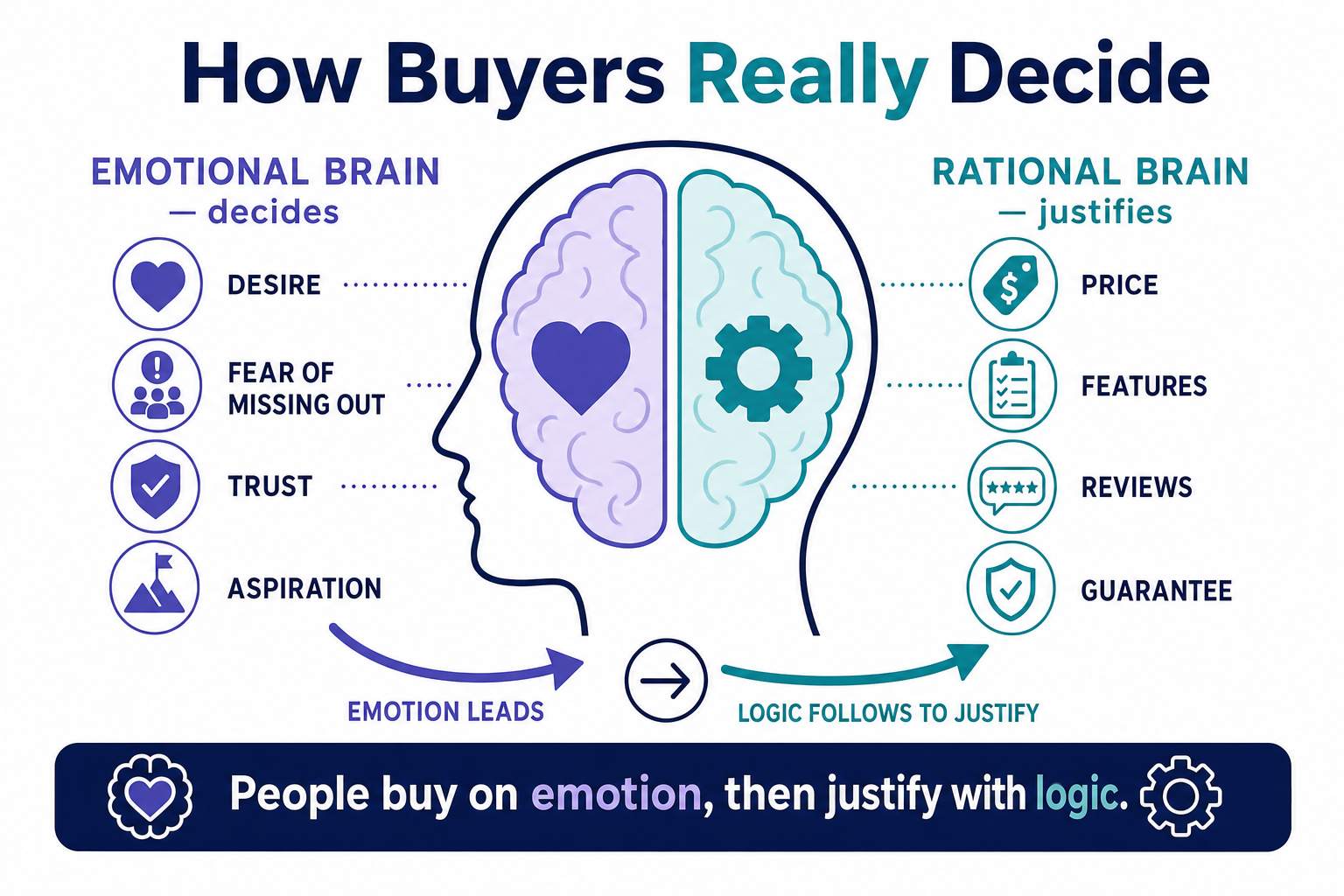 Emotion drives the decision; logic defends it afterwards.
What this means for you: lead your product page with the transformation and feeling, then supply the logical proof (specs, reviews, guarantee) so the buyer can comfortably justify the purchase to themselves.
Decades of behavioural research keep pointing to the same handful of triggers. Here’s how each one applies to digital products.
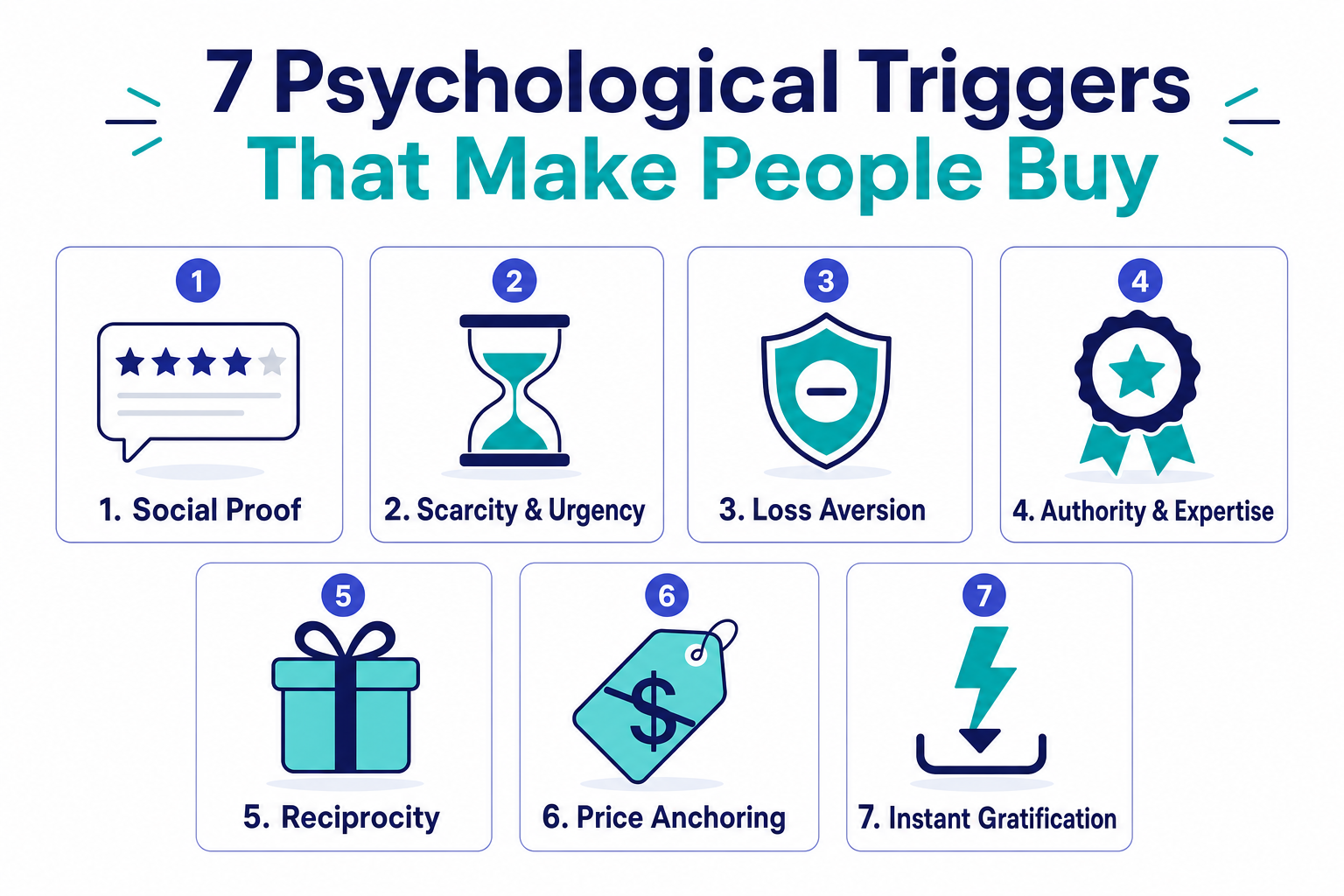 The seven triggers behind most digital-product purchases.
We look to others to decide what’s safe and worthwhile. Reviews, ratings, sales counts, and testimonials are the single most powerful conversion lever you have. If you’re still gathering your first reviews, making your first £1,000 selling digital products shows how to earn those early sales that seed your social proof.
Limited-time bonuses, launch pricing, or a closing enrolment window push fence-sitters to act now instead of “later” (which usually means never). Keep it honest — fake countdowns destroy trust.
People fear losing more than they enjoy gaining. Frame the cost of not buying: the time wasted, the income left on the table, the problem that keeps recurring. This is often more persuasive than listing benefits alone.
Buyers trust credible sources. Show your results, credentials, or a strong track record; write with clarity and confidence. Becoming a recognised, trusted seller compounds over time — see how to become a top seller on Vezill.
When you give first — a free chapter, a helpful blog post, a useful template — people feel a natural pull to give back by buying. Valuable free content at the top of your funnel does quiet, constant selling.
Value is relative. Showing a higher “anchor” (original price, or the cost of the problem) makes your actual price feel like a bargain. Bundling raises the anchor too — the “How to Sell More Ebooks” publishing blueprint covers pricing and bundling tactics you can copy.
Digital products deliver immediately. That’s a psychological superpower physical goods can’t match — and you should say it out loud: “Instant download. Start in the next 2 minutes.”
Digital purchases carry unique psychology. There’s no shipping wait (instant reward), low price risk (many products cost a few dollars), and often resale potential — on Vezill, Master Resell Rights mean a buyer can become a seller, turning a purchase into a potential income stream. That reframes the price from “spending” to “investing,” a powerful motivator. If your buyers want products they can create and resell fast, point them to “How AI Tools Work Together to Create Digital Products Fast”.
The flip side: because buyers can’t physically hold the product, perceived value and trust must be built entirely through your page — the copy, the visuals, the proof.
Buyers don’t judge price in isolation. They weigh it against the value they perceive. When perceived value clearly outweighs the price, the decision feels easy — even obvious.
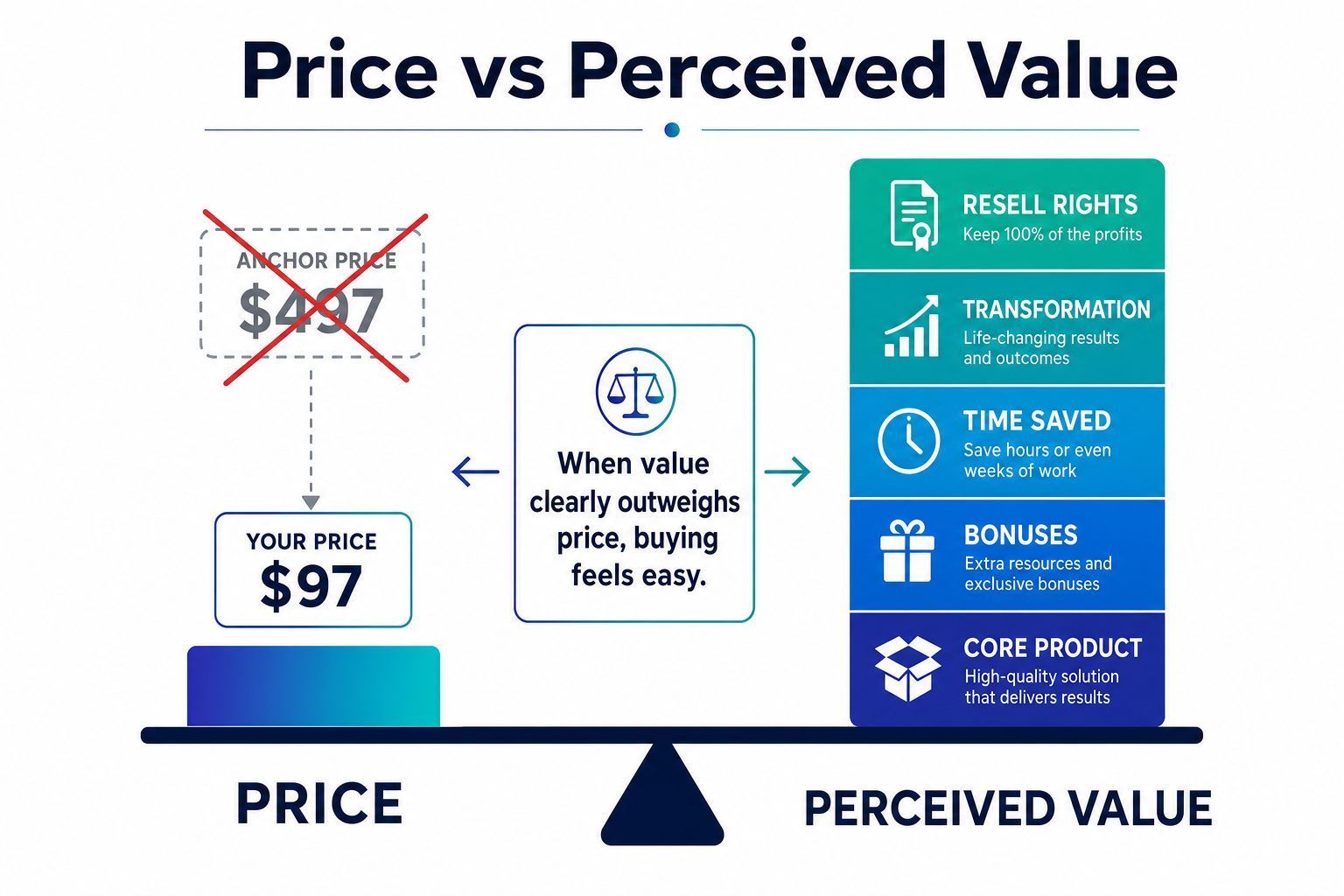 Stack real value and the price stops being the objection.
Raise perceived value by stacking bonuses, quantifying the time or money saved, and spelling out the transformation. Then present the price against a fair anchor. Your job isn’t to be the cheapest — it’s to make the value obvious.
Almost nobody buys from a complete stranger. Buyers climb a ladder of trust, and each step needs the right nudge.
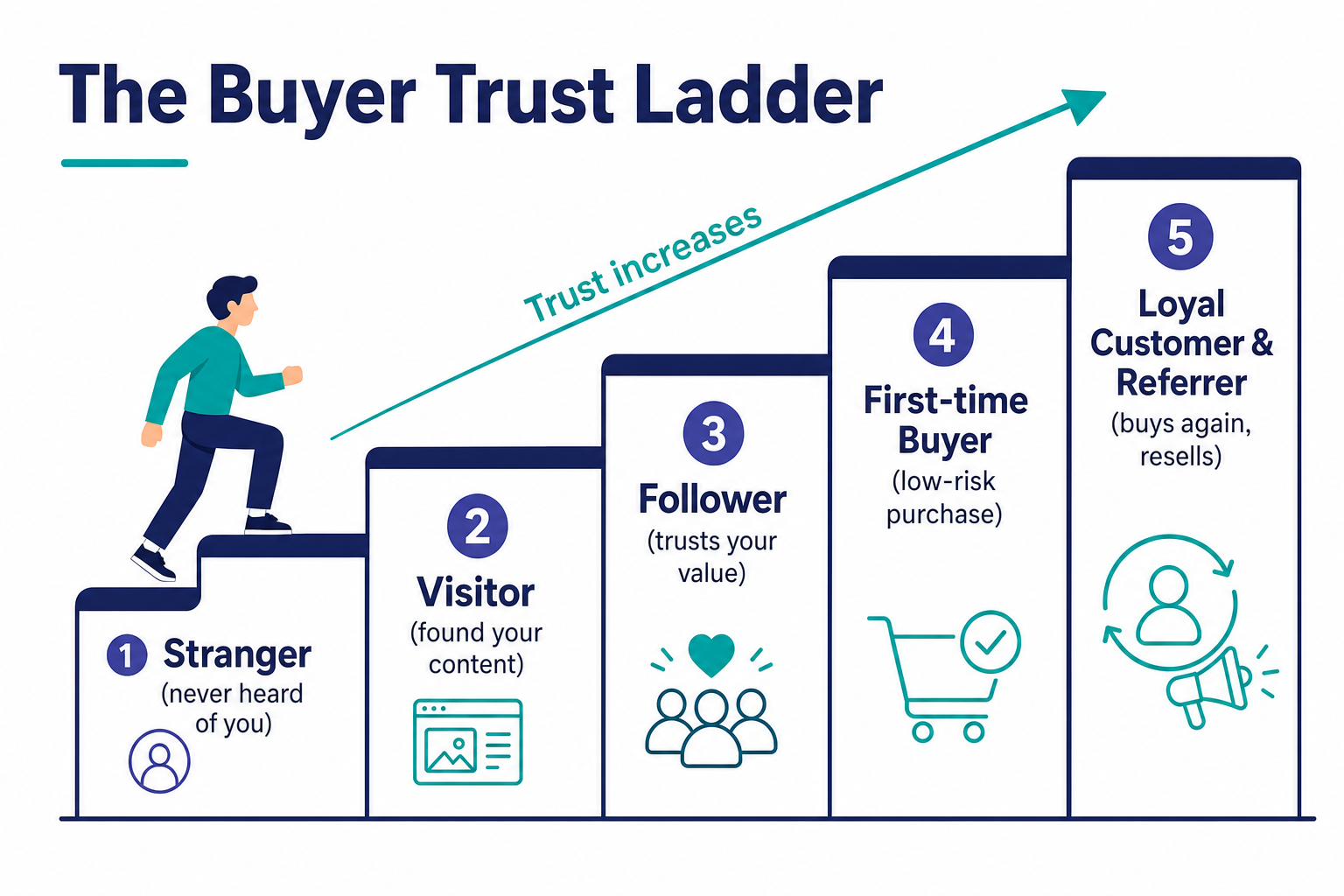 Every sale is the top of a trust ladder the buyer has climbed.
Move people up the ladder with helpful content (awareness), consistent value (following), a low-risk first offer (first purchase), and a great post-purchase experience (loyalty and referrals). A free, credible platform helps you look trustworthy from day one — here’s why Vezill is a great free platform to sell on, and how selling on Vezill works.
Every unanswered doubt is a silent “no.” The big four for digital products:
“Will this actually work for me?” → specifics, examples, and who it’s for.
“Is it worth the money?” → value stacking and a fair price anchor.
“Can I trust this seller?” → reviews, guarantees, and a professional page.
“What if it’s not what I expected?” → a clear risk-reversal or refund promise.
Answer these directly in your description and FAQ. Doing so also makes your page easier for AI assistants to understand and recommend — see how to make your products visible in ChatGPT and Google AI search, or grab the done-for-you “How to Optimise Products for AI Search” guide and the “Get Your Business Recommended by AI” playbook.
These triggers are powerful, which is exactly why you must use them honestly. Ethical persuasion means the tactic and the truth point the same way: real scarcity, genuine reviews, honest anchors, products that deliver what they promise. Manipulation — fake timers, invented testimonials, inflated claims — wins one sale and loses a reputation. Trust is your most valuable long-term asset; protect it.
Rule of thumb: If a buyer knew exactly how you were using a trigger, would they still feel good about buying? If yes, it’s persuasion. If no, it’s manipulation — cut it.
☐ Headline leads with the emotional outcome/transformation
☐ Real reviews, ratings, or sales numbers visible (social proof)
☐ The cost of not buying is made clear (loss aversion)
☐ Credibility/authority shown (results, expertise)
☐ A free sample or helpful content given first (reciprocity)
☐ Price presented against a fair anchor + value stack
☐ “Instant access” stated explicitly (instant gratification)
☐ A guarantee or clear risk-reversal (removes fear)
☐ FAQ answering the four hidden objections
☐ Every trigger used honestly
Selling digital products isn’t about tricks — it’s about deeply understanding your buyer and making the right decision feel easy and safe. Speak to the emotion, prove your claims, stack real value, remove the risk, and answer every doubt. Do that consistently and you won’t have to “convince” anyone; the right buyers will recognise the value and say yes on their own.
Pick one product, rewrite its page with these principles, and watch how differently people respond. Then do it again. Understanding psychology is a skill that pays you back on every product you ever launch.
People buy digital products to get a specific outcome or transformation, to solve a problem quickly, or to save time and effort. The decision is primarily emotional and then justified with logic such as price, reviews, and guarantees. Instant delivery and low price risk make digital products especially easy to say yes to.
The strongest are social proof, scarcity and urgency, loss aversion, authority and expertise, reciprocity, price anchoring, and the instant gratification of digital delivery. Used honestly on a clear product page, these triggers significantly increase conversions.
Show genuine reviews and ratings, demonstrate expertise and results, present a professional and detailed product page, offer a clear guarantee or risk-reversal, and answer common objections directly. Selling on a trusted platform with built-in reviews and secure checkout, like Vezill, also boosts confidence.
No. Buyers judge price against perceived value, not in isolation. A higher-priced product with strong proof, bonuses, and a clear transformation often outsells a cheap one with a weak page. Focus on making the value obvious rather than simply being the cheapest.
It doesn’t have to be. Ethical persuasion aligns the tactic with the truth — real scarcity, honest reviews, fair anchors, and products that deliver. Manipulation uses fake or misleading tactics and destroys long-term trust. Persuade honestly and protect your reputation.
Lead your product title and description with the outcome, display reviews, present a fair price anchor with a value stack, state that delivery is instant, add a guarantee, and answer key objections in your FAQ. Vezill’s free hosting, reviews, instant delivery, and resell rights support every one of these triggers.
Discover more articles you might be interested in
Affiliate Marketing for Digital Products
By Davie

Digital Product Bundling: 3x Your Average Order Value
By Davie

Telegram Channel Marketing for Digital Products
By Davie
Facebook Groups Marketing Strategy for Digital Products
By Davie
Get the updates, on newly released, popular & fast-moving MRR digital products
Up to Top
Comments All
Neimah
@neimah
I really liked how it explains what actually influences people when deciding to buy digital products. The points about trust, value, and understanding what customers need make a lot of sense. Definitely a helpful perspective for anyone selling digital products.
September 08,2026 At 09:43 PM
Natasha
@natasha
The psychology side was probably my favorite part of this one. It made me realize that people aren’t just buying a digital product—they’re buying the result or solution they expect from it. That’s something I’d definitely keep in mind when creating or marketing a product.
August 27,2026 At 11:38 PM