
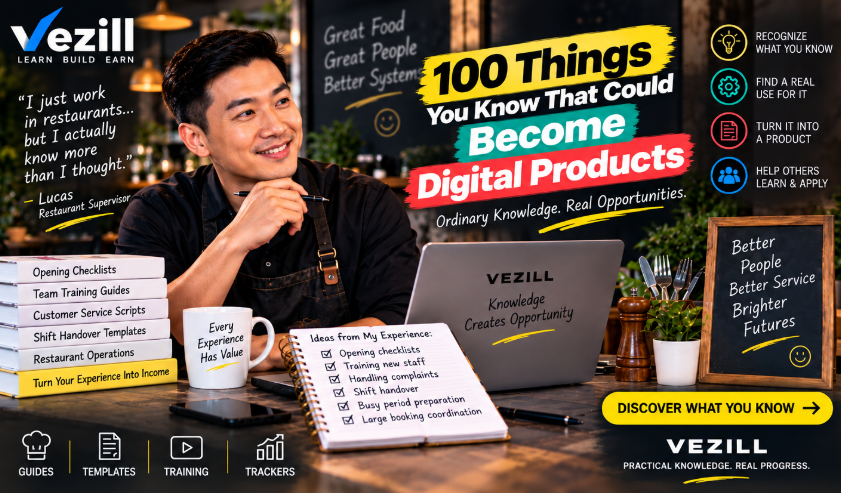
A practical inventory to help you notice useful knowledge already hiding inside your work, skills, hobbies, routines, community experience and local context.
Lucas has worked in restaurants for about seven years. Ask what he knows and he says, “Nothing special. I just work in restaurants.” Yet that ordinary sentence hides opening procedures, shift organization, reservations, waiter coordination, customer complaints, kitchen communication, closing checks, new-staff training, incident notes and large-booking preparation.
Those are not automatically products. They are knowledge assets. Some may be confidential, too narrow or unwanted. Others may help a beginner if Lucas can extract the general process, remove employer-specific material and package it clearly.
THE KNOWLEDGE THAT FEELS ORDINARY TO YOU MAY FEEL USEFUL TO SOMEONE WHO HAS NOT LEARNED IT YET. QUICK ANSWER: Things you already know that could become digital products include work processes, checklists, planning systems, templates, decision frameworks, beginner explanations, troubleshooting methods, client workflows, organizational systems, scripts, spreadsheets, lessons from experience and step-by-step methods. The opportunity is to identify a useful piece of knowledge that helps a specific person solve a specific problem.Research on tacit knowledge and practical intelligence describes practical know-how as procedural, useful in everyday life and often unspoken. Research on reflection and experience-based knowledge examines how guided reflection can make knowledge acquired through experience more explicit. That helps explain why repeated work can feel ordinary to the person doing it.
A photographer may automatically check lighting. A recruiter notices weak interview answers. A chef organizes prep before service. A designer asks clarifying questions before opening a design file. A freelancer clarifies scope before starting. Familiarity can hide the number of decisions inside a task.
FAMILIARITY CAN HIDE COMPLEXITY.But familiarity is not proof of market value. VEZILL’s knowledge-audit guide emphasizes specific people, meaningful problems, evidence, competence and responsible explanation.
Use this as an editorial reflection framework, not a validated psychological test. Ask: What do people ask me for help with? What can I do without constantly looking it up? What have I repeated? What mistakes have I learned to avoid? What process have I improved? What tool do I know better than a beginner? What problem have I solved more than once? What do I explain to new people? What checklist exists in my head? What did experience teach me that training did not?
REPEATED EXPERIENCE → PATTERN → KNOWLEDGE → POSSIBLE PRODUCT The Knowledge Hiding in Plain Sight
These are recognition prompts, not 100 products to copy. Every example connects a real piece of possible knowledge to a plausible user, problem and product format. Each remains a hypothesis until researched.
Who may need it: new shift workers.
Problem: important opening tasks are forgotten.
Could become: Shift-Start Preparation Checklist.
Best format: checklist.
Who may need it: teams working across shifts.
Problem: key information disappears between people.
Could become: Shift Handover Template.
Best format: template.
Who may need it: busy office workers.
Problem: weekly duties are handled from memory.
Could become: Recurring Task Planner.
Best format: planner.
Who may need it: new team leads.
Problem: progress is difficult to summarize consistently.
Could become: Weekly Work Report Template.
Best format: template.
Who may need it: small-team supervisors.
Problem: new hires receive inconsistent explanations.
Could become: New Employee First-Week Guide.
Best format: guide + checklist.
Who may need it: junior professionals.
Problem: meetings begin without the right questions or information.
Could become: Meeting Preparation Worksheet.
Best format: worksheet.
Who may need it: operations teams.
Problem: useful work notes are scattered.
Could become: Work Documentation System.
Best format: template + log.
Who may need it: employees and freelancers.
Problem: difficult updates are postponed.
Could become: Delay Communication Script Pack.
Best format: scripts.
Who may need it: new professionals.
Problem: everything feels equally urgent.
Could become: Daily Priority Decision Worksheet.
Best format: framework.
Who may need it: shift teams.
Problem: unfinished tasks carry into the next day.
Could become: End-of-Day Closing Checklist.
Best format: checklist.
Who may need it: new freelancers.
Problem: projects start without shared expectations.
Could become: Freelance Client Onboarding Kit.
Best format: toolkit.
Who may need it: designers and writers.
Problem: clients give vague instructions.
Could become: Client Brief Questionnaire.
Best format: questionnaire.
Who may need it: new service providers.
Problem: work expands after agreement.
Could become: Project Scope Worksheet.
Best format: worksheet.
Who may need it: freelancers.
Problem: quotes omit important scope details.
Could become: Freelance Quotation Template Pack.
Best format: template.
Who may need it: new freelancers.
Problem: they do not know what to say after a proposal.
Could become: Client Follow-Up Scripts.
Best format: scripts.
Who may need it: creative freelancers.
Problem: feedback arrives in scattered messages.
Could become: Revision & Approval Tracker.
Best format: tracker.
Who may need it: designers and consultants.
Problem: good work is delivered without context.
Could become: Client Work Presentation Template.
Best format: presentation.
Who may need it: service providers.
Problem: clients give vague comments.
Could become: Client Feedback Questionnaire.
Best format: questionnaire.
Who may need it: freelancers.
Problem: files and next steps remain unclear.
Could become: Project Closure Checklist.
Best format: checklist.
Who may need it: beginner freelancers.
Problem: timing, inputs and revisions are unclear.
Could become: Client Communication Toolkit.
Best format: toolkit.
Who may need it: small retailers.
Problem: stock counts live in notebooks or memory.
Could become: Inventory Tracking Spreadsheet.
Best format: spreadsheet.
Who may need it: microbusiness owners.
Problem: everyday expenses are poorly organized.
Could become: Expense Organization Tracker.
Best format: spreadsheet.
Who may need it: new business owners.
Problem: supplier choices use inconsistent criteria.
Could become: Supplier Comparison Scorecard.
Best format: scorecard.
Who may need it: small online sellers.
Problem: the same questions consume time.
Could become: Customer Inquiry Script Pack.
Best format: scripts.
Who may need it: home businesses.
Problem: orders are scattered across chats.
Could become: Customer Order Tracker.
Best format: spreadsheet.
Who may need it: small teams.
Problem: only one person remembers the workflow.
Could become: Simple SOP Builder.
Best format: template.
Who may need it: small-business owners.
Problem: campaigns launch without structure.
Could become: Promotion Planning Workbook.
Best format: workbook.
Who may need it: solo service businesses.
Problem: bookings and follow-ups get lost.
Could become: Appointment Tracker.
Best format: tracker.
Who may need it: small service businesses.
Problem: prospects are forgotten after contact.
Could become: Lead Follow-Up Sheet.
Best format: spreadsheet.
Who may need it: first-time owners.
Problem: routine work competes with interruptions.
Could become: Daily Operations Dashboard.
Best format: planner.
Who may need it: beginner photographers.
Problem: they arrive without a shot plan.
Could become: Photoshoot Planning Workbook.
Best format: workbook.
Who may need it: portrait clients.
Problem: clients do not know what to bring or expect.
Could become: Photo Session Preparation Guide.
Best format: guide.
Who may need it: new designers and founders.
Problem: visual direction remains vague.
Could become: Brand Mood Board Template.
Best format: template.
Who may need it: junior designers.
Problem: versions and exports become confusing.
Could become: Design File Organization System.
Best format: guide.
Who may need it: small-business owners.
Problem: they struggle to explain what they need.
Could become: Design Brief Builder.
Best format: worksheet.
Who may need it: small-business owners.
Problem: posting is random and inconsistent.
Could become: 30-Day Content Planner.
Best format: planner.
Who may need it: beginner marketers.
Problem: posts sound generic.
Could become: Story-to-Caption Workbook.
Best format: workbook.
Who may need it: new creators.
Problem: scenes and props are forgotten.
Could become: Video Shoot Checklist.
Best format: checklist.
Who may need it: DIY event planners.
Problem: decor decisions conflict.
Could become: Event Visual Theme Kit.
Best format: workbook.
Who may need it: junior designers.
Problem: preflight details are missed.
Could become: Print Preparation Checklist.
Best format: checklist.
Who may need it: first-time site owners.
Problem: building starts before pages and goals are defined.
Could become: Website Planning Workbook.
Best format: workbook.
Who may need it: web-design clients.
Problem: projects stall waiting for text and images.
Could become: Website Content Collection Kit.
Best format: toolkit.
Who may need it: everyday users.
Problem: credentials are reused or poorly managed.
Could become: Password Hygiene Checklist.
Best format: defensive checklist.
Who may need it: small software teams.
Problem: release tasks are scattered.
Could become: Software Launch Checklist.
Best format: checklist.
Who may need it: junior web designers.
Problem: broken links and content issues are overlooked.
Could become: Website QA Sheet.
Best format: QA checklist.
Who may need it: beginner analysts.
Problem: duplicates and inconsistent values distort work.
Could become: Data Cleaning Checklist.
Best format: checklist.
Who may need it: remote workers.
Problem: files become difficult to find.
Could become: Digital File Organization System.
Best format: guide.
Who may need it: small teams.
Problem: they automate before understanding the workflow.
Could become: Automation Planning Worksheet.
Best format: worksheet.
Who may need it: junior marketers.
Problem: metrics are copied without structure.
Could become: Analytics Report Template.
Best format: template.
Who may need it: professionals using AI.
Problem: requests lack context and constraints.
Could become: Practical AI Prompt Framework.
Best format: framework.
 From “I Know How” to Digital Product
Who may need it: first-time job seekers.
Problem: experience is hard to organize clearly.
Could become: CV Preparation Workbook.
Best format: workbook.
Who may need it: students and junior creatives.
Problem: projects are not presented coherently.
Could become: Portfolio Organization Planner.
Best format: planner.
Who may need it: first-time interviewees.
Problem: preparation is random.
Could become: 7-Day Interview Workbook.
Best format: workbook.
Who may need it: job applicants.
Problem: they arrive without role context.
Could become: Employer Research Checklist.
Best format: checklist.
Who may need it: job seekers.
Problem: they are unsure what to say.
Could become: Interview Follow-Up Templates.
Best format: templates.
Who may need it: active job seekers.
Problem: deadlines and responses are hard to track.
Could become: Job Application Tracker.
Best format: spreadsheet.
Who may need it: employees.
Problem: useful examples are forgotten.
Could become: Career Achievement Log.
Best format: tracker.
Who may need it: early-career workers.
Problem: the request feels awkward.
Could become: Reference Request Scripts.
Best format: scripts.
Who may need it: new employees.
Problem: the first week lacks structure.
Could become: First-Week-at-Work Planner.
Best format: planner.
Who may need it: job seekers.
Problem: searching is endless and reactive.
Could become: Weekly Job Search System.
Best format: planner.
Who may need it: busy households.
Problem: meals are decided at the last minute.
Could become: Weekly Meal Planner.
Best format: planner.
Who may need it: households.
Problem: shopping does not match planned meals.
Could become: Grocery Planning Template.
Best format: template.
Who may need it: busy households.
Problem: cleaning is reactive.
Could become: Home Cleaning Schedule.
Best format: calendar.
Who may need it: families.
Problem: responsibilities live in separate places.
Could become: Family Coordination Planner.
Best format: planner.
Who may need it: first-time movers.
Problem: packing and logistics overwhelm them.
Could become: Moving House Checklist.
Best format: checklist.
Who may need it: renters and homeowners.
Problem: important items are undocumented.
Could become: Home Inventory Sheet.
Best format: spreadsheet.
Who may need it: first-time hosts.
Problem: food, timing and supplies are forgotten.
Could become: Home Event Planner.
Best format: planner.
Who may need it: occasional travelers.
Problem: important items are remembered late.
Could become: Travel Packing Checklist.
Best format: checklist.
Who may need it: adults building home systems.
Problem: documents are scattered.
Could become: Document Organization Guide.
Best format: guide.
Who may need it: households seeking organization.
Problem: income and expenses are reviewed inconsistently.
Could become: Monthly Budget Organization Worksheet.
Best format: worksheet.
Who may need it: beginner gardeners.
Problem: plants are bought before space and routine are considered.
Could become: Garden Planning Workbook.
Best format: workbook.
Who may need it: beginner home bakers.
Problem: ingredients and tools are not prepared.
Could become: Baking Prep Checklist.
Best format: checklist.
Who may need it: beginner cooks.
Problem: cooking becomes stressful mid-recipe.
Could become: Kitchen Prep Sheet.
Best format: checklist.
Who may need it: beginner sewists.
Problem: materials and steps are not organized.
Could become: Sewing Project Planner.
Best format: planner.
Who may need it: beginner photographers.
Problem: practice lacks structure.
Could become: 30-Day Photography Log.
Best format: workbook.
Who may need it: beginner artists.
Problem: they do not know what to practice.
Could become: Drawing Practice Planner.
Best format: planner.
Who may need it: new journalers.
Problem: blank pages create friction.
Could become: 30-Day Reflection Journal.
Best format: prompt workbook.
Who may need it: beginner hikers.
Problem: planning and basic preparation are overlooked.
Could become: Day-Hike Preparation Checklist.
Best format: safety checklist.
Who may need it: independent travelers.
Problem: research and bookings are scattered.
Could become: Trip Planning Workbook.
Best format: workbook.
Who may need it: renters and homeowners.
Problem: purchases lack a coherent plan.
Could become: Room Décor Planning Kit.
Best format: workbook.
Who may need it: church admin teams.
Problem: tasks and deadlines are scattered.
Could become: Church Event SOP Starter Kit.
Best format: SOP.
Who may need it: community groups.
Problem: volunteers are unsure where to report.
Could become: Volunteer Coordination Kit.
Best format: toolkit.
Who may need it: local organizers.
Problem: meetings lack preparation.
Could become: Community Meeting Template.
Best format: template.
Who may need it: volunteer teams.
Problem: responsibilities are forgotten.
Could become: Volunteer Duty Roster.
Best format: template.
Who may need it: community groups.
Problem: contributions and follow-ups are hard to coordinate.
Could become: Fundraising Admin Tracker.
Best format: tracker.
Who may need it: church communication teams.
Problem: announcements omit details.
Could become: Announcement Template Pack.
Best format: templates.
Who may need it: volunteer coordinators.
Problem: orientation is inconsistent.
Could become: Volunteer Onboarding Checklist.
Best format: checklist.
Who may need it: community programs.
Problem: attendance records vary.
Could become: Attendance Tracking Sheet.
Best format: spreadsheet.
Who may need it: youth leaders.
Problem: activities and logistics are not coordinated.
Could become: Youth Event Workbook.
Best format: workbook.
Who may need it: volunteer teams.
Problem: updates get lost across chats.
Could become: Community Communication Planner.
Best format: planner.
Who may need it: couples and beginner planners.
Problem: generic advice misses local coordination realities.
Could become: Kenyan Wedding Workbook.
Best format: workbook.
Who may need it: new savings groups.
Problem: meetings and records lack structure.
Could become: Chama Administration Kit.
Best format: toolkit.
Who may need it: early-career Kenyans.
Problem: generic advice can miss local context.
Could become: Kenyan Interview Workbook.
Best format: workbook.
Who may need it: Kenyan microbusinesses.
Problem: transaction records are hard to review.
Could become: M-PESA Record Organization Sheet.
Best format: template.
Who may need it: first-time local organizers.
Problem: venue and vendor details fragment.
Could become: Nairobi Event Checklist.
Best format: checklist.
Who may need it: first-time shop operators.
Problem: daily stock and tasks rely on memory.
Could become: Retail Operations Starter Pack.
Best format: toolkit.
Who may need it: small Kenyan brands.
Problem: exhibitor materials and follow-up are incomplete.
Could become: Trade Fair Workbook.
Best format: workbook.
Who may need it: short-stay hosts.
Problem: reset tasks vary each time.
Could become: Short-Stay Turnover Checklist.
Best format: checklist.
Who may need it: university students.
Problem: routine spending is poorly organized.
Could become: Student Budget Worksheet.
Best format: worksheet.
Who may need it: first-time importers.
Problem: they do not know what to research before committing.
Could become: Importer Research Checklist.
Best format: research checklist.
If three entries made you think, “I actually know how to do that,” the list has worked. Your next step is selection and research, not designing ten products.
1. Have I actually done this? Not merely read about it.
2. Can I explain it clearly? Could a beginner follow?
3. Does someone struggle with it? There must be a user problem.
4. Can I package it safely? Some expertise should not become DIY guidance.
5. Can I make it easier to apply? Would a guide, checklist, template or tool genuinely help?
 The VEZILL Knowledge Filter
Write under twelve headings: My Job—what do I repeat? Previous Jobs—what did I learn? Education—what can I explain? Hobbies—what have I practiced? Business—what systems have I created? Family/Home—what have I learned to organize? Community—what have I coordinated? Software/Tools—what can I use confidently? Problems—what have I solved repeatedly? Mistakes—what do I now avoid? Questions—what do people ask me? Local Context—what do I understand because of where I live or work?
YOUR PERSONAL KNOWLEDGE INVENTORY SHOULD BE MORE VALUABLE THAN A RANDOM LIST OF TRENDING PRODUCT IDEAS.Do not begin with “Give me 100 products.” Make AI interview you first. That keeps the source material anchored in your actual experience.
VEZILL KNOWLEDGE DISCOVERY PROMPTCOPY PROMPTAct as a knowledge-discovery interviewer. I want to identify practical knowledge I already have that could potentially become useful digital products. Do not suggest products yet. Interview me one question at a time about my current work, previous jobs, education, hobbies, projects, responsibilities, software I use, problems I have solved, things people ask me for help with, repeated processes, mistakes I have learned from, local knowledge and things I can explain to beginners. Ask follow-up questions whenever an answer contains a potentially useful process or lesson. At the end, organize what I genuinely know into knowledge assets. Do not invent skills or experience for me.AI SHOULD EXTRACT BEFORE IT GENERATES. PRODUCT POSSIBILITY PROMPTCOPY PROMPT
Using only the knowledge assets identified from my interview, generate possible digital products. For each idea, identify the specific knowledge it uses, who might need it, what problem it could help solve, the best format and what evidence I still need before assuming there is demand. Do not invent customer demand or expertise I did not provide.
After extraction, use the broader workflow in What Can I Create and Sell Online Using AI? and How to Create a Digital Product With AI.
Knowledge answers: What could I potentially teach or package? Market research asks: Does a relevant problem exist? Validation asks: Will the intended person engage, commit, use or pay? Compliments and likes are signals of attention, not guarantees of demand.
A GOOD PRODUCT IDEA NEEDS BOTH SIDES: SOMETHING USEFUL TO TEACH AND SOMEONE WHO CARES ENOUGH TO USE IT.VEZILL’s beginner digital-product guide makes the same distinction: the easiest file to create is not necessarily the most useful product.
This is an editorial framework, not a mathematical prediction. Distribution, price, timing, execution and competition still matter.
 From Knowledge to Product Hypothesis
You explain something → Guide/Ebook. You repeat a process → Checklist/SOP. You reuse a document → Template. You track something → Spreadsheet/Tracker. You ask the same questions → Questionnaire/Workbook. You make repeated decisions → Framework/Decision Tree. You say similar things → Script/Swipe File. You teach visually → Tutorial/Micro-course. You use AI repeatedly → Prompt Workflow. You use several tools together → Toolkit/Bundle.
DO NOT FORCE YOUR KNOWLEDGE INTO AN EBOOK IF A CHECKLIST WOULD HELP THE USER MORE.VEZILL’s current FAQ explicitly says creators do not have to create ebooks and should choose the format that best solves the problem.
Do not casually package confidential employer information, trade secrets, customer data, copyrighted material you do not own, private family information, fraudulent methods or deceptive practices. High-consequence guidance such as medical treatment, individualized legal or financial advice, dangerous electrical work and unsafe chemical instructions may require qualifications, official standards or professional review.
The U.S. Copyright Office explains that copyright protects original expression rather than ideas, procedures, methods, systems or processes, while ownership of particular works can depend on authorship, employment and contracts. Laws vary by jurisdiction.
THE FACT THAT YOU KNOW SOMETHING DOES NOT AUTOMATICALLY MEAN YOU HAVE THE RIGHT—OR SHOULD HAVE THE CONFIDENCE—TO SELL IT.Knowing that captions should have hooks is information. A working social-media manager may additionally know which client questions reveal stories, how approvals break down, how to turn one story into several posts and how to build a monthly workflow. That practical sequence is richer than a searchable fact.
That is one reason human experience still matters in the age of AI. Research on worked examples also shows that stepwise examples can be especially useful for novices in appropriate learning tasks.
INFORMATION TELLS YOU WHAT EXISTS. EXPERIENCE OFTEN TELLS YOU HOW IT ACTUALLY PLAYS OUT.Someone who recently built a first portfolio may create a useful My First Portfolio Organization Checklist if it accurately reflects what they learned. They should not call it an elite professional system unless that is true. Scope, competence and claims matter.
TEACH WITHIN THE BOUNDARIES OF WHAT YOU ACTUALLY KNOW.VEZILL’s knowledge monetization guide similarly separates possessing a skill from turning it into a concrete offer.
Generic global information can miss local workflows, payment habits, institutions, purchasing power and customer expectations. Kenyan wedding coordination, M-PESA record organization, chama administration, church-event systems, short-stay turnover and local trade-fair preparation can all contain contextual knowledge.
YOU MAY NOT HAVE INVENTED THE PROCESS. YOUR VALUE MAY BE KNOWING HOW IT WORKS IN A SPECIFIC CONTEXT.When current rules matter, verify them. Tax and customs information should be checked with Kenya Revenue Authority; personal-data obligations should be checked with the Office of the Data Protection Commissioner and qualified advice where needed.
I want to discover practical knowledge I genuinely have that could potentially become useful digital products. Act as a structured interviewer and product-research assistant. Do not invent my expertise, experience, credentials, customers or demand.

PHASE 1 — LIFE INVENTORY
Interview me one question at a time about jobs, education, hobbies, projects, business, family/home responsibilities, community work, tools and local context.

PHASE 2 — PROCESS EXTRACTION
Identify tasks I have performed repeatedly. Ask how I actually do them, what order matters and what I check.

PHASE 3 — PROBLEM EXTRACTION
Identify problems I have solved more than once, including mistakes, delays and recurring questions.

PHASE 4 — BEGINNER GAP
Ask what now feels obvious to me but used to be confusing.

PHASE 5 — KNOWLEDGE ASSETS
Organize only what I told you into processes, checklists, lessons, examples, decisions, tools, scripts, templates and contextual knowledge.

PHASE 6 — AUDIENCE HYPOTHESES
Suggest narrow groups who might need each asset. Label them as hypotheses.

PHASE 7 — PRODUCT HYPOTHESES
Match assets to guides, checklists, SOPs, templates, spreadsheets, workbooks, scripts, frameworks, tutorials, prompt workflows or toolkits.

PHASE 8 — RANKING
Choose five ideas for research based on competence, problem clarity, audience clarity, usefulness, safety, originality and ease of creating a small version.

PHASE 9 — VALIDATION PLAN
For each idea, tell me what real-world evidence to collect before building.

RULES
Base ideas only on what I tell you. Clearly label assumptions. Do not invent demand. Flag confidential, employer-owned, copyrighted, regulated, unsafe or privacy-sensitive material.
Score promising ideas from 1–5 on: I genuinely know this; I have practical experience; I can explain it; a clear person may need it; the problem is specific; I can package it safely; it can produce a useful outcome; I can create a small first version; I can research demand; and I would enjoy improving it.
IDEA A: __________ IDEA B: __________ IDEA C: __________Research those three. Do not build all three immediately.
VEZILL’s About page describes Quick Knowledge as focused practical information designed around a task, problem or result. Its FAQ describes VEZILL as a digital knowledge marketplace connecting people who know how with people who need to know how.
WHAT YOU KNOW → EXTRACT → ORGANIZE → PACKAGE → DIGITAL KNOWLEDGE PRODUCT → VEZILL → PERSON WHO NEEDS TO KNOW HOW → ACCESS → LEARN → APPLY YOUR KNOWLEDGE IS THE VALUE.Explore the VEZILL homepage and VEZILL Products. Then continue with turning work experience into a digital product, identifying valuable knowledge and moving from question to practical result.
Processes, checklists, templates, lessons, workflows, decision frameworks, tool knowledge, beginner explanations and contextual know-how can become product inputs when they are useful, accurate, transferable and safe.
Audit repeated tasks, problems you solve, questions people ask, responsibilities you handle, tools you use and mistakes you learned from. Find knowledge before choosing a product.
Yes. Repeated work processes can sometimes become original checklists, guides, templates, spreadsheets or toolkits after confidential and employer-owned material is removed.
Yes. Practiced hobbies can produce beginner planners, checklists, project templates, practice logs or tutorials when the creator has genuine competence.
Guides, ebooks, checklists, SOPs, templates, spreadsheets, trackers, workbooks, prompt workflows, tutorials, micro-courses and toolkits are common examples.
Look for repeated usefulness: tasks you perform confidently, problems you solve, mistakes you prevent, processes you improve and things you can explain. Then test whether that usefulness matters to a real audience.
Yes. AI can interview you, organize answers and generate hypotheses from what you supply. It should not invent expertise, customers or demand.
Not every beginner resource requires world-class expertise, but you need enough competence to make the promised material accurate, useful and safe, and you must describe your level honestly.
Research the problem and alternatives, speak to intended users and test meaningful behavior such as pilot use, sign-ups or purchases where appropriate.
The easiest useful format depends on the knowledge: processes may fit checklists, repeated documents templates, tracking spreadsheets and explanation-heavy knowledge short guides.
Yes. Local context can be useful when generic information misses local workflows or institutions. Verify current rules through official sources when the topic is regulated.
You can use your own website or a suitable marketplace. VEZILL is designed around practical digital knowledge products such as guides, templates, spreadsheets, prompts, tutorials and toolkits.
Lucas began with: “I don't know anything special. I just work in restaurants.” Now he can see opening procedures, closing procedures, shift handovers, waiter onboarding, customer complaint handling, large-booking preparation, reservation organization, service preparation, incident documentation and task coordination as separate knowledge assets.
He does not create all of them. He chooses one hypothesis: a New Waiter First-Week Training Kit containing a first-shift checklist, service-orientation notes, opening and closing duty prompts, guest-communication examples, common beginner mistakes and a generic handover sheet—built from knowledge he can legitimately share.
“I JUST WORK IN RESTAURANTS.” → EXPERIENCE → KNOWLEDGE → PROCESS → PRODUCT HYPOTHESIS LUCAS DID NOT SUDDENLY LEARN SOMETHING NEW. HE LEARNED TO SEE SOMETHING HE ALREADY KNEW.That may be your first step too. Before searching for the next trending product idea, search your own experience. There may already be a useful product hiding inside something you do without thinking.
VEZILLTurn practical knowledge into resources people can access, learn from and apply.
EXPLORE VEZILL → VEZILL — Practical Knowledge, Packaged for Action.
Discover more articles you might be interested in
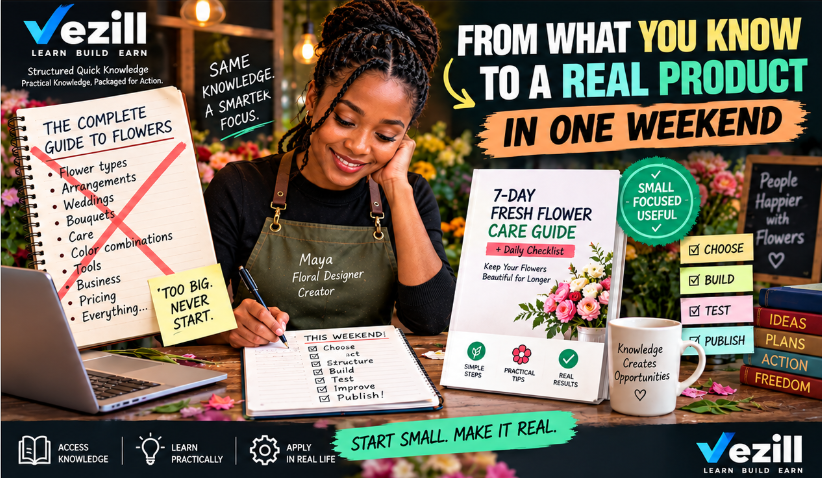
how to create your first knowledge product in one weekend
By Davie
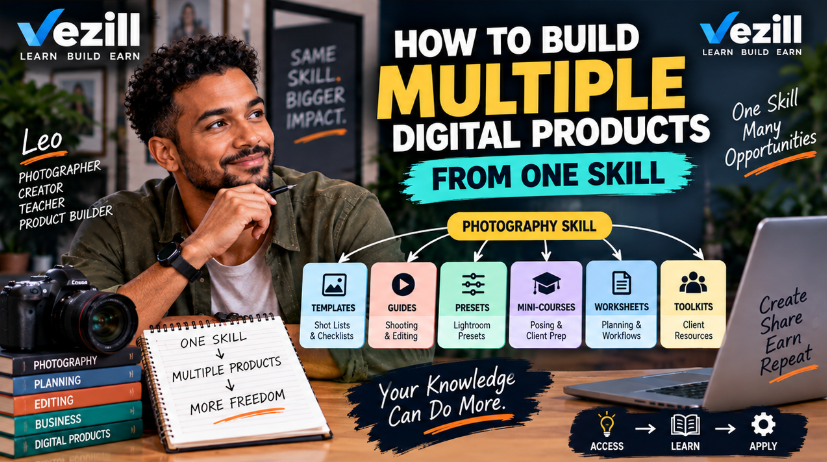
how to build multiple digital products from one skill
By Davie

how to find problems people will pay you to solve
By Davie

How to turn a hobby into a digital product
By Davie
Get the updates, on newly released, popular & fast-moving MRR digital products
Up to Top