
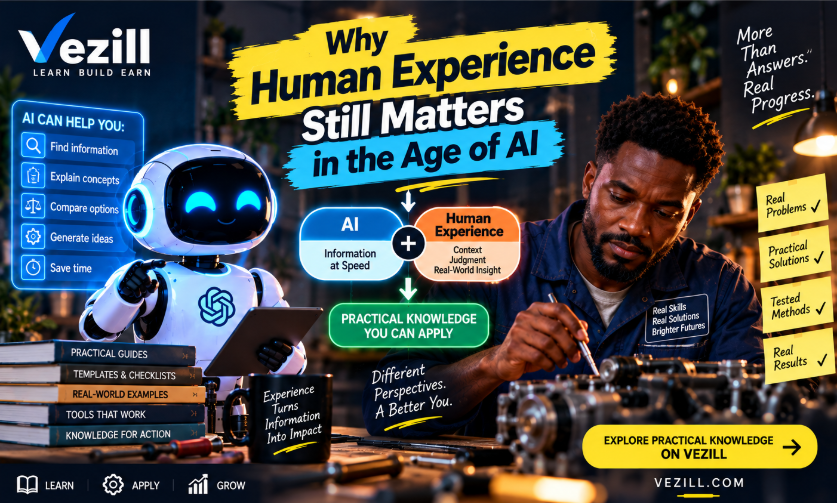
AI can make answers abundant. Experience still matters because real work requires context, pattern recognition, failure knowledge, trade-offs and judgment—not only access to information.
A new mechanic and an experienced mechanic can both access Google, YouTube, repair manuals, diagnostic software, AI assistants and technical documentation. Both can ask: “Why is this engine making a knocking sound?”
AI can return a list of plausible causes. A manual can provide specifications. A video can demonstrate common repairs. But an experienced mechanic may start somewhere different: When did the noise begin? Does it change when the engine warms? Does it get louder under load? Was the oil recently changed? Is the sound actually coming from the engine? What repairs happened before the noise appeared? What does the oil-pressure reading show?
The difference is not simply “human knows, AI does not.” AI can surface many of those same diagnostic questions. The important point is that experience changes which questions get asked, which signals get attention and which possibilities get ruled out first.
INFORMATION GIVES YOU POSSIBILITIES.
EXPERIENCE HELPS YOU NAVIGATE THEM. QUICK ANSWER
Human experience still matters in the age of AI because many real-world tasks require more than retrieving information. Experience can contribute pattern recognition, context, judgment, tested processes, knowledge of failure modes and an understanding of when standard advice does not fit the situation. AI can make expertise easier to access, explain, organize and adapt, but it does not automatically make every answer reliable or remove the value of lessons learned through repeated practice.
AI DOES NOT MAKE EXPERIENCE OBSOLETE.
IT CHANGES HOW EXPERIENCE CAN BE CAPTURED, SHARED AND USED.
Before the web, access to information was often the bottleneck. You needed the right book, teacher, colleague, library, manual or institution. Search engines changed that by making enormous amounts of information discoverable. Generative AI changes the interface again: instead of only locating pages, it can explain, summarize, compare and answer follow-up questions.
As answers become easier to obtain, a different bottleneck appears. Which answer applies? Which source is current? Which assumption matters? Which instruction should come first? When should a general rule be ignored because the situation is unusual?
ACCESS TO INFORMATION → SELECTION → CONTEXT → TRUST → APPLICATION → JUDGMENT
This is an explanatory argument, not a universal economic law. But it helps explain why practical expertise does not automatically lose value when information becomes abundant. In many fields, the hard part was never only knowing a fact. It was knowing which fact matters now.
WHEN INFORMATION BECOMES CHEAPER, KNOWING WHAT INFORMATION MATTERS CAN BECOME MORE VALUABLE.
Consider baking. Information might say, “Bake at 180°C.” Instruction might say, “Bake for approximately 35 minutes.” Experience notices that this batter is wetter than usual, the tin is deeper and this oven runs hot, so checking earlier may prevent overbaking.
Consider advertising. Information says CTR is clicks divided by impressions. A generic instruction says to improve the creative. Experience may say: before changing the creative, check whether the tracking, offer, audience, landing page or simply insufficient data is actually the bottleneck.
Consider a plant with yellow leaves. A simplistic instruction says to add fertilizer. Experience asks whether the cause could instead be watering, roots, pests, soil conditions, disease or normal aging.
EXPERIENCE OFTEN CHANGES THE DECISION BEFORE IT CHANGES THE ANSWER.
 The answer is not always the decision; real-world application adds context and judgment.
A useful way to describe the value of practical experience is through six recurring contributions. This is an original VEZILL explanatory framework, not a scientifically validated model of expertise.
1 · PATTERN
Have I seen something like this before?
2 · CONTEXT
What is different about this situation?
3 · SEQUENCE
What should be checked first?
4 · FAILURE
How does this usually go wrong?
5 · TRADE-OFF
What do we gain and lose with each option?
6 · JUDGMENT
Which option fits this situation best?
Research on expertise has long treated experience and tacit knowledge as important parts of how experts recognize and act on situations. At the same time, expertise is multifactorial: practice matters, but research does not support reducing expert performance to one simple rule such as “10,000 hours.” A 2020 review argues for a broader, multifactorial view of expertise rather than attributing expert performance to deliberate practice alone.
See the peer-reviewed review of deliberate practice and expertise for that qualification.
EXPERIENCE IS NOT JUST MEMORY. IT CAN BECOME MEMORY ORGANIZED AROUND CONSEQUENCES.
That line is a VEZILL editorial interpretation, not a formal scientific definition. The idea is that repeated exposure becomes useful when the practitioner learns what signals predict trouble, what sequence reduces risk and what outcome should follow a decision.
 Pattern, context, failure and judgment are practical ways to think about what repeated experience can contribute.
Tacit knowledge is useful here, but it is often oversimplified. In practical terms, it refers to knowledge that may be procedural, experience-based or difficult to completely express as explicit rules. Research on practical intelligence has described tacit knowledge as knowledge acquired through everyday experience that is often unspoken yet useful for solving real problems.
A study on practical intelligence conducted in Kenya described tacit knowledge as procedural and practically useful, while also noting that it can sometimes be made explicit with effort. Read the research summary.
Examples are familiar: how tight a fitting “feels,” when dough has the right consistency, when a client’s hesitation signals a hidden objection, when an interview answer is becoming too long, whether a layout feels visually unbalanced, or whether a machine sound is ordinary or unusual.
None of this needs mystical framing. Tacit knowledge can often be made more teachable through demonstration, measurement, examples, video, simulations, checklists, decision trees, better documentation, sensors and AI-supported explanation.
THE FACT THAT KNOWLEDGE IS TACIT DOES NOT MEAN IT CAN NEVER BE TAUGHT.
IT MEANS TEACHING IT MAY REQUIRE MORE THAN A PARAGRAPH.
AI does not merely compete with expertise. It can amplify it. An experienced person can use AI to organize scattered notes, draft a process, turn a workflow into a checklist, produce beginner explanations, create practice scenarios, generate FAQs, compare variants and identify gaps in documentation.
THE PERSON BRINGS THE EXPERIENCE.
AI CAN HELP TURN THAT EXPERIENCE INTO A RESOURCE.
This creates a new possibility for knowledge transfer. A practitioner who is excellent at the work but weak at writing can use AI to create a first structure. A trainer can turn field notes into examples. A small-business owner can document recurring procedures. A farmer can organize a seasonal checklist. A software specialist can convert repeated troubleshooting into a decision tree.
The important quality boundary is provenance. AI should not be asked to invent experience the creator never had. It should help clarify, structure and test the communication of experience that genuinely exists.
AI CAN HELP EXPERTS PACKAGE WHAT THEY KNOW.
Anyone can now generate a generic blog post, ebook, checklist, tutorial or template in minutes. That reduces the cost of producing text. It does not automatically create original experience, original data, proven workflows, reliable local context or an understanding of what actually fails in practice.
AI CAN LOWER THE COST OF PRODUCING CONTENT.
IT DOES NOT AUTOMATICALLY LOWER THE COST OF ACQUIRING EXPERIENCE.
Imagine asking AI for “a guide to running a restaurant.” It can produce a useful structure. Now compare that with a guide built by someone who has opened restaurants, hired staff, negotiated with suppliers, controlled food costs, dealt with waste, survived slow days, handled customer complaints, trained cooks and made expensive mistakes. AI can help package those lessons—but the provenance of the source material is different.
As generic information becomes easier to generate, buyers may have stronger reasons to look for identifiable experience, original examples, evidence, tested tools, transparent limitations and clear context.
YEARS OF EXPERIENCE ARE NOT AUTOMATICALLY YEARS OF LEARNING.
A person can repeat the same weak process for twenty years. Time spent in a role is not identical to improvement. Experience becomes more valuable when it is paired with feedback, reflection, measurement, updated knowledge, evidence, correction and deliberate attempts to improve.
EXPERIENCE + FEEDBACK + REFLECTION + EVIDENCE → BETTER PRACTICAL JUDGMENT
This is also why newer practitioners can sometimes outperform veterans. They may use better tools, more current evidence, stronger feedback loops or more deliberate practice. Experience deserves respect when it produces useful learning—not simply because it is old.
It would be inaccurate to say AI has no access to experience. AI systems can learn patterns from large bodies of human-produced material containing expert explanations, case studies, manuals, research, code, documentation, troubleshooting discussions and examples. When connected to search or retrieval, they can also synthesize current published sources.
The user therefore faces a provenance problem rather than a simplistic human-versus-machine problem. Whose knowledge is represented? How current is it? Does the answer match this context? What evidence supports it? Has an important source been omitted?
Human–AI collaboration research reinforces the need for nuance. A 2024 meta-analysis of 106 experiments found that human–AI combinations were not automatically superior to the better of humans or AI alone; outcomes varied by task, with gains in some creative settings and losses in some decision settings.
Read the Nature Human Behaviour systematic review and meta-analysis for the underlying findings.
Human experience can be wrong. “I have always done it this way” is not proof that a method is optimal, safe or current. Anecdotes do not automatically outweigh controlled research, measurements, current standards, regulations or large datasets.
EXPERIENCE SHOULD INFORM EVIDENCE—not automatically override it.
In medicine, clinical experience matters, but evidence and current guidelines matter too. In agriculture, a farmer’s observation of local conditions can be invaluable, while soil testing, weather data and agronomic research can correct misleading impressions. In marketing, a practitioner may recognize a familiar pattern, but campaign data should confirm whether the pattern actually exists in this account.
The strongest practical knowledge often combines evidence with experience: evidence establishes what is broadly supported; experience helps interpret what that evidence means in a particular situation.
THE STRONGEST PRACTICAL KNOWLEDGE OFTEN COMBINES EVIDENCE WITH EXPERIENCE.
KNOW WHAT
Facts and definitions.
KNOW HOW
Procedure and technique.
KNOW WHEN
Context and timing.
KNOW WHY / WHY NOT
Judgment, trade-offs and limits.
AI is making “know what” dramatically easier to access. It can also be useful for “know how,” “know when” and “know why” where enough context and source material exist. The consequence is not that the deeper layers disappear. It is that resources capturing process, conditions, exceptions and reasoning become more useful than resources that merely repeat facts.
Experts often know not only how to perform the normal process but how that process fails. A web developer knows which plugin combinations commonly break, what should be backed up before an update and which error message looks more catastrophic than it is. A cook knows what overmixed batter looks like and when adding more flour will make the problem worse.
A marketer may recognize that poor performance is not yet a creative problem because there is insufficient data, broken tracking or a weak offer. A farmer may recognize that one visible symptom can have several plausible causes and that treating the wrong cause can make the problem worse.
FAILURE IS DATA TOO.
This is one of the strongest reasons practical guides should include troubleshooting, warnings and checkpoints. A perfect happy-path tutorial teaches the process only under ideal conditions. Real work requires knowing what to do when reality diverges from the example.
GOOD PRACTICAL KNOWLEDGE TEACHES BOTH THE PATH AND THE PITFALLS.
Mistakes do not automatically create wisdom. They become valuable when they are observed, understood, corrected and translated into a better process.
MISTAKE → FEEDBACK → LESSON → PROCESS → PRACTICAL KNOWLEDGE
That matters because the point of packaged knowledge is not to glorify failure. It is to help another person avoid unnecessary failure. A creator can say: “Here is the step I skipped, here is what happened, here is how I now verify it, and here is the checkpoint you should use.”
YOU DO NOT NEED TO MAKE EVERY MISTAKE YOURSELF TO LEARN FROM EXPERIENCE.
A useful guide can compress some of the lessons produced by years of experience. It cannot give the buyer five years of mastery in twenty pages. It can, however, identify the mistakes worth avoiding, the process worth following, the checklist worth keeping, the formula worth using, the questions worth asking and the signals worth watching.
A GUIDE CANNOT GIVE YOU SOMEONE ELSE'S YEARS OF EXPERIENCE.
BUT IT CAN GIVE YOU ACCESS TO SOME OF THE LESSONS THOSE YEARS PRODUCED.
This is a healthier promise than “become an expert overnight.” Practical knowledge shortens unnecessary searching and avoidable trial-and-error. It does not erase the need for practice where competence itself requires practice.
That distinction fits VEZILL’s current explanation of Quick Knowledge vs online courses: focused knowledge can solve a narrow task, while repeated skills and professional capability require deeper learning, practice and experience.
 Experience can produce lessons that are documented and transferred without pretending mastery itself can be downloaded.
These examples are not claims that experience always wins. They show how the useful contribution changes by field and consequence.
| Field | AI Can Help With | Experience Adds | Best Combination |
|---|---|---|---|
| Cooking | Explain techniques and substitutions | Recognizes texture, heat behavior and timing cues | Recipe + AI + sensory checks |
| Baking | Calculate ratios and explain chemistry | Recognizes batter consistency and oven behavior | Guide + measurements + experience |
| Farming | Summarize crop requirements | Reads local weather, pests and field variation | Agronomy + local observation + data |
| Plumbing | Explain components and simple faults | Recognizes hidden causes from symptoms | Guide for low-risk tasks; technician when needed |
| Electrical work | Explain concepts | Understands site conditions and hazards | Official standards + qualified professional |
| Carpentry | Plan cuts and measurements | Anticipates material movement and tool behavior | Plans + demonstrations + hands-on practice |
| Mechanics | List possible causes | Prioritizes likely faults from sound, history and measurements | Diagnostics + manuals + experienced technician |
| Software development | Explain code and generate examples | Recognizes architectural trade-offs and failure patterns | AI + tests + code review |
| Cybersecurity | Explain controls and attack concepts | Recognizes operational risk and incident context | AI + standards + specialist judgment |
| Data analysis | Generate code and explain methods | Spots bad assumptions, leakage and misleading metrics | AI + statistical checks + domain knowledge |
| Graphic design | Generate concepts and critique | Recognizes hierarchy, balance and audience fit | AI ideation + human design judgment |
| Video editing | Suggest structure and effects | Feels pacing, timing and emotional rhythm | AI assistance + editor judgment |
| Photography | Explain exposure and composition | Reads changing light and anticipates moments | Technical guidance + practice |
| Marketing | Generate ideas and frameworks | Distinguishes symptom from actual bottleneck | AI + customer data + practitioner judgment |
| SEO | Explain concepts and audit patterns | Recognizes site-specific technical and content interactions | Official docs + tools + experience |
| Facebook Ads | Generate hypotheses and copy | Judges when data is insufficient and where funnel fails | AI + platform data + marketer |
| Google Ads | Suggest keywords and structure | Understands intent, tracking and account economics | AI + platform data + specialist |
| Sales | Draft scripts and objections | Reads timing, hesitation and stakeholder dynamics | AI practice + salesperson experience |
| Customer service | Draft replies and SOPs | Recognizes emotion, escalation risk and policy boundaries | AI + policy + experienced support |
| Negotiation | Generate options and role-play | Reads leverage, timing and relationship costs | AI preparation + human judgment |
| Hiring | Draft questions and scorecards | Recognizes role fit and weak evidence | Structured process + trained interviewers |
| Management | Summarize frameworks | Balances people, incentives and organizational history | AI + leadership experience + feedback |
| Accounting | Explain principles and templates | Recognizes classification, controls and exceptions | Software + standards + accountant |
| Bookkeeping | Create categories and trackers | Understands real transaction patterns and reconciliation | Template + local workflow |
| Tax | Explain terminology | Knows jurisdictional rules and documentation realities | Official authority + qualified professional |
| Investing | Explain products and scenarios | Understands risk behavior and market context | Education + regulated advice where applicable |
| Entrepreneurship | Generate business models | Knows customers, cash constraints and execution friction | AI + field testing + founder experience |
| Ecommerce | Draft listings and funnels | Recognizes operational issues in fulfillment and returns | AI + platform data + operator experience |
| Logistics | Suggest routing logic | Understands delays, handoffs and local constraints | Systems + operational experience |
| Construction | Explain methods and planning | Recognizes site conditions, sequencing and safety risks | Plans + standards + professionals |
| Healthcare | Explain terminology | Integrates history, examination and clinical context | AI education + clinician |
| Fitness | Explain exercises and programming | Adjusts to technique, recovery and injury constraints | AI + coach / clinician where needed |
| Law | Explain general concepts | Interprets facts, jurisdiction and procedural strategy | AI education + lawyer for real matters |
| Teaching | Generate examples and quizzes | Reads confusion, pacing and misconceptions | AI tools + teacher judgment |
| Research | Summarize literature and methods | Recognizes weak designs, missing variables and field context | AI + primary literature + researcher |
| Writing | Draft, edit and brainstorm | Understands voice, audience and lived specificity | AI + author judgment |
| Public speaking | Generate outlines and practice questions | Reads room energy, timing and delivery | AI rehearsal + live feedback |
| Project management | Generate plans and risk lists | Understands dependencies, politics and team capacity | AI + team data + PM experience |
| UX design | Generate flows and copy | Recognizes user behavior and research nuance | AI + user research + designer |
| AI workflows | Design prompts and automations | Recognizes privacy, reliability and operational failure modes | AI + testing + process owner |
Not every question needs an expert. Simple unit conversion, spelling correction, straightforward definitions, text reformatting, basic brainstorming, summarizing supplied text, a simple formula explanation and other low-risk reversible tasks often do not benefit much from deep experience.
NOT EVERY QUESTION NEEDS AN EXPERT.
The purpose of arguing for experience is not to make expertise a gate around ordinary knowledge. It is to match the source to the task. If the answer is easy to verify and the consequence is low, AI or a simple reference may be perfectly adequate.
Experience becomes especially valuable when the situation contains ambiguity, incomplete information, unusual conditions, multiple plausible causes, competing objectives, significant consequences, repeated workflows, human behavior, local context, exceptions or troubleshooting.
THE MORE REALITY DEVIATES FROM THE TEXTBOOK, THE MORE CONTEXT AND JUDGMENT MAY MATTER.
This is also why professional environments often rely on escalation. Standard cases follow the normal procedure. Unusual cases move to someone with deeper context, responsibility or experience. AI can participate in both layers, but the governance around its use should change as consequence rises.
A global AI answer may explain tomato production accurately in general terms. A Kenyan farmer may still need local knowledge about rainfall, altitude, soil, pest pressure, input availability, market timing and local regulations. The relevant context can differ between Kiambu, Nakuru, Machakos, Kisumu and other regions.
For small businesses, generic advice might say “accept digital payments.” In Kenya, practical execution may involve M-PESA, till or paybill workflows, transaction reconciliation, customer habits and local record keeping. The general principle transfers; the operational details do not always transfer automatically.
The same is true for employment and importing. Generic CV advice may need adaptation to the employer, role and sector. Generic import guidance may fail if it ignores Kenyan customs, taxes, product requirements, logistics and supplier realities.
GLOBAL KNOWLEDGE BECOMES MORE USEFUL WHEN IT MEETS LOCAL EXPERIENCE.
Local experience should not be treated as superior to official information by default. Regulation, tax, safety and formal requirements should still be checked against the responsible authority.
If you know how to repair something, cook something, run a process, use software, manage a business task, build something, calculate something, market something, design something, grow something or troubleshoot something, AI does not automatically make that knowledge worthless. It may make it easier to package.
DO NOT ASK AI TO INVENT YOUR EXPERIENCE.
USE AI TO HELP ORGANIZE THE EXPERIENCE YOU ACTUALLY HAVE.
A practical creator workflow can look like this: choose one task you repeatedly perform; define the outcome; document the process; record common mistakes; record exceptions; add examples; add tools, templates or checklists; verify important claims; use AI to organize and clarify the material; then package the result for the right audience.
VEZILL’s article on identifying valuable knowledge you already have already frames useful knowledge around repeated problems, questions, mistakes, improved processes and explainable outcomes. That is a stronger starting point than asking AI to invent a niche and fill it with generic content.
WHAT I DO → WHAT I HAVE LEARNED → WHAT BEGINNERS STRUGGLE WITH → MY PROCESS → MY MISTAKES → MY TOOLS → MY EXAMPLES → PRACTICAL KNOWLEDGE → GUIDE / TEMPLATE / CHECKLIST / TUTORIAL / TOOLKIT
The creator is not selling “experience” as an abstract badge. They are converting useful lessons from experience into a form another person can understand and apply. The quality test remains the same: does the resource genuinely help a defined person complete a task, solve a problem or avoid a mistake?
If the task itself is still unclear, VEZILL’s practical knowledge search framework starts with the question: “What are you trying to do?”
VEZILL’s current About page positions the platform around Quick Knowledge: focused practical knowledge for specific tasks, problems and outcomes. Its public examples include guides, templates, spreadsheets, calculators, prompts, tutorials, checklists and toolkits. The VEZILL FAQ similarly describes it as a global digital knowledge marketplace connecting people who know how with people who need to know how.
That creates a clear role in an AI-rich world. The internet is full of information. AI makes that information easier to query and reorganize. Human work still produces lessons, workflows, mistakes, examples and practical judgment that may not yet be organized for others to use.
EXPERIENCE → PRACTICAL KNOWLEDGE → DIGITAL RESOURCE → APPLICATION
VEZILL does not need to claim that every resource is expert-created or universally correct. The stronger position is that VEZILL provides a marketplace and format for practical knowledge. Buyers still evaluate the creator, evidence, freshness, scope, limitations and task fit.
AI CAN HELP YOU ASK.
EXPERIENCE CAN HELP PROVIDE THE LESSON.
VEZILL CAN HELP PACKAGE AND DISCOVER PRACTICAL KNOWLEDGE.
Creators can use VEZILL to think in terms of useful knowledge rather than content volume, while buyers can browse VEZILL products for practical resources relevant to the task in front of them.
The deeper model is cyclical. Experience produces lessons. Lessons can become practical knowledge. Practical knowledge can be packaged and discovered. A learner applies it, gets a result, and creates new experience of their own.
HUMAN EXPERIENCE → LESSONS → PRACTICAL KNOWLEDGE → PACKAGE → VEZILL → DISCOVERY → LEARN → APPLY → RESULT → NEW EXPERIENCE
This is a VEZILL explanatory model rather than a scientific theory of learning. Its purpose is to show why a knowledge marketplace can still matter in an era of generative AI: the marketplace can help lessons move from one person’s experience into another person’s application.
EXPERIENCE CREATES KNOWLEDGE.
KNOWLEDGE ENABLES ACTION.
ACTION CREATES NEW EXPERIENCE.
 Experience can be turned into practical knowledge, discovered, applied and turned into new experience.
Because many real-world tasks require context, pattern recognition, failure knowledge, trade-offs and judgment in addition to information.
AI can automate or augment parts of some expert tasks, but whether it can substitute for expertise depends on the task, available context, evidence, accountability and consequences.
AI may synthesize more information than one person, while an expert may have deeper task-specific context, experience and responsibility. The answer depends on the domain and task.
Experiential knowledge is understanding developed through doing, observing outcomes, receiving feedback and learning from repeated situations.
Tacit knowledge is knowledge that can be difficult to fully express as explicit rules and is often acquired through practice, participation or repeated exposure.
AI can learn patterns from human-produced data and can synthesize expert material in training data, retrieved sources and user-provided context.
Some routine knowledge tasks may become less scarce, while expertise grounded in original experience, evidence, context, judgment and responsibility can remain highly valuable.
Skills involving problem definition, judgment, evidence evaluation, communication, domain knowledge, feedback, creativity, coordination and responsible application remain useful alongside AI.
Experts can use AI to document workflows, organize notes, create drafts, generate examples, build FAQs, translate terminology and make practical knowledge easier to teach.
AI can help structure, edit and clarify your real experience, but it should not invent experience, results or expertise that you do not have.
Start with a repeated task or problem, document your process, mistakes, exceptions, examples and tools, verify important claims, then package the lessons around a specific outcome.
VEZILL is a digital knowledge marketplace where creators can package legitimate know-how and buyers can discover practical digital resources, depending on available listings.
THE BIG IDEA
AI changes the economics of information. It can make answers faster to find, explanations easier to understand and expertise easier to package. But real-world knowledge is not created only by reading information. It is also created by doing, observing, testing, failing, correcting and refining.
AI CAN HELP US ACCESS KNOWLEDGE.
EXPERIENCE CAN HELP CREATE KNOWLEDGE WORTH ACCESSING. EXPERIENCE → LESSON → PRACTICAL KNOWLEDGE → APPLICATION → RESULT
The opportunity in the age of AI is not to choose between artificial intelligence and human experience. It is to use AI to make valuable human knowledge easier to capture, organize, discover and apply.
FIND KNOWLEDGE YOU CAN APPLY ON VEZILL → VEZILL — Practical Knowledge, Packaged for Action.
Discover more articles you might be interested in

how to create your first knowledge product in one weekend
By Davie

how to build multiple digital products from one skill
By Davie

how to find problems people will pay you to solve
By Davie

How to turn a hobby into a digital product
By Davie
Get the updates, on newly released, popular & fast-moving MRR digital products
Up to Top