
Quick Knowledge is a practical way to learn the smallest reliable set of ideas and steps needed to complete a specific task, solve an immediate problem or make the next useful decision—without first studying an entire subject. It is not a shortcut to expertise. It is a way to match the depth of learning to the problem in front of you.
Imagine you need to create a professional invoice today. One path is to search for a complete accounting course and work through bookkeeping, financial statements, taxation, cash flow, auditing and accounting software before you send the invoice. That may eventually be useful—but it is much broader than the problem you need to solve right now.
The more focused question is: What information must I understand to create a correct invoice for this situation, where should I verify it, and how will I check that I did it properly?
That is the idea behind Quick Knowledge.
Quick Knowledge is a focused way of learning only the information needed to complete a specific task, solve an immediate problem or make a practical decision. Instead of studying an entire subject first, you identify the outcome you need, learn the smallest reliable set of concepts and steps required, apply them immediately, verify the result and deepen your knowledge when the task becomes more complex or higher-risk.
NEED → LEARN → APPLY → VERIFY → EXPAND
Quick Knowledge is not an established academic theory with one universally accepted definition. In this article, VEZILL uses the phrase as a practical reader-friendly framework. It overlaps with established ideas such as just-in-time learning, microlearning, performance support, self-directed learning and task-based learning, but it is not identical to any one of them.
It also fits a pattern already visible in VEZILL's article on what you can realistically learn in 30 days: narrow outcomes are easier to practise and prove than vague goals such as “learn everything about digital marketing.”
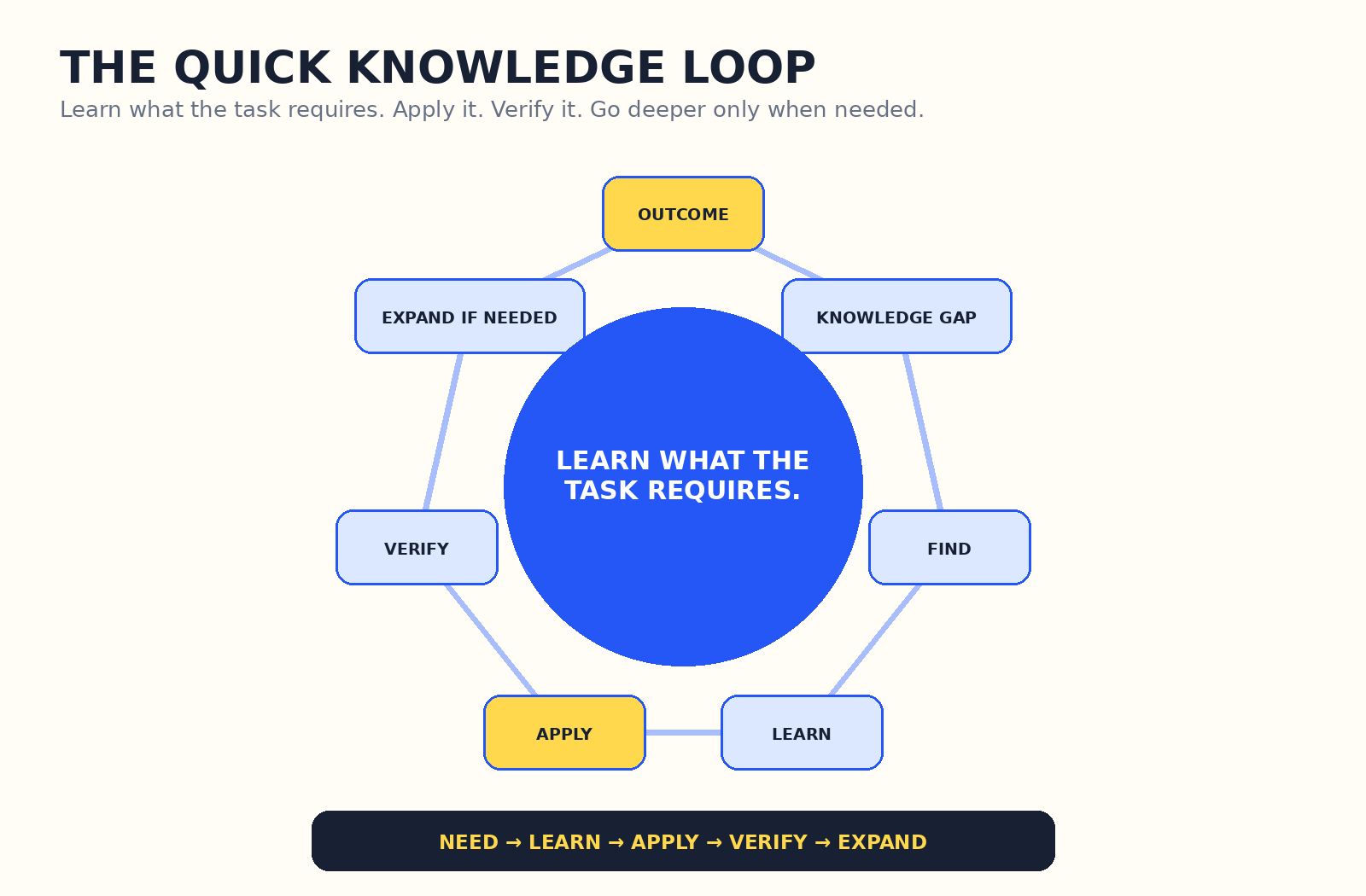 The Quick Knowledge Loop: define the outcome, close the exact gap, apply what you learn and verify the result.
Quick does not necessarily mean five minutes. It does not mean easy, superficial, effortless or instantly mastered.
It means the learning scope is deliberately narrow. You remove information that does not help the immediate task, find a reliable learning unit, use it quickly and then decide whether you need a deeper layer.
A person learning one Excel formula may need ten minutes. Someone configuring DNS may need an hour, documentation and careful checking. A person responsible for tax compliance may need professional advice and much broader knowledge. The method adapts to the consequence of the task.
Do not learn less. Learn at the depth the problem requires.
What exactly are you trying to do? “Learn Canva” is broad. “Export an Instagram carousel at the correct size without losing image quality” is specific.
What is stopping you? Is it one setting, one concept, one formula, one process or one decision?
That might be official documentation, a short guide, an expert explanation, a worked example, a template, a checklist, a short course or an AI-assisted explanation.
Understand enough to know what you are doing rather than merely copying steps blindly.
Use the knowledge on the actual task while the explanation is still fresh.
Check whether the result works, whether it matches authoritative requirements and whether you understand why it worked.
If the task becomes recurring, more complex or higher-risk, learn the next layer rather than pretending the first explanation made you an expert.
OUTCOME → GAP → LEARN → APPLY → VERIFY → EXPAND
Quick Knowledge makes more sense when you separate three levels of learning.
“I need to do this.” Examples: compress a PDF, create one invoice, remove an image background, use one Excel formula or schedule one social post. Focused learning often works well here.
“I need to do this repeatedly and understand why it works.” Examples: managing business finances, running social-media campaigns, analysing datasets, maintaining a website or producing client reports. This requires broader understanding and repeated practice.
“I am responsible for important outcomes.” Cybersecurity, accounting, healthcare, law, engineering, complex software systems and high-consequence financial decisions usually demand structured learning, practice, verification, standards and sometimes formal qualifications.
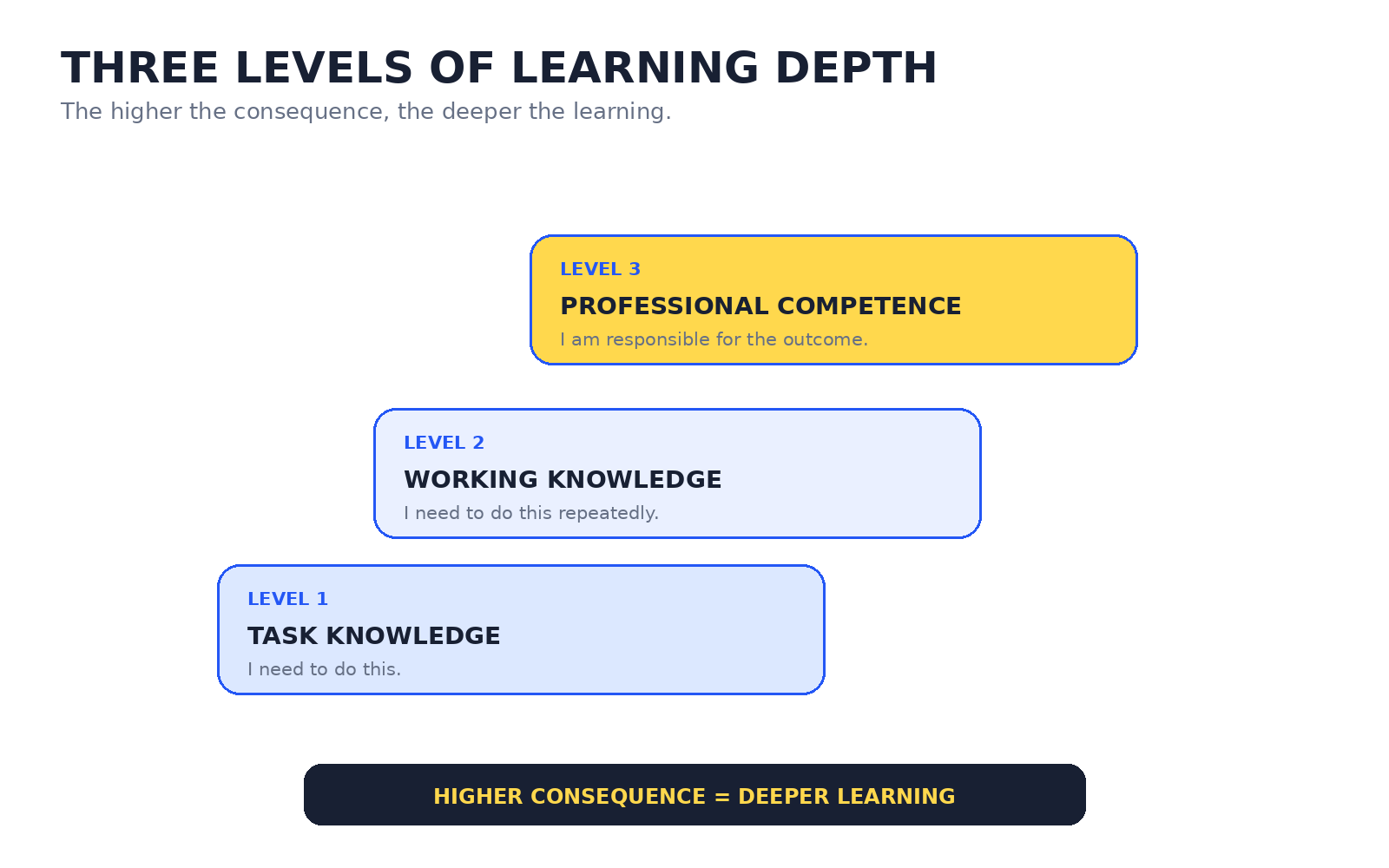 Quick Knowledge is strongest for narrow tasks; deeper responsibility requires deeper competence.
| Concept | Main Idea | Typical Use |
|---|---|---|
| Quick Knowledge | Learn what is necessary for one immediate outcome. | Solve or perform something now. |
| Microlearning | Deliver learning in small, focused units. | Training, reinforcement and bite-sized learning. |
| Just-in-Time Learning | Access learning close to the moment it is needed. | Workplace and task support. |
| Traditional Course | Structured progression across a broader subject. | Building comprehensive competence. |
| Tutorial | Shows how to perform a task. | Specific procedure. |
| Documentation | Authoritative instructions or specifications. | Technical reference. |
| AI Assistance | Interactive explanation, adaptation and questioning. | Clarification and guided support. |
These approaches overlap. A five-minute microlearning lesson can provide Quick Knowledge. A documentation page can provide just-in-time support. An AI tutor can help you understand one concept or work through a broad course. The difference is the purpose.
| Traditional Path | Quick Knowledge Path |
|---|---|
| Choose a subject | Define a task |
| Find a comprehensive course | Find the required knowledge |
| Learn many concepts | Learn the relevant concepts |
| Practice later | Apply immediately |
| Finish curriculum | Verify outcome |
| Eventually use knowledge | Expand only when needed |
Traditional learning is not bad. It is designed for a different objective.
QUICK KNOWLEDGE OPTIMIZES FOR IMMEDIATE APPLICATION.
STRUCTURED LEARNING OPTIMIZES FOR BROADER COMPETENCE.
Both can coexist. If the narrow task becomes something you perform every day, that is often the signal to move into deeper learning.
Choose deeper structured learning when knowledge is cumulative, foundational concepts matter, repeated practice is necessary, professional standards apply, certification is required, errors could be dangerous or your goal is long-term mastery.
If you discover a narrow skill and decide you want to turn it into a business, VEZILL's article on skills you can learn online and turn into a business explains the next step: connecting skill → problem → customer → offer → proof.
Searchable documentation, video tutorials, digital guides, online communities, AI assistants and multimodal tools have reduced the distance between a question and a usable explanation.
Historically, a learner might search a broad topic, open many pages, compare explanations and try to infer the correct next step. Today, an AI assistant can often clarify the exact question, explain it at the learner's level, generate an example and answer follow-up questions.
OpenAI's current Study Mode, for example, is designed to guide learners with questions, explain ideas step by step, use uploaded learning materials and check understanding. Google likewise offers Guided Learning in Gemini, using questions and step-by-step support rather than only delivering a final answer. Those features show how interactive learning is becoming more conversational. They do not remove the need for verification or real practice.
Previously, people often searched for the course. Increasingly, they can search for the answer, the next step or the explanation they need right now.
Instead of asking, “Teach me Microsoft Excel,” a learner can ask:
“I have customer names in column A and sales in column B. How do I calculate total sales only for customers from Nairobi? Explain the simplest formula like I am a beginner, then tell me the most common mistake that would make the result wrong.”
This creates a new learning rhythm:
QUESTION → EXPLANATION → EXAMPLE → APPLICATION → FOLLOW-UP
That is powerful because the learner can keep narrowing the explanation around the actual task.
AI can produce outdated instructions, invented facts, incorrect formulas, hallucinated citations, oversimplified legal advice, inaccurate financial guidance or unsafe technical recommendations.
Use the Quick Knowledge Trust Rule:
Verify reasonably. Example: resizing an image.
Check official documentation or another authoritative source.
Use qualified professionals, official sources or structured expertise.
The higher the consequence, the higher the verification standard.
| Task | Complexity | Consequence of Error | Quick Knowledge Appropriate? |
|---|---|---|---|
| Resize an image | Low | Low | Yes |
| Create a spreadsheet formula | Low–Medium | Low–Medium | Usually |
| Configure website DNS | Medium | Medium | Yes, carefully |
| File a business tax return | Medium–High | High | Learn, then verify professionally |
| Diagnose an illness | High | Very High | No as the sole source |
| Configure production cybersecurity | High | Very High | Requires deeper expertise |
These are illustrative judgments, not universal ratings. Complexity depends on context, and professional obligations vary by jurisdiction and role.
Before committing to a large course for an immediate problem, ask seven questions:
The name is a decision filter, not a promise that every task can be learned in 20 minutes.
| Layer | Meaning | Example |
|---|---|---|
| Knowledge | Knowing what. | Understanding how Facebook Ads targeting works. |
| Skill | Being able to perform reliably. | Building and optimizing campaigns. |
| Experience | Recognizing how real situations behave when conditions change. | Diagnosing why a campaign is failing despite apparently good metrics. |
Quick Knowledge can close a knowledge gap. It cannot instantly create experience.
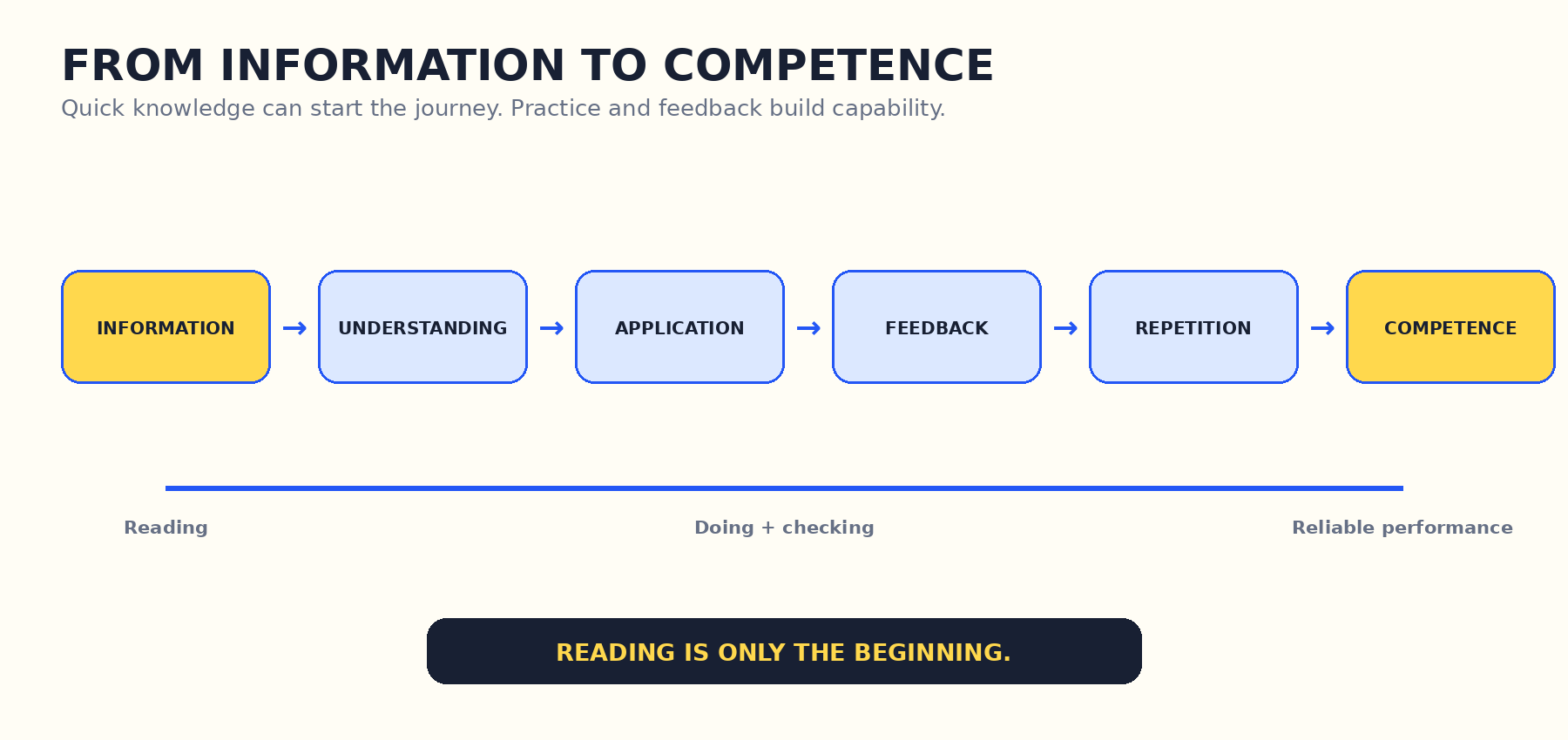 Reading can begin the process; application, feedback and repetition build competence.
INFORMATION → UNDERSTANDING → APPLICATION → FEEDBACK → REPETITION → COMPETENCE
Watching “How to create a PivotTable” is knowledge acquisition. Creating three PivotTables from different datasets is practice. Diagnosing why one table is wrong begins developing deeper skill.
Research on retrieval practice and repeated recall also supports the broader point that one exposure is not the same as durable learning. If you need to retain something, use a cycle such as RETRIEVE → REPEAT → APPLY → REVIEW.
Source quality matters more than source length.
| Source | Best Use |
|---|---|
| Official documentation | Software instructions, rules, specifications and current procedures |
| Expert guides | Explanation and practical context |
| Short courses | Several connected concepts that need structure |
| Video tutorials | Visual procedures and demonstrations |
| Checklists | Repeatable processes |
| Templates | Tasks where structure matters |
| AI assistants | Explanation, adaptation, examples and follow-up questions |
| Communities | Edge cases and lived experience |
Broad search terms create broad learning journeys. Task-specific questions create task-specific knowledge.
Instead of “digital marketing,” search: “How do I create a basic content calendar for a small restaurant?”
Instead of “Excel course,” search: “How do I remove duplicates from one Excel column?”
Instead of “graphic design,” search: “What dimensions should I use for an Instagram carousel?”
This same problem-first logic appears in VEZILL's guide to problems you can solve online and get paid for: useful work becomes clearer when the task and outcome are specific.
I NEED TO [OUTCOME] + USING [TOOL / CONTEXT] + FOR [PURPOSE] + MY OBSTACLE IS [PROBLEM] + EXPLAIN ONLY WHAT I NEED NEXT.
“I need to create a monthly sales dashboard in Google Sheets for a small shop. I already have Date, Product and Sales columns. I do not know how to summarize sales by month. Explain the simplest reliable approach and show me one example.”
The formula reduces ambiguity and helps AI, search engines and human teachers understand what you actually need.
Employees often need narrow knowledge while inside a workflow: one Excel formula, PowerPoint formatting, meeting minutes, invoice setup, calendar scheduling, CRM tasks, report formatting, presentation preparation or basic analytics.
That does not mean workplace capability should be built from random tips. Repeated tasks should eventually become documented processes, broader training and practice.
A freelancer may need to learn proposal structure, client onboarding, invoice setup, discovery questions, project handover, portfolio formatting or reporting before delivering a specific service.
Once those tasks repeat, move from isolated tutorials into a reliable service system. VEZILL's guide on how to package a freelance service shows how to turn a capability into a defined customer, outcome, scope and process. The companion article on problems small businesses pay freelancers to solve can help you decide which knowledge gaps are worth developing into real skills.
An entrepreneur may need to create one landing page, validate one idea, write an offer, analyse a competitor, create a simple spreadsheet, understand customer feedback, configure a payment process or document a basic SOP.
Focused knowledge is especially useful at the experimentation stage because it allows a founder to test a process before committing to a large tool, course or system. VEZILL's digital entrepreneurship with AI guide applies a similar principle: start with a useful customer problem, then choose the technology that helps solve it.
Digital-product creators constantly encounter narrow learning gaps: format an ebook, build a spreadsheet, create a cover, write a product description, validate an idea, build a sales page, make a thumbnail, understand licensing or market a product.
If the issue is product demand rather than creation, start with validating the digital product idea. If the issue is AI-assisted production, VEZILL's digital-product-with-AI workflow explains the broader creation process.
People do not necessarily pay because information is unavailable for free. They often pay for organized usefulness: clarity, sequencing, filtering, examples, templates, convenience, reduced search time and implementation guidance.
The internet may contain 100 fragments of an answer. A useful Quick Knowledge product can organize them into:
HERE IS THE PROBLEM → HERE IS WHAT MATTERS → HERE IS WHAT TO DO → HERE IS AN EXAMPLE → HERE IS A TOOL → HERE IS HOW TO CHECK THE RESULT.
That can become a short guide, checklist, template, mini-course, walkthrough, calculator, workbook, SOP or troubleshooting guide.
If you are exploring product formats, VEZILL's current guide to what you can create and sell online using AI shows how guides, templates, spreadsheets, lessons and tools can be shaped around a customer problem.
ONE NARROW PROBLEM → ONE CLEAR OUTCOME → ESSENTIAL KNOWLEDGE → ACTIONABLE STEPS → EXAMPLE → TOOL / TEMPLATE → VERIFICATION = QUICK KNOWLEDGE PRODUCT
The product does not have to be short simply to satisfy the label. What matters is that every component helps the customer accomplish the intended task.
Solves one clear problem.
Uses reliable information.
Removes unnecessary theory.
Presents steps in a useful order.
Lets the learner act.
Makes abstract ideas concrete.
Shows how to check the result.
Updates time-sensitive material.
AI-generated junk ebooks, copied tutorials, outdated screenshots, shallow summaries, misinformation, fake experts, generic “1,000 prompts” packs and incorrect technical instructions are not improved simply because they are short.
SHORT DOES NOT MEAN USEFUL. FAST DOES NOT MEAN CARELESS.
This is an editorial self-check, not a scientifically validated instrument. Score 1–5 for specificity, accuracy, actionability, source quality, example quality, verification, freshness and risk awareness. Maximum score: 40.
| Score | Interpretation |
|---|---|
| 32–40 | Strong foundation |
| 24–31 | Useful, but review weak areas |
| 16–23 | Significant gaps |
| Below 16 | Weak as a reliable learning resource |
A 30-second TikTok tip, a YouTube Short or a one-line post may be quick content. That does not automatically make it Quick Knowledge.
Quick Knowledge should create three things:
UNDERSTANDING + ACTION + VERIFICATION.
A life hack says, “Try this trick.” Quick Knowledge says, “Here is the minimum reliable understanding needed to do this correctly.”
A focused explanation can help you perform a task today. If you need to retain that knowledge, one exposure is rarely enough.
Use:
RETRIEVE → REPEAT → APPLY → REVIEW
Ask yourself to recall the steps without looking. Perform the task again in a slightly different situation. Check the result. Revisit difficult parts. Quick Knowledge is the entry point; repeated retrieval and application build durability.
Current AI learning tools can provide conversational explanations, adaptive examples, guiding questions, quizzes, document analysis, image-based help and feedback. OpenAI's Study Mode can guide learners through material rather than only returning an answer, and Google's Guided Learning takes a similar step-by-step approach.
These tools are useful because you can ask follow-up questions immediately: “Explain that more simply,” “Give me another example,” “Quiz me,” “What did I misunderstand?”
But AI does not understand every learner perfectly, and it can still be wrong. Use it as a learning assistant, not an unquestionable authority.
A smartphone now combines an AI assistant, browser, video player, notes, PDFs, documentation, screenshots, camera, voice input and cloud storage. That supports a highly practical loop:
QUESTION → LEARN → TRY → SCREENSHOT → ASK → CORRECT → CONTINUE.
The same mobile-first principle applies to creation. A person who learns how to solve a narrow problem from a phone can also turn that knowledge into a useful guide, checklist or tutorial using mobile tools.
Kenya has a large mobile and digital-services ecosystem, and government and industry initiatives continue to emphasize digital skills. The practical value of Quick Knowledge is not that every Kenyan learns the same way; it is that many everyday digital problems can be solved at the point of need using a phone, browser, documentation or learning assistant.
Consider these situations:
For creators interested in local digital products, VEZILL's guide to digital products to sell in Kenya can help with category ideas, but every idea still needs specific validation.
Kenyan examples should not automatically be generalized across Africa. Connectivity, language, education systems, regulations, payments and device usage vary considerably between countries.
Someone may not have time or money for a large course, may only need one immediate capability, may be testing whether they like a field or may need to solve an urgent low-risk problem.
Quick Knowledge can help them start. But if the capability becomes important to their career or responsibilities, deeper structured learning becomes more valuable.
This is where focused learning and formal training complement one another. Quick Knowledge might teach “How do I create one Power BI chart?” A structured data course builds broader analytical competence. It might teach “How do I resize an image correctly?” A graphic-design course develops composition, typography, branding and professional workflows.
Current Inceptor courses provide examples of the deeper-learning side of that escalation. A learner who repeatedly needs marketing skills can explore Digital Marketing; someone moving beyond one chart or spreadsheet task can explore Data Analytics; and someone repeatedly creating visual materials can consider Graphic Design with AI.
The point is not to force every Quick Knowledge task into a course. It is to recognize when the task has become a repeated capability worth developing properly.
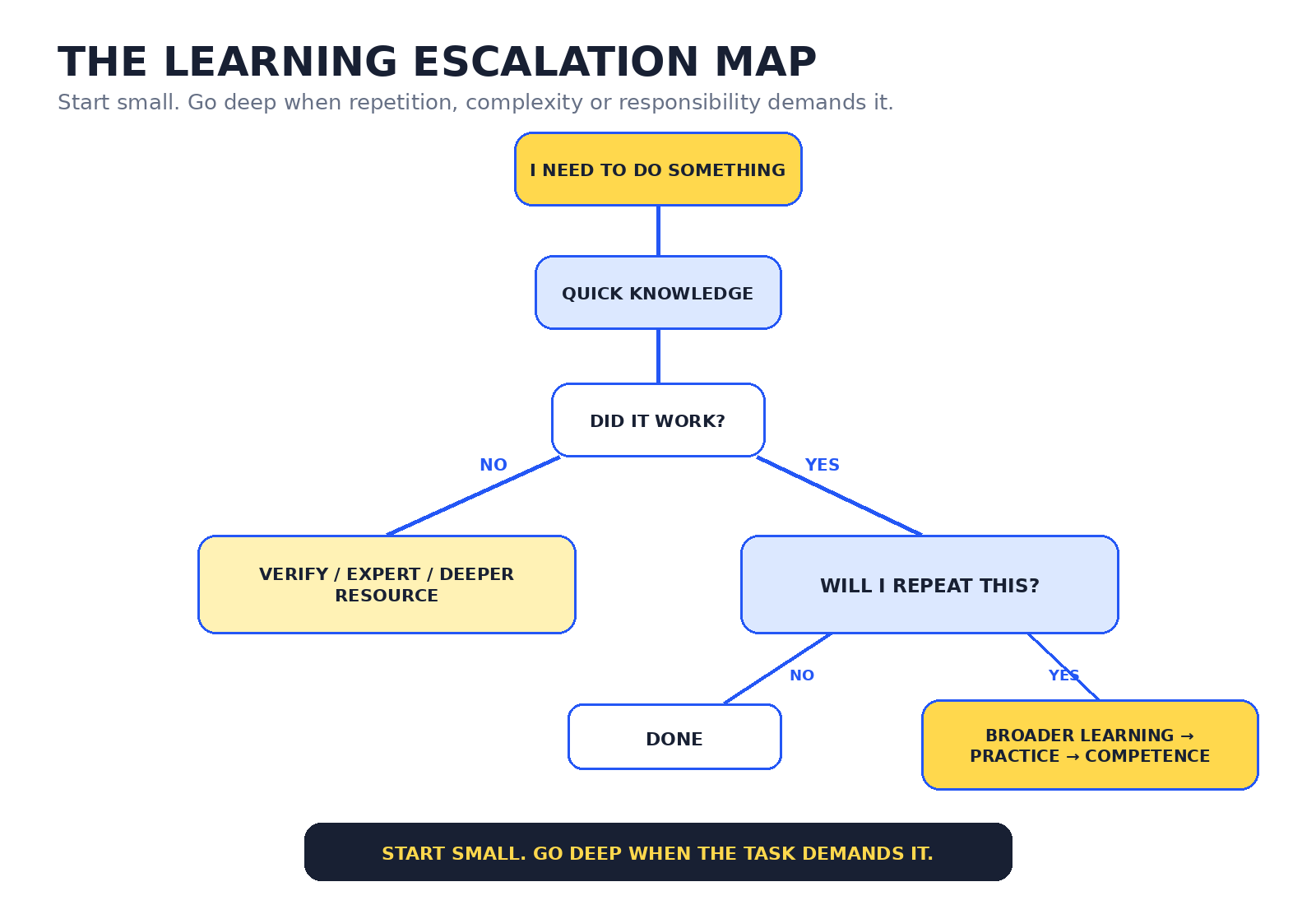 Start small, verify the result and go deeper when repetition, complexity or responsibility demands it.
I NEED TO DO SOMETHING → QUICK KNOWLEDGE → DID IT WORK?
If no, stop and verify. Use a better source, documentation, expert or deeper resource.
If yes, ask: Will I do this repeatedly?
If no, the immediate learning may be enough. If yes, move into broader learning, practice and competence. If the work creates professional responsibility, add the structured training, supervision, certification or mentorship that the role requires.
| Person | Immediate Problem | Quick Knowledge | Verify | Go Deeper When... |
|---|---|---|---|---|
| Freelancer | Needs a proposal | Proposal structure and scope | Compare to client brief | Proposals become a repeated sales process |
| Shop owner | Needs inventory sheet | Basic columns and totals | Test with sample stock | Inventory becomes complex or multi-user |
| Student | Needs Excel formula | One function and example | Check result manually | Analysis becomes recurring |
| Teacher | Needs presentation | Slide layout and export | Preview on classroom device | Instructional design becomes important |
| Digital marketer | Needs campaign tracking | UTM basics and reporting | Test links and analytics | Managing paid budgets |
| Designer | Needs export settings | Correct dimensions and file type | Inspect output | Professional production work |
| Developer | Needs Git command | Command purpose and safe use | Check repository state | Working on production systems |
| Entrepreneur | Needs landing page | Headline, offer, CTA basics | Test page and forms | Conversion optimization matters |
| HR officer | Needs scorecard | Consistent interview criteria | Review against policy | Legal/employment decisions are involved |
| Data analyst | Needs one chart | Chart choice and labels | Compare with source data | Decision-critical analytics |
| Restaurant owner | Needs WhatsApp catalogue | Product setup and media | Test customer view | Order workflow becomes complex |
| Digital-product creator | Needs PDF formatting | Page size, export and readability | Open on phone and desktop | Publishing becomes a regular business process |
WHAT I NEED TO DO
____________________________
WHAT I ALREADY KNOW
____________________________
WHAT I DON'T KNOW
____________________________
SMALLEST QUESTION I CAN ASK
____________________________
BEST SOURCE
____________________________
ACTION
____________________________
HOW I WILL VERIFY IT
____________________________
DO I NEED DEEPER LEARNING? YES / NO
This is an example workflow, not a claim that mastery takes 15 minutes.
If it fails, do not continue guessing.
STOP → VERIFY → ESCALATE
Escalate when instructions conflict, consequences are high, the source is unclear, AI is uncertain, sensitive data is involved or the result differs from what you expected.
One of the strongest ways to deepen Quick Knowledge is to turn it into a small piece of evidence. If you learn how to clean a spreadsheet, clean one. If you learn how to create a presentation, build one. If you learn a basic reporting method, produce a sample report with safe demonstration data.
This turns the learning cycle from “I watched something” into “I can show what I did.” For beginners, that distinction matters. A certificate may show that you completed training, but a relevant project shows how you apply what you learned. VEZILL's guide to building a portfolio when you have no experience explains how small, honest demonstration projects can become useful proof without pretending they were paid client work.
A Quick Knowledge project should stay proportional to your current competence. Do not turn one tutorial into a claim of professional expertise. Label practice work honestly, document your process and identify what you still need to learn.
Focused learning is not always starting from zero. Often you already understand 80% of the situation and need one missing piece.
A restaurant manager who already understands stock movement may only need to learn one spreadsheet formula. A marketer who already understands campaigns may only need to learn a new reporting feature. A designer may understand composition but need the export requirements for a new platform.
This is why auditing what you already know can save learning time. VEZILL's guide to identifying valuable knowledge you already have is useful here: repeated tasks, questions people ask you and mistakes you have learned to avoid can reveal which parts of a subject you already understand and which gaps are actually blocking progress.
When that experience becomes organized and transferable, it may also become a digital resource. VEZILL's article on turning work experience into a digital product explains how to extract a repeatable method while avoiding confidential or employer-owned material.
A good Quick Knowledge resource makes the next action clearer without pretending the real world is simpler than it is. The creator should say what the guide covers, what it does not cover and when the reader needs a more authoritative source.
For example, a guide about creating a simple social-media content calendar can be narrow and practical. It should not quietly expand into unsupported promises about sales growth, advertising law, customer data or brand strategy. A basic AI workflow guide can explain one low-risk process while still warning that customer information, permissions and automation errors require stronger safeguards.
This proportional approach also matches VEZILL's current article on practical AI use for small businesses: AI is most useful when attached to a specific problem and controlled process, not when presented as a replacement for every business skill.
Quick Knowledge is focused, task-specific learning that gives you the reliable information needed to complete one action, solve an immediate problem or take the next step.
No. Microlearning describes small learning units. Quick Knowledge describes the goal of learning only what a specific immediate task requires.
Just-in-time learning means accessing knowledge close to the moment it is needed, often while performing a task.
Sometimes for a narrow low-risk task, but not when broad competence, professional standards, certification or repeated practice are required.
You can often learn a narrow component quickly. Building reliable skill usually requires practice, feedback and repetition.
AI can explain concepts, adapt examples, answer follow-up questions, quiz you and help analyze documents or images, but important information should still be verified.
It can be useful, but AI can make mistakes. Verification should increase with the consequence of the task.
Define one outcome, identify the exact gap, choose a reliable source, apply the knowledge immediately and verify the result.
When the task becomes repeated, complex, cumulative, professionally important or difficult to verify safely from isolated instructions.
Yes. It is particularly useful for narrow workplace tasks such as software functions, document formatting, reporting and simple workflows.
It can help you solve individual setup and operating tasks, but building a business still requires broader skills, customer understanding and repeated execution.
Yes, for appropriate task-specific learning. Students should still follow school requirements and use structured learning for subjects that require cumulative understanding.
You do not always need to learn an entire subject before taking the next useful step. Sometimes you need one reliable piece of knowledge, applied correctly at the right moment. The skill is knowing when that is enough—and when it is time to go deeper.
DEFINE WHAT YOU NEED TO DO → IDENTIFY WHAT YOU NEED TO KNOW → FIND THE SMALLEST RELIABLE LEARNING UNIT → LEARN → APPLY → VERIFY → GO DEEPER WHEN REQUIRED.
Don't learn less. Learn at the depth the problem requires.
Discover more articles you might be interested in

how to sell digital products without a large social media following
By Davie
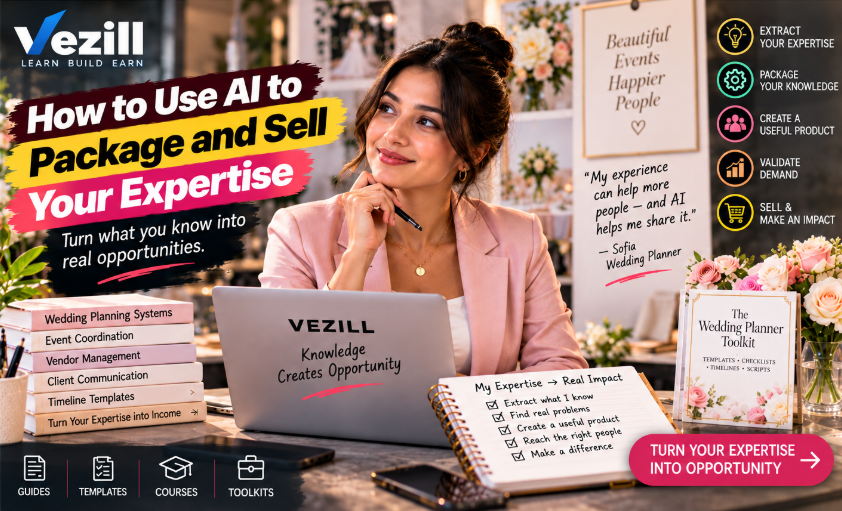
A practical expertise-to-product workflow for extracting what you genuinely know, connecting it to a real problem, packaging it into a useful digital product, validating demand and using AI without inventing proof.
By Davie

how to turn your experience into a digital product
By Davie

Turn What You Know Into Practical Knowledge
By Davie
Get the updates, on newly released, popular & fast-moving MRR digital products
Up to Top
Comments All
Fatuma
@fatuma
Sometimes you just need the right information at the right time instead of spending hours learning everything. Quick knowledge makes sense when you’re trying to solve a specific problem and move on.
September 17,2026 At 05:53 PM