
A beginner opens YouTube and is told they can learn coding, digital marketing, design, copywriting and artificial intelligence in one month—and start earning immediately. The timeline is not the main problem. The goal is. “Learn graphic design” is too broad for 30 days; “create clear social-media posters for local restaurants” is testable. “Become a data analyst” is unrealistic; “clean a sales spreadsheet and build a basic dashboard” is achievable proof.
The right 30-day target is not mastery. It is to learn one narrow capability, practise it, produce evidence and test whether somebody values the result. This article shows what that can look like without pretending that a calendar guarantees a customer.
In 30 days, a committed beginner can build commercially testable ability in Canva-based business design, short-form video editing, social-media content support, virtual assistance, spreadsheet organisation, AI-assisted research, basic no-code landing pages, writing support, simple digital-product creation or online tutoring. “Commercially testable” means you can create an honest sample and offer a small, low-risk result; it does not mean you have mastered a profession or are guaranteed income. The best choice depends on your device, existing knowledge, available practice time, customer access and the consequences of mistakes. Choose one customer group and one narrow outcome. Spend the month learning the essentials, creating three samples, packaging one clear starter offer and showing it to relevant people. A sale is useful evidence, but so are objections, referrals and feedback that reveal what to improve.
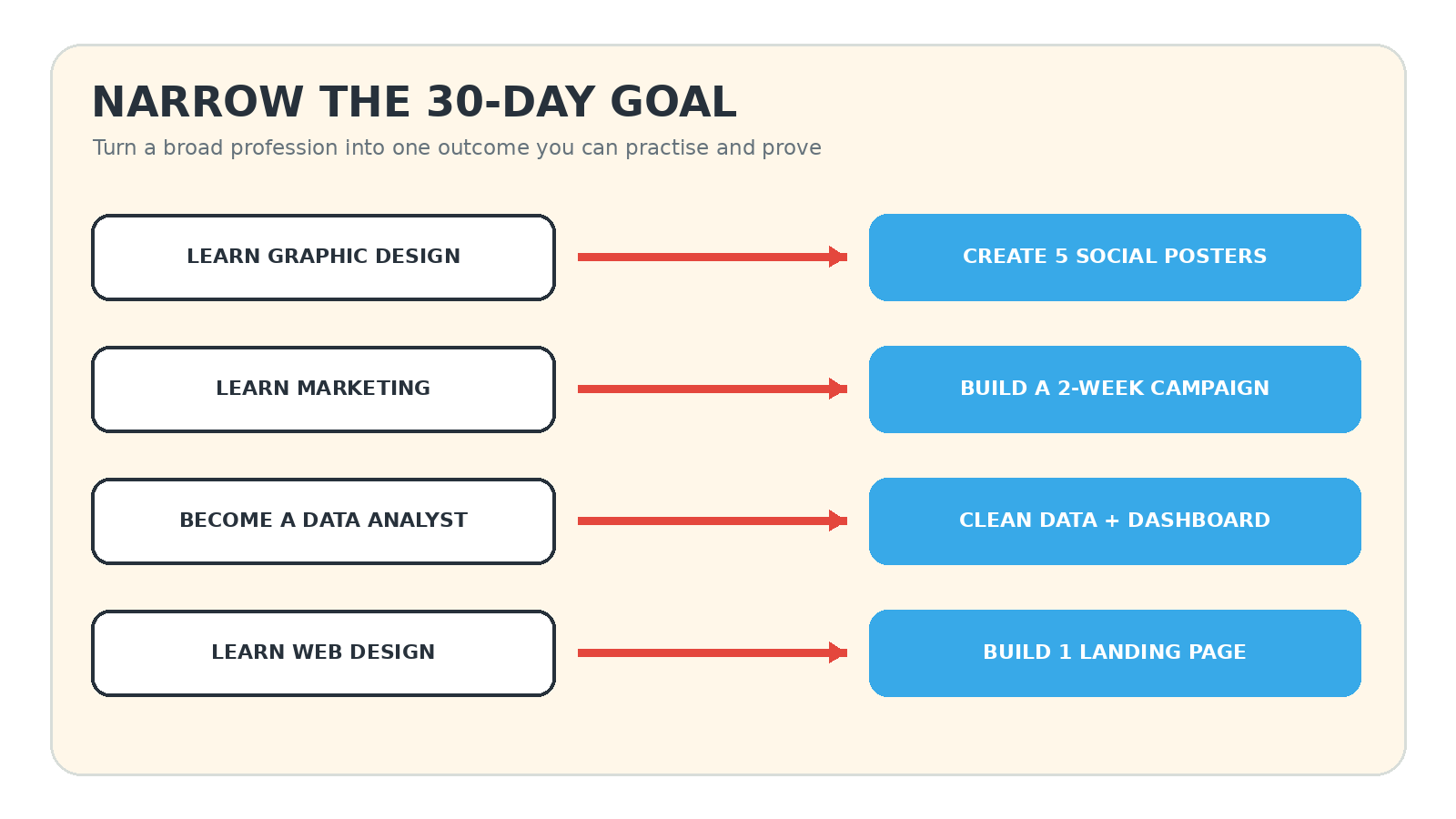 Four broad learning goals narrowed into specific outcomes that can be tested within 30 days
Thirty days becomes useful when the goal is narrow enough to practise and prove.
A 30-day earnable skill is a narrow capability that a committed beginner can practise, demonstrate and package into a low-risk starter offer within one month. That is a VEZILL editorial definition, not a promise of profit.
Learning information is the first layer: you understand terms and follow tutorials. Practice means repeating the task without copying every click. Producing a result means the work solves a recognisable problem. Proof lets another person inspect that result. Packaging defines what you will deliver, for whom, by when and within what limits. Payment happens only when a buyer agrees that the result is valuable enough.
The distinction matters because a course-completion badge shows that you finished material; a relevant project shows what you can do. Vezill’s broader overview of AI and digital skills for work and income helps compare long-term paths. For a 30-day test, narrow the path until safe delivery is believable.
A skill qualifies for this experiment when you can access the tools, learn the fundamentals safely, create a realistic sample independently, connect it to a clear problem and deliver a small offer without misleading the buyer. It does not qualify when errors could expose sensitive data, waste a large budget or create legal, financial, medical or security harm.
Use five stages: LEARN → PRACTISE → PROVE → PACKAGE → PITCH.
Learn the essentials of one narrow capability. Practise the core task repeatedly until the result becomes consistent. Prove it with a realistic sample or case study. Package it into one clear beginner offer. Pitch the offer to relevant potential customers and collect market feedback.
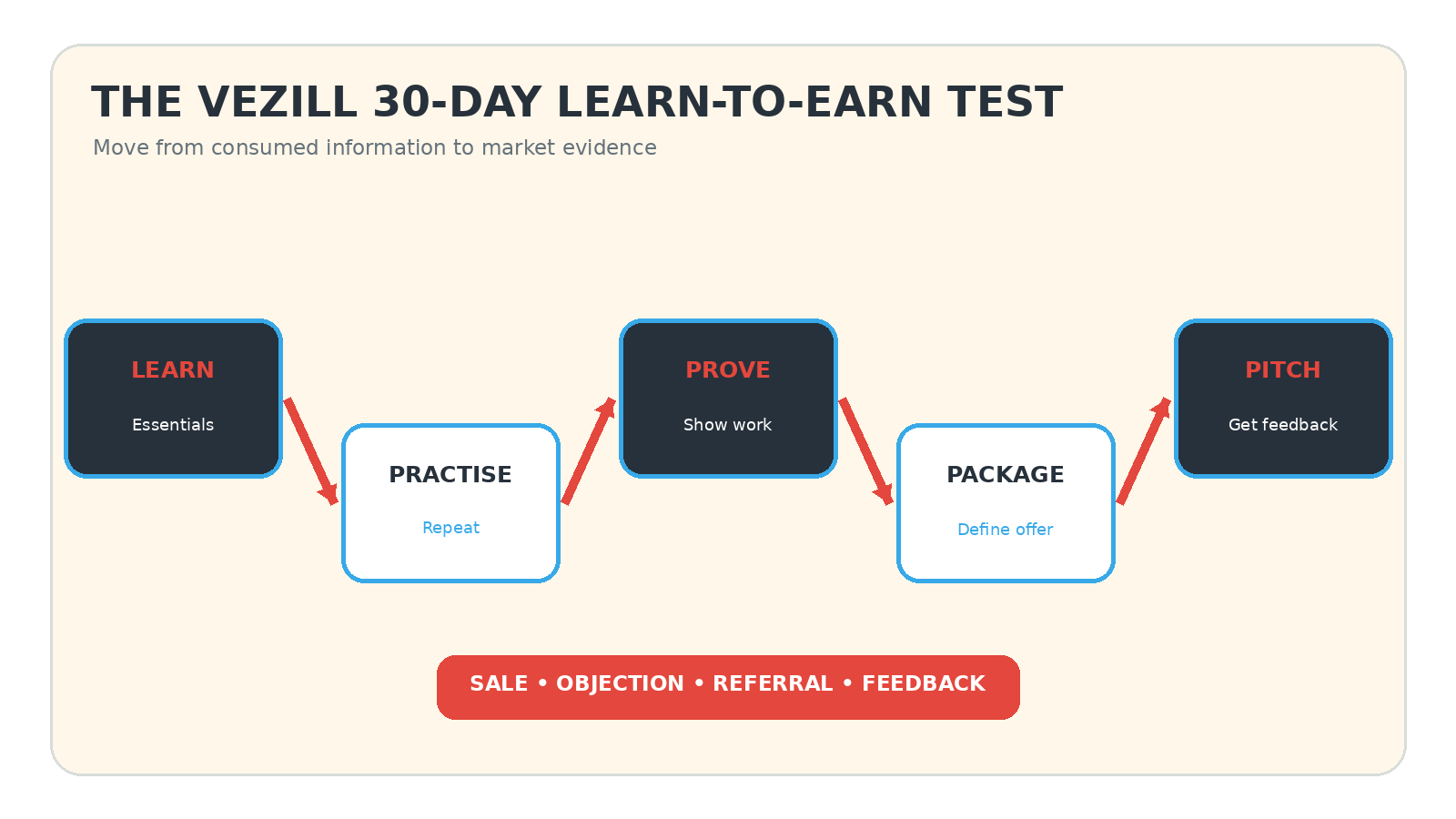 Five-stage pathway from learning through practice, proof and packaging to a market pitch
A 30-day learning project becomes commercial only when it reaches the market.
Pitching does not guarantee a sale. It can produce a sale, objection, referral, useful question, evidence that your offer is unclear or evidence that the problem is weak. All are more valuable than spending another month learning in isolation.
Before committing, score a candidate skill from one to five on five questions: Can I access the tools? Can I practise the work daily? Can I build visible proof? Can I identify potential buyers? Can I deliver the starter result safely? A low score signals that you should narrow the outcome or choose a more suitable first test.
Within 30 days, a beginner can learn layout, alignment, contrast, typography, resizing and consistent use of brand colours well enough to create simple social posts, flyers, menus, thumbnails or presentation slides. They cannot honestly claim to have mastered brand strategy, illustration, pre-press production or every design discipline.
Practise for 60–90 minutes daily by recreating strong designs and explaining why the hierarchy works. Build a five-piece campaign for a fictional but realistic restaurant, salon or event. The proof is not “I know Canva”; it is a coherent set of visuals that communicates an offer clearly.
A starter service could be: “Five branded social posts for one campaign, delivered in agreed sizes with one revision round.” Exclude logo strategy, unlimited changes and print management. Potential buyers include restaurants, tutors, small shops, churches and coaches. Begin with businesses whose current visuals show an obvious, respectful improvement opportunity. A practical graphic-design course with AI-supported workflows can provide structure, while Vezill’s article on online opportunities for graphic designers shows how the skill can deepen over time.
Phone-friendly? Yes, for basic Canva work. The common mistake is decorating without solving the communication problem. A possible digital product is a carefully tested template pack for one niche—not another collection of generic layouts.
Thirty days is enough to learn trimming, pacing, basic sound balance, captions, hooks, resizing and repurposing provided footage. It is not enough to become a cinematographer, advertising strategist or advanced motion designer.
Use CapCut or another accessible editor to turn one longer clip into three platform-ready shorts. Show the original, editing decisions and finished versions. A clear offer is: “I will edit four vertical videos from footage you provide, including captions, basic sound cleanup and one revision per video.” Exclude filming, complex animation, paid media management and unlicensed music.
For social-media support, a beginner may learn basic content research, caption drafting, scheduling, comment organisation and simple weekly reporting. Full strategy and advertising require more experience. A two-week social-media marketing programme may help establish foundations, but commercial proof still matters.
Potential customers include restaurants, property agents, trainers, event organisers and small e-commerce brands. Ask for permission before using client footage, confirm music rights and protect account credentials. The biggest beginner mistake is offering “full social media management” without defining platforms, post volume, response hours, approval process or reporting.
An organised beginner can use 30 days to build ability in email organisation, calendars, web research, data entry, customer-response tracking, document formatting and basic CRM updates. Accuracy, discretion and reliability are the actual product.
Create a fictional client workspace: an organised inbox-label plan, weekly calendar, customer enquiry tracker and standard operating procedure. Do not include real private information. A starter package might provide five hours of defined administrative support per week, with tasks agreed in advance and a simple completion report.
Tools can include Google Workspace, Microsoft Office, Trello, Notion or an approved CRM. Phone-only work is possible for communication and simple tasks, but a computer improves document handling, multi-tab research and spreadsheets. Beginners who need foundational confidence can evaluate a verified computer packages course covering productivity tools.
Never request or store passwords carelessly. Use client-approved access, two-factor authentication and confidentiality rules. The common mistake is saying “I can do anything.” A defined offer—calendar and enquiry administration for one type of professional—is easier to trust and deliver.
In one month, a beginner can learn data cleaning, common formulas, tables, sorting, validation, charts and simple dashboards in Excel or Google Sheets. They should not call themselves a data scientist or accept financial reporting they cannot verify.
Build a proof project using fictional shop sales. Clean inconsistent categories, calculate totals, create a weekly view and write three plain-language observations. A starter offer might be: “I will clean one sales spreadsheet, create a reusable weekly summary and explain how to update it.” Exclude bookkeeping certification, tax advice, large database work and automatic integrations unless you can handle them safely.
Potential buyers include retailers, small distributors, associations and service businesses that already collect data but struggle to read it. Laptop access is strongly preferable. Vezill’s article on income opportunities for data analysts shows the longer path beyond starter spreadsheets, while structured data analytics training can develop the deeper methods required for professional work.
AI can shorten drafting and organisation, but “I know ChatGPT” is not an offer. In 30 days, you can learn to frame research questions, compare sources, draft from approved material, summarise documents, repurpose existing content and document a repeatable review process.
Create proof by converting one verified source pack into a short article, email, social post and fact-check log. Show what the AI proposed, what you verified and what you changed. A starter service could be: “I will turn one approved webinar transcript into an edited article and three social posts, with a source and accuracy check.” Exclude original expert claims, confidential uploads and unsupervised publication.
AI tools can hallucinate facts, expose sensitive information or produce generic prose. Use only information the client permits, verify factual statements and make a human accountable for the final output. A relevant digital marketing programme can help connect content to audiences and measurable goals rather than treating generation as strategy.
Writing support can also cover product descriptions, email drafts, landing-page sections and scripts. Your advantage must be accuracy, audience understanding, judgement or niche expertise—not raw word volume.
Thirty days can be enough to build a simple, mobile-friendly landing page with a clear offer, contact form, basic search metadata and accessibility fundamentals. It is not enough to safely promise complex e-commerce, custom software, sensitive-data handling or advanced security.
Choose one no-code platform and build a complete fictional site for a local service business. Test it on mobile, check every link and explain the user journey. A starter offer might cover one landing page, supplied copy and images, a contact form and two revision rounds. State clearly that hosting, domains, advanced integrations, legal policies and ongoing maintenance are separate.
This path usually needs a computer. Vezill’s guides to earning as a no-code developer and building online income through web design show how a small site can evolve into specialised packages and retainers.
Within 30 days, a beginner can create a narrow checklist, tracker, worksheet, template or short practical guide. Creating the file is not the same as validating or selling it. Start with a problem you understand and speak to intended users before producing a large product.
For example, a tutor might test a revision checklist with five learners before expanding it. A shop owner might build an inventory sheet from a process already used in the business. A job seeker should not copy generic AI text into an ebook and expect demand. Vezill’s analysis of why digital products fail to find buyers explains the importance of problem selection and positioning.
A practical starter product can emerge through the digital product and AI masterclass, provided the learner validates the idea and reviews AI-assisted work carefully. Students can also examine digital-product opportunities designed around student knowledge without assuming that every note or template will sell.
Online tutoring is equally testable. A knowledgeable person can prepare one clear lesson, worksheet and feedback activity. They should not teach regulated, high-risk or unfamiliar subjects. The product is not merely information; it is explanation, sequencing, practice and correction.
The ratings below are VEZILL editorial estimates. They describe entry-level testing, not mastery or guaranteed income.
| Skill | 30-day feasibility | Phone-friendly? | Proof project | Starter offer | Customer difficulty | Long-term growth |
|---|---|---|---|---|---|---|
| Canva business design | High | Yes | Five-piece campaign | Small design pack | Moderate | High |
| Short-form editing | High | Yes | Three edited clips | Four-video package | Moderate | High |
| Social content support | High | Yes | Two-week content plan | Planning and scheduling | Moderate | High |
| Virtual assistance | High | Partly | Admin workspace | Defined weekly support | Moderate | High |
| Spreadsheet reporting | Moderate | Limited | Sales dashboard | Clean-and-report package | Moderate | Very high |
| AI content operations | High | Partly | Repurposed source pack | Reviewed content package | Moderate | High |
| No-code landing pages | Moderate | No | One complete landing page | Fixed-scope page | Moderate–high | Very high |
| Writing support | High | Yes | Three niche samples | Defined copy package | High | High |
| Digital products | High to create | Yes | Validated small product | One useful download | High | Very high |
| Online tutoring | High with knowledge | Yes | Sample lesson | One-to-one lesson | Moderate | High |
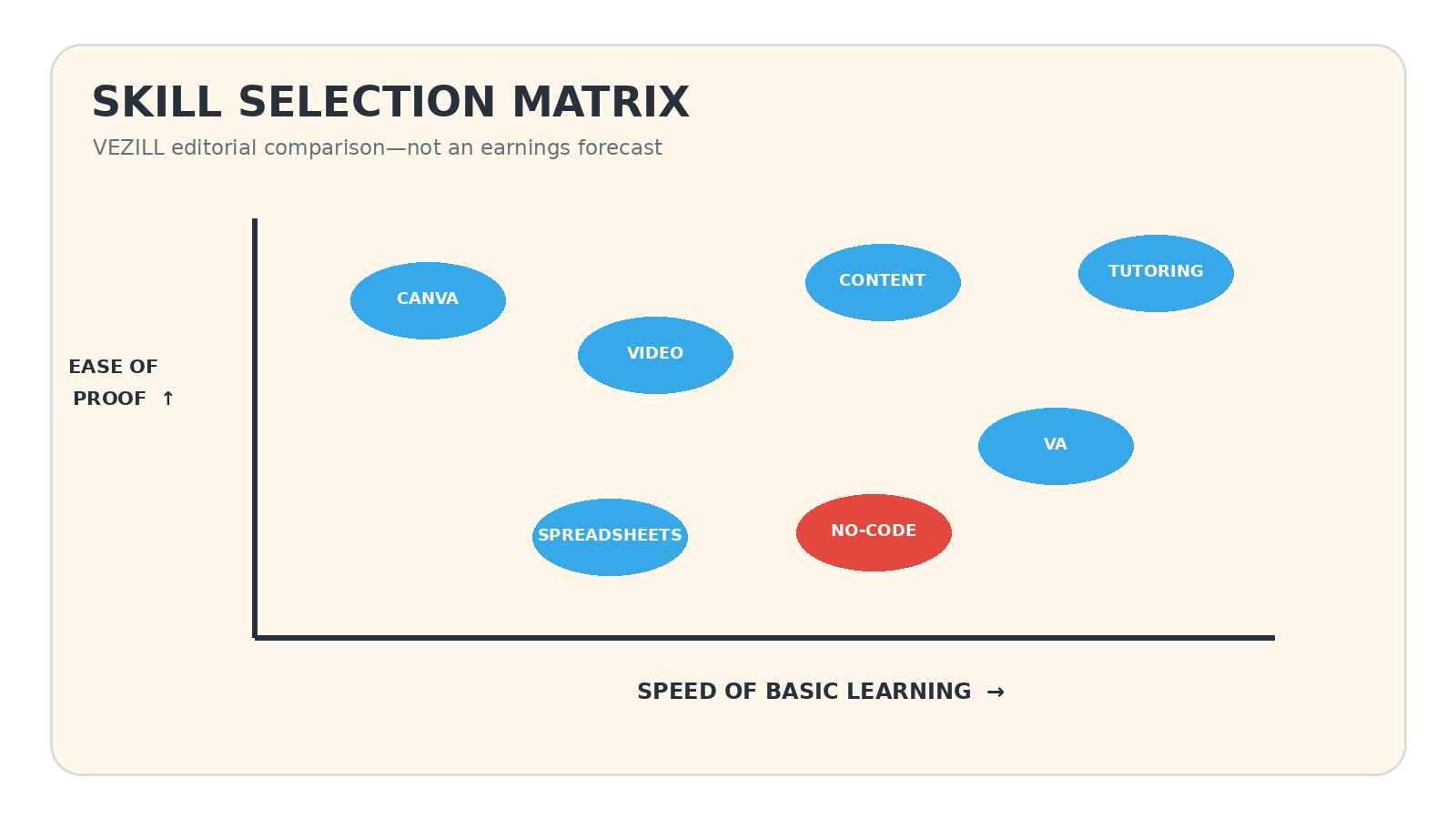 A two-axis editorial matrix comparing speed of basic learning with ease of creating proof
Choose a skill whose proof you can build with the tools and time you actually have.
If you have only a smartphone, Canva design, short video, content support and tutoring are accessible starting points. With a laptop, spreadsheets and landing pages become more practical. Creative people may prefer design or video; organised people may suit virtual assistance; number-comfortable learners may choose reporting. Existing professional knowledge can become tutoring or a small product. Someone seeking the fastest feedback should usually offer a small service before creating a large download in isolation.
Week 1—narrow and learn. Choose one capability, one customer and one recurring problem. Study only the essential tools, analyse good examples and complete a short exercise every day. This prevents tutorial overload and makes practice comparable. Your expected outcome is one sentence: “I am learning to [produce result] for [specific customer].”
Week 2—practise and prove. Create three versions of the core task rather than three unrelated projects. Ask two or three suitable people what is confusing, weak or useful, then improve the strongest version. Document the starting problem, your decisions and the finished result. Your expected outcome is one portfolio-ready case study.
Week 3—package the offer. Define the result, what is included, what the customer must supply, what is excluded, the delivery time, revision limit and price basis. This removes ambiguity and protects a beginner from promising too much. Your expected outcome is a short offer that a buyer can understand in less than a minute.
Week 4—pitch and improve. Identify 20 genuinely relevant prospects, personalise each message, show the most relevant proof, follow up once and record every response. Do not spam strangers. Your expected outcome is market evidence: interest, objections, referrals, questions or a first small sale.
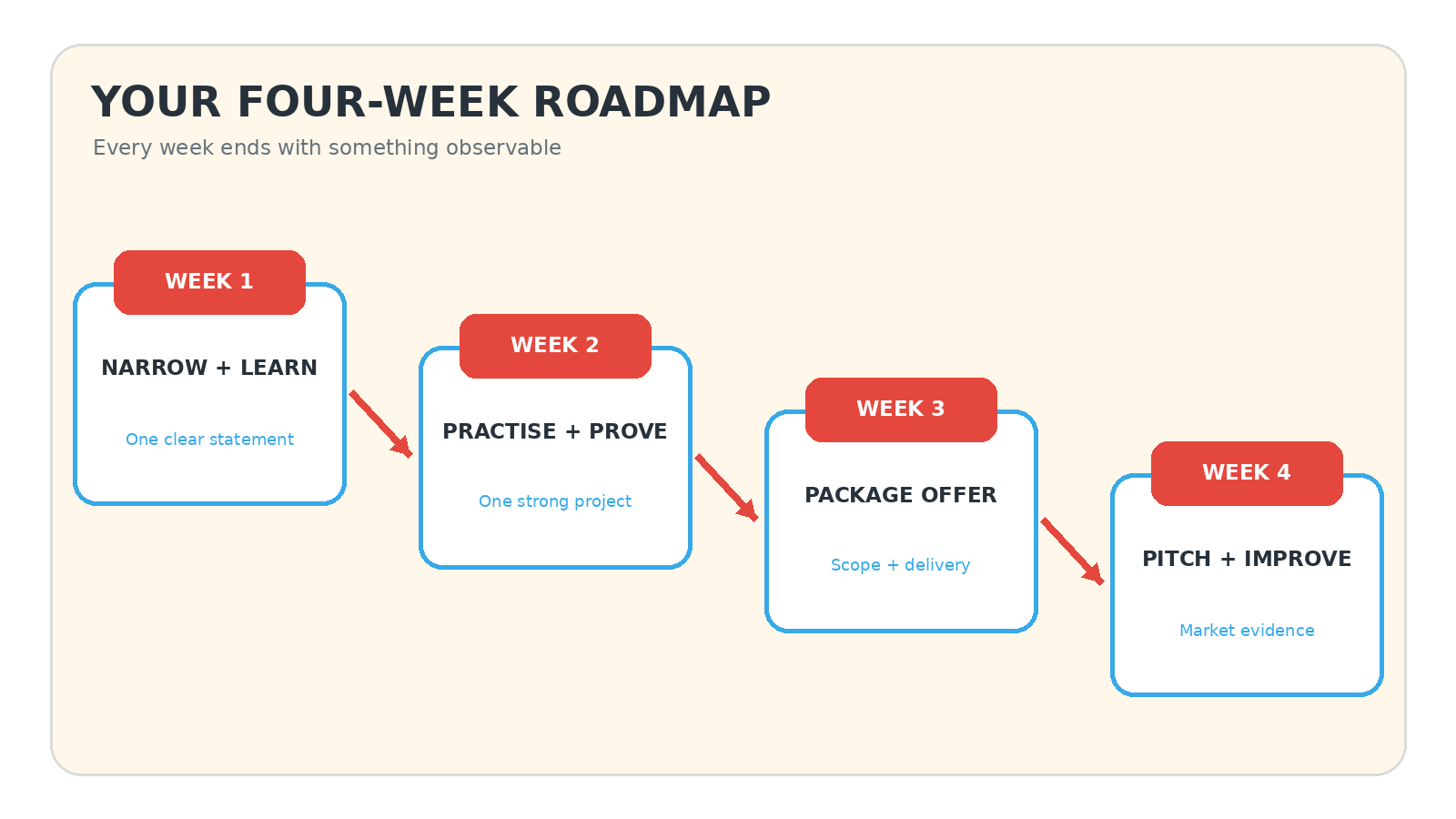 A four-week roadmap progressing from narrow learning through proof and packaging to pitching and improvement
Each week ends with something observable—not only more consumed content.
Try this outreach:
“Hi [Name], I noticed [specific issue]. I have been developing [specific capability] and created this short example showing how I could improve [outcome]. I’m offering a small starter package that includes [deliverable]. Would you be open to discussing whether it would be useful for your business?”
Keep the observation respectful and truthful. Do not attach huge files or demand a reply. Existing contacts, local businesses, schools, churches, LinkedIn connections, WhatsApp networks, relevant groups and referrals may provide warmer first conversations than anonymous global marketplaces. Vezill’s advice for freelancers building additional income is most useful when paired with clear scope and reliable delivery.
Restaurants, salons, barbershops, property agents, tutors, schools, churches, NGOs, agricultural businesses, e-commerce sellers and small professional firms all have real digital tasks. Not every organisation needs or can afford every service. Observe before pitching.
Local understanding is an advantage: you recognise M-Pesa workflows, customer language, seasonal demand and the role of referrals. Constraints include data and equipment costs, payment delays, informal scope, limited software budgets and international payment friction. Protect yourself and the customer with written scope, a reasonable deposit for project work, staged delivery, clear revisions and secure handling of information.
Beware of “jobs” that require you to pay an activation fee, receive money through your account for strangers, buy cryptocurrency to unlock work or hand over identity documents without a legitimate process. Never inflate your competence to win a project.
After only 30 days, do not sell advanced cybersecurity audits, financial advice, legal services, medical guidance, tax work, production systems handling sensitive information, high-budget advertising or complex automation without the training and safeguards those activities require. A serious beginner knows where the boundary is.
Can I really learn a profitable skill in 30 days? You can build a narrow useful capability and test it. Profit depends on quality, demand, customer access, pricing and delivery; it is not guaranteed by the timeline.
Which online skill is easiest for a complete beginner? Basic Canva design, content support or administration often have lower entry barriers, but the best fit depends on your abilities and tools.
What can I learn using only a smartphone? Basic design, short-video editing, social content, writing support, tutoring and simple digital products are phone-friendly. Complex spreadsheets and web work are easier on a computer.
Can I start freelancing after one month? You can offer a small, honest, low-risk service when you have proof and can deliver it. Do not present yourself as an expert.
Do I need a certificate? Many unregulated services are judged by proof and reliability. Regulated work may require formal qualifications or registration.
Can AI help me learn faster? AI can explain, generate exercises and critique drafts, but its output must be verified. It cannot replace practice or responsibility.
Should I offer a service or create a product first? A small service usually produces faster feedback. A product is stronger after you understand a repeated customer problem.
What if I get no customer after 30 days? Review your audience, problem, proof, message and outreach. Use objections as evidence, improve one variable and run another focused test.
Thirty days is enough to test a narrow skill; it is rarely enough to master an entire profession. Use the VEZILL path: LEARN → PRACTISE → PROVE → PACKAGE → PITCH.
Choose one skill, one customer group and one proof project today. By the end of the month, aim to possess evidence: evidence of competence, customer interest, objections and whether to continue, specialise or change direction. A first sale would be welcome. A truthful market lesson is valuable too.
If your test points toward a digital-product model, Vezill’s 30-day digital-product business roadmap can help you examine the next stage critically. Learning opens the door; proof and responsible delivery give somebody a reason to pay.
Discover more articles you might be interested in

How to Make Money Online as an SEO Specialist: 18 Realistic Income Opportunities
By Davie

Learn how small businesses can use AI for marketing, sales, customer service and automation—and turn real business experience into digital products to sell online.
By Davie

Learn how to build an AI-powered online business with practical ideas, tools, customer strategies, AI automation and a 30-day startup roadmap
By Davie
how web designers can make money online
By Davie
Get the updates, on newly released, popular & fast-moving MRR digital products
Up to Top
Comments All
Kashiriko
@kashiriko
Learning a skill in just 30 days sounds challenging, but I like how this makes it feel possible to actually learn something useful and start earning from it.
September 11,2026 At 10:33 PM