
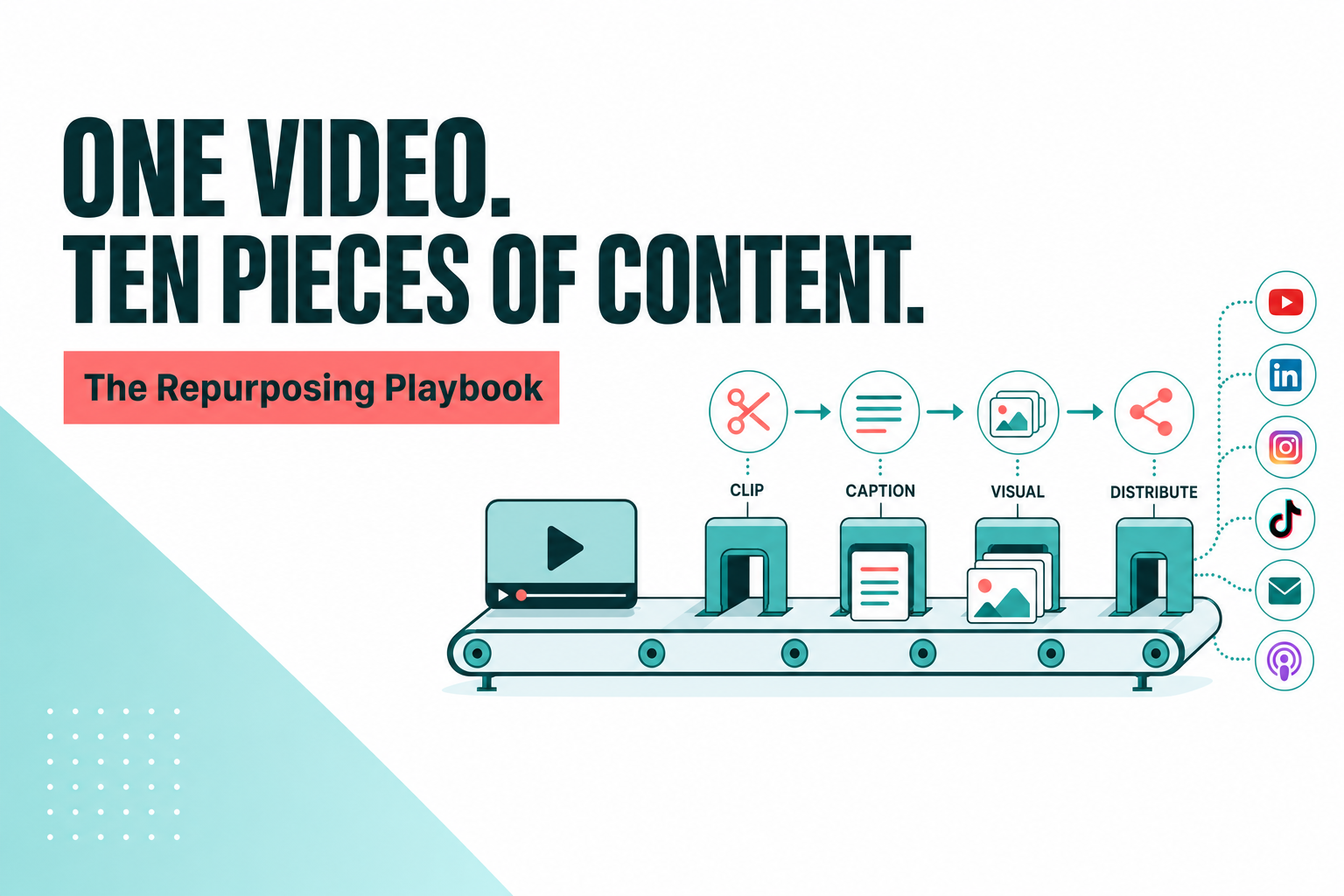
Most creators treat every platform as a separate content job — filming something new for TikTok, writing something new for LinkedIn, designing something new for Pinterest. That's exhausting, and it's also unnecessary. One well-made video already contains a hook, a lesson, a visual, and a call to action — everything ten different pieces of content need.
This guide shows exactly how to break one video into a full week of content across the platforms your buyers already spend time on.
To repurpose one TikTok video into 10 pieces of content: (1) pull the transcript/voiceover into a blog post or thread, (2) cut 3–4 short clips for Instagram Reels and YouTube Shorts, (3) turn the key point into a Pinterest pin and a quote graphic, (4) convert your hook into a LinkedIn post, (5) repost the raw clip natively to Facebook and a Telegram channel, (6) share it as a WhatsApp Status update, and (7) compress the full lesson into a Vezill digital product.
One good video, filmed once, can realistically feed seven or more distinct platforms — multiplying reach without multiplying filming time.
Filming is usually the most time-consuming part of content creation. Once it's done, everything downstream — clipping, captioning, quoting, reformatting — takes a fraction of the effort. Creators who repurpose consistently show up everywhere their buyers are, without a proportional increase in production time, which is exactly why the best monetization methods for content creators increasingly treat one source video as a starting asset, not a finished output.
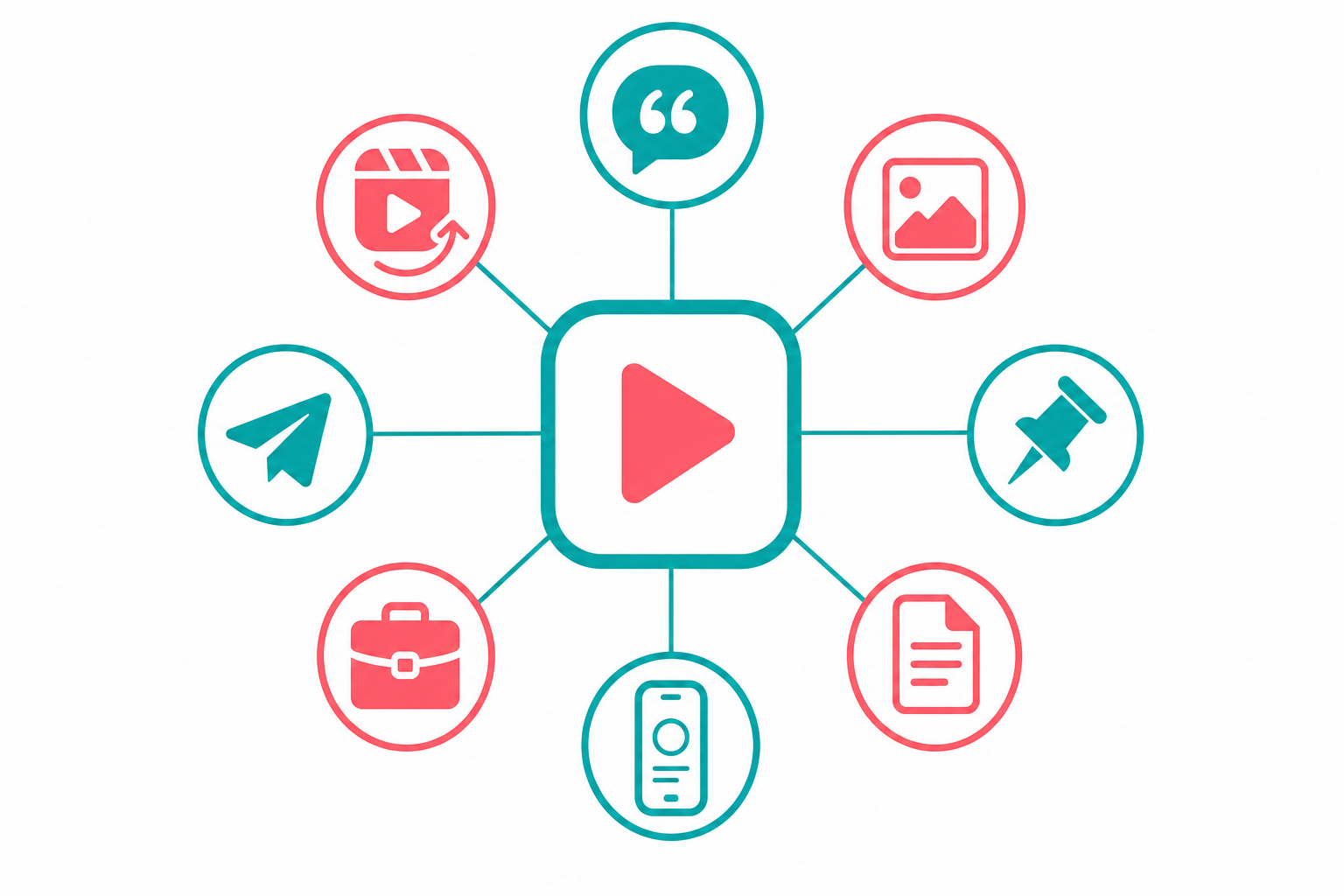 One filmed video, ten distinct outputs.
Here's exactly what to pull from one TikTok video before you ever pick up your phone to film again:
Blog post — expand the voiceover into a written article with the visuals as supporting screenshots.
Instagram Reel — re-export the same clip natively, following the format shown in Instagram Reels marketing for digital products.
YouTube Short — same clip, vertical format, different discovery algorithm entirely.
Pinterest pin — turn the key frame or main tip into a static graphic, using the approach from Pinterest marketing for digital products.
LinkedIn post — rewrite the hook and lesson in a professional tone, as covered in LinkedIn marketing for digital products.
Facebook Group post — share the native video or a summary inside a relevant community, the same style used in Facebook Groups marketing strategy for digital products.
Telegram channel post — drop the raw clip with a short caption, following Telegram channel marketing for digital products.
WhatsApp Status — a 15–30 second cut works perfectly as a Status update, per WhatsApp marketing for digital products.
Quote graphic / carousel — extract the single best line and turn it into a shareable image post.
Digital product chapter — fold the lesson directly into a guide, exactly the model behind monetizing existing video content on Vezill.
Treat repurposing as a simple, repeatable production line rather than a fresh creative decision every time.
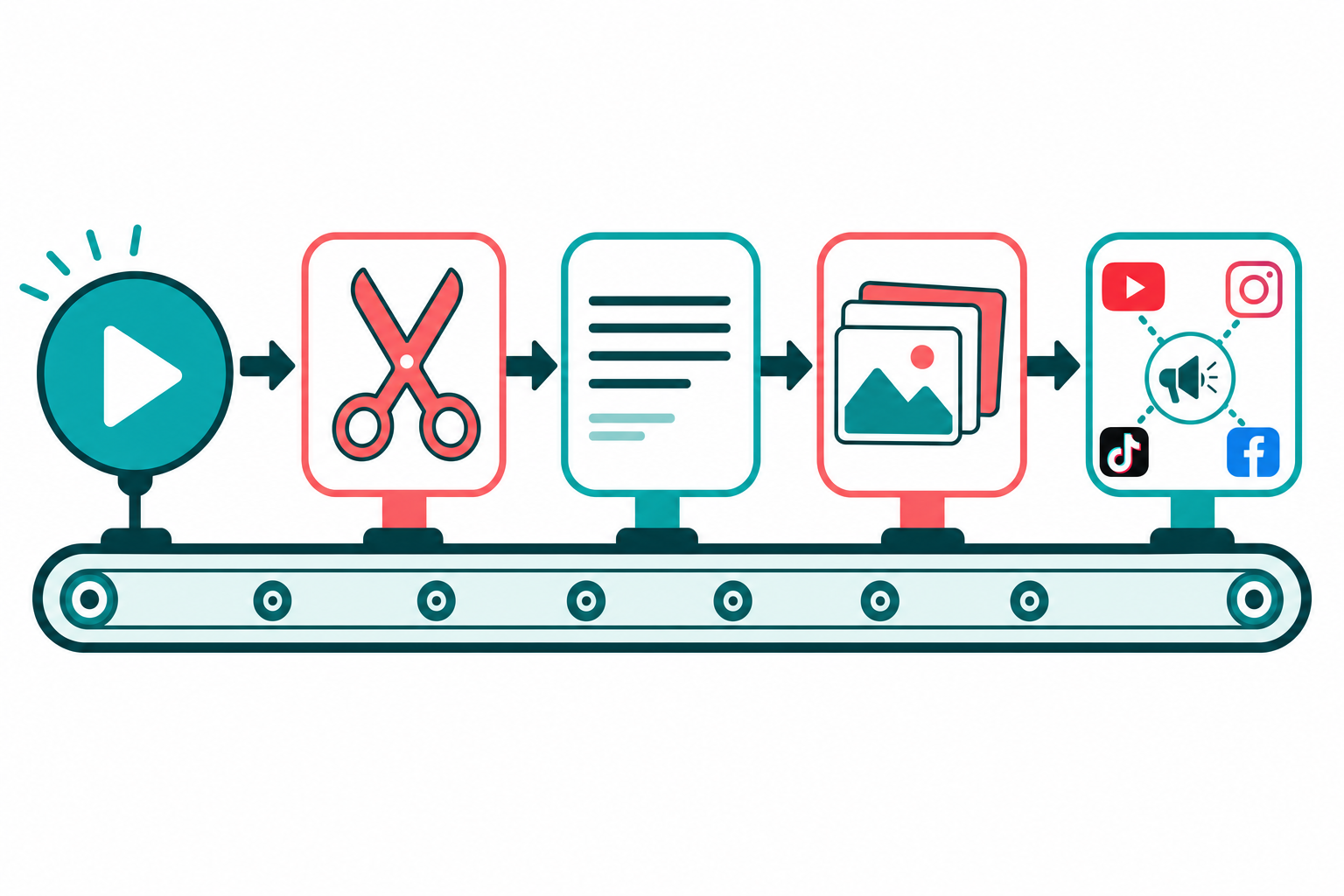 Four simple stations turn one video into a week of content.
Station one is clipping — pull out 3 to 4 short segments that stand alone. Station two is captioning — every clip needs on-screen text since most viewers watch on mute. Station three is reformatting — turn the strongest quote into a still graphic or carousel. Station four is distribution — push everything out across your platforms in the same sitting, rather than trickling it out over weeks.
Batch it: Set aside one hour per week purely for repurposing, separate from filming time. Treating it as its own scheduled task is the difference between "I'll get to it" and it actually happening.
Not every repurposed piece deserves equal effort — match the format to what each platform's audience actually responds to.
 Match the format to the platform, not the other way around.
Short vertical clips dominate Reels, Shorts, and Status updates. Static quote graphics and pins perform best on Pinterest and in carousels. Text-first rewrites work better on LinkedIn and in Facebook Groups than a raw video drop. For a broader view of which platforms suit digital product sellers specifically, this comparison of the best platforms for digital products in Kenya is a useful companion read.
The highest-leverage repurposing move isn't another social post — it's compressing several related videos into one sellable guide.
For a broader monetization framework beyond just this one guide, The Ultimate Monetization Guide for Content Creators walks through platform-specific playbooks and a repeatable audience-to-income framework worth studying alongside your repurposing routine.
Monday: Film or select one strong source video.
Tuesday: Clip 3–4 short segments and add captions.
Wednesday: Publish the native clip to TikTok, Reels, and Shorts.
Thursday: Turn the best line into a Pinterest pin and a quote carousel.
Friday: Rewrite the hook as a LinkedIn post and a Facebook Group share.
Weekend: Drop the raw clip to Telegram and WhatsApp Status, and log the theme for your next digital product chapter.
Posting once and moving on — most good videos still have 6–9 unused pieces of content inside them.
Reposting identically everywhere — each platform rewards a slightly different format and tone.
No captions on repurposed clips — most viewers scroll with sound off; uncaptioned clips lose them in seconds.
Never compiling themes into a product — recurring topics across your videos are the outline of a guide you haven't written yet.
Treating repurposing as an afterthought — without a scheduled block of time, it rarely gets done consistently.
The fastest way to show up everywhere isn't filming more — it's extracting more value from what you've already filmed. One strong video, broken down deliberately, can carry an entire week of content across seven or more platforms, and eventually become the outline of a digital product that earns long after the original post stops getting views.
Pick your best video from the last month and spend one hour this week turning it into three new pieces of content.
Create your free Vezill account and package your best-performing content into a digital product this week.
Create your Vezill store now →
A well-made 60–90 second video can realistically produce 8 to 10 pieces of content, including short clips, a written post, a quote graphic, a Pinterest pin, and platform-specific rewrites of the same core idea.
No. Most repurposing uses only clipping, captioning, and reformatting of footage you've already filmed. Reshoots are rarely necessary unless a platform strictly requires a different aspect ratio you didn't originally film.
Whichever platform is your primary sales channel should get the most polished cut, since that audience is closest to converting. Secondary platforms can receive lighter, faster edits of the same source clip.
Any video that performed above your average engagement, or covers a topic your audience asks about repeatedly, is a strong repurposing candidate — it has already proven the idea resonates.
Yes. Several videos built around the same theme can be compiled, expanded, and structured into a single downloadable guide, turning content you already created into a one-time-effort, repeatedly-sellable asset.
Most creators can fully repurpose one strong source video into a week's worth of content in about one focused hour, once clipping and captioning becomes a routine rather than a fresh decision each time.
Discover more articles you might be interested in

Learn where to find reliable step-by-step guides online, how to choose the right tutorial for your task, check whether it is current and follow instructions safely.
By Davie

Stop searching broad topics and start finding the exact knowledge you need. Learn how to define your problem, search smarter, choose reliable sources, verify answers and take action.
By Davie

Quick Knowledge or an online course? Learn when a focused answer is enough, when structured learning is better, and how to choose the right learning depth for your goal.
By Davie

Learn how to turn one useful digital product into multiple income streams through premium versions, bundles, courses, licensing, services, subscriptions, B2B sales and complementary products.
By Davie
Get the updates, on newly released, popular & fast-moving MRR digital products
Up to Top
Comments All
Felister
@felister
I never really thought about how one TikTok video could be turned into so many different pieces of content. The idea makes creating content feel a lot less stressful and more manageable. Definitely something I’d like to try.
September 06,2026 At 09:56 PM
Jesse
@jesse
The 1-to-10 content idea is something I could use immediately. Instead of creating every post from scratch, I can take one TikTok video and turn it into short clips, quotes, posts, and other formats for different platforms. That would save time while keeping my content active across multiple channels.
August 26,2026 At 10:56 PM