
You may already know something useful enough to help a beginner, improve a process, prevent a mistake or become the foundation of a service or digital product. The challenge is learning to see it clearly, test it responsibly and explain it without exaggerating your expertise.
Most people look for opportunity by asking, “What new skill should I learn?” That can be useful, but it misses a second question: what useful knowledge have I already accumulated without noticing? Work, freelancing, study, business, volunteering, farming, caregiving, community leadership and personal projects all create practical lessons. Some of those lessons may be valuable because they help another person solve a problem faster, avoid an error, understand a confusing process or make a better decision.
To identify valuable knowledge you already have, examine problems you repeatedly solve, questions people ask you, tasks others find difficult, mistakes you have learned to avoid, processes you have improved and results you can explain. Then match that knowledge to a specific person, problem and useful outcome, and test whether it genuinely helps.
EXPERIENCE → REPEATED PROBLEM → PERSONAL METHOD → SPECIFIC AUDIENCE → USEFUL OUTCOME → EVIDENCE OF VALUE
Knowledge is not automatically valuable because it took years to learn, sounds technical, uses AI, comes with a certificate or appears in someone else’s online business. Commercial value depends on usefulness, relevance, accuracy, demand, trust, accessibility, timing and whether the intended user can act on it.
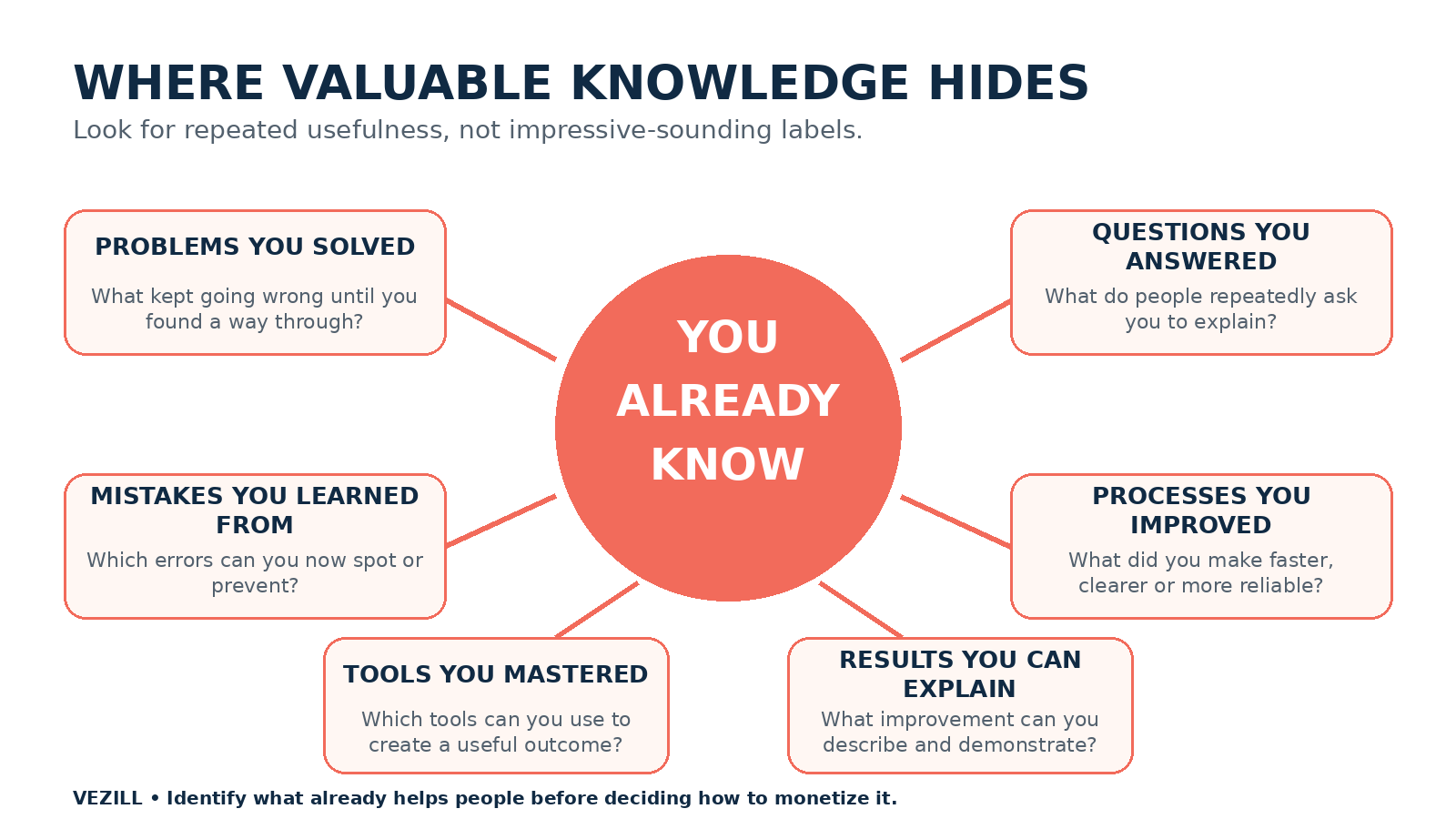 Valuable knowledge often hides in repeated everyday usefulness.
Valuable knowledge is knowledge that helps a specific person solve a meaningful problem, complete a task, avoid a mistake, save time or achieve a useful improvement. The value is not the information by itself; it is the combination of usefulness, context, evidence and delivery.
| Term | Meaning | Example | Evidence | Possible use | Limitation |
|---|---|---|---|---|---|
| Information | Facts or material you can access. | A list of Excel formulas. | Reliable source. | Reference sheet. | May not show how to apply it. |
| Knowledge | Understanding what something means and why. | Knowing when a formula is appropriate. | Accurate explanation. | Guide or tutorial. | Understanding does not prove execution. |
| Skill | Ability to perform a task. | Cleaning a messy workbook. | Demonstration or sample. | Freelance service. | A skill name alone does not define customer value. |
| Experience | Lessons gained from applying knowledge and skill in real situations. | Recognising common reporting errors after many monthly reports. | Projects, examples, documented decisions. | Training, service, SOP. | May contain confidential material that must be removed. |
| Expertise | Reliable judgement developed through deeper practice and learning. | Choosing an appropriate analysis method under uncertainty. | Track record, credentials where relevant, strong reasoning. | Advanced consulting or education. | Must not be overstated. |
| Insight | A useful interpretation or pattern. | Realising customers abandon a process at one recurring step. | Observation plus supporting evidence. | Audit, article, recommendation. | One observation may not generalise. |
| Process | A repeatable sequence for completing work. | A weekly content approval workflow. | Documented repeatability. | Checklist, template, SOP. | May depend on a specific environment. |
| Intellectual property | Protected creative or commercial material. | Original training content or software. | Authorship, contracts, licences. | Licensed product. | Ownership must be clear. |
| Confidential information | Non-public information you are not free to disclose. | Client records, internal reports, private strategies. | Contract or confidentiality context. | Usually exclude from public products. | Disclosure can create legal and ethical risk. |
You do not need to be the world’s leading authority to help someone who is earlier in the journey. But you must describe your level honestly. A junior designer can teach a beginner how to organize a simple Canva workflow without presenting themselves as a senior brand strategist. A parent can share an organization system that worked for their household without presenting it as medical or psychological advice.
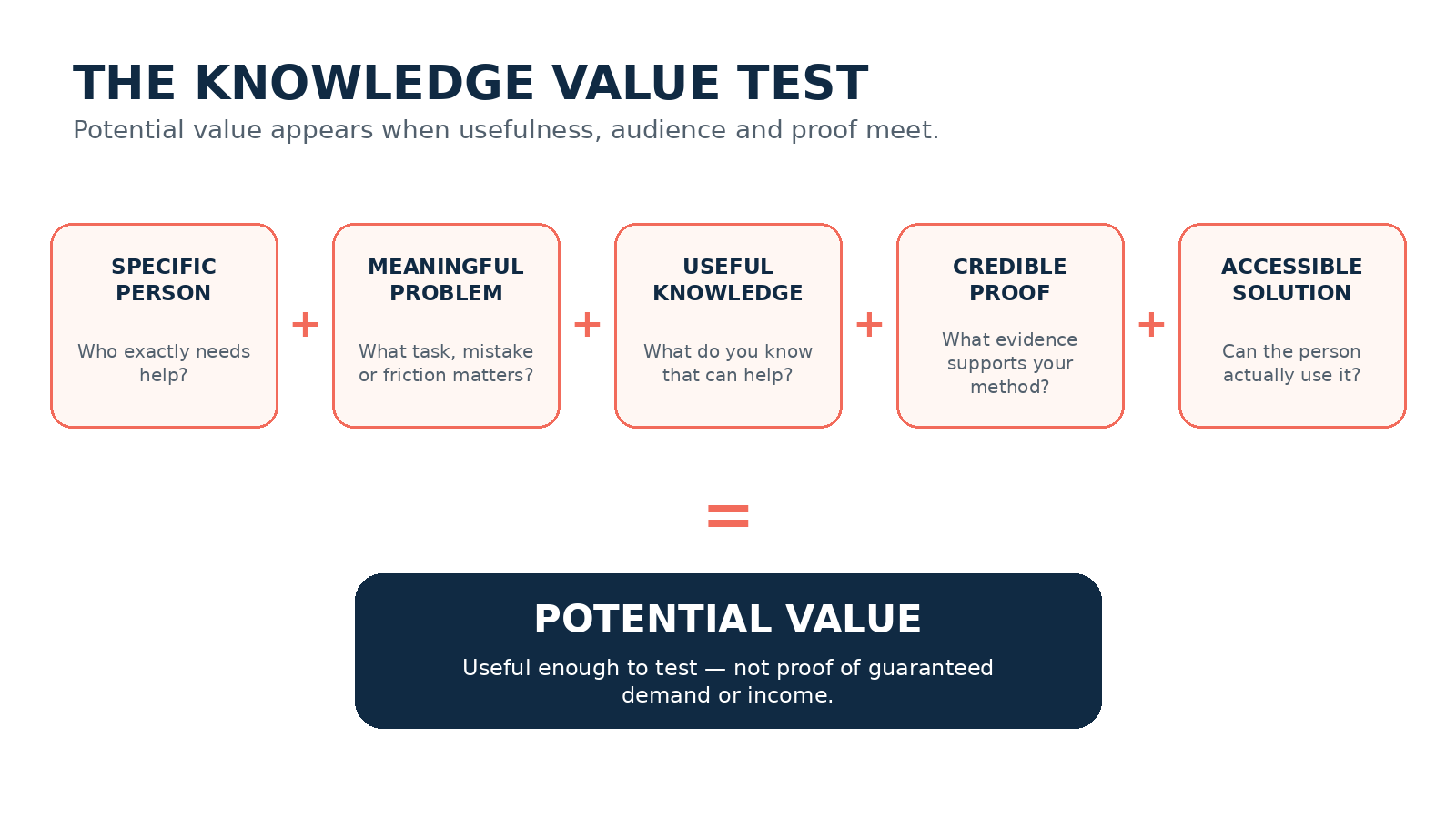 Knowledge, skill, experience and expertise are connected, but they are not interchangeable.
People often overlook valuable knowledge because familiarity makes competence feel ordinary. If you have done the same task every week for three years, you may forget how confusing it was at the beginning. What now takes you fifteen minutes may take a beginner two hours.
Informal skills are especially easy to dismiss. An office administrator may think organizing meetings, records and follow-ups is “just admin,” yet a small organization struggling with lost information may value a clear operating system. A church volunteer who has coordinated registrations for many events may have practical knowledge about communication, attendance tracking and volunteer handover. A farmer may have learned through several seasons how to keep simple input and harvest records that make planning easier.
Comparison creates another blind spot. People compare themselves with the most visible expert online, then conclude they have nothing to contribute. A more useful comparison is with the person who is one or two stages behind you. Can you explain a task they currently find confusing? Can you help them avoid a mistake you made? Can you give them a tested template rather than asking them to start from zero?
AI has added a new form of doubt: “If an AI can answer this, why would my knowledge matter?” Generic information is easier to generate than before, but contextual judgment, local examples, tested processes, responsible curation, real demonstrations and accountability still matter. AI can help organize what you know; it should not invent experience you do not have.
Useful knowledge can come from employment, freelancing, running a business, education, professional training, hobbies, volunteering, parenting, caregiving, church or community leadership, farming, personal projects, career changes, learning technology, household systems and lessons from mistakes.
The test is not “Was this formal?” The test is “Can I identify a specific situation where this knowledge helps someone act better?” A Nairobi online seller may understand how to organise WhatsApp enquiries. A tutor may know how to turn a difficult topic into a sequence a beginner can follow. A retail worker may know how to write clear product labels and handle recurring customer questions. A software developer may have a practical debugging checklist that helps junior developers narrow down errors faster.
Experience must also stay within appropriate boundaries. Personal experience is not a substitute for professional medical, legal, financial or psychological advice. If the consequence of being wrong is serious, the standard of competence and evidence must rise.
A good knowledge audit starts with specific examples, not broad labels such as “marketing,” “business” or “technology.” Ask yourself:
Instead of writing “I know social media,” write: “I have created monthly content calendars for three different types of organisations and learned how to collect approvals before posts become urgent.” That statement gives you something concrete to test.
A personal knowledge audit makes invisible experience visible. It turns roles, tasks and repeated decisions into themes you can evaluate.
| Experience or role | Repeated problem | What I learned | Who needs it | Useful outcome | Evidence |
|---|---|---|---|---|---|
| Office administrator | Follow-ups get lost | Simple status tracking and reminder routines | Small teams | Clearer follow-up | Example tracker + demonstration |
| Tutor | Learners repeat the same misunderstanding | Better explanation sequence | Beginners | Faster understanding | Lesson sample + learner exercise |
| Online seller | Repeated delivery questions | Standard order information system | Small online shops | More consistent communication | Template tested with sample orders |
Customers rarely buy a skill name. They care about what the skill enables. “Excel” is not an outcome; cleaner records and clearer monthly reporting are. “Writing” is not an outcome; a clear onboarding sequence or understandable guide is. “Project management” becomes valuable when responsibilities, deadlines and handoffs become easier to manage.
Use this formula:I know how to [perform a task] for [specific person] so they can [achieve a useful improvement] without [important obstacle].
Be precise about the difference between a task, a deliverable and a supported outcome. “Clean 1,000 rows of transaction data” is a task. “A cleaned workbook plus a summary tab” is a deliverable. “Easier monthly review” is a supported outcome. “Your business will increase profit by 30%” is a guarantee you probably cannot control.
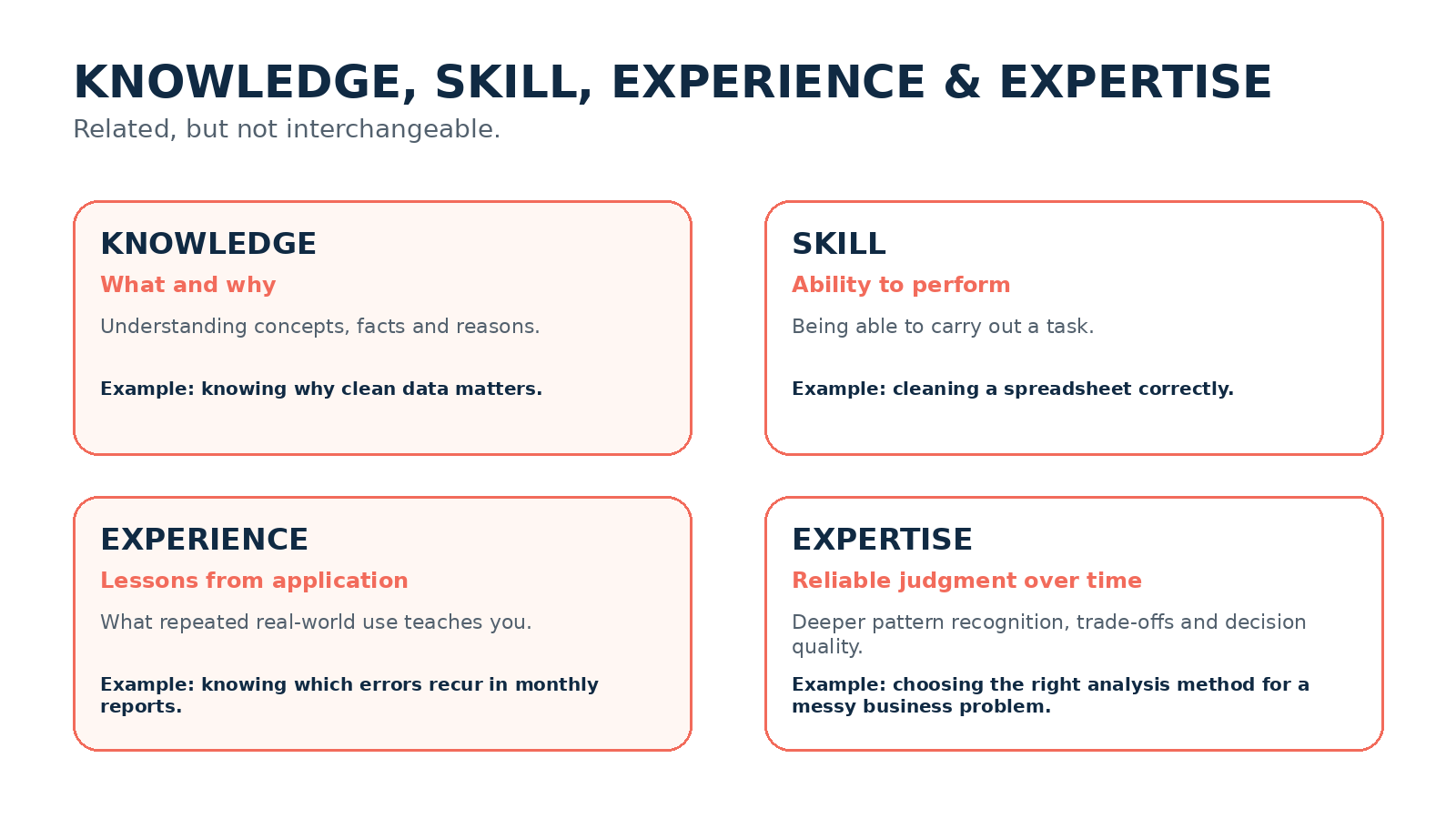 Potential value requires more than having information: a specific person, meaningful problem, useful knowledge, credible proof and an accessible solution must come together.
The same knowledge can have different value for different audiences. Beginners entering a field, junior employees, students, job seekers, career changers, freelancers, small-business owners, managers training teams, community organisations, parents, caregivers and people adopting new technology may all need different versions of the same core knowledge.
For example, spreadsheet knowledge could become a beginner class for university students, a stock-record template for a local retailer, a farm-expense tracker for a small agricultural enterprise or a reporting-cleanup service for a consultancy. The skill is similar; the problem, language, evidence and format change.
If you are still deciding which skills can become commercial opportunities, VEZILL’s guide on turning online skills into a business shows how skill → problem → customer → offer → proof fit together. A person building proof can also use the guide on building a portfolio without formal experience to demonstrate capability without inventing client work.
Value requires evidence, not compliments. The fastest way to learn is to put a small useful version of your knowledge in front of the right people and observe what happens.
Useful tests include customer interviews, repeated questions in communities, search behaviour, competing products and services, a practical article, a free checklist, a small workshop, a demonstration, a freelance service, a paid pilot, a waitlist or a responsible preorder. The goal is not to manufacture urgency; it is to learn whether the problem matters.
| Weak signal | Stronger signal |
|---|---|
| “That sounds interesting.” | The person asks how to access or use it. |
| Likes | Email sign-ups or downloads from the intended audience. |
| Friends praising it | Target customers testing it. |
| Views | Completed actions. |
| General interest | A specific request for help. |
| Survey promises | A paid pilot or carefully disclosed preorder. |
Before building a larger product, the VEZILL article on validating a digital product idea before you build it is a useful next step. If the opportunity looks more like client work, study the difference between a loose skill and a defined offer in how to package a freelance service.
If you identify ten possible knowledge themes, score each one from 1 to 5 on problem importance, frequency, audience clarity, evidence of demand, ability to reach users, personal competence, proof available, ease of explanation, ethical and legal safety, suitability for a service or product, and your willingness to keep learning.
Add the scores only as a decision aid. A high score is not scientific proof. It simply helps you compare “I enjoy this” with “I can reach these people, the problem repeats, I can demonstrate the solution and I can explain it responsibly.”
Most information is available somewhere. People may still value organization, specificity, local context, tested templates, clear examples, convenience, curation, implementation guidance, time savings, professional review, useful tools, updates and support.
A farmer does not necessarily need another hundred search results about record keeping. They may value one tested spreadsheet with simple instructions and examples that match the way they actually record costs. A junior employee may not need a library of project-management theory; they may need a meeting-action tracker and a short explanation of how to use it.
Do not copy free material, remove the original branding and sell it as your own. Original value comes from your reasoning, organization, examples, testing, adaptation, tools and responsible explanation.
No, not for every type of helpful content or beginner-level product. You do need enough competence to be accurate, honest about your level and safe in what you recommend.
You should understand the topic, stay within your competence, avoid unsupported claims, use credible sources, correct mistakes and continue learning. Where a qualified professional is required, refer people appropriately.
You may be able to help someone who is earlier in the journey without pretending to know everything.AI can conduct a structured self-interview, organize your career history, group repeated tasks, identify patterns, translate technical work into plain language, suggest possible audiences, generate validation questions, find gaps in a process, compare product formats and turn rough notes into an outline.
Practical AI prompt:Do not upload confidential documents, passwords, personal data, employer records, protected client materials or trade secrets into an AI system without appropriate permission and safeguards. AI should help identify patterns in what you actually did; it should not manufacture experience.
If you decide to use AI during product creation, VEZILL’s step-by-step workflow for creating a digital product with AI emphasizes that AI should accelerate research and production rather than replace expertise, fact-checking or licensing.
Do not treat access as ownership. Employer-owned documents, confidential information, customer or employee data, trade secrets, proprietary software or code, private databases, internal reports, licensed assets, unpublished strategies, unauthorised logos and images, contract-restricted work and illegally obtained information may be off limits.
General experience can often be separated from protected material. You might be free to say, “I learned that weekly status reviews reduce missed handoffs,” while being prohibited from sharing the employer’s internal dashboard, client names, revenue data or exact operating procedures. The World Intellectual Property Organization explains that trade-secret protection can apply to commercially valuable confidential information when reasonable steps are taken to keep it secret.
This is general educational information, not legal advice. When ownership or contractual restrictions are unclear, check the agreement and seek qualified advice.
These are illustrations, not verified customers, standard prices or guaranteed opportunities.
Experience: explaining difficult topics repeatedly. Overlooked knowledge: the sequence of examples that helps beginners understand. Audience: students struggling with one topic. Problem: confusion and poor revision structure. Outcome: clearer practice. Proof: sample lesson and exercise results. Possible product: revision workbook or live workshop. Limitation: do not promise grades. Exclude: private student records. Next test: pilot one worksheet with a small group.
Experience: schedules, documents and follow-ups. Overlooked knowledge: a practical method for preventing tasks from disappearing. Audience: small teams. Problem: scattered action items. Outcome: clearer ownership. Proof: demonstration tracker. Possible product: meeting-action template plus SOP. Limitation: a template cannot fix poor management alone. Exclude: internal staff records. Next test: let two small teams use a sanitized version.
Experience: planning campaigns and content. Overlooked knowledge: how to turn a vague promotion into a four-week content plan. Audience: small retailers. Problem: inconsistent publishing. Outcome: a clearer content routine. Proof: sample calendar and original demonstrations. Possible product: planning toolkit or service. Limitation: do not guarantee reach or sales. Exclude: client analytics without permission. Next test: run a planning session with one business type.
Experience: handling repeated questions. Overlooked knowledge: how to classify enquiries and write clearer approved responses. Audience: small online shops. Problem: slow or inconsistent replies. Outcome: easier response handling. Proof: fictional FAQ system. Possible product: customer-response template pack. Limitation: sensitive complaints may require human escalation. Exclude: customer names and conversations. Next test: test the categories against public or invented examples.
Experience: tracking inputs, planting activity and harvests. Overlooked knowledge: which records are practical enough to maintain weekly. Audience: small farmers starting to record costs. Problem: incomplete records. Outcome: easier seasonal review. Proof: sample tracker using fictional data. Possible product: farm-record spreadsheet and guide. Limitation: not agronomic or financial advice. Exclude: private supplier or buyer terms. Next test: observe whether three farmers can use it without assistance.
Experience: cleaning and summarizing data. Overlooked knowledge: a repeatable error-checking routine. Audience: junior analysts or small businesses. Problem: inconsistent spreadsheets. Outcome: cleaner inputs and clearer reports. Proof: before-and-after public dataset. Possible product: cleanup checklist, template or service. Limitation: complex analytics requires appropriate competence. Exclude: employer datasets. Next test: create a public-data demonstration.
Experience: organizing listings, enquiries and viewings. Overlooked knowledge: a structured enquiry-to-viewing workflow. Audience: small property teams. Problem: enquiries are hard to track. Outcome: clearer follow-up. Proof: fictional listing workflow. Possible product: viewing tracker and response templates. Limitation: do not give legal or investment advice beyond qualifications. Exclude: tenant, buyer and landlord data. Next test: interview three agents about their current process.
Experience: event registration, volunteers and announcements. Overlooked knowledge: how to coordinate recurring events with simple tools. Audience: small nonprofits and community groups. Problem: information scattered across chats and notebooks. Outcome: more consistent coordination. Proof: fictional event setup. Possible product: event administration toolkit. Limitation: every organization has its own approval structure. Exclude: member personal data. Next test: pilot the workflow on a low-risk public event.
Validated knowledge can become a freelance service, consulting offer, workshop, ebook, checklist, template, SOP, spreadsheet, toolkit, course, newsletter, blog series, video channel, productized service, software tool or digital product.
LEARN → DO → DOCUMENT → CREATE → SHARE → SELL → IMPROVE
If your strongest knowledge comes from employment or professional experience, the next article in this sequence explains how to turn your work experience into a digital product responsibly. That step begins only after you separate useful general lessons from confidential material and identify a real audience problem.
If you want to explore marketplace examples, VEZILL’s Sell Your First Digital Product resource covers ideation, validation, creation and launch; review the current product page and its stated licence before buying or using it. In Kenya, Inceptor currently lists a Digital Product Trading Masterclass with AI, while its Digital Marketing course and Data Analysis course may be relevant when your audit reveals gaps that require deeper practical training.
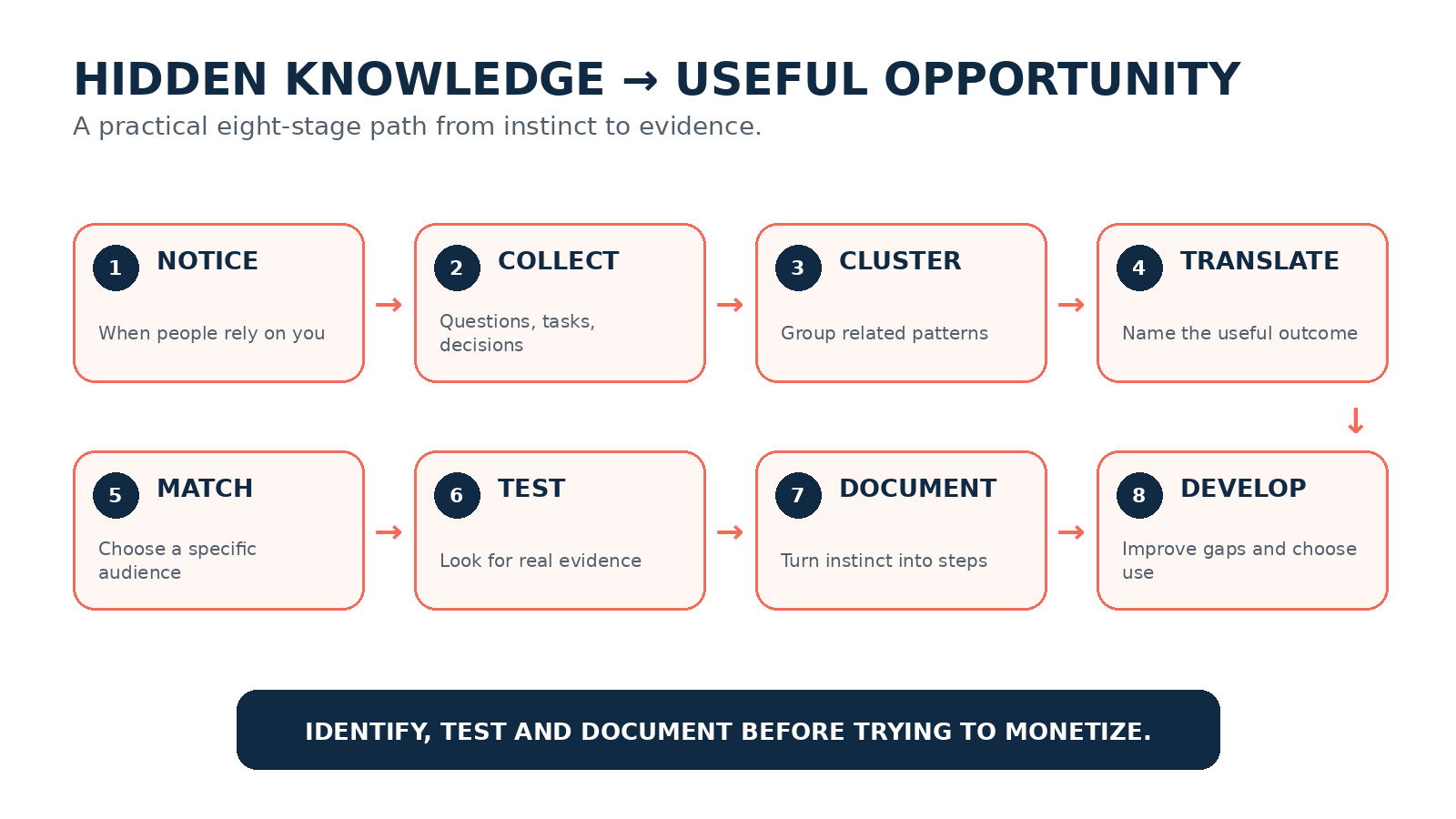 Identify, test and document before trying to monetize.
Roles I have held: ______________________________
Projects I have completed: _______________________
Problems I repeatedly solved: ____________________
Questions people ask me: _________________________
Tasks that feel easy to me: _______________________
Mistakes I learned to avoid: _____________________
Processes I improved: ____________________________
Decisions I regularly made: ______________________
Tools I know how to use: _________________________
People I have helped: ____________________________
Outcomes I can explain: __________________________
Knowledge I can demonstrate: _____________________
Knowledge I need to strengthen: __________________
Confidential information I must exclude: _________
Potential audience: ______________________________
Problem the audience faces: ______________________
Possible service or product: _____________________
Evidence of demand: ______________________________
Smallest useful test: ____________________________
Write every meaningful role from the last several years—paid, unpaid, formal and informal. Under each one, add three real situations you handled. Evidence to collect: project names, dates, public examples, certificates where relevant and non-confidential outputs. Expected outcome: a broad experience map.
Highlight tasks, questions and frustrations that appeared more than once. Look through old notes, calendars and public work rather than relying only on memory. Evidence: repeated requests or recurring task patterns. Outcome: a shortlist of problems.
For each shortlist item, write what you actually did, what choices mattered and which mistakes changed your method. Evidence: sanitized checklists, before-and-after demonstrations or public examples. Outcome: the beginnings of a personal method.
Replace labels such as “Excel” or “social media” with practical statements about what the knowledge helps someone do. Evidence: one clear task → deliverable → supported outcome chain. Outcome: language a potential user can understand.
Choose one reachable group whose situation you understand. Describe what they are trying to do, what currently blocks them and what they use instead. Evidence: real conversations, search behaviour or existing solutions. Outcome: one audience-problem hypothesis.
Show a small demonstration, checklist or explanation to suitable people and observe whether they use it. Ask what is confusing, missing and useful. Evidence: completed actions, follow-up questions, downloads, pilot use or payment where appropriate. Outcome: a tested signal, positive or negative.
If the evidence is promising, choose the smallest format that can deliver the value: service, template, workshop, guide, spreadsheet or another appropriate format. If evidence is weak, refine the problem instead of building more. Outcome: a tested knowledge opportunity—not guaranteed income.
Knowledge becomes valuable when it helps a specific person solve a meaningful problem, complete a task, avoid a mistake, save time or achieve a useful improvement.
Review repeated problems you solve, questions people ask, processes you improved, mistakes you learned from, tools you can use and outcomes you can demonstrate.
Familiarity often hides competence. Compare your current ability with a beginner’s starting point and test whether your explanation or method actually helps.
Not for every topic, but you must stay within your competence and describe your level honestly. Regulated or high-risk advice may require professional qualifications.
You cannot know from compliments alone. Test demand through interviews, demonstrations, waitlists, pilots, preorders where responsible or a small paid service.
People may still value organization, specificity, local context, tested templates, implementation guidance, curation and time savings.
Yes. AI can help interview you, organize experiences, group patterns and suggest validation questions. It should not invent skills or expertise you do not have.
Tacit knowledge is practical know-how that can be difficult to express because it has become intuitive through repeated experience. Documenting decisions and examples helps make it explicit.
Separate general lessons from employer-owned documents, internal data, private strategies, customer records, proprietary code and contract-restricted material.
Sometimes. First identify a useful lesson, audience and problem, then test whether the knowledge helps. Do not present personal experience as professional advice where specialist qualifications are required.
The question is not “What do I know that sounds impressive?” It is “Where have I repeatedly become useful?” Notice those moments, collect evidence, cluster related experiences, translate them into outcomes, match them to a specific audience, test whether they help, document the method and keep developing your competence.
That process may reveal a freelance service, a better portfolio direction, a training need, a useful article or the beginning of a digital product. It may also reveal that an idea is not ready—and that is useful information too.
Discover more articles you might be interested in

Learn where to find reliable step-by-step guides online, how to choose the right tutorial for your task, check whether it is current and follow instructions safely.
By Davie
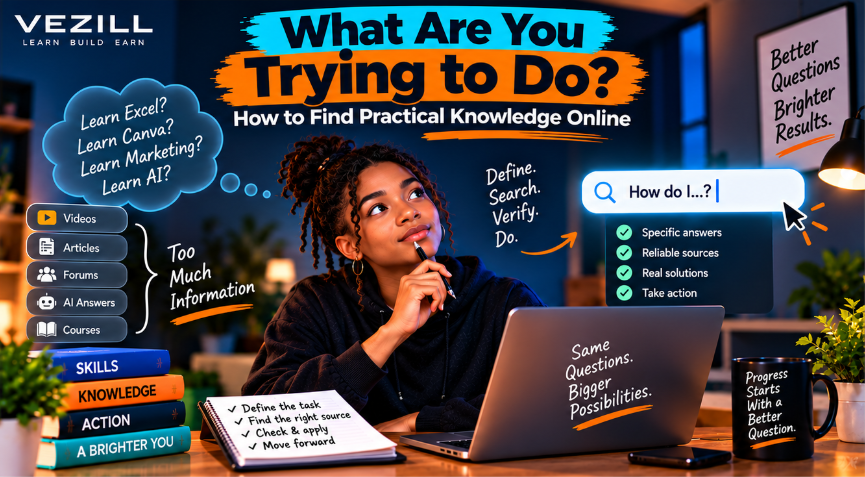
Stop searching broad topics and start finding the exact knowledge you need. Learn how to define your problem, search smarter, choose reliable sources, verify answers and take action.
By Davie
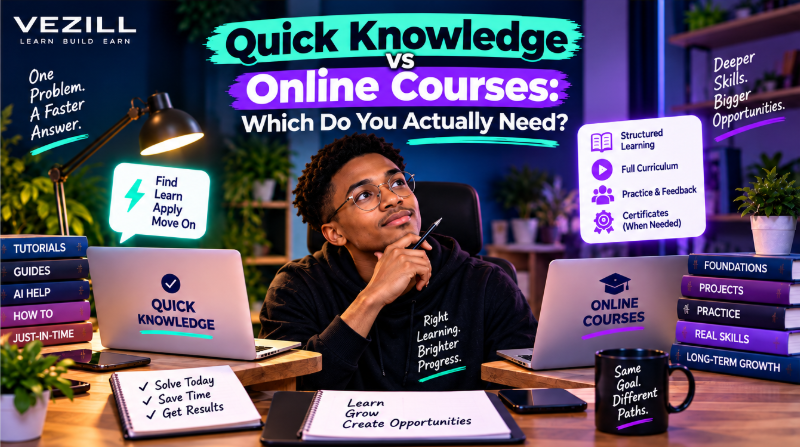
Quick Knowledge or an online course? Learn when a focused answer is enough, when structured learning is better, and how to choose the right learning depth for your goal.
By Davie

Learn how to turn one useful digital product into multiple income streams through premium versions, bundles, courses, licensing, services, subscriptions, B2B sales and complementary products.
By Davie
Get the updates, on newly released, popular & fast-moving MRR digital products
Up to Top
Comments All
Stephen
@stephen
We often don’t realize how valuable the things we already know can be. This made me stop and think about the skills and experiences I have that could actually help someone else or even turn into something useful online.
September 17,2026 At 05:31 PM