
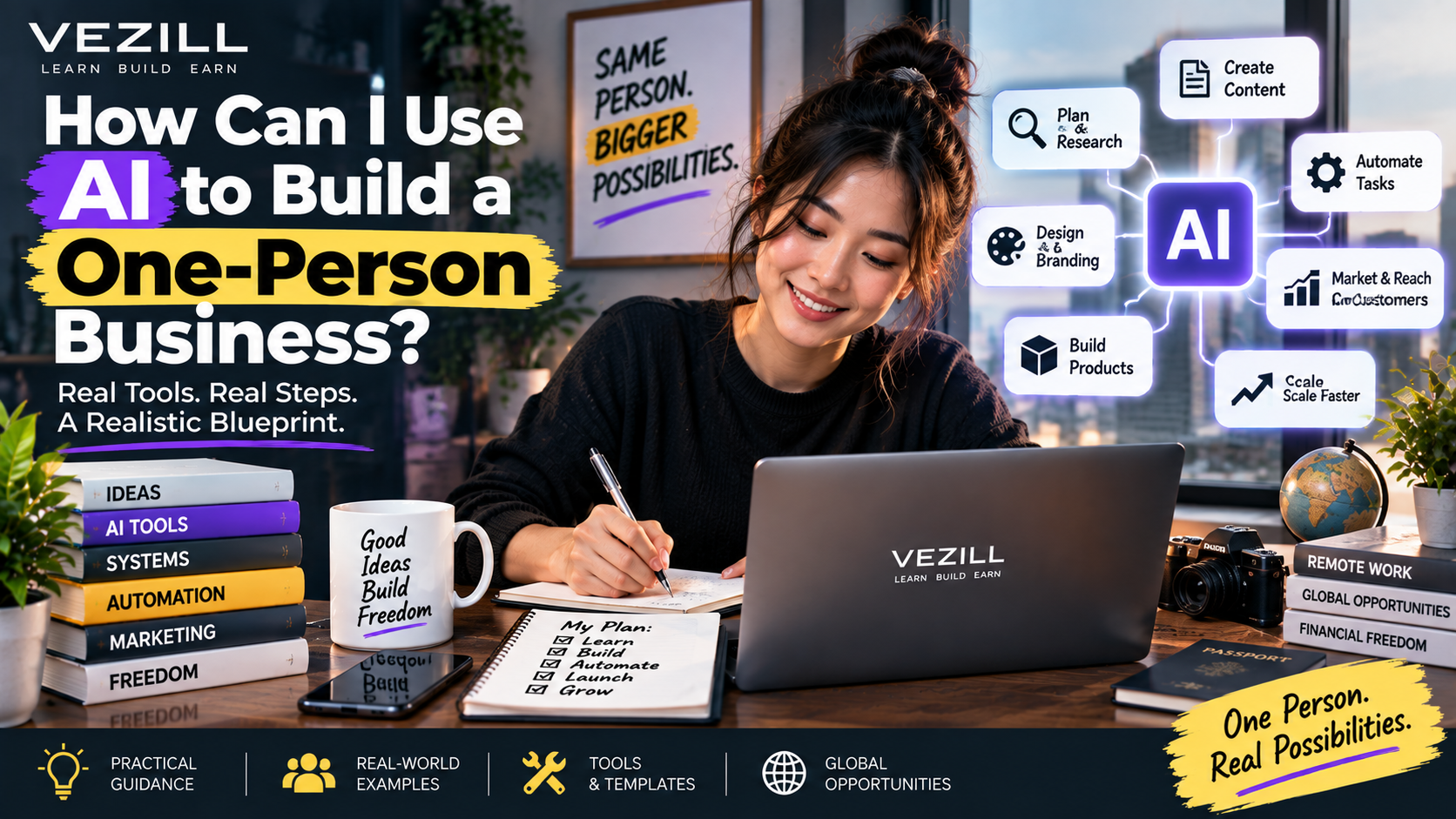
AI can make one capable person dramatically more productive—but the business still starts with a customer, a painful problem, a clear offer and a dependable way to sell and deliver it. The opportunity is not “AI does everything.” It is designing a smaller business where AI and automation reduce repetitive work while you keep control of judgment, relationships and quality.
For years, building a company usually meant hiring people as soon as the workload grew. That is changing. Modern AI can research, summarize, draft, analyze, create first versions, assist with coding and, increasingly, use connected tools to complete parts of longer workflows. Automation software can then move information between forms, calendars, CRMs, email, storage and delivery systems.
That does not mean one person can safely replace an entire company with a chatbot. It means the cost of coordinating knowledge work is falling. A founder can now spend more time on customers, positioning, decisions and quality while software handles more of the repetitive preparation and movement around those tasks.
You can use AI to build a one-person business by choosing a problem one customer group will pay to solve, creating a clear offer, and using AI to reduce the manual work involved in research, marketing, sales preparation, product creation, customer support, administration and analysis. The strongest model is not “AI does everything.” It is one person designing a business where AI handles repeatable work while the owner remains responsible for strategy, relationships, quality and important decisions.
PROBLEM → CUSTOMER → OFFER → SALES → DELIVERY → SYSTEMS → AI → AUTOMATION → SCALE
YOUStrategy • Judgment • Relationships • Accountability AIResearch • Drafting • Analysis • Assistance • Repetition AUTOMATIONTriggers • Routing • Delivery • Follow-ups • Updates BUSINESSCustomer → Offer → Sale → Delivery → Retention
Do not automate a business that has not yet proved anyone wants what it sells. AI should amplify a working process—not hide a weak business model.
A one-person business is owned and primarily operated by one person, but the operating model can take several forms.
| Model | What it means | Typical constraint |
|---|---|---|
| Freelancer | Sells personal labour or expertise directly. | Income often remains tied to delivery time. |
| Solopreneur | Owns and operates a business primarily alone. | Owner coordinates every function. |
| Productized service | Sells a standardized outcome or process. | Needs tight scope and repeatability. |
| Creator business | Monetizes audience, expertise or content. | Distribution is essential. |
| Digital-product business | Creates a reusable asset and sells access repeatedly. | Product still needs demand and support. |
| Micro-SaaS | Runs a narrowly focused software product. | Maintenance, reliability and support. |
| AI-enabled service | Uses AI internally to deliver a human-owned service more efficiently. | Human remains accountable for quality. |
| One-person company | Founder coordinates software, contractors, AI and automation rather than a traditional team. | Operational complexity can still grow. |
These categories overlap. A freelance analyst can become a productized reporting service, then sell a template, then build a tiny software tool. The one-person model describes how the business is operated—not one fixed revenue model.
The biggest change is not simply faster content creation. AI increasingly reduces the cost of coordination: gathering information, turning notes into drafts, preparing decisions, moving information between systems and checking recurring work.
| Business Function | Traditional One-Person Workflow | AI-Assisted Workflow | Human Still Responsible For |
|---|---|---|---|
| Research | Hours of manual browsing | AI-assisted synthesis | Verification |
| Writing | Blank-page drafting | Structure and first drafts | Accuracy and voice |
| Design | Manual ideation | Concepts and variations | Brand judgment |
| Sales | Manual preparation | Lead/account research | Relationship and closing |
| Support | Repetitive responses | Suggested or bounded answers | Escalations |
| Analytics | Manual interpretation | Summaries and anomaly surfacing | Decisions |
| Administration | Repeated processing | Workflow automation | Oversight |
| Product creation | Everything manually | AI-assisted production | Expertise and testing |
| Coding | Developer-only execution | AI-assisted development | Architecture, security and testing |
AI reduces the cost of coordination. That may matter more than “AI creates content.”
OpenAI now describes agents as moving knowledge work from short interactions toward delegated, longer-horizon tasks, while modern workflow platforms such as Zapier combine AI reasoning with deterministic triggers, actions, filters and branching. The practical implication for a one-person business is that more work can be prepared or executed before you personally touch it—but only within boundaries you design.
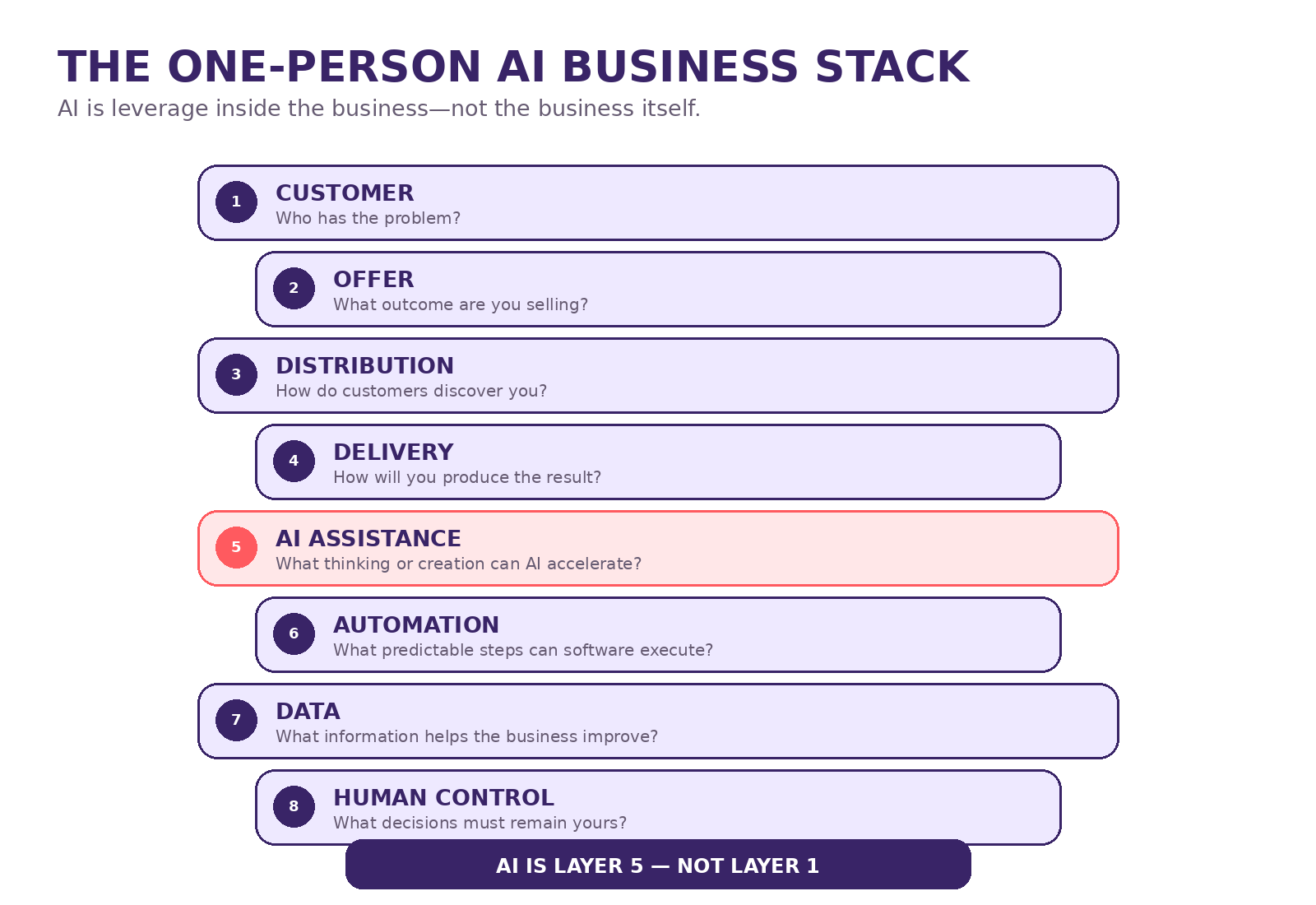 AI belongs inside a business system. It is Layer 5—not Layer 1.
A useful one-person business can be designed as eight layers.
Who has the problem? If the answer is “everyone,” you probably have not defined the market clearly enough.
What useful outcome are you selling? The customer buys an outcome, not your collection of AI subscriptions.
How will the right people discover you? Search, marketplaces, referrals, professional networks, email, content, partnerships or direct outreach may all work depending on the market.
What must happen after someone pays? This is the operational core of the business.
Which research, drafting, analysis or preparation tasks can AI accelerate?
Which predictable steps can software execute when a known event occurs?
What do you need to measure to understand acquisition, conversion, delivery, retention, quality and cost?
Which decisions must remain yours because they involve judgment, risk, customer relationships, money, reputation or legal responsibility?
If you start at Layer 5 by asking “What AI business should I build?” you may create something technically interesting but commercially irrelevant.
The strongest one-person systems divide work by risk and repeatability.
Market choice, customer understanding, strategy, pricing, negotiation, sensitive communication, ethical decisions, financial decisions, quality control, legal responsibility, brand direction and final approval.
Research, summarization, brainstorming, drafting, categorization, data analysis, meeting notes, content repurposing, documentation, FAQs, lead research, proposal drafts, support drafts, formula generation and competitive research.
Form submissions, file routing, notifications, CRM updates, scheduling, data synchronization, standard delivery workflows, status changes and recurring reports.
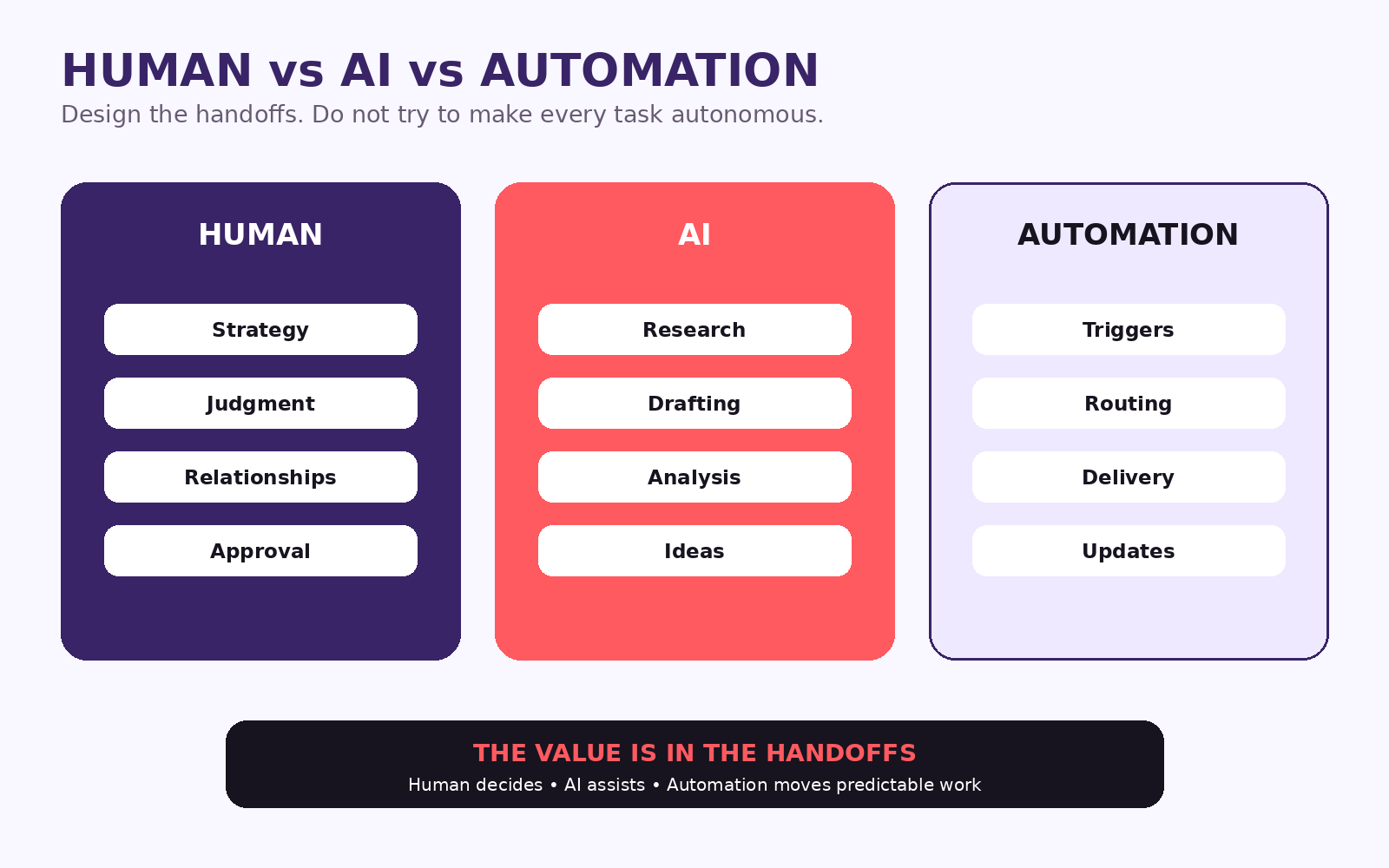 Design the handoffs: human decides, AI assists, automation moves predictable work.
A business system still has to move customers through a real journey:
TRAFFIC → LEAD → QUALIFICATION → SALE → ONBOARDING → DELIVERY → SUPPORT → FOLLOW-UP → RETENTION / UPSELL → ANALYTICS
AI may research a lead or draft a proposal. Automation may create the CRM record and schedule reminders. You may hold the discovery call, make the pricing decision, approve the final output and handle an unhappy customer. The goal is not to remove yourself from everything. It is to reserve your attention for the parts that create trust or carry meaningful risk.
These models are not guaranteed opportunities. They are business structures that can be tested against specific markets.
Customer: businesses needing SEO, writing, research, design, marketing or analysis. Owner: discovery, expertise, final delivery. AI: research, drafts, summaries. Automation: intake, reminders, file routing. Revenue: project or retainer. Main risk: generic output and overreliance on AI.
Sell a defined deliverable such as an SEO audit, competitor report or content package. AI can speed preparation while a fixed scope makes automation easier. Additional help becomes necessary when custom exceptions dominate the standardized process.
Guides, templates, spreadsheets, toolkits and mini-courses can be created from real expertise. AI can organize and edit; automation can deliver files and follow-up. VEZILL's guide on creating a digital product with AI covers this model in more depth.
AI can help summarize sources, organize research and repurpose issues. The owner still chooses the editorial angle, validates facts and builds trust. Revenue may come from sponsorship, subscriptions, services or products.
Sell verified market, competitor or industry reports. AI speeds synthesis; human verification is critical. Recurring reports can create recurring revenue.
Help small businesses map repetitive workflows and implement bounded automations. Human skills in process design, data handling and error recovery matter more than simply knowing a tool interface.
Create useful media around one problem or audience. AI can support research and repurposing, but mass-generating low-quality content is not a strategy.
Teach a skill through workshops, courses or resources. AI assists curriculum planning and examples; the teacher remains accountable for accuracy.
One founder can initially coordinate AI, automation and occasional contractors to deliver a narrow service. The business stops being truly one-person if delivery consistently depends on a hidden team, so scope the label honestly.
Build a narrow software tool solving one recurring workflow. Coding agents can reduce implementation friction, but architecture, security, testing, support and uptime still require real responsibility.
Offer product-description cleanup, catalog organization, customer FAQ systems or analytics support to stores. Avoid giving AI access to sensitive customer or payment data unless necessary and properly controlled.
Provide compliant, high-quality prospect research and outreach preparation. Avoid mass spam, deceptive identities or unauthorized scraping.
Turn raw business data into recurring reports or dashboards. AI can surface patterns; the analyst verifies calculations and context.
Help teams adopt AI safely for specific workflows. The owner needs practical AI literacy, facilitation ability and a strong grasp of privacy and business process.
| Business Model | Beginner Difficulty | Startup Cost | AI Leverage | Human Expertise Needed | Recurring Revenue Potential | Automation Potential | Validation Speed | Scalability |
|---|---|---|---|---|---|---|---|---|
| AI-assisted freelancing | Low–Medium | Low | High | High | Medium | Medium | Fast | Medium |
| Productized service | Medium | Low | High | High | High | High | Fast | High |
| Digital products | Low–Medium | Low | High | Medium–High | Medium | High | Moderate | High |
| Newsletter | Medium | Low | Medium | High | Medium–High | Medium | Moderate | Medium–High |
| Research service | Medium | Low | High | High | High | Medium | Fast | Medium |
| AI automation consulting | High | Medium | High | High | High | High | Moderate | High |
| Micro-SaaS | High | Medium | High | High | High | High | Slow | High |
| Data/reporting service | Medium | Low–Medium | High | High | High | Medium | Fast | Medium–High |
Use this equation:
SKILL × PROBLEM × CUSTOMER × DISTRIBUTION × AI LEVERAGE
Do not start with “What AI business should I build?” Start with “What valuable problem can I solve better because AI gives me leverage?”
Avoid “small businesses.” Prefer a group with a recognizable context: independent ecommerce stores selling beauty products, accounting firms that struggle to publish educational content, or property managers with repetitive tenant communication.
Study complaints, reviews, job postings, freelance requests, community discussions, competitor services, bottlenecks and repetitive manual work.
Validate the offer with conversations, proposals, pilots or commitments. Do not spend months wiring automations for a service nobody has bought.
Learn what customers actually need, which steps repeat, which exceptions occur and which decisions require judgment.
Write the SOP as INPUT → PROCESS → DECISION → OUTPUT. If you cannot explain the process, you are not ready to automate it safely.
Examples: research → summary, notes → report, brief → first draft, dataset → observations, customer question → suggested answer.
For example: form submitted → create record → notify owner → generate draft → human approves → send or deliver.
Automation without customers creates nothing. VEZILL's article on selling AI products without an audience makes the same distinction: audience is optional; distribution is mandatory.
Track leads, conversion, delivery time, satisfaction, repeat purchases, refunds, support issues, AI errors and cost per delivery.
Keep high-risk and high-judgment work close. Automate boring predictability, not accountability.
A practical schedule might use Monday for market/customer research, Tuesday for sales, Wednesday for delivery or product creation, Thursday for content and distribution, and Friday for follow-up, analytics and process improvement. Real schedules will vary.
AI can prepare research briefs, summarize tasks, draft reports, repurpose content and prepare follow-up drafts before you review them. The purpose is to reduce context-switching—not to fill every day with AI output.
Customer: small accounting firms. Problem: they know their subject but rarely publish useful educational content. Offer: a monthly educational content package.
Human owner: discovery, positioning, expert interviews, final editing and client relationship. AI: transcript analysis, topic extraction, outlines, first drafts and repurposing suggestions. Automation: intake, scheduling, file organization, status notifications and content-calendar updates.
LEAD → DISCOVERY → PAYMENT → INTERVIEW → AI PROCESSING → HUMAN REVIEW → CLIENT APPROVAL → DELIVERY → RENEWAL
This is hypothetical. The model works only if the customer values the result and the owner can maintain quality.
An experienced HR professional could create an original hiring toolkit for small companies. AI might help organize the professional's knowledge, draft checklist versions, create fictional examples and prepare marketing variations. The human supplies the actual framework, accuracy and legal/ethical judgment.
Automation could handle purchase confirmation, delivery, onboarding email and follow-up. If your business begins with a guide, template or toolkit, VEZILL's broader article on what you can create and sell online using AI is a useful companion.
Traditional AI often follows PROMPT → RESPONSE. An agentic workflow is closer to GOAL → PLAN → TOOL USE → ACTION → CHECK → RESULT.
Research agents can gather and organize public information. Content agents can turn approved source material into drafts. Support agents can answer approved common questions and escalate exceptions. Analytics agents can surface anomalies. Coding agents can help build and test software. Operations agents can coordinate repeatable workflows across connected systems.
The key change is tool use. For example, Zapier's 2026 AI workflow documentation describes agentic steps that can reason and act with tools inside deterministic workflows, while OpenAI describes current agentic work as delegated, longer-horizon tasks rather than single chat exchanges.
AGENT + PERMISSION + BAD INSTRUCTION = BUSINESS RISK.
Use approval gates, limited permissions and clear recovery paths.
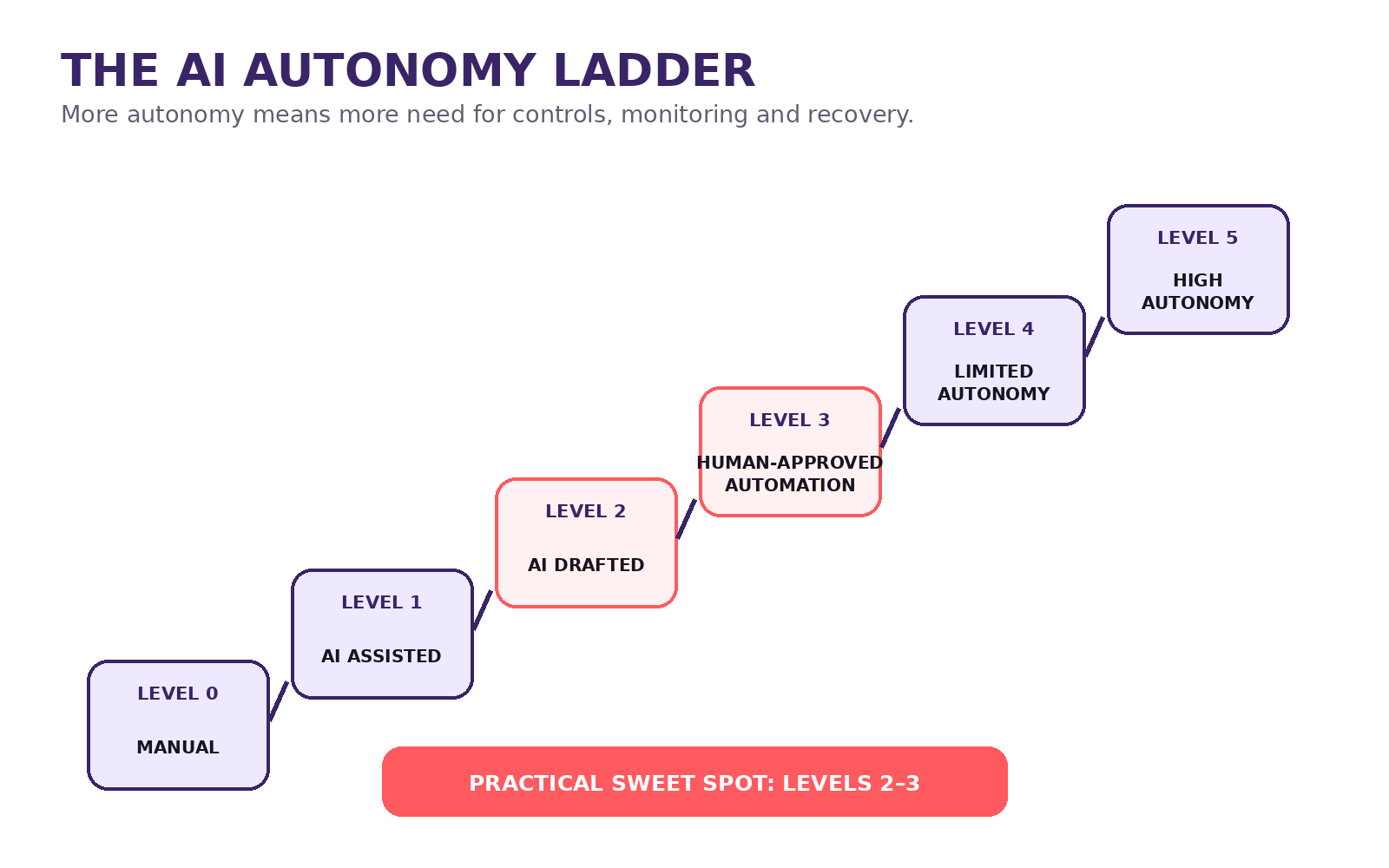 For many small businesses, AI-drafted work and human-approved automation are a practical sweet spot.
Do not jump from Level 0 to Level 5 because a tool demo looks impressive.
AI can research prospects, summarize accounts, suggest personalization, draft proposals, prepare objection responses and update CRM notes. It should not create fake personalization, deceptive identities, mass spam, fabricated testimonials, false scarcity or invented case studies.
Human relationships remain especially important where buyers need trust before committing money or sharing sensitive information.
A practical content loop is RESEARCH → BRIEF → DRAFT → HUMAN INSIGHT → PUBLISH → REPURPOSE → ANALYZE → IMPROVE. The human insight step is what prevents your content from becoming indistinguishable from thousands of generic AI posts.
Distribution can include search, email, professional networks, communities, marketplaces, partnerships and carefully targeted outreach. VEZILL's article on digital entrepreneurship with AI explores several of these routes.
A safe support flow can be: customer question → knowledge-base search → AI suggested answer → low-risk approved response or human escalation.
Refunds, complaints, financial issues, legal questions, angry customers, personal data and unusual exceptions often deserve human review. A support agent should not improvise company policy.
AI may assist with categorization, invoice drafts, expense summaries, cash-flow explanations, report summaries and reminders. It should not be treated as a substitute for an accountant, tax professional, lawyer or financial adviser where professional expertise is required.
Your basic dashboard should track acquisition, conversion, delivery, retention, quality and AI performance. Include AI errors, corrections, cost and time saved. AI can summarize the data; you decide what the business should do next.
AI is not automatically free. A one-person business can accumulate subscriptions, API usage, automation operations, storage, email software, hosting, payment-processing fees and agent-run costs faster than expected.
REVENUE PER WORKFLOW COST PER WORKFLOW
Do not automate a task that creates less value than the tools required to automate it. Start with fewer tools: one general AI assistant, one document workspace, one automation platform when needed, simple CRM tracking, one payment solution, cloud storage, basic analytics and one or two distribution channels.
A one-person business usually needs fewer tools than social-media screenshots suggest. Too many subscriptions create cost, duplicated features and operational confusion. Start with categories, not brands.
| Category | Purpose | When You Actually Need It |
|---|---|---|
| AI brain | Research, drafting, analysis and assistance | From the beginning, if it clearly saves time |
| Documents/workspace | Notes, SOPs, product files and business knowledge | Immediately |
| CRM | Track leads, customers and follow-ups | As soon as conversations become difficult to remember manually |
| Automation | Connect triggers and predictable actions | After the workflow repeats reliably |
| Payments | Collect money and record transactions | As soon as the offer is ready to sell |
| Storage | Protect and organize business files | Immediately |
| Analytics | Measure acquisition, conversion and delivery | As soon as real activity begins |
| Distribution | Reach customers | Before launch—not after everything is built |
A common mistake is assembling an impressive AI stack before the first customer conversation. The better sequence is to solve the problem manually, note where work repeats, then add the smallest tool that removes a real bottleneck. If a spreadsheet can replace a CRM for the first ten leads, use the spreadsheet. If a manual approval takes two minutes once a week, it may not deserve an agent. Complexity should earn its place.
Do not judge AI adoption by the number of tasks you automate. Judge it by whether the business improves. A useful AI workflow should do at least one of four things: reduce delivery time, improve consistency, expand capacity or make better information available for a decision.
For example, an AI research step that saves two hours but introduces thirty minutes of fact-checking may still be worthwhile. An automated support bot that answers quickly but creates refund disputes is not. A proposal generator that produces ten proposals per hour is useless if the proposals are generic and damage response rates.
Measure a workflow before and after implementation. Record approximate human time, tool cost, corrections required, customer outcome and frequency. This lets you calculate whether the workflow genuinely creates leverage or only shifts work somewhere less visible.
Simple leverage test: Did the system make the customer outcome better, faster, more consistent or easier to deliver without creating unacceptable new risk?
The goal is not to remain solo at all costs. “One-person business” is an operating choice, not an ideology. Hiring, contracting or partnering can be the right decision when demand has been validated and a real human bottleneck remains.
Consider additional help when customer relationships require more attention than you can provide, specialist expertise is needed, quality falls as volume increases, regulated work requires qualified review, support expectations exceed your availability, or the founder becomes the single point of failure for critical delivery.
AI may delay some hires by removing repetitive work, but it should not become an excuse for poor customer service or unsafe delegation. Sometimes the highest-leverage decision is not another automation—it is bringing in the right person.
Yes. A Kenyan founder can sell services, digital products, remote consulting, AI implementation, education, research, data analysis, marketing or ecommerce support locally or globally. The practical constraints depend on the specific customer and business model.
For Kenyan businesses handling personal data, the Office of the Data Protection Commissioner enforces the Data Protection Act, 2019 and regulates data controllers and processors. That matters if your AI workflows process customer names, contact details, employee information or other personal data. Do not send sensitive customer data into third-party AI tools merely because an integration makes it convenient.
Payment availability, taxes, business registration, currency and platform terms should be checked against current official sources for the exact business. Africa is not one market; a workflow appropriate for Nairobi may not match a customer in Lagos, Johannesburg or London.
These are illustrations, not verified businesses or guaranteed opportunities.
Skill: campaign strategy. Customer: local service firms. Problem: inconsistent content. Offer: monthly content system. AI: research and drafts. Automation: intake and calendar updates. Human: strategy and final editing. Revenue: retainer. Risk: generic content.
Create financial-reporting templates for small businesses. AI can explain formulas or summarize trends; the accountant verifies calculations and avoids personalized financial advice beyond scope.
Create original educational resources or workshops. AI supports examples and lesson variations; the teacher maintains instructional quality.
Build a narrow micro-SaaS. Coding agents accelerate implementation; the developer owns architecture, security and reliability.
Offer recurring management reports. AI can surface patterns; the analyst validates data quality and interpretation.
Build niche brand-template systems. AI assists ideation; the designer controls visual quality and licensing.
Create an original hiring toolkit or training offer. AI organizes content; the professional handles employment-law sensitivity and accuracy.
Productize a client-admin system with onboarding, scheduling and follow-up. AI drafts; automation routes information; the VA manages exceptions.
Create record-keeping resources for small farms. AI assists documentation; the expert avoids unsupported agronomic claims.
Offer authorized awareness training, policy education or security reviews. AI may assist documentation, but high-risk security actions require explicit authorization and expert control.
HIGH IMPACT = HIGHER HUMAN CONTROL
Protect customer data, passwords, payment information, confidential files and company documents. Give an AI or automation only the minimum permissions required. Review third-party retention policies, access controls, data-processing terms and backup procedures.
Do not give an AI agent more access than it needs.
AI can confidently produce incorrect facts, citations, calculations, legal claims, customer information, competitor information and product specifications. Use VERIFY BEFORE CONSEQUENCE: the more costly the error, the stronger your verification process must be.
This plan aims for a validated business system—not guaranteed income.
Days 1–2: inventory skills and evidence. Days 3–4: choose a specific customer. Days 5–7: research repeated and costly problems.
Talk to suitable customers, test a clear offer and look for meaningful commitment rather than compliments.
Serve manually. Document the process. Note which steps repeat and where exceptions occur.
Add AI to repetitive cognitive work, automate predictable movement, build distribution and measure what improves.
Customer — Who pays? ______________________________
Problem — What do they need solved? __________________
Offer — What outcome do I sell? _______________________
Distribution — How do they find me? __________________
Delivery — What happens after purchase? ______________
Human Tasks — What requires my judgment? _____________
AI Tasks — What can AI accelerate? ___________________
Automation Tasks — What can happen predictably? ______
Risk — Where could automation cause harm? ____________
Measurement — What proves the business works? ________
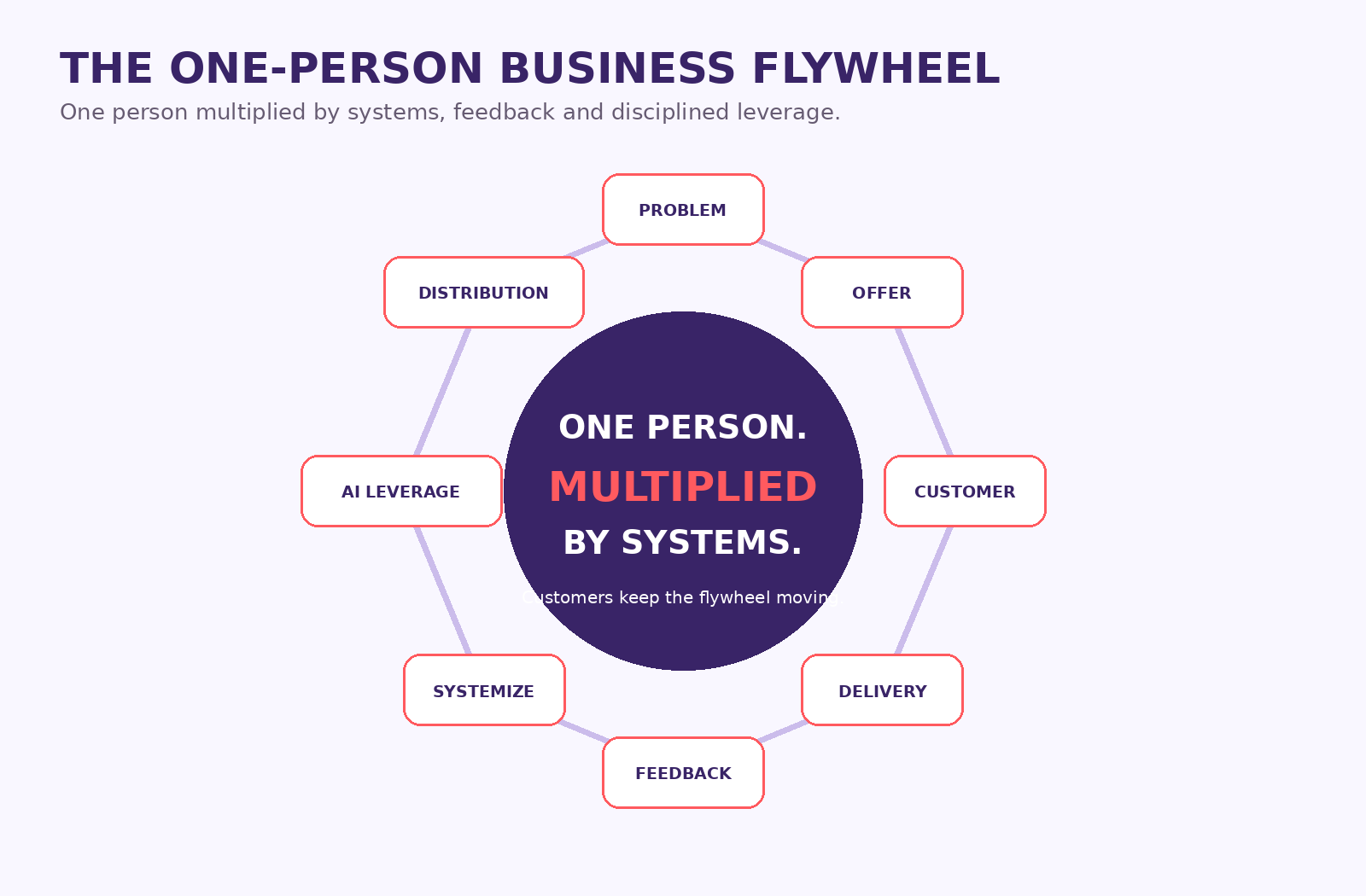 One person becomes more leveraged when customer feedback improves the system—not simply when more tools are added.
Yes, especially a narrow service, productized service, knowledge business or small software product. AI can reduce workload, but the owner still needs customers, judgment, quality control and distribution.
There is no universal best model. Start with a customer problem you understand, a clear offer and a workflow where AI creates meaningful leverage.
No for many service, digital-product and automation businesses. Coding becomes more important for custom software, integrations and technical products.
Potentially a large share of repetitive preparation and predictable workflow steps, but autonomy should be limited according to risk, reliability and consequence.
AI can reduce some tasks or delay certain hires, but it does not replace all human judgment, accountability, relationships or specialized expertise.
Usually fewer than expected: one strong general AI assistant, basic documents, customer tracking, storage, distribution and automation only when the process is proven.
Usually no. Validate the offer and deliver manually first so you understand the actual workflow before automating it.
You can research and validate with low-cost tools, but most real businesses eventually incur costs such as software, payments, hosting, internet or compliance.
Use AI for market research, account summaries, content preparation and proposal drafts. Do not rely on spam, fake personalization or deceptive identities.
AI can answer bounded common questions and draft responses. Refunds, sensitive complaints, unusual cases and high-risk issues should escalate to a person.
Yes. Choose local or global customers, then verify current payment, tax, registration and data-protection requirements for the exact business model.
Consider help when demand is proven and human bottlenecks remain after simplification, AI assistance and sensible automation—or when specialist expertise is required.
A customer problem creates the business. The offer creates value. Distribution creates access to customers. Systems create consistency. AI creates leverage. Automation creates scale. Human judgment keeps control.
ONE PERSON → ONE CUSTOMER → ONE PAINFUL PROBLEM → ONE CLEAR OFFER → FIRST SALES → REPEATABLE DELIVERY → DOCUMENTED SYSTEM → AI ASSISTANCE → AUTOMATION → LEVERAGED BUSINESS
The opportunity is not to replace an entire company with ChatGPT. It is to design a smaller, smarter business where one person uses AI and automation to accomplish more without losing control of the work that actually requires human judgment.
Discover more articles you might be interested in

Learn where to find reliable step-by-step guides online, how to choose the right tutorial for your task, check whether it is current and follow instructions safely.
By Davie

Stop searching broad topics and start finding the exact knowledge you need. Learn how to define your problem, search smarter, choose reliable sources, verify answers and take action.
By Davie

Quick Knowledge or an online course? Learn when a focused answer is enough, when structured learning is better, and how to choose the right learning depth for your goal.
By Davie

Learn how to turn one useful digital product into multiple income streams through premium versions, bundles, courses, licensing, services, subscriptions, B2B sales and complementary products.
By Davie
Get the updates, on newly released, popular & fast-moving MRR digital products
Up to Top
Comments All
Sharon
@sharon
AI is making it possible to handle so much of a business on your own. This gave me a better idea of how one person can use AI to save time, get things done faster, and actually build something without needing a big team.
September 17,2026 At 05:36 PM