David
Joined - July 2026

Learning Python, web development, cybersecurity, AI, data analysis, UI/UX, graphic design or another tech skill is valuable.
But there's an important question:
What are you actually building with those skills?
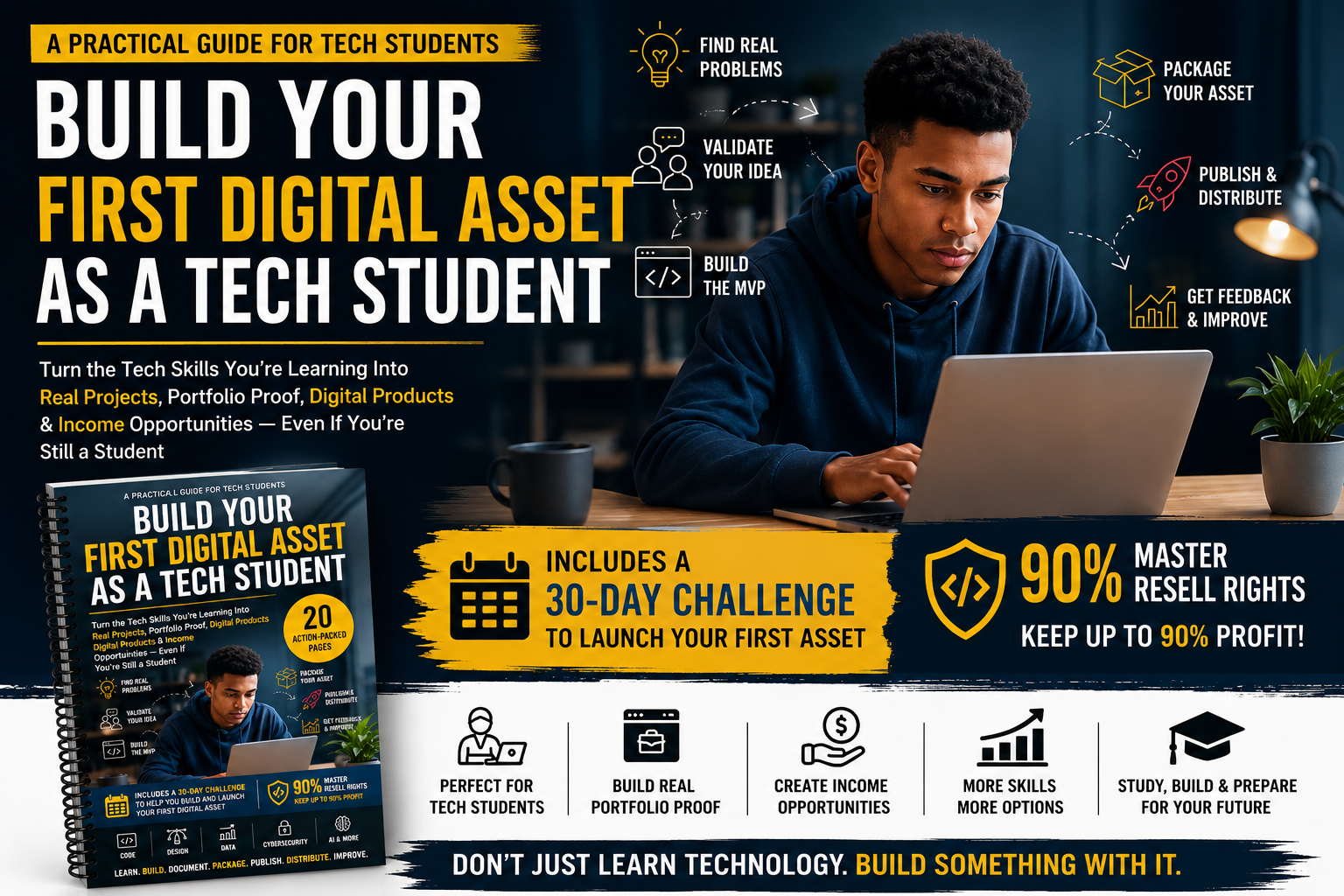
Build Your First Digital Asset as a Tech Student is a short, practical step-by-step guide designed to help technology students move beyond simply collecting skills and certificates — and start creating useful digital assets they can actually own, publish, showcase and potentially monetize.
Instead of telling you to “start a business” or build the next massive startup, this guide shows you a much more realistic approach:
ONE SKILL → ONE REAL PROBLEM → ONE SMALL USEFUL ASSET
Your first asset could be a simple software tool, website template, automation, open-source project, technical guide, UI kit, spreadsheet tool, digital product, dataset, newsletter or another useful resource.
The objective is simple:
Don't graduate with skills alone. Build something you can point to.
This practical guide walks you through the entire process, including:
This isn't a long textbook filled with theory.
It's a compact 20-page action guide and workbook designed to help you choose something useful and start building.
This guide is especially useful for:
Computer Science Students
Turn programming knowledge into tools, applications, open-source projects and portfolio evidence.
IT Students
Build practical utilities, digital resources, automation systems and useful technology products.
Software Engineering Students
Move beyond tutorial projects and start solving specific user problems.
Cybersecurity Students
Explore legitimate defensive tools, educational resources, checklists and open-source projects.
AI & Machine Learning Students
Use AI to create specialized workflows and utilities rather than another generic AI wrapper.
Data & Analytics Students
Turn your skills into dashboards, calculators, spreadsheet systems, visualizations and legitimate datasets.
UI/UX & Graphic Design Students
Create reusable templates, UI kits, design systems and other creative assets.
It's also useful for self-taught developers, recent graduates and beginner tech professionals who want more practical proof of what they can do.
A lot of career advice ends with:
Learn a valuable skill.
That's important — but it's only part of the opportunity.
This guide asks you to go one step further:
What can you create with that skill?
You don't have to choose between getting a job and becoming an entrepreneur.
You can prepare for employment while building things you own.
That means developing:
SKILLS + EXPERIENCE + PORTFOLIO PROOF + DIGITAL ASSETS + OPTIONALITY
A useful project might strengthen your CV.
An open-source tool might demonstrate your abilities.
A template might become a digital product.
A tutorial might attract an audience.
A small application might find its first users.
And even if your first asset earns nothing, the process can still leave you with stronger skills, practical experience and something real to show.
Knowing what to do isn't enough.
That's why the guide finishes with a practical four-week challenge:
Week 1 — FIND
Choose your skill, identify problems and select an idea.
Week 2 — VALIDATE
Speak to potential users and define your smallest useful solution.
Week 3 — BUILD
Create, test and document the core product.
Week 4 — PUBLISH
Release it, find your first users, collect feedback and improve.
You also get a final worksheet for defining your:
Skill → Problem → User → Asset → MVP → Features → Distribution → Success Metric → Launch Date
So you finish the guide knowing what to do next.
This purchase also includes 90% Master Resell Rights (MRR).
That means eligible buyers can resell the digital product under the supplied MRR terms and retain up to 90% of the resale revenue, subject to the applicable Vezill and product licensing conditions.
This can make the guide useful in two ways:
1. Learn from it yourself — use the framework to create your own first digital asset.
2. Resell the guide — where permitted under the included MRR license, offer the product to your own audience and retain up to 90% of eligible resale revenue.
This is 90% MRR — not 100%.
Master Resell Rights do not mean unrestricted ownership of the underlying intellectual property. Buyers should follow the specific license supplied with the product and applicable marketplace rules.
Digital Product: Build Your First Digital Asset as a Tech Student
Format: PDF
Length: 20 concise, action-focused pages
Includes: Step-by-step frameworks, checklists, examples, 30-day challenge and planning worksheet
License: 90% Master Resell Rights, subject to the supplied license terms
Delivery: Digital — no physical product will be shipped
You don't need to wait until graduation.
You don't need a huge startup idea.
You don't need to master every technology first.
Start smaller.
ONE SKILL.
ONE REAL PROBLEM.
ONE USEFUL DIGITAL ASSET.
Build it. Document it. Publish it. Get feedback. Improve.
Learn → Build → Document → Package → Publish → Distribute → Improve
Don't just learn technology. Build something with it.
Get the updates, on newly released, popular & fast-moving MRR digital products
Up to Top
Comments