
Most sellers chase more traffic when sales stall — a new channel, more posts, another ad. But there's a faster lever sitting right in front of every buyer who's already decided to purchase: raise what they spend per order. Bundling is the single highest-leverage way to do that, because it requires zero extra traffic — just a smarter offer.
This guide covers exactly how to build bundles that increase average order value without feeling like an upsell trick.
Digital product bundling means combining two or more products into one offer priced lower than buying them separately, which increases average order value (AOV) without needing more traffic. The core moves: (1) build a 3-tier offer ladder (basic, bundle, premium), (2) choose a bundling strategy — complementary, volume, tiered, or fast-action bonus, (3) anchor the bundle against the sum of individual prices, and (4) add a one-click upsell at checkout.
A buyer who was going to spend $10 anyway often happily spends $25–$40 when the extra value is obvious and the discount feels real.
Host your bundle on Vezill with instant delivery and resell rights so every product in the stack sells itself.
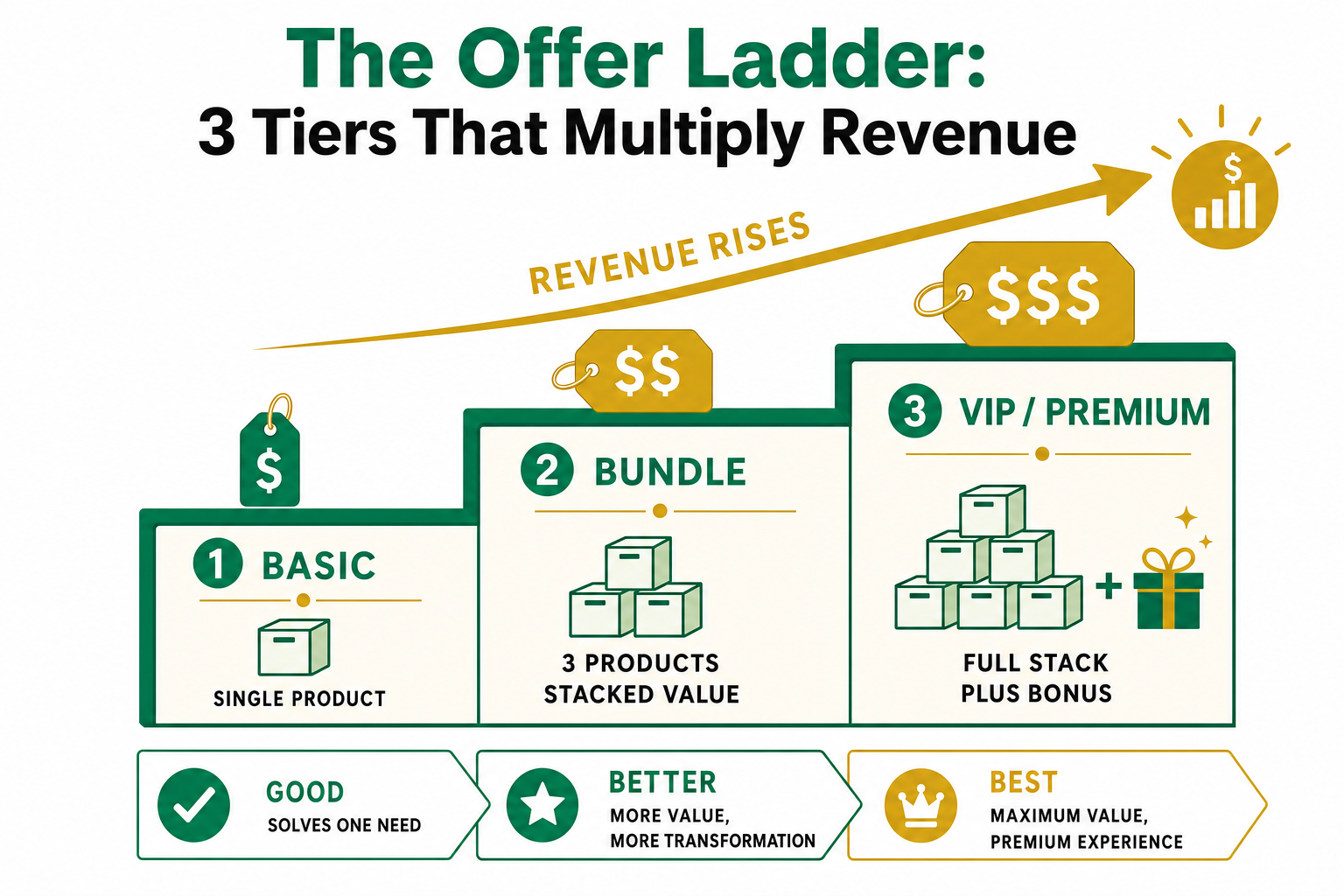 A simple three-tier ladder gives every buyer a reason to spend more.
Getting a new visitor to your page is expensive — in time, content, or ad spend. Getting an already-committed buyer to add $15 more to their order is nearly free. If your average order value goes from $10 to $25, you don't need 2.5x the traffic to hit the same revenue goal — you need the same traffic and a better offer.
Give every buyer a reason to spend more than the minimum, without forcing anyone into a price they're not ready for.
Basic is your entry product — the one that gets a "yes" fastest. Bundle stacks 2–4 related products together at a visible discount. VIP/Premium adds bonuses, priority support, or exclusive extras for buyers who want the complete package. Most buyers choose the middle tier when it's priced and framed well — that's the tier your marketing should lead with.
Not every bundle needs to be complicated — pick the strategy that fits your catalogue.
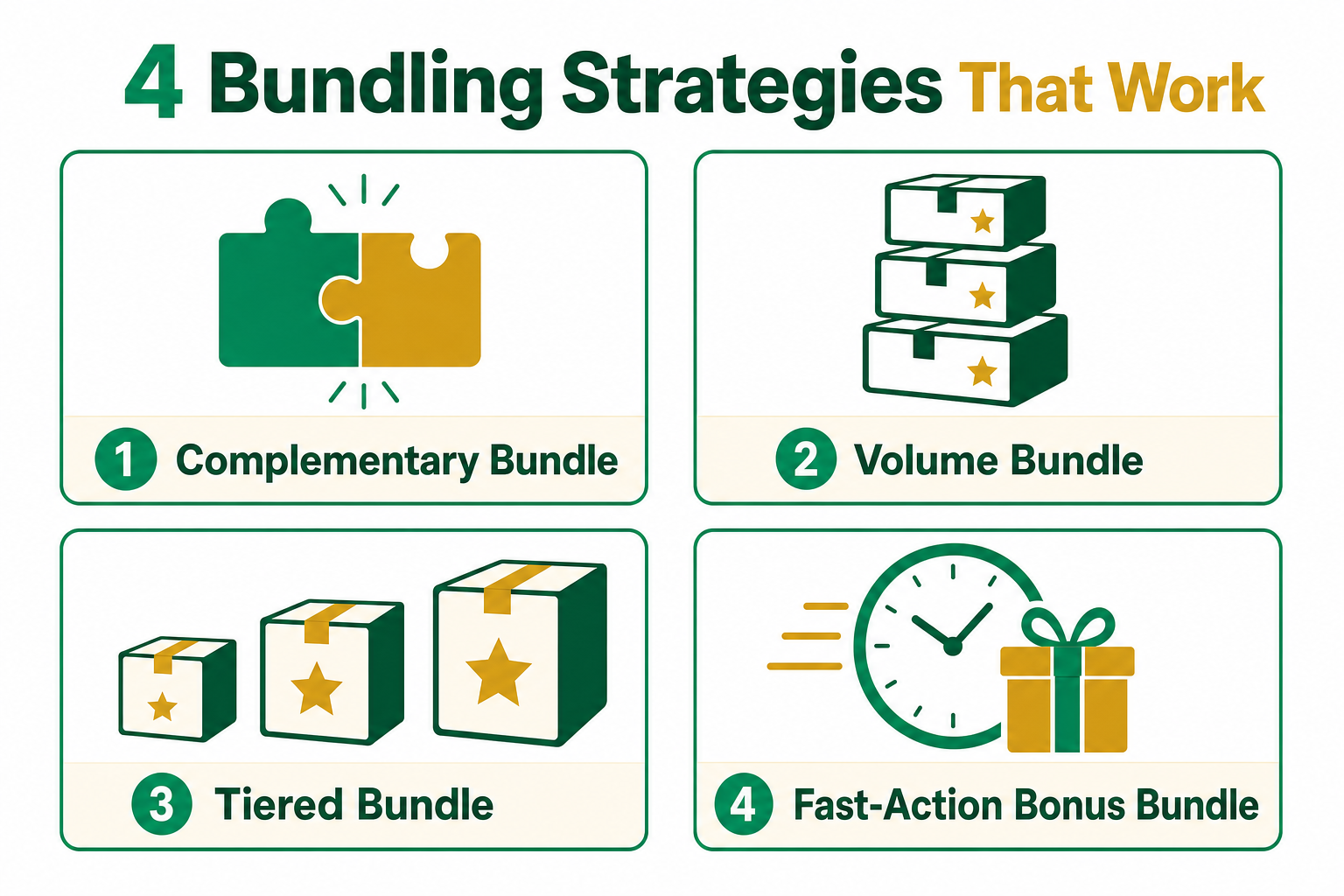 Four proven ways to combine products into an irresistible offer.
Complementary bundles pair products that solve related problems (a study guide + a revision planner). Volume bundles offer more of the same thing at a per-unit discount. Tiered bundles stack the same core offer with increasing bonuses at each price point. Fast-action bonus bundles add a time-limited extra to reward buyers who decide quickly. If you're just building your first products to bundle, "How to Create a 6-Figure Digital Product" covers the foundation of building a catalogue worth stacking.
Price isn't judged in isolation — it's judged against a reference point. Show the individual prices added up first, then reveal the bundle price beneath it.
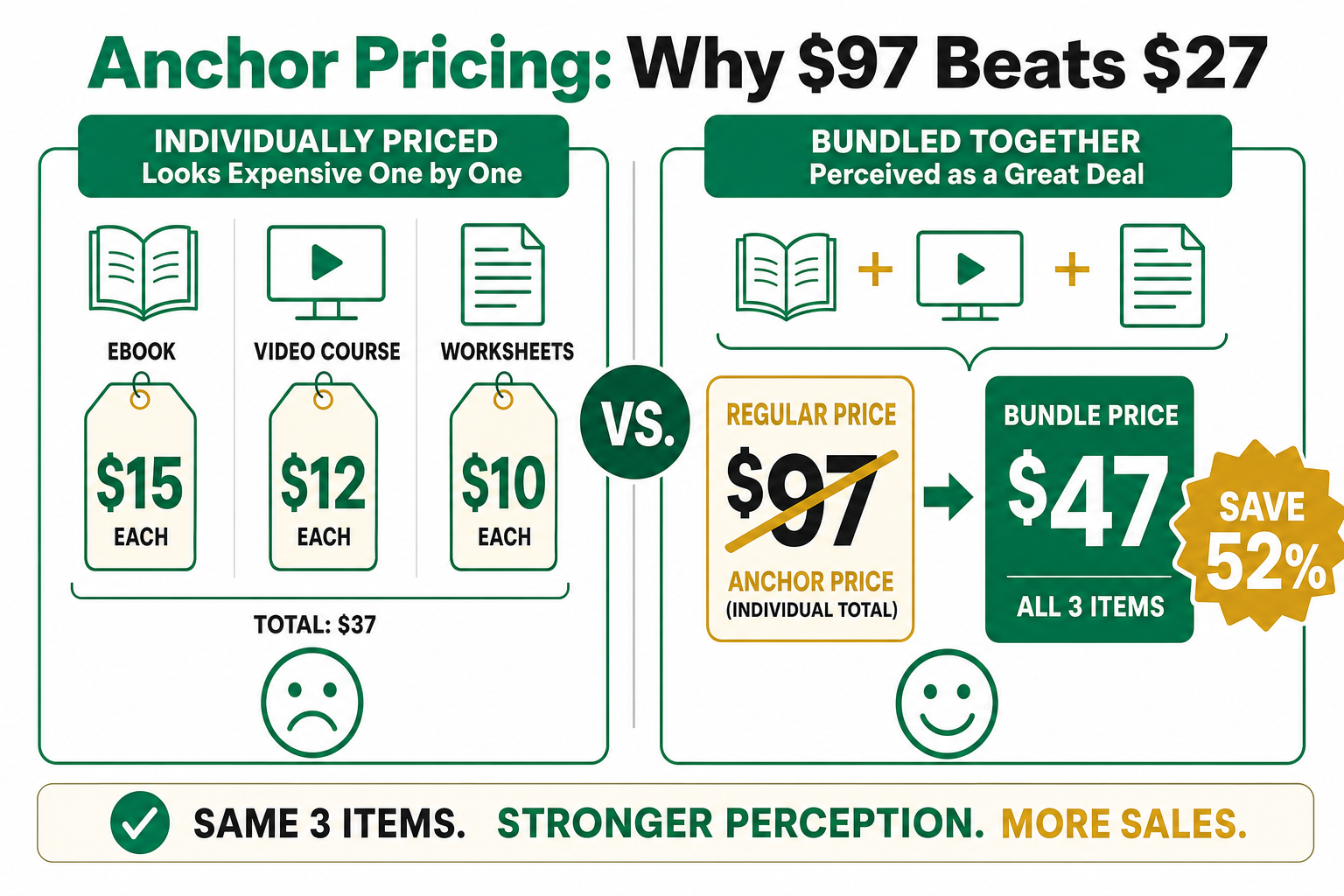 The same products, framed differently, convert completely differently.
A bundle that "saves 52%" feels like a smart decision, even if the buyer never intended to buy all three items separately. This is the same anchoring principle that drives conversion in high-converting sales pages — bundling is simply anchoring applied to multiple products at once.
Round numbers convert: A bundle priced at $47 or $97 often outperforms an oddly precise $43.20 — clean numbers feel more like a deliberate offer than a calculated markup.
The second someone decides to buy is the best moment to offer more — resistance is already gone.
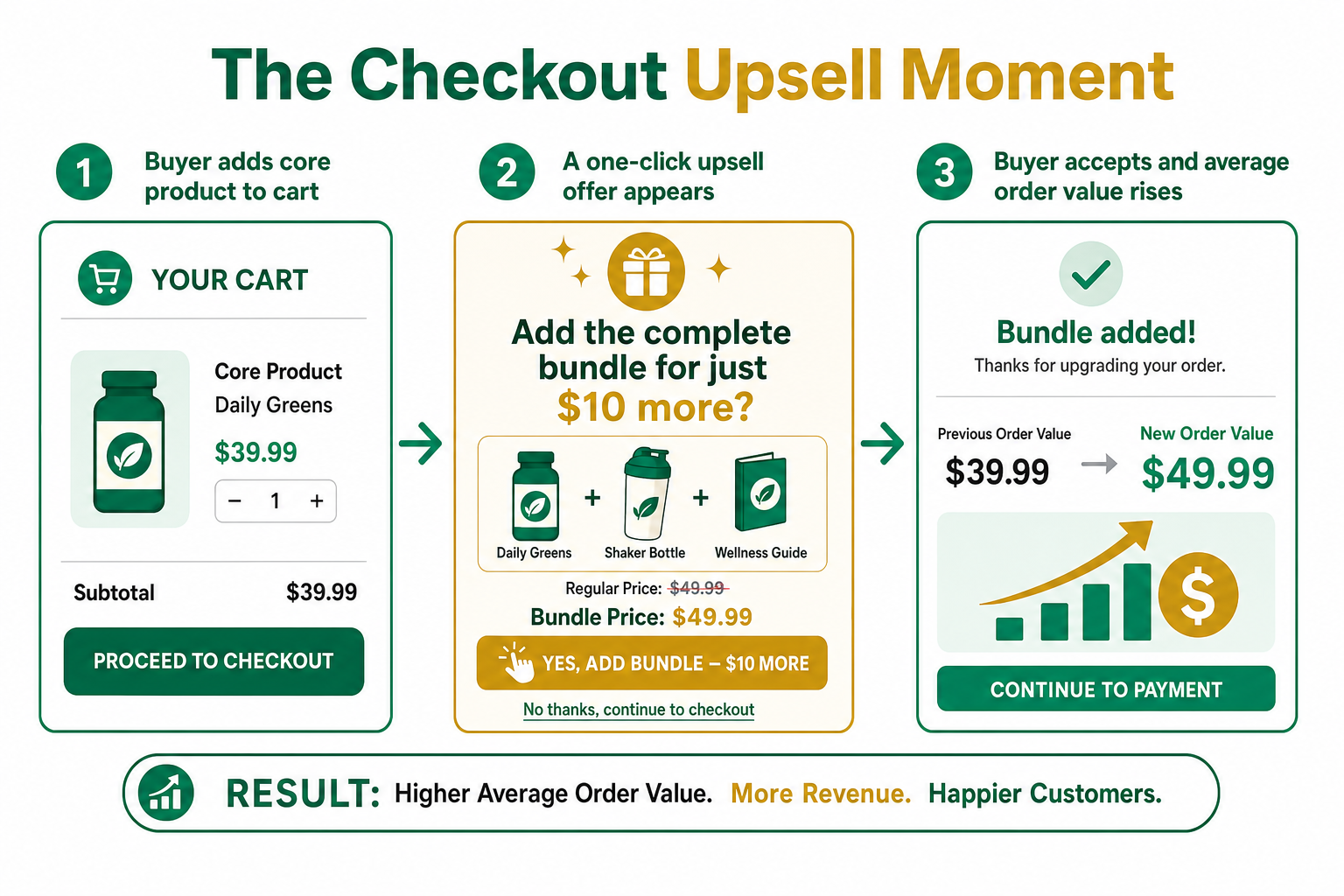 A single well-timed upsell can lift your average order value overnight.
A simple "Add the complete bundle for just $10 more?" prompt at checkout converts a meaningful share of buyers who were only planning to buy the base product. Keep the offer relevant, keep the ask small relative to the original purchase, and make accepting a single click.
Some of the strongest bundles pair two products solving the same broader goal from different angles. A great example: the KUCCPS 2026 University Placement and Admission Guide and the Scholarship & Education Funding Guide both target the exact same buyer — a KCSE graduate figuring out university — from two complementary angles: getting placed, and paying for it once placed. Bundled together, they solve one complete problem instead of half of one.
Pick 2–3 products that solve related parts of the same problem
Price each individually, then add them up as your anchor
Set the bundle price 30–50% below the anchor total
Give the bundle a name that describes the outcome, not just "Bundle #1"
Add a checkout upsell offering the bundle to anyone buying just one item
Bundling unrelated products — buyers sense a bundle built to move inventory, not solve a problem.
No visible anchor — if the discount isn't shown clearly, the bundle doesn't feel like a deal.
Pricing too close to the sum of parts — the savings need to feel real, not token.
Too many tiers — three options is usually the ceiling before choice paralysis sets in.
No upsell at checkout — the highest-converting moment to offer more is wasted if it's skipped.
You don't always need more buyers — sometimes you just need a better offer for the ones you already have. Build a simple ladder, pick one bundling strategy that fits your catalogue, anchor the price clearly, and add a checkout upsell. Small changes to how you present the same products can lift revenue without a single new visitor.
Pick two products you already sell, bundle them today, and price the bundle 30–50% below their combined total.
Digital product bundling means combining two or more digital products into a single offer, typically priced lower than the sum of the individual products, to increase the average amount each buyer spends per order.
A discount of roughly 30 to 50 percent off the combined individual prices tends to feel meaningful enough to motivate a purchase while still improving revenue compared to selling items separately.
Complementary bundling is usually easiest to start with — pairing two or three products that address different parts of the same broader problem, so the bundle clearly solves more than any single item alone.
Yes. Bundling and checkout upsells both increase how much a buyer spends per transaction without requiring additional traffic, making them one of the highest-leverage ways to grow revenue from an existing audience.
Yes. A bundle sets up the offer, and a checkout upsell captures buyers who were only planning to purchase a single item, giving them a low-friction, one-click option to upgrade at the exact moment they've already decided to buy.
Three tiers — a basic option, a bundle, and a premium or VIP option — is generally the ceiling before too many choices start reducing conversions rather than improving them.
Discover more articles you might be interested in
Affiliate Marketing for Digital Products
By Davie

Telegram Channel Marketing for Digital Products
By Davie
Facebook Groups Marketing Strategy for Digital Products
By Davie
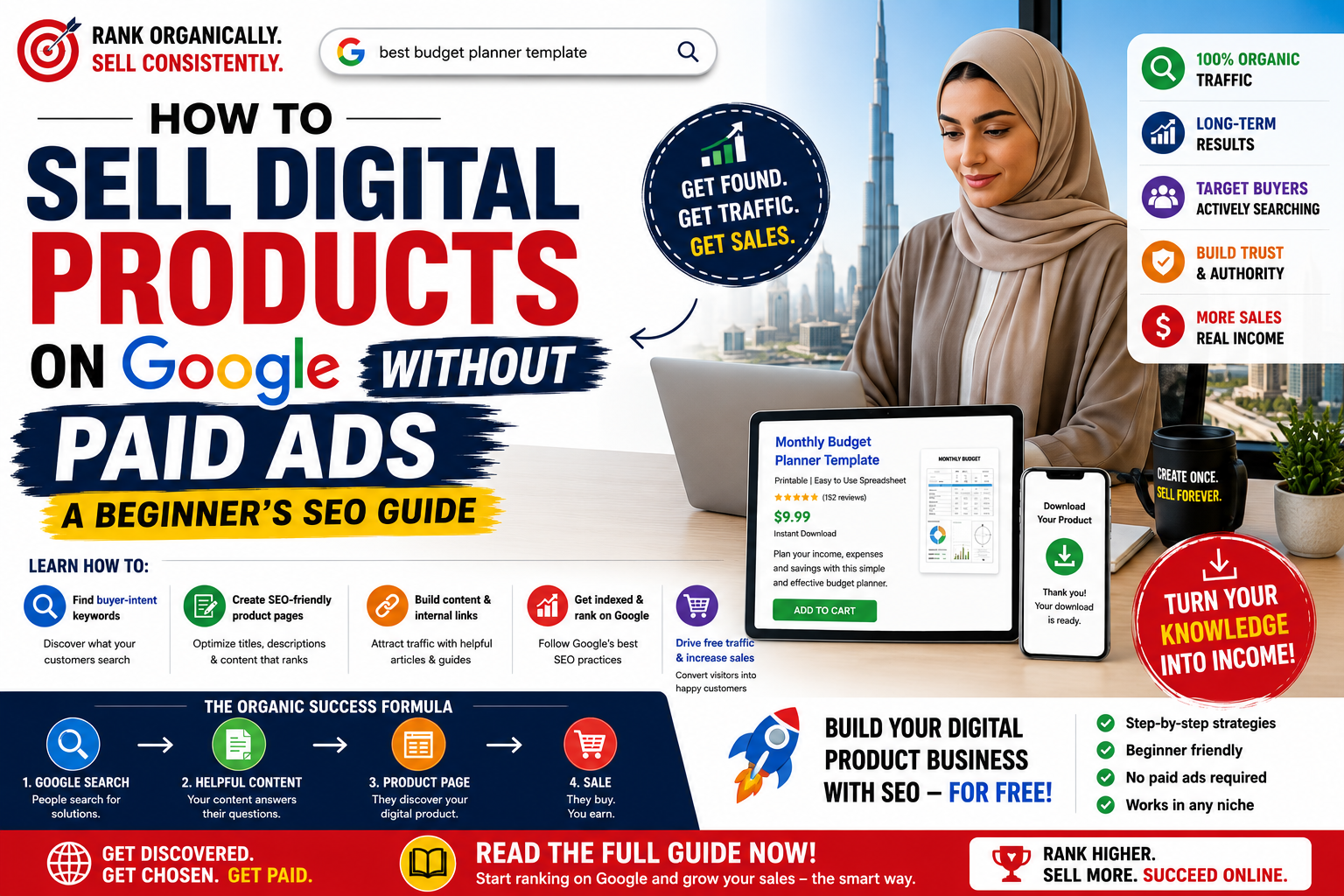
Learn how to sell digital products on Google without paid ads

By Super Admin
Get the updates, on newly released, popular & fast-moving MRR digital products
Up to Top
Comments All
Gloh
@gloh
I like the idea of bundling digital products because it can make your offer feel more valuable without making things complicated for the customer. The examples were easy to understand and gave me a few ideas I’d love to try for myself. Such a useful read!
September 07,2026 At 09:27 PM
Jesse
@jesse
Bundling digital products is a smart way to increase the value of each sale. I could apply this by combining related products into one package and offering it at a slightly better price than buying each item separately. It’s a simple strategy that could encourage customers to spend more while giving them more value.
August 26,2026 At 11:02 PM