

Making your first £1,000 online no longer requires coding, inventory, expensive equipment, or even a large social media following.
Thousands of people worldwide are earning income by creating and selling digital products such as ebooks, templates, online courses, AI prompts, planners, spreadsheets, and printable resources.
The biggest advantage?
Unlike physical products, digital products can be created once and sold repeatedly with almost no additional production cost.
Thanks to AI tools like ChatGPT, Canva, CapCut, and other productivity platforms, creating high-quality digital products has become faster than ever.
If your goal is to earn your first £1,000, this guide shows exactly how to do it, even if you're starting from zero.
Digital products are downloadable or online resources customers can purchase instantly.
Examples include:
eBooks
AI Prompt Packs
Excel Templates
Canva Templates
Study Notes
Digital Planners
Business Checklists
Online Courses
Stock Photos
Printable Worksheets
Resume Templates
Budget Planners
Meal Plans
Social Media Templates
Since there's no manufacturing or shipping involved, digital products offer extremely high profit margins.
Digital products solve several common business challenges:
No inventory
No warehouse
No shipping costs
Low startup costs
High profit margins
Global customer reach
Unlimited sales potential
Passive income opportunities
For many beginners, selling digital products is one of the simplest online business models to launch.
The biggest mistake beginners make is creating products they like instead of products customers need.
Instead, identify problems people actively search for.
Popular niches include:
Exam revision guides
Study planners
Lesson notes
Practice papers
Business plan templates
Marketing guides
Proposal templates
AI automation workflows
AI business guides
Budget spreadsheets
Debt trackers
Savings planners
Meal plans
Workout guides
Habit trackers
CV templates
Interview guides
LinkedIn optimisation kits
Never guess.
Research demand first.
Useful methods include:
Google search suggestions
AI search conversations
Community forums
Reddit discussions
YouTube comments
Keyword research tools
Google Trends
Ask questions like:
What are people struggling with?
What questions keep appearing?
What resources are missing?
What shortcuts are people willing to pay for?
The best digital products solve recurring problems.
Artificial intelligence dramatically reduces creation time.
Examples:
Write ebooks
Generate course outlines
Produce worksheets
Create prompt libraries
Design covers
Build templates
Create planners
Design workbooks
Produce tutorial videos
Edit promotional content
Create:
Budget planners
Financial trackers
Business dashboards
Instead of spending weeks creating one product, AI allows many creators to finish professional products in days.
Your pricing determines how quickly you reach £1,000.
Example:
|
Product Price |
Sales Needed |
|
£10 |
100 |
|
£20 |
50 |
|
£25 |
40 |
|
£40 |
25 |
|
£50 |
20 |
Rather than chasing thousands of customers, focus on creating a product people genuinely value.
High-converting digital products typically include:
Professional cover
Clear title
Practical content
Step-by-step instructions
Real examples
Action checklists
Templates
Bonuses
FAQs
Customers buy outcomes - not pages.
Many purchases begin with AI-assisted search.
Your product page should naturally answer questions such as:
Who is this for?
What problem does it solve?
What will buyers learn?
What is included?
Why is it different?
What results can users expect?
Include naturally relevant keywords without stuffing them.
Choose platforms that match your goals.
Some creators prefer marketplaces with existing buyers, while others build their own websites.
Look for platforms offering:
Instant digital delivery
Secure payments
Global reach
Easy uploads
SEO-friendly listings
Creator-friendly revenue sharing
If you're using a marketplace such as Vezill, you can also take advantage of Master Resell Rights (MRR) products, allowing you to legally resell qualifying digital products while keeping a significant share of each sale.
The biggest reason digital products fail is lack of marketing.
Simple daily marketing activities include:
Publish one helpful social media post.
Answer questions in your niche.
Create short educational videos.
Share customer success stories.
Write SEO blog articles.
Build an email list.
Repurpose content across platforms.
Use AI to generate content ideas.
Consistency matters more than going viral.
Successful digital sellers rarely rely on one product.
For example:
Starter Ebook (£15)
↓
Workbook (£20)
↓
Prompt Pack (£25)
↓
Video Course (£80)
↓
Membership (£15/month)
↓
Consultation (£100/hour)
Each product supports the next, increasing customer lifetime value.
Avoid spending your initial earnings immediately.
Instead, reinvest in:
Better design
AI tools
Advertising
SEO
More digital products
Email marketing
Website improvements
Video production
Scaling becomes much easier after your first profitable product.
Imagine Sarah, a university graduate who notices many students struggle with CV writing.
She creates:
A CV template
Cover letter templates
Interview preparation guide
LinkedIn optimisation checklist
She prices the bundle at £25.
After publishing helpful career tips on social media and writing search-friendly blog content, she sells 40 bundles over several months.
40 × £25 = £1,000
No physical inventory.
No shipping.
Just one well-designed digital product solving a genuine problem.
Avoid these pitfalls:
Creating products without validating demand.
Trying to appeal to everyone instead of a specific audience.
Publishing low-quality content.
Ignoring product descriptions.
Giving up after only a few weeks.
Failing to market consistently.
Pricing too low to reflect value.
Not collecting customer feedback for improvements.
Yes. Many creators reach this milestone by solving a specific problem with a useful digital product and promoting it consistently. The timeline varies based on product quality, demand, pricing, and marketing.
Not necessarily. You need enough knowledge to create something genuinely helpful, accurate, and well-organised. Research and AI tools can help improve quality, but your content should still be reviewed for accuracy and usefulness.
Popular categories include:
AI prompt packs
Templates
Educational resources
Online courses
Printable planners
Business documents
Career resources
Financial spreadsheets
Some creators make their first sales within days, while others take several months. Consistent creation, optimisation, and promotion usually matter more than speed.
Making your first £1,000 selling digital products is achievable with the right strategy.
Focus on solving a real problem, validate demand before creating, use AI to accelerate production, optimise your product pages for both search engines and AI assistants, and market consistently.
Remember that one successful digital product can become the foundation of a much larger online business. As you gain experience, expand your catalogue, refine your marketing, and improve your customer experience. Over time, your first £1,000 can grow into a reliable and scalable source of online income.
Discover more articles you might be interested in
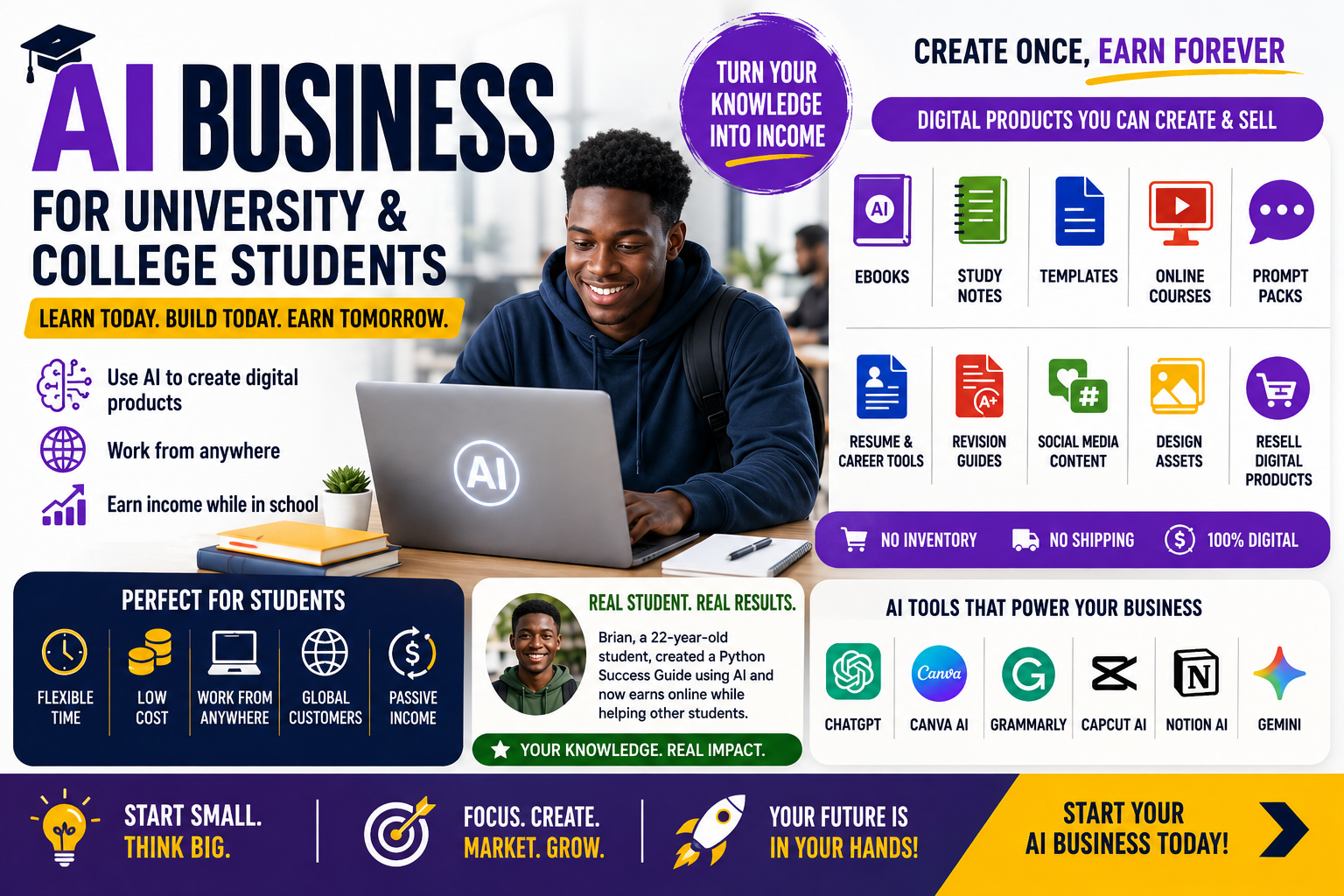
Discover the best AI business ideas for university and college students.

By Super Admin

Discover the best online businesses for teachers
By Super Admin

Passive Income in 2026: The Complete Beginner's Guide to Building Passive Income with AI and Digital Products
By Super Admin

Best platforms for digital products and make money online in Kenya and Globally
By Super Admin
Get the updates, on newly released, popular & fast-moving MRR digital products
Up to Top
Comments All
George
@george
Getting that first 1,000 from a digital product can feel like a big deal, so I found the tips here really helpful. Some of the ideas are simple enough to actually try, which I liked. Definitely got me thinking! 😊
September 09,2026 At 10:18 PM
Diana
@diana
The $1,000 goal feels a lot more realistic when you break it down into smaller sales targets. I liked that this focuses on the actual steps behind getting those first customers rather than making it sound like overnight success. Definitely gave me a few ideas to try.
August 28,2026 At 02:24 PM