
Some of the most profitable content channels today never show a human face. AI voice, AI avatars, and screen recordings have made it possible to publish professional-quality tutorials, explainers, and courses entirely behind the scenes — no camera confidence, no studio, no on-screen presence required. This guide covers the exact tools and workflow faceless creators use in 2026.
Once you've built the habit, our Guide to Sell Digital Products Without Showing Your Face walks through the full selling side — positioning, pricing, and promotion — step by step.
Faceless content creation uses AI tools instead of your own face and voice: AI scriptwriting to plan content, AI voice or avatars for narration, screen recording or text-to-video for visuals, and auto-editing and captions to finish fast. The core pipeline is Idea → AI Script → AI Voice/Avatar → Visuals → Edit → Publish & Sell.
Choose your format based on the content: AI avatars work well for tutorials, voice-only screen recordings suit how-to guides, and text-and-slides videos are fastest for quick explainers.
Once you've created it, sell the result on Vezill — instant delivery, reviews, and resell rights included.
Faceless content removes the two biggest blockers that stop people from starting: camera anxiety and production cost. AI has closed the quality gap almost entirely — a well-scripted, well-edited faceless video now competes directly with a traditional talking-head video, often at a fraction of the time and cost. If you'd rather understand the bigger income picture first, 3 simple ways to make money online with AI lays out where faceless content fits into a broader strategy.
Six categories of tools cover almost everything a faceless creator needs.
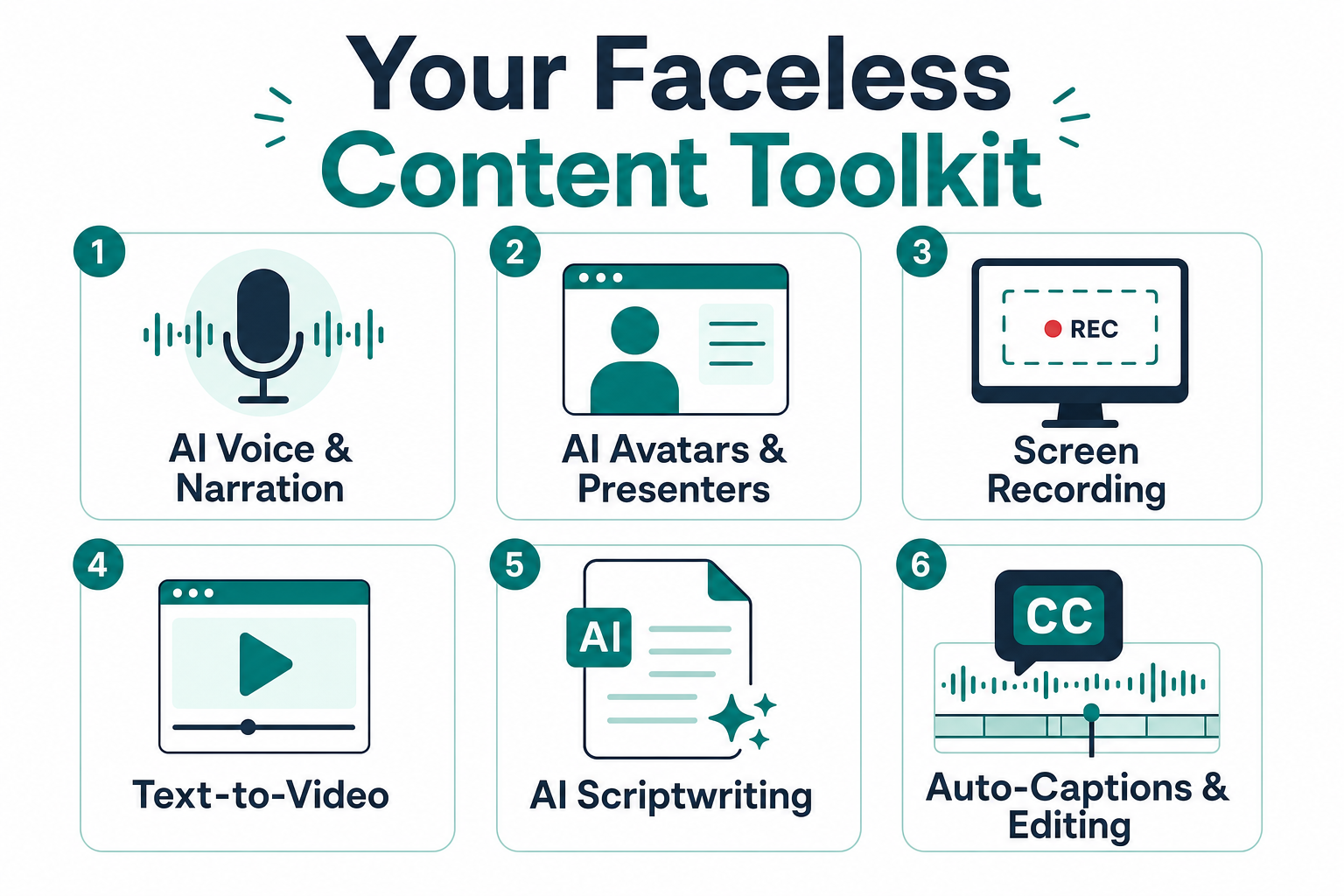 Six tool categories cover the entire faceless production stack.
You rarely need every tool at once — pick two or three that match your chosen format and get fluent with them before adding more. For a broader look at what's available across every category, the best AI tools to make money online covers writing, design, video, and audio tools side by side.
Every faceless piece of content follows the same repeatable path, whether it's a 60-second clip or a full course.
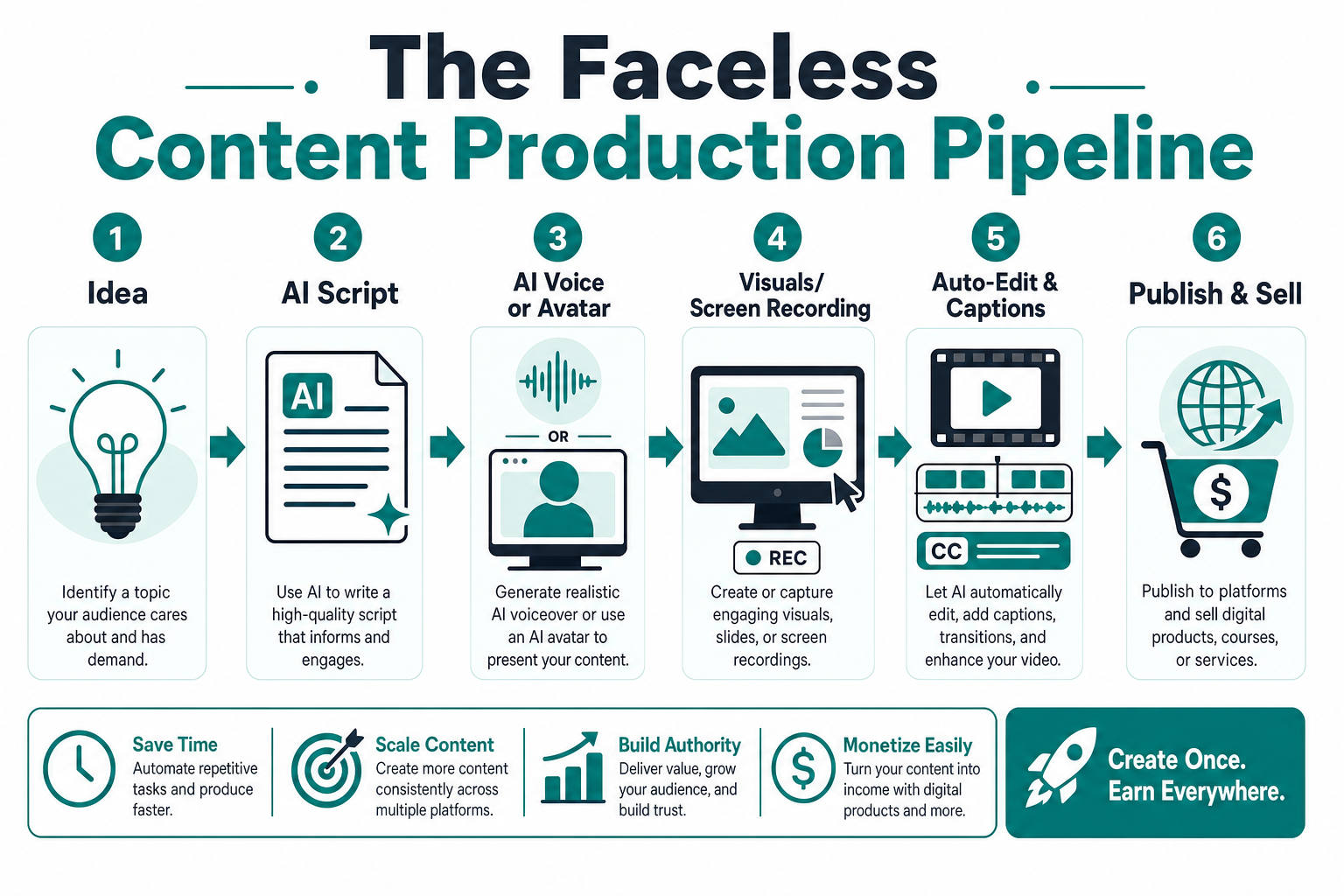 The same six-step pipeline scales from a single video to an entire course.
Start with one clear idea, let AI draft the script, choose your narration method, capture or generate the visuals, run it through auto-editing and captioning, then publish. For a fully detailed walkthrough of this exact pipeline applied to a course, see how to create a video tutorial or micro-course using AI.
Not every format suits every topic — match the format to the content.
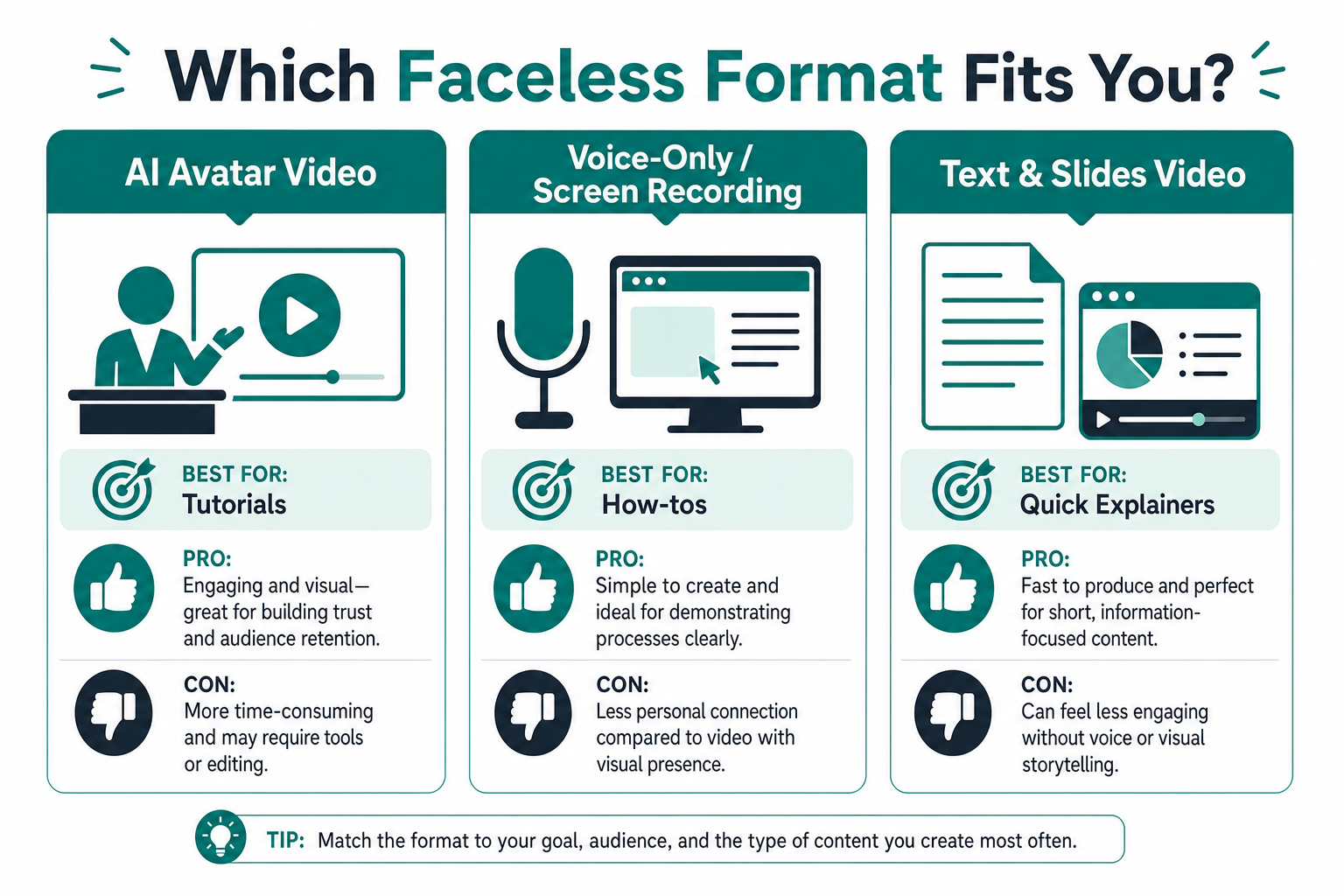 Match your format to your content type, not the other way around.
AI avatar video feels the most "presented" and works well for tutorials that benefit from a visible presence without it being your own. Voice-only screen recording is the fastest and most natural fit for software or app walkthroughs. Text-and-slides video is the quickest to produce and ideal for short explainers or listicle-style content.
Start simple: If you're unsure which format to pick, start with voice-only screen recording. It requires the fewest tools, has the shortest learning curve, and still produces genuinely useful content.
A single piece of faceless content rarely stays just one thing — it's raw material for several digital products.
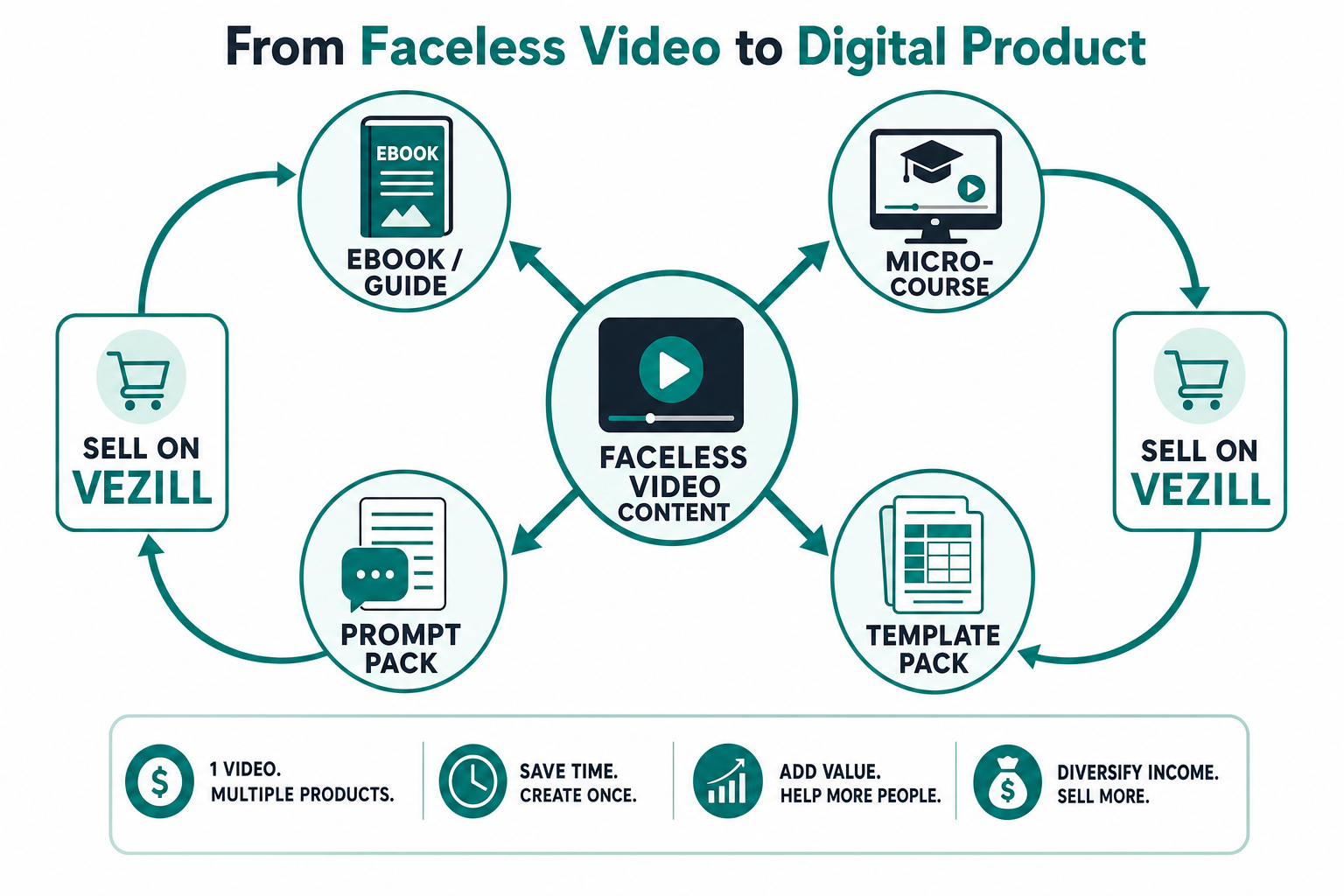 One video, several products — repurpose relentlessly.
A script becomes an ebook, a recorded walkthrough becomes a micro-course, and a repeated process becomes a template or prompt pack. If you're building this out around short-form platforms, how to monetise TikTok videos step-by-step shows the exact repackaging process for that channel specifically.
You don't need technical skill to run this pipeline — every tool in the stack is designed for non-technical creators. If you want the fuller business-building context around this, how to start an AI business without coding walks through picking a model, a niche, and a toolset without ever touching a line of code.
Once your faceless content is packaged into a product, host it somewhere that removes friction from the sale. Instant delivery, visible reviews, and clear pricing matter more than ever when buyers can't put a face to the seller — trust has to be built entirely through the page itself. Vezill handles checkout and delivery automatically, and Master Resell Rights let buyers become your distribution network.
Choosing the wrong format for the topic — match complexity to format, not preference.
Overproducing your first piece — publish something simple before perfecting your workflow.
Weak scripts — even great narration can't save a poorly structured script.
Ignoring captions — a large share of viewers watch muted; captions are not optional.
Never repackaging content — one video should become more than one product over time.
No clear product at the end — faceless content still needs somewhere to send viewers to buy.
Faceless content isn't a workaround anymore — it's a legitimate, scalable production method that AI has made genuinely competitive with traditional video. Pick one format, run it through the six-step pipeline, and repurpose everything you make into more than one product. The tools have never been more accessible; the only remaining step is starting.
Produce one short, simple piece of faceless content today using the format that matches your first topic — and when you're ready to sell without ever stepping on camera, the complete guide walks you through it.
Faceless content creation means producing videos, tutorials, or courses using AI voice, AI avatars, screen recordings, or text-and-slides formats instead of appearing on camera yourself. It relies on AI tools for scripting, narration, and editing to reach the same quality as traditional presenter-led content.
Common tools include AI scriptwriting assistants, AI voice generators, AI avatar platforms, screen recording software, text-to-video generators, and auto-captioning and editing tools. Most creators combine two or three of these depending on their chosen format.
Voice-only screen recording is usually the easiest starting point because it requires the fewest tools and has the shortest learning curve, while still producing genuinely useful content. AI avatar video and text-and-slides formats are good next steps once you're comfortable with the basic pipeline.
Yes. Many successful digital-product businesses are entirely faceless, using AI-generated content to build trust through clarity, consistency, and results rather than personal presence. Selling platforms with reviews and instant delivery help reinforce trust further.
Repurpose the script into an ebook, package a series of recordings into a micro-course, or turn a repeated process into a template or prompt pack. These can then be uploaded and sold on a platform like Vezill with instant delivery and optional resell rights.
No. Most faceless content tools are cloud-based and require only a computer or smartphone, an internet connection, and free or low-cost AI tool subscriptions to get started.
Discover more articles you might be interested in

Learn where to find reliable step-by-step guides online, how to choose the right tutorial for your task, check whether it is current and follow instructions safely.
By Davie

Stop searching broad topics and start finding the exact knowledge you need. Learn how to define your problem, search smarter, choose reliable sources, verify answers and take action.
By Davie

Quick Knowledge or an online course? Learn when a focused answer is enough, when structured learning is better, and how to choose the right learning depth for your goal.
By Davie

Learn how to turn one useful digital product into multiple income streams through premium versions, bundles, courses, licensing, services, subscriptions, B2B sales and complementary products.
By Davie
Get the updates, on newly released, popular & fast-moving MRR digital products
Up to Top
Comments All
Dennis
@dennis
I’ve been curious about faceless content for a while, so I found the ideas here really interesting. I especially liked how the article makes the whole process feel simple and doable. It definitely gave me some inspiration to try it out myself.
September 07,2026 At 09:40 PM
Jesse
@jesse
If you want to create content without being on camera, this is worth a read. The AI tools and techniques mentioned make faceless content seem much easier to manage, especially for beginners. Some really practical ideas here for anyone looking to start.
August 26,2026 At 11:14 PM