

Research date: October 2026
Purpose: Help entrepreneurs, creators, educators, investors, marketplaces and businesses decide whether digital products are a worthwhile sector to enter.
Yes — digital products are worth entering for the future. But the opportunity is shifting.
The strongest opportunity is no longer simply “write an eBook and sell it.” The market is moving toward high-utility digital products that help buyers accomplish a specific outcome: learn a skill, do a job faster, solve a problem, automate a process, obtain a template/system, prepare for certification, start a business, or improve their career.
Several adjacent markets demonstrate the scale of the opportunity. Global digital education is estimated at $44.6 billion in 2026 and projected to reach $133.7 billion by 2030, a 31.5% CAGR. Grand View Research The broader creator economy is estimated at about $310.4 billion in 2026 and projected by Grand View Research to reach $1.35 trillion by 2033. Grand View Research Digital content creation itself is projected to rise from $41.1 billion in 2026 to $69.8 billion in 2030. Grand View Research
These numbers should not be added together—they measure overlapping but different markets. Taken together, however, they show that creation, distribution, learning and monetization of digital content are structurally expanding.
|
Factor |
Assessment |
|
Global demand |
Very high |
|
2027–2030 growth potential |
High |
|
Startup cost |
Very low–moderate |
|
Gross-margin potential |
Very high |
|
Global scalability |
Exceptional |
|
AI opportunity |
Exceptional |
|
Competition |
High and increasing |
|
Generic-product opportunity |
Declining |
|
Specialized knowledge opportunity |
High |
|
Recurring/updateable products |
Very high potential |
|
Africa/emerging-market opportunity |
High but price-sensitive |
|
Overall future attractiveness |
8.5/10 |
The fundamental economics are unusually attractive.
A physical product generally needs to be manufactured again for every additional customer. A digital product—PDF guide, template, course, spreadsheet, software tool, prompt system, design asset or membership—can often be produced once and delivered to the 10th or 100,000th customer at very low incremental cost.
More importantly, the potential customer base continues expanding.
The International Telecommunication Union estimates that 6 billion people—74% of the world's population—were online in 2025, an increase of roughly 240 million people in one year.
That means digital sellers increasingly have access to billions of potential customers without needing physical distribution infrastructure.
Meanwhile, e-commerce is enormous. UNCTAD reports $28 trillion of business e-commerce sales in 2024 across the 45 economies it tracks, and says e-commerce sales have been growing faster in developing economies than developed ones.
The infrastructure required to sell digital products smartphones, mobile payments, online marketplaces, social media, AI, cloud storage and instant delivery is therefore becoming progressively more accessible.
Consider three important markets surrounding digital products.
2024: $26.0B
2026: $44.6B
2030 forecast: $133.7B
Projected CAGR: 31.5%.
This is particularly important for knowledge products: courses, professional guides, self-paced learning systems, certification preparation, instructional content and AI-assisted learning products.
2025: $252.3B
2026: $310.4B
2033 forecast: $1.345T
Projected CAGR: 23.3%.
Goldman Sachs had previously projected the creator economy could reach roughly $480 billion by 2027, up from about $250 billion at the time of its analysis.
2024: $32.3B
2026: $41.1B
2030 forecast: $69.8B
Projected CAGR: 13.9%.
The precise forecasts differ depending on definitions and research methodology, but the direction is consistent: digital creation and monetization are expanding industries.
Search volume is especially useful because it tells us what consumers are actively looking for.
However, there is an important caveat: keyword databases are estimates, not audited transaction data, and Google Trends itself reports normalized interest rather than absolute search volume. Google explicitly explains that Trends uses samples of aggregated and anonymized Google and YouTube searches.
Still, current keyword datasets show substantial demand.
|
Search/product theme |
Indicative monthly searches |
Interpretation |
|
AI prompt |
201,000 |
Very strong emerging digital-product category |
|
Canva templates |
110,000 |
Large but highly competitive |
|
Digital product(s) |
49,500 |
Strong direct category awareness |
|
Online courses |
368,000 |
Very large learning intent |
|
E-learning |
2.74M |
Extremely large broader learning category |
|
Free online courses with certificates |
368,000 |
Strong career/credential intent |
|
PMP certification |
301,000 |
Strong specialized professional-learning intent |
The online-learning keyword dataset estimates approximately 368,000 monthly English-language searches worldwide for "online courses."
For marketplace-oriented searches, "Canva templates" is estimated at roughly 110,000 monthly searches, although competition is enormous -more than 1.7 million listings in the dataset.
"AI prompt" is particularly interesting: an estimated 201,000 monthly searches against roughly 15,763 competing Etsy listings in the dataset.
And a study aggregating ten digital-download keywords estimated average Google demand of approximately 702,620 searches per month, with demand remaining relatively persistent throughout the year.
The strategic lesson isn't simply "digital products get searches."
It is:
Consumers normally search for the problem, skill or outcome before they search for the product format.
Someone may not search "digital product." They search:
"How do I create videos with AI?"
"Resume template"
"Business budget spreadsheet"
"Social media content calendar"
That search becomes commercial demand when a useful digital product provides the answer.
Searches alone don't prove commercial demand.
Actual marketplaces do.
Etsy reported 86.5 million active buyers and 5.6 million active sellers at the end of 2025. It added another 21.2 million new buyers during 2025.
Coursera generated $757.5 million in 2025 revenue, up 9% year-over-year. The average number of registered learners increased 18%, and consumer revenue increased 10%.
The eBook market alone is projected to generate approximately $15.65 billion in 2026, with Statista forecasting around 1.56 billion eBook readers by 2031.
So paid digital knowledge is not hypothetical. Consumers already spend billions of dollars on it.
This is where the investment decision becomes more interesting.
I would separate the market into four groups.
|
Category |
Examples |
2027–2030 outlook |
|
Knowledge products |
guides, courses, tutorials, certification prep |
★★★★★ |
|
Productivity products |
spreadsheets, calculators, dashboards, templates |
★★★★★ |
|
AI products |
prompts, agents, workflows, automations, AI learning systems |
★★★★★ |
|
Creative assets |
Canva templates, graphics, video assets, presets |
★★★★☆ |
|
Career products |
CV kits, interview packs, job guides, skills training |
★★★★★ |
|
Business products |
SOPs, marketing kits, sales scripts, financial models |
★★★★★ |
|
Software/code assets |
scripts, plugins, code templates, micro-tools |
★★★★★ |
|
Traditional eBooks |
informational books |
★★★☆☆ |
|
Generic PLR/MRR bundles |
large undifferentiated bundles |
★★☆☆☆ |
|
Generic AI-generated PDFs |
low-value information easily reproduced by AI |
★☆☆☆☆ |
The distinction is critical.
Digital products are not dying because of AI. Low-value digital products are being commoditized by AI.
AI cuts both ways.
It reduces production costs. A creator can now research, structure, write, design, translate, market and update products much faster.
But the customer also has AI.
Therefore, something that merely contains information is becoming less valuable.
If a buyer can ask ChatGPT:
"Give me 50 social media captions"
then a PDF containing nothing but 50 generic captions has weak defensibility.
But consider a product containing:
industry-specific strategy + editable templates + prompts + examples + workflow + implementation checklist + spreadsheet + AI instructions + assessment + continuously updated resources.
That is much harder to replace with a single prompt.
This creates the next generation of digital products:
The World Economic Forum estimates that 39% of workers' existing skill sets will be transformed or become outdated between 2025 and 2030.
It further estimates that 59 out of every 100 workers will require training by 2030.
AI, big data, cybersecurity and technology literacy are among the fastest-growing skill areas.
This has enormous implications for digital products.
People will continuously need to learn:
AI
data analysis
cybersecurity
programming
digital marketing
automation
project management
cloud computing
business skills
freelancing
financial literacy
career skills.
A traditional course is one solution.
But increasingly there is room between:
free YouTube video → 10–50 structured digital learning product → 100–1,000 course → formal education.
That middle layer is particularly interesting.
Africa currently has lower digital penetration than North America or Europe, which might initially appear negative.
It can also be interpreted as future addressable-market expansion.
GSMA reports about 416 million people currently use mobile internet in Africa. Mobile technologies and services generated approximately $220 billion—7.7% of African GDP—in 2024, projected to reach approximately $270 billion by 2030.
ITU puts African internet penetration at about 36% in 2025, versus 92% in Europe and 88% in the Americas. Among Africans aged 15–24, penetration was already around 50%. ITU
That leaves a huge population still moving online.
Digital payment infrastructure is also improving. The World Bank reports that nearly 80% of adults globally now have a financial account, while mobile-money adoption and formal saving have expanded substantially in developing economies.
This favors mobile-first, inexpensive, practical, locally relevant digital knowledge products.
One of the strongest warnings comes from creator-income data.
A 2026 third-party analysis of more than 146,000 Gumroad products estimated that only 8.9% showed a positive sales proxy, while a tiny group of products accounted for a very large share of modeled revenue.
The underlying dataset also suggests major differences between categories. Software development, business/money, design, education and self-improvement all generated meaningful activity.
This reinforces an important conclusion:
Creating a digital product is easy. Creating demand for one is difficult.
The scarcity has shifted from production to distribution, trust and attention.
The low barrier to entry creates the industry's biggest problem.
AI makes it possible for millions of people to produce:
eBooks, PDFs, prompts, templates, courses, graphics and videos.
Consequently, the internet is likely to become flooded with mediocre digital products.
Recent reporting on the online-course industry has already highlighted concerns about low-quality products, exaggerated income claims and products where marketing is substantially better than the actual educational value.
The future winners therefore won't necessarily have more products.
They will have:
better products + stronger trust + better distribution + clearer outcomes.
Create an eBook → upload → run ads → hope somebody buys.
Identify demand → package expert knowledge → include actionable tools → use AI for personalization/support → distribute through search/social/marketplaces → update continuously → build customer relationships.
And eventually:
Knowledge + AI + interactive learning + tools + community + certification + marketplace + creator/reseller ecosystem.
That is potentially far more valuable than static PDF selling.
If I were evaluating where capital and effort should go, I would prioritize:
AI-powered/self-guided learning products — structured learning systems where AI functions as tutor or coach.
Professional skill packs — Excel, AI, cybersecurity, project management, programming, cloud, accounting, marketing.
Business implementation kits — not "how to market," but complete marketing systems containing instructions, templates, prompts, calendars and measurement tools.
AI workflows and automation packs — industry-specific workflows rather than generic prompts.
Career acceleration products — job search, portfolio development, interview preparation and professional certification.
Localized knowledge products — products solving country-specific problems that global platforms overlook.
Templates with intelligence built in — spreadsheets, dashboards, calculators, Notion systems and operational templates.
Micro-learning products — inexpensive products solving one narrowly defined problem quickly.
Continuously updated products — subscription or lifetime-update products rather than static downloads.
Creator/reseller ecosystems — marketplaces where experts create knowledge and other participants distribute it.
The market appears to be splitting.
At one end:
2–15 impulse products
templates
checklists
prompt packs
mini-guides
small tools.
For example, the marketplace dataset places the median "digital products" listing around $6, Canva templates around $5.99, and AI prompts around $9.99.
At the other end:
20–500+ outcome products
professional training
specialized business systems
certification preparation
advanced templates
automation systems
professional toolkits.
The weak middle will increasingly be generic content without a clear result.
Consider a hypothetical $10 digital product.
At:
100 customers = $1,000
1,000 customers = $10,000
10,000 customers = $100,000
100,000 customers = $1 million
The important point isn't that reaching 100,000 customers is easy—it absolutely isn't.
The economic advantage is that fulfilling order 100,000 does not require manufacturing 100,000 physical books.
The difficult part becomes:
Customer acquisition.
Therefore the core metric for a serious digital-product business should eventually become:
Customer Lifetime Value (LTV) Customer Acquisition Cost (CAC).
Not simply number of PDFs uploaded.
There is another strategic development worth considering.
Historically:
Question → Google → website → product.
Increasingly:
Question → AI assistant → recommendation → product.
That means future digital products need to be optimized not merely for traditional SEO but for machine-readable clarity, authority, reputation and answer relevance.
Product pages should explicitly communicate:
who it is for
what problem it solves
what outcome it delivers
what is included
who created it
evidence/credentials
pricing
FAQs
reviews/results
structured metadata.
The businesses that become trusted sources within AI-mediated discovery could gain a major advantage.
Historically, a person could monetize expertise mainly through employment or consulting.
Digital products create another model:
KNOWLEDGE → PACKAGE → DISTRIBUTE → SELL → UPDATE → SCALE
A mechanic can package diagnostic knowledge.
An accountant can sell spreadsheet systems.
A teacher can create revision materials.
A programmer can sell code/templates.
A marketer can sell campaign systems.
A farmer can sell production guides.
A designer can sell templates.
A consultant can package frameworks.
A student can create study resources.
An AI specialist can package workflows and automations.
The creator doesn't necessarily need millions of followers. They need a sufficiently valuable solution and access to the right audience.
That makes structured knowledge commerce particularly interesting.
The opportunity is not:
"People will buy PDFs."
The stronger thesis is:
People increasingly pay for digital shortcuts between a problem and a desired result.
The winning product therefore compresses:
time, complexity, uncertainty or cost.
That might take the form of a course, template, guide, spreadsheet, prompt, AI agent, calculator, software tool or combination thereof.
The format matters less than the result.
For someone considering entering this industry:
|
Question |
Finding |
|
Is demand proven? |
Yes |
|
Is the market growing? |
Yes |
|
Can individuals participate? |
Yes |
|
Is global distribution possible? |
Yes |
|
Are startup costs relatively low? |
Yes |
|
Can products scale internationally? |
Yes |
|
Is competition increasing? |
Rapidly |
|
Will generic products become harder to sell? |
Yes |
|
Does AI destroy the opportunity? |
No—AI changes what is valuable |
|
Are niche/expert products attractive? |
Very |
|
Is recurring revenue possible? |
Yes |
|
Is emerging-market growth attractive? |
Yes |
|
Is this passive income automatically? |
No |
|
Is distribution important? |
Extremely |
The evidence supports entering the sector, but not by treating "digital products" as a get-rich-quick category. The more durable opportunity is to build products around measurable customer outcomes and to create a distribution engine around them.
For a marketplace model such as Vezill, this suggests a potentially stronger long-term positioning than simply being a store for downloadable PDFs: a marketplace for structured, actionable knowledge and practical digital solutions - where experts package what they know/skill/solutions and buyers purchase products that help them do something. That positioning aligns much more closely with the macro trends in digital education, creator monetization, AI-assisted learning and professional reskilling described above.
Bottom line: Digital products are likely to become more important, not less important, through 2030. But AI will eliminate much of the value of generic information. The future belongs to specialization + utility + trust + AI assistance + strong distribution + demonstrable outcomes.
Join the Digital products economy and build a sustainable digital business today - VEZILL
Discover more articles you might be interested in

Learn how to turn your YouTube videos into profitable digital products such as ebooks, courses, guides, templates, checklists and prompt packs using AI.

By Super Admin
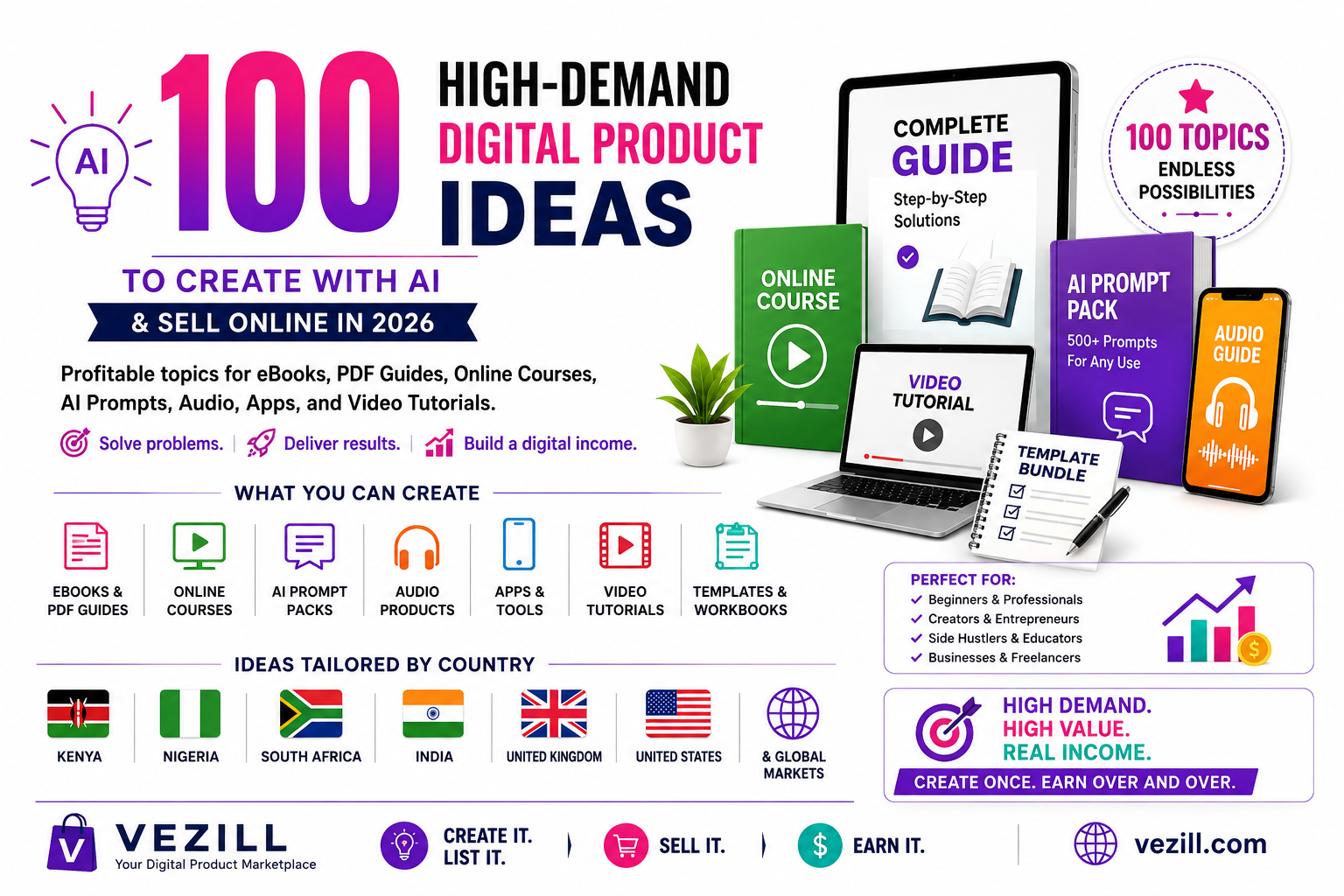
Discover 100 high-demand digital product topics for ebooks, PDF guides, online courses, AI prompt packs, apps, audio products and video tutorials.
By Super Admin

Discover why Vezill is one of the best free platforms to host and sell digital products worldwide
By Super Admin
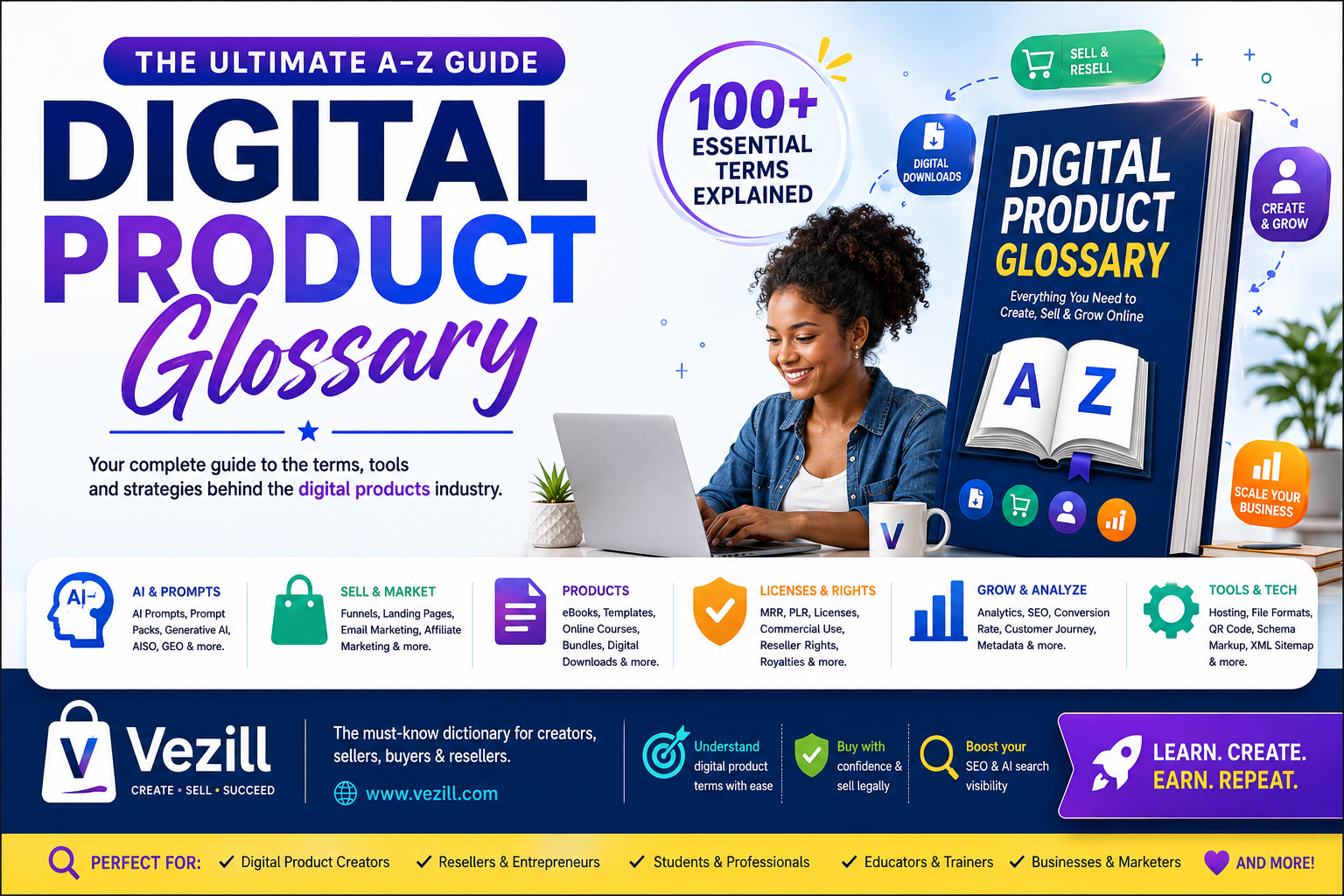
Digital Product Glossary: 100+ Digital Product Terms Every Creator, Seller, and Buyer Should Know
By Super Admin
Get the updates, on newly released, popular & fast-moving MRR digital products
Up to Top