
Ellan
Joined - December 2025

By Inceptor Institute of Technology
Self-Paced • AI Tutor-Enabled • Practical Projects • Portfolio Development • Certification Pathway • Vezill Master Resell Rights (MRR)
Perhaps you have searched for how to learn Python from scratch, a Python course for beginners, Python programming with AI, Python for data analysis, Python automation, or a practical way to learn coding at your own pace.
The challenge is that watching tutorials or copying code generated by AI does not necessarily make you a programmer.
You need to understand how the code works, how to solve problems, how to debug errors, how to test your solutions, and how to build projects you can actually demonstrate.
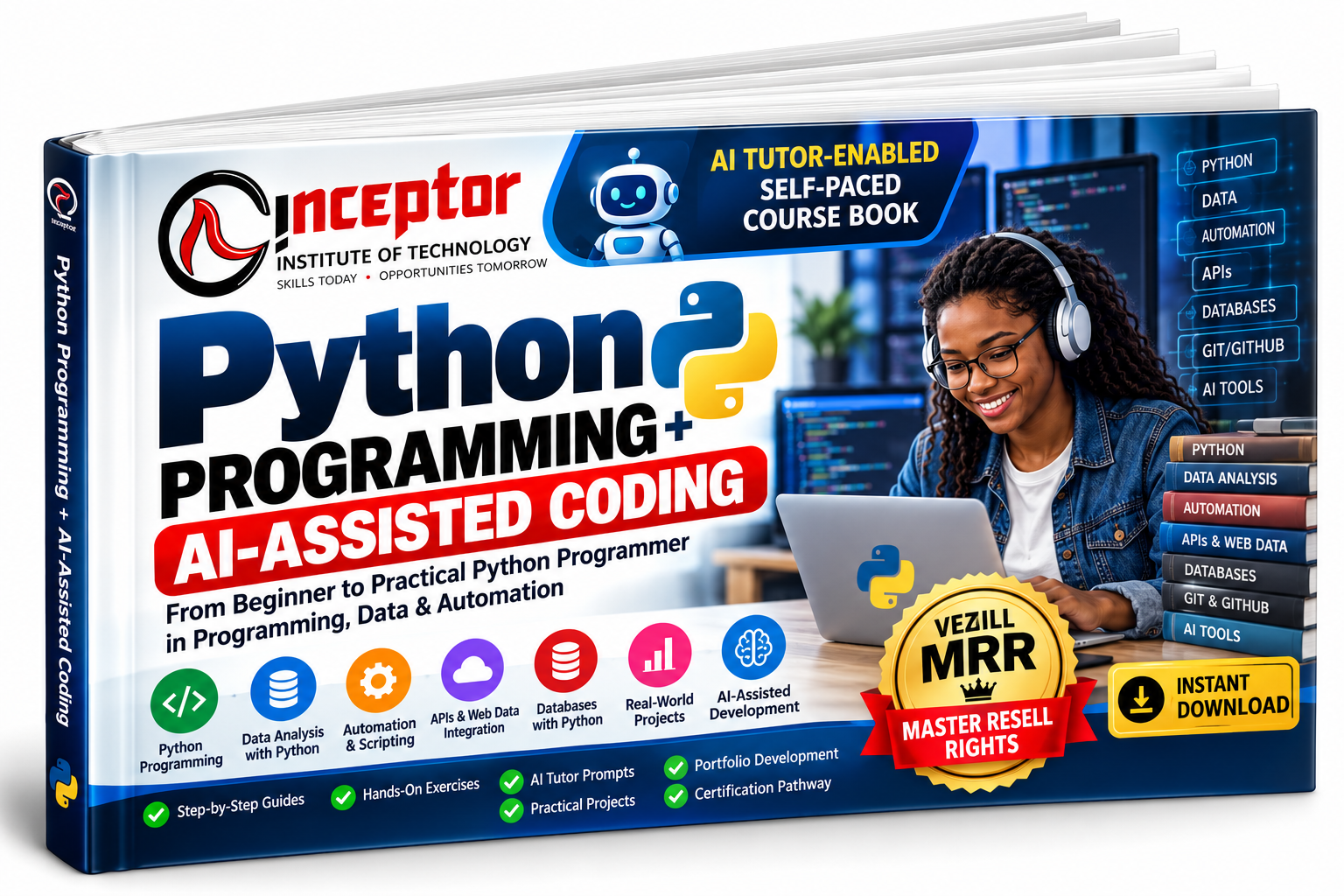
That is exactly what the Python Programming + AI-Assisted Coding — AI Tutor-Enabled Self-Paced Professional Course Book is designed to help you do.
The course starts with learners who may have little or no previous programming experience and progressively develops practical competency in Python programming, problem solving, data analysis, automation, APIs, databases, testing, Git/GitHub and AI-assisted software development.
This isn't designed to be another theory-heavy programming textbook.
The learning system follows:
CONCEPT → DEMONSTRATION → AI TUTOR → HANDS-ON PRACTICE → CHALLENGE → DEBUG → PROJECT → EVIDENCE
You don't simply read about Python.
You write Python.
You run Python.
You make mistakes and debug them.
You ask your AI Tutor for explanations and guidance.
You build projects.
And you progressively create evidence of the skills you've developed.
The course specifically teaches you to use AI as a personal Python tutor, coding instructor, pair programmer, debugging assistant, code reviewer and project mentor - without encouraging blind copy-and-paste coding.
Your learning journey takes you from the fundamentals into practical professional applications.
Start from the beginning and learn:
Python syntax
Variables and data types
Strings, integers, floats and Booleans
Operators
Input and output
f-strings
Calculations
Conditions and decision making
Loops
Lists, tuples, dictionaries and sets
Functions
Error handling
Object-oriented programming
No previous programming experience is assumed.
Don't become a programmer who immediately asks AI to rewrite every piece of broken code.
Learn a systematic debugging workflow:
ERROR → READ → REPRODUCE → ISOLATE → ASK → TEST → VERIFY → DOCUMENT
You'll work with syntax errors, runtime errors, logic errors, tracebacks, exceptions, defensive programming and basic logging. .
Learn practical Python skills for:
Text files
CSV
JSON
File paths
Reading and writing files
File and folder operations
Safe file handling
These skills provide the foundation for useful automation and data-processing applications. .
Want to learn Python for data analysis?
You'll progress into practical work with pandas, DataFrames and structured datasets.
Learn how to:
Import → Inspect → Clean → Analyze → Visualize → Interpret → Export → Present Findings
You'll work with CSV, Excel and JSON/tabular data, including filtering, missing values, sorting, grouping, aggregation, merging and basic exploratory data analysis. .
And instead of stopping at exercises, you'll create a portfolio-ready data analysis project.
One of Python's most useful applications is automating repetitive work.
This course introduces practical automation including:
Batch file operations
Organizing files
CSV processing
Spreadsheet processing
Report generation
Automated calculations
Data cleaning
Structured information extraction
Scheduled scripts
Basic system automation
Business workflow automation
Your automation project challenges you to identify a repetitive manual task and create a Python solution that measurably reduces manual effort. .
Go beyond standalone scripts.
Learn important API concepts including HTTP basics, requests, endpoints, parameters, headers, JSON responses, authentication concepts, API keys, GET/POST concepts, status codes, rate limits and error handling. .
You'll also learn database fundamentals and use Python with SQLite, including:
Create → Read → Update → Delete
You'll work with SQL, tables, primary keys, parameterized queries and data persistence before building a useful database-backed Python application.
AI can generate code quickly.
But can you determine whether that code is correct?
Can you test it?
Can you find the bug?
Can you explain what it does?
Can you maintain it when requirements change?
That's why this course teaches AI-assisted development, not AI dependency.
You'll learn a professional AI pair-programming workflow:
PROBLEM → REQUIREMENTS → PSEUDOCODE → HUMAN ATTEMPT → AI ASSISTANCE → REVIEW → TEST → DEBUG → REFACTOR → DOCUMENT → COMMIT
The objective is to progress from:
“AI wrote this code for me.”
to:
“I used AI to accelerate code I understand and can maintain.” .
Throughout the course, you'll find prompts designed to turn your preferred capable AI assistant into a more useful learning companion.
You can ask AI to:
“Explain this concept to me as a complete beginner…”
“Do not give me the answer yet. Ask me questions that help me solve…”
“Review my Python code and identify problems without rewriting it…”
“Explain this traceback line-by-line…”
“Give me three increasingly difficult exercises on…”
“Generate edge cases I should test…”
“Act as a senior Python developer reviewing my code…”
The course uses module-specific AI prompts rather than relying only on generic prompts.
Instead of long chapters of passive reading, modules are structured around practical competency.
Each module incorporates:
Module Overview → Learning Outcomes → Concepts → Visual Explanation → Code Demonstration → Code Walkthrough → Practice → AI Tutor Session → AI-Assisted Exercise → Debugging Challenge → Independent Challenge → Mini Project → Knowledge Check → Practical Assessment → Portfolio Evidence → Completion Checklist. .
That means you're continually moving from:
“I read about Python.”
to:
“I can demonstrate that I can use Python.”
By the end of the learning pathway, your evidence can include multiple practical projects.
Create a useful command-line application demonstrating variables, conditions, loops, collections, functions and validation.
Work with a realistic dataset and produce:
Cleaned Data + Analysis Code + Visualizations + Findings + README + Evidence
Take a repetitive workflow and document:
Problem → Before/After Workflow → Python Solution → Error Handling → Testing → Results
Build an application that obtains and processes information from an API or another appropriate data source.
Bring your skills together to solve a real problem in areas such as:
Business automation
Data analysis and reporting
Productivity
File/document processing
API integration
Database applications
Administrative automation
Financial/data utilities
Your capstone follows:
Problem → Requirements → Solution Design → Build → Test → Debug → Refactor → Document → GitHub → Demonstrate. .
What can you show someone after learning Python?
This course addresses that question directly.
Your professional portfolio can progressively include:
Python fundamentals application
File/data processing tool
Data analysis project
Automation solution
API integration
Database application
Final capstone project
GitHub repositories
README documentation
Screenshots/results
Project descriptions
Testing evidence
The objective is to leave the learning process with demonstrable evidence of what you can build and explain. .
This learning system is particularly suitable if you are a:
Complete beginner searching for how to learn Python from scratch
Student who wants practical programming skills
University or college learner who wants additional hands-on experience
Job seeker developing a technical portfolio
Working professional interested in automating repetitive work
Entrepreneur interested in building useful scripts and tools
Freelancer developing Python-based service capabilities
Aspiring data professional learning Python and pandas
Future developer preparing for backend, data, AI or cloud specialization
The course is explicitly designed to assume no prior programming knowledge. .
↓
↓
↓
↓
↓
↓
↓
↓
↓
↓
This is the intended progression of the complete course-book system. .
The course also provides a pathway toward professional certification by Inceptor Institute of Technology.
Importantly, buying or completing the course book does not automatically award certification.
For certification, the learner must submit the required practical project and portfolio evidence to Inceptor Institute of Technology for evaluation under the institution's applicable requirements. .
Potential evidence includes source code, project documentation, GitHub/repository links where applicable, screenshots/results, project reports, capstone work, AI-use declaration and learner reflection.
This makes the pathway:
LEARN → PRACTICE → BUILD → DOCUMENT → SUBMIT → EVALUATION → CERTIFICATION
Why stop at learning the skill?
This course book also comes with a Vezill Master Resell Rights opportunity, subject to the product's MRR licence and applicable Vezill platform terms.
That creates a second pathway:
Learn from the course yourself.
Develop your Python knowledge.
Build your projects.
Then market the licensed digital course book to other people who want to learn Python.
Under the accompanying Vezill MRR licence, eligible resellers can participate in the applicable 90% reseller revenue-share model, subject to Vezill's platform, transaction, refund, chargeback and payout terms.
That means the same digital product can potentially serve two purposes:
1. A practical Python learning resource
and
2. A digital product you are licensed to resell
No sales or income level is guaranteed; your results depend on demand, audience, marketing execution and applicable platform rules.
Potential audiences include people already searching for:
Python course for beginners • learn Python from scratch • Python programming course • AI-assisted coding course • learn coding with AI • Python data analysis course • Python automation course • Python scripting • Python projects for beginners • Python with pandas • Python API course • Python database course • self-paced Python course • Python course book • practical Python training • Python portfolio projects
The product therefore gives a reseller multiple search-intent angles rather than relying on a single generic “learn Python” message.
You aren't buying hundreds of pages merely to read.
You are getting a structured learning pathway built around:
Learn → Code → Ask AI → Debug → Test → Build → Document → Portfolio
The central principle remains:
AI can help you write code. You remain responsible for understanding, testing, validating, securing and improving that code. .
That distinction matters increasingly in an era where generating code is easy but understanding, evaluating and applying code to real problems remains valuable.
You don't have to wait for the next classroom intake.
You don't have to fit your learning around a live class timetable.
And you don't need previous programming experience to begin.
Start with the fundamentals.
Use your AI Tutor when you need explanations.
Practise the code.
Debug your mistakes.
Complete the challenges.
Build the projects.
Create your portfolio.
And, if you choose, pursue the Inceptor project-evaluation certification pathway and use your Vezill MRR licence to resell the course book.
✓ Instant Digital Access
✓ Beginner-Friendly Python Training
✓ AI Tutor-Enabled Self-Paced Learning
✓ Hands-On Coding Exercises
✓ Python Data Analysis
✓ Automation & Scripting
✓ APIs & Databases
✓ AI-Assisted Coding
✓ Testing & Debugging
✓ Git & GitHub
✓ Practical Projects
✓ Portfolio Development
✓ Inceptor Certification Pathway
✓ Vezill Master Resell Rights Opportunity
Get Instant Access Now →
Get the updates, on newly released, popular & fast-moving MRR digital products
Up to Top

Comments