
Valid
Joined - November 2025

Confused about KUCCPS? Don't make one of the biggest education decisions of your life by guessing.
If you are a KCSE graduate, parent or guardian trying to understand KUCCPS university placement in Kenya, you may be asking:
Which courses do I qualify for?
How do I check KUCCPS courses and requirements?
What are cluster points?
What is the difference between cluster points and cut-off points?
How should I choose my KUCCPS courses?
How does KUCCPS placement work?
How do I know where I have been placed?
Where do I get my university admission letter?
What happens if I don't get my preferred course?
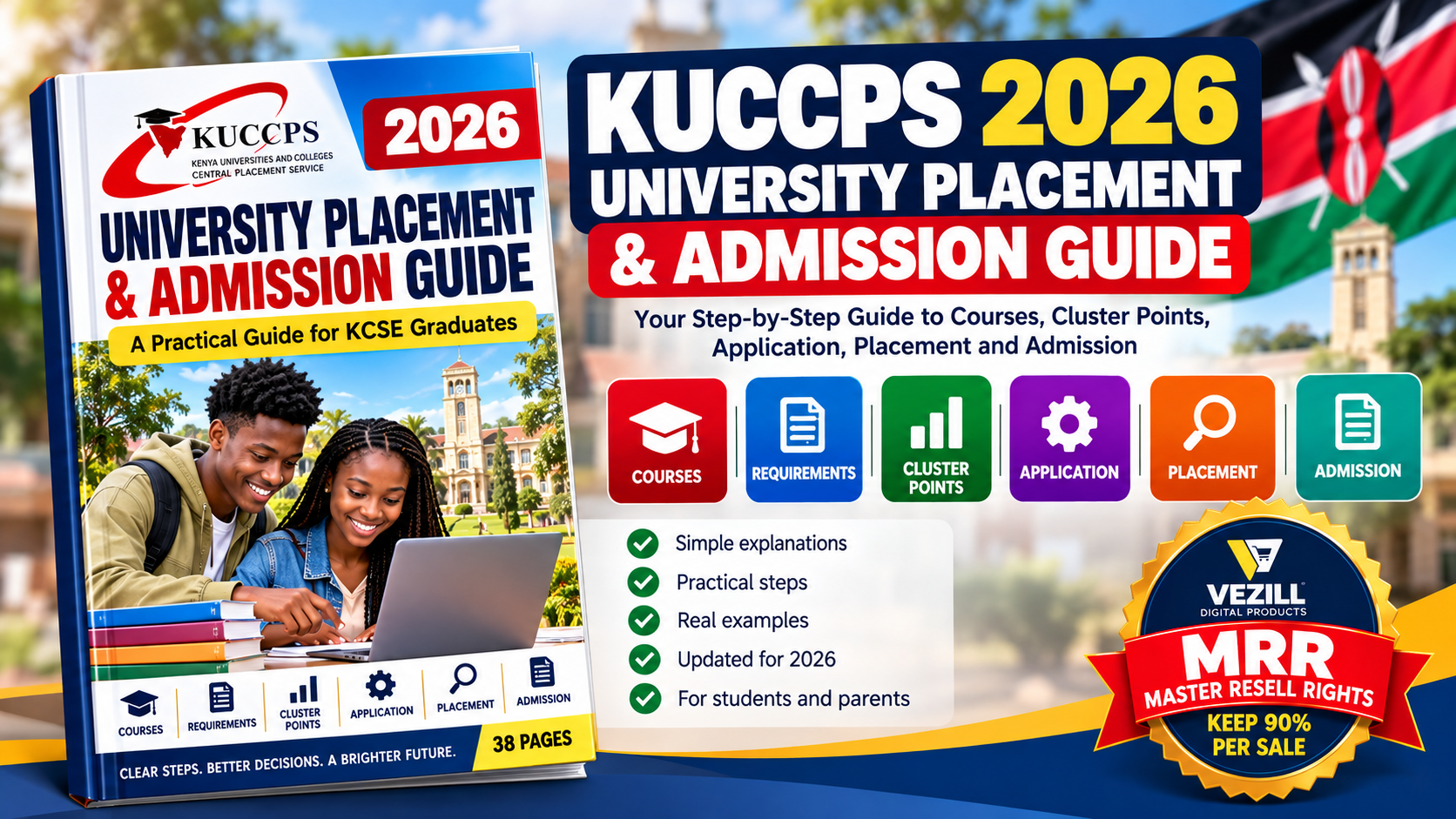
The KUCCPS 2026 University Placement & Admission Guide is designed to make the process easier to understand.
It gives students and parents a practical roadmap for moving from:
Getting your KCSE results is only the beginning.
The next major decision is:
This is where many students become confused.
There are universities.
There are TVET institutions.
There are hundreds of programmes.
There are minimum subject requirements.
There are cluster points.
There are cut-off points.
There are programme codes.
There are application and revision windows.
And choosing a course simply because its name sounds attractive can be a costly mistake.
The KUCCPS 2026 University Placement & Admission Guide helps you approach this process systematically.
The Kenya Universities and Colleges Central Placement Service—KUCCPS—is responsible for coordinating placement into participating universities and colleges under applicable government-sponsored programmes.
Placement isn't simply:
“I selected this course, therefore I will get it.”
Applicants must first satisfy the applicable programme requirements.
Placement is then competitive and considers factors including the applicant's qualifications, listed choices and available programme capacity.
That means making informed choices matters.
One of the most important questions after KCSE is:
But your overall mean grade isn't always enough to answer that question.
Individual programmes can have specific minimum subject requirements.
The guide helps you understand the process of checking:
Your KCSE results
Programme level
Minimum requirements
Required subjects
Your programme options
Institution options
Programme codes
Your order of preference
So instead of selecting courses blindly, you can make choices based on the actual information available through KUCCPS.
You're not alone.
Students frequently search for:
KUCCPS cluster points
how to calculate cluster points
KUCCPS cluster points calculator
course cluster points
KUCCPS cut-off points
how to check KUCCPS cluster points
One of the most important things to understand is the difference between:
and
Your weighted cluster points relate to your performance for a particular degree programme.
A programme's cut-off point reflects the weighted cluster points of the last competitively placed applicant for that programme in the relevant placement cycle.
You don't need to rely on unofficial calculations of your cluster points.
KUCCPS advises applicants to check the weighted cluster points already computed and provided through the KUCCPS system.
The guide helps you understand how to use this information when evaluating possible degree choices.
Imagine seeing a course you like.
You immediately put it among your first choices.
But you haven't checked:
Minimum subject requirements
Your weighted cluster points
Previous cut-off information
The institution offering it
Alternative universities
Related programmes
Career direction
Your realistic placement options
That is not a strategy.
The guide encourages a better approach:
↓
↓
↓
↓
↓
↓
↓
Previous cut-off points can help you assess the competitiveness of different course and university combinations.
But there is an important distinction:
Competition and available capacity can change.
The goal is therefore not to treat historical cut-offs as promises.
Instead, use them as decision-support information when comparing programme options.
This guide helps you approach that comparison more intelligently.
A good application should not be based only on:
“This is my dream course.”
A better selection process asks:
The guide helps you create a more balanced course-selection strategy instead of depending on one highly competitive option.
When applying through KUCCPS, programme codes matter.
Selecting the wrong programme code can mean selecting something different from what you intended.
The guide helps you understand how to:
Find programmes
Identify institutions
Check requirements
Locate programme codes
Record your intended choices
Arrange choices in order of preference
Review information before final submission
If you've never used the KUCCPS Student's Portal before, the application process can feel complicated.
The guide breaks the process into understandable stages:
That final step matters.
Selecting courses without completing the required submission process does not amount to a completed application.
The guide is designed to help you avoid problems such as:
❌ Choosing courses without checking minimum requirements
❌ Confusing mean grade with programme-specific requirements
❌ Depending on unofficial cluster-point calculations
❌ Treating previous cut-off points as guaranteed future cut-offs
❌ Entering incorrect programme codes
❌ Choosing courses without comparing institutions
❌ Building an application with no alternatives
❌ Forgetting to review your choices
❌ Failing to complete the application submission process
❌ Using unofficial websites when official KUCCPS information is available
Not getting an initial preferred choice doesn't automatically mean the journey is over.
Depending on the placement cycle and your circumstances, KUCCPS may provide revision opportunities or other application options.
The important thing is to understand:
Why wasn't I placed?
What options remain?
Which programmes still match my qualifications?
Should I revise my choices?
What should I change this time?
The guide helps you think through those questions rather than simply repeating the same selections.
If KUCCPS invites eligible applicants to revise their choices, the revision process is an opportunity to reassess available programmes and make new decisions based on current information.
Instead of rushing to select anything available, learn to check:
Remaining programme options
Eligibility
Subject requirements
Institutions
Programme codes
Your priorities
Alternative pathways
Always confirm the current revision window and eligible applicants through official KUCCPS communication because dates and conditions vary by placement cycle.
Another major search after applications close is:
KUCCPS advises applicants to check placement information through the Student's Portal and also communicates placement information through official channels.
Once placement is complete, your next question becomes:
The institution where you have been placed is responsible for issuing its admission letter and joining instructions.
This guide helps you understand the transition from:
so you know where one process ends and the next begins.
Being placed is not the final step.
After placement, you may need to follow your institution's admission process.
Depending on the university or college, this can include:
Checking official admission information
Obtaining your admission letter
Reading joining instructions
Preparing required documents
Understanding reporting requirements
Following the institution's registration process
Preparing for fees and funding arrangements
Always use the specific institution's official admission instructions because requirements differ.
Not every student needs to follow exactly the same education pathway.
KUCCPS provides access to different programme categories and institutions depending on the placement cycle and applicant eligibility.
The right question is not:
“Which course sounds most prestigious?”
A better question is:
This guide helps you think beyond simply getting any placement.
The goal is to make a more informed education decision.
The KUCCPS 2026 University Placement & Admission Guide is particularly useful for:
✓ KCSE graduates preparing for KUCCPS applications
✓ Students asking which courses they qualify for
✓ Applicants confused about cluster points
✓ Students researching KUCCPS cut-off points
✓ Applicants comparing university courses
✓ Students who don't understand programme codes
✓ Applicants preparing to revise their KUCCPS choices
✓ Students waiting for placement results
✓ Parents helping their children through university placement
✓ Students trying to understand what happens after placement
✓ Career mentors, teachers and education advisers who regularly assist KCSE graduates
Parents often play a major role in education decisions.
But choosing a course simply because it has a familiar title or appears prestigious can create problems later.
Use the guide together.
Discuss:
What is the student's KCSE performance?
Which programmes do they qualify for?
What subjects are they strongest in?
What are their interests?
Which institutions offer suitable programmes?
What alternative pathways exist?
A better-informed conversation can lead to a better-informed application.
By working through the guide, you should be better prepared to:
✓ Understand how KUCCPS placement works
✓ Research courses and institutions
✓ Check minimum programme requirements
✓ Understand weighted cluster points
✓ Understand previous cut-off points
✓ Compare programme options
✓ Identify programme codes
✓ Arrange your choices more carefully
✓ Complete the application process with fewer avoidable errors
✓ Understand revision of choices
✓ Check placement information
✓ Understand what happens after placement
✓ Move from KCSE results toward university or college admission with greater clarity
You spent years preparing for KCSE.
Your next education decision deserves more than a few minutes of guessing.
Don't simply ask:
Ask:
That is the difference between randomly filling an application and approaching placement strategically.
Use it to understand:
COURSES → REQUIREMENTS → CLUSTER POINTS → CUT-OFF POINTS → PROGRAMME CODES → APPLICATION → REVISION → PLACEMENT → ADMISSION
Download the guide and use it while researching and preparing your KUCCPS choices.
Your purchase includes Vezill Master Resell Rights (MRR), subject to the licence supplied with the product.
This means eligible buyers can use the guide and also resell the digital product under the applicable Vezill MRR terms.
BUY → LEARN → SHARE → SELL → EARN
Get your copy of the KUCCPS guide.
Understand the resource so you can explain its value to students and parents.
Promote it to people looking for help with KUCCPS applications, courses, cluster points, placement and admission.
Resell the digital guide according to the Vezill MRR licence.
Receive the applicable seller earnings on qualifying sales according to current Vezill terms.
Every KCSE cycle creates another group of students and parents searching for answers to questions such as:
How do I apply for KUCCPS?
Which courses do I qualify for?
How do I check my KUCCPS cluster points?
What are KUCCPS cut-off points?
How do I choose university courses?
How do I revise KUCCPS choices?
How do I check KUCCPS placement results?
Where do I download my university admission letter?
That makes this guide useful not only as an education resource but also as a resellable knowledge product for people serving the student market.
MRR does not guarantee sales, earnings or profit. All reselling must comply with the licence and current Vezill terms.
Understand the KUCCPS process and make more informed course, institution and placement decisions.
Get a practical education digital product you can market to students and parents under the applicable Vezill MRR licence.
Don't wait until an application deadline to start asking:
“Which course should I choose?”
Understand the process.
Check your qualifications.
Research your options.
Compare programmes.
Make informed choices.
Submit carefully.
And know what to do next.
Make your next education decision with better information.
Get the updates, on newly released, popular & fast-moving MRR digital products
Up to Top


Comments