
Ellan
Joined - December 2025

Buying a used car can save you money — but buying the wrong one can leave you with expensive repairs, hidden damage and a vehicle you regret purchasing.
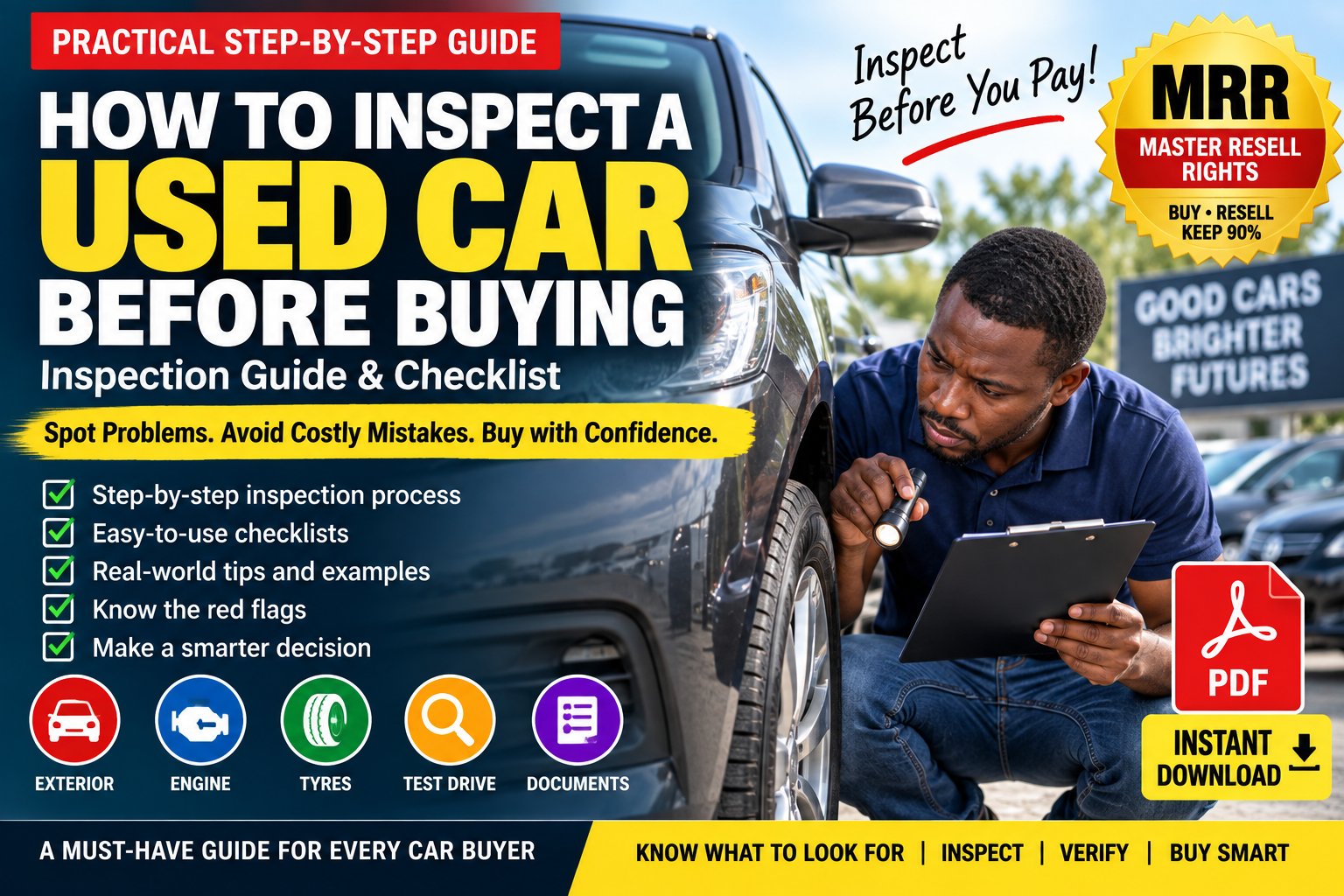
How to Inspect a Used Car Before Buying is a practical, step-by-step pre-purchase inspection guide designed to help ordinary car buyers know exactly what to check before committing their money.
You don't need to be a mechanic.
Take the guide with you on your phone or print the checklists and follow the inspection process while viewing the car.
The guide takes you through the used-car inspection process in a logical sequence:
VERIFY → WALK AROUND → INSPECT → START → SCAN → TEST DRIVE → RECHECK → PROFESSIONAL INSPECTION → DECIDE
For each important area, you'll learn:
WHAT TO CHECK → HOW TO CHECK IT → WHAT NORMAL LOOKS LIKE → WARNING SIGNS → WHAT TO DO NEXT
The objective is simple: help you recognize obvious problems, identify warning signs early and know when a vehicle needs professional investigation before you buy.
Learn the questions to ask the seller before travelling to inspect a vehicle, what inspection tools to carry and why inspecting the car in daylight and starting it cold can reveal useful information.
Learn how to compare the VIN/chassis number, registration information, mileage and other vehicle details.
You'll also learn which inconsistencies should make you STOP THE PURCHASE until the vehicle's identity and ownership have been properly verified.
Use a simple walk-around procedure to inspect:
✓ Paint differences
✓ Overspray
✓ Uneven panel gaps
✓ Unusual body repairs
✓ Rust and corrosion
✓ Windscreen and windows
✓ Lights and exterior components
You'll know what deserves a closer look before accepting a vehicle that appears perfect at first glance.
Learn what tyre wear can tell you about the car.
The guide explains clues including:
✓ Uneven tyre wear
✓ One-edge wear
✓ Centre wear
✓ Shoulder wear
✓ Cupping/scalloping
✓ Cracks and bulges
✓ Wheel damage
✓ Mismatched tyres
Some tyre patterns can point to alignment, suspension, inflation or maintenance issues that deserve further investigation.
Follow a beginner-friendly inspection of:
✓ Engine oil
✓ Coolant
✓ Brake fluid
✓ Transmission fluid where applicable
✓ Battery
✓ Belts
✓ Hoses
✓ Wiring
✓ Visible leaks
No complicated mechanical knowledge required.
Starting the vehicle can reveal clues you might otherwise miss.
Learn to observe:
✓ Dashboard warning-light self-test
✓ Starting behaviour
✓ Engine idle
✓ Vibration
✓ Knocking and rattling
✓ Squealing
✓ Exhaust smoke
✓ Warning lights that remain illuminated
The guide also explains the possible significance of persistent blue, white or black exhaust smoke without encouraging you to make a complex mechanical diagnosis yourself.
Follow the checklist and test the:
✓ Air conditioning
✓ Windows
✓ Mirrors
✓ Central locking
✓ Seat belts
✓ Horn
✓ Lights
✓ Wipers
✓ Infotainment
✓ USB/charging ports
✓ Reverse camera
✓ Parking sensors
✓ Dashboard controls
✓ Heater and demister
✓ Other fitted equipment
You'll also learn to look for combinations of dampness, musty smells, staining, corrosion and electrical abnormalities that may justify investigation for water intrusion or previous flood damage.
Don't look at the odometer alone.
Learn how to compare the displayed mileage against the condition of the steering wheel, driver's seat, pedals, gear selector and other frequently touched areas.
Then compare the mileage against available service, inspection and vehicle-history records.
If the vehicle is compatible and you have a scanner, the guide explains how to:
✓ Connect the scanner
✓ Read stored trouble codes
✓ Check pending codes
✓ Review readiness monitors where applicable
✓ Recognize situations that need further investigation
You'll also learn an important rule:
A trouble code points you toward a system or condition that needs investigation — it doesn't automatically tell you which component has failed.
Don't just drive around the block.
Follow a structured test-drive procedure and pay attention to:
✓ Steering
✓ Suspension
✓ Brakes
✓ Engine performance
✓ Automatic transmission
✓ Manual transmission and clutch
✓ Acceleration
✓ Vibration
✓ Unusual noises
✓ Straight-line stability
✓ Warning lights
You'll know what to listen, look and feel for while driving.
One of the most valuable sections of this guide helps you identify issues that deserve serious investigation.
These include:
⚠ VIN or document mismatches
⚠ Evidence of identity tampering
⚠ Seller refusing an independent inspection
⚠ Serious structural corrosion
⚠ Suspicious accident repairs
⚠ Engine overheating
⚠ Major engine knocking
⚠ Transmission slipping
⚠ Serious brake problems
⚠ Persistent abnormal exhaust smoke
⚠ Airbag/SRS or ABS faults
⚠ Suspected flood damage
⚠ Unexplained mileage discrepancies
⚠ Multiple unexplained electrical problems
⚠ Unverified vehicle ownership
You'll also learn the difference between a negotiable defect and a high-risk defect.
A worn tyre may have a predictable replacement cost.
A questionable VIN, serious structural damage or major transmission problem is a completely different type of risk.
Take the included inspection sheet with you when viewing a car.
Evaluate key areas using:
PASS | CONCERN | FAIL | NOT CHECKED
The scorecard covers:
Documents & VIN • Vehicle History • Body & Paint • Structural Condition • Rust • Glass & Lights • Tyres • Wheels • Engine • Cooling System • Fluids • Battery • Transmission • Steering • Suspension • Brakes • Interior • Air Conditioning • Diagnostics • Cold Start • Test Drive • Leaks • Warning Lights • Service History • Professional Inspection
There's also space to record:
Immediate repairs required: __________
Estimated repair cost: __________
Other observations: __________
Viewing several cars?
Use the condensed checklist for rapid initial screening.
Documents → VIN → Body → Paint → Panel Gaps → Tyres → Visible Leaks
Engine Bay → Fluids → Cold Start → Warning Lights → Exhaust → Electrical Equipment
Steering → Brakes → Transmission → Acceleration → Suspension → Warning Lights → Post-Drive Leak Check
Then decide whether the vehicle deserves a full professional pre-purchase inspection.
The guide avoids misleading percentage scores.
Instead, make your decision according to risk.
You haven't identified a major warning sign during your initial inspection.
The next step is professional verification.
Something requires further diagnosis, documentation, a repair estimate or specialist inspection.
Don't rush to pay while important questions remain unresolved.
Serious identity, safety, structural or other unacceptable risks remain unresolved.
Sometimes the smartest car-buying decision is simply choosing another car.
This knowledge pack is useful if you are:
• Buying your first used car
• Buying a vehicle from a private seller
• Visiting a used-car dealership
• Comparing several second-hand cars
• Buying a vehicle for your family
• Helping someone inspect a car
• Looking for a practical used-car inspection checklist
• Trying to reduce the risk of expensive buying mistakes
Whether you're considering a small commuter car, family vehicle, SUV, pickup or another used vehicle, the same principle applies:
Inspect first. Verify the important facts. Then decide.
This knowledge pack helps you perform an informed first-stage inspection.
It does not turn you into a professional mechanic and should not replace an independent pre-purchase inspection.
If a vehicle passes your initial screening, have a qualified independent mechanic inspect important systems such as the engine, transmission, brakes, steering, suspension, cooling system, structural condition and electrical systems before completing a significant purchase.
Ask for a written report and repair estimates where appropriate.
A shiny exterior doesn't tell you everything about a used car.
A short test drive doesn't tell you everything either.
Know what to check.
Know what questions to ask.
Know the warning signs.
Know when to bring in a professional.
And know when it's safer to walk away.
Inspect Smarter. Spot Problems Earlier. Make a More Informed Buying Decision.
Get the updates, on newly released, popular & fast-moving MRR digital products
Up to Top

Comments