
Ellan
Joined - December 2025

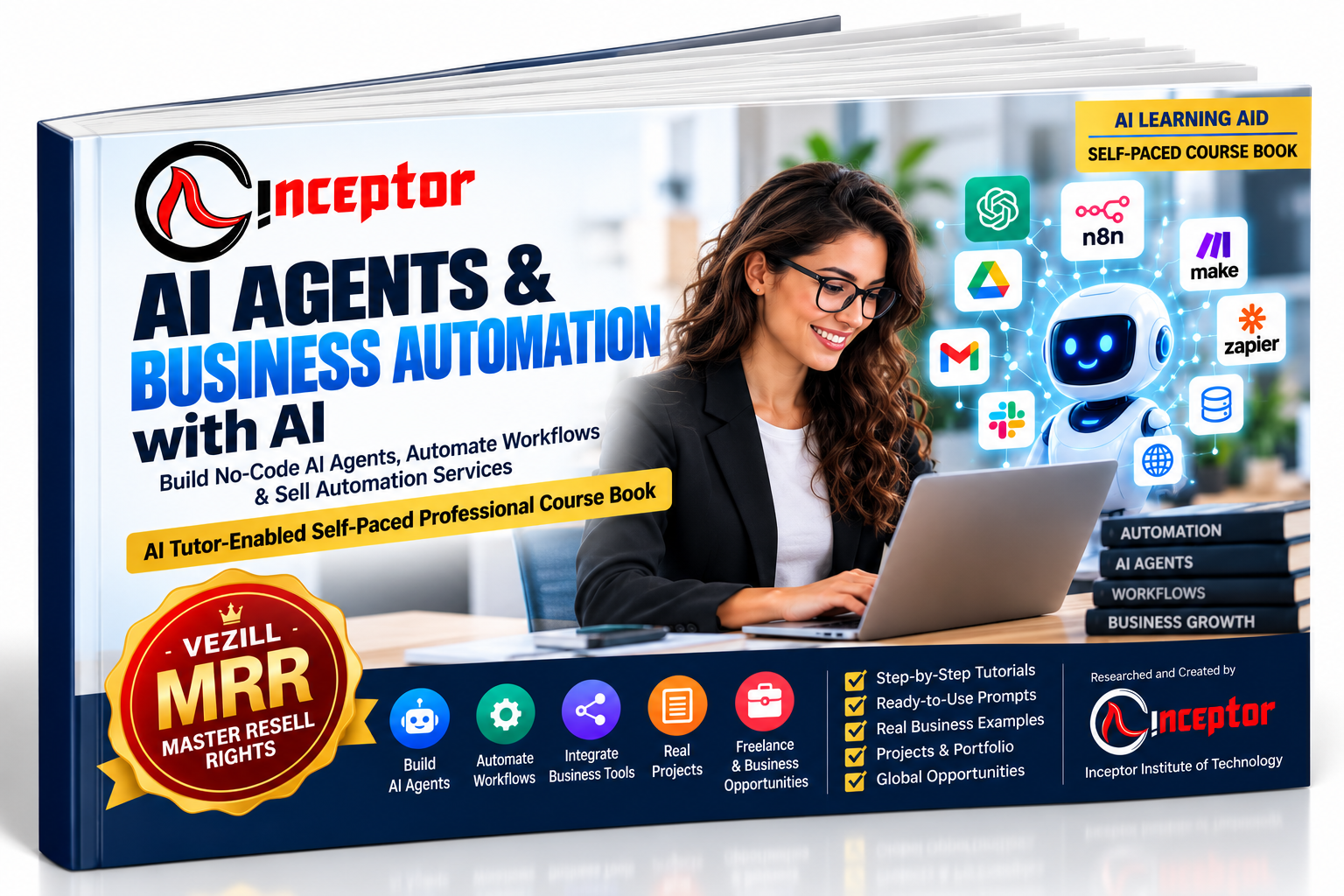
AI Tutor-Enabled Self-Paced Professional Course Book | Beginner-Friendly | Practical Projects | Portfolio Building | Vezill Master Resell Rights
Businesses worldwide are moving beyond basic chatbots and isolated AI prompts toward AI agents, workflow automation and connected business systems that can help qualify leads, process documents, answer customer questions, manage information, automate repetitive tasks and coordinate work across applications.
That shift is reflected in current AI automation training demand. Popular 2027 courses increasingly focus on AI agents, n8n, APIs, RAG, MCP, Make, Zapier, real business workflows and selling automation services, often starting from zero coding experience.
If you have been searching for how to build AI agents, how to automate a business with AI, n8n automation for beginners, no-code AI automation, AI workflow automation, RAG agents, or how to start offering AI automation services, this course book was designed around that practical intent.
You don't just read about AI automation. You learn → build → test → apply → document → create portfolio evidence.
AI Agents & Business Automation with AI is a practical, self-paced professional learning guide designed to take you from beginner concepts to building useful AI-powered business automations.
You will learn how to combine AI with workflows, business applications, APIs, webhooks, knowledge bases and automation platforms such as n8n, Make and Zapier.
The curriculum covers the same major capability areas appearing in current AI-automation learning demand: no-code/low-code automation, AI agents, APIs, RAG, business integrations and real-world automation projects.
But there is an important difference:
Instead of depending entirely on scheduled classroom lessons or watching hours of videos, the course book contains ready-to-use AI Tutor prompts and instructions.
When you don't understand something, ask AI to explain it.
When you are building something, ask AI to coach you step by step.
When your workflow fails, use AI to troubleshoot it.
When you finish a project, ask AI to review it.
READ → ASK AI → BUILD → PRACTICE → TEST → TROUBLESHOOT → IMPROVE → DOCUMENT
Learn at your own pace, from wherever you are.
By working through the course book and completing the practical exercises, you will progressively learn how to:
Understand AI agents, agentic AI, LLMs and business automation
Identify repetitive tasks and processes worth automating
Map a manual business process before automating it
Build no-code and low-code workflows
Create AI-powered workflows with n8n
Understand and use Make and Zapier
Connect systems using APIs and webhooks
Build your first practical AI agent
Write effective system prompts and agent instructions
Give AI agents controlled access to business tools
Understand agent memory, tools and decision logic
Build RAG and company-knowledge agents
Create customer-support and sales automations
Automate lead qualification and follow-up
Build email and administrative automations
Automate document and invoice processing
Understand multi-agent workflows
Add human approval and guardrails
Test and troubleshoot AI automations
Monitor reliability, costs and performance
Calculate potential business automation ROI
Build a professional automation portfolio
Package your skills for jobs and freelance work
Learn how automation consultants identify business opportunities
Structure and sell AI automation services
Understand how an AI automation agency operates
Current production-oriented automation platforms likewise emphasize combining AI agents with integrations, explicit workflow logic, human approvals and RAG rather than simply giving a model unrestricted autonomy.
This is where the course book becomes especially valuable.
You work toward practical projects including:
Learn how AI can classify messages, summarize information, extract tasks and prepare responses while retaining appropriate human approval.
Build an assistant that retrieves information from approved company knowledge before answering customer questions.
Learn the architecture behind:
New Lead → Validate → AI Qualification → CRM → Personalized Follow-Up → Next Action
Learn how businesses can use AI to extract, validate, route and process information from documents.
Build toward an integrated workflow such as:
Lead Capture → AI Qualification → CRM → Follow-Up → Appointment → Notification → Reporting
These aren't arbitrary examples. Current business implementations prominently use AI automation for lead management, support, document processing, email, CRM and other repetitive operations.
You don't want to learn one button in one software application and become stuck when the interface changes.
The course teaches the underlying automation architecture.
You'll understand concepts such as:
Trigger → Input → Validation → Processing → Decision → Action → Output → Exception
And for AI agents:
Goal → AI Agent → Context → Reason/Decide → Tools → Action → Observe → Continue/Stop/Escalate
You then apply those concepts using modern automation technologies.
Learn workflows, nodes, triggers, credentials, expressions, webhooks, HTTP requests, AI integrations, testing and debugging.
n8n itself currently positions its agent platform around modular agents that combine models, memory and tools, with conditional logic and human-in-the-loop controls available for production workflows.
Understand alternative no-code automation environments and learn when different platforms may suit different requirements.
Finally understand terms such as:
API • Endpoint • GET • POST • JSON • API Key • OAuth • Headers • Parameters • Webhook • Status Code
without needing to begin as a programmer.
Learn how an AI assistant can retrieve relevant information from approved company knowledge before generating an answer.
That means progressing beyond a generic chatbot toward systems that can work with actual business information.
Imagine being able to look at a repetitive business process and think:
“How could I automate this?”
You will explore applications across:
Sales: lead capture, qualification, CRM updates and follow-up.
Customer Service: FAQ knowledge agents, ticket classification and escalation.
Administration: emails, scheduling, information processing and repetitive office tasks.
Marketing: content workflows, research and structured approval processes.
HR: candidate-information processing and recruitment workflows with human review.
Finance & Documents: information extraction, validation, routing and approvals.
Management: reporting, information consolidation and operational workflows.
The objective is not automation for its own sake.
It is to identify a real business problem and determine whether automation can solve it reliably and economically.
You don't need to be a software developer to begin.
The book starts with:
What is automation?
then progresses to:
What is an AI agent?
then:
How do workflows work?
then:
How do I build one?
then:
How do APIs connect applications?
and eventually:
How do I build, test and deploy useful business automation?
This beginner-to-practical positioning matches current successful AI-automation learning programs, several of which explicitly require no prior programming knowledge.
Throughout the book you receive ready-to-use prompts.
For example:
“Act as my AI Agents and Business Automation tutor. I am studying [TOPIC]. Explain it as a beginner using simple language, an analogy and a realistic business example. Then test my understanding.”
Building a workflow?
“Teach me how to build [AUTOMATION] step by step. Give me one step at a time. Wait for me to complete each step. If I encounter an error, help me troubleshoot it.”
Something isn't working?
“My automation should produce [EXPECTED RESULT], but instead it produces [ACTUAL RESULT]. Diagnose the problem systematically and help me test one likely cause at a time.”
Finished your project?
“Act as a senior AI automation engineer. Review my project for architecture, reliability, security, cost, error handling, business value and documentation. Tell me exactly what I should improve.”
This course is also designed for professionals who don't necessarily want to become automation consultants.
If you work in sales, administration, customer service, marketing, operations, HR or another information-heavy role, automation skills can help you identify tasks that consume unnecessary time and redesign how the work gets done.
The goal becomes:
Manual repetitive work → structured workflow → appropriate AI assistance → human oversight → faster execution
That can make your AI skills demonstrable rather than merely theoretical.
Completing tutorials isn't enough when you need to prove what you can do.
That's why the course emphasizes portfolio evidence.
For your projects, you'll learn to document:
Business Problem → Process Before Automation → Architecture → Tools → AI Components → Testing → Results → Risks → ROI → Lessons Learned
This gives you material that can be presented when pursuing:
AI Automation Specialist • Workflow Automation Specialist • AI Agent Builder • AI Implementation Specialist • Automation Consultant • Freelancer • Business Automation Roles
The course goes beyond technical learning.
You also learn the business side of automation.
Choose a niche → identify inefficient processes → conduct an automation audit → discover client pain → design a solution → build a prototype → demonstrate business value → prepare a proposal → implement → document → support
The book also introduces service structures such as:
Starter Automation — one clearly defined workflow.
Business Automation Package — several connected workflows.
AI Agent Solution — an agent connected to business systems with appropriate controls.
Automation Support/Retainer — monitoring, maintenance and controlled improvements.
This reflects an important real-world distinction: businesses generally purchase solutions to operational problems, not “AI” in isolation. Contemporary automation-agency guidance similarly emphasizes selling business outcomes and solving existing problems rather than selling AI hype.
There's an entire pathway for that.
Understand workflows, AI agents and integrations.
Create working projects.
Turn your projects into portfolio evidence.
Identify businesses with inefficient processes.
Understand what is consuming time, money or opportunities.
Show how automation could improve the process.
Implement and test the solution.
Monitor and improve it.
Develop repeatable services and systems.
Current AI automation courses increasingly pair technical automation skills with portfolio development and agency/service creation, showing clear market interest in this combination.
No guaranteed income is implied. Your commercial results depend on your skills, execution, market, offer, pricing, client acquisition and other factors.
This course book is particularly suitable for beginners who want to understand AI agents, students and job seekers building practical AI skills, employees who want to automate repetitive work, entrepreneurs wanting to automate operations, virtual assistants, freelancers looking for a new service capability, marketers and sales professionals, consultants, small-business owners, developers exploring agentic automation, and aspiring AI automation agency owners.
You can begin with basic computer and internet skills and progressively move into more technical integrations.
You don't receive theory alone.
Inside you'll find:
18 structured learning modules • AI Tutor prompts • guided practical exercises • real-world business examples • workflow architecture diagrams • troubleshooting guidance • module assessments • API and webhook training • RAG training • agent prompt templates • automation opportunity audit • process-mapping templates • agent specification templates • test-plan templates • security checklists • client-discovery templates • automation proposal framework • ROI framework • portfolio case-study structure • five capstone projects • 30-day practical learning challenge • career and freelance pathway
The course-book specification is explicitly designed to progress from beginner understanding through workflow design, APIs, AI agents, RAG, business implementation and ultimately portfolio and commercial application. Pasted text
Want to go beyond self-paced learning and have your practical work assessed?
Complete the specified:
Tests → Practical Projects → Capstone → Documentation → Portfolio
You may then submit the required project evidence to Inceptor Institute of Technology for assessment.
Submit Projects to Inceptor Institute of Technology
Important: Purchasing or completing the course book does not automatically award certification. Certification is subject to Inceptor's applicable assessment requirements and successful evaluation.
This creates a second potential value proposition.
Use the course book to develop practical AI automation skills.
Build workflows, AI agents and portfolio projects.
Use your skills in your workplace, freelance work, consulting or your own business.
Where your purchase includes a valid Vezill Master Resell Rights (MRR) licence, you can resell the eligible digital product according to the licence and applicable Vezill terms.
Suppose you learn from the book and start creating educational content about:
“How AI agents work”
or
“3 business tasks you can automate with AI”
or
“How to build your first n8n workflow”
or
“How small businesses can use AI agents”
Your content attracts people who want to learn the same skill.
Instead of only telling them where you learned it, you can direct interested buyers to the course book through your permitted Vezill reseller pathway.
Your marketing funnel can look like:
↓
↓
↓
↓
↓
You can promote through TikTok, Facebook, Instagram Reels, LinkedIn, YouTube, WhatsApp Status, blogs, email, webinars and professional communities, subject to each platform's rules.
Consider the difference.
Find buyer → Sell digital product → Earn applicable reseller revenue
Find business problem → Design automation → Build solution → Charge for implementation/support
Learn → Build → Demonstrate → Create Educational Content → Sell Course Book → Find Automation Clients → Build Portfolio
You are therefore not limited to a single possible use of the product.
Choose one audience, for example:
Create content around:
“5 repetitive business tasks AI can automate.”
Show a simple example:
Website Lead → AI Qualification → CRM → Follow-Up
Then explain that someone who wants to learn how to build such systems can use the AI Agents & Business Automation with AI self-paced course book.
Your call to action becomes:
Want to learn how to build AI agents and automate real business workflows? Get the self-paced AI Tutor-enabled course book and start building practical projects step by step.
Repeat the approach with different problems and audiences.
MRR does not guarantee earnings. Sales depend on demand, audience, product positioning, marketing, pricing, conversion rates and applicable Vezill terms. Always follow the specific MRR licence supplied with your purchase.
Develop practical AI-agent and automation knowledge.
Improve repetitive processes in your work or business.
Create real AI agents and workflow projects.
Develop portfolio evidence.
Use the skills when pursuing relevant professional opportunities.
Offer appropriate automation services.
Develop an automation consulting or agency model.
Where covered by your Vezill MRR licence, market the course book to other interested learners.
AI agents become valuable when they can work with tools, business systems and controlled workflows- not merely generate text.
If you've been searching for a practical way to learn:
AI agents • business automation • n8n • no-code AI automation • workflow automation • Make • Zapier • APIs • webhooks • RAG • AI business agents • automation freelancing • AI automation agency skills
this course book brings those subjects into one structured self-paced learning system.
Get AI Agents & Business Automation with AI - AI Tutor-Enabled Self-Paced Professional Course Book.
Researched and Created by Inceptor
Optional Project & Portfolio Assessment by Inceptor Institute of Technology
Vezill Master Resell Rights opportunity available subject to the applicable licence terms.
Get the updates, on newly released, popular & fast-moving MRR digital products
Up to Top
Comments