
Most digital-product sellers spend all their energy finding the next new buyer and almost none nurturing the ones who already said yes. That's backwards — a customer who bought from you once has already cleared every objection a stranger still has to overcome. Turning that first purchase into a second, third, and tenth is one of the cheapest, most reliable ways to grow revenue.
This guide covers the specific system for keeping buyers coming back, without feeling pushy or transactional.
Turning one-time buyers into repeat customers means treating the sale as the start of a relationship, not the end of one. The system: (1) deliver instantly and thank the buyer warmly, (2) follow up with genuine value, not just more offers, (3) ask for a review at the right moment, (4) give returning buyers an exclusive reason to come back, and (5) tell them the moment you release something new.
A repeat customer costs almost nothing to reach again, already trusts you, and typically spends more per purchase than a first-time buyer — making retention one of the highest-return activities in any digital-product business.
Deliver every repeat purchase through Vezill for instant, professional checkout every single time.
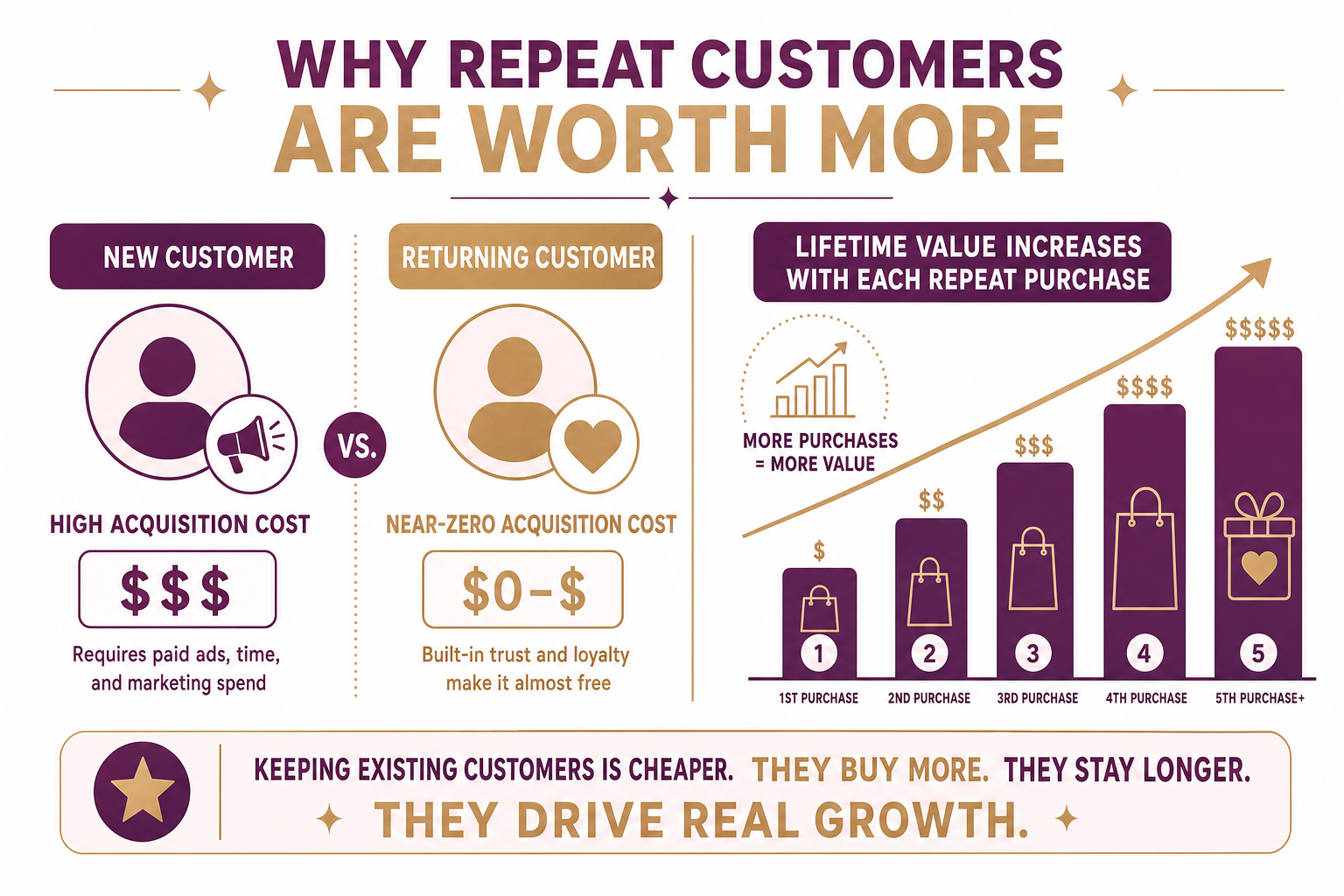 A returning customer is nearly free to reach again — and worth more each time.
Acquiring a new buyer costs time, content, or ad spend. Reaching a past buyer again costs almost nothing — they already know who you are, already trust your delivery, and already own something that proves your quality. That trust compounds: repeat buyers tend to spend more per purchase and refer others more readily than first-time buyers ever do.
Retention isn't a single action — it's a loop that repeats after every sale.
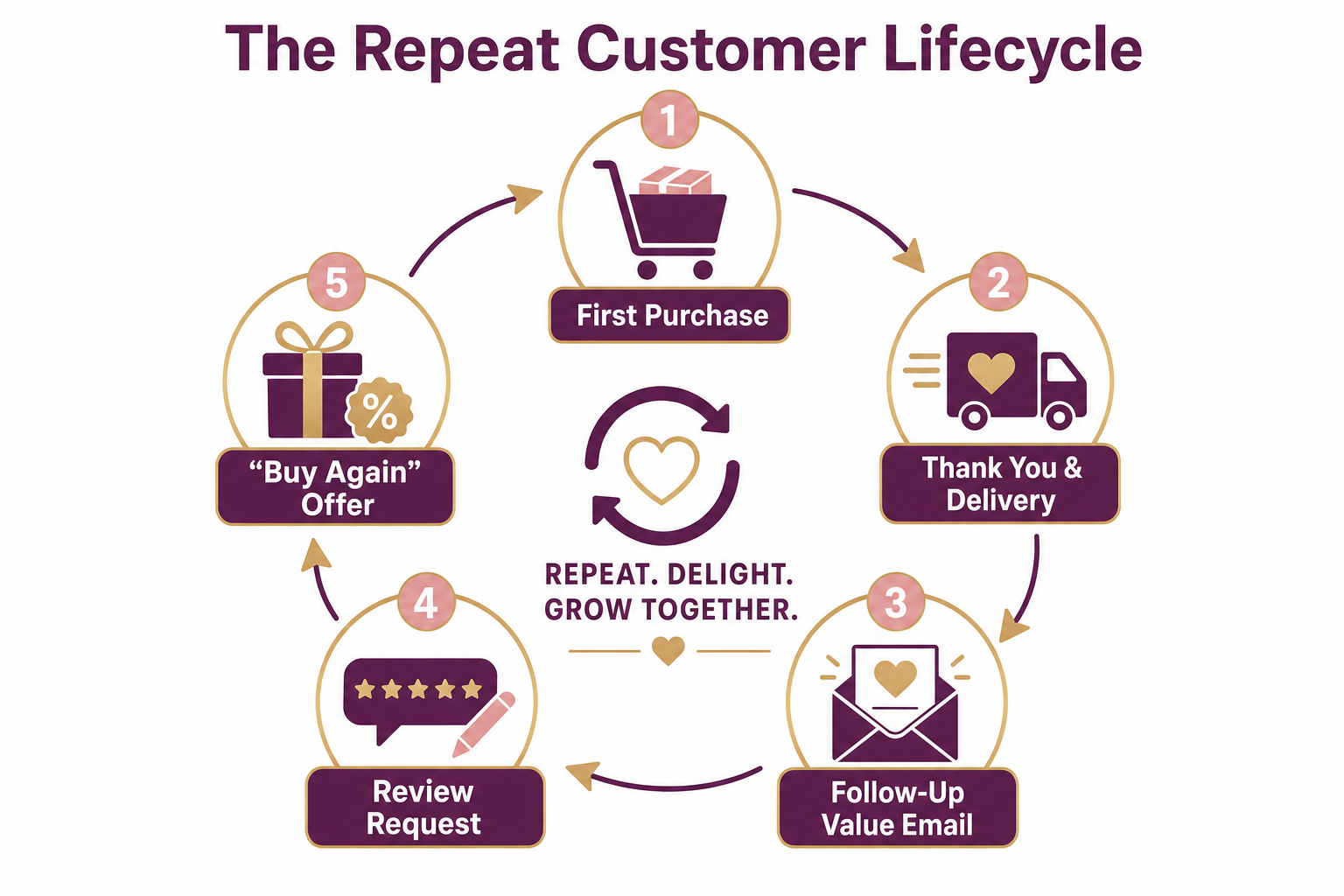 Every purchase should end by setting up the next one.
Each stage of this loop earns the right to the next: a great delivery earns attention for a follow-up, genuine value earns a review request, and a review earns the right to make another offer. Skip a stage, and the loop breaks before it compounds.
The days right after a purchase are when a buyer is most engaged — don't let them go silent.
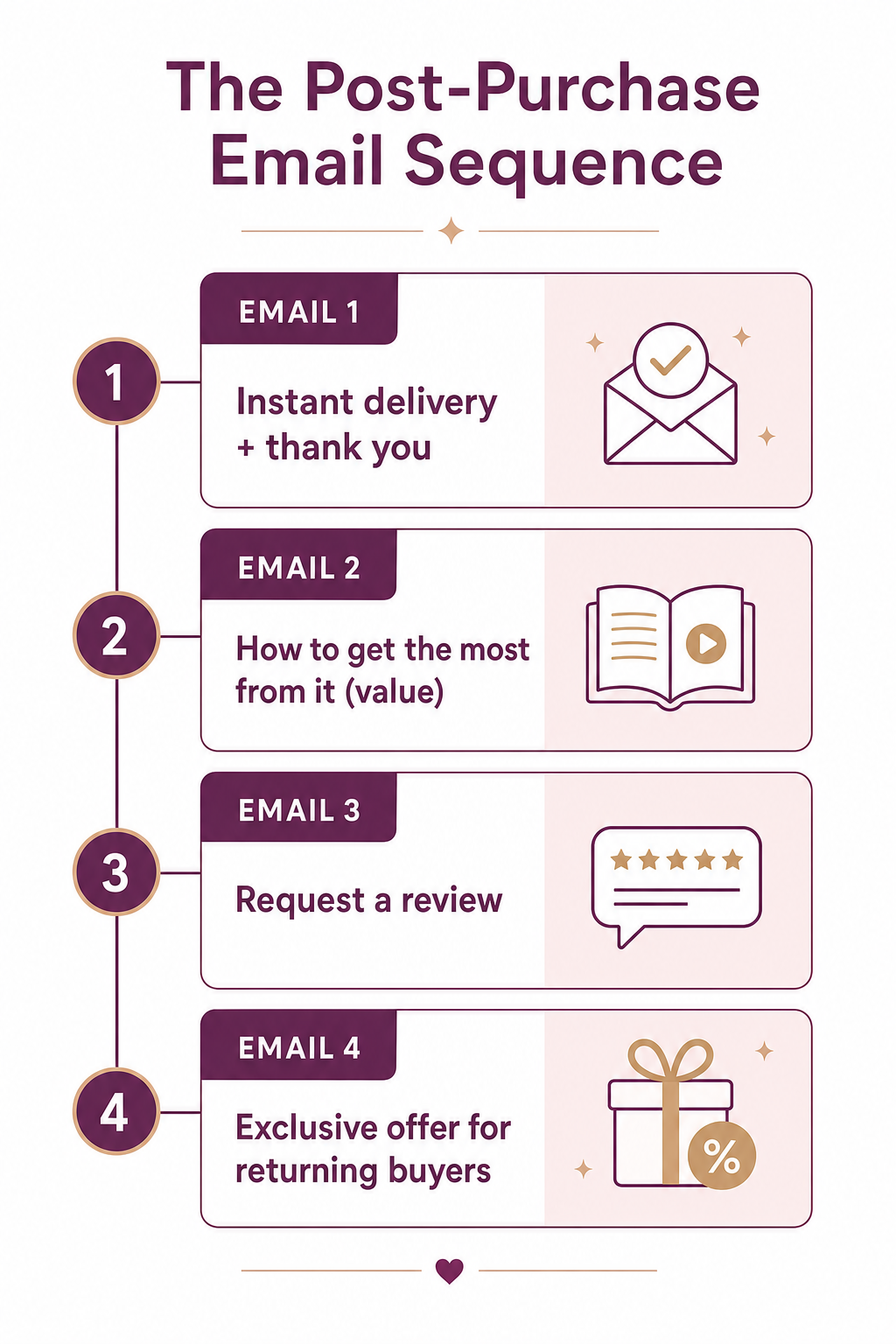 A simple four-email sequence keeps the relationship alive after the sale.
Send delivery and thanks immediately, follow up a few days later with genuine tips for getting the most from the product, ask for a review once they've had time to use it, then — and only then — introduce an exclusive offer reserved for returning buyers. If you haven't built this sequence yet, building an email list from zero covers the foundation this whole system runs on.
Beyond email, a handful of concrete triggers reliably pull past buyers back to purchase again.
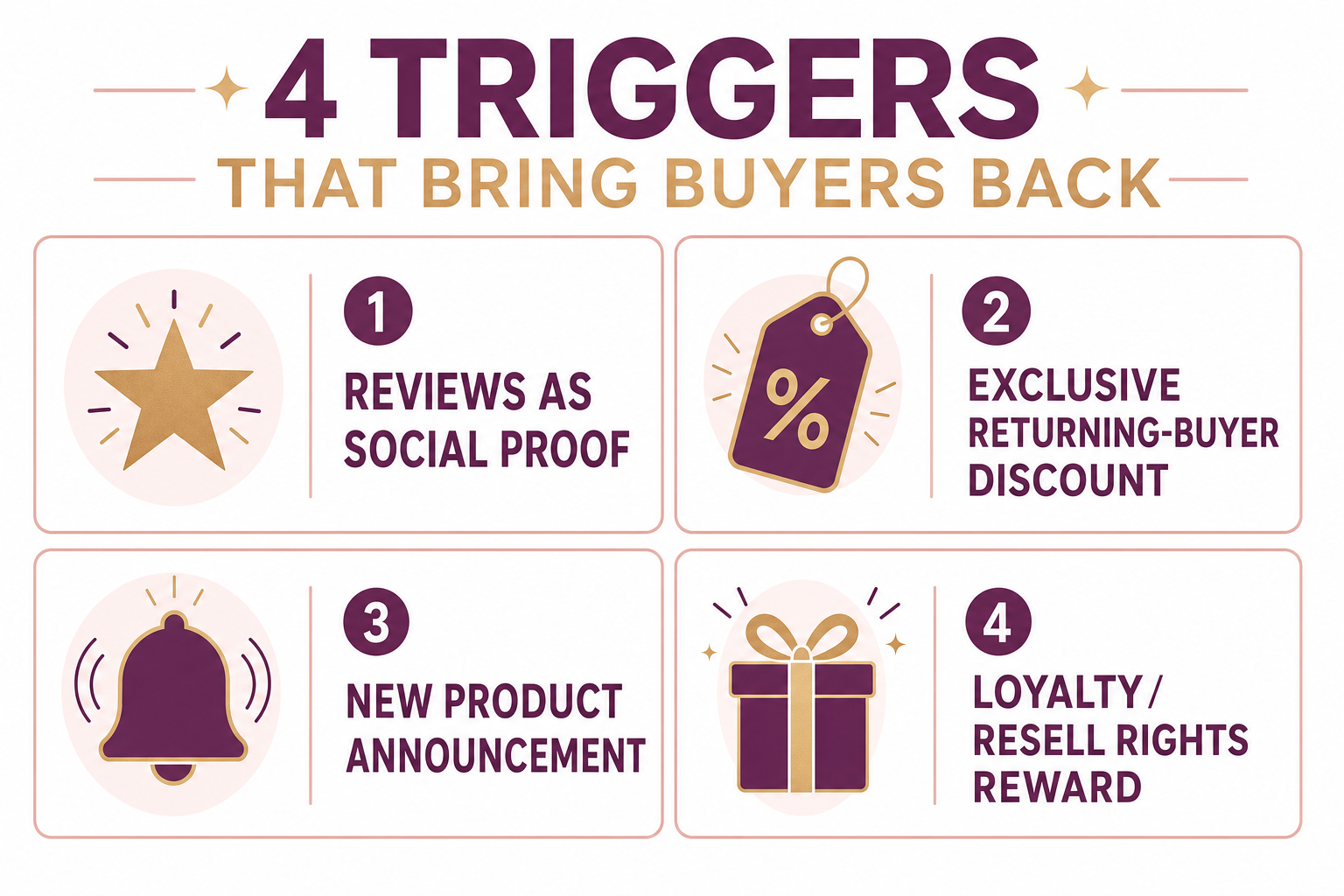 Four simple triggers, each one a legitimate reason to reach out again.
Social proof from other buyers reassures hesitant returners, an exclusive discount rewards loyalty without devaluing your regular price, a new product announcement gives past buyers first access, and offering resell rights turns a satisfied buyer into your own promoter — see what Master Resell Rights actually means for how this turns retention into distribution.
The easiest repeat sale: A buyer who already trusts you is the easiest person on earth to sell your next product to. Never let a satisfied customer become a stranger again by going silent after the sale.
Most sellers think of reviews purely as marketing for new buyers — but asking for a review is also a retention touchpoint. It re-engages a past buyer, reminds them of the value they received, and opens a natural door to mention what's coming next. Understanding why buyers say yes in the first place makes this ask land better — see the psychology behind buying digital products for the trust signals a genuine review reinforces.
The sellers who retain best treat every past buyer as a relationship, not a transaction record. Consistency and quality across every release is what turns a list of past buyers into a genuinely loyal following — the same principle that lets artists build a steady income on Vezill by focusing on quality and consistency instead of chasing constant new discovery.
Going silent after the sale — the relationship doesn't end at checkout; it starts there.
Only emailing when you have something to sell — value-first follow-ups earn the right to offer more.
Never asking for a review — most satisfied buyers will leave one if simply asked at the right moment.
Treating every buyer the same as a stranger — returning buyers deserve recognition, not the same generic pitch.
No clear next offer — a happy buyer with nothing else to buy is a missed second sale.
The most profitable digital-product businesses aren't the ones constantly chasing brand-new strangers — they're the ones that keep the buyers they've already earned coming back. Deliver well, follow up with genuine value, ask for reviews at the right moment, and give loyal buyers a real reason to return. The compounding effect of a small, loyal audience often outperforms a much larger cold one.
Look at your last ten buyers today — if you haven't followed up with any of them, that's your first step.
Repeat customers cost almost nothing to reach again since they already trust you, and they typically spend more per purchase and refer others more readily than first-time buyers. Acquiring a brand-new customer, by contrast, requires ongoing time, content, or advertising effort.
It's a short series of follow-up emails sent after a sale — typically a delivery and thank-you message, a value-focused follow-up, a review request, and an exclusive offer for returning buyers, sent in that order over the following days or weeks.
Ask at the right moment, usually a few days after purchase once the buyer has had time to use the product, and make the request simple and specific rather than generic. Reviews also serve as a natural, low-pressure re-engagement touchpoint.
Yes, when used sparingly. An exclusive discount reserved for past buyers rewards loyalty and encourages a repeat purchase without devaluing your regular price for new customers.
Focus on consistent quality across every product you release, communicate regularly with genuine value rather than only sales pitches, and treat every past buyer as an ongoing relationship rather than a closed transaction.
Yes. Offering Master Resell Rights turns a satisfied buyer into an active promoter of your product, which both retains them as a customer and extends your reach through their own resale efforts.
Discover more articles you might be interested in

Learn where to find reliable step-by-step guides online, how to choose the right tutorial for your task, check whether it is current and follow instructions safely.
By Davie

Stop searching broad topics and start finding the exact knowledge you need. Learn how to define your problem, search smarter, choose reliable sources, verify answers and take action.
By Davie

Quick Knowledge or an online course? Learn when a focused answer is enough, when structured learning is better, and how to choose the right learning depth for your goal.
By Davie

Learn how to turn one useful digital product into multiple income streams through premium versions, bundles, courses, licensing, services, subscriptions, B2B sales and complementary products.
By Davie
Get the updates, on newly released, popular & fast-moving MRR digital products
Up to Top
Comments All
Mercy
@mercy
It’s easy to focus so much on getting new customers that we forget about the ones we already have. I liked the simple tips on how to keep customers coming back. Definitely gave me something to think about, especially when it comes to building a business that lasts. 😊
September 07,2026 At 09:25 PM
Jesse
@jesse
Keeping a customer after the first purchase can make a big difference. I could apply this by following up with buyers, offering useful recommendations, and giving them a reason to come back. The article helped me see that getting a sale isn't the end of the customer relationship.
August 26,2026 At 11:01 PM