
If you are searching for past papers with answers in Kenya, the most useful revision materials are not simply old examination papers. Students get more value from past papers that include answers, marking schemes, worked solutions and explanations showing how marks are awarded.
Whether you are preparing for KCSE, KJSEA, KPSEA, school examinations, mocks or end-of-term exams, practising exam-style questions can help you identify weak topics, understand question patterns, improve time management and become more confident before the actual examination.
This guide explains how to find and use KCSE past papers with answers, KJSEA revision questions, KPSEA revision papers, KNEC past papers, mock examinations, topical questions and marking schemes in Kenya.
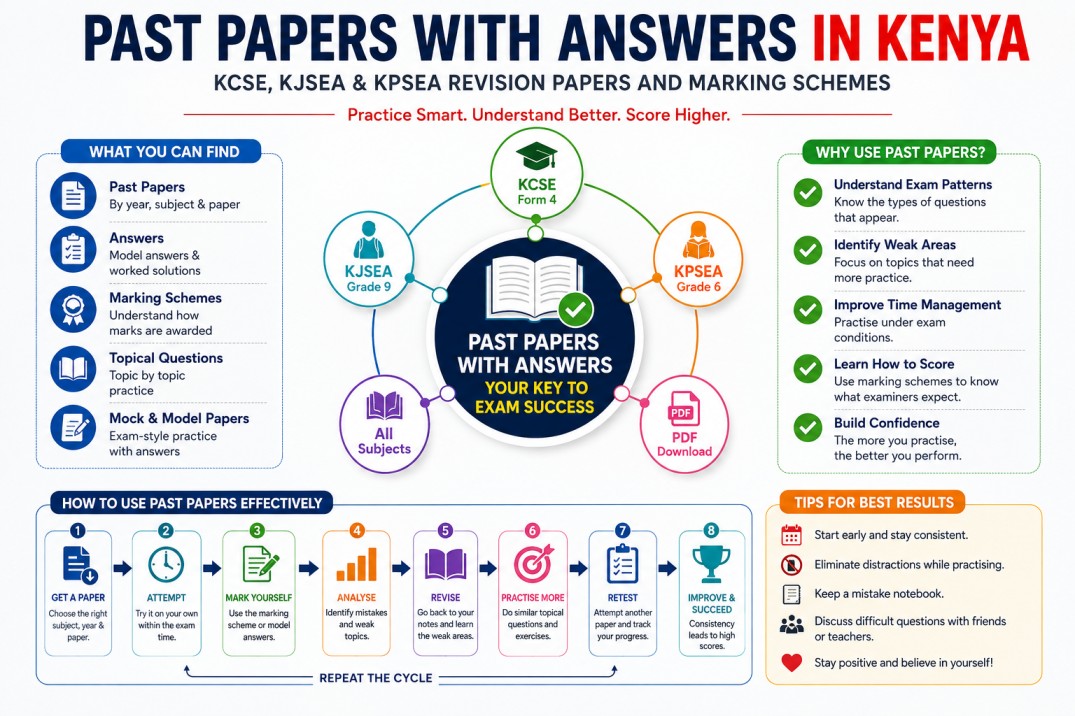
Students in Kenya can find past papers and revision materials through educational websites, schools, teachers, publishers and examination revision platforms.
The most useful resources typically include:
KCSE past papers with answers
KCSE marking schemes
KNEC past examination papers
KJSEA revision questions and answers
Grade 9 revision papers
KPSEA revision questions and answers
Grade 6 revision papers
KCSE mock papers with answers
KCSE topical questions and answers
Subject-specific revision papers
Model examination papers
Worked solutions and examiner-style explanations
When choosing revision material, check the exam, subject, year, paper number and curriculum carefully.
For example, a KCSE Mathematics candidate may need separate Mathematics Paper 1 and Paper 2 resources rather than a generic Mathematics revision PDF.
One of the most common revision searches among Kenyan secondary-school students is for KCSE past papers with answers.
Past KCSE papers allow candidates to practise questions structured similarly to those previously administered in the Kenya Certificate of Secondary Education examination.
Large Kenyan revision archives currently organize KCSE material by year, subject, individual paper and marking scheme, reflecting the way students look for these resources online.
Students preparing for KCSE should ideally practise papers from several years rather than relying on one examination.
Useful searches include:
KCSE past papers with answers PDF
KCSE past papers and marking schemes
KNEC past papers with answers
KCSE revision papers with answers
Form 4 past papers with answers
KCSE questions and answers
KCSE past papers free download
KCSE mock papers with answers
KCSE topical questions and answers
Many students specifically search for KCSE past papers with answers PDF because PDF revision materials can be saved on a phone, tablet or computer and used offline.
Current Kenyan revision collections offer year-by-year archives and organize resources using precisely this combination of examination papers, answers, marking schemes and downloadable formats.
However, downloading hundreds of papers does not automatically improve examination performance.
The important part is how you use them.
A student should attempt the questions before checking the answers.
After completing a paper:
Mark your answers.
Identify incorrect questions.
Determine which topics caused the mistakes.
Review those topics.
Attempt similar questions again.
Record recurring mistakes.
Repeat the process under timed conditions.
This turns past papers into a learning system rather than a collection of PDFs.
A marking scheme is almost as important as the question paper.
It helps students understand what examiners expect before awarding marks.
KCSE revision resources commonly pair examination papers with marking schemes for exactly this reason.
For example, you may understand a Biology concept correctly but still lose marks because your answer lacks a required scientific term.
Similarly, in Mathematics, getting the final answer wrong does not necessarily mean every step of your calculation was wrong.
Studying worked solutions and marking schemes can help you understand where marks are earned.
This is an important distinction.
The purpose of using past papers is not to memorise hundreds of answers.
Instead, ask:
Why is this answer correct?
Which concept is being tested?
What keywords are required?
How are the marks distributed?
Where did I make my mistake?
Could I answer a similar question if the wording changed?
That is where real examination improvement happens.
Mathematics is one of the subjects where worked answers can provide substantially more value than a simple answer key.
Students commonly look for:
KCSE Mathematics past papers with answers
KCSE Maths Paper 1 questions and answers
KCSE Maths Paper 2 questions and answers
Form 4 Mathematics revision papers
KCSE Mathematics topical questions
KCSE Mathematics marking schemes
KCSE Maths worked solutions
When solving Mathematics past papers, do not immediately look at the answer.
Attempt the problem independently.
Then compare your method with the worked solution.
If your answer is incorrect, identify the exact step where the error occurred.
Create a list of weak areas such as:
Algebra → weak
Trigonometry → improving
Statistics → strong
Vectors → needs revision
Your next revision session should concentrate on the weakest topics.
Students preparing for Biology can search for:
KCSE Biology past papers with answers
KCSE Biology Paper 1 questions and answers
KCSE Biology Paper 2 questions and answers
KCSE Biology Paper 3 questions and answers
KCSE Biology practical questions
Biology topical questions and answers
KCSE Biology marking schemes
Science revision benefits particularly from understanding the terminology expected in answers.
Instead of merely checking whether your general idea was correct, compare the scientific terms and logical sequence in your response with the marking guide.
For Chemistry, useful revision searches include:
KCSE Chemistry past papers with answers
Chemistry Paper 1 questions and answers
Chemistry Paper 2 questions and answers
Chemistry Paper 3 practical questions
KCSE Chemistry marking schemes
Chemistry topical questions and answers
Form 4 Chemistry revision papers
When reviewing Chemistry questions, pay particular attention to calculations, chemical equations, observations, explanations and practical procedures.
Physics candidates can use past papers to practise both conceptual questions and calculations.
Useful searches include:
KCSE Physics past papers with answers
KCSE Physics Paper 1 questions and answers
KCSE Physics Paper 2 questions and answers
KCSE Physics Paper 3 questions and answers
KCSE Physics calculations with solutions
KCSE Physics topical questions
For numerical questions, a detailed worked solution is particularly useful because it shows the formula, substitution, units and calculation steps rather than providing only the final answer.
English revision requires a different strategy.
Students can search for:
KCSE English past papers with answers
KCSE English Paper 1 questions
KCSE English Paper 2 questions
KCSE English Paper 3 questions
KCSE English comprehension questions and answers
KCSE English grammar questions
KCSE English functional writing questions
KCSE English model answers
For composition and essay questions, don't expect one universally correct answer.
Instead, study model responses to understand structure, relevance, grammar, vocabulary, organization and how ideas are developed.
Kiswahili students can similarly search for:
KCSE Kiswahili past papers with answers
KCSE Kiswahili Paper 1
KCSE Kiswahili Paper 2
KCSE Kiswahili Paper 3
KCSE Kiswahili Insha
KCSE Kiswahili Fasihi questions and answers
KCSE Kiswahili marking schemes
Practising under examination conditions is particularly useful for sections requiring longer written responses.
Past-paper revision can be used across almost every examinable subject.
Students frequently need revision materials for subjects such as:
CRE
History and Government
Geography
Agriculture
Business Studies
Computer Studies
Home Science
French
German
IRE and other examinable subjects.
A useful search formula is:
KCSE + Subject + Past Papers + Answers + Paper + Year
For example:
KCSE CRE Paper 1 past papers with answers
or:
KCSE Agriculture Paper 2 questions and answers
This produces much more targeted results than simply searching for “past papers.”
Another effective approach is to revise chronologically.
Students may search for:
2025 KCSE past papers with answers
2024 KCSE past papers with answers
2023 KCSE past papers and marking schemes
2022 KCSE past papers
2021 KCSE questions and answers
2020 KCSE past papers
Current online archives demonstrate substantial demand for this year-by-year structure, with recent examinations prominently separated from older papers.
There is no single number that guarantees a particular grade.
A better principle is:
Practise enough papers to identify recurring weaknesses, correct them and demonstrate that you can handle unfamiliar questions independently.
Start with recent papers because they are generally more relevant to the current examination context.
Older papers can then provide additional practice where the underlying syllabus content remains relevant.
Grade 9 learners preparing for the Kenya Junior School Education Assessment (KJSEA) increasingly need assessment-specific revision material.
Useful searches include:
KJSEA past papers
KJSEA questions and answers
KJSEA revision papers
Grade 9 revision papers with answers
KJSEA Mathematics questions and answers
KJSEA English questions and answers
KJSEA Integrated Science questions
KJSEA Social Studies revision
KJSEA model papers
KJSEA sample papers
KJSEA marking schemes
Because KJSEA is considerably newer than KCSE, students should be particularly careful about websites describing ordinary practice questions as official past KNEC papers.
Look for clear descriptions distinguishing official assessment materials, sample papers, model papers and independently created practice questions.
Grade 6 learners and parents also search for KPSEA past papers with answers and related revision material.
Popular resources include:
KPSEA Mathematics questions and answers
KPSEA English revision questions
KPSEA Kiswahili questions and answers
KPSEA Integrated Science revision
KPSEA Social Studies revision
Grade 6 revision papers
KPSEA model papers
KPSEA sample papers
As with KJSEA, always confirm whether a resource is an actual previously administered assessment or independently developed exam-style practice material.
Past KNEC papers are not the only useful resources.
Students can also practise using:
KCSE mock papers
Pre-mock papers
Post-mock papers
County mock exams
Joint mock exams
Cluster exams
Trial examinations
Model papers
Topical tests
Kenyan revision platforms currently organize these as separate revision categories alongside official past papers.
Mock examinations can be useful because they expose students to fresh questions they have not already memorised.
Some students make the mistake of attempting complete examination papers before mastering individual topics.
If you consistently struggle with a specific topic, switch temporarily to topical revision.
For example, instead of doing an entire Mathematics paper, practise 20–30 questions on one weak area.
Search for:
KCSE topical questions and answers
Then add the subject and topic.
For example:
KCSE Mathematics Trigonometry topical questions and answers
KCSE Biology Genetics topical questions
KCSE Chemistry Organic Chemistry questions and answers
KCSE Physics Electricity topical questions
Once your performance improves, return to complete papers.
A highly effective past-paper routine can be summarized as:
Select the correct subject, year and paper.
Do not open the marking scheme.
This tests what you genuinely know.
Practise completing the paper within the allocated time.
Use a reliable marking scheme or model solution.
Record the result.
For example:
Mathematics Paper 1 — 54%
Separate mistakes into categories:
Didn't know the concept
Forgot the formula
Misread the question
Calculation error
Didn't use required terminology
Ran out of time
Return to your notes, textbook or teacher.
Use topical questions until the weakness improves.
Measure whether your score improves.
This creates a feedback loop:
Attempt → Mark → Analyse → Learn → Practise → Retest
That process is more valuable than completing dozens of papers without analysing mistakes.
Yes—but AI should be used as a study assistant, not as a replacement for learning or as an assumed authoritative marking scheme.
For example, after attempting a Mathematics question, you can give the question and your attempted solution to an AI assistant and ask:
Explain this problem step by step. Do not just give me the final answer. Show me where my method went wrong and then give me a similar question to attempt independently.
For Biology:
Explain why this answer earns the marks. Identify the important biological terms I should understand, then test me with three similar questions.
For revision planning:
I scored 48% in Mathematics Paper 1. I lost most marks in vectors, probability, trigonometry and transformations. Create a seven-day revision plan focused on these weaknesses.
This is where AI can make traditional past-paper revision substantially more interactive.
However, verify important answers against reliable curriculum materials, teachers and legitimate marking schemes. AI systems can make mistakes.
Instead of searching:
past papers
be specific.
Use this formula:
For example:
KCSE Mathematics Paper 1 2025 questions and answers PDF
or:
KCSE Biology Paper 2 2024 marking scheme
or:
KJSEA Grade 9 Mathematics revision questions with answers
Specific searches generally make it easier to find the exact revision material you need.
KCSE past papers can be found through Kenyan education websites, revision platforms, schools, teachers and educational publishers. Look for resources that clearly identify the year, subject, paper and corresponding marking scheme.
Many educational platforms provide KCSE past papers and marking schemes in downloadable formats. Current Kenyan search results prominently feature PDF collections organized by subject and year.
Yes. They can help candidates understand question styles, practise time management, identify weak areas and learn how answers are assessed.
Usually, no.
Attempt the question first. Then compare your answer with the marking scheme.
Otherwise, it becomes easy to mistake recognition of an answer for genuine understanding.
Not always.
A marking scheme is designed primarily to guide marking. Students may benefit more from worked solutions and detailed explanations that show why an answer is correct.
Past examination and revision materials are available across major KCSE subjects, including Mathematics, English, Kiswahili, Biology, Chemistry, Physics, CRE, Geography, History, Agriculture, Business Studies and others.
A past paper is an examination that was actually administered previously by the relevant examination body. A mock paper is a practice examination created to simulate an upcoming examination.
No.
Prediction papers are independently created practice materials based on anticipated topics or question styles. They should never be presented as leaked or official future KNEC examinations.
Topical questions group examination-style questions according to syllabus topics rather than examination years. They are useful when a student needs intensive practice in a particular weak area.
Modern AI systems can explain many examination questions, but their answers should not automatically be treated as official. Students should verify important answers against trusted educational sources and marking schemes.
The objective of using past papers with answers in Kenya should not be to collect the largest number of PDFs.
The objective is to become better at answering examination questions.
Whether you are preparing for KCSE, KJSEA, KPSEA, mocks or school examinations, use past papers to identify what you know, expose what you don't know and systematically improve weak areas.
For KCSE candidates, combine past papers, marking schemes, topical questions, mock examinations, worked solutions and timed practice.
For KJSEA and KPSEA learners, use curriculum-appropriate revision questions, sample assessments, model papers and clearly identified past assessment materials.
And when using AI, use it to explain difficult concepts, diagnose mistakes, generate additional practice and create personalized revision plans, not simply to copy answers.
The best revision question is not the one you already know how to answer.
It is the one that exposes a weakness early enough for you to fix it before examination day.
Discover more articles you might be interested in

how to create your first knowledge product in one weekend
By Davie

how to build multiple digital products from one skill
By Davie

how to find problems people will pay you to solve
By Davie

How to turn a hobby into a digital product
By Davie
Get the updates, on newly released, popular & fast-moving MRR digital products
Up to Top
Comments All
Daniel
@daniel
It highlights the value of using past papers with answers for revision. Having something this clear and easy to use can make studying feel much more manageable for students.
September 09,2026 At 10:01 PM
Willis Jr.
@willis_jr.
This is the kind of resource students can actually use. Having past papers together with answers makes revision much easier because you can practice and immediately see where you went wrong. I’d definitely recommend it to anyone preparing for exams.
August 28,2026 At 02:09 PM