
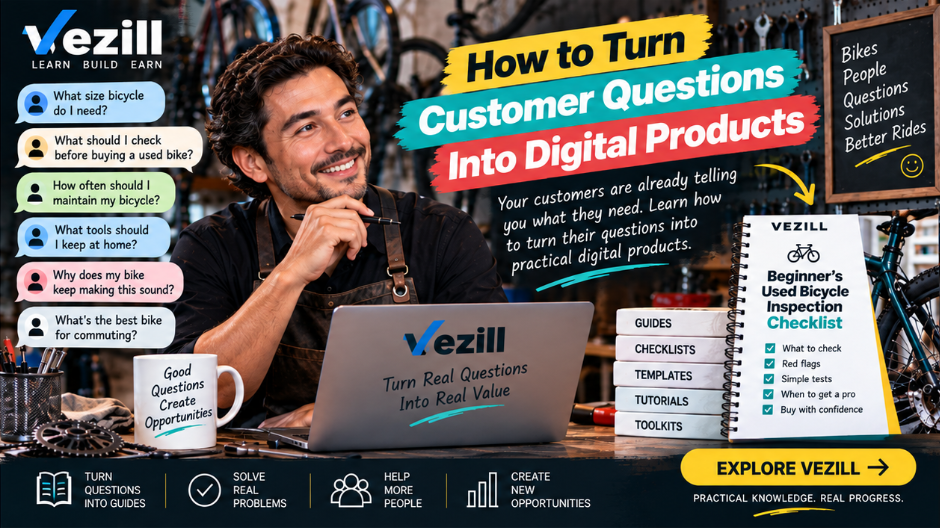
A research-led framework for finding the problems hidden inside repeated customer questions, packaging useful answers responsibly, and validating whether they deserve to become digital products.
Mateo is behind the counter in his bicycle shop when several conversations overlap. One customer is collecting a repaired bicycle. Another is comparing commuter bikes. A message arrives asking about bicycle sizing. Then a customer points at a second-hand bicycle and asks a question Mateo has answered in one form or another many times: “What should I check before buying a used bike?”
Mateo begins explaining. He talks about looking carefully, asking about the bicycle’s history, noticing obvious signs of damage or neglect, checking whether important parts appear to operate normally, and knowing when uncertainty deserves a professional inspection rather than a guess. He avoids pretending that a quick visual check can guarantee safety.
The customer listens and says: “Can you just write all this down for me?”
YOUR CUSTOMERS MAY ALREADY BE GIVING YOU A PRODUCT RESEARCH DATABASE—ONE QUESTION AT A TIME. QUICK ANSWER — How can I turn customer questions into digital products?A customer’s exact wording matters because it is evidence of what they are thinking about. But the sentence they say is not always the problem you need to solve. Good customer research asks what people are trying to do, how they do it now, where friction appears and what outcome they actually need.
GOV.UK’s discovery research guidance recommends finding out what users are trying to do, how they currently do it, what problems or frustrations they experience and what they need to achieve their goal. Its live-service guidance also recommends analysing support tickets to identify problems users have with a service.
Suppose a photography customer asks, “What camera should I buy?” The surface question is about a camera. The underlying problem could be uncertainty about specifications, fear of wasting money, confusion about which features matter, or difficulty matching equipment to a particular type of photography.
QUESTION: What camera should I buy? The Question Is a Signal
1. Customer Question: record what the customer actually asked. Preserve meaning, but remove unnecessary identifying information from research notes.
2. Question Category: classify it. Is it about choosing, preparing, doing, troubleshooting, process, planning, cost or avoiding mistakes?
3. Repeated Pattern: look for semantically similar questions, not only identical wording. “Which camera should I get?” and “What camera is best for me?” may belong to the same selection theme.
4. Underlying Problem: ask what difficulty produces the question. The real problem may be uncertainty, lack of preparation, poor comparison criteria, missing instructions or inability to make a decision.
5. Knowledge Gap: identify what the customer does not yet understand that prevents action.
6. Desired Outcome: define what the person is trying to accomplish. A product should be organized around that outcome, not around how much information you can include.
7. Best Format: decide what would make the solution easiest to apply. A repeated sequence may need a checklist; a recurring document may need a template; a decision problem may need a worksheet.
8. Product Hypothesis: name the smallest reusable resource that might help.
9. Validation: gather evidence that the problem is frequent and important enough—and test whether the proposed resource actually helps.
CUSTOMER QUESTION → QUESTION CATEGORY → REPEATED PATTERN → UNDERLYING PROBLEM → KNOWLEDGE GAP → DESIRED OUTCOME → BEST FORMAT → PRODUCT HYPOTHESIS → VALIDATIONCustomer questions live wherever customers interact with a business: email, support tickets, sales calls, WhatsApp Business chats, DMs, live chat, comments, consultations, onboarding, meetings, product reviews, return reasons, sales objections, surveys, website searches, post-purchase support, webinars, workshops and questions employees repeatedly receive.
Support is especially valuable because it records friction after people encounter the real service. GOV.UK’s user-support guidance recommends grouping enquiries by common reasons for contact so recurring problems can be identified.
EXTRACT THE QUESTION PATTERN.1. Choice questions — “Which one should I choose?” These often reveal decision uncertainty. Possible formats include comparison guides, decision trees and buyer worksheets.
2. How-to questions — “How do I do this?” These may point toward a guide, checklist or tutorial when the task is safe and appropriately scoped.
3. Preparation questions — “What do I need before I start?” These often fit preparation checklists, starter kits and planners.
4. Troubleshooting questions — “Why isn’t this working?” These can support troubleshooting guides or decision trees, but high-risk technical, medical, financial or safety-sensitive situations may require qualified professional help rather than a DIY product.
5. Process questions — “What happens next?” These can reveal a need for a roadmap, workflow or onboarding guide.
6. Cost / planning questions — “How much should I prepare?” A calculator or worksheet may help when assumptions are transparent and the topic is not misrepresented as regulated financial advice.
7. Mistake / risk questions — “What should I avoid?” These may become mistake checklists, risk-awareness guides or preparation workbooks.
 The 7 Customer Question Buckets
Before turning a recurring question into a product, evaluate ten dimensions: frequency, problem depth, specificity, actionability, repeatability, outcome clarity, format fit, expertise fit, safety and evidence. This is an editorial decision tool, not a scientifically validated scoring system.
ONE RANDOM QUESTION → NOTE ITThe following 50 examples are hypotheses designed to show the method. They do not claim proven demand. Each begins with a question, interprets a possible underlying problem and matches that problem to a practical format.
Customer question: “What should I check before buying a used bike?”
Underlying problem: Beginner buyers do not know what visible warning signs and questions deserve attention.
Possible digital product: Beginner’s Used Bicycle Inspection Checklist
Format: checklist
Customer question: “How do I know which size to order online?”
Underlying problem: Customers need a consistent way to compare their measurements with the shop’s sizing information.
Possible digital product: Online Clothing Size Preparation Guide
Format: guide + worksheet
Customer question: “What should I compare before choosing a laptop?”
Underlying problem: Buyers struggle to translate technical specifications into their actual use case.
Possible digital product: Laptop Needs Comparison Worksheet
Format: decision worksheet
Customer question: “How do I know if this sofa will fit?”
Underlying problem: Buyers forget doorway, room and access measurements before ordering.
Possible digital product: Furniture Fit Measurement Checklist
Format: checklist
Customer question: “How much food should I prepare for my event?”
Underlying problem: Clients need a structured way to gather event variables before requesting quantities or quotations.
Possible digital product: Event Catering Requirements Planner
Format: planner
Customer question: “How should I store the cake before the event?”
Underlying problem: Customers need clear post-purchase handling information.
Possible digital product: Cake Collection & Storage Guide
Format: mini guide
Customer question: “What meals should I order for the week?”
Underlying problem: Customers struggle to match options to schedule and preferences.
Possible digital product: Weekly Meal Selection Planner
Format: worksheet
Customer question: “Which coffee should I choose if I am new to specialty coffee?”
Underlying problem: Beginners lack a simple vocabulary for choosing among roast and flavor options.
Possible digital product: Beginner Coffee Preference Finder
Format: quiz + guide
Customer question: “What information do you need before I arrive?”
Underlying problem: Guests are unsure how to prepare for check-in.
Possible digital product: Guest Pre-Arrival Checklist
Format: checklist
Customer question: “What should I pack for this day trip?”
Underlying problem: Travelers need destination-specific preparation without searching across messages.
Possible digital product: Day-Trip Packing Planner
Format: planner
Customer question: “What should I put in my guest guide?”
Underlying problem: New hosts do not know which practical information guests repeatedly need.
Possible digital product: Short-Stay Guest Guide Builder
Format: template + checklist
Customer question: “What happens after I book?”
Underlying problem: Guests lack a clear post-booking journey.
Possible digital product: Booking-to-Arrival Roadmap
Format: roadmap
Customer question: “How should I prepare my hair before the appointment?”
Underlying problem: Clients arrive without understanding pre-appointment preparation.
Possible digital product: Hair Appointment Preparation Checklist
Format: checklist
Customer question: “What should I bring to my bridal trial?”
Underlying problem: Clients do not know what references and details make the session productive.
Possible digital product: Bridal Trial Preparation Planner
Format: planner
Customer question: “Which haircut will work with the style I want?”
Underlying problem: Clients need a better way to communicate preferences.
Possible digital product: Haircut Preference Conversation Card
Format: worksheet
Customer question: “What should we prepare before the shoot?”
Underlying problem: Couples do not know which details, items and timing information the photographer needs.
Possible digital product: Wedding Photo Preparation Planner
Format: planner
Customer question: “What should I wear for my session?”
Underlying problem: Clients are uncertain how clothing choices affect the planned look.
Possible digital product: Portrait Session Outfit Planner
Format: worksheet
Customer question: “What do I need to send before you photograph my products?”
Underlying problem: Small businesses arrive without a complete asset and shot brief.
Possible digital product: Product Photo Brief Template
Format: template
Customer question: “What should I prepare before my first gym session?”
Underlying problem: Beginners are anxious because they do not know what a first session involves.
Possible digital product: First Gym Session Preparation Guide
Format: mini guide
Customer question: “What should I track when I start running?”
Underlying problem: Beginners collect random metrics without a simple training log.
Possible digital product: Beginner Running Log
Format: tracker
Customer question: “What should I bring to my first class?”
Underlying problem: First-time participants need basic preparation information.
Possible digital product: First Yoga Class Checklist
Format: checklist
Customer question: “What information do you need before you start?”
Underlying problem: Clients do not know how to brief a writer.
Possible digital product: Writing Project Brief Builder
Format: template
Customer question: “What access should I prepare for onboarding?”
Underlying problem: Clients arrive at onboarding without organized tools, permissions and priorities.
Possible digital product: VA Client Onboarding Checklist
Format: checklist
Customer question: “What happens after I book a consultation?”
Underlying problem: Clients need a clear process and preparation path.
Possible digital product: Consultation Preparation Pack
Format: guide + worksheet
Customer question: “What should I send you so you can create content?”
Underlying problem: Clients do not know what stories, offers, visuals and business information are useful.
Possible digital product: Client Content Collection Questionnaire
Format: questionnaire
Customer question: “Which marketing channel should I focus on first?”
Underlying problem: Small businesses need a structured way to think about audience, goal and resources.
Possible digital product: Marketing Channel Decision Worksheet
Format: worksheet
Customer question: “What do I need before launching a newsletter?”
Underlying problem: Beginners overlook audience, consent, content and setup decisions.
Possible digital product: Newsletter Launch Preparation Checklist
Format: checklist
Customer question: “What content do you need before you start my website?”
Underlying problem: Clients do not know which copy, images, business details and assets to prepare.
Possible digital product: Website Content Preparation Workbook
Format: workbook
Customer question: “What should I prepare for a website discovery session?”
Underlying problem: Clients arrive without clear goals, users or constraints.
Possible digital product: Website Discovery Preparation Sheet
Format: worksheet
Customer question: “Which pages does my small business website need?”
Underlying problem: Owners struggle to map business needs to a simple site structure.
Possible digital product: Small Business Website Page Planner
Format: planner
Customer question: “How do I know which delivery option to choose?”
Underlying problem: Customers need a simple explanation of delivery choices and trade-offs.
Possible digital product: Delivery Option Decision Guide
Format: comparison guide
Customer question: “What should I prepare before opening an online shop?”
Underlying problem: Beginners underestimate product, payment, fulfillment and policy preparation.
Possible digital product: Online Store Readiness Checklist
Format: checklist
Customer question: “Why do customers keep asking the same product questions?”
Underlying problem: Sellers need a way to identify missing listing information.
Possible digital product: Product Listing FAQ Audit
Format: audit worksheet
Customer question: “What information should a new tenant receive at move-in?”
Underlying problem: Small landlords lack a consistent tenant-information pack.
Possible digital product: Tenant Move-In Information Builder
Format: template + checklist
Customer question: “How should I prepare the property before photos?”
Underlying problem: Owners do not know what to organize before the shoot.
Possible digital product: Property Photo Preparation Checklist
Format: checklist
Customer question: “What should cleaners check between guests?”
Underlying problem: Hosts need a repeatable turnover quality process.
Possible digital product: Turnover Quality Checklist
Format: checklist
Customer question: “What should I confirm with vendors before the wedding?”
Underlying problem: Couples and new coordinators struggle to organize final confirmations.
Possible digital product: Vendor Final-Confirmation Checklist
Format: checklist
Customer question: “What measurements do you need from the venue?”
Underlying problem: Clients do not know which venue details affect setup.
Possible digital product: Venue Measurement & Setup Worksheet
Format: worksheet
Customer question: “What information should speakers submit?”
Underlying problem: Speaker coordination becomes fragmented across messages.
Possible digital product: Speaker Information Collection Pack
Format: template
Customer question: “What should my child prepare before the first tutoring session?”
Underlying problem: Parents do not know which materials and learning context are useful.
Possible digital product: First Tutoring Session Preparation Sheet
Format: worksheet
Customer question: “What should I practice between lessons?”
Underlying problem: Learners need a repeatable self-practice structure.
Possible digital product: Weekly Language Practice Planner
Format: planner
Customer question: “How do I know what to revise first?”
Underlying problem: Students need a simple way to prioritize weak topics.
Possible digital product: Revision Priority Worksheet
Format: worksheet
Customer question: “How should I prepare examples for an interview?”
Underlying problem: Candidates know they need examples but lack a structure for selecting and organizing them.
Possible digital product: Interview Example Builder
Format: workbook
Customer question: “What documents should I prepare each month?”
Underlying problem: Small-business clients arrive with incomplete or disorganized records.
Possible digital product: Monthly Bookkeeping Preparation Checklist
Format: checklist
Customer question: “What do you need before you design my logo?”
Underlying problem: Clients begin projects without clear brand information and references.
Possible digital product: Logo Design Brief Builder
Format: questionnaire
Customer question: “What should I bring to our kickoff meeting?”
Underlying problem: Clients need to organize goals, stakeholders and constraints before kickoff.
Possible digital product: Project Kickoff Preparation Pack
Format: worksheet
Customer question: “What information should I send when placing an order?”
Underlying problem: Customers omit delivery, variant or contact details and create avoidable back-and-forth.
Possible digital product: WhatsApp Order Information Template
Format: message template
Customer question: “What should a new client know before booking?”
Underlying problem: Repeated booking questions reveal missing preparation and policy information.
Possible digital product: Salon New-Client Booking Guide
Format: guide
Customer question: “What information do volunteers need before event day?”
Underlying problem: Volunteer instructions are scattered across chats.
Possible digital product: Volunteer Event Brief Template
Format: template
Customer question: “What should local travelers confirm before departure?”
Underlying problem: Customers need one preparation resource covering timing, meeting point and essentials.
Possible digital product: Local Tour Departure Checklist
Format: checklist
Before purchase → CHOOSE. “Which one?” “Is this right for me?” “What do I need?” “What is the difference?” These can reveal comparison, decision and preparation problems.
During purchase or onboarding → START. “What happens next?” “Where do I send this?” “What information do you need?” “How do I begin?” These can reveal onboarding, process and documentation problems.
After purchase → SUCCEED. “How do I use this?” “What should I check next?” “How do I maintain it?” “Why isn’t this working?” These can reveal implementation, maintenance, education and troubleshooting gaps.
THE BEST PRODUCT IDEA MAY NOT COME FROM WHY PEOPLE BUY. The Customer Question Journey
Do not rely on memory alone. A lightweight question log lets you distinguish a question that merely feels common from one that actually recurs. Record only what is necessary for the research purpose.
VEZILL CUSTOMER QUESTION LOGAvoid collecting names, phone numbers, addresses, account identifiers or sensitive details unless there is a legitimate need and lawful basis. For product ideation, an anonymized pattern is usually more useful than a customer identity.
Step 1 — Collect questions over time. Use consistent categories and, where helpful, note the channel and customer stage.
Step 2 — Remove unnecessary personal information. Separate the research signal from identifiers.
Step 3 — Normalize wording. “What camera do I need?”, “Which camera should I get?” and “What camera is best for me?” can all become CAMERA SELECTION if they reflect the same underlying need.
Step 4 — Cluster similar questions. Group by meaning, not only keywords.
Step 5 — Count recurrence. Count only the evidence actually present in your dataset.
Step 6 — Identify underlying problems. Ask what customers are trying to do and what blocks them.
Step 7 — Map desired outcomes. Turn “What are they asking?” into “What result are they trying to reach?”
Step 8 — Generate possible formats. Match the problem to a checklist, template, worksheet, guide, tutorial, calculator or toolkit.
Step 9 — Research demand. Look at current alternatives, search behavior, conversations, existing products and the consequences of leaving the problem unsolved.
Step 10 — Test the smallest useful solution. Put a prototype in front of suitable users and observe whether it helps.
GOV.UK’s analysis guidance recommends filtering, organizing and interpreting research data rather than treating raw notes as conclusions. That principle transfers well to question analysis: the raw message is evidence, while the theme and root problem remain analytical judgments to test.
AI can accelerate the mechanical parts of analysis: normalizing wording, grouping themes, summarizing, suggesting categories, mapping themes to possible outcomes and helping generate product hypotheses. It can also flag ambiguous clusters for human review.
What AI cannot legitimately do is manufacture evidence. If you provide 37 anonymized questions, it can count those 37. It cannot truthfully claim “thousands of customers want this” unless you supply evidence that supports the statement.
USE AI TO FIND PATTERNS IN CUSTOMER QUESTIONS.I will provide anonymized customer questions. Do NOT create products yet. PHASE 1 — EVIDENCE 1. Normalize questions with similar meaning. 2. Group them into themes. 3. Count how many supplied questions belong to each theme. 4. Use only evidence actually present in the supplied dataset. 5. Identify the likely underlying problem for each theme. 6. Identify what the customer appears to be trying to accomplish. 7. Separate DIRECT EVIDENCE from INFERENCE. 8. Flag ambiguous questions. 9. Do not invent demand, frequency, customers, sales or willingness to pay. PHASE 2 — RANK THEMES Rank themes using frequency in the supplied dataset, problem clarity, actionability, expertise fit, possible reusable value and safety/regulatory risk. PHASE 3 — PRODUCT HYPOTHESES Only for the strongest themes, show: QUESTION PATTERN UNDERLYING PROBLEM WHO MAY EXPERIENCE IT DESIRED OUTCOME POSSIBLE FORMAT PRODUCT HYPOTHESIS WHAT STILL NEEDS VALIDATION PRIVACY / SAFETY CONCERNS RULES: Do not infer that a frequent question automatically creates willingness to pay. Do not reproduce personal data. Tell me when the dataset is too small or ambiguous to support a conclusion.
For ChatGPT specifically, current OpenAI Data Controls guidance says signed-in users can turn off “Improve the model for everyone”; chats can remain in history while no longer being used to train models. That setting does not make it appropriate to upload customer data you lack permission or a lawful basis to process. Anonymize and minimize first.
A recurring question can improve your business even when it never becomes a paid download. Sometimes the correct response is simply to make the answer easier to find.
SIMPLE QUESTION → ANSWER ITPaid value usually needs to come from greater usefulness: organization, application, convenience, depth, tools, templates, workflow, examples, structure or saved time—not from deliberately withholding essential customer support.
This fits VEZILL’s current Quick Knowledge positioning: the format is secondary to the useful knowledge inside it. A product becomes more defensible when it organizes practical knowledge around something the user is trying to do.
Question: “What should I check before buying a used bike?” Pattern: Mateo hears variations around second-hand buying. Underlying problem: beginners do not know which visible warning signs, questions and uncertainties deserve attention. Desired outcome: make a more informed buying decision and know when professional inspection is appropriate. Expertise needed: genuine bicycle retail/maintenance experience plus safe boundaries. Best format: checklist. Free or paid? Test both possibilities; basic safety information should not be withheld. Still to validate: whether the checklist is useful enough, to whom, and whether there is willingness to pay.
Question: “What should we prepare before the shoot?” Pattern: couples repeatedly arrive uncertain about timing, details and preparation. Problem: they do not know what will make the session smoother. Outcome: arrive prepared. Format: Wedding Photo Preparation Planner. Free or paid? It may work best as client support, a lead resource or part of a broader planning product. Validate: test whether couples actually use it.
Question: “What content do you need from me?” Pattern: projects stall because clients do not know what to prepare. Problem: website inputs are scattered. Outcome: collect copy, images, offers, contact information and brand assets before build work. Format: Website Content Preparation Workbook. Free or paid? It may be onboarding for current clients and potentially a standalone resource for another audience. Validate: measure whether it reduces delays.
Question: “What should I prepare before my first gym session?” Pattern: first-timers are uncertain about what to bring and what to expect. Problem: uncertainty creates avoidable anxiety and poor preparation. Outcome: arrive prepared for an introductory session. Format: First Gym Session Preparation Guide. Keep it general and avoid individualized medical advice. People with health concerns should seek appropriate professional guidance. Validate: test with genuine first-time clients.
Question: “What information should my guest guide contain?” Pattern: new hosts repeatedly ask what guests need to know. Problem: arrival, property-use and local information is scattered. Outcome: create a clear guest resource. Format: Short-Stay Guest Guide Builder. Validate: compare against actual guest questions and test with hosts and guests.
If ten customers ask the same question, you have evidence that the question exists among those ten interactions. You do not automatically have evidence that all ten would buy a standalone product.
QUESTION EVIDENCE ≠ PURCHASE EVIDENCEValidation can investigate frequency, urgency, current alternatives, consequences of the problem, effort already spent solving it, willingness to try a solution, willingness to pay, search behavior, competing resources and actual product usage.
VEZILL’s guide to finding problems people may pay to solve makes the same distinction: observe recurring problems, confirm willingness to pay and test a small solution rather than assuming a problem is profitable.
QUESTIONS TELL YOU WHERE TO LOOK.Customer support data can contain names, phone numbers, email addresses, account identifiers, payment information, location data, complaints, health details or other sensitive context. Product research rarely needs all of that.
In Kenya, the ODPC Personal Data Protection Handbook summarizes principles including purpose limitation, data minimization, storage limitation, integrity/confidentiality and accountability. The ODPC FAQ defines personal data broadly as information relating to an identified or identifiable natural person.
A responsible workflow asks: What is the minimum information required to understand this pattern? Can identifiers be removed before analysis? Who needs access? How long should raw material be retained? Is the new research use compatible with the purpose for which the data was collected? Do recordings or research activities require notice or consent?
The ODPC’s data-subject rights guidance also emphasizes lawful, fair and transparent processing and limiting personal data to what is necessary for the purpose.
CUSTOMER QUESTIONS ARE RESEARCH MATERIAL.Local context changes the questions people ask. Kenyan and African businesses may repeatedly encounter questions around WhatsApp ordering, M-PESA-enabled business workflows, local delivery, events, church administration, chama organization, small retail, salons, hospitality, property, tours, freelancing and digital services.
A Kenyan retailer hearing “Can I pay by M-PESA?” has a simple customer-support question, not automatically a product. But if small merchants repeatedly ask how to organize their own M-PESA sales records for internal reconciliation, that may reveal a broader organization problem worth researching. If a proposed resource crosses into tax, accounting, regulated finance or legal compliance, current official sources and qualified professional advice may be required.
LOCAL QUESTIONS CAN REVEAL LOCAL KNOWLEDGE GAPS THAT GLOBAL CONTENT DOES NOT ANSWER WELL.After several weeks of logging questions, Mateo can see clusters around bicycle size, beginner equipment, used-bike buying, maintenance, commuting and pre-ride preparation. At first he thinks, “I could make six products.”
But the log changes his behavior. Used-bike questions keep returning to the same uncertainty: beginners are afraid of buying a bicycle with problems they do not understand. That is more useful than the literal wording of any single question.
QUESTION: What should I check before buying a used bike?Mateo has not made a sale. He has not proved a market. He has simply moved from a vague idea to a better-supported hypothesis.
These formulas are decision frameworks, not mathematical guarantees. They are useful because they force the creator to separate evidence of a question from evidence of a market.
 The VEZILL Question-to-Product Engine
VEZILL currently describes Quick Knowledge as focused digital knowledge designed to help people accomplish specific tasks, solve problems or achieve outcomes. Customer-question analysis fits that model because a repeated question is often the first visible sign of a practical knowledge gap.
CUSTOMER QUESTIONS → KNOWLEDGE GAPS → PRACTICAL KNOWLEDGE → DIGITAL PRODUCTS → VEZILL → PEOPLE WHO NEED TO KNOW HOW PEOPLE WHO KNOW HOW → VEZILL → PEOPLE WHO NEED TO KNOW HOWFor creators, continue with How to Identify Valuable Knowledge You Already Have, How to Turn What You Know Into a Digital Product, How to Sell Your Knowledge Online, What Problems Can I Solve Online and Get Paid For?, How to Monetize a Skill You Already Have, Why Human Experience Still Matters in the Age of AI. Browse the VEZILL Products marketplace or return to the VEZILL homepage.
Yes, some recurring questions can reveal problems that may be solved with a reusable guide, checklist, template, worksheet, tutorial or toolkit. The question is a signal; validation is still required.
Collect anonymized questions, group similar questions, identify the underlying problem and desired outcome, match the problem to a practical format, then research and test the strongest hypotheses.
Questions are more promising when they recur, reveal a meaningful and specific problem, can be addressed with knowledge you genuinely have, lead to an actionable outcome and can be handled safely.
There is no universal threshold. Frequency depends on customer volume, segment and context. One question is a clue; repeated independent evidence makes the pattern more worth investigating.
No. Many questions belong in a free FAQ, support article or one-sentence answer. Paid value should usually come from deeper organization, application, tools, templates, workflow or convenience.
They can reveal friction and unmet needs, but a complaint may indicate that the existing service should be fixed rather than that the customer should buy another product.
Support messages can be useful, but use them lawfully and responsibly. Minimize personal data, protect confidentiality, respect applicable consent and purpose requirements, and analyze patterns rather than exposing customers.
Remove unnecessary identifiers, collect only what the research needs, restrict access, use secure storage, avoid unnecessary retention and follow applicable data-protection obligations.
AI can help cluster, categorize and summarize anonymized questions. It should not invent frequency, demand, customers or willingness to pay, and sensitive customer data should not be uploaded unnecessarily.
Questions alone cannot prove willingness to pay. Research alternatives, urgency and current behavior, then test a small solution and observe real usage or purchase behavior where appropriate.
Useful formats include checklists, templates, worksheets, comparison guides, decision trees, planners, trackers, tutorials, calculators, workbooks and toolkits. Choose the format that makes the outcome easiest to apply.
Creators can use their own distribution channels or appropriate marketplaces. VEZILL is positioned around practical Quick Knowledge packaged in formats such as guides, templates, spreadsheets, prompts, tutorials and toolkits.
A repeated question became a pattern. The pattern exposed a problem. The problem pointed to a knowledge gap. The knowledge gap suggested an outcome. The outcome suggested a checklist. And the checklist remained a hypothesis until real users could test it.
Mateo also learned something equally important: some questions should stay free. Some should improve the shop’s FAQ. Some should improve the sales conversation. Some should become better post-purchase support. Only a subset deserve investigation as standalone products.
THE QUESTIONS ARE NOT INTERRUPTING THE BUSINESS.VEZILL’s knowledge-to-product framework begins with useful knowledge and a specific outcome. Customer questions give you another way to find that outcome: listen for what people repeatedly struggle to understand, then investigate the problem behind the words.
VEZILLFind the pattern. Understand the problem. Package the useful knowledge. Validate before you build.
EXPLORE VEZILL → VEZILL — Practical Knowledge, Packaged for Action.
Discover more articles you might be interested in

how to create your first knowledge product in one weekend
By Davie

how to build multiple digital products from one skill
By Davie

how to find problems people will pay you to solve
By Davie

How to turn a hobby into a digital product
By Davie
Get the updates, on newly released, popular & fast-moving MRR digital products
Up to Top