

Until recently, producing a professional-looking video could mean hiring a camera operator, finding actors, recording voiceovers, arranging lighting and locations, and spending hours editing footage. AI video generation is changing parts of that process. Today, AI tools can help create short video clips, product demonstrations, advertising creatives, presenters, voiceovers, animations, B-roll, multilingual versions of existing videos, and social media content.
That creates a real digital business opportunity. But simply having access to an AI video generator won't make you money. The money is in using AI video technology to solve a problem someone is willing to pay you to solve. A restaurant doesn't necessarily care whether you used AI — it wants videos that make its food look appealing. An online shop wants product videos that help it sell. Once you look at AI video generation this way, there are several realistic businesses you can build around it.
You can make money with AI video generation by creating video ads for businesses, producing social media Reels and Shorts, making product videos for e-commerce brands, offering AI spokesperson videos, creating explainers and training videos, localizing existing videos into other languages, producing content for YouTube creators, selling original video assets, or building an AI video agency.
For beginners, one of the simplest approaches is to choose a specific customer, such as restaurants or online stores, create several sample videos, and sell a clearly defined video package instead of advertising yourself simply as an "AI video creator."
This is probably the easiest AI video business model to understand. Businesses need video for Instagram, TikTok, Facebook, YouTube, websites, advertising, product launches, events, sales campaigns, and training — but producing a constant stream of video content can be expensive and time-consuming. That's the gap an AI-assisted video creator can help fill.
Imagine a restaurant that already has high-quality photographs of its food but rarely posts videos. You could create a short promotional video built around those existing assets: write a hook, develop the concept, generate appropriate supplementary visuals where permitted, add motion, music, captions, and a call to action, and deliver it in a format suitable for Reels or TikTok. The restaurant isn't really buying "AI generation" — it's buying marketing content. Instead of advertising "I generate videos using AI," sell "I create short promotional videos for restaurants to use on Instagram and TikTok." The second offer tells the customer exactly what they receive.
AI advertising creatives could become one of the most useful services to learn. Businesses running online advertisements constantly need new creative ideas. A traditional production might involve models, cameras, locations, product shoots, editing, and multiple rounds of production — AI doesn't eliminate all of that, but it can make some creative experimentation much faster.
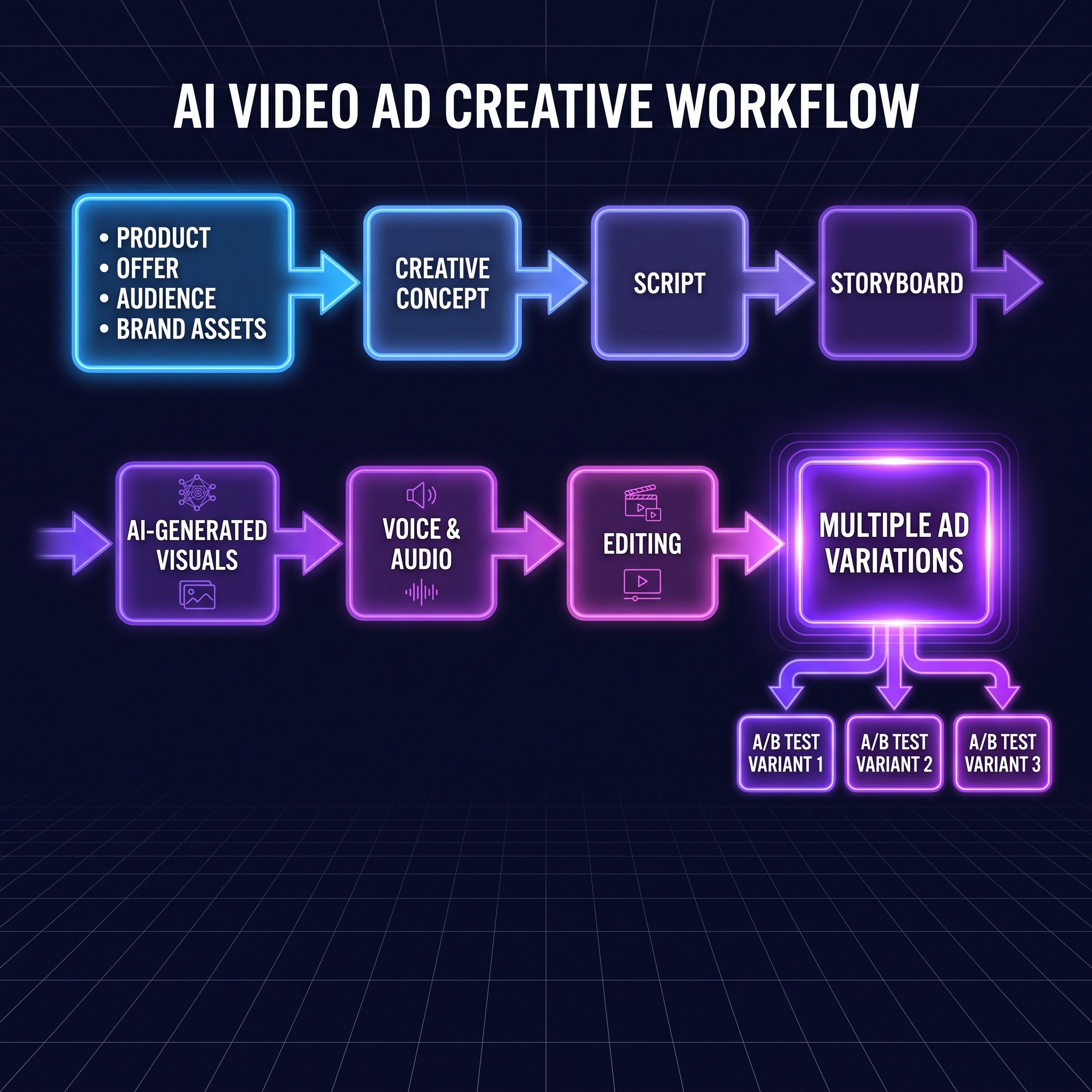 The advantage isn't creating one ad faster — it's producing several creative directions to actually test.
For example, an online skincare business could provide product photos, branding, and its current offer. You might create several short advertising concepts around those assets for the company to test — one focused on the product, another on the problem it addresses, another that tells a short story, another using an AI presenter. But don't promise clients that an AI-generated advertisement will automatically sell. Advertising performance still depends on the product, offer, audience, positioning, creative strategy, and targeting — skills covered alongside AI tooling in Inceptor's Digital Marketing course.
You've probably seen social media advertisements where someone holds a product and talks directly to the camera — a style often associated with user-generated content, or UGC. AI tools can now create synthetic presenters and other UGC-style advertising concepts without traditional filming, useful for product demonstrations, app promotions, e-commerce advertisements, and promotional clips.
An important ethical distinction: a synthetic AI presenter isn't a genuine customer testimonial. Don't create a fictional AI person and falsely imply that they bought a product and experienced specific results. Instead, businesses can transparently use synthetic presenters as part of their advertising creative where platform rules, advertising requirements, and applicable laws allow. Your service could therefore be "AI-assisted product video production for e-commerce brands" — a much clearer business than simply selling "AI videos."
Not every business wants cinematic AI video — sometimes it just wants somebody to explain something clearly. AI avatars and presenters can be useful for employee training, product demonstrations, tutorials, customer onboarding, internal communications, educational videos, sales presentations, and multilingual content.
Imagine a company has a 20-page employee onboarding document and wants a series of short training videos instead. Your offer could be "I turn your company training documents into professional presenter-led training videos" — document, script, scenes, AI presenter, voice, graphics, editing, finished training modules. Platforms such as HeyGen and Synthesia are built around AI-avatar and business-video workflows, making this an increasingly accessible type of production. Notice what you're selling — not the avatar, but the completed training or communication system.
Short-form video is another obvious service opportunity — Instagram Reels, TikTok, YouTube Shorts, Facebook, and advertising. Instead of selling one video at a time, turn this into a recurring package: for example, 12 short-form videos, 4 promotional videos, captions, vertical formatting, and brand consistency per month.
You could specialize further — instead of "AI Video Creator," become "Short-Form Video Creator for Restaurants," "AI Product Video Creator for E-commerce Brands," or "Short-Form Content Creator for Real Estate Agents." Specialization makes your offer easier to understand and your portfolio easier to build.
You don't necessarily need clients — another possibility is building your own media property. AI-assisted workflows can help creators produce faceless YouTube channels around business stories, history, technology, science, education, documentaries, and storytelling.
An important warning: don't interpret "AI YouTube channel" as "automatically generate hundreds of low-quality videos." YouTube's current monetization policies explicitly say channels with repetitive or mass-produced content can be ineligible, and specifically address generic, unoriginal AI-generated templates that appear mass-produced. YouTube says content created with automated tools can still monetize when the finished work demonstrates creative vision and delivers real educational or entertainment value. The winning strategy isn't AI + quantity — it's AI + original research + storytelling + creative direction + audience value. YouTube also requires creators to disclose realistic content meaningfully altered or generated using AI in certain circumstances, though making the required disclosure doesn't by itself reduce a video's monetization eligibility.
There may be an easier business than trying to build your own YouTube channel — help people who already have one. Thousands of creators already understand their audience and have distribution, and may need AI B-roll, Shorts, animated sequences, explainer graphics, visual storytelling, video repurposing, promotional clips, storyboards, or intros. Suppose a finance creator produces two 15-minute videos every week — you could offer to turn each long video into several vertical Shorts. Or a history creator might need visual sequences depicting ancient environments that would otherwise be difficult to film.
This is an important principle for finding AI business opportunities generally: sometimes selling the shovel is easier than searching for gold yourself. Instead of spending months trying to build an audience, provide a useful service to someone who already has one.
Companies constantly need to explain things — a startup needs to explain its app, a SaaS company needs to explain a feature, a consultant needs to explain a process, a school needs to teach a concept. AI-assisted video production creates an opportunity to turn complicated information into clear visual explanations for startups, SaaS companies, schools, NGOs, consultants, and training organizations.
Imagine a software startup has just launched a new feature and gives you the product information and screenshots. You create a 60-second product explainer with a script, presenter or voiceover, interface visuals, animation, captions, and branding — now you have a highly specific productized service.
This is one of the more interesting business opportunities created by modern AI video technology. A company might have an excellent English-language video but want to reach audiences speaking other languages. Historically, that could require translators, new voice actors, recording sessions, audio synchronization, and re-editing. AI-assisted localization can help with translation, dubbing, subtitles, voice replacement, lip synchronization, and multilingual presenters — a business might give you one English product video and ask for several localized versions.
Human review remains important. A technically accurate translation can still sound unnatural, use the wrong tone, or misunderstand local context, so professional localization should include human quality control rather than blindly publishing machine output.
Real estate is an example of how choosing one niche can transform a generic AI skill into a business — property listing videos, vertical property Reels, agent promotional videos, animated listing information, and neighborhood explainers. There is one important boundary: don't use AI to fabricate property features. If a house doesn't have a swimming pool, don't generate one and present it as though it exists. AI should improve the presentation of legitimate information rather than mislead potential buyers.
Online sellers are another attractive customer segment, needing video for product pages, Instagram, TikTok, Reels, paid advertising, and marketplace listings. Imagine a business selling watches with professional product photographs but very little video — AI-assisted production could help turn those existing assets into motion-based promotional concepts, provided the final video accurately represents the product.
Musicians also need visual content — music visualizers, lyric-video visuals, album-release teasers, and concert visuals. AI generation makes visual experimentation much more accessible to independent artists who can't afford a large traditional music-video production. But copyright still matters: don't assume you can use copyrighted music, celebrity likenesses, movie characters, or someone else's artwork simply because an AI tool allows you to generate something related to them. Technical possibility and commercial permission are different things.
Client work isn't the only option. Creators can build reusable digital assets — original motion backgrounds, video loops, social media templates, video project templates, and specialized prompt or workflow packs — through Inceptor's Digital Product Trading Masterclass with AI. These products can potentially be sold repeatedly rather than recreated from scratch for every buyer, but check the marketplace rules and the AI generator's own terms before uploading — being allowed to generate something doesn't automatically mean every commercial use is permitted.
Once you've proven people will pay for your service, you can think bigger: learn AI video production, choose a niche, get your first customers, develop repeatable workflows, sell monthly packages, hire editors or creators, and build an AI video agency. The important point is that access to an AI model isn't your competitive advantage — your competitors can buy access too. Your advantage comes from better creative direction, faster workflows, industry expertise, customer relationships, reliability, and stronger processes. The AI tool is infrastructure. The business is what you build around it.
You don't have to live in Silicon Valley to build an AI video business. For someone in Kenya, there are two markets: local customers and international customers. Locally, potential customers include restaurants, real-estate agents, hotels, tour companies, churches, schools, SMEs, e-commerce businesses, event companies, startups, creators, marketing agencies, and NGOs.
Consider the actual problems around you — a Nairobi restaurant may need three Reels every week, a real-estate agent may need vertical listing videos, a tour company may need promotional videos showing destinations and packages. Those are businesses. And because the final product can be delivered digitally, you're not restricted to Kenya — you can also pitch creators, agencies, startups, and businesses elsewhere in Africa or internationally. Your location doesn't determine the value of the video; your portfolio, communication, creativity, and ability to deliver what the customer needs matter far more.
The AI-video market changes quickly, so don't build your identity around one platform — learn the workflow first. Current tools cover several different parts of video creation: Sora and Google Veo for generative video and creative production, Runway for text/image-to-video with strong creative controls, Adobe Firefly for creative workflows across partner models, HeyGen and Synthesia for avatars, training, and localization, and CapCut or Canva for accessible editing and short-form production.
For example, Runway's current Gen-4.5 supports both text-to-video and image-to-video generation, including multiple output aspect ratios useful for landscape and vertical content. Adobe Firefly also now exposes several partner video models alongside Adobe's own tools, including Runway and Veo models — a trend worth understanding, since creators increasingly work across multiple models inside a single production workflow rather than relying on one generator. The best tool depends on the job: an avatar training video and a cinematic product advertisement are different problems. Choose the tool after identifying the deliverable.
Being able to type prompts isn't enough. A commercially useful AI video creator should understand storytelling (why should someone keep watching), scriptwriting (can you communicate an idea in 15, 30, or 60 seconds), storyboarding (can you plan what should happen visually before generating expensive clips), AI video prompting (subjects, movement, camera behavior, lighting, composition, timing), editing (generated clips still need to become a coherent finished video), audio (music, voiceovers, and sound design dramatically affect perceived quality), marketing (hooks, offers, audiences, calls to action), and client communication.
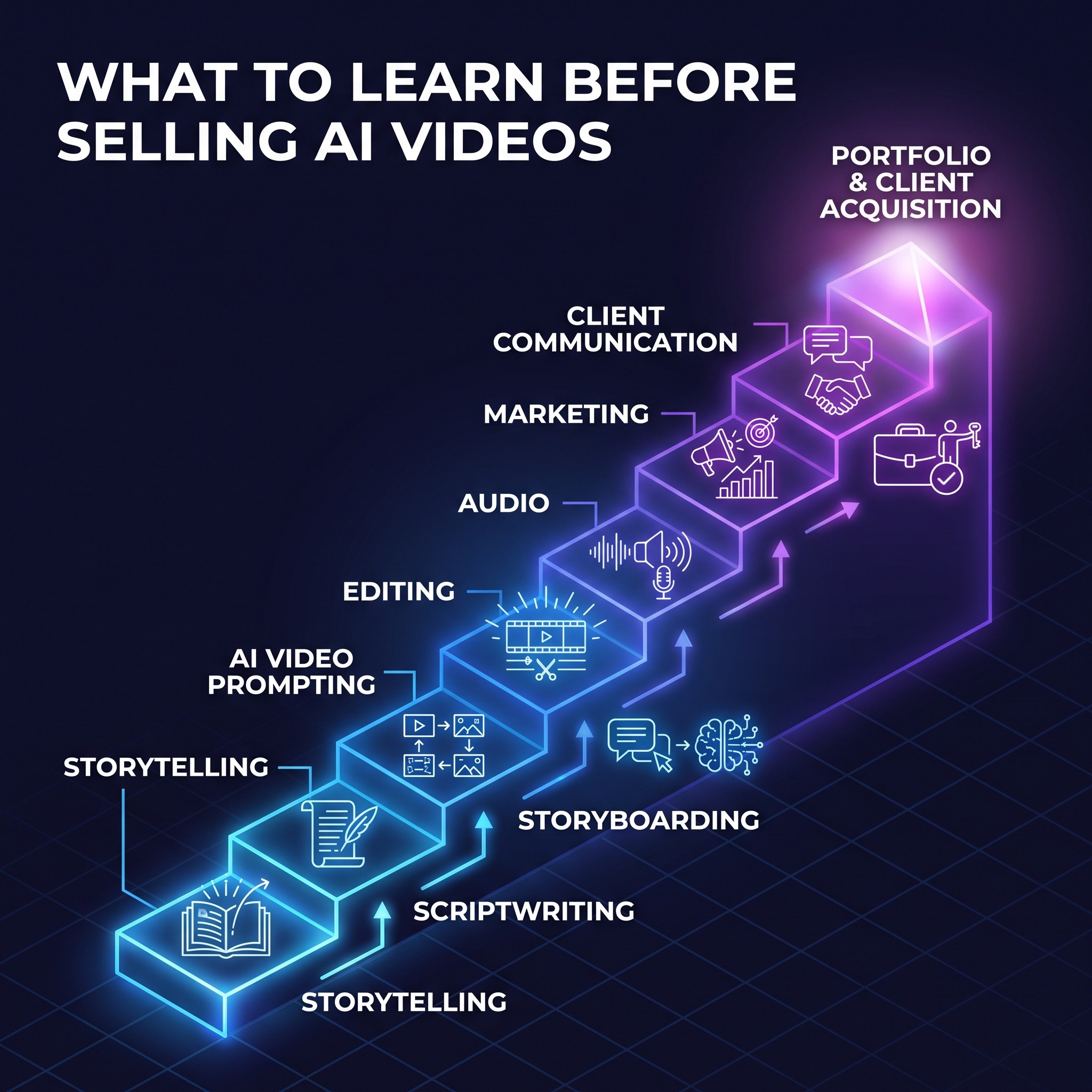 Prompting is one rung on this ladder, not the whole ladder.
If you want structured training before trying to monetize these skills, Inceptor's AI Video Generation & Editing course and its AI, Agents & Automation course both build toward this exact combination — learning how digital tools connect to practical business and marketing problems rather than learning software in isolation. Learners who want a stronger footing in traditional editing and production fundamentals alongside the AI layer can also explore the Video Production course.
This is where many people make the process unnecessarily complicated. You don't need an agency with 20 employees. Start small: choose one niche (for example, restaurants), identify one problem (they need attractive short-form content consistently), create 3–5 portfolio videos using your own, licensed, fictional, or properly authorized assets, and build a simple portfolio showing your strongest work rather than 50 mediocre examples.
Then find businesses through Instagram, TikTok, Google Maps, and local business directories — looking for good products with weak or inconsistent video marketing. Contact them personally rather than sending identical AI-generated messages; research the company and mention something specific. Sell the result, not the tool: don't say "I use Veo, Sora and Runway" — say "I create short promotional videos for restaurants so you have fresh content to post on Instagram and TikTok every week." Now the customer understands the product.
Potentially, yes — but there is no universal rule that every AI-generated video can automatically be sold. Several layers matter: commercial rights (check the terms of the AI platform you're using — different models, plans, and platforms may have different commercial-use conditions), copyright (don't assume AI gives you permission to use copyrighted music, images, characters, or footage — YouTube, for example, requires creators monetizing videos to have the necessary commercial rights to the visual and audio elements in their content), likeness (don't clone someone's face or voice for commercial content without appropriate permission — YouTube now has likeness-claim mechanisms for altered or AI-generated content matching a person's face or voice, and explicitly notes that simply labeling something as AI doesn't grant permission to use another person's likeness), disclosure (YouTube currently requires disclosure when AI meaningfully creates or alters realistic content in ways such as making a real person appear to do something they didn't do), and advertising (never use AI to fabricate testimonials, fake product performance, or create misleading demonstrations).
The simplest rule is: use AI to communicate truth more effectively — not to manufacture fake evidence.
You don't need six months before testing whether people will pay you.
Learn. Choose a few tools and learn the fundamentals — prompting, camera movement, image-to-video, character consistency, storyboarding, editing, sound, and captions. Don't spend the week watching tutorials without creating anything — generate actual projects.
Specialize. Choose one customer, for example real-estate agents, and create 3–5 excellent portfolio examples specifically for property marketing. Your portfolio should immediately communicate that you understand real-estate video.
Package the service. Create one offer — for example, a Property Social Video Package with 4 listing videos, 4 vertical Reels, branded captions, and social-ready delivery. Build a simple portfolio page and identify 30–50 potential customers.
Sell. Start personalized outreach, publish examples publicly, contact agencies that might outsource production, approach creators, and ask existing contacts for referrals. Track messages sent, replies, calls, objections, and projects won. If nobody buys, don't immediately change industries — figure out whether the problem is your portfolio, audience, offer, outreach, or pricing, then improve it.
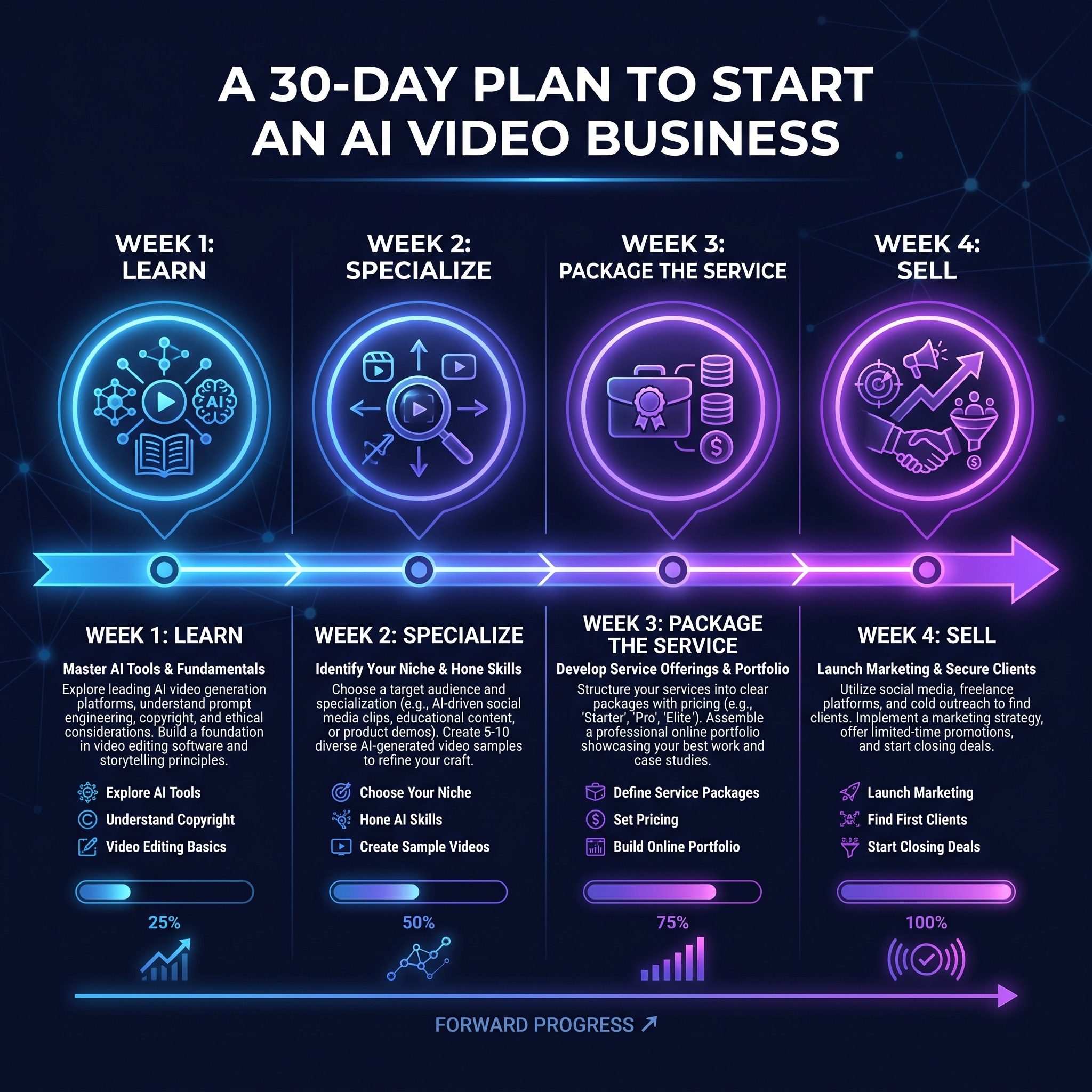 Four weeks is enough to find out if anyone will pay — not to master every tool.
Inceptor Institute offers hands-on, project-based training in AI video generation and editing, AI agents and automation, and digital marketing — the practical skill layer underneath every opportunity in this guide.
Explore all courses at Inceptor →
Yes. The most direct route is usually selling a useful video service to businesses or creators — short-form content, product videos, advertisements, explainers, avatar videos, localization, and creator-production support. AI itself isn't the product; the finished deliverable is.
Short-form video creation can be relatively approachable because businesses and creators already need Reels, Shorts, and similar content. Choose one niche and learn to create one specific type of video extremely well.
Potentially, but you need to check the commercial-use terms of the specific tools and assets involved. Music, trademarks, copyrighted material, likeness rights, and marketplace rules can also affect what you can sell.
Yes, AI-assisted content isn't automatically disqualified. YouTube's current policy focuses heavily on originality and authenticity — repetitive, template-driven, mass-produced content can be ineligible, while content demonstrating genuine creative input and audience value can qualify. Required AI disclosure itself doesn't make a video ineligible to earn money.
Yes. You could create client advertisements, animations, product videos, explainers, B-roll, faceless YouTube content, or other video services without appearing on camera — you still need to create something valuable and original.
Potential customers include e-commerce stores, restaurants, real-estate companies, startups, creators, agencies, hotels, tour companies, educators, and businesses that need training or product-explainer content.
There isn't one correct rate. Pricing depends on complexity, duration, number of generations, revisions, editing, voice work, commercial usage, turnaround time, and your market. Instead of copying arbitrary online prices, calculate your production cost and time, research comparable services, understand the customer's value, and build a sustainable margin.
Yes. Potential Kenyan customers include restaurants, real-estate businesses, hotels, online stores, churches, schools, SMEs, creators, startups, NGOs, and marketing agencies. Because the finished product can be delivered digitally, Kenyan creators can also serve international clients.
AI video generation is impressive technology. But technology alone isn't a business. Someone who knows how to generate beautiful clips but doesn't know who needs them has a tool. Someone who can walk into a specific market and say "I know exactly what video content your business needs, I can create it consistently, and here are examples" has the beginning of a business.
The formula is: AI video technology + valuable problem + creative execution + distribution = business opportunity.
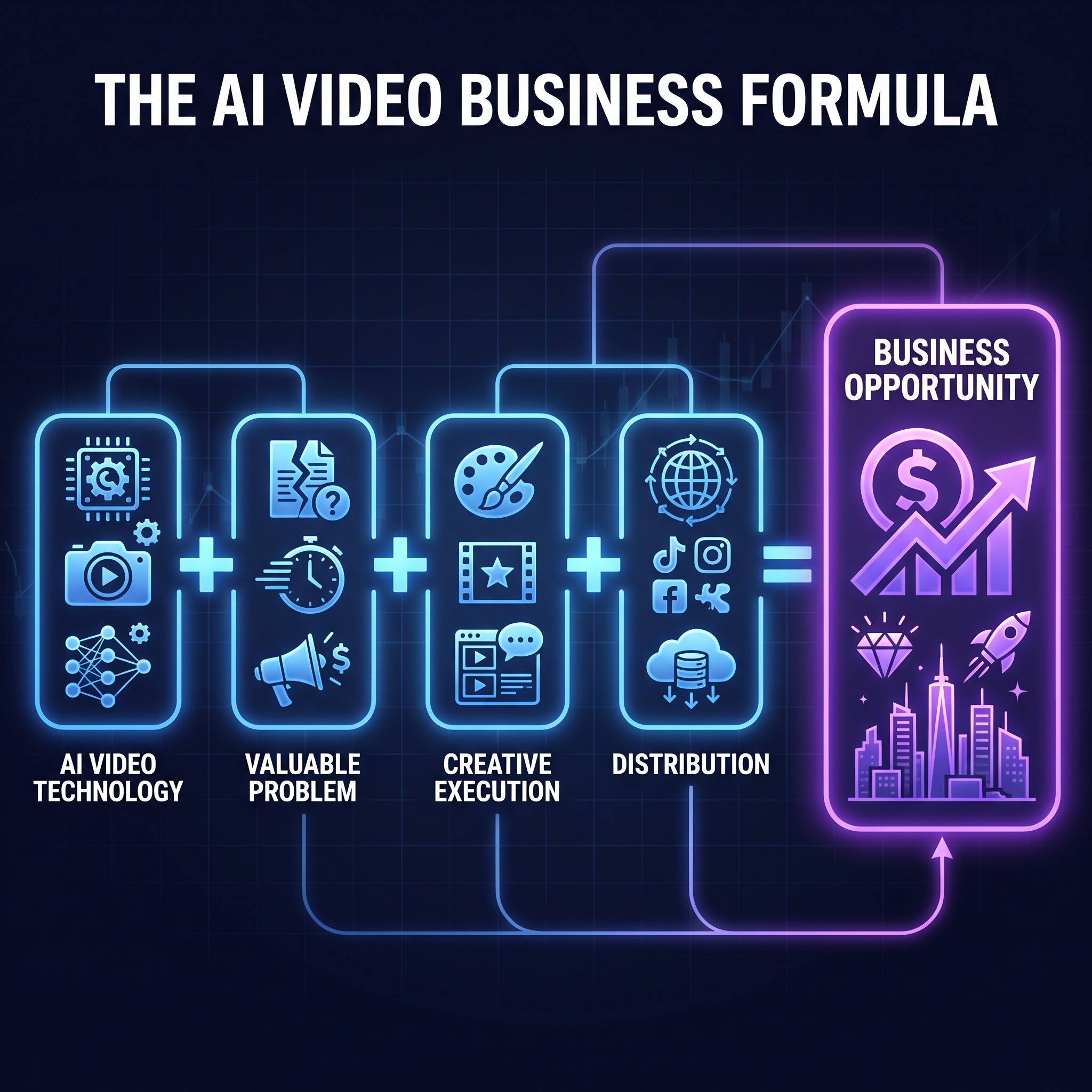 Remove any one term on the left and the equation stops producing income on the right.
You don't need to master every AI video platform. You don't need to launch five businesses. You don't need to create 500 faceless videos. Start much smaller: choose one niche, identify one problem, create three excellent examples, package one service, find potential customers, sell, improve. Once that works, AI gives you something much more valuable than a cool video generator — it gives you leverage.
Visit Inceptor Institute to explore practical, project-based training in AI video generation, editing, and digital marketing.
Discover more articles you might be interested in
Learn where to find reliable step-by-step guides online, how to choose the right tutorial for your task, check whether it is current and follow instructions safely.
By Davie
Stop searching broad topics and start finding the exact knowledge you need. Learn how to define your problem, search smarter, choose reliable sources, verify answers and take action.
By Davie
Quick Knowledge or an online course? Learn when a focused answer is enough, when structured learning is better, and how to choose the right learning depth for your goal.
By Davie

Learn how to turn one useful digital product into multiple income streams through premium versions, bundles, courses, licensing, services, subscriptions, B2B sales and complementary products.
By Davie
Get the updates, on newly released, popular & fast-moving MRR digital products
Up to Top
Comments All
Grace muthoni
@grace_muthoni
This was a really interesting read! I like how the article shows the different ways AI video generation can be turned into an income opportunity. The ideas are practical and made me realize there’s more you can do with these tools than I thought. Definitely worth a read! 👏
September 05,2026 At 10:53 PM