
Ellan
Joined - December 2025

You have a business idea.
It sounds promising.
People may even be telling you:
“That could make money.”
But there is a much more important question:
Before you buy stock, rent premises, build a website, pay for advertising, hire employees or invest your savings, calculate what must happen for the business to become profitable.
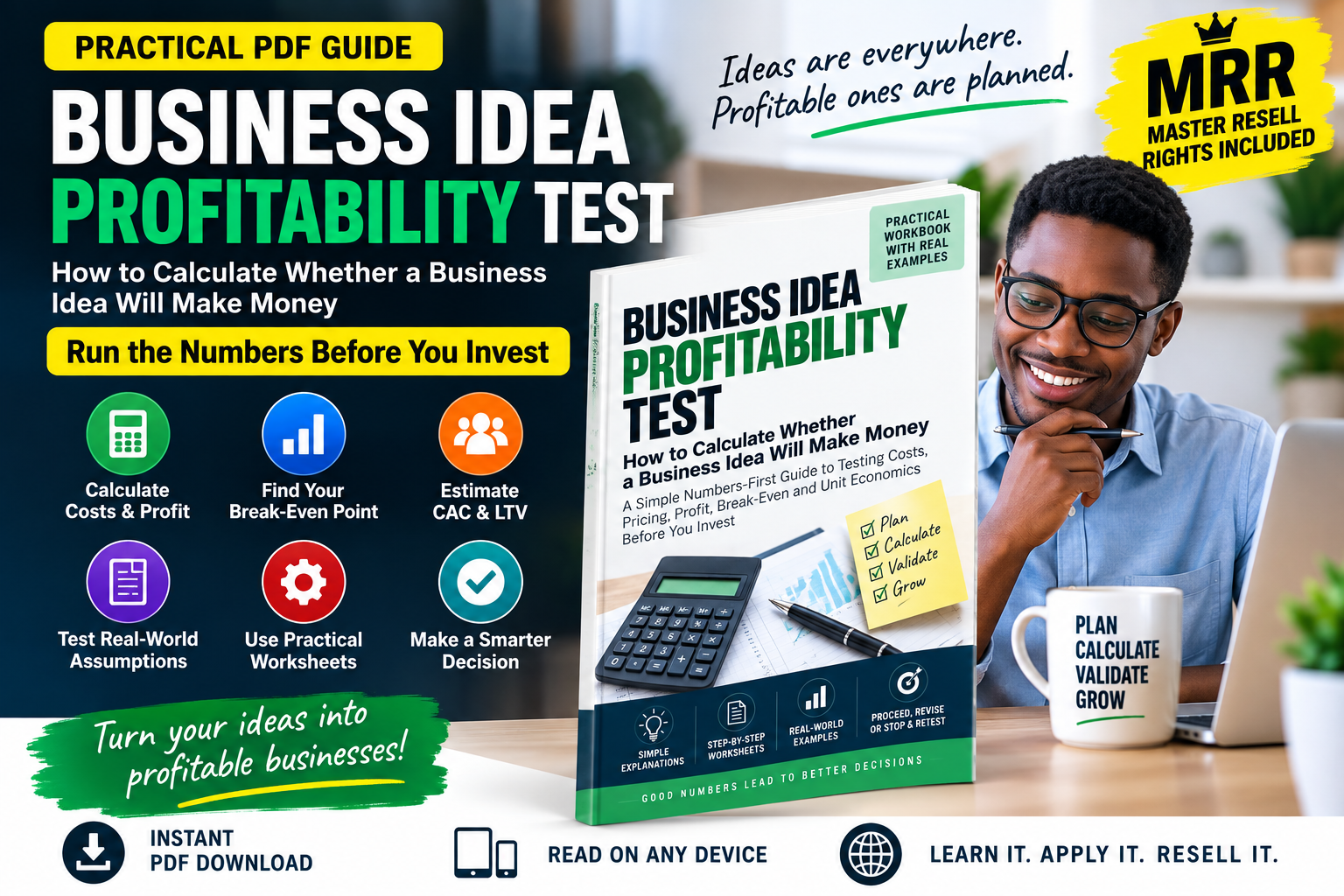
Business Idea Profitability Test is a practical, numbers-first PDF workbook designed to help entrepreneurs, side-hustlers and small-business owners test the financial logic of a business idea before committing significant money.
No finance degree required.
No complicated spreadsheets required.
No 50-page business plan required.
Just your idea, realistic estimates, a calculator and this step-by-step workbook.
By working through the guide, you can answer questions such as:
How much profit could I make from each sale?
How many customers do I need to break even?
Are my prices high enough?
Am I forgetting important business costs?
How much will it cost me to acquire a customer?
How much startup capital could I need?
How long could it take to recover my investment?
What happens if sales are lower than expected?
Can this business survive if costs increase?
Is my expected sales volume realistic?
And ultimately:
Ask a better question:
A business can have customers.
It can generate sales.
It can even have impressive revenue.
And still lose money.
That is why this workbook starts with unit economics — understanding what happens financially every time you make a sale.
You'll learn to calculate:
Selling Price − Variable Costs = Contribution Per Sale
Then determine whether that contribution is enough to cover your monthly expenses and eventually generate profit.
You don't need to understand accounting before you begin.
Start by entering a few numbers:
Selling price
Expected customers per month
Cost of delivering one sale
Customer acquisition cost
Monthly fixed costs
Startup investment
The workbook then walks you through what those numbers mean.
Instead of saying:
“I think this business could work.”
You can begin saying:
“At this price and cost structure, I need approximately X customers per month to cover my costs.”
That is a much stronger starting point for a business decision.
One of the most important numbers in any business is:
The workbook teaches the standard break-even calculation:
Break-Even Units = Fixed Costs ÷ Contribution Per Unit
For example:
Monthly fixed costs: $2,000
Selling price: $50
Variable cost: $30
Contribution per sale: $20
Break-even:
$2,000 ÷ $20 = 100 sales
You now know that, under those assumptions, the business needs approximately 100 sales per month just to cover its fixed costs.
Then comes the question many business plans overlook:
The guide helps you work backwards:
Prospects → Leads → Customers → Revenue → Contribution → Profit
Because a break-even number is only useful if you have a realistic way of reaching it.
Getting customers is rarely completely free.
The guide introduces Customer Acquisition Cost (CAC) in simple language.
If you spend:
$500 on marketing
and acquire:
25 paying customers
your CAC is:
$20 per customer
Now put that into your unit economics.
Selling price: $80
Variable cost: $30
Customer acquisition cost: $20
Estimated first-sale contribution after acquisition:
That gives you a much clearer picture than simply saying:
“I sell this product for $80.”
The guide helps you investigate costs such as:
Product or material costs
Supplier costs
Packaging
Delivery
Payment-processing fees
Marketplace fees
Sales commissions
Refunds and returns
Direct labour
Customer support
Software and API usage
Installation
Marketing
Rent
Utilities
Salaries
Licences
Insurance
Website expenses
Equipment
Working capital
Other overhead
Small forgotten costs can become large problems when multiplied across hundreds or thousands of sales.
Learn exactly how much of every sale is available to cover overhead and eventually create profit.
For example:
Selling price: $100
Variable costs: $45
Contribution: $55
Contribution margin:
Then test what happens when:
Supplier prices increase.
You offer customers a discount.
Delivery costs increase.
Advertising becomes more expensive.
Your selling price changes.
Instead of discovering these problems after investing, you can model them beforehand.
Don't build a business plan around one optimistic forecast.
The workbook helps you test:
What happens if sales are 30% lower than expected?
What happens under assumptions you can reasonably support with evidence?
What happens if demand and economics outperform your expectations?
You'll also test questions such as:
What if customer acquisition costs increase by 25%?
What if suppliers increase their prices?
What if you need to discount your product?
What if customers purchase less frequently?
What if refunds are higher than expected?
A business idea should not depend entirely on everything going perfectly.
A business can appear profitable on paper and still run out of cash.
The guide explains the impact of:
Inventory purchases
Supplier payment terms
Customer credit
Payment delays
Deposits
Refunds
Seasonality
Tax obligations
Loan repayments
You'll use a simple cash-flow worksheet to estimate:
Opening Cash → Cash In → Cash Out → Closing Cash
This can help you identify how much working capital may be required before the business becomes self-supporting.
If your business requires startup capital, you need to know more than expected monthly revenue.
The workbook introduces a simple payback calculation:
Initial Investment ÷ Expected Monthly Profit = Approximate Payback Period
If you invest:
$6,000
and the business eventually generates a sustainable:
$1,000 monthly profit
the simplified payback period would be approximately:
The guide also explains why uneven cash flows may require a more detailed month-by-month forecast.
Some businesses depend on customers buying repeatedly.
For subscriptions, SaaS, memberships, e-commerce and repeat-purchase businesses, you'll learn why the first sale may not tell the whole story.
The guide introduces:
Customer Acquisition Cost — CAC
Customer Lifetime Value — LTV
Repeat Purchases
Contribution Per Customer
CAC Payback
This helps answer an important question:
See the calculations applied to different types of businesses:
Understand product cost, fulfillment, CAC and break-even volume.
Calculate labour, materials, travel costs, capacity and monthly break-even.
Understand project contribution, overhead, workload and capacity.
Calculate platform fees, payment costs, customer acquisition and contribution.
Understand recurring revenue, service cost, CAC, customer value and payback.
You can adapt the examples to your own currency and business model.
Bring the important numbers together in one place:
Selling price
Variable cost
Contribution
Contribution margin
CAC
Estimated customer value
Monthly fixed costs
Break-even units
Expected monthly sales
Expected revenue
Expected profit/loss
Startup investment
Payback period
Cash requirement
Margin of safety
You can then assess the quality of your evidence for:
Demand
Costs
Pricing
Customer acquisition
A profitable spreadsheet does not prove that customers will buy.
That is why the guide includes an:
Suppose you believe:
“Customers will pay $50.”
Don't simply put $50 into a spreadsheet.
Test the offer with real potential customers.
Look for stronger evidence such as:
Purchases
Deposits
Pre-orders
Qualified leads
Actual conversion rates
Real advertising results
The goal is to progressively replace guesses with evidence.
After completing the workbook, choose one of three paths:
The numbers remain plausible and you have enough evidence to justify the next limited investment.
The idea may have potential, but something needs to change.
Maybe you need to:
Increase the price
Reduce costs
Find a cheaper supplier
Lower CAC
Reduce overhead
Change customer segment
Improve repeat purchases
Change your sales channel
Change the delivery model
Then run the numbers again.
The current model requires unrealistic sales, excessive startup capital, unsustainable acquisition costs or assumptions that you cannot yet support.
Finding that out before investing heavily can be extremely valuable.
Break-even too high?
Investigate:
↑ Price
↓ Variable Costs
↓ Fixed Costs
↑ Average Order Value
Customer acquisition too expensive?
Investigate:
Better conversion
Repeat purchases
Higher contribution margin
Alternative acquisition channels
Referrals
Profit looks good but cash keeps running out?
Investigate:
Deposits
Pre-orders
Supplier terms
Smaller inventory orders
Faster collections
Working-capital planning
You aren't simply calculating whether the current model works.
You're learning which numbers could make it work better.
This practical workbook is designed for:
First-time entrepreneurs
Aspiring business owners
Side-hustlers
Small-business owners
Freelancers
Consultants
Online entrepreneurs
E-commerce sellers
Digital-product creators
Startup founders
Service-business owners
People comparing several business ideas
Anyone considering investing money into a new business
You do not need an accounting or finance background.
Complete the final one-page assessment showing:
Business Idea
Target Customer
Selling Price
Cost Per Sale
Customer Acquisition Cost
Contribution Per Customer
Contribution Margin
Fixed Monthly Costs
Break-Even Sales
Realistic Expected Sales
Expected Monthly Revenue
Expected Monthly Profit/Loss
Initial Investment
Cash Requirement
Estimated Payback
Margin of Safety
Most Dangerous Assumption
Next Test to Run
And then make your next decision:
You're not only buying knowledge you can apply to your own business ideas.
This product also comes with Vezill Master Resell Rights (MRR).
That means, subject to the Vezill MRR licence terms supplied with the product, you can legally resell this digital guide through Vezill.
So there are two ways to use your purchase:
Use the workbook to calculate the economics of your own business idea before investing.
List and promote the guide on Vezill under its applicable MRR terms and earn from qualifying sales.
This is particularly relevant because the guide solves an evergreen problem for aspiring entrepreneurs:
“How do I know whether my business idea will actually make money?”
Instead of having to create a business guide from scratch, an eligible MRR buyer can start with an existing practical digital product and focus on learning how to market and sell it.
This is not hundreds of pages of entrepreneurship theory.
It is a practical numbers workbook.
Open it.
Choose your business idea.
Enter your numbers.
Calculate.
Stress-test.
Validate.
Then make a more informed decision.
A promising idea is not enough.
Customers are not enough.
Revenue is not enough.
The underlying economics matter.
Then decide what deserves your money.
Instant Digital PDF Access
Practical Worksheets + Worked Examples
No Finance Background Required
Includes Vezill MRR
Learn It. Apply It. Resell It.
Get the updates, on newly released, popular & fast-moving MRR digital products
Up to Top


Comments