
David
Joined - July 2026

Government tender documents can look complicated, technical and overwhelming — especially when you are opening one for the first time.
You may find dozens of pages covering eligibility, mandatory documents, technical requirements, tender security, specifications, price schedules, declarations, evaluation criteria and submission instructions.
The biggest mistake is trying to fill in forms before first understanding what the tender is actually asking you to prove.
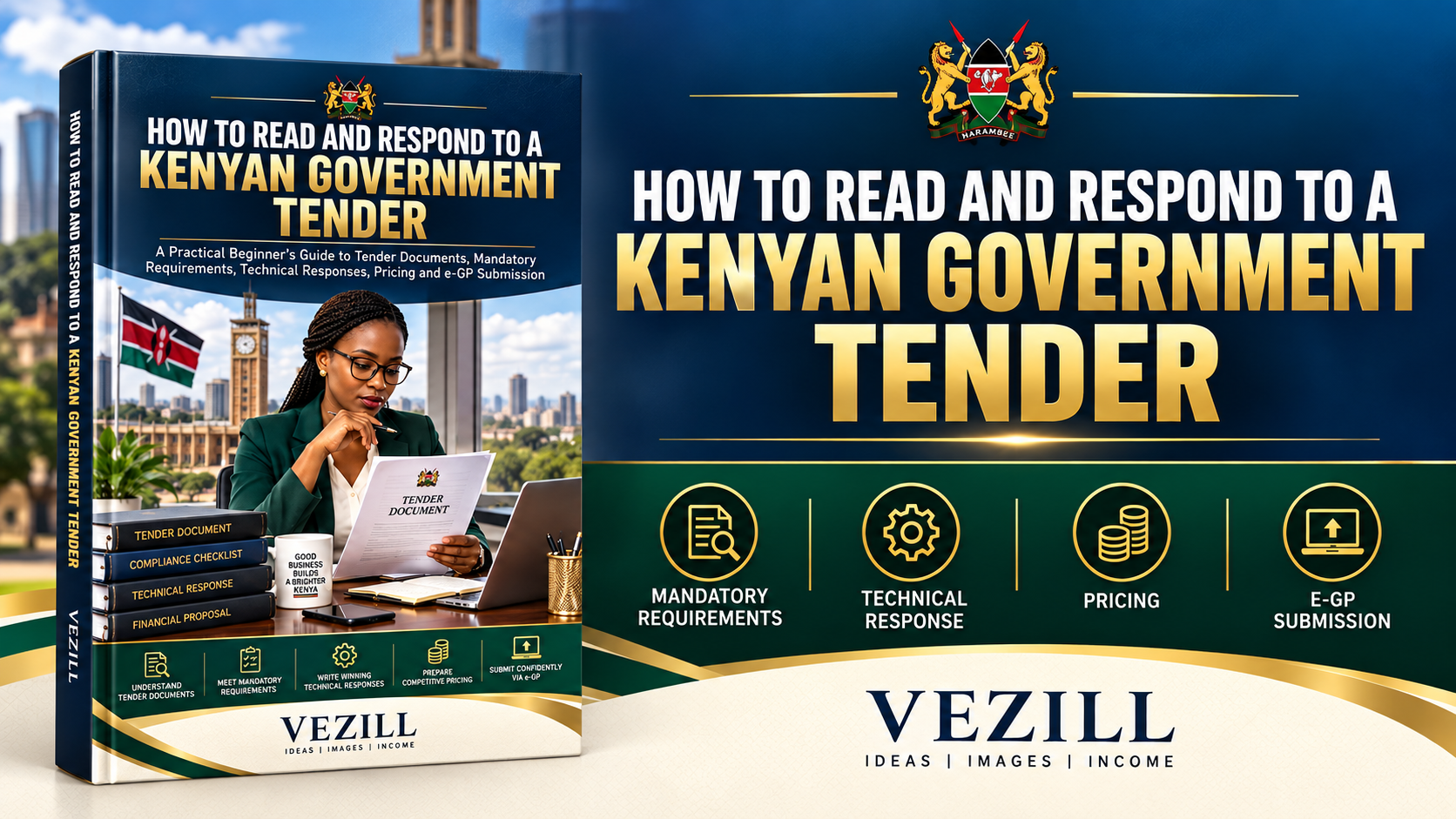
How to Read and Respond to a Kenyan Government Tender is a practical Vezill e-guide designed for Kenyan businesses, suppliers, contractors and consultants who want to understand how government tendering works and how to prepare a more organized, compliant response.
The goal is simple:
READ IT → UNDERSTAND IT → CHECK ELIGIBILITY → BUILD THE RESPONSE → VERIFY COMPLIANCE → SUBMIT CORRECTLY. Pasted markdown
This guide does not promise that you will win a government tender. Instead, it teaches you how to understand the tender document, identify the requirements that matter, prepare the requested evidence, price responsibly and reduce avoidable mistakes before submission.
The guide begins with the basics so that even a complete beginner can understand procurement terminology such as:
You'll understand how Kenyan public entities procure goods, works, consulting services, non-consulting services, IT, maintenance and other requirements.
The guide explains Kenya's current electronic procurement environment and the growing role of e-GP Kenya.
It helps readers understand the difference between current electronic procurement and older/manual processes, while emphasizing that the specific procurement notice and tender document always control the required submission method. Pasted markdown
You'll also understand how to be more cautious around fake tender emails, unofficial WhatsApp offers, fraudulent procurement officers, fake LPOs and people asking for money to “help you win.”
Not every tender is right for your business.
This guide teaches you to make a practical bid / no-bid decision before investing time and money.
You'll learn to examine eligibility, experience, technical capacity, licences, financial capacity, delivery capability, security requirements, deadlines and whether the contract makes commercial sense.
Sometimes the smartest business decision is not to bid.
Instead of reading an 80-page tender from beginning to end without knowing what matters, the guide shows you how the document is structured.
You'll learn where to look for information such as:
Deadline → Tender Notice / Tender Data
Mandatory Documents → Evaluation Criteria
Technical Requirements → Specifications / Terms of Reference
Pricing → Price Schedule / Bill of Quantities
Tender Security → Tender Data + Relevant Forms
Contract Obligations → Conditions of Contract
The guide is built around the principle that the tender document is the instruction manual for that specific procurement. Requirements should never be assumed simply because another tender asked for them. Pasted markdown
One missing mandatory requirement may prevent a bid from progressing to later evaluation stages.
The guide teaches you how to identify requirements that may include registration documents, tender forms, licences, tender security, tax documentation, manufacturer authorization, site-visit evidence, AGPO certification or signed declarations.
However, it also makes an important distinction:
These are examples. The actual mandatory requirements are whatever the specific tender states.
You will learn how to separate:
MANDATORY REQUIREMENTS
from
SCORED REQUIREMENTS
from
INFORMATIONAL REQUIREMENTS
so that you know where to focus your attention.
One of the most practical techniques taught in this guide is creating a simple Tender Compliance Matrix.
Instead of relying on memory, you organize each requirement by:
Tender Requirement → Mandatory or Scored → Evidence Required → Tender Page → Your Document → Status
This helps prevent requirements buried deep inside long tender documents from being forgotten.
The guide explains what government buyers may look for during technical evaluation depending on the tender.
This can include specifications, past experience, key personnel, equipment, work plans, methodologies, delivery schedules, samples, manufacturer authorization, professional qualifications and technical capacity.
You'll learn the important difference between:
PASS / FAIL TECHNICAL REQUIREMENTS
and
SCORED TECHNICAL REQUIREMENTS.
Simply writing:
“We comply with all requirements.”
may not be enough when a tender expects evidence.
The guide teaches you to break technical specifications into measurable requirements and respond clearly.
For example:
Tender Requirement → Offered Specification → Supporting Evidence
This makes it easier to show exactly how your offer meets what the procuring entity requested.
Not every tender looks the same.
A goods tender may focus heavily on specifications and delivery.
A consultancy tender may focus on:
Objectives → Scope → Deliverables → Personnel → Methodology → Timeline
A works tender may include a Bill of Quantities, requiring careful attention to item descriptions, units, quantities, rates and totals.
The guide introduces these concepts at beginner level so you understand what you are looking at without pretending to replace specialized technical professionals.
Winning a contract at a price that causes your business to lose money is not a successful tender.
The guide helps readers think about costs such as purchasing, transport, labour, delivery, installation, insurance, overheads, taxes where applicable, warranty obligations, financing, contract risk and profit.
It does not give a fake universal markup percentage.
Instead, it teaches you to price according to the specific tender and your actual cost of performing the contract.
And it corrects one of the biggest procurement myths:
The applicable award depends on responsiveness and the evaluation method stated in the tender document. Pasted markdown
Tender security can be one of the most confusing parts of bidding.
This guide explains:
What tender security is
Why it may be required
How validity matters
Why the correct amount and issuer matter
What tender-securing declarations are
Why every tender should be checked individually
Not every procurement has identical security requirements.
Tender forms are not meaningless paperwork.
The guide explains the role of forms and declarations relating to areas such as:
Form of Tender, eligibility, conflicts of interest, debarment, beneficial ownership, manufacturer authorization, Powers of Attorney, financial information and experience.
You'll learn why required forms should be completed carefully and why changing legal declarations casually can create problems.
Sometimes a tender changes after publication.
The guide explains how to understand:
Clarification — when something in the tender needs explanation.
Addendum — an official change to the procurement.
Pre-bid meeting — a meeting providing tender-specific information.
Site visit — where certain tenders require or provide a physical inspection.
You'll understand why ignoring an addendum or mandatory tender activity can create serious problems.
The guide also explains AGPO at beginner level.
You'll understand how preference and reservation can affect opportunities for qualifying youth-owned, women-owned and PWD-owned enterprises.
But it makes one principle very clear:
Eligible businesses still need to comply with the requirements of the specific procurement.
The guide shows how a tender response may be organized into sections such as:
Mandatory Documents
Company Information
Technical Response
Experience
Financial / Pricing Response
Declarations and Forms
The exact organization should always follow the tender itself.
The objective is simple:
This guide reflects Kenya's current electronic government procurement environment rather than teaching readers only about delivering printed envelopes.
Readers learn the general workflow around locating the tender, reviewing requirements, preparing the bid, uploading information and documents, handling tender security where applicable, reviewing the submission and confirming completion.
The guide deliberately avoids inventing portal buttons or claiming that every procurement uses exactly the same screen flow. Pasted markdown
Before submission, you'll learn to verify critical issues such as the correct tender and lot, mandatory documents, signatures, technical response, pricing, tender security where applicable, addenda, valid certificates, readable files, tender validity, deadline and successful final submission.
This gives you a final opportunity to catch mistakes before it is too late.
The guide explains how bids can fail because of problems such as missing mandatory documents, incorrect tender security, unsigned forms, incomplete pricing schedules, missing licences, failure to meet specifications, missed site visits, ignored addenda or incorrect authorization.
The central lesson is:
Submitting the tender is not the end of the process.
The guide introduces the journey through possible stages such as:
SUBMITTED → RESPONSIVENESS → TECHNICAL → FINANCIAL → AWARD CRITERIA → NOTIFICATION → CONTRACT
Actual evaluation depends on the procurement method and tender document.
Not every tender will succeed.
Instead of immediately giving up, the guide shows how businesses can review the outcome and ask useful questions:
Did we miss something mandatory?
Was our technical response weak?
Was our pricing unrealistic?
Did we misunderstand a specification?
Do we need stronger evidence of experience?
Every bid can help improve the next one.
This guide strongly promotes ethical procurement.
It does not encourage:
bribery, secret facilitation fees, fabricated LPOs, forged certificates, fake experience, falsified accounts, collusion, fake manufacturer authorizations, false beneficial-ownership declarations or manipulation of the procurement process.
The rule is simple:
The entire guide comes together in one practical framework:
FIND → QUALIFY → READ → EXTRACT → MATRIX → EVIDENCE → RESPOND → VERIFY → SUBMIT → LEARN
By the end, the reader should understand where to find requirements, whether they are mandatory, what evidence is required, how the bid may be evaluated, what needs to be prepared and how to approach submission correctly. Pasted markdown
This guide is suitable for Kenyan SMEs, first-time government suppliers, AGPO businesses, consultants, contractors, service providers, goods suppliers, entrepreneurs looking to understand public procurement and businesses that have seen tenders before but never understood how to respond properly.
No previous tender-writing experience is required.
This is not a “secret trick to win government tenders.”
It does not promise connections.
It does not promise guaranteed contracts.
It teaches the actual practical skill of reading and understanding the procurement document, identifying what the buyer requires, organizing evidence and preparing a more careful response.
That is a skill a business can use again and again when evaluating future opportunities.
Where this product is offered under Vezill's applicable Master Resell Rights licence, eligible resellers may earn 90% of qualifying resale revenue, subject to Vezill's platform and product-licence terms.
You can use the guide to learn the skill yourself or resell the digital product to other entrepreneurs and businesses interested in understanding Kenyan government procurement.
MRR does not guarantee sales, customers, tender awards, profit or income.
Government tender documents become much easier to handle once you know where to look, what matters and what evidence the evaluator expects to see.
Don't just fill forms.
Understand the tender.
Prove compliance.
Price responsibly.
Verify everything.
Submit correctly.
Get the updates, on newly released, popular & fast-moving MRR digital products
Up to Top


Comments