
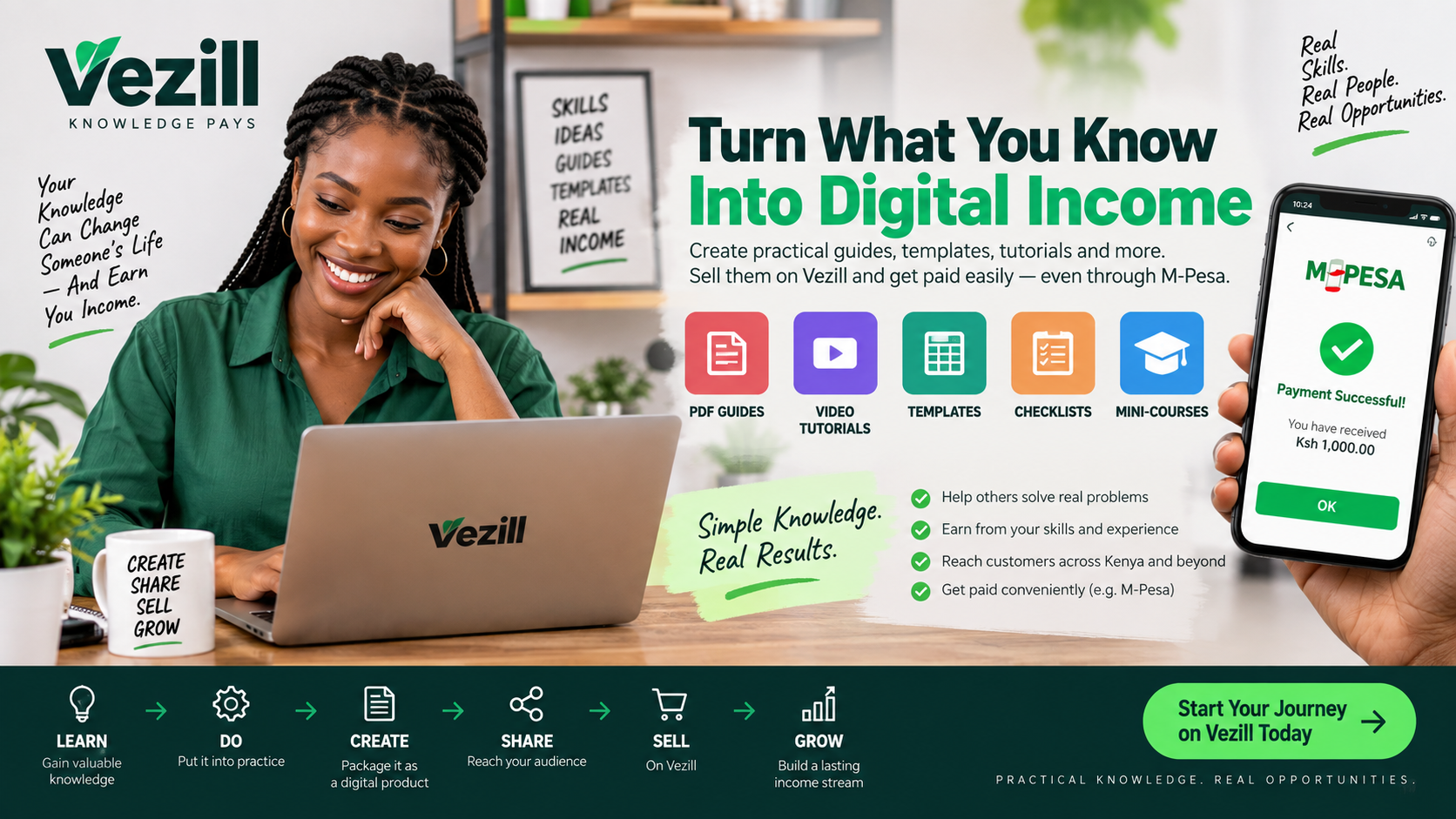
If you are searching for how to make money online in Kenya and get paid through M-Pesa, there is one important thing to understand:
M-Pesa itself does not create the income. You need something valuable to sell.
That could be your time, a service, a skill, a physical product or increasingly, useful knowledge packaged as a digital product.
Instead of searching endlessly for a “money-making app,” consider a simpler question:
What useful thing do I know that could help another person get a specific result?
You may already know something that another person is trying to learn on Google, YouTube, TikTok or an AI assistant such as ChatGPT.
It could be:
How to calculate construction materials for a small project
How to prepare professional quotations for clients
How to use Excel for a particular business task
How to create professional CVs
How to set up WhatsApp Business properly
How to troubleshoot a common phone or computer problem
How to make a particular household product
How to prepare a specific type of food commercially
How to use an AI tool for a specific task
How to organize business records
How to photograph products using a smartphone
How to perform a particular repair
How to prepare for a specific examination or interview
The important word is specific.
People don't necessarily want more information.
They want results.
That creates an opportunity to turn simple, practical knowledge into a PDF guide, checklist, template, video tutorial, mini-course or other digital resource and sell it repeatedly online.
There are several legitimate ways to earn online in Kenya, including:
Freelancing
Remote employment
Online tutoring
Virtual assistance
Social media management
Graphic design
Web development
Affiliate marketing
E-commerce
Selling digital products
Creating and selling practical guides
Selling templates and digital tools
Most of these models fall into two broad categories:
You perform work for someone and get paid.
For example, you might design a poster for Ksh 1,500.
To earn another Ksh 1,500, you normally need another customer and another design.
You create something useful once and make it available to multiple buyers.
For example, instead of repeatedly teaching different small businesses how to create invoices in Excel, you could package your knowledge into:
“Simple Excel Invoice & Sales Tracker for Small Businesses”
The product could contain:
A ready-made Excel template
A 15-minute video demonstration
A short setup guide
Sample records
Instructions for customizing it
Now you have a reusable digital asset.
That is one of the fundamental advantages of digital products: creation and delivery do not have to happen again for every individual customer.
One common mistake beginners make is thinking they need to create a 200-page eBook or a 20-hour online course.
You don't.
A small digital product can be valuable when it solves a specific problem quickly and clearly.
Think:
Problem → Practical Knowledge → Structured Solution → Digital Product
For example:
Someone searches:
“How do I calculate how many tiles I need for my house?”
A person experienced in construction could create:
It could contain:
How to measure floor area
How to calculate square metres
How to account for wastage
How to calculate the number of tile boxes
How to estimate adhesive and grout
A printable measurement sheet
Three worked examples
A simple calculator spreadsheet
This is not merely “information about tiles.”
It helps the buyer accomplish something:
Estimate tile requirements before purchasing materials.
That distinction matters.
People regularly go online because they have problems to solve.
They search questions such as:
How do I...?
What is the easiest way to...?
How can I...?
How much do I need to...?
What should I do if...?
How do I fix...?
How do I create...?
How do I start...?
The creator's opportunity is to take useful experience and transform it from scattered knowledge into an organized shortcut to a result.
Your digital product should ideally help the customer move from:
“I don't know how.”
to:
“Now I can do it.”
That is much more valuable than simply compiling information that someone could easily find elsewhere for free.
Imagine Mary runs a small laundry business in Nairobi.
Over several years she has learned:
How to price laundry services
How to calculate detergent costs
How to deal with difficult stains
How to record customer orders
How to avoid losing customers' clothes
How to calculate profit
How to market through WhatsApp
How to organize collection and delivery
Mary may consider this ordinary knowledge because she uses it every day.
But someone planning to start a small laundry business may spend weeks making avoidable mistakes.
Mary could package her experience into:
The package might include:
PDF Guide
How to set up and operate a small laundry service.
Pricing Calculator
A spreadsheet for calculating prices and margins.
Customer Order Form
A ready-to-use template.
WhatsApp Marketing Templates
Sample messages for attracting and retaining customers.
Short Video Tutorials
Demonstrations of practical processes.
Instead of selling “information,” Mary is selling a structured implementation package.
Suppose she lists it for Ksh 1,000.
If 3 people buy it, gross sales are:
3 × Ksh 1,000 = Ksh 3,000
If 30 people eventually buy:
30 × Ksh 1,000 = Ksh 30,000
That is an illustration—not an income guarantee.
Actual sales depend on product quality, demand, pricing, trust, marketing, competition and the size of the audience reached.
But importantly, Mary does not have to recreate the guide from scratch after every purchase.
That is the leverage of a digital product.
You don't necessarily need an extraordinary skill.
Start by identifying a problem that you can solve reliably.
Examples:
How to price a service profitably
Simple bookkeeping for small businesses
How to manage stock
How to prepare quotations
How to find customers through WhatsApp
How to photograph products professionally with a phone
Examples:
How to use Excel for business records
How to create invoices with Google Sheets
How to set up WhatsApp Business
How to design posters with Canva
How to use AI for a particular business task
How to build a simple website
Examples:
Furniture repair
Home organization
Basic appliance troubleshooting
Gardening techniques
Craft production
Cleaning techniques
Interior improvement
Examples:
Interview preparation
CV preparation
Portfolio creation
Freelancing starter guides
Customer service scripts
Workplace productivity systems
Examples:
Revision notes
Practice questions
Study systems
Exam preparation guides
Mathematics shortcuts
Language learning materials
Computer skills tutorials
The key is not simply choosing a popular category.
Ask:
What exact result will the buyer achieve after using my product?
This is one of the easiest ways to create a useful digital product.
Example:
Small businesses struggle to calculate whether they are actually making a profit.
Help them calculate sales, expenses and profit correctly.
Create:
“Simple Daily Profit Tracker for Small Businesses”
Include:
Excel/Google Sheets template
10-minute tutorial
PDF instructions
Worked example
The customer should ideally be able to download the product and start using it quickly.
That is result-oriented knowledge.
The internet already contains enormous amounts of free information.
Therefore, don't simply collect information and expect people to buy it.
Your product needs to add value.
A strong knowledge product should be:
Solve one clearly defined problem.
Put the information in the correct sequence.
Explain exactly what the customer needs to do.
Avoid unnecessary complexity.
Include steps, templates, examples, formulas, demonstrations or checklists.
Don't make claims you cannot substantiate.
Create your own material or ensure you have permission to sell or distribute anything you include.
Define what the customer should reasonably be able to accomplish.
The buyer is essentially paying to reduce:
Confusion + research time + mistakes + trial and error.
You can start with tools you probably already have.
Use Word, Google Docs or Canva.
Structure it:
Problem → Explanation → Steps → Examples → Checklist → Next Action
Use your smartphone or screen recorder.
Instead of merely explaining, demonstrate the process.
Create something the buyer can immediately use:
Excel spreadsheet
Business form
Checklist
Planner
Calculator
Canva template
Combine several resources.
For example:
Small Business Pricing Toolkit
could contain:
Pricing guide
Excel calculator
Costing worksheet
Video tutorial
Printable checklist
This may provide greater practical value than a long generic eBook.
Once you have created your product, you need somewhere customers can access it.
Vezill is a marketplace for practical knowledge, skills and digital products where creators can package useful information and make it available to buyers.
A simple process is:
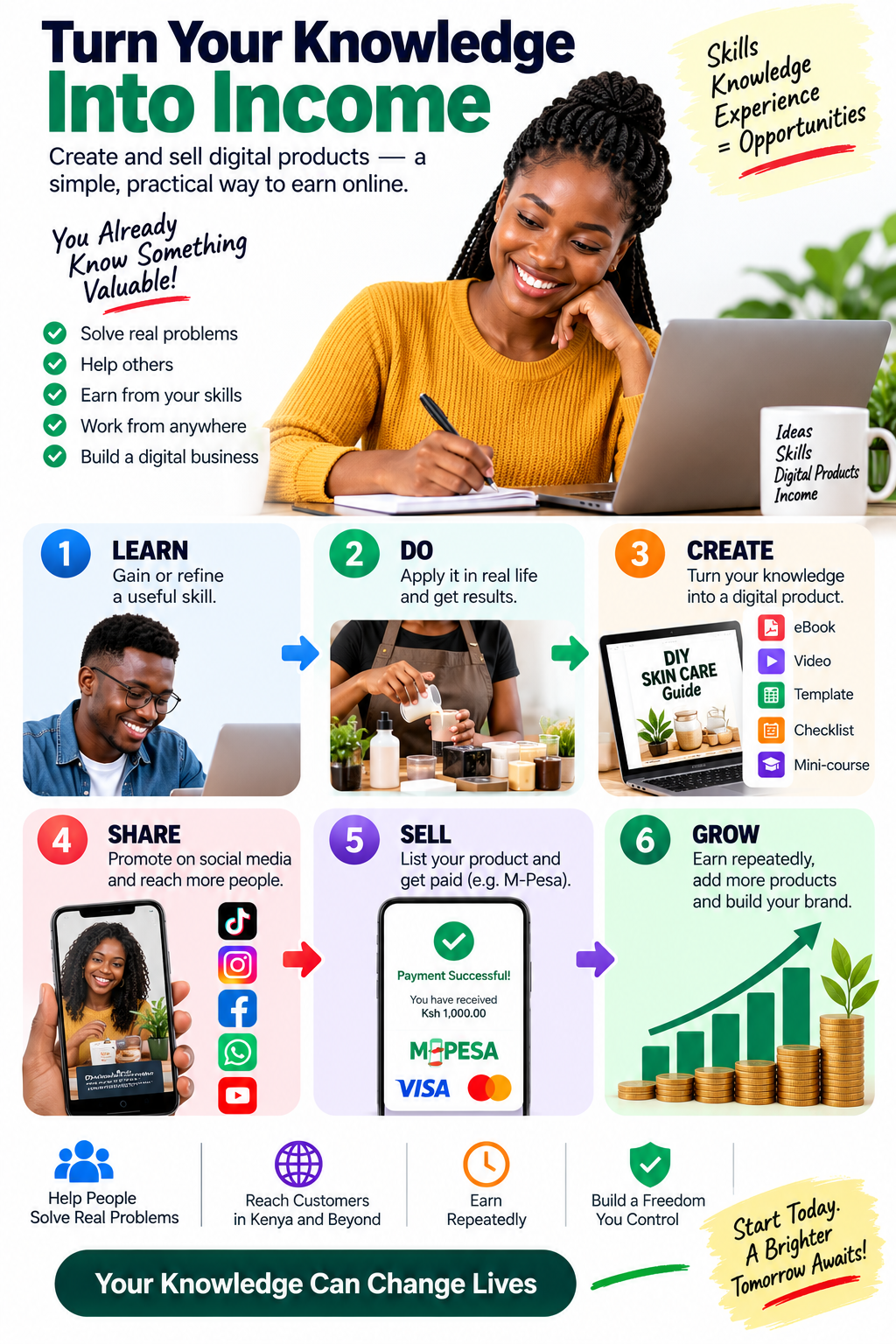
LEARN → DO → CREATE → SHARE → SELL → GROW
Acquire useful knowledge or develop a skill.
Apply it yourself.
Practical experience makes your knowledge considerably more useful.
Turn what works into a structured digital product.
This could be:
Video
Tutorial
Template
Checklist
Toolkit
Mini-course
Software or digital tool
Publish useful snippets, demonstrations and tips through WhatsApp, TikTok, Facebook, Instagram, YouTube or other channels.
Direct interested people to your Vezill product page where they can learn what the product contains and purchase it.
Improve the product from customer feedback, create complementary products and build a collection around your expertise.
Suppose you are very good at Microsoft Excel.
Don't begin with:
“Complete Microsoft Excel Course.”
That is extremely broad.
Start with specific outcomes:
Excel Stock Tracker for Small Shops
Excel Expense Tracker for Families
Excel Payroll Template for Small Businesses
Excel Sales Dashboard for Beginners
How to Create Professional Invoices in Excel
Excel Record-Keeping System for Rental Properties
These products address identifiable problems.
Later, you can combine several into a larger bundle or course.
M-Pesa has helped make digital commerce more accessible in Kenya because customers and businesses are accustomed to making digital payments.
But remember the correct sequence:
Knowledge/Skill → Useful Product → Customer → Sale → Digital Payment
Not:
M-Pesa → Automatic Income
The real asset is the value you create.
M-Pesa is one possible mechanism through which money moves.
This distinction can protect beginners from misleading “M-Pesa money-making app” claims and unrealistic get-rich-quick schemes.
Yes.
If you are not ready to create your own digital product, another model is to legally resell products whose licenses explicitly permit resale.
For example, some products on Vezill can be offered with Master Resell Rights (MRR).
MRR can allow a buyer to resell the digital product according to its specific license terms.
This means you should always check the permissions attached to a product before redistributing or reselling it.
It can provide a starting point for someone who wants to learn digital selling before creating original products.
Don't create first and research later.
Start with the problem.
Look at questions people ask on:
Google autocomplete
YouTube
TikTok
Facebook communities
Quora
ChatGPT and other AI assistants
Customer conversations
Your own workplace or business
Look particularly for repeated phrases such as:
“How do I...”
“How can I...”
“Best way to...”
“Step-by-step...”
“Template for...”
“Example of...”
“How to fix...”
“How to calculate...”
“How to start...”
Repeated questions can reveal information gaps.
Your job is to transform that gap into a practical solution.
Suppose people frequently ask you:
“How do I price my cakes and still make a profit?”
Instead of repeatedly explaining it individually, you could create:
It might contain:
Ingredient costing sheet
Labour calculator
Overhead calculator
Profit-margin calculator
Pricing spreadsheet
Worked examples
15-minute video tutorial
Now you aren't selling an abstract “baking eBook.”
You are selling a specific outcome:
Help bakers calculate profitable prices.
That positioning is considerably stronger.
The same principle can be applied across hundreds of skills and industries.
Creating the product is only the beginning.
People need to discover and trust it.
Instead of repeatedly posting:
“Buy my guide.”
Create content that demonstrates your knowledge.
For example, if you're selling a pricing calculator, publish:
“3 reasons small businesses underprice their services.”
Then explain one useful idea.
Your call to action can be:
“If you want the complete calculator, examples and step-by-step guide, access the full toolkit on Vezill.”
This creates a natural sequence:
Useful Content → Trust → Product → Customer
Making money online is possible, but no legitimate platform can guarantee that uploading a product will automatically produce sales.
Your results depend on factors such as:
Demand
Product quality
Competition
Pricing
Marketing
Audience
Credibility
Customer satisfaction
Consistency
Instead of asking:
“How can I make Ksh 10,000 today?”
A better question is:
“What useful digital asset can I build that people will continue finding valuable?”
That is how an online income activity can gradually become a digital business.
You can earn online by selling services, freelancing, tutoring, e-commerce, affiliate marketing or selling digital products. M-Pesa can then serve as a convenient payment method where supported. The income itself comes from providing a valuable service or product.
Yes. Useful knowledge can be packaged into digital guides, video tutorials, templates, checklists, mini-courses and toolkits. The strongest products usually solve a specific problem or help the buyer achieve a defined result.
Common formats include PDF guides, eBooks, video tutorials, templates, spreadsheets, checklists, educational materials, mini-courses and software or digital tools.
You should understand the subject well enough to provide accurate, safe and useful guidance. For regulated or high-risk areas such as health, finance and legal matters, appropriate qualifications, evidence and disclaimers become especially important.
Yes. Creators can use Vezill to list eligible digital products such as guides, tutorials and other digital resources, subject to the platform's requirements and policies.
Generally, yes. That is one of the major advantages of digital products. You create the asset once and can make it available to multiple customers, subject to any third-party licenses or usage restrictions.
A small product solving one specific problem is often easier to create than a comprehensive course. A PDF guide, template, checklist, calculator or short video tutorial can be a practical starting point.
You don't necessarily need another “money-making app.”
You may need to look more carefully at the knowledge, experience and practical skills you already possess.
Ask yourself:
What do people regularly ask me for help with?
What have I learned through experience that could save another person time or mistakes?
What problem can I explain or solve step-by-step?
Can I turn that solution into a PDF, video, template, checklist or toolkit?
If the answer is yes, you may already have the foundation of a digital product.
Package the knowledge.
Make it practical.
Give it a clear outcome.
Put it where people can access it.
Then promote it by demonstrating the value it provides.
KNOW SOMETHING → STRUCTURE IT → PACKAGE IT → SELL IT → IMPROVE IT → GROW
Instead of chasing shortcuts, build something useful.
That is a more sustainable path toward creating a digital income stream.
Ready to turn what you know into a digital product?
Create a practical guide, tutorial, template or toolkit and start selling through Vezill.
Discover more articles you might be interested in
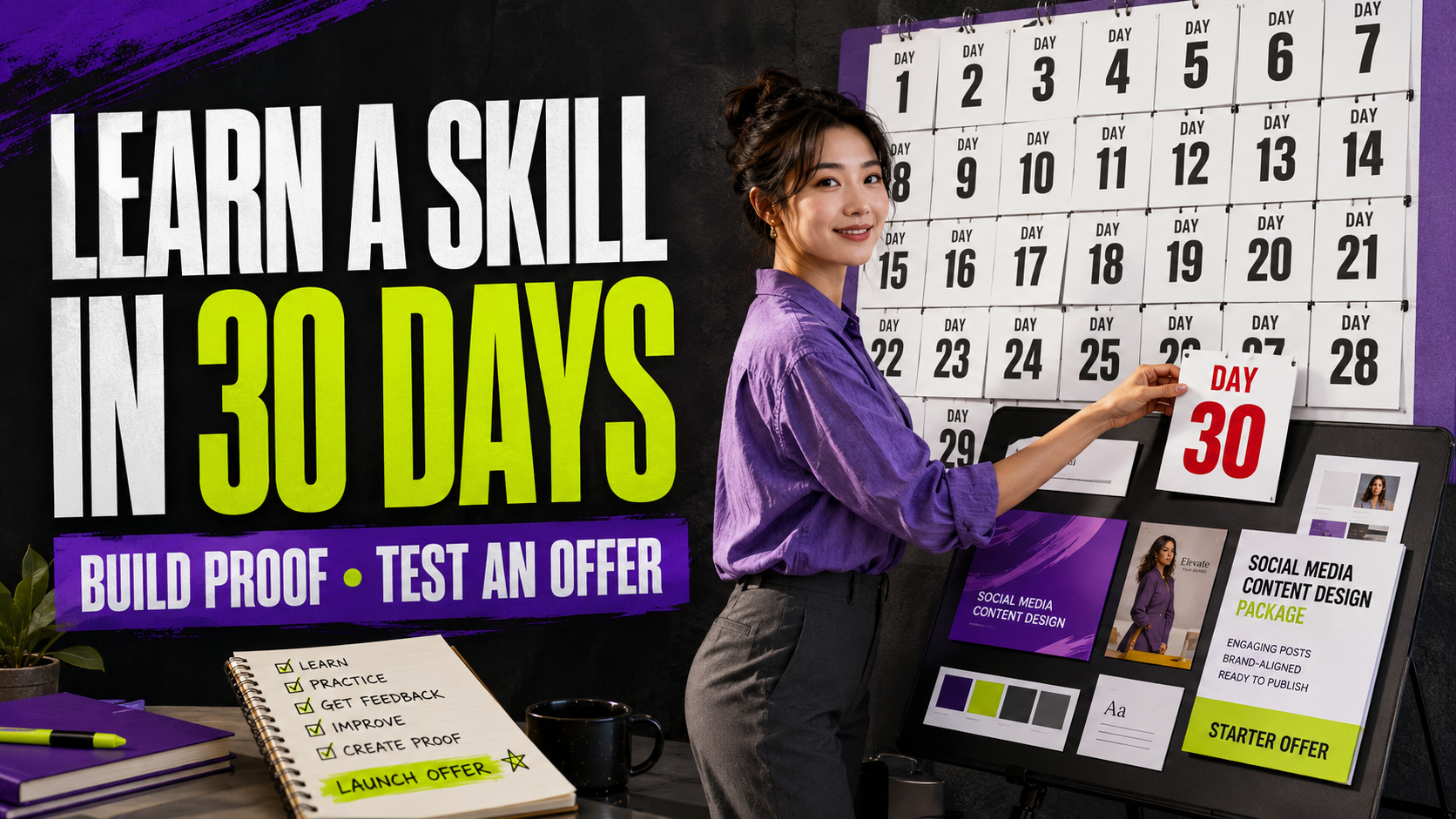
Discover 10 practical skills you can begin learning in 30 days, create proof of your ability and package into a realistic starter offer for earning online.
By Davie

How to Make Money Online as an SEO Specialist: 18 Realistic Income Opportunities
By Davie
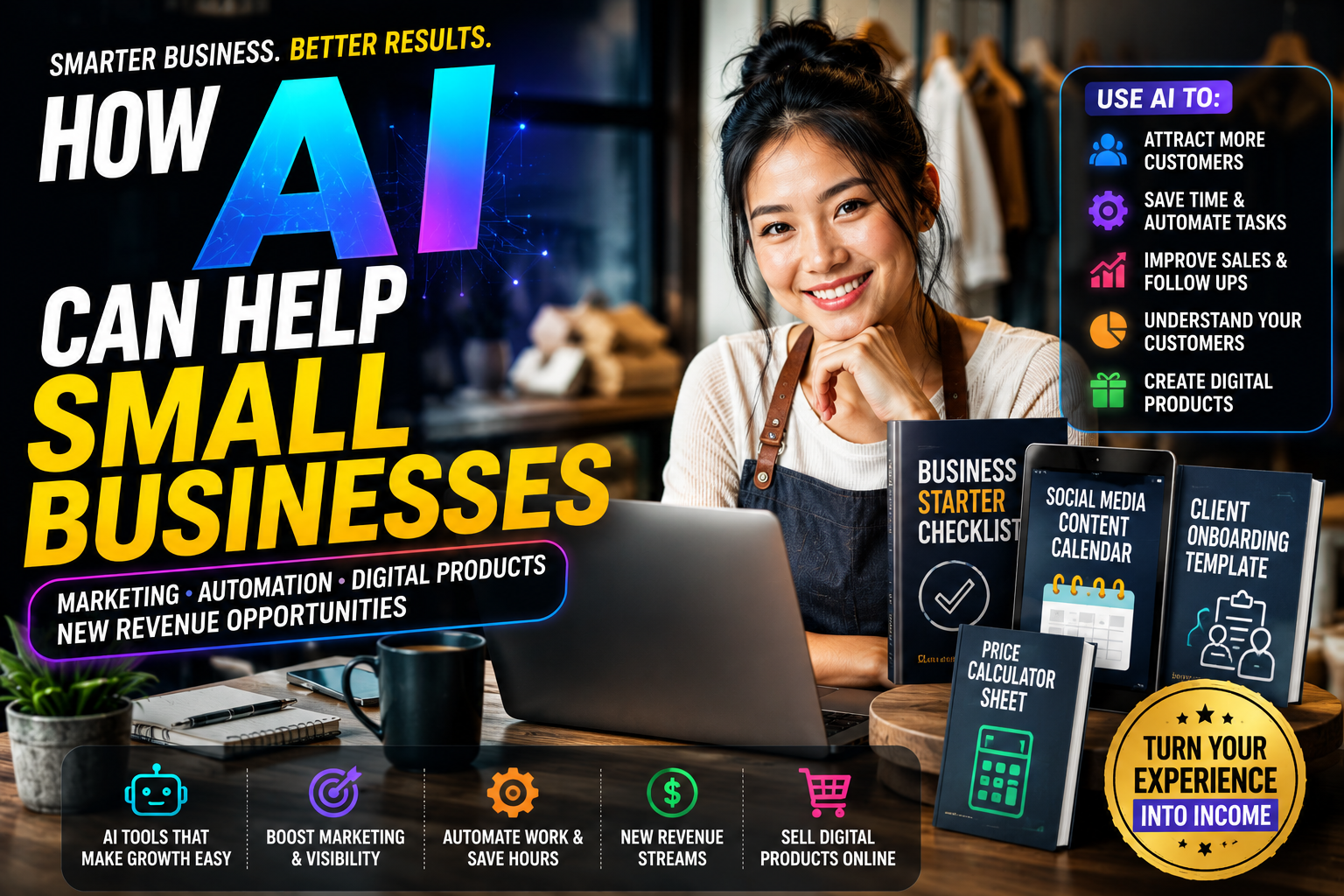
Learn how small businesses can use AI for marketing, sales, customer service and automation—and turn real business experience into digital products to sell online.
By Davie

Learn how to build an AI-powered online business with practical ideas, tools, customer strategies, AI automation and a 30-day startup roadmap
By Davie
Get the updates, on newly released, popular & fast-moving MRR digital products
Up to Top