

Can you really make money online in Kenya without capital?
Yes -but “no capital” does not mean no work, no skills, no internet, and instant money.
If you already have a smartphone, internet access and something useful you know or are willing to learn you can start building an online income stream without renting a shop, buying physical stock or investing large amounts of money.
For most beginners, there are three practical things you can sell online:
Your time → your skills → or your knowledge.
For example, you can freelance and get paid for your time. You can provide a service such as graphic design or social-media management. Or you can package useful knowledge into a digital product that can be sold repeatedly.
This guide explains the options, but focuses particularly on the third model because it allows you to build something you own rather than constantly searching for another task.
If you're starting with little or no money, practical options include freelancing, virtual assistance, social-media services, online tutoring, content creation, affiliate marketing and selling digital products.
But there is an important difference.
With most online jobs, you have to keep working to keep earning.
With a digital product, you can:
KNOW SOMETHING → PACKAGE IT → SELL IT → IMPROVE IT → SELL IT AGAIN
And if you don't yet have a product to create, Master Resell Rights (MRR) can provide another starting point: buy an eligible product that includes resale rights, then promote your authorised purchaser/reseller link according to its licence.
That makes MRR particularly useful for someone asking:
How do I start making money online with no experience?
How can I earn online using my phone?
What can I sell online without physical stock?
How can I make money online without creating a product?
How can I start an online business in Kenya with little money?
How can I make money from what I know?
What digital products can I sell in Kenya?
Can AI help me create something I can sell?
Let's answer these questions practically.
Be careful whenever someone tells you that making money online requires absolutely nothing.
You still need resources.
If you already own a smartphone and have access to mobile data or Wi-Fi, however, you may be able to start without additional major financial investment.
You do not necessarily need:
❌ An office
❌ Physical inventory
❌ Expensive equipment
❌ A warehouse
❌ Employees
❌ A physical shop
❌ Thousands of shillings in startup capital
But you do need:
✓ Internet access
✓ A phone or computer
✓ Time
✓ Something useful to offer
✓ Willingness to learn
✓ Consistent marketing
✓ Patience
The internet isn't the source of the money.
The value you provide to another person is.
This is the most important principle to understand.
There are many online-income methods, but most fall into several broad categories.
You sell a skill to clients.
Examples include:
Writing
Graphic design
Web development
Video editing
Data analysis
Virtual assistance
Translation
Social-media management
This can work well, but you normally have to find clients and complete new work to continue earning.
Instead of joining a freelance marketplace, you can sell services directly to businesses or individuals.
For example:
A salon may need social-media posters.
A restaurant may need a digital menu.
A small business may need help setting up WhatsApp Business.
A job seeker may need help improving a CV.
Find a problem and provide the service that solves it.
You can build an audience through platforms such as TikTok, YouTube, Facebook, Instagram or a blog.
Income can eventually come from advertising, sponsorships, affiliate offers, services or your own products.
The challenge is that building an audience usually takes time.
You promote somebody else's product and receive a commission when a qualifying sale occurs.
You don't create the product, but you also don't normally own it.
If you understand mathematics, languages, software, fitness, business, agriculture or another useful subject, you can teach people remotely.
This converts your knowledge into income -but usually still requires your time for every learner.
This changes the model.
Instead of repeatedly selling an hour of your time, you turn useful information, expertise or a tool into a downloadable or accessible product.
Create it once, improve it when necessary and sell it repeatedly.
If you aren't ready to create your own product, this can be a simpler entry point.
Find a useful digital product on Vezill that includes Master Resell Rights (MRR), understand its licence, purchase it and promote it to people who genuinely need the solution.
You are therefore starting with an existing product instead of creating one from scratch.
A digital product is something useful that a customer can access electronically rather than receiving as a physical item.
On Vezill, creators can package useful knowledge and resources in formats such as:
PDF and document guides, video tutorials, audio files, spreadsheets, templates, prompt packs, software/apps, courses, checklists and other downloadable or digitally accessible resources.
The important word is useful.
People generally aren't looking for “another PDF.”
They are looking for an answer or a result.
For example, someone may want to know:
“How do I test a second-hand laptop before paying for it?”
You could create:
How to Test a Second-Hand Laptop Before Buying It — 30-Minute Inspection Checklist
Another person searches:
“How can I recover storage on my Android phone without deleting important files?”
That could become:
Android Storage Rescue Guide — Free Space Without Losing Important Files
A farmer searches:
“How do I start poultry farming with 100 chickens?”
That could become:
Start Your First 100-Chicken Poultry Project — 12-Week Action Pack
This is the opportunity Vezill is built around:
Turn useful knowledge into structured, practical products people can immediately apply.
One of the biggest misconceptions about digital products is:
“I don't know enough to create something people would pay for.”
Ask yourself a different question:
What problem can I help somebody solve?
Perhaps you know how to:
Prepare a particular recipe
Grow tomatoes
Keep chickens
Repair phones
Design posters
Use Excel
Pass a particular examination
Write professional CVs
Use ChatGPT productively
Create videos
Install software
Budget household expenses
Market a small business
Make natural beauty products
Bake cakes
Use a particular machine
Find scholarships
Prepare for interviews
Use an application effectively
Someone else may currently be searching Google or asking an AI assistant exactly how to do it.
Instead of giving them scattered information, package the complete process.
This is critical.
People can already get enormous amounts of free information from Google, YouTube and AI.
So don't try to sell information that can be answered adequately in a single Google search.
Sell structure, convenience, application and a specific result.
For example, instead of:
“Poultry Farming Ebook”
create:
“Your First 100 Broilers: Day 1–42 Feeding, Vaccination, Cost and Management Action Pack.”
Instead of:
“ChatGPT Guide”
create:
“ChatGPT for Small Business: 30 Ready-to-Use Workflows for Marketing, Customer Replies, Planning and Documents.”
Instead of:
“Used Car Ebook”
create:
“Used Car Inspection Checklist: A Step-by-Step Procedure to Follow Before Paying a Seller.”
The customer should be able to say:
“This saves me research, reduces trial and error and tells me exactly what to do.”
That is structured knowledge.
Imagine Wanjiku has experience keeping chickens.
Friends regularly ask her questions about chicks:
“What should I feed them?”
“When should I vaccinate?”
“How much feed do I need?”
“Why are my chicks dying?”
Instead of answering the same questions repeatedly, she develops a practical knowledge pack:
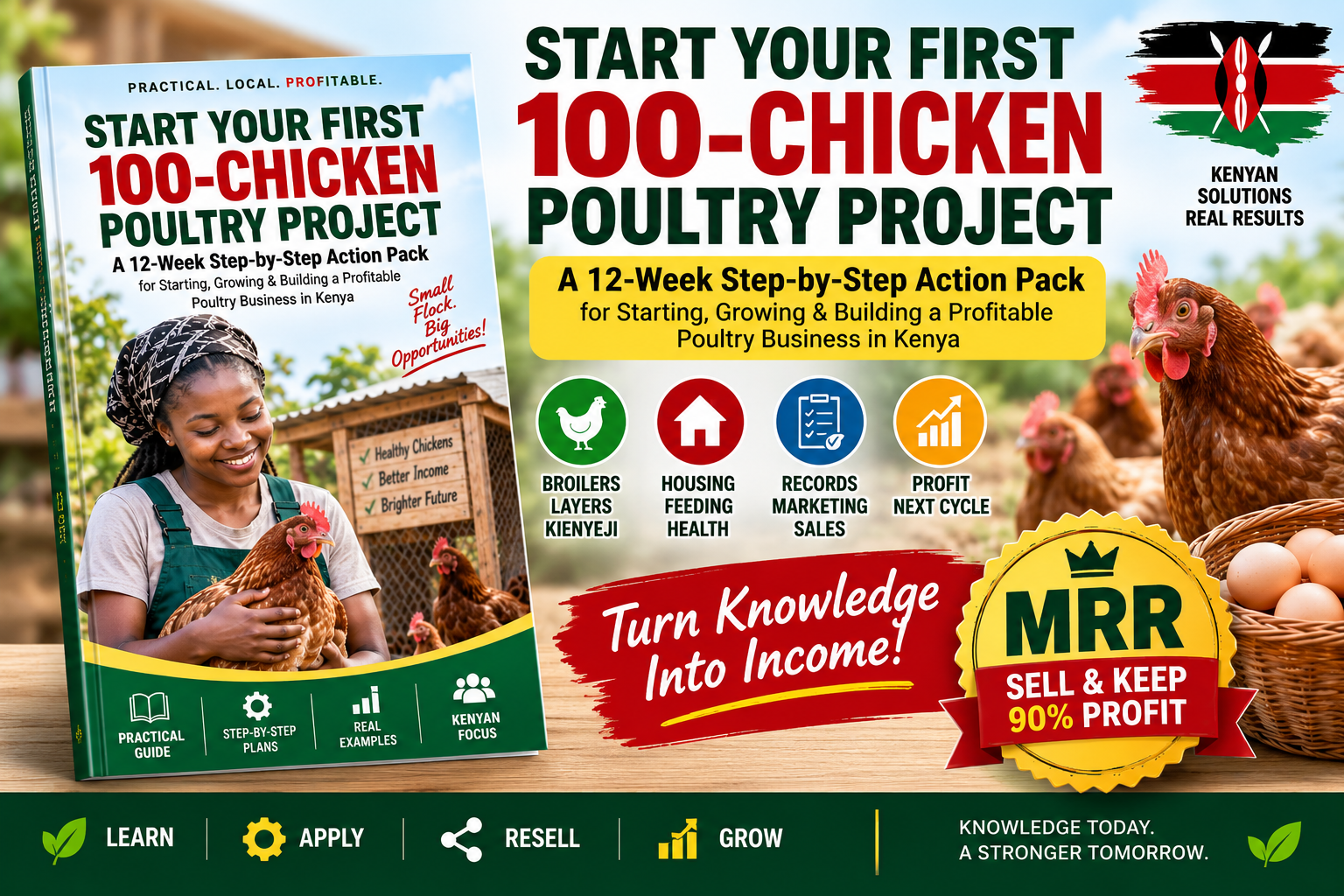
It contains:
Equipment checklist
Brooder setup
Chick sourcing checklist
Week-by-week feeding plan
Vaccination schedule
Common disease warning signs
Farm records
Cost worksheet
Daily management checklist
She turns this into a PDF and spreadsheet pack and lists it on Vezill.
Suppose she prices it at KSh 500.
If she eventually gets 10 sales, the gross sales value is:
10 × KSh 500 = KSh 5,000
If she gets 100:
100 × KSh 500 = KSh 50,000
Those numbers are illustrations, not earnings promises. Actual results depend on demand, product quality, pricing, platform terms and especially how effectively the product is marketed.
The important point is that Wanjiku doesn't have to rewrite the poultry guide for every customer.
She created a digital asset.
Start with problems, not products.
Search for questions people repeatedly ask within an area you understand.
For example:
Agriculture: How to formulate chicken feed, start onion farming, control common crop pests.
Employment: How to write an ATS-friendly CV, prepare for an interview or optimise a LinkedIn profile.
Technology: How to test a used laptop, free Android storage, protect a WhatsApp account or troubleshoot a slow computer.
Education: Revision guides, practice packs, study systems and subject-specific learning resources.
Business: Record-keeping spreadsheets, customer-service scripts, pricing calculators, marketing templates and business checklists.
AI: Practical prompt packs, AI workflows, automation guides and task-specific tutorials.
DIY: Step-by-step procedures for making, repairing, installing or improving something.
The narrower and clearer the outcome, the easier it is for a potential customer to understand why they need your product.
AI has dramatically lowered the technical barrier to creating digital products.
You can use tools such as ChatGPT to help:
Research a topic
Organise your knowledge
Create an outline
Identify missing questions
Simplify explanations
Build checklists
Generate examples
Improve grammar
Create FAQs
Draft product descriptions
Then combine that assistance with your experience, research, testing, local context and human judgement.
Don't simply ask AI for “an ebook,” download the response and upload it.
That produces generic information that customers could generate themselves.
Your competitive advantage should be:
AI efficiency + human knowledge + practical structure + specific outcome.
Try asking ChatGPT:
“I know about [YOUR TOPIC]. Identify 20 specific problems beginners repeatedly experience in this area. For each problem, suggest a practical digital knowledge product I could create that saves the buyer time, reduces mistakes or helps them achieve a specific result. Prioritise products that can be delivered as a short PDF, checklist, spreadsheet, template, video tutorial or combination of these.”
Then evaluate the ideas.
Ask:
Who needs this?
What exact problem does it solve?
What result will the buyer get?
Could they easily find exactly the same thing free elsewhere?
What practical tools can I include to make mine more useful?
The process can be simple:
Step 1 — Identify a problem.
Find something useful that people want to accomplish.
Step 2 — Gather the knowledge.
Use your experience, reliable research and AI assistance.
Step 3 — Structure the solution.
Turn scattered information into a clear sequence:
Problem → Requirements → Steps → Examples → Checklist → Result
Step 4 — Package it.
Your product might be a PDF, document, video tutorial, audio resource, spreadsheet, template, app/software or a combination.
Step 5 — Create your Vezill seller account.
Set up your profile and prepare your product listing.
Step 6 — Upload the product.
Create a strong thumbnail, preview, product description, title and search-friendly metadata.
Step 7 — Market the solution—not merely the file.
Don't post:
“Buy my ebook.”
Try:
“Buying a second-hand laptop? Here are 5 things you should test before handing over your money. I created a complete inspection checklist you can follow while checking the laptop.”
That gives people useful information first and introduces the product naturally.
This deserves special attention for beginners.
Perhaps you're thinking:
“I want to start, but I don't know what to create yet.”
You don't necessarily have to begin by creating something.
On Vezill, selected products can include Master Resell Rights (MRR).
MRR means the product includes permission to resell it according to the licence attached to that product.
So the process becomes:
FIND A USEFUL MRR PRODUCT → BUY/ACCESS IT → UNDERSTAND IT → SHARE YOUR AUTHORISED RESELL LINK → EARN FROM QUALIFYING SALES
This eliminates one major beginner obstacle:
product creation.
You can concentrate first on learning how to identify buyers and market a useful solution.
Suppose you find an MRR guide called:
How to Inspect a Used Car Before Buying
Instead of randomly posting the link everywhere, think about the customer.
Who needs it?
Someone actively considering buying a used vehicle.
Your content could therefore answer questions such as:
What should I check when buying a used car?
How do I identify accident damage?
What should I check under the bonnet?
How do I test-drive a used car?
Which documents should I verify?
Should I take a mechanic with me?
You could create a short educational TikTok, Facebook post, WhatsApp Status or YouTube Short:
Buying a used car? Don't inspect only the paint and tyres. Check cold-start behaviour, dashboard warning lights, uneven panel gaps, fluid leaks and service documentation before discussing the final price.
Then:
I have a complete step-by-step used-car inspection guide you can follow while inspecting a vehicle.
Now you're not simply dropping a sales link.
You're connecting a problem with a solution.
That's digital marketing.
Assume an eligible Vezill MRR product sells for KSh 390 and its current terms allow a reseller to retain 90% of the qualifying resale revenue.
For illustration:
1 sale × KSh 390 = KSh 390 gross sales
10 sales × KSh 390 = KSh 3,900 gross sales
100 sales × KSh 390 = KSh 39,000 gross sales
At a 90% reseller share, KSh 39,000 would correspond to KSh 35,100 before considering any other applicable terms, charges or obligations.
This is an illustration, not a guarantee or income projection.
Making 100 sales requires reaching the right audience and convincing real customers that the product is worth buying. Always check the current licence and platform terms for the specific product before promoting it.
You don't necessarily need thousands of followers.
You need relevant attention.
Imagine you sell a KSh 500 guide about starting a 100-chicken poultry project.
A TikTok account with 100,000 followers interested in comedy might be less useful than a Facebook community containing 5,000 people genuinely interested in poultry farming.
Focus on where the problem exists.
That may include:
Google Search
TikTok
YouTube
Facebook groups
WhatsApp Status
Telegram communities
Blogs
Don't spam communities.
Teach something useful and direct interested people to the complete resource.
For many types of digital products, yes.
A phone can be used to:
Research → write → design → upload → promote → communicate with customers.
For example:
ChatGPT can help you research and structure the content.
Google Docs can help you write.
Canva can help design the PDF or graphics.
CapCut can help create promotional videos.
Vezill can host and sell the digital product.
WhatsApp, Facebook, TikTok and other channels can help you promote it.
A laptop becomes helpful for more complex products such as advanced spreadsheets, software, coding, long-form video production or complex design work- but it isn't necessary for every beginner product.
Yes, provided they have something legitimate and useful to offer and comply with applicable platform and age requirements.
A university student, for example, might create:
“First-Year University Survival & Study Planner”
or:
“ChatGPT Study Prompt Pack for University Students.”
A student who doesn't yet want to create a product could instead learn digital marketing by promoting an eligible MRR product.
The objective shouldn't be “easy money.”
It should be:
learn → create value → market → improve.
Not sustainably.
But you can learn a small useful skill.
You don't necessarily need to spend six months learning programming.
You could learn something specific such as:
Canva poster design
CV optimisation
ChatGPT prompting
Short-video editing
Excel basics
Social-media content creation
Online research
Digital-product creation
Then apply the skill.
The internet rewards useful capabilities much more reliably than simply “being online.”
There is no responsible answer such as “24 hours” or “KSh 5,000 per day.”
A person with an existing audience and a highly relevant product may sell quickly.
Someone starting without an audience may need considerably longer.
Your results depend on:
Demand × Product Quality × Trust × Visibility × Offer × Consistency
If any of those is close to zero, sales become difficult.
So instead of asking:
“How quickly can I make money?”
ask:
“How quickly can I find a real problem and put a credible solution in front of the people experiencing it?”
That question leads to better decisions.
Be especially careful with offers promising guaranteed daily income for little or no meaningful work.
Warning signs include:
🚩 Guaranteed profits
🚩 “Send money to unlock your earnings”
🚩 Pressure to deposit immediately
🚩 No identifiable product or service
🚩 Earnings based mainly on recruiting people
🚩 Unrealistic income screenshots presented as proof
🚩 Requests for sensitive financial credentials
🚩 Claims that you cannot lose
A legitimate online business still involves value, customers, effort and risk.
MRR isn't magic either.
The product still needs genuine demand, and you still have to market it.
Think of the difference this way.
Online job/freelancing:
You complete work → you get paid.
Digital product:
You create an asset → multiple people can potentially buy access to the same asset.
MRR digital product:
Someone has already created the asset → you obtain authorised resale rights → you concentrate on finding customers.
None automatically guarantees income.
But digital products can be more scalable because the same digital asset can potentially serve multiple customers without recreating it for every transaction.
Don't spend another month searching “how to make money online.”
Use one week to test an idea.
Day 1: Write down 10 things you know how to do or 10 problems you understand.
Day 2: Research which of those problems people actively ask about.
Day 3: Choose ONE specific problem.
Day 4: Decide whether to create your own solution or find a relevant MRR product.
Day 5: Set up your Vezill profile/product listing and prepare your marketing material.
Day 6: Create three useful pieces of content answering questions related to the problem.
Day 7: Publish and start collecting feedback.
Then improve.
Your first objective isn't to become rich in seven days.
Your first objective is to move from:
“I want to make money online”
to:
“I have something useful available for somebody to buy.”
That is a much more important milestone.
There isn't one universally easiest method. If you already possess a marketable skill, freelancing or providing a service may be the quickest route to test. If you're interested in building a reusable digital asset, creating a practical digital product is another option. If product creation is the main obstacle, an eligible MRR product can provide a simpler starting point because the product already exists.
Yes. Many activities- including writing, simple design, social-media marketing, digital-product creation and selling- can be managed from a smartphone. More technically demanding work may require a computer.
You can start some online-income activities without significant additional startup capital if you already have a smartphone and internet access. You will still invest time, data, effort and learning.
No. An online job is only one model. You can also freelance, sell services, create content, teach, promote products or build your own digital products.
Knowledge, digital tools and digital resources. Examples include practical guides, templates, spreadsheets, video tutorials, audio resources, prompt packs, checklists, apps/software and courses.
AI can help you research, create, organise, analyse, design and market more efficiently. AI itself doesn't guarantee income. You still need to turn those capabilities into something people value.
It can become more scalable and less directly tied to hours worked, but describing it as completely passive can be misleading. Products require research, creation, promotion, customer support and occasional updates.
Not necessarily. A digital-product marketplace such as Vezill can provide the infrastructure for listing and delivering digital products, allowing you to concentrate on the product and marketing.
Digital products are particularly suited to international markets because there is no physical shipping. Your ability to sell globally will depend on the product, audience, platform availability, payments and applicable terms.
Start with an eligible MRR product and learn how to sell a solution before creating your own product.
This is perhaps the most useful lesson in this entire guide.
Millions of people are searching online because they have problems.
They want to:
learn something, fix something, make something, improve something, understand something, avoid a mistake or achieve a result.
That creates an opportunity.
You don't necessarily need another “online job.”
You need to identify something useful you can provide.
Vezill's updated model is built around exactly that idea:
You can use Vezill from either side of the knowledge economy.
As a learner: find structured knowledge that helps you accomplish something.
As a creator: package what you know into a digital product.
As an MRR reseller: promote eligible knowledge products that already have resale rights.
Over time, you can even progress through all three:
Don't leave this article and search for another 50 “ways to make money online.”
Take one concrete action.
Think of one useful thing you know.
Turn it into a practical guide, template, spreadsheet, video tutorial, audio resource, app, checklist or knowledge pack.
Then list it on Vezill and start showing potential customers what problem it solves.
If creating a product feels difficult right now, start with an existing useful product that includes Master Resell Rights.
Understand the product, understand the licence, identify the people who need it and start marketing the solution.
For many complete beginners, MRR can be the easier place to start because you can focus on learning how to sell before learning how to create.
Still don't know what to sell?
Leave a comment below.
Tell us:
“I know how to ______.”
or:
“I am interested in ______.”
We can help you think about how that knowledge could be structured into a useful digital product.
Have knowledge? Package it.
Don't have a product yet? Start with MRR.
Have a question? Comment below.
Your first online income doesn't begin with finding a secret website.
It begins when you have a real solution that a real person is willing to pay for.
Create it. List it. Share it. Learn from the market. Improve it. Repeat.
Discover more articles you might be interested in

Learn how to make your first £1,000 selling digital products online.
By Super Admin
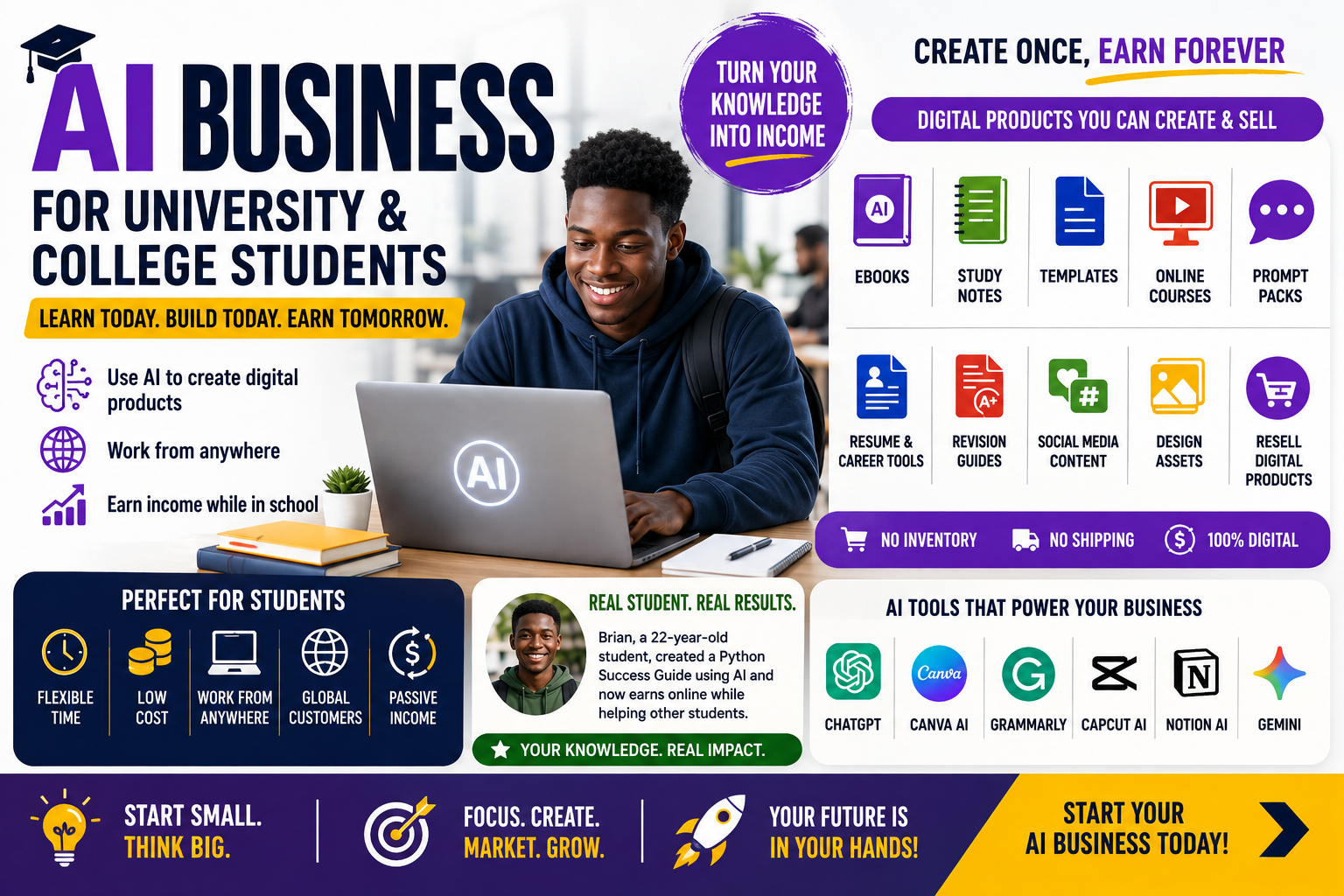
Discover the best AI business ideas for university and college students.
By Super Admin
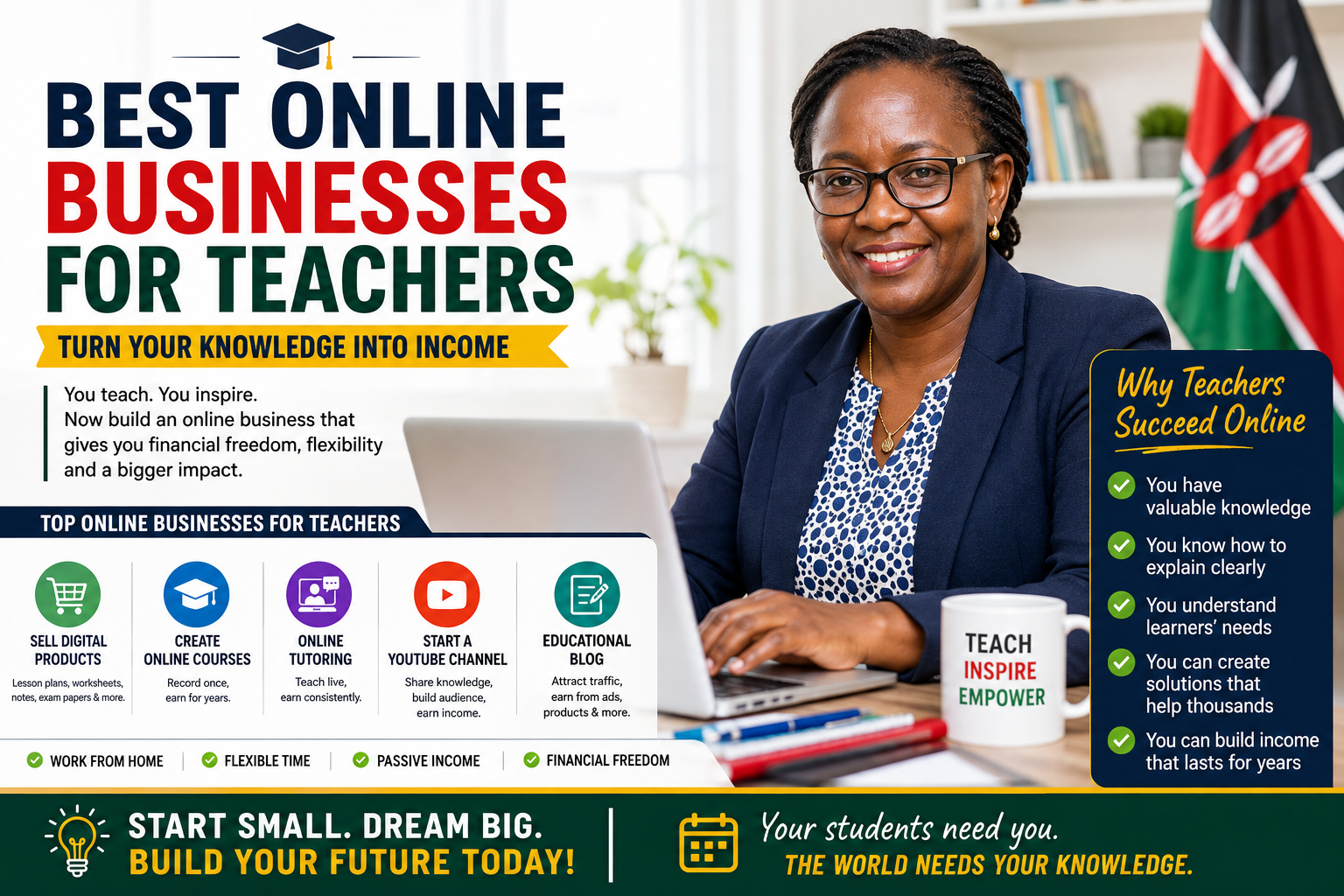
Discover the best online businesses for teachers
By Super Admin
Passive Income in 2026: The Complete Beginner's Guide to Building Passive Income with AI and Digital Products
By Super Admin
Get the updates, on newly released, popular & fast-moving MRR digital products
Up to Top
Comments All
Danson
@danson
This is one of the most helpful articles I’ve come across on how to make money online in Kenya without capital. I especially like that it doesn’t just mention random online jobs - it explains practical options such as freelancing, affiliate marketing, online courses, and creating digital products using a smartphone and free AI tools. The section on creating and selling digital products is particularly useful because it shows how students, teachers, farmers, designers, parents, freelancers, and other Kenyans can turn their existing skills and knowledge into income. The step-by-step approach also makes it easier for a beginner to know where to start. If someone is searching for legitimate ways to earn money online in Kenya, work from home using a phone, or start an online business with little or no capital, this is definitely a useful resource. I’m very happy I found this article and will be sharing it with others who are looking for practical online income ideas.
August 27,2026 At 06:00 PM
Edwin Kanyutu
@edwin_kanyutu
Perfect. Very useful and practical ways... I have applied these steps and are working. Thanks Vezill
August 24,2026 At 02:51 PM
Keniiken
@keniiken
I would like to join this site and start earning mony through online task.
July 31,2026 At 11:42 AM
Mourine Nzioka
@mourine_nzioka
i need a job
July 20,2026 At 09:07 AM