
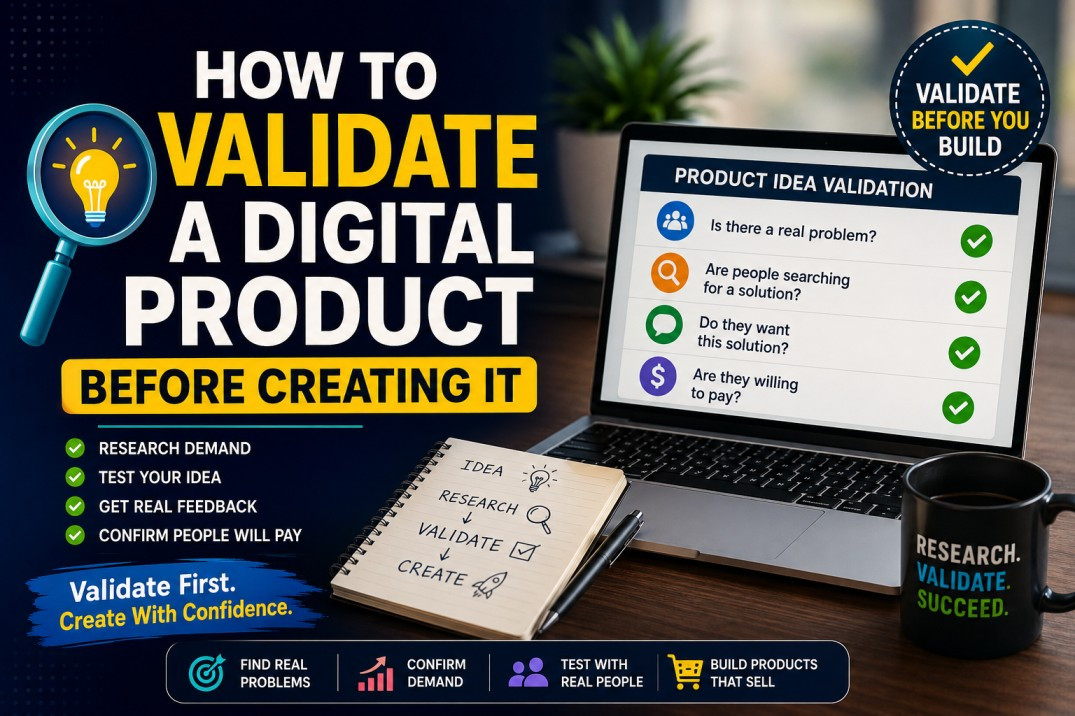
How to Validate a Digital Product Before Creating It (Complete Guide)
One of the biggest mistakes digital entrepreneurs make is spending weeks or even months creating a product nobody wants.
Imagine writing a 250-page eBook, recording a 10-hour online course, or designing dozens of templates only to receive zero sales.
Unfortunately, this happens every day.
The good news?
You can dramatically reduce this risk by validating your digital product before creating it.
Validation helps you answer one critical question:
"Will people actually pay for this?"
In this guide, you'll learn exactly how successful creators validate ideas before investing their time, money, and effort.
Whether you're planning to sell an eBook, online course, AI prompts, templates, software, planners, or printable products, this guide will help you build products people genuinely want.
What Is Digital Product Validation?
Digital product validation is the process of confirming that there is genuine demand for your idea before you create it.
Instead of guessing, you collect evidence.
You want proof that:
Validation removes assumptions from your business.
Why Product Validation Matters
Creating a digital product requires effort.
Even with AI helping you create content faster, you'll still invest time in:
Validation helps ensure that effort is directed toward a product with real demand.
Benefits include:
The Biggest Mistake Most Beginners Make
Most creators follow this process:
Idea → Create → Upload → Hope
Successful creators follow this process:
Problem → Research → Validate → Create → Launch → Improve
That single difference often determines whether a product succeeds or fails.
Step 1: Start With a Problem, Not a Product
People don't wake up wanting an eBook.
They wake up wanting solutions.
Instead of asking:
"What should I create?"
Ask:
"What problem can I solve?"
Strong examples include:
The more painful the problem, the stronger the demand tends to be.
Step 2: Check What People Are Searching For
Search engines reveal what people need.
Look for questions on:
Type your topic and review:
These are based on real user searches.
Example:
Instead of searching:
Digital products
Search:
Google Trends
Compare:
Look for steady or increasing interest.
ChatGPT
Ask questions like:
AI can help you brainstorm, but always confirm demand with real-world data.
Step 3: Study Your Competitors
Competition is usually a positive sign.
If nobody is selling something, there may be no demand.
Research:
Look for:
Your goal isn't to copy it's to improve.
Step 4: Read Customer Reviews
Reviews reveal exactly what buyers love and what frustrates them.
Pay attention to comments like:
"I wish this included templates."
"Too complicated."
"Didn't explain the beginner steps."
"Needed more examples."
Every complaint is an opportunity to build a better product.
Step 5: Find Questions People Keep Asking
Questions equal demand.
Search:
Notice repeated questions.
If thousands of people ask the same thing, there's likely a market for a product that answers it well.
Step 6: Use Keyword Research
Keyword research shows what people actively search for online.
Useful tools include:
Look for:
For example:
Instead of targeting:
Digital products
Target:
Specific keywords often convert better because they match clear intent.
Step 7: Validate on Social Media
Social media shows what people engage with today.
Publish short content about your idea.
Examples:
Watch for:
Strong engagement often signals market interest.
Step 8: Ask Your Audience Directly
The simplest validation method is often the best.
Ask questions like:
Use:
Even 20–50 quality responses can provide valuable insights.
Step 9: Build a Simple Landing Page
You don't need a finished product to test demand.
Create a page that explains:
Include:
If nobody joins the waiting list, revisit the idea before building.
Step 10: Test Pre-Orders
One of the strongest forms of validation is when people are willing to pay before the product exists.
Offer:
Real purchases provide stronger validation than likes or compliments.
Step 11: Create a Minimum Viable Product (MVP)
Don't build the biggest product first.
Launch a simplified version.
Instead of:
300-page book
Start with:
50-page guide.
Instead of:
12-hour course
Launch:
90-minute workshop.
Instead of:
200 templates
Release:
20 high-quality templates.
Gather feedback and improve over time.
Step 12: Analyze the Competition but Don't Fear It
Many beginners think competition means the market is saturated.
In reality, competition usually indicates healthy demand.
Ask:
Differentiation beats imitation.
Step 13: Validate Pricing
People often ask:
"How much should I charge?"
Research similar products.
Consider:
Sometimes a slightly higher price increases perceived value.
Step 14: Validate With AI
AI can accelerate your research.
Use ChatGPT or similar tools to:
Remember: AI should support your research, not replace real customer validation.
Step 15: Measure the Right Validation Signals
Not every positive response indicates demand.
The strongest validation signals include:
✅ Email sign-ups
✅ Waiting list registrations
✅ Pre-orders
✅ Direct inquiries
✅ Requests for launch dates
✅ Repeat questions
✅ Customers willing to pay
Likes and views are encouraging, but purchases and sign-ups are much stronger indicators.
A Practical Validation Checklist
Before creating your product, ask yourself:
If you answer "yes" to most of these, you're in a much stronger position to build a successful product.
Common Validation Mistakes
Avoid these pitfalls:
How Vezill Helps Validate and Sell Digital Products
Once you've confirmed demand, you need a marketplace where customers can easily discover and purchase your product.
Vezill provides creators with a platform to list and sell:
The platform also supports Master Resell Rights (MRR) products, allowing eligible creators to expand distribution by enabling buyers to legally resell selected digital products.
By validating your idea first and then launching through a marketplace designed for digital products, you improve your chances of reaching interested buyers faster.
Frequently Asked Questions
How do I know if my digital product idea is good?
A good idea solves a real problem, has measurable demand, and targets a specific audience willing to pay for a solution.
Should I create the product before marketing it?
No. Test demand first through surveys, landing pages, waiting lists, or pre-orders whenever possible.
What is the fastest way to validate a product idea?
Publish content around the topic, collect feedback, build a simple landing page, and invite people to join a waiting list or pre-order. These actions provide much stronger evidence than assumptions.
How many people should validate my idea?
There's no fixed number, but meaningful engagement—such as dozens of survey responses, strong email sign-ups, or genuine purchase intent—is generally more useful than a large number of passive likes.
Can AI validate product ideas?
AI can help identify trends, questions, and opportunities, but true validation comes from real customer behavior, search demand, and willingness to pay.
Final Thoughts
Creating a digital product without validation is like building a house before checking whether anyone wants to live there.
Successful digital entrepreneurs don't rely on guesswork. They research real problems, analyze customer behavior, test ideas, gather feedback, and launch with confidence.
Before investing weeks into your next eBook, course, template, or AI resource, take the time to validate it. That simple step can save countless hours, reduce risk, and significantly improve your chances of building a product that customers genuinely want.
Remember:
Research first. Validate second. Create third. Sell with confidence.
Discover more articles you might be interested in

Digital Products Market 2026–2030: Is It Worth Investing In? Global Data, Trends & Opportunities

By Super Admin
Learn how to turn your YouTube videos into profitable digital products such as ebooks, courses, guides, templates, checklists and prompt packs using AI.
By Super Admin
Discover 100 high-demand digital product topics for ebooks, PDF guides, online courses, AI prompt packs, apps, audio products and video tutorials.
By Super Admin
Discover why Vezill is one of the best free platforms to host and sell digital products worldwide
By Super Admin
Get the updates, on newly released, popular & fast-moving MRR digital products
Up to Top