

Want to make money online daily but don’t know where to start? Millions of people - every minute, keep searching for - “How Can I Make Money Online Daily?”
One practical option is selling digital products, downloadable or online products such as ebooks, PDF guides, templates, tutorials, courses, checklists, planners, prompts, software and other useful digital resources.
Unlike physical products, a digital product does not need to be manufactured again every time someone buys it. You create or acquire it once and, depending on its licence, can potentially sell it repeatedly.
This makes digital product selling particularly suitable for students, teachers, stay-at-home parents, employed people, unemployed job seekers, freelancers and anyone looking for an online side hustle.
However, there is an important point:
Selling digital products can generate daily sales, but daily income is not guaranteed. Your earnings depend on the product, demand, pricing, audience and how consistently you market it.
This guide explains how it works and gives simple, realistic examples.
One way to work toward daily online income is to:
Find a problem people are actively trying to solve.
Create a useful digital product that solves it or legally acquire one with resell rights.
List the product on a digital marketplace such as Vezill.
Set an affordable price.
Promote it through WhatsApp, TikTok, Facebook, Instagram, YouTube, X or other channels.
Make a profit whenever someone purchases.
For example:
Create a KSh 500 digital guide → attract 3 buyers in a day → KSh 1,500 gross sales.
That does not mean you will automatically make KSh 1,500 every day. It demonstrates the basic business model.
The objective is to build enough visibility and demand that sales can occur regularly.
A digital product is something customers can purchase and access electronically rather than receiving as a physical item. See digital products available for sale and resell HERE.
Examples include:
Ebooks
PDF guides
Study notes
Revision materials
Templates
Planners
Checklists
Video tutorials
Micro-courses
Online courses
AI prompt collections
Business documents
Worksheets
Design resources
Software and apps
Photography
Audio products
The advantage is simple:
You don't need physical inventory, a shop or delivery vehicles.
One useful product can potentially be sold to many customers.
There are two straightforward models.
Turn your knowledge, profession, skills, experience or research into something useful that another person can buy.
For example:
A teacher could create:
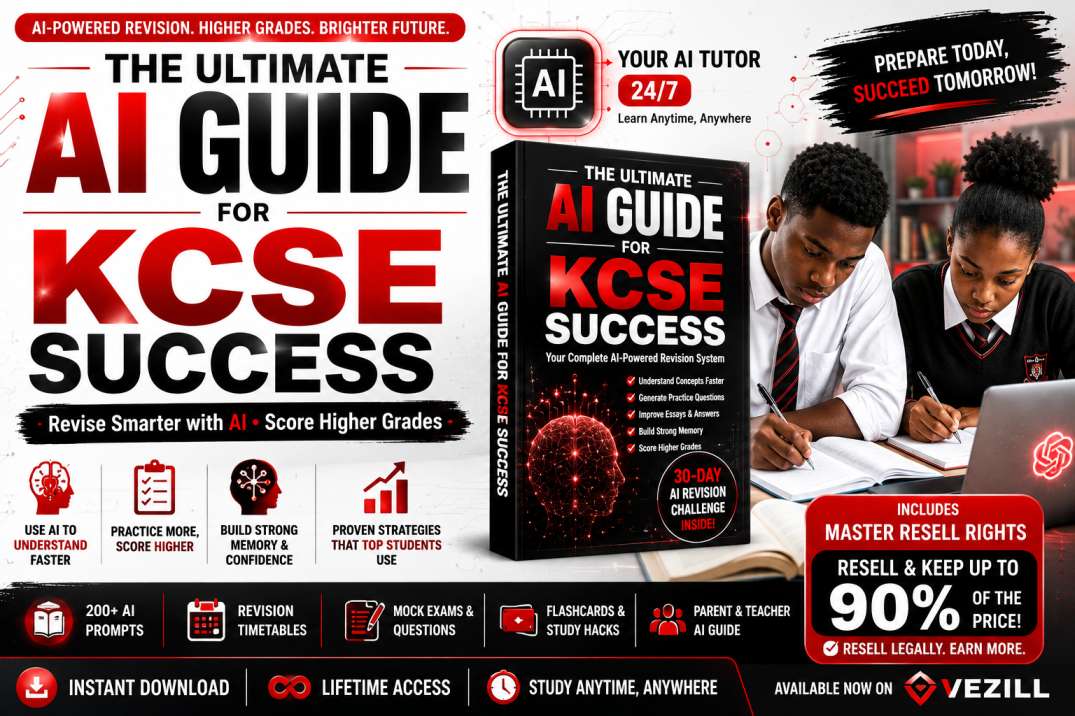
“KCSE Mathematics Revision Workbook: 100 Practice Questions With Answers.”

A graphic designer could create:
“50 Editable Social Media Templates for Small Businesses.”
A university student could create:
“University Student Budget & Study Planner.”
AI tools can also assist with research, brainstorming, outlining, editing, design and video production.
The important part is adding real human value rather than simply generating generic AI content and immediately putting it up for sale.
You don't necessarily have to create a product yourself.
Some digital products are sold with resell rights or Master Resell Rights (MRR).
Depending on the licence, this can allow you to purchase the product and legally resell it.
The process becomes:
Find product → Check licence → Purchase → Get reseller rights → Promote → Customer buys → Earn your permitted margin
Always read the individual product licence because resell-rights terms can differ.
This option can be useful for beginners who want to learn digital marketing before creating their own products.
Here is where the business model becomes easier to understand.
If you have been asking how to make money online as student, Meet Brian, a university student who has adopted new ways to earn online.
Brian notices that other students frequently struggle with writing professional CVs and preparing for internship applications.
He creates a simple package:
“Student CV + Internship Application Toolkit”
It contains:
CV template
Cover-letter template
Internship application checklist
Interview preparation questions
AI prompts for improving a CV
Suppose Brian prices it at KSh 400.
If he gets:
2 sales × KSh 400 = KSh 800 gross sales
On another day he may make no sales. During internship application season, he might sell considerably more.
He could create TikTok videos such as:
“3 CV mistakes stopping students from getting internships.”
At the end, he directs interested students to his digital toolkit.
Instead of simply posting:
“Buy my ebook.”
he creates useful content that attracts people who already have the problem his product solves.
Consider Mary, a secondary-school teacher.
She has spent years preparing revision materials for students.
Instead of using that knowledge only in her classroom, she creates:
“Form 4 Biology Revision Guide: Questions, Answers & Revision Checklist.”
Price: KSh 600
If five copies sell over a weekend:
5 × KSh 600 = KSh 3,000 gross sales
She could later create:
Topic-by-topic revision guides
Mock exams
Revision planners
Video lessons
Teacher lesson-plan templates
Study guides
One area of professional knowledge can therefore become several digital products.
Consider Grace, a parent spending most of her day at home caring for her child.
She knows how difficult it can be to organize meals, chores and children's activities.
She creates a downloadable:
“Busy Parent Weekly Home Planner”
It includes:
Meal planner
Grocery checklist
Family budget sheet
Children's activity planner
Weekly cleaning schedule
Price: KSh 350
Instead of needing to leave home to deliver physical products, customers receive the digital product online.
Grace can promote it through parenting communities and short social-media videos.
For example:
“How I plan an entire family's meals in 15 minutes.”
The content attracts the same audience likely to need her planner.
David works from 8 a.m. to 5 p.m.
He doesn't want another job requiring him to work several extra hours every evening.
Instead, he turns something he already knows into a digital resource:
“Excel Expense Tracker for Small Businesses.”
Price: KSh 750
He spends his weekend creating the template and instructions.
During the week, he publishes short educational posts explaining:
How small businesses lose track of expenses
Simple bookkeeping habits
How to calculate monthly profit
How to organize business records
The digital product becomes the paid solution for people who want the ready-made tool.
His job provides his primary income while the digital product operates as a side business.
What if you currently don't have a job or professional expertise?
Start with a simple problem you understand well.
Suppose Peter has been applying for jobs for several months.
During that process he researches:
Job-search websites
CV formatting
Interview questions
Cover letters
LinkedIn optimization
AI prompts for job applications
After carefully verifying and organizing the information, he creates:
“Job Seeker Starter Toolkit.”
Instead of pretending to be a recruitment expert, he positions the resource transparently as a practical toolkit compiled to help other job seekers organize their search.
Alternatively, he can start by legally reselling an existing digital product with the appropriate resell rights.
The key is providing genuine usefulness.
Suppose Amina designs social-media posts for businesses.
Rather than selling only her time, she creates:
“100 Canva Social Media Templates for Small Businesses.”
If she charges KSh 1,000 for the package, she does not need to redesign the same templates every time someone purchases.
This demonstrates an important advantage of digital products:
Don't begin by asking:
“What ebook should I create?”
Ask:
“What problem can I help someone solve?”
Good examples include:
How to pass an exam
How to write a CV
How to start a small business
How to use AI
How to create social-media content
How to budget money
How to learn Excel
How to prepare for an interview
How to create an online course
How to organize a business
How to market products online
Search engines, social platforms, online communities and AI assistants can help you identify recurring questions.
Repeated questions often indicate potential demand.
Your first product does not need to be a 200-page ebook.
You could start with:
Checklist → Template → PDF guide → Workbook → Video tutorial → Micro-course
Choose the simplest format capable of solving the customer's problem.
Someone searching for a monthly budget may prefer a ready-made spreadsheet over a 100-page personal-finance ebook.
Solve the problem in the easiest usable format.
AI tools can reduce the time required to develop a digital product.
For example, you can use AI to help:
Research → Outline → Draft → Edit → Design → Create marketing content
But verify important facts and add your own experience, examples and expertise.
Generic AI-generated information is easy for customers to find for free.
People are more likely to pay for something that is organized, practical, specific and immediately useful.
Don't simply write:
“Business Ebook – Buy Now.”
Explain:
For example:
Weak title:
“CV Ebook”
Better title:
“Job Seeker CV & Interview Toolkit: Editable CV Template, Cover Letter, Interview Questions + AI Prompts”
Specificity helps both customers and search engines understand the product.
You need somewhere customers can view and purchase the product.
A marketplace such as Vezill allows digital creators and traders to list digital products online.
Depending on the product and its licence, you can sell your own product or participate in digital-product reselling.
Your product page effectively becomes your online salesperson.
This is one of the biggest differences between people who simply upload digital products and people who build an actual digital-product business.
Suppose you're selling:
“30-Day Weight-Loss Meal Planner.”
Don't post the purchase link repeatedly.
Create content answering questions such as:
How do I plan healthy meals for a week?
How can I stop buying unhealthy food?
How do I prepare meals on a budget?
Then introduce your planner as a tool that makes the process easier.
The formula is:
Useful content → Audience trust → Relevant product → Sales
You can start with platforms where your potential customers already spend time:
WhatsApp Status
TikTok
YouTube
X
Telegram
Blogs
Relevant online communities
You don't necessarily need thousands of followers.
You need the right people seeing the right offer.
A creator with 500 highly relevant followers can sometimes outperform someone with 50,000 followers who have little interest in the product.
If your goal is to generate sales regularly, consistency matters.
Try this:
Post one useful tip related to the problem your product solves.
Respond to comments and questions.
Create one short TikTok, Reel, YouTube Short or educational post.
Check:
Views
Clicks
Questions
Sales
Which content performed best
Then improve the next day's content.
You are creating a simple cycle:
Learn → Create → Promote → Measure → Improve → Repeat
There is no guaranteed amount.
Your revenue can be estimated with a simple formula:
Product price × Number of sales = Gross sales revenue
For example:
|
Product |
Price |
Sales |
Gross Sales |
|
Student planner |
KSh 300 |
5 |
KSh 1,500 |
|
Revision guide |
KSh 500 |
10 |
KSh 5,000 |
|
Business template |
KSh 1,000 |
10 |
KSh 10,000 |
|
Micro-course |
KSh 2,000 |
10 |
KSh 20,000 |
These figures are illustrations, not income promises.
Actual profit will depend on your costs, platform charges or revenue-sharing arrangements, advertising expenditure, taxes and any royalties or licensing terms that apply.
If you're starting today, consider products that solve a narrow problem.
Good beginner ideas include:
CV templates
Study guides
Revision planners
Budget spreadsheets
Business templates
Social-media templates
Checklists
AI prompt packs
Short ebooks
How-to PDF guides
Video tutorials
Micro-courses
Worksheets
Business planners
Job-search toolkits
A small product that solves one important problem extremely well can be more valuable than a huge product that tries to cover everything.
Yes—provided you have the legal right to resell the product.
This is where products carrying Resell Rights or Master Resell Rights can be useful.
For example:
Suppose you purchase a useful digital guide that includes permission to resell it.
Your workflow might become:
Buy licensed product → Understand it → Identify target customer → Create promotional content → Share product link → Make sales
This reduces product-creation time, but you still need to learn marketing.
Resell rights do not guarantee customers.
The reseller who understands the customer's problem and markets the product effectively has a stronger chance of generating sales.
The business model is flexible.
Students can turn useful knowledge, research and student resources into products.
Teachers can package educational expertise into revision materials, worksheets and courses.
Stay-at-home parents can build products around parenting, planning, budgeting, cooking, organization or professional skills they already possess.
Employees can create a side business around professional knowledge without immediately leaving their jobs.
Unemployed people can learn a practical skill, create a useful resource or begin with properly licensed resell-rights products.
Freelancers can convert services they repeatedly provide into templates, guides and training products.
The common principle is:
Identify something useful that people need, package it digitally and make it easy for those people to find and buy it.
It is possible to receive digital-product sales on any day because an online store can remain accessible around the clock. However, daily sales are not guaranteed. Consistent sales normally require a good product, demand, effective marketing and continued testing.
Creating your own digital product can have a relatively low startup cost, particularly if you already have a phone or computer and use free or low-cost tools. Your actual costs depend on the tools, platform and marketing method you choose.
For many simple digital products, yes. A smartphone can be used for research, AI assistance, document creation, design, video production, social-media marketing and managing an online store.
A computer can make some tasks easier but isn't necessary for every digital-product business.
There isn't one universally easiest product.
A better question is:
What simple product solves an urgent problem for an audience I can reach?
For one person that may be a CV template. For another it could be KCSE revision material, a budgeting spreadsheet or a short video tutorial.
Yes. Beginners can start with small products such as templates, checklists, planners and short guides before progressing to larger ebooks and courses.
Yes. AI can assist with research, brainstorming, outlines, drafting, editing and marketing. You should still fact-check the material and add original expertise, examples and value instead of selling unedited generic AI output.
Digital products can be sold through digital marketplaces and ecommerce platforms. Vezill is one option focused on digital products and resell-rights opportunities.
If you are searching for how to make money online daily, the biggest mistake is expecting money simply because you uploaded a product.
Think of digital-product selling as a small business.
Start with: One audience.
Find: One real problem.
Create: One useful product.
Choose: One or two marketing channels.
The numbers will differ, but the underlying business model remains the same:
Find a problem → Provide a useful digital solution → Put it where customers can buy it → Promote it consistently → Earn when customers purchase.
You don't need to create ten products. Start with one useful digital product for one specific audience. If you already have knowledge or a skill, turn it into a digital product. If you don't want to create a product yet, explore products that legally include resell rights and learn how digital-product marketing works. Then focus on helping the right customers discover your offer. Start small. Make your first product useful. Get your first customer. Learn from the result. Then scale what works.
Want help deciding what digital product you could sell? Leave a comment with what you do - student, teacher, parent, employee, freelancer or job seeker and we'll suggest practical digital-product ideas you can start with.
Discover more articles you might be interested in

Learn how to make your first £1,000 selling digital products online.

By Super Admin
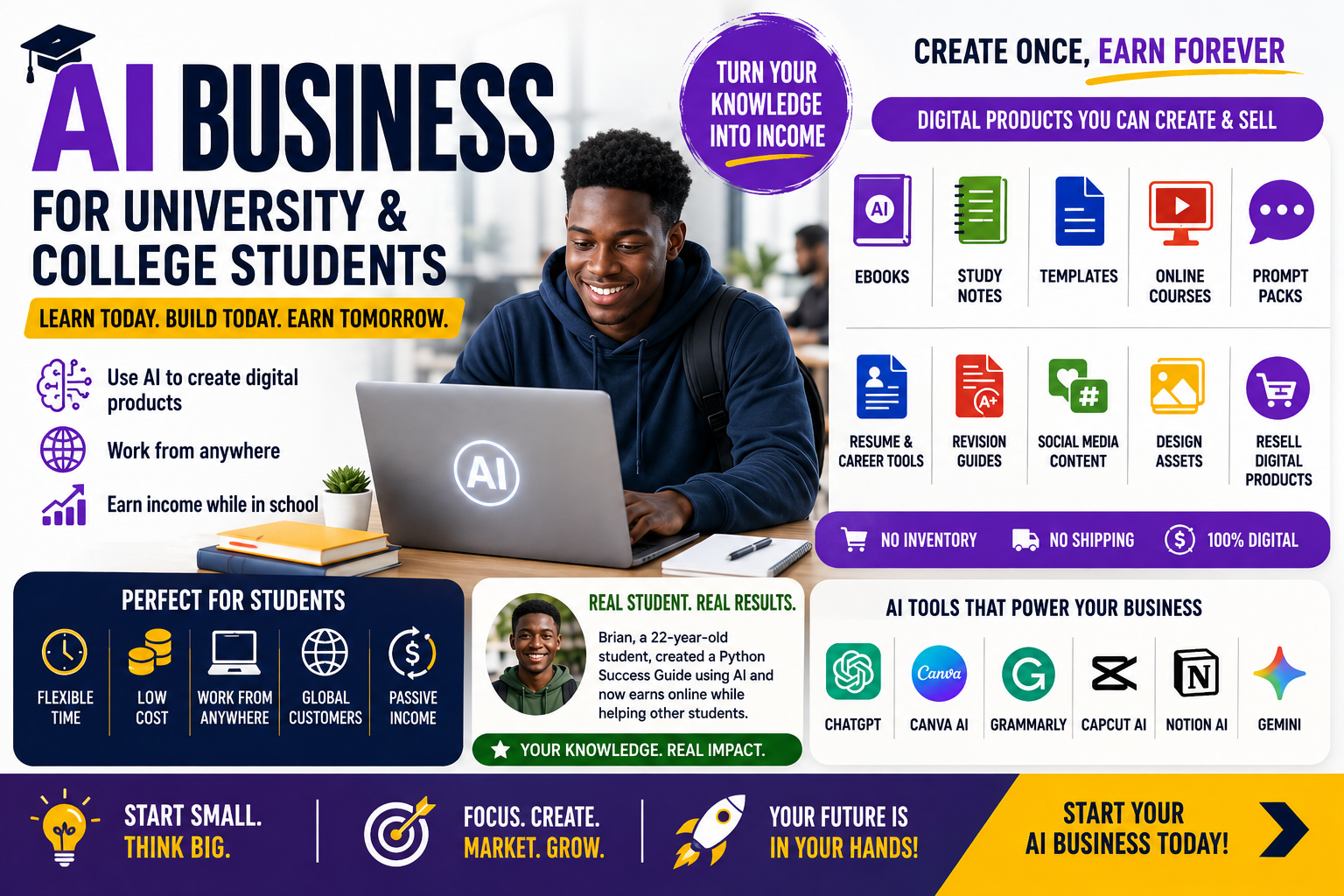
Discover the best AI business ideas for university and college students.
By Super Admin
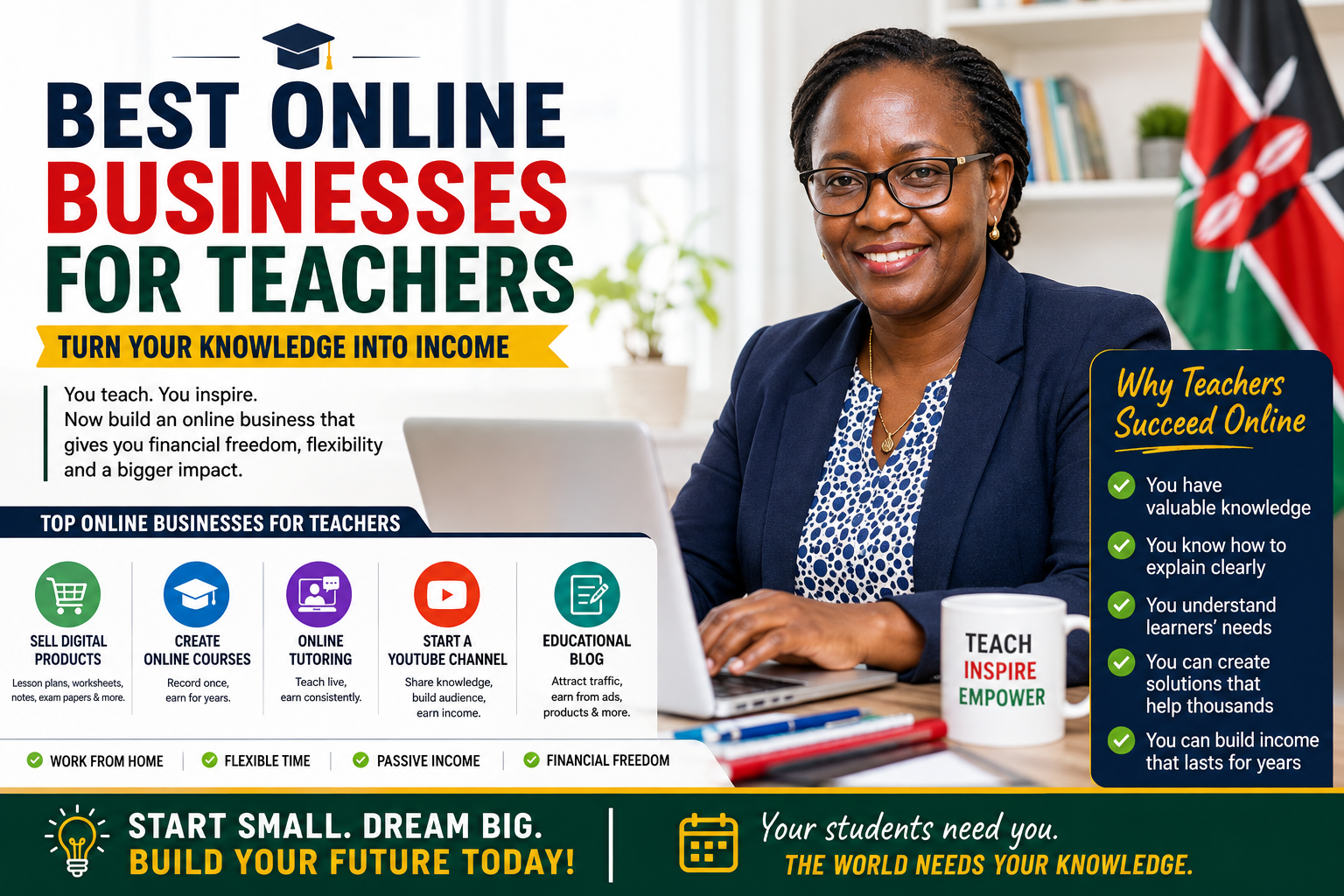
Discover the best online businesses for teachers
By Super Admin

Passive Income in 2026: The Complete Beginner's Guide to Building Passive Income with AI and Digital Products
By Super Admin
Get the updates, on newly released, popular & fast-moving MRR digital products
Up to Top