
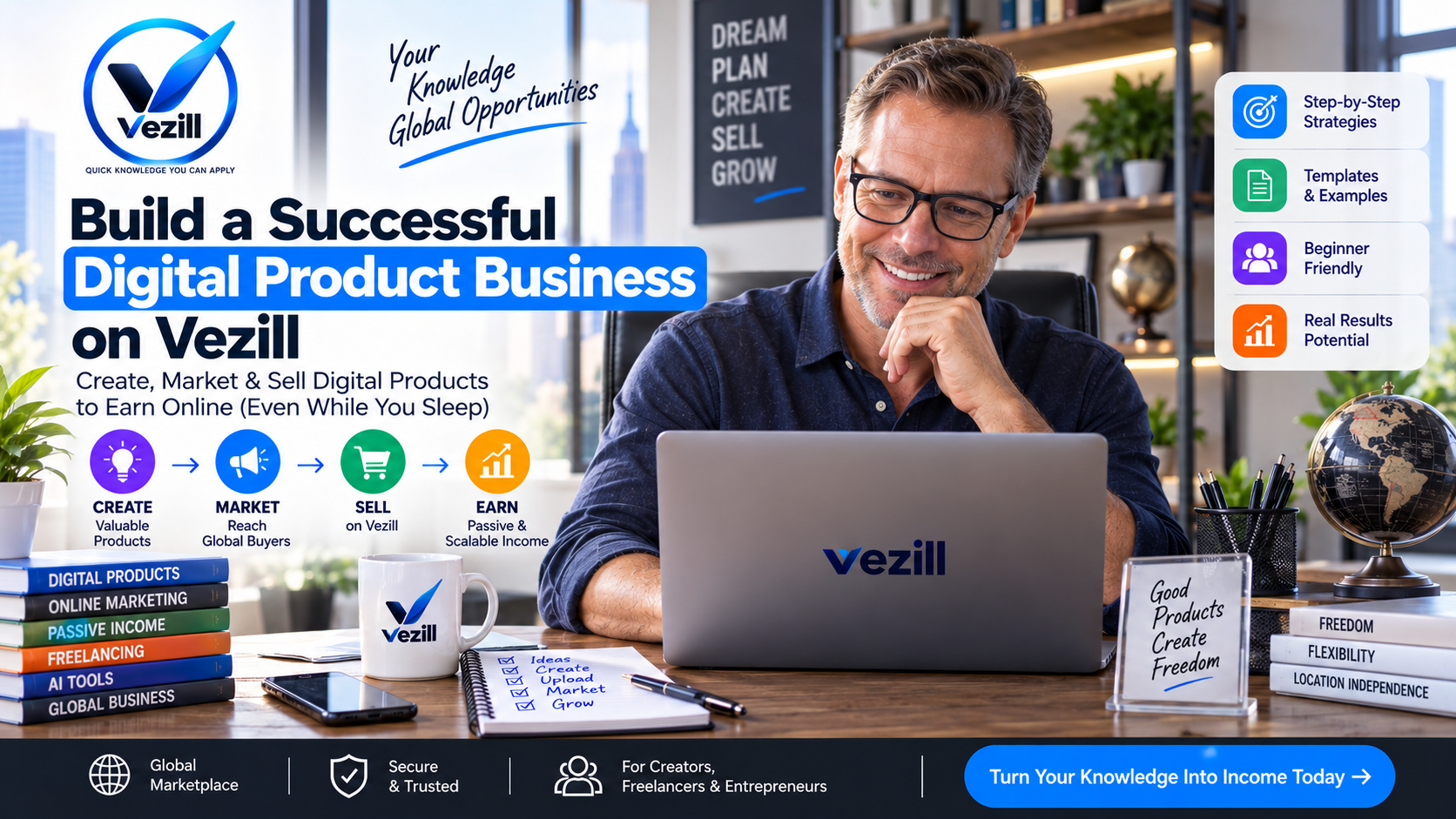
For freelancers, creators, digital entrepreneurs, online traders, professionals, students, and anyone interested in building an online income stream.
The result this guide is designed to help you achieve:
FIND A PROBLEM → CREATE THE SOLUTION → PACKAGE IT → LIST IT → MARKET IT → SELL → IMPROVE → SCALE
You are not simply uploading PDFs to the internet.
You are building a digital-product business.
A digital product is an asset delivered electronically rather than physically. Examples include practical guides, templates, spreadsheets, calculators, prompt systems, tutorials, checklists, mini-courses and digital toolkits. Vezill currently supports this broader practical-knowledge approach rather than limiting creators to ebooks.
The business model is attractive because one useful resource can potentially be sold repeatedly without manufacturing another physical copy for each customer.
But there is an important principle:
A digital product does not make money merely because it exists. It makes money when it solves a problem people care enough about to act on.
Your job therefore consists of four systems:
Product → Marketplace → Traffic → Conversion
This guide will help you build all four.
Do not think:
“I want to sell an ebook.”
Think:
“What result can I help somebody achieve?”
The PDF, spreadsheet, video or template is simply the delivery mechanism.
For example:
Weak idea: Social Media Ebook
Stronger product: 30-Day Social Media Content Planner for Small Restaurants
Weak idea: Freelancing Guide
Stronger product: First Freelance Client Starter Kit: Proposal + Pricing + Client Outreach Templates
Weak idea: ChatGPT Ebook
Stronger product: ChatGPT for Small Business: 30 Tasks You Can Automate Today
The second version in each case tells the buyer what they will be able to accomplish.
That is the foundation of a results-oriented digital product.
Do not create a product and then search for customers.
Find customers with a problem and create a product for them.
Use this formula:
PERSON + PROBLEM + DESIRED RESULT = PRODUCT OPPORTUNITY
Example:
Person: Freelancer
Problem: Struggles to write proposals
Result: Send better proposals quickly
Product: Freelance Proposal Toolkit
Another:
Person: Small business owner
Problem: Doesn't know what to post online
Result: Consistent marketing
Product: 30-Day Small Business Social Media Content System
This is consistent with Vezill's current knowledge-product framework: move from broad knowledge to a specific person, specific problem and specific result.
Before spending days creating anything, validate demand.
List:
Your professional skills.
Your hobbies.
Problems you have solved.
Questions people regularly ask you.
Processes you repeatedly perform.
Templates you already use.
Things beginners struggle with that are easy for you.
Things you have learned through experience.
You don't necessarily need to be the world's leading expert.
But you must know enough to responsibly help the intended buyer, and you must not misrepresent your qualifications or expertise.
Research the problem using sources such as:
Google searches and autocomplete, Google Trends, YouTube searches, TikTok, Reddit discussions, online marketplaces, Facebook communities, Quora and AI assistants.
Look for recurring language such as:
“How do I…”
“Best way to…”
“Template for…”
“How to fix…”
“How to start…”
“Step-by-step…”
“Checklist for…”
“Why isn't…”
“What do I need to…”
Repeated questions indicate potential problems worth investigating.
Give greater weight to stronger evidence.
Level 1 — Assumption: You think people need it.
Level 2 — Search: People search for the solution.
Level 3 — Discussion: People repeatedly discuss the problem.
Level 4 — Workaround: People already spend time trying to solve it themselves.
Level 5 — Spending: People buy related solutions.
Level 6 — Direct request: People ask you to help them.
Level 7 — Purchase: Someone actually pays for your solution.
A purchase is much stronger validation than social-media likes.
Vezill describes a similar evidence ladder in its current creator guidance.
Use this five-question filter.
Score each potential product from 1–5 for:
|
Question |
Score |
|
Does it solve a specific problem? |
/5 |
|
Are people actively looking for the solution? |
/5 |
|
Can I genuinely provide the solution? |
/5 |
|
Can the result be packaged digitally? |
/5 |
|
Can I easily explain its value? |
/5 |
|
TOTAL |
/25 |
Prioritize ideas scoring roughly 20+, but treat the score as a decision aid - not proof that sales will occur.
Don't automatically create an ebook.
Ask:
What is the fastest format that helps the customer achieve the desired result?
If the customer needs knowledge → practical PDF guide
If they need to calculate something → spreadsheet/calculator
If they need repeated instructions → checklist/SOP
If they need words to reuse → scripts/templates
If they need AI outputs → prompt system
If they need demonstration → video tutorial
If they need several resources → toolkit/bundle
Vezill currently recognizes formats including guides, templates, spreadsheets, calculators, prompts, checklists, tutorials and micro-courses.
Often, the strongest product is a combination.
Example:
PDF Quick Guide
Proposal Template
Pricing Calculator
+ 20 Outreach Messages
Client Questionnaire
Follow-Up Checklist
That is much more actionable than a long theoretical ebook.
A practical guide should answer these questions in order:
1. What will I achieve?
Tell the buyer the specific outcome.
2. What do I need?
Tools, accounts, knowledge, materials or prerequisites.
3. What do I do first?
Give an immediate first action.
4. What do I do next?
Break the process into numbered steps.
5. Show me an example.
Provide a realistic illustration.
6. What could go wrong?
Explain common mistakes and troubleshooting.
7. How do I know it worked?
Provide a completion/result checklist.
AI can dramatically accelerate product development, but don't simply generate generic content and sell it unchanged.
Vezill's FAQ explicitly states that AI can assist with structuring, editing and packaging knowledge, while the creator remains responsible for accuracy, originality, intellectual-property rights and relevant safety information.
Copy this into ChatGPT:
I want to create a practical digital product for [TARGET CUSTOMER]. Their problem is [PROBLEM], and the result they want is [RESULT]. Help me identify the questions, obstacles, mistakes, tools, steps, templates and examples this person needs to move from the problem to the desired result. Do not create filler. Structure the answer around practical implementation.
Design a practical, results-oriented knowledge pack that helps [TARGET USER] achieve [SPECIFIC RESULT]. Build the shortest complete path from their current situation to the desired outcome. Include prerequisites, step-by-step instructions, examples, templates, checklists, troubleshooting, action exercises and a final implementation plan.
Then add your expertise, examples, processes and verification.
Don't assume bigger is better.
A 15-page guide that solves one expensive problem can be more valuable than a 200-page ebook full of general information.
Ask:
What is the smallest complete product that can genuinely help this customer make meaningful progress toward the promised result?
For example, instead of:
Complete Guide to Freelancing
create:
Freelancer First Client Toolkit
It could contain:
Service Selection Worksheet
Pricing Worksheet
Portfolio Checklist
Proposal Template
10 Client Outreach Scripts
Follow-Up Messages
Client Onboarding Checklist
Now the buyer can do something, not merely read something.
Before publishing, perform the USE Test.
Does this solve the stated problem?
Is it designed for a clearly identifiable customer and outcome?
Can the buyer actually implement what you teach?
Then check:
Accuracy
Originality
Grammar
Formatting
Copyright
Links
Examples
Instructions
File accessibility
Mobile readability
Claims and disclaimers
Never knowingly sell fabricated, plagiarized, dangerously incomplete or misleading material.
Your listing is your salesperson.
The visitor should quickly understand:
What is this?
Who is it for?
What problem does it solve?
What will I receive?
Why should I trust it?
What can I do after purchasing it?
Vezill currently positions itself as a marketplace for practical digital knowledge and allows creators to offer appropriate digital resources through listings subject to platform requirements.
Avoid vague titles.
Bad:
Online Business Ebook
Better:
Digital Product Business Starter Guide
Stronger:
Build Your First Digital Product Business: Create, Launch & Market Products Online
Use:
Desired Result + Specific Mechanism/Audience + Clarifier
Examples:
ChatGPT for Small Business: 30 Tasks You Can Automate Today
Freelancer First Client Toolkit: Proposals, Pricing & Outreach Templates
30-Day Social Media Content Planner for Small Businesses
Use this structure.
Promise the primary transformation accurately.
Describe what the customer is struggling with.
Introduce your product.
Explain the practical skills/outcomes.
List every component.
Help visitors self-identify.
Explain how to use the product.
Translate features into results.
Use genuine examples, demonstrations, previews or testimonials.
Never manufacture testimonials.
Clearly state what the buyer may and may not do.
Tell them the next step.
MRR can create another distribution mechanism.
However, don't assume every Vezill product can be resold.
Vezill's current FAQ states that resale is permitted only where the individual product licence expressly allows it.
For eligible MRR products, Vezill currently describes its model as allowing a buyer to resell and pass resale rights onward according to the applicable licence; some current Vezill materials advertise resellers retaining up to 90% per sale.
Always define clearly:
What can be resold.
Whether modifications are permitted.
Whether MRR can be transferred.
Whether source files are included.
Whether the buyer may claim authorship.
What trademarks/branding may be used.
Any minimum pricing restrictions.
Publishing is not marketing.
You need traffic.
Build a simple Traffic Engine:
CONTENT → INTEREST → PRODUCT PAGE → PURCHASE → CUSTOMER → REFERRAL/RESALE
Current Vezill guidance also emphasizes combining marketplace exposure with channels such as social media rather than relying solely on the listing.
Don't make every post an advertisement.
Approximately:
80% useful/problem-oriented content
20% direct product promotion
If you're selling a guide about getting freelance clients, create posts such as:
“5 reasons clients ignore freelance proposals”
“How to price your first freelance project”
“3 mistakes new freelancers make”
“A simple client follow-up message”
Then connect the content naturally to the product.
You're building problem awareness + credibility + solution awareness.
One product can generate dozens of marketing pieces.
Suppose you sell:
Create content around:
Customer replies
Marketing
Quotations
Business planning
Email writing
Social captions
Meeting notes
Research
Customer FAQs
Product descriptions
Every topic leads back to the same product.
This is far more efficient than creating unrelated content every day.
Use:
HOOK → PROBLEM → QUICK VALUE → PRODUCT → CTA
Example:
Hook:
“Freelancers: stop writing every proposal from scratch.”
Problem:
“It wastes time and produces inconsistent proposals.”
Value:
“Create three reusable proposal structures based on project type.”
Product:
“My Freelancer Client Toolkit gives you the complete structure and templates.”
CTA:
“Access the full toolkit on Vezill.”
One video can be adapted for TikTok, Instagram Reels, Facebook and YouTube Shorts.
Don't repeatedly post:
BUY MY PRODUCT!
Instead use a sequence.
“Getting views but no customers?”
“People rarely buy because a product exists. They buy because they understand the result it can help them achieve.”
Show one actionable technique.
“That's one of the systems covered step-by-step in my Digital Product Marketing Guide.”
Provide the Vezill product link.
Your product page should use the language your intended customer actually searches.
For example, instead of targeting:
“Ultimate Wealth Knowledge System”
use clear language such as:
“How to Create and Sell Digital Products Online”
Search engines and AI systems need to understand:
What it is + who it helps + what problem it addresses.
Include the primary topic naturally in:
Product title
Page heading
Opening paragraph
Product description
Image alt text where available
SEO title
Meta description
FAQs
Do not keyword-stuff.
Your business should eventually look like:
Free Content
↓
Useful Low-Cost Product
↓
Core Product
↓
Related Product
↓
Bundle
↓
Repeat Customer
Example:
Free post:
“How to write a freelance proposal”
↓
Freelance Proposal Templates
↓
Freelancer First Client Toolkit
↓
Freelancer Business Toolkit
Now one customer can purchase more than one product.
Don't create random products.
Choose an audience.
Example:
Product 1: Choosing Your Freelance Service
Product 2: Freelance Portfolio Starter Kit
Product 3: Proposal Templates
Product 4: Freelance Pricing Calculator
Product 5: Client Outreach Scripts
Product 6: Client Onboarding Toolkit
Product 7: Freelancer Business System
Then bundle related resources.
One audience can support multiple products because each solves a different stage of the customer's journey.
Treat this as a business.
Track at least:
Product-page visitors
Sales
Conversion rate
Average selling price
Revenue
Traffic source
Refunds/complaints
Repeat customers
Basic conversion calculation:
Conversion Rate = Purchases ÷ Product Page Visitors × 100
Example:
500 visitors.
15 purchases.
15 ÷ 500 × 100 = 3% conversion rate.
Don't immediately create another product if sales are weak.
Diagnose the system.
Low traffic → marketing/discovery problem.
Traffic but few sales → offer, trust, positioning, pricing or sales-page problem.
Sales but poor feedback → product quality/expectation problem.
Strong sales + positive feedback → potential scaling opportunity.
Choose one audience.
Identify 10 problems.
Research evidence of demand.
Select one specific problem.
Define the desired outcome.
Choose the best format.
Outline the solution.
Create the minimum useful product.
Add examples, worksheets/templates and checklists.
Test every instruction.
Proofread.
Verify factual claims.
Check copyright/licensing.
Have another person test usability where possible.
Create:
Product title
Cover/thumbnail
Preview
Description
SEO title
Meta description
Product file
Licence terms
Upload to Vezill.
Check the live listing.
Test it on mobile.
Verify the product description and preview.
Publish useful content every day.
Create short videos.
Share useful excerpts.
Promote through appropriate communities.
Send potential customers to the product page.
Review:
Traffic
Questions
Sales
Objections
Feedback
Improve weak areas.
Create additional promotional content.
Add a complementary product.
Bundle related products.
Encourage legitimate customer feedback.
Test another traffic source.
Repeat what generates qualified buyers.
You do not need to spend your entire day on the business.
Use:
15 minutes — Research
Look for questions and problems.
20 minutes — Content
Create one useful promotional asset.
15 minutes — Distribution
Post, share and engage.
10 minutes — Optimization
Check your listing, traffic, questions and conversions.
Consistency compounds.
Every Sunday record:
|
Metric |
This Week |
Last Week |
|
Content published |
||
|
Product visitors |
||
|
Sales |
||
|
Conversion rate |
||
|
Revenue |
||
|
Customer questions |
||
|
Positive feedback |
||
|
Refunds/issues |
Then answer:
What worked?
What failed?
What question appeared repeatedly?
What should I improve?
What should I repeat next week?
Fix: validate the problem first.
Fix: define the transformation.
Fix: narrow the audience and problem.
Fix: add genuine expertise, verification, examples and practical tools.
Fix: improve title, thumbnail, preview and sales page.
Fix: build a traffic system.
Fix: build several complementary products for one audience.
Fix: build the system actively before expecting it to operate with less intervention.
Fix: market the usefulness of the product—not guaranteed earnings.
Complete this before creating anything:
Target Customer: ______________________
Main Problem: _________________________
Desired Result: _______________________
Product: ______________________________
Format: _______________________________
Why They Need It: _____________________
Evidence of Demand: ___________________
Price: ________________________________
Primary Marketing Channel: ____________
Secondary Channel: ____________________
Main Search Keyword: __________________
MRR/Resale Licence: Yes / No
Next Related Product: _________________
Before clicking Publish, confirm:
☐ I know exactly who this product is for.
☐ It solves one recognizable problem.
☐ The result is clearly explained.
☐ Instructions are actionable.
☐ Examples are included.
☐ Templates/checklists are included where useful.
☐ Information has been checked for accuracy.
☐ I have the rights to all included material.
☐ The product looks professional.
☐ The title communicates value.
☐ The thumbnail is readable.
☐ The sales page explains the offer.
☐ The licence is clearly stated.
☐ The files work correctly.
☐ I have a marketing plan.
☐ I know which metric I will track.
☐ I have planned at least 10 promotional content pieces.
If you cannot check several of these boxes, fix them before launch.
Find a real problem.
Use knowledge you genuinely possess or can responsibly develop and verify.
Turn scattered information into an efficient process.
Create the guide, template, spreadsheet, prompts, tutorial or toolkit.
Create a clear Vezill listing.
Create useful content around the problem.
Convert interested people into customers.
Use questions, analytics and customer feedback.
Strengthen the product and offer.
Build complementary products, bundles and repeatable distribution.
A sustainable digital-product business is not based on uploading hundreds of random ebooks.
It is based on repeatedly answering three questions:
What does this person need to accomplish?
What is preventing them from accomplishing it?
Can I package a trustworthy, practical solution that shortens the path?
When the answer is yes, you have the foundation of a digital product.
Vezill can provide the marketplace infrastructure, but the creator still needs to supply the useful knowledge, positioning, product quality and marketing that make customers want the solution.
Don't research indefinitely.
Complete this sentence:
I will help [TYPE OF PERSON] solve [SPECIFIC PROBLEM] so they can achieve [SPECIFIC RESULT] using a [PRODUCT FORMAT].
Then build the smallest genuinely useful version.
Research → Build → Publish → Promote → Measure → Improve → Repeat.
Discover more articles you might be interested in
Learn how to use AI and ChatGPT to make money online
By Super Admin
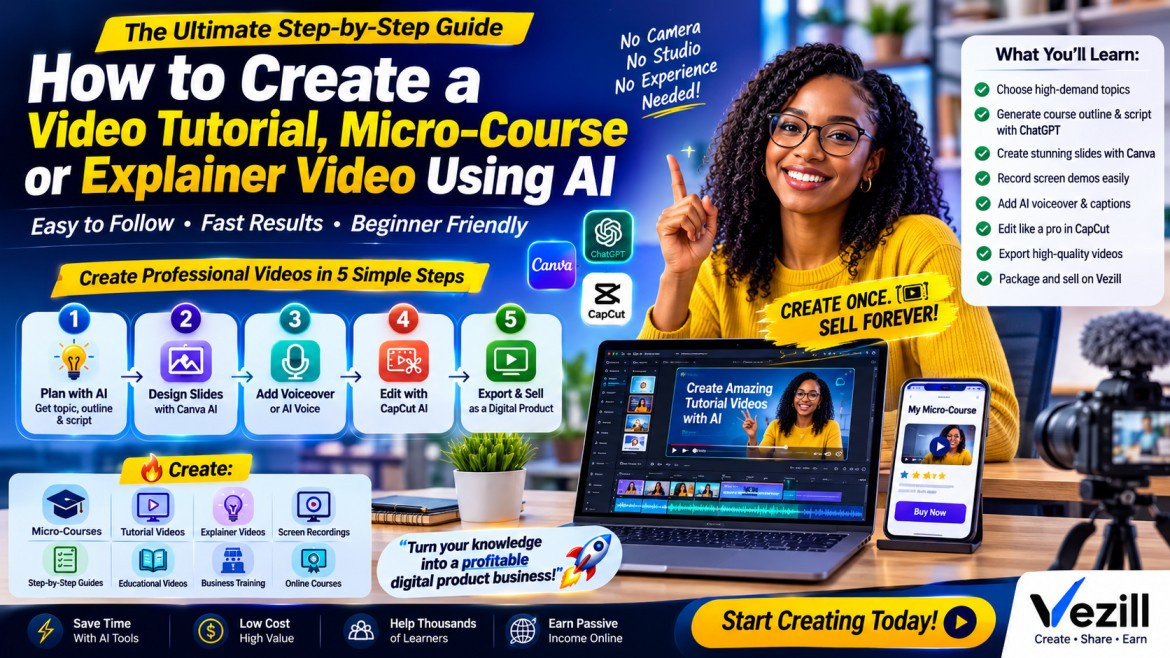
Learn How to Create a Video Tutorial, Micro-Course or Explainer Video Using AI
By Super Admin
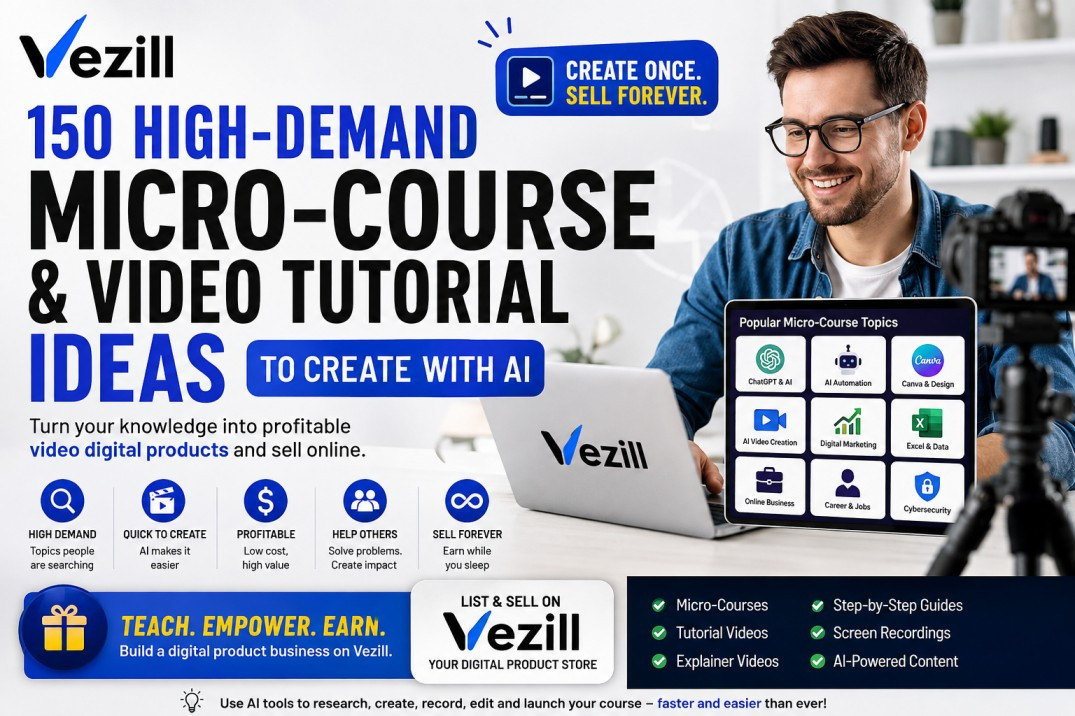
Discover 150 high-demand micro-course, video tutorial and explainer video ideas you can create with AI and sell online as digital products.
By Super Admin
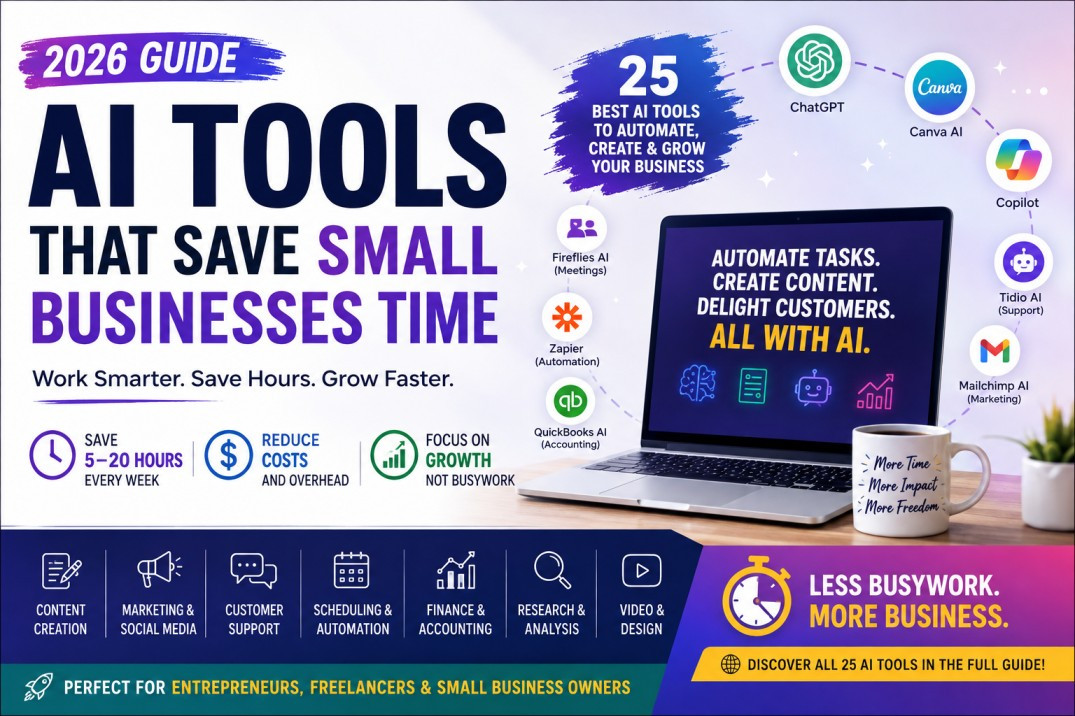
Discover the best AI tools for small businesses that automate marketing, customer support, accounting, content creation, emails, scheduling, and administration.
By Super Admin
Get the updates, on newly released, popular & fast-moving MRR digital products
Up to Top