
Ellan
Joined - December 2025

Late period? Irregular cycle? Painful cramps? Unexpected spotting? Heavy bleeding? Or simply trying to calculate when your next period will come?
Your menstrual cycle shouldn't feel like a monthly mystery.
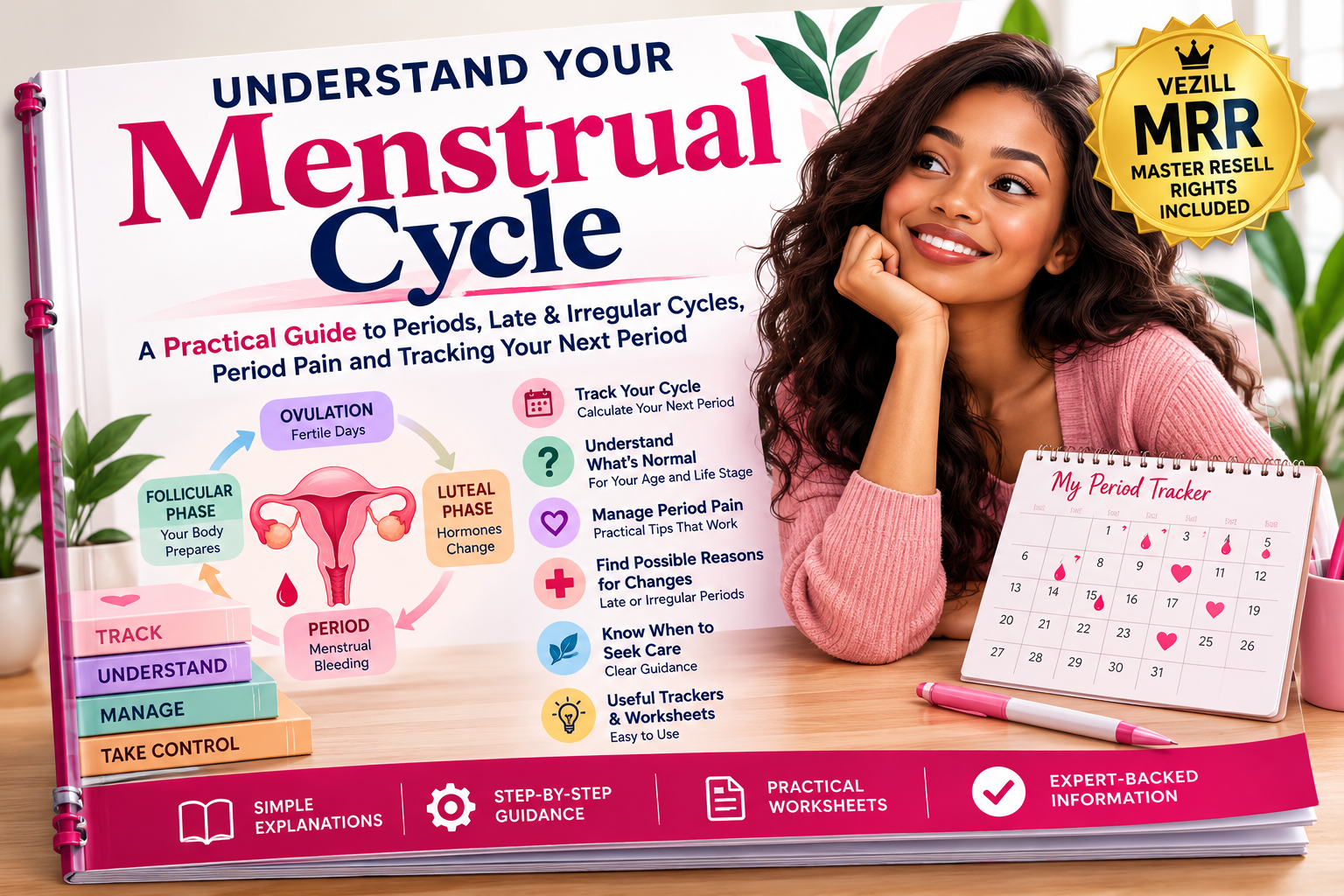
Understand Your Menstrual Cycle is a detailed, easy-to-follow practical guide designed to help you understand your period, track your cycle correctly, recognize changes in your normal pattern, manage common menstrual discomfort, and know when a symptom may need medical attention.
Whether you're wondering “Why is my period late?”, trying to understand irregular periods, struggling with period pain, or simply want a reliable way to track your cycle, this guide gives you clear explanations and practical tools you can start using immediately.
Perhaps your period hasn't arrived when you expected it.
And now you're wondering:
“Why is my period late?”
“Could I be pregnant?”
“My pregnancy test is negative - so why hasn't my period come?”
Or maybe your periods seem unpredictable.
One month your cycle is 28 days.
The next month it's 35 days.
Then your period comes earlier or later than expected.
You may be asking:
“Are my periods irregular?”
“What causes irregular periods?”
“Is something wrong with my hormones?”
Or perhaps the problem isn't timing.
It's the pain.
Every month you experience cramps that leave you uncomfortable, exhausted or unable to concentrate.
And you're wondering:
“Are painful periods normal?”
“Why are my cramps so painful?”
“When should period pain concern me?”
Maybe your bleeding has changed.
It is heavier than usual.
You are seeing clots.
You're spotting between periods.
Or your period suddenly seems much lighter.
The hardest part can be not knowing what the change means.
That's exactly why this guide was created.
This isn't another complicated reproductive-health textbook.
It's a practical, beginner-friendly guide designed to help you answer four important questions:
Understand how your menstrual cycle actually works.
Learn which dates, symptoms, bleeding changes and patterns matter.
Follow practical steps for tracking your cycle and dealing with common menstrual concerns.
Learn the difference between changes you may simply monitor and symptoms that deserve professional assessment.
Many people know when their period arrives - but don't fully understand what happens during the rest of the cycle.
This guide explains the menstrual cycle in simple language:
PERIOD → FOLLICULAR PHASE → OVULATION → LUTEAL PHASE → NEXT PERIOD
You'll understand:
What actually causes your period
What “Day 1” means
What happens before ovulation
What ovulation means
What happens after ovulation
How estrogen and progesterone influence the cycle
Why ovulation doesn't always happen on Day 14
Why every healthy cycle doesn't have to be exactly 28 days
Instead of memorizing complicated medical terms, you'll understand what your body is doing and why.
If you've ever counted dates repeatedly trying to predict your next period, this section alone can make cycle tracking much easier.
The guide shows you exactly how to calculate your menstrual cycle.
You'll learn the simple formula:
First Day of Your Last Period + Your Usual Cycle Length = Estimated Next Period
You'll see worked examples for:
28-day cycles
30-day cycles
32-day cycles
and importantly…
irregular cycles.
You'll also understand the difference between:
Period duration — how many days you bleed
and
Cycle length — the number of days from the start of one period to the start of the next.
Record:
Your last period
Previous cycle lengths
Average cycle length
Shortest cycle
Longest cycle
Estimated next period
Actual next period
So instead of guessing every month, you can begin understanding your own pattern.
A late period can create immediate anxiety.
You may start wondering whether you're pregnant or whether something is wrong.
The guide walks you through the situation calmly and practically.
You'll learn about possible reasons cycle timing can change, including:
Pregnancy
Normal cycle variation
Stress
Illness
Major weight changes
Intensive exercise
Breastfeeding
Hormonal contraception
Adolescence
Perimenopause
PCOS and thyroid problems that healthcare professionals may investigate
Other medical causes
Most importantly, the guide does not encourage you to diagnose yourself.
Instead, you'll follow a simple:
Step 1: Check your dates
Step 2: Consider whether pregnancy is possible
Step 3: Test appropriately if pregnancy is possible
Step 4: Review recent changes
Step 5: Continue tracking
Step 6: Know when to seek healthcare advice
That turns uncertainty into a practical next step.
This is one of the most stressful menstrual-cycle situations.
The guide explains:
Why a pregnancy test may initially be negative
Why testing too early matters
Why test instructions and timing matter
When repeating a test may be appropriate
What other factors may affect your period
What symptoms you should track
When persistent missed periods deserve medical assessment
Instead of repeatedly searching the internet for different answers, you'll have a clear framework to follow.
Having a cycle that isn't exactly 28 days doesn't automatically mean something is wrong.
You'll learn how to look at your menstrual pattern properly.
The guide explains:
What an irregular cycle means
Why cycles naturally vary
How age and life stage affect periods
Why adolescence may involve greater variation
How breastfeeding can affect periods
How contraception can change bleeding
Why perimenopause can change cycle timing
When persistent irregularity deserves medical attention
You'll also learn about conditions healthcare professionals may investigate, including PCOS and thyroid disorders, without falling into the trap of diagnosing yourself from an online symptom list.
Period pain is common.
But that doesn't mean every level of pain should simply be tolerated.
The guide explains dysmenorrhea - the medical term for painful periods - in straightforward language.
You'll discover:
Why the uterus contracts during menstruation
Why cramps happen
What's generally manageable with self-care
When worsening pain deserves attention
When pain that interrupts work, school or sleep should be assessed
Why pain during sex, urination or bowel movements may be important to mention to a healthcare professional
You'll also understand why clinicians sometimes investigate conditions such as:
Endometriosis
Adenomyosis
Fibroids
Pelvic inflammatory disease
Certain ovarian conditions
without assuming that pain automatically means you have one of them.
The guide covers practical comfort measures including:
Heat
Gentle movement
Rest
Sleep
Hydration
Relaxation techniques
Appropriate consideration of common over-the-counter pain relief
You'll also receive a Period Pain Tracker so you can record:
Date → Pain Score → Location → What You Tried → What Helped → Effect on Daily Activities
This can help you see whether your pain is stable, improving or getting worse.
Changes in menstrual bleeding can be difficult to interpret.
The guide explains the difference between:
Light bleeding
Moderate bleeding
Heavy bleeding
Spotting
Menstrual clots
Bleeding between periods
You'll learn which details are worth recording and why unusually heavy, prolonged or unexpected bleeding may need medical assessment.
There's also a dedicated:
Record your:
Flow
Menstrual-product changes
Clots
Spotting
Weakness or dizziness
Other symptoms
So if you eventually speak with a healthcare professional, you have useful information rather than relying entirely on memory.
PMS and early-pregnancy symptoms can overlap.
Breast tenderness.
Fatigue.
Cramping.
Bloating.
Mood changes.
Even a missed period can have more than one explanation.
The guide includes an easy comparison and explains one crucial principle:
If pregnancy is possible, appropriate pregnancy testing is more useful than trying to diagnose pregnancy from symptoms.
Does ovulation always happen on Day 14?
No.
You'll learn:
What ovulation actually is
How it relates to your period
Why ovulation timing can change
How cervical mucus may change
What basal body temperature can tell you
How ovulation predictor kits work
Why irregular cycles make calendar predictions less reliable
The guide also explains why predicted fertile days or “safe days” should not be treated as guaranteed contraception.
One of the most valuable parts of the guide is the simple:
Understand minor variations that can often simply be recorded and observed.
Learn when symptoms such as persistent irregularity, repeated missed periods, unusual bleeding or increasingly painful periods deserve professional assessment.
Recognize warning signs such as extremely heavy bleeding, fainting, marked weakness, severe or rapidly worsening pelvic pain, or concerning symptoms associated with possible pregnancy.
This gives you something internet searches often don't:
a clearer next step.
The guide includes a Period Health Appointment Prep Sheet.
Instead of arriving at an appointment saying:
“My periods are irregular.”
you can bring information such as:
Last period
Typical cycle length
Recent cycle lengths
Shortest and longest cycle
Bleeding duration
Flow changes
Pain score
Spotting
Pregnancy-test results
Medication
Contraception
Other symptoms
Questions you want answered
That can make the conversation with a healthcare professional much more productive.
This isn't just something you read once and forget.
You'll receive practical worksheets and trackers you can continue using:
✓ Next Period Calculator
✓ 3-Month Period Tracker
✓ Personal Cycle Dashboard
✓ Period Pain Tracker
✓ Bleeding & Flow Tracker
✓ PMS & Symptom Tracker
✓ Late Period Checklist
✓ Medication & Symptom Log
✓ Healthcare Appointment Prep Sheet
✓ 3-Month Know-Your-Cycle Plan
The guide gives you a simple system:
Record your dates, bleeding, pain and symptoms.
Compare your timing, duration, flow and recurring symptoms.
Identify your typical range and recognize meaningful changes.
By the end, you'll be better equipped to answer:
Is my cycle reasonably consistent?
Has something changed?
Is my pain interfering with normal life?
Is my bleeding unusually heavy?
Am I repeatedly missing periods?
Could pregnancy be possible?
Should I discuss this with a healthcare professional?
This guide may be especially useful if you:
Keep wondering when your next period will come
Have late periods
Experience irregular cycles
Frequently worry about missed periods
Want to understand painful periods
Have noticed changes in menstrual flow
Experience spotting or clots
Want to understand ovulation better
Want to track your menstrual cycle properly
Want to know which menstrual symptoms deserve medical attention
Want a practical cycle tracker instead of relying only on memory
Want to understand your body better
You don't need dozens of conflicting articles, videos and social-media opinions.
You need a clear system for understanding:
What's happening.
What to track.
What you can do next.
And when you should seek professional care.
Get instant access to the detailed practical guide plus all included trackers, calculators, worksheets and action plans.
GET YOUR COPY NOW
Want to do more than use the guide yourself?
Your copy also comes with VEZILL Master Resell Rights (MRR) subject to the included licence terms.
That means eligible buyers can use the guide personally and resell the digital product under the applicable VEZILL MRR terms.
So you're not only buying practical menstrual-health knowledge.
You're also receiving a digital product with a resale opportunity.
LEARN IT → USE IT → SHARE IT → RESELL IT
Start with the first day of your last period and add your usual cycle length. The guide walks you through worked examples and includes a calculator worksheet. Remember that the result is an estimate, particularly if your cycles are irregular.
Pregnancy is one possible reason, but cycle variation, stress, illness, significant weight changes, intensive exercise, breastfeeding, contraception, life stage and some medical conditions can also affect timing. The guide shows you what to consider and what to do next.
Testing timing matters. The guide explains what to check, when repeating a test may be appropriate according to its instructions, what other factors to consider, and when persistent missed periods deserve medical assessment.
No. Cycle patterns vary with age, life stage, contraception and other factors. Persistent or significant changes, however, can warrant medical evaluation.
Some menstrual cramping is common. Severe, worsening or disruptive pain deserves attention. The guide explains what to track and when to seek professional care.
No. The guide is educational and does not diagnose medical conditions. It explains symptoms and patterns healthcare professionals may investigate and helps you prepare useful information for an appointment.
No. Predicted dates and fertile-window calculations should not be treated as guaranteed contraception.
No. It provides educational information, practical tracking tools and guidance about when professional medical assessment may be appropriate.
Instead of wondering every month…
“Is this normal?”
start understanding what is normal for you.
Track your cycle.
Understand your period.
Recognize meaningful changes.
Know when to seek help.
Practical Knowledge. Clear Guidance. Useful Tools. Better Body Awareness.
Get the updates, on newly released, popular & fast-moving MRR digital products
Up to Top
Comments